
By-the-wind-sailor (Velella velella)
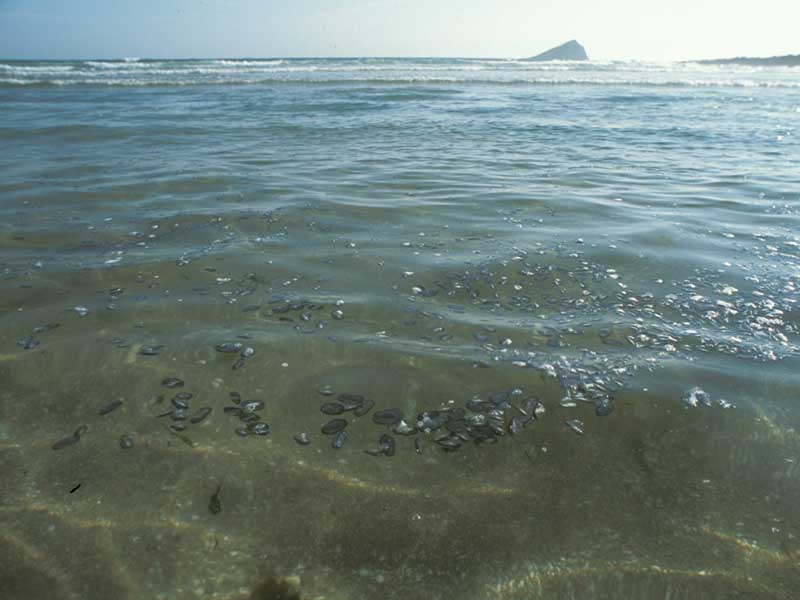
Velella velella being washed ashore.
Photographer: Dr Keith Hiscock Copyright: Dr Keith Hiscock
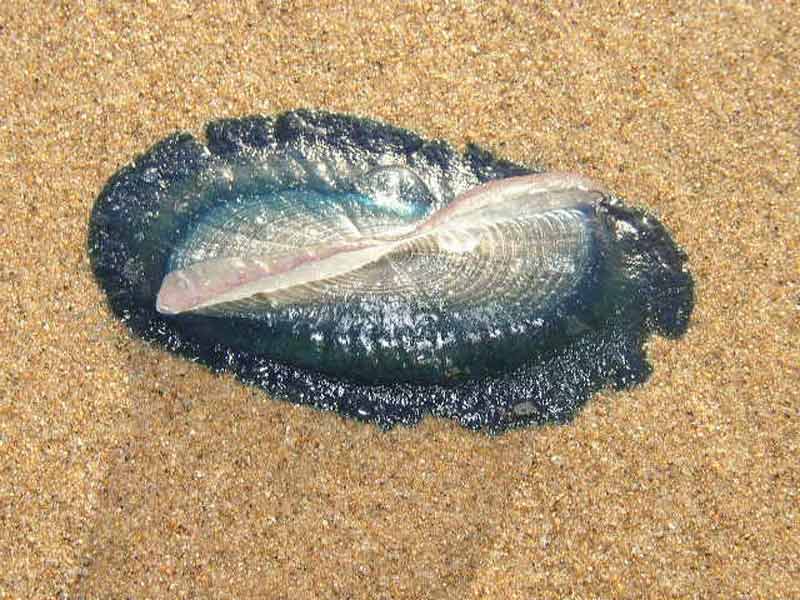
Velella velella stranded on a sandy shore.
Photographer: Dr Keith Hiscock Copyright: Dr Keith Hiscock
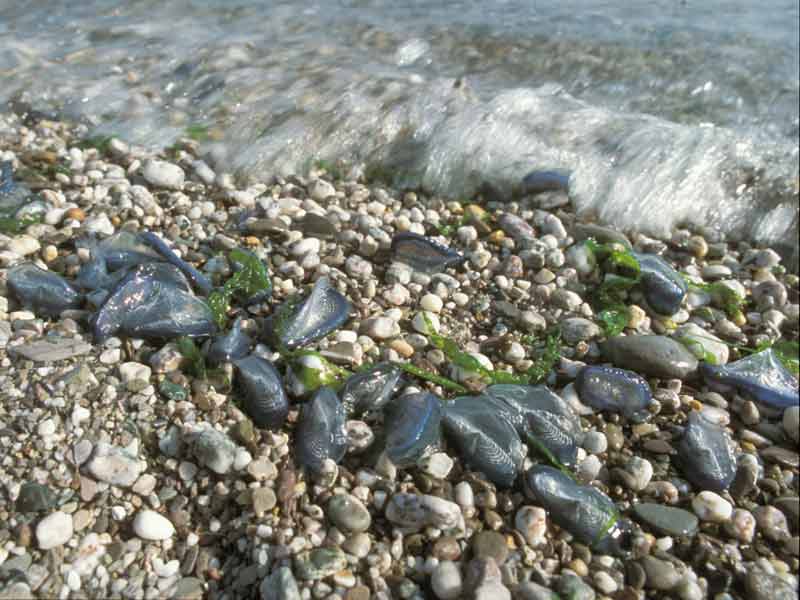
Velella velella stranded on the shore.
Photographer: Dr Keith Hiscock Copyright: Dr Keith Hiscock
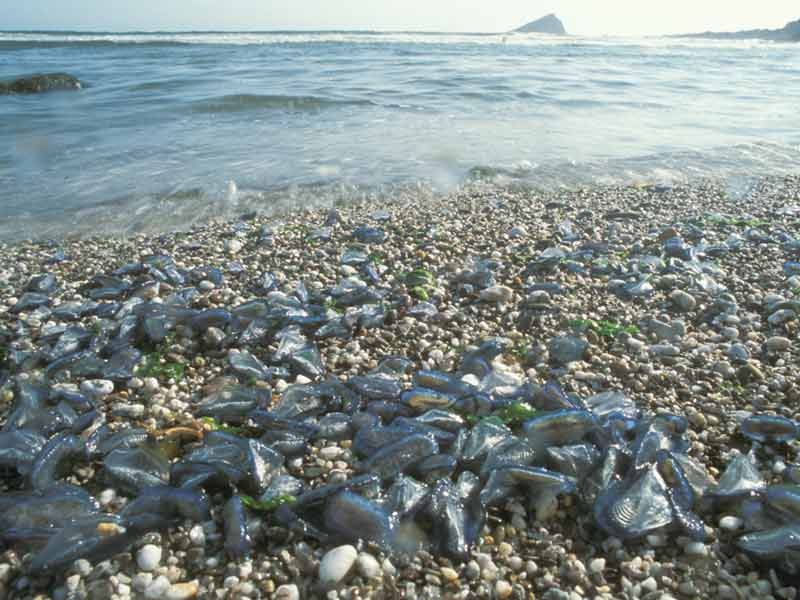
Velella velella washed ashore.
Photographer: Dr Keith Hiscock Copyright: Dr Keith Hiscock
Distribution data supplied by the Ocean Biodiversity Information System (OBIS). To interrogate UK data visit the NBN Atlas.Map Help
| Researched by | Olwen Ager | Refereed by | Admin |
| Authority | (Linnaeus, 1758) | ||
| Other common names | - | Synonyms | Velella spirans |
Summary
Description
Recorded distribution in Britain and Ireland
Velella velella is an ocean dwelling species that is occasionally seen in the open sea and washed up around British and Irish coasts (see additional information below).Global distribution
-Habitat
Velella velella is a pelagic species but is occasionally seen washed up around Britain and Ireland.Depth range
-Identifying features
- Deep blue oval float up to 10 cm in length.
- Semicircular sail set diagonally along float.
- Short tentacles hanging down from float
- Left sailing and right sailing forms.
Additional information
Velella velella is commonly found on the surface of the warmer waters of the World's oceans (Kirkpatrick & Pugh, 1984). McGrath (1985; 1992) reported large numbers of Velella velella washed up around the west coast of Ireland each year between 1976-1984, and again in 1992. In 1981 strandings were reported along the north Cornish coast, in north Devon, Lundy, Weston-Super-Mare and south-west Wales (Turk, 1982b). The Cornish Wildlife Trust Strandings Index (2002) has reports of two main stranding events per year in the winter, December-February, and late summer early autumn, August-September.In 2002 there were numerous reports of washed up Velella velella. John White reported Velella velella washed up on a Sussex beach at Bognor rocks and Robert Harvey reported the species as far north as Kilmory Bay in the Sound of Jura (BMLSS, 2002a). Mike Bates reported Velella velella being washed up on the south of the Isle of Man, the last confirmed record previous to this was in 1954 (BMLSS, 2002a). At Millport, on the Isle of Cumbrae, Philip Smith reported small numbers of Velella velella washed ashore (BMLSS, 2002a), the first record from the Isle of Cumbrae despite there being a marine station there for over a hundred years (Smith, pers comm.). Edwards (1959) reported living specimens of Velella velella at Croy Sands, Turnberry Bay but no specimens were found on the Isle of Cumbrae despite a search.
Listed by
- none -
Bibliography
BMLSS (British Marine Life Study Society), 2002. Jellyfish page [On-line] http://ourworld.compuserve.com/homepages/BMLSS/Moonjell.htm, 2002-07-02
Cornwall Wildlife Trust, 2002. Strandings Index: Hydrozoa [On-line] http://www.wildlifetrust.org.uk/cornwall/strand/hydrozoa.html, 2002-07-02
Edwards, C., 1959. Occurrence of the chondrophore Velella velella (L.) on western Scottish coasts. The Glasgow Naturalist, 28, 78-81.
Fish, J.D. & Fish, S., 1996. A student's guide to the seashore. Cambridge: Cambridge University Press.
Hayward, P., Nelson-Smith, T. & Shields, C. 1996. Collins pocket guide. Sea shore of Britain and northern Europe. London: HarperCollins.
Hayward, P.J. & Ryland, J.S. (ed.) 1995b. Handbook of the marine fauna of North-West Europe. Oxford: Oxford University Press.
Howson, C.M. & Picton, B.E., 1997. The species directory of the marine fauna and flora of the British Isles and surrounding seas. Belfast: Ulster Museum. [Ulster Museum publication, no. 276.]
Kirkpatrick, P.A., & Pugh, P.R., 1984. Siphonophores and Velellids London: Academic Press. [Synopses of the British Fauna No. 29.]
McGrath, D., 1985. The by-the-wind sailor Velella velella (L) (Coelenterata: Hydrozoa) in Irish waters 1976-1984. The Irish Naturalists Journal, 21, 479-484.
McGrath, D., 1994. Extraordinary occurrences of the by-the-wind sailor Velella velella (L) (Cnidaria) in Irish waters in 1992 The Irish Naturalists Journal, 24, 383-388.
Picton, B. E. & Morrow, C.C., 1994. A Field Guide to the Nudibranchs of the British Isles. London: Immel Publishing Ltd.
Turk, S.M., 1982b. Influx of warm-water oceanic drift animals into Bristol and English Channels summer 1981. Journal of the Marine Biological Association of the United Kingdom, 62 , 487-489.
Datasets
Bristol Regional Environmental Records Centre, 2017. BRERC species records within last 15 years. Occurrence dataset: https://doi.org/10.15468/vntgox accessed via GBIF.org on 2018-09-25.
Cofnod – North Wales Environmental Information Service, 2018. Miscellaneous records held on the Cofnod database. Occurrence dataset: https://doi.org/10.15468/hcgqsi accessed via GBIF.org on 2018-09-25.
Fenwick, 2018. Aphotomarine. Occurrence dataset http://www.aphotomarine.com/index.html Accessed via NBNAtlas.org on 2018-10-01
Isle of Wight Local Records Centre, 2017. IOW Natural History & Archaeological Society Marine Invertebrate Records 1853- 2011. Occurrence dataset: https://doi.org/10.15468/d9amhg accessed via GBIF.org on 2018-09-27.
Manx Biological Recording Partnership, 2017. Isle of Man wildlife records from 01/01/2000 to 13/02/2017. Occurrence dataset: https://doi.org/10.15468/mopwow accessed via GBIF.org on 2018-10-01.
Marine Conservation Society, 2018. UK Jellyfish Sightings from 2003 to 2015. Occurrence dataset: https://www.mcsuk.org/ accessed via NBNAtlas.org on 2018-10-01.
National Trust, 2017. National Trust Species Records. Occurrence dataset: https://doi.org/10.15468/opc6g1 accessed via GBIF.org on 2018-10-01.
NBN (National Biodiversity Network) Atlas. Available from: https://www.nbnatlas.org.
OBIS (Ocean Biodiversity Information System), 2025. Global map of species distribution using gridded data. Available from: Ocean Biogeographic Information System. www.iobis.org. Accessed: 2025-07-09
Outer Hebrides Biological Recording, 2018. Invertebrates (except insects), Outer Hebrides. Occurrence dataset: https://doi.org/10.15468/hpavud accessed via GBIF.org on 2018-10-01.
South East Wales Biodiversity Records Centre, 2023. SEWBReC Marine and other Aquatic Invertebrates (South East Wales). Occurrence dataset:https://doi.org/10.15468/zxy1n6 accessed via GBIF.org on 2024-09-27.
Citation
This review can be cited as:
Last Updated: 17/04/2008