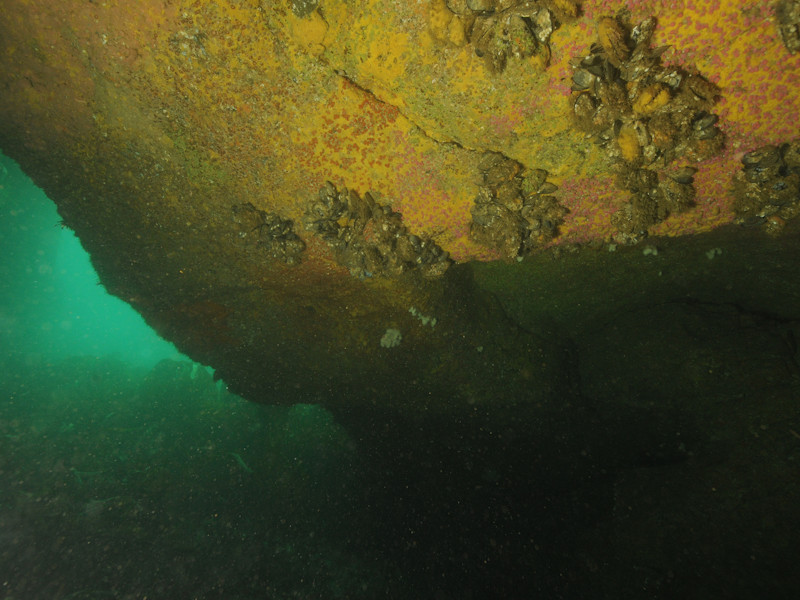
Circalittoral caves and overhangs

Distribution Map

Map Key

  • Orange points: Core Records
  • Pale Blue points: Non-core, certain determination
  • Black points: Non-core, uncertain determination
  • Yellow areas: Predicted habitat extent

Summary

UK and Ireland classification

Description

Caves and overhanging rock in the circalittoral zone, away from significant influence of strong wave action (compare FIR.SG). This habitat may be colonized by a wide variety of species, with sponges such as Dercitus bucklandi, anemones Parazoanthus spp. and the cup corals Caryophyllia inornatusHoplangia durotrix and others particularly characteristic. (Information from Connor et al., 2004; JNCC, 2015).

Depth range

10-20 m, 20-30 m, 30-50 m

Additional information

-

Habitat review

Ecology

Ecological and functional relationships

The main components of the biotope probably interact very little and live independently. However, the corals provide a host for the barnacle Boschia anglica (in the south-west) and a calcareous substratum for boring species such as Hiatella arctica, Potamilla reniformis and the horseshoe worm Phoronis hippocrepia to live. Boring species may weaken the skeleton of the corals to the extent that they are easily detached (see Hiscock & Howlett,1976). The soft coral Alcyonium glomeratum may be predated on by the prosobranch Xandarovula patula. Encrusting sponges may overgrow other species and Harmelin (1990) has shown how encrusting bryozoans may engulf cup corals and kill them. Grazers such as the sea urchin Echinus esculentus, may occasionally pass through the biotope grazing away barnacles and erect bryozoans especially , possible freeing space for new colonisation (Keith Hiscock, own observations).

Seasonal and longer term change

Most of the species in the biotope are long-lived. However, seasonal change occurs in the light-bulb ascidian Clavellina lepadiformis which grows rapidly in the spring to die-back in winter. A longer term decline has been recorded in the abundance of long-lived species (especially Leptopsammia pruvoti, Hoplangia durotrix and Alcyonium coralloides) at Lundy (K. Hiscock, own observations).

Habitat structure and complexity

There is little complexity in the habitat, most species living directly attached to the rock and not offering architectural complexity as shelter for other species.

Productivity

No information found

Recruitment processes

Several of the species in the biotope appear to have short-lived benthic larvae. For instance, the soft coral Alcyonium hibernicum broods planulae larvae that are released at a late development phase and so probably has a short planktonic life (Hartnoll, 1977 as Alcyonium coralloides). Leptopsammia pruvoti also seems to have short-lived planulae larvae which may settle immediately or very soon after release and recruitment at a site at Lundy has been extremely small (as low as 1% over the years 1983 to 1999 at least) (K. Hiscock, own observations). Sponges are likely to have a longer lived larva. Some species, such as the zoanthid anemones Parazoanthus axinellae and Parazoanthus dixoni, reproduce asexually to produce large colonies..

Time for community to reach maturity

As recruitment processes are so slow for many species and individual species will not colonize readily, the community will most likely take in excess of 25 years to reach maturity.

Additional information

Alcyonium hibernicum is named as Parerythropodium coralloides in the Species Directory (Howson & Picton 1997). McFadden (1999) has shown that it is taxonomically distinct species and should be known as Alcyonium hibernicum. Its current taxonomic name is accepted as Alcyonium coralloides (see WoRMS).

Preferences & Distribution

Habitat preferences

Depth Range 10-20 m, 20-30 m, 30-50 m
Water clarity preferencesNo information
Limiting Nutrients No information
Salinity preferences Full (30-40 psu)
Physiographic preferences No information
Biological zone preferences Circalittoral
Substratum/habitat preferences Bedrock
Tidal strength preferences Very weak (negligible), Weak <1 knot (<0.5 m/sec.)
Wave exposure preferences Exposed, Moderately exposed, Sheltered, Very exposed
Other preferences Caves, overhanging rock, deep shade

Additional Information

The habitat is distinctively one of vertical cliffs with a degree of overhang and small (shallow) caves.

Species composition

Species found especially in this biotope

Rare or scarce species associated with this biotope

Additional information

Whilst the structural and functional aspects of the biotope are similar across its range, species composition varies. The species composition of the biotope includes a small number of nationally rare or scarce species.

Sensitivity review

Sensitivity characteristics of the habitat and relevant characteristic species

The CR.FCR.Cv biotope and its sub-biotope Cr.FCR.Cv.SpCup are defined by circalittoral shaded overhanging rock not subject to wave surge.  There are few records of caves that are not subject to wave surge and almost all differ in species composition (Connor et al., 2014). The biotope is characterized by a sponge community (including Stryphnus ponderosus, Dercitus bucklandiChelonaplysilla noevusPseudosuberites sp. and Spongosorites sp), anthozoans (such as Parazoanthus spp, Leptopsammia pruvotiHoplangia durotrixCaryophyllia inornatus) and the soft coral Alcyonium coralloides.  Given the variety and lack of information on some species, assessments may be quite general.

Resilience and recovery rates of habitat

Little information on sponge longevity and resilience exists. Reproduction can be asexual (e.g. budding) or sexual (Naylor, 2011), and individual sponges are usually hermaphrodites (Hayward & Ryland, 1994). Short-lived ciliated larvae are released via the aquiferous system of the sponges, and metamorphosis follows settlement. Growth and reproduction are generally seasonal (Hayward & Ryland, 1994). Rejuvenation from fragments is also considered an important form of reproduction (Fish & Fish, 1996). Some sponges are known to be highly resilient to physical damage, with an ability to survive severe damage, regenerate and reorganize to function fully againhowever, this recoverability varies between species (Wulff, 2006). Marine sponges often harbour dense and diverse microbial communities, which can include bacteria, archaea and single-celled eukaryotes (fungi and microalgae), and can comprise up to 40% of sponge volume, which may have a profound impact on host biology (Webster & Taylor, 2012). In addition, sponges, such as the massive demosponge Spongosorites coralliophaga, often host a species-rich community of epibionts composed mainly of cnidarians, ophiuroids, other sponges and bryozoans (Kazanidis et al., 2018). Many sponges recruit annually and growth can be rapid, with a lifespan of one to several years (Ackers, 1983). However, sponge longevity and growth have been described as highly variable depending on the species and environmental conditions (Lancaster et al., 2014). It is likely that erect sponges are generally longer lived and slower growing, given their more complex nature than smaller encrusting or cushion sponges.

Fowler & Lafoley (1993) monitored the marine nature reserves in Lundy and the Isles of Scilly and found that a number of more common sponges showed great variation in size and cover during the study period. However, Fowler & Lafoley (1993) studied the deeper water sponges in Lundy and found that the growth rates for branching sponges were irregular, but generally very slow, with apparent shrinkage in some years (notably between 1985 and 1986). Monitoring studies at Lundy (Hiscock, 1994; Hiscock, 2003; Hiscock, pers comm) suggested that the growth of Axinellid sponges was no more than about 2 mm a year (up to a height of ca 300 mm) and that all branching sponges included in photographic monitoring over a period of four years exhibited very little or no growth over the study. In addition, no recruitment of Axinellia dissimilis or Axinellia infundibuliformis was observed, although ‘several more’ Axinella damicornis were noted between 2010 compared to 1985 during monitoring in Lundy (Hiscock, 2011). Freese (2001) studied deep cold-water sponges in Alaska. Following an experimental trawl, 46.8% of sponges exhibited damage, with 32.1% having been torn loose. None of the damaged sponges displayed signs of regrowth or recovery a year after the trawl event.  This was in stark contrast to early work by Freese (1999) on warm shallow sponge communities, with impacts of trawling activity being much more persistent due to the slower growth/regeneration rates of deep, cold-water sponges. Given the slow growth rates and long lifespans of the rich, diverse fauna, it is likely to take many years for deep sponge communities to recover if adversely affected by physical damage (Kaiser et al. 2018; Graves et al., 2023). Due to sponge sensitivity to human activity, as well as their functional significance and structural complexity, it has resulted in their classification as vulnerable marine ecosystems (VMEs) by the United Nations General Assembly and a threatened and/or declining habitat by OSPAR (Graves et al., 2023).

Cold-water corals (CWCs) encompass different taxonomic groups within the classes Hexacorallia (e.g. true corals and cup corals), Octocorallia (e.g. soft corals and black corals), and some Hydrozoa (e.g. fire corals), and can occur at relatively low temperatures (i.e. <14 °C for reef-building CWCs) at both shallow and deep (>200 m) depths (Maier et al., 2023). Leptopsammia pruvoti is thought to be a slow-growing and long-lived cup coral. Recruitment is likely to be slow for a population at the northerly limit of its distribution, with failure probably due to the water temperature being unsuitable for promoting gamete production and/or the synchrony of gamete release (Irving, 2004). Fertilized eggs have been found to survive for up to six weeks in aquaria, though planula larvae are likely to settle close to the adults within 24 hours, increasing the likelihood of them becoming detached from the rock surface (Irving, 2004). Dioecious polyps of Leptopsammia pruvoti in the Mediterranean have been reported to be sexually mature at 3 mm in length and brood their larvae. The maturation of spermaries took 12 months and oocytes 24 months. Optimum gonad development was reported over winter (November to January). Subsequent fertilization occurred from January to April, with planulation during May and June. Seasonal variations in water temperature and photoperiod may have played an important role in regulating reproductive events. Fecundity was reported as 36 to 105 mature oocytes/100 mm³ of polyp, with an embryonic incubation period of between 1 to 4 months (Goffredo et al., 2006). However, only limited local recruitment has been recorded at Lundy during more than 12 years of monitoring, and there has been no observation of colonization of wrecks or new natural surfaces near existing colonies (Jackson, 2008).

Marchini et al. (2020) noted how increased seawater temperatures negatively affected Balanophyllia europaea’s ability to reproduce, while Leptopsammia pruvoti was unaffected. Yet, Sani et al. (2024) found that a combination of increasing ocean warming and acidification decreased regenerative capacity in corals, including Leptopsammia pruvoti, and could have a compounding effect on coral regeneration following injury, potentially hindering the capacity of corals to recover following physical disturbance under predicted climate change. Irving (2004) noted very little new recruitment to populations of Leptopsammia pruvoti in south-west Britain, and that the number of individuals was declining. Populations were found to have lost 8% of their individual corals between 1983 and 1990, and between 1984 and 1996, part of this same population had declined by 22%. In addition to being at the northern edge of its distribution limit, a number of organisms have been identified as possibly being responsible for the decline in the adult population. In particular, it is thought that certain boring organisms are capable of weakening the attachment of the adult skeleton to the substratum (Irving, 2004). While Leptopsammia pruvoti is unlikely to recover from significant removal, other characterizing anthozoans present in the biotope would likely be able to recruit and replace the species, maintaining the nature of the biotope.

Caryophyllia smithii is a small (max 3 cm across) solitary cup coral, common within tide-swept sites of the UK (Wood, 2005) but is common on the cliffs within Lough Hyne that experience little water movement (Hiscock, pers comm.). It is distributed from Greece (Koukouras, 2010) to the Shetland Islands and southern Norway (Wilson, 1975; NBN, 2015). In Sweden, Caryophyllia smithii are reported to dominate shallower depths, with the national depth distribution of the species between 25 and 50 m (Nilsson et al., 2025). It was suggested by Fowler & Laffoley (1993) that Caryophyllia smithii was a slow-growing species (0.5 to 1 mm in horizontal dimension of the corallum per year), which in turn suggested that inter-specific spatial competition with colonial faunal or algae species were important factors in determining local abundance of Caryophyllia smithii (Bell & Turner, 2000). Analysis by Rodolfo‐Metalpa et al. (2015) reported that the growth rate of Caryophyllia smithii was 0.070 to 0.073%/day. Caryophyllia smithii reproduces between January and March, and spawning occurs from March to June (Tranter et al., 1982). The pelagic stage of the larvae may last up to 10 weeks, which provides this species with a good dispersal capability (Tranter et al., 1982). Asexual reproduction and division are also commonly observed (Hiscock & Howlett, 1976). Bell (2002) reported that juvenile Caryophyllia smithii have variable morphology, which gives them an advantage in colonizing a wide range of habitats. Aggregations of cup coral can form cup coral meadows, which are classed as a vulnerable marine ecosystem, and although there is no commonly agreed density threshold, in the northeast Atlantic, it is proposed as 0.1 to 0.9 /m² (for Caryophyllia cup corals on mixed substrata at depths of 1069 to 769 m) (Long et al., 2021).

Caryophyllia inornata is a solitary cup coral and widely distributed in the eastern and western Mediterranean Sea, extending to the northeast of the Atlantic coast and from the Canary Islands to the southern coasts of England (Marchini et al., 2020). It colonizes caves, walls, and wrecks, from the surface down to 100 m depth in dimly lit or dark environments, representing one of the main species that populate the walls and the vaults of caves, where it can dominate (Marchini et al., 2020). It is a slow-growing coral with a population density that can reach thousands of individuals per m2, and its abundance along the Western Italian coasts varies from 100 to 1,500 individuals per m2 (Marchini et al., 2020).

Off the coast of the Gallipoli peninsula, Caryophyllia inornata and Hoplangia durotrix have both been documented colonizing the HMS Majestic and Helles Barges, First World War ships sunk in 1915 that now lie between 18 and 25 m deep (Öz, 2023). A total of 24 sponge species were identified across both wrecks. Hoplangia durotrix was the first anthozoan reported from the wreck site ecosystems of the Turkish Seas, although its distributional character and ecology of the local communities in the Çanakkale Strait have not yet been published in detail (Öz, 2023). In addition, Hoplangia durotrix had the most extensive existence on the dimly lit parts associated with coralligenous facies of the HMS Majestic wreck site, whereas Caryophyllia inornata commonly occurred on the dark parts of both wreck sites (Öz, 2023). However, the main difference between the two species was that Caryophyllia inornata was spreading over coralligenous communities on the HMS Majestic wreck, and that it was broadly found around the deep-sea oyster Neopycnodonte cochlear communities on the Helles Barges wreck (Öz, 2023).

Alcyonium coralloides is a soft coral that commonly grows over other coral species, particularly colonizing the skeletal portions deprived of coenenchyme and can subsequently continue its expansion to the detriment of the coral to fully occupy its skeleton (Canessa et al., 2022). Canessa et al. (2022) documented Alcyonium coralloides growing on the sea fan Eunicella verrucosa, always on its basal or central portions, and that the high occurrence of this epibiont may be correlated, in frequented sites, to anthropogenic damages; similar considerations are also true for erect bryozoans, such as Turbicellepora avicularis.

For the characterizing species in this biotope, recovery is expected to be variable, but similarly, recovery has been observed in the context of colonizing artificial reefs. Caryophyllia smithii was first observed colonizing the wreck of the ex-HMS Scylla in September 2005, eighteen months after the vessel was placed on the seabed near Plymouth. The coral was still only occasional on the reef after five years (Hiscock et al., 2010).  

Deep sponges and CWCs are sessile benthic organisms, recovery would be aided by the exclusion of demersal towed fishing equipment (Pikesley et al., 2016; Chimienti, Nisio, & Lanzolla, 2020; Kaiser et al., 2018). Kaiser et al. (2018) specifically studied the recovery of sessile epifauna following the exclusion of towed mobile fishing gear in Lyme Bay, UK. Their estimates suggest that no recovery occurred within the timescale of the study (10 years), and that some biogenic habitats (particularly sponges and soft corals) could require up to, or more than, 20 to 30 years before signs of recolonization and recovery may occur. The maximum recovery time modelled was 51 years for yellow branched sponges, while Eunicella verrucosa and Pentapora foliacea increased in abundance, but had not fully recovered, with their projected recovery time being 17 to 20 years (Kaiser et al., 2018). Therefore, recovery rates of biota depend on life-history factors and habitat-specific requirements, with the longer-lived species that require specific habitats and have low dispersal potential, taking longer to recover (Kaiser et al., 2018). A 15-year review of the Lyme Bay trawling ban by Renn et al. (2024) highlighted definitive evidence of recovery, in terms of increased species richness. Key sessile taxa (Pentapora foliacea and Phallusia mammillata) showed signs of early recovery between 2008 and 2013. Renn et al. (2024) concluded that the evidence of recovery recorded in Lyme Bay broadly aligned with the wider literature by detecting early stages of recovery within the first few years of MPA establishment. However, full recovery was thought to occur over decadal timescales, and measuring full recovery rates in-situ remained a priority for future research in Lyme Bay.

Prolonged recovery timescales, in terms of sponge communities following disturbance events, were also estimated in other parts of the world. In Lough Hyne, a small (∼0.5 km2) lough on the southwest coast of Ireland, an unknown disturbance event caused a large decline of sponges, averaging a 35% reduction in coverage, with some communities experiencing reductions exceeding 95%, which prompted local habitat recovery monitoring (Micaroni et al., 2025). This decrease was documented from surveys conducted in 2010 and 2015, with healthy sponge assemblages observed in 2010 and severely depleted populations in 2015 (Micaroni et al., 2025). Since 2015, continued monitoring of Lough Hyne (6 to 11 years post-2015) has shown minimal signs of community reassembly and limited population recovery for key habitat-forming species, and it is estimated that recovery times are on the order of at least decades for communities dominated by long-lived species (Micaroni et al., 2025). This means that the recovery of benthic communities was either not happening or was occurring too slowly to be detected by the monitoring study. Micaroni et al. (2025) estimated that at the current Lough Hyne population growth rate, papillate polymastid sponges will reach their pre-impact cover at Glannafeen in 5 to 8 years, while erect sponges will take longer (18 to 30 years, at both Glannafeen and Labhra Cliff). However, the absence of recovery at the innermost sites 6 to 10 years after the disturbance event(s) suggests that lough-wide recovery could take even longer. Yet, one of the monitoring sites within Lough Hyne, Glannafeen, showed greater signs of recovery. This is possibly due to the site experiencing the greatest water movement among the internal sites, and sponges may be using ambient currents to reduce the high energy costs associated with their filtration activity, thus having more energy reserves for growth, leading to a more rapid recovery of their populations (Micaroni et al., 2025). Furthermore, the dispersal ability of sponge larvae is generally low, which can slow the recolonization rates in disturbed areas, and it is possible that the very slow current speed in the most internal sites (West Cliff and Goleen) could have reduced larvae supply to these sites (Micaroni et al., 2025).

Resilience assessment. Deep water sponges are likely to be long-lived and have slow growth and reproduction rates. Freese (2001) reported no recovery a year after a deep, cold water trawl event. Long-term recovery was indeterminate but was considered likely to take many years. Monitoring work in Lundy and Lyme Bay also found slow growth and limited reproduction of deep-water sponges (Fowler & Laffoley, 1993; Hiscock, 2011; Kaiser et al., 2018; Renn et al., 2024; Micaroni et al., 2025). Limited recovery of Leptopsammia pruvoti was reported around Lundy (possible due to being close to its northerly distribution limit). However, other anthozoans would probably replace this species if lost, and the nature of the biotope would not be changed. Growth and recruitment for other cup corals, whilst slow, is likely to be comparable or more rapid than that of the deepwater sponges. However, the recovery of sponges and soft corals may take decades (Kaiser et al., 2018; Micaroni et al., 2025). Sponges in the genus Halichondria were reported growing continuously on subtidal rock after extreme storm action, however, exposed sites seem to discourage colonization of smaller suspension feeders, like sponges, in favour of larger ones, and Halichondria are more abundant at protected sites (Sebens, 1985, 1986). Halichondria have also been observed being overgrown by other species, more so at protected sites, and when mostly overgrown (1,159 mm² of Halichondria), none of the sponge reappeared. (Sebens, 1986). In addition, during a clearance experiment, the sponges Halichondria and Leucosolenia were slow to recolonize the cleared area, making their appearance only after 23.5 and 20 months, respectively. Both Halichondria panicea, and Leucosolenia cancellata reached their pre-removal level of cover only after >2 years (Sebens, 1986). Slow-growing species, such as some sponges and anemones (see Sebens, 1985, 1986), will probably take several years to develop significant cover, so the community may also take 2 to 10 years to develop, depending on local conditions. Based on the resilience of the sponges, if the community were significantly or completely removed from the habitat (resistance of ‘None’ or ‘Low’), resilience is assessed as ‘Low’ (recovery within 10-25 years). If resistance is assessed as ‘Medium’, then resilience is assessed as ‘Medium’ (recovery within 2-10 years). A lack of species-specific evidence for the sponges results in a ‘Low’ confidence score.

Hydrological Pressures

Use [show more] / [show less] to open/close text displayed

ResistanceResilienceSensitivity
Temperature increase (local) [Show more]

Temperature increase (local)

Benchmark. A 5°C increase in temperature for one month, or 2°C for one year. Further detail

Evidence

There is little information available about the tolerance of the characterizing deep sponges in this biotope. However, Kazanidis et al. (2019) reported how water temperature and salinity explained a significant amount of variation in sponge density, and in the North Atlantic, the highest density values were found where temperature and salinity ranged from 6.52 to 8.98°C and 34.91 to 35.13 psu, respectively. Whilst Dercitus bucklandi is found from the Celtic Sea to southern Europe (Ackers et al., 1992), the sponge is recorded as far north as the Outer Hebrides. Chelonaplysilla noevusis is found from the British Isles to the Mediterranean and the Canary Isles. Stryphnus ponderosus is found from Norway to southern Europe (Ackers et al., 1992). Parazoanthus anguicomus is found across many parts of the north-east Atlantic and is probably widespread in deep water off the continental shelf. In the British Isles, it is found from western Ireland to northern Scotland (Manuel, 1988), with scattered records across the south-west of England (NBN, 2015). In Lough Hyne, a small (∼0.5 km2) lough on the southwest coast of Ireland, sponge communities are observed in waters where temperatures range from 7 to 9°C in winter and 14–18°C in summer (Micaroni et al., 2025).

Long-term increases in temperature may cause extension of the British Isles sponge populations and decreases in temperature may result in population shrinkage. Goodwin et al (2013) noted increases in the abundance of Axinella damicornis and Axinella dissimilis in Northern Ireland over a 20-year period and suggested the increase was due to sea temperature warming (relating to a 0.3 to 0.5°C increase in Northern Irish sea surface temperature between 1850 and 2007). Berman et al. (2013) monitored sponge communities off Skomer Island, UK, over four years, with all characterizing sponges for this biotope assessed. Seawater temperature, turbidity, photosynthetically active radiation and wind speed were all recorded during the study. They concluded that, despite changes in species composition, primarily driven by the non-characterizing Hymeraphia stellifera and Halicnemia patera, no significant difference in sponge density was recorded in all sites studied. 

Davison et al. (2019) highlighted the relationship between Porifera aggregations and temperature in the Faroe-Shetland Channel and noted a statistically significant positive relationship between sponge density and temperature range between 400 and 600 m, with the highest sponge densities occurring at depths of greatest temperature range. Aggregations of sponges in the Faroe-Shetland Channel are frequently subjected to water <0°C due to the movement of the pycnocline, but temperature varies between approximately −1 and 9°C and is on average around 3.5°C, and consistently experience 6°C shifts in temperature, with the highest variation being over 9°C (Davison et al. 2019). This temperature range approximately lines up with the evidence found by Graves (2022), who recorded a temperature range of 3 to 8.5°C between 800 and 2,200 m deep at the Rosemary Bank (UK) when studying the sessile benthic Xenophyophore, Syringammina fragilissima. Graves (pers comm, 2022) characterized the thermal niche of Reteporella and Axinellid sponge assemblages across the UK and Ireland as 9.3 to 9.5°C based on their biotope distribution.

Cebrian et al. (2011) conducted four-year surveys of two shallow-water sponge species, Ircinia fasciculata and Sarcotragus spinosulum, in the western Mediterranean Sea. Two severe sponge die-offs (total mortality ranging from 80 to 95% of specimens) occurred in the summers of 2008 and 2009. These events primarily affected Ircinia fasciculata, and a significant positive correlation was observed between elevated temperature and injured specimens. It was suggested, following in vitro studies of the associated cyanobacteria in increasing temperatures up to those experienced in the ‘extreme summer’ of 27°C, that heat-related disappearance of the cyanobacteria in Ircinia fasciculata (a bacteriosponge) was important when considering sponge mortality. 

Bell et al. (2018) investigated the potential response of sponges to climate change. Although numerous mass sponge mortalities have been reported in association with abnormally high seawater temperatures, it was unclear if these resulted from exceeding the host's thermal threshold, or because of the disruption of functionally important symbiotic partnerships, or infection by opportunistic pathogens. In contrast, Bell et al. (2018) highlighted that other studies had shown sponges to be more tolerant to increased temperature than other benthic organisms. For example, sponge assemblages in Brazil were highly stable before and after the El Niño Southern Oscillation (a 2°C increase in temperature during the El Niño event), despite massive declines in corals and other benthic organisms. However, ocean warming could induce bleaching, such as in the bioeroding sponge Cliona orientalis (an increase of 2.7°C above the local maximum monthly mean), or reduce flow rates and feeding efficiency, such as in the sponge Rhopaloeides odorabile (exposed to a 2°C higher than the average local ambient seawater temperature). Therefore, temperature tolerance appears to vary among sponge species.

Cold-water corals (CWCs) encompass different taxonomic groups within the classes Hexacorallia, Octocorallia, and Hydrozoa, and can occur at relatively low temperatures (i.e. <14 °C for reef-building CWCs) at both shallow and deep (>200 m) depths (Maier et al., 2023). Leptopsammia pruvoti is commonly found in sea caves and under overhangs throughout the Mediterranean basin and along European coasts from Portugal to southern England (Goffredi et al., 2006), while Hoplangia durotrix is found from the north and south coasts of Devon to the Mediterranean and Canary Isles (Manuel, 1988). Marchini et al. (2020) noted how increased seawater temperatures negatively affected Balanophyllia europaea’s ability to reproduce; however, Leptopsammia pruvoti was unaffected. Yet, Sani et al., (2024) found that a combination of increasing ocean warming (range 16°C to 24°C) and acidification (range pHTS 7.4 to 8.1) decreased regenerative capacity in corals, including Leptopsammia pruvoti, and could have a compounding effect on coral regeneration following injury, potentially hindering the capacity of corals to recover following physical disturbance under predicted climate change.

Parazoanthus axinellae is a more southerly distributed species and is found from the south-west coasts of the British Isles to the Mediterranean (Manuel, 1988). Azzola et al. (2024) observed in the field (northwest Mediterranean) and lab that in warming environments, Parazoanthus axinellae cover decreased due to a combination of thermal stress causing necrosis, and an increase of predation from Hermodice carunculate. Bianchi et al. (2019a) monitored populations of Parazoanthus axinellae in the Ligurian Sea, Italy, where previously (1980-90s) rapid temperature increases had led to dramatic changes in biota and communities, and caused a disease in Parazoanthus axinellae whereby polyps were covered with dense mats of the filamentous cyanobacterium Porphyrosiphon. In the summer of 2018, Bianchi et al. (2019a) dived in the Ligurian Sea to observe these sites again and found that diseased colonies of Parazoanthus axinellae were localized above the thermocline, whereas those living below the thermocline were healthy, suggesting a combined action between microbial attack and elevated temperature. Bianchi et al. (2019a) also noted that the other species that would ‘lose’ in an elevated seawater temperature scenario include the algae Cystoseira spp, Flabellia petiolata and Sargassum vulgare, the sponge Axinella damicornis, the cnidarian Alcyonium coralloides, and the bryozoan Cellaria fistulosa. However, some species (such as the sponges Agelas oroides and Petrosia ficiformis and the cnidarians Eunicella singularis and Parazoanthus axinellae) recovered, at least partially. In an additional study, Bianchi et al. (2019b) looked back on the period of warming between 1960 and 2018 in the eastern Ligurian Sea, and between 1995 and 2018, seawater temperatures were on average 0.8°C at 0 m, 0.7°C at 20 m, and 0.4°C at 40 m higher compared to previous measurements. They noted that ten species became scarcer (e.g., the gorgonian Paramuricea clavata) or even disappeared (e.g., the soft coral Alcyonium coralloides and the gorgonian Eunicella singularis) with respect to 1961, showing little or no sign of recent recovery.

Caryophyllia inornata is a solitary coral and widely distributed in the eastern and western Mediterranean Sea, extending to the northeast of the Atlantic coast and from the Canary Islands to the southern coasts of England (Marchini et al., 2020). Marchini et al. (2020) stated that while variations have been observed in the population dynamics of Caryophyllia inornata, previous studies revealed that increasing temperature and solar radiation do not affect population density, growth parameters, net calcification rate, bulk skeletal density, and linear extension rate of the species. Therefore, reproduction in Caryophyllia inornata is also not likely to be affected by increasing solar radiation and temperature (Marchini et al., 2020).

Caryophyllia smithii is found across the British Isles (NBN, 2015; Coolen et al., 2015) and has been recorded in Greece (Koukouras, 2010). In the Mediterranean, Caryophyllia smithii has been recorded in seawater between 13 and 14°C (Rodolfo‐Metalpa et al., 2015). It is therefore unlikely to be significantly affected by an increase at the benchmark level. However, Tranter et al. (1982) suggested Caryophyllia smithii reproduction was cued by seasonal increases in seawater temperature. Therefore, unseasonal increases in temperature may disrupt natural reproductive processes and negatively influence recruitment patterns. Holt (pers. comm.) also suggested that long-term increases in temperature due to climate change may allow the parasitic barnacle Adna anglica to extend its range northwards and overlap the range of this biotope. Adna anglica is a southern species limited to the southwest of Britain where it parasitizes Caryophillia and has probably contributed to the decrease in abundance of Leptopsammia (Holt pers. comm.). It may impact the abundance of Caryophyllia if climate change allows it to extend its range northwards (Holt pers. comm.).

Sensitivity assessment. All the characterizing sponges have been reported from the north to the south of the British Isles (NBN, 2015). A number of the characterizing species have a southerly distribution. Given the variety of characterizing species, the decline or loss of some species may not have a significant effect on the nature of the biotope. Resistance is assessed as ‘High’, resilience as ‘High’, and the biotope is ‘Not sensitive’ at the benchmark level.

High
Medium
Low
Medium
Help
High
High
High
High
Help
Not sensitive
Medium
Low
Medium
Help
Temperature decrease (local) [Show more]

Temperature decrease (local)

Benchmark. A 5°C decrease in temperature for one month, or 2°C for one year. Further detail

Evidence

There is little information available about the tolerance of the characterizing deep sponges in this biotope. However, Kazanidis et al. (2019) reported how water temperature and salinity explained a significant amount of variation in sponge density, and in the North Atlantic, the highest density values were found where temperature and salinity ranged from 6.52 to 8.98°C and 34.91 to 35.13 psu, respectively. Whilst Dercitus bucklandi is found from the Celtic Sea to southern Europe (Ackers et al., 1992), the sponge is recorded as far north as the Outer Hebrides. Chelonaplysilla noevusis is found from the British Isles to the Mediterranean and the Canary Isles. Stryphnus ponderosus is found from Norway to southern Europe (Ackers et al., 1992). Parazoanthus anguicomus is found across many parts of the north-east Atlantic and is probably widespread in deep water off the continental shelf. In the British Isles, it is found from western Ireland to northern Scotland (Manuel, 1988), with scattered records across the south-west of England (NBN, 2015). In Lough Hyne, a small (∼0.5 km2) lough on the southwest coast of Ireland, sponge communities are observed in waters where temperatures range from 7 to 9°C in winter and 14–18°C in summer (Micaroni et al., 2025).

Long-term increases in temperature may cause extension of the British Isles sponge populations and decreases in temperature may result in population shrinkage. Berman et al. (2013) monitored sponge communities off Skomer Island, UK, over four years, with all characterizing sponges for this biotope assessed. Seawater temperature, turbidity, photosynthetically active radiation and wind speed were all recorded during the study. They concluded that, despite changes in species composition, primarily driven by the non-characterizing Hymeraphia stellifera and Halicnemia patera, no significant difference in sponge density was recorded in all sites studied. 

Some sponges do exhibit morphological strategies to cope with winter temperatures, e.g. Halichondria bowerbanki goes into a dormant state below 4°C, characterized by major disintegration and loss of choanocyte chambers, with many sponges surviving mild winters in more protected areas from where it can recolonize (Vethaak et al., 1982). Crisp (1964a) studied the effects of an unusually cold winter (1962-3) on the marine life in Britain, including Porifera in North Wales. Whilst difficulty distinguishing between mortality and delayed development was noted, Crisp (1964a) found that Pachymastia johnstonia and Halichondria panicea were wholly or partly killed by frost, and several species appeared to be missing, including Amphilectus fucorum. Others, including Hymeniacidon perleve, were unusually rare, and a few species, including Polymastia boletiformis, were not seriously affected. No mention was made of the characterizing sponges assessed in this review. It should be noted that Crisp’s general comments on all marine life state that damage decreased the deeper the habitat. In addition, the extremely cold temperatures recorded in 1962/63 (sea temperatures between 4 to 6°C colder than the five-year mean over a period of 2 months) are more extreme than the benchmark level for assessment. 

Davison et al. (2019) highlighted the relationship between Porifera aggregations and temperature in the Faroe-Shetland Channel and noted a statistically significant positive relationship between sponge density and temperature range between 400 and 600 m, with the highest sponge densities occurring at depths of greatest temperature range. Aggregations of sponges in the Faroe-Shetland Channel are frequently subjected to water <0°C due to the movement of the pycnocline, but temperature varies between approximately −1 and 9°C and is on average around 3.5°C, and consistently experience 6°C shifts in temperature, with the highest variation being over 9°C (Davison et al. 2019). This temperature range approximately lines up with the evidence found by Graves (2022), who recorded a temperature range of 3 to 8.5°C between 800 and 2,200 m deep at the Rosemary Bank (UK) when studying the sessile benthic Xenophyophore, Syringammina fragilissima. Graves (pers comm, 2022) characterized the thermal niche of Reteporella and Axinellid sponge assemblages across the UK and Ireland as 9.3 to 9.5°C based on their biotope distribution.

Cold-water corals (CWCs) encompass different taxonomic groups within the classes Hexacorallia (e.g. true corals and cup corals), Octocorallia (e.g. soft corals and black corals), and some Hydrozoa (e.g. fire corals), and can occur at relatively low temperatures (i.e. <14 °C for reef-building CWCs) at both shallow and deep (>200 m) depths (Maier et al., 2023). Leptopsammia pruvoti is commonly found in sea caves and under overhangs throughout the Mediterranean basin and along European coasts from Portugal to southern England (Goffredi et al., 2006), while Hoplangia durotrix is found from the north and south coasts of Devon to the Mediterranean and Canary Isles (Manuel, 1988). Parazoanthus axinellae is a more southerly distributed species and is found from the south-west coasts of the British Isles to the Mediterranean (Manuel, 1988). Caryophyllia inornata is a solitary coral and widely distributed in the eastern and western Mediterranean Sea, extending to the northeast of the Atlantic coast and from the Canary Islands to the southern coasts of England (Marchini et al., 2020). Caryophyllia smithii is a southern species (Fish & Fish, 1992) with a northern range limit in the Shetland Isles (NBN, 2015). It is therefore likely to be close to its northerly range limit and therefore likely to be negatively affected by a decrease in temperature at the benchmark level. 

Sensitivity assessment. There is evidence of sponge mortality at extremely low temperatures in the British Isles, although some sponges do exhibit morphological strategies to cope with winter temperatures (Crisp, 1964a), and others consistently experience 6°C shifts in temperature (Davison et al., 2019). Combined with the evidence that a number of the species in this biotope have a mainly southern distribution, such as Leptopsammia pruvoti and Parazoanthus axinellae (Goffredi et al., 2006; Manuel, 1988), while some species are their northern range, such as Caryophyllia smithii, mortality could be expected with a decrease in temperature. Yet, the circalittoral nature of the biotope may afford some resistance to short-lived temperature events. Therefore, resistance is assessed as ‘Medium’ with a resilience of ‘Medium’ and sensitivity is assessed as ‘Medium’ at the benchmark level.

Medium
Medium
Low
Medium
Help
Medium
Low
Low
Low
Help
Medium
Low
Low
Low
Help
Salinity increase (local) [Show more]

Salinity increase (local)

Benchmark. A increase in one MNCR salinity category above the usual range of the biotope or habitat. Further detail

Evidence

The biotope occurs in full salinity, circalittoral environments, and an increase at the benchmark level (40 ppt or greater) is unlikely. Kazanidis et al. (2019) reported how water temperature and salinity explained a significant amount of variation in sponge density, and in the North Atlantic, the highest density values were found where temperature and salinity ranged from 6.52 to 8.98°C and 34.91 to 35.13 psu, respectively. However, hypersaline water is likely to sink to the seabed, and the biotope could be affected by hypersaline effluents (brines). Ruso et al. (2007) reported that changes in the community structure of soft sediment communities due to desalination plant effluent in Alicante, Spain. In particular, in close vicinity to the effluent, where the salinity reached 39 psu, the community of polychaetes, crustaceans and molluscs was lost and replaced by one dominated by nematodes. Roberts et al. (2010b) suggested that hypersaline effluent dispersed quickly but was more of a concern at the seabed and in areas of low energy where widespread alternations in the community of soft sediments were observed. In several studies, echinoderms and ascidians were amongst the most sensitive groups examined (Roberts et al., 2010b).

Nevertheless, ‘No evidence’ of the effects of hypersaline effluent on the characterizing species in hypersaline conditions was found.

No evidence (NEv)
NR
NR
NR
Help
Not relevant (NR)
NR
NR
NR
Help
No evidence (NEv)
NR
NR
NR
Help
Salinity decrease (local) [Show more]

Salinity decrease (local)

Benchmark. A decrease in one MNCR salinity category above the usual range of the biotope or habitat. Further detail

Evidence

The biotope occurs in full salinity, circalittoral environments, and a decrease at the benchmark level to reduced salinity (18-30 ppt) is unlikely. The sponges Stryphnus ponderosus, Dercitus bucklandiChelonaplysilla noevus and the anthozoans Parazoanthus anguicomus, Parazoanthus axinellae, Leptopsammia pruvoti and Hoplangia durotrix have only been recorded as occurring in full salinity biotopes (Connor et al., 2004; JNCC, 2015, 2022; Kazanidis et al., 2019). Therefore, whilst there is no specific evidence for salinity tolerance in the characterizing species, resistance is likely to be ‘Low’. Hence, resilience is assessed as ‘Low' and sensitivity as ‘High’.

Low
Low
NR
NR
Help
Low
Low
Low
Low
Help
High
Low
Low
Low
Help
Water flow (tidal current) changes (local) [Show more]

Water flow (tidal current) changes (local)

Benchmark. A change in peak mean spring bed flow velocity of between 0.1 m/s to 0.2 m/s for more than one year. Further detail

Evidence

Sponges and corals are suspension feeders, relying on water currents to supply food (Hiscock, 1983; O’Reilly et al., 2022). Riisgard et al. (1993) discussed the low energy cost of filtration for sponges and concluded that passive current-induced filtration may be insignificant for sponges. Some studies have also stated how massive and encrusting sponge morphotypes are more abundant at high-flow areas in the sublittoral zone, due to a high basal area to volume ratio, which decreases removal from the substrates (Kazanidis et al., 2019). In Lough Hyne, a small (∼0.5 km2) lough on the southwest coast of Ireland, sponge communities experience currents reaching >300 cm/s, and greater sponge growth/recovery was observed at sites with greater water movement, possibly due to sponges using ambient currents to reduce the high energy costs associated with their filtration activity (Micaroni et al., 2025). Furthermore, the dispersal ability of sponge larvae is generally low, which can slow the recolonization rates in areas, and it is possible that very slow current speeds could reduce larvae supply to sites (Micaroni et al., 2025).  

In flume experiments, Hiscock (1983) noted that the tentacles of Caryophyllia smithii were displaced by currents over ca 0.5 m/s but withdrawn at 0.75 m/s and took several hours to re-emerge after cessation of strong flow. Hiscock (1983) noted that Caryophyllia smithii was most abundant in semi-exposed and sheltered habitats. The other cup corals (Balanophyllia regia, Hoplangia durotrix and Leptopsammia pruvoti) were recorded from weak and very weak tidal streams in cave and overhang biotopes (Connor et al., 2004). 

The life cycle of Caryophyllia smithii includes a larval planktotrophic stage with a duration of 8 to 10 weeks, and during this time, the released larvae float freely in the water column and are transported in the direction of net water movement, which is driven by tidal currents and wind. Residual currents in the North Sea, UK, range between 0.02 and 0.08 cm/s (Coolen et al., 2015). Caryophyllia smithii, in particular, is described as favouring sites with a high tidal flow (Bell & Turner, 2000; Wood, 2005; Coolen et al., 2015). Caryophyllia smithii has been recorded in biotopes from negligible to strong water flow (0 to 6 knots; 0 to >3 m/s) (Connor et al., 2004). Rodolfo‐Metalpa et al. (2015) noted how off the coast of Italy, Caryophyllia smithii was recorded in waters with a tidal current of 24 cm/s (± 15). This biotope consists mainly of species firmly attached to the substratum, which would be unlikely to be displaced by an increase in the strength of tidal streams at the benchmark level.

Sensitivity assessment. The biotope (CR.FCR.Cv) and its sub-biotope (CR.FCR.Cv.SpCup) are characterized by low energy (moderate to negligible tidal flows (0-1.5 m/sec) and a significant increase would probably result in a fundamental change to the nature of the community, such as an increase in the abundance of bryozoan and hydroid turfs, and hence reclassification would be required. A decrease in water flow is probably 'not relevant' as the biotopes occur in weak or negligible flow. However, an increase in the flow of 0.1-0.2 m/s (the benchmark level) may increase the abundance of bryozoan turfs and reduce the abundance of cup corals, especially in caves and overhangs that otherwise experience negligible flow. Therefore, a precautionary resistance of 'Medium' is suggested to represent minor changes in the community. Hence, resilience is assessed as 'Medium' and sensitivity as 'Medium' at the benchmark level. Nevertheless, Connor et al. (2004) noted that the species composition varies between records of the biotope, which may imply subtle differences in the community with local environmental parameters such as water flow and turbidity.

Medium
Low
NR
NR
Help
Medium
Low
Low
Low
Help
Medium
Low
Low
Low
Help
Emergence regime changes [Show more]

Emergence regime changes

Benchmark.  1) A change in the time covered or not covered by the sea for a period of ≥1 year or 2) an increase in relative sea level or decrease in high water level for ≥1 year. Further detail

Evidence

Changes in emergence are ‘Not relevant’ to this biotope as it is restricted to fully subtidal/circalittoral condition. The pressure benchmark is relevant only to littoral and shallow sublittoral fringe biotopes.

Not relevant (NR)
NR
NR
NR
Help
Not relevant (NR)
NR
NR
NR
Help
Not relevant (NR)
NR
NR
NR
Help
Wave exposure changes (local) [Show more]

Wave exposure changes (local)

Benchmark. A change in near shore significant wave height of >3% but <5% for more than one year. Further detail

Evidence

This biotope is defined as occurring in caves and gullies that are not subject to wave surge. Wave action is attenuated with depth, and the depth at which the biotopes occur and their aspect to incoming waves offer resistance to wave effects.  For example, these biotopes (CR.FCR.Cv and CR.FCR.CV.SpCup) occur in a range of wave exposures from very exposed to sheltered conditions, and yet, are not subject to wave surge.  Therefore, they probably occur in areas of circalittoral rock and caves protected from the direct effect of wave action.

A significant increase in wave action in their locality may result in a fundamental change to the nature of the biotope and hence reclassification. However, an increase in wave exposure at the benchmark level (a 3-5% change in significant wave height) is unlikely to alter the biotope. Therefore, resistance is as ‘High’, resilience as ‘High’, and the biotope is assessed as ‘Not sensitive’ at the benchmark level.

High
Low
NR
NR
Help
High
High
High
High
Help
Not sensitive
Low
Low
Low
Help

Chemical Pressures

Use [show more] / [show less] to open/close text displayed

ResistanceResilienceSensitivity
Transition elements & organo-metal contamination [Show more]

Transition elements & organo-metal contamination

Benchmark. Exposure of marine species or habitat to one or more relevant contaminants via uncontrolled releases or incidental spills. Further detail

Evidence

Whilst some sponges, such as Cliona spp. have been used to monitor heavy metals by looking at the associated bacterial community (Marques et al., 2007; Bauvais et al., 2015), no literature on the effects of transition element or organo-metal pollutants on the characterizing sponges could be found.

Nevertheless, this pressure is Not assessed but evidence is presented where available.

Not Assessed (NA)
NR
NR
NR
Help
Not assessed (NA)
NR
NR
NR
Help
Not assessed (NA)
NR
NR
NR
Help
Hydrocarbon & PAH contamination [Show more]

Hydrocarbon & PAH contamination

Benchmark. Exposure of marine species or habitat to one or more relevant contaminants via uncontrolled releases or incidental spills. Further detail

Evidence

This pressure is Not assessed but evidence is presented where available.

Oil pollution is mainly a surface phenomenon its impact upon circalittoral turf communities is likely to be limited. However, as in the case of the Prestige oil spill off the coast of France, high swell and winds can cause oil pollutants to mix with the seawater and potentially negatively affect sub-littoral habitats (Castège et al., 2014). Filter feeders are highly sensitive to oil pollution, particularly those inhabiting the tidal zones which experience high exposure and show correspondingly high mortality, as are bottom dwelling organisms in areas where oil components are deposited by sedimentation (Zahn et al., 1981).

Zahn et al. (1981) found that Tethya lyncurium concentrated BaP (benzo[a ]pyrene )to 40 times the external concentration and no significant repair of DNA was observed in the sponges, which, in higher animals, would likely lead to cancers. As sponge cells are not organized into organs the long-term effects are uncertain (Zahn et al., 1981).

Not Assessed (NA)
NR
NR
NR
Help
Not assessed (NA)
NR
NR
NR
Help
Not assessed (NA)
NR
NR
NR
Help
Synthetic compound contamination [Show more]

Synthetic compound contamination

Benchmark. Exposure of marine species or habitat to one or more relevant contaminants via uncontrolled releases or incidental spills. Further detail

Evidence

This pressure is Not assessed but evidence is presented where available.

Not Assessed (NA)
NR
NR
NR
Help
Not assessed (NA)
NR
NR
NR
Help
Not assessed (NA)
NR
NR
NR
Help
Radionuclide contamination [Show more]

Radionuclide contamination

Benchmark. An increase in 10µGy/h above background levels. Further detail

Evidence

‘No evidence’ was found.

No evidence (NEv)
NR
NR
NR
Help
Not relevant (NR)
NR
NR
NR
Help
No evidence (NEv)
NR
NR
NR
Help
Introduction of other substances [Show more]

Introduction of other substances

Benchmark. Exposure of marine species or habitat to one or more relevant contaminants via uncontrolled releases or incidental spills. Further detail

Evidence

This pressure is Not assessed.

Not Assessed (NA)
NR
NR
NR
Help
Not assessed (NA)
NR
NR
NR
Help
Not assessed (NA)
NR
NR
NR
Help
De-oxygenation [Show more]

De-oxygenation

Benchmark. Exposure to dissolved oxygen concentration of less than or equal to 2 mg/l for one week (a change from WFD poor status to bad status). Further detail

Evidence

In general, respiration in most marine invertebrates does not appear to be significantly affected until extremely low concentrations are reached. For many benthic invertebrates, this concentration is about 2 ml/l (Herreid, 1980; Rosenberg et al., 1991; Diaz & Rosenberg, 1995; Vaquer-Sunyer & Duarte, 2008). Cole et al. (1999) suggested possible adverse effects on marine species below 4 mg/l and probable adverse effects below 2 mg/l.

Hiscock & Hoare (1975) reported an oxycline forming in the summer months (June to September) in a quarry lake (Abereiddy, Pembrokeshire) from close to full oxygen saturation at the surface to <5% saturation below ca 10 m. No sponges were recorded at depths below 10 to 11 m. Demosponges maintained under laboratory conditions can tolerate hypoxic conditions for brief periods. Gunda & Janapala (2009) investigated the effects of variable dissolved oxygen (DO) levels on the survival of the marine sponge, Haliclona pigmentifera. Under hypoxic conditions (1.5 to 2.0 ppm O2; 1.5 to 2 mg/l), Haliclona pigmentifera with intact ectodermal layers and subtle oscula survived for 42 ± 3 days. Sponges with prominent oscula, foreign material, and damaged pinacoderm exhibited poor survival (of 1 to 9 days) under similar conditions. Complete mortality of the sponges occurred within two days under anoxic conditions (<0.3 ppm O2; <0.3 mg/l). Schiaparelli et al. (2007) described the decline of Leptopsammia pruvoti by 85% following an anoxic event caused by decomposing mucilage, due to an unexpected bloom of the brown alga Acinetospora crinite as a result of a summer heatwave in 2003 in the Mediterranean.  

Bell et al. (2024) studied the stability of shallow water sponges at Lough Hyne, Ireland, and concluded that changes to the deeper subtidal sponge assemblages were possibly driven by local processes associated with deeper water, potentially related to the seasonal oxythermocline that forms within Lough Hyne. This low-oxygen layer is thought to have a strong influence on the ecology and biology of organisms in the deeper areas of the lough, with a marked decline in the biodiversity of sponges and other organisms below approximately 25 m (Bell et al., 2024). However, explicit testing of Lough Hyne sponges’ oxygen tolerance found sponges to be resilient to short-term oxygen stress, with the focus now being on the presence of hydrogen sulphide as the main driver of change (Bell et al., 2024). Bell (2002) reported that an oxycline at Lough Hyne (<5% surface concentration) limited vertical colonization by Caryophillia smithii. Similarly, in Abereiddy, a coastal quarry in Pembrokeshire, a seasonal oxycline limits the settlement and migration of some species, for example, Protula tubular (14 m deep in late summer), Apomatus similis (16 m deep in early autumn), and Micromaldane ornithochae (20 m deep in spring) (Hiscock & Hoare 1975).

Sensitivity assessment. Whilst some sponges have demonstrated tolerance to short-term hypoxic events, it is likely that significant mortality to the biotope community would occur if exposed to < 2m/l O2 for a week.  Given the low-energy nature of the biotope, recovery to typical oxygen levels is likely to be protracted.  Therefore, resistance is assessed as ‘Low’, resilience as ‘Low’, and sensitivity is assessed as ‘High’ at the benchmark level.

Low
Medium
Low
Medium
Help
Low
Low
Low
Low
Help
High
Low
Low
Low
Help
Nutrient enrichment [Show more]

Nutrient enrichment

Benchmark. Compliance with WFD criteria for good status. Further detail

Evidence

Gochfeld et al. (2012) studied the effect of nutrient enrichment (≤0.05 to 0.07 μM for nitrate and ≤0.5 μM for phosphate) as a potential stressor in the sponge Aplysina caulifornis and its bacterial symbionts. They found that nutrient enrichment had no effects on sponge or symbiont physiology when compared to control conditions. This study contradicted findings in Gochfeld et al. (2007), in which Aplysina spp. sponges were virtually absent from a site of anthropogenic stress in Bocas del Toro, Panama, which experienced high rainfall and terrestrial runoff. The authors suggested that whilst this site did include elevated nutrient concentrations, other pressures and stresses could be contributing to the observed effects. Rose & Risk (1985) described an increase in abundance of Cliona delitrix in an organically polluted section of Grand Cayman fringing reef affected by the discharge of untreated faecal sewage and reported a positive correlation between the two. Ward-Paige et al. (2005) noted that the greatest size and biomass of Clionids corresponded with areas with the highest nitrogen, ammonia and δ15N levels.

Kazanidis et al. (2019) studied the nitrogen assimilation rates in Spongosorites coralliophaga and Parazoanthus anguicomus. They found that Spongosorites coralliophaga preferentially assimilated particulate organic nitrogen over particulate organic carbon, while this was not the case for Parazoanthus anguicomus. They suggested that the metabolic flexibility of Spongosorites coralliophaga played an important role in its survival under the food-limited conditions in the deep sea. Therefore, it seems Spongosorites coralliophaga can cope with high levels of nitrogen. Kazanidis et al. (2019) reported that this species has been observed in concentrations of ammonium from 30, 100, and 200 μM (from depths of 2 to 15 m).

Sensitivity assessment. Limited evidence on the effects of nutrient enrichment on the characteristic species was found. The evidence suggests that the characteristic species vary in their response to nutrients. Therefore, the evidence is ‘insufficient’ to form the basis of an assessment.

Insufficient evidence (IEv)
NR
NR
NR
Help
Not relevant (NR)
NR
NR
NR
Help
Insufficient evidence (IEv)
NR
NR
NR
Help
Organic enrichment [Show more]

Organic enrichment

Benchmark. A deposit of 100 gC/m2/yr. Further detail

Evidence

Organic enrichment leads to organisms no longer being limited by the availability of organic carbon.  The consequent changes in ecosystem function can lead to the progression of eutrophic symptoms (Bricker et al., 2008), changes in species diversity and evenness (Johnston & Roberts, 2009) and decreases in dissolved oxygen and uncharacteristic microalgae blooms (Bricker et al., 1999, 2008).  Indirect adverse effects associated with organic enrichment include increased turbidity, increased suspended sediment and the increased risk of deoxygenation.  Rose & Risk (1985) described an increase in the abundance of the sponge Cliona delitrix in an organically polluted section of Grand Cayman fringing reef affected by the discharge of untreated faecal sewage. De Goeij et al. (2008) used 13C to trace the fate of dissolved organic matter in the coral reef sponge Halisarca caerulea.  Biomarkers revealed that the sponge incorporated dissolved organic matter through both bacteria mediated and direct pathways, suggesting that it feeds, directly and indirectly, on dissolved organic matter.

Sensitivity assessment.  The above evidence suggests that resistance to this pressure is 'High'.  Therefore, resilience is assessed as 'High' and the biotope is assessed as 'Not sensitive' at the benchmark level.

High
Low
NR
NR
Help
High
High
High
High
Help
Not sensitive
Low
Low
Low
Help

Physical Pressures

Use [show more] / [show less] to open/close text displayed

ResistanceResilienceSensitivity
Physical loss (to land or freshwater habitat) [Show more]

Physical loss (to land or freshwater habitat)

Benchmark. A permanent loss of existing saline habitat within the site. Further detail

Evidence

All marine habitats and benthic species are considered to have a resistance of ‘None’ to this pressure and to be unable to recover from a permanent loss of habitat (resilience is ‘Very low’). Sensitivity within the direct spatial footprint of this pressure is, therefore ‘High’. Although no specific evidence is described confidence in this assessment is ‘High’, due to the incontrovertible nature of this pressure.

None
High
High
High
Help
Very Low
High
High
High
Help
High
High
High
High
Help
Physical change (to another seabed type) [Show more]

Physical change (to another seabed type)

Benchmark. Permanent change from sedimentary or soft rock substrata to hard rock or artificial substrata or vice-versa. Further detail

Evidence

In northern Norway, the sponges Phakellia ventilabrum and Axinella infundibuliformis were primarily observed at sites with hard substratum, including sandy-gravels and cobbles, and dominate sponge communities on wave-exposed circalittoral rock habitat (Dunlop et al. 2020). Kazanidis et al. (2019) found that the type of substratum explained a significant amount of variation in sponge density, with the highest densities found in cobble with boulders.

Caryophillia smithii and other coral species require a hard substratum to attach to, such as rock, steel, and other coralligenous formations (Fabri et al., 2022; Langton, Stirling & Boulcott, 2023). High terrain ruggedness index (TRI) values are often associated with hard substrata, which may explain the positive relationship between the density of records and TRI. Areas with a high TRI would indicate a more complex seabed with local topographic highs, which coral species have been found to prefer (Langton, Stirling & Boulcott, 2023).

This biotope is characteristic of circalittoral rock (JNCC, 2022). If rock were replaced with sediment, this would represent a fundamental change to the physical character of the biotope, and the species would be unlikely to recover. The biotope would be lost. Therefore, resistance to the pressure is assessed as ‘None’, resilience as ‘Very low’, and sensitivity is assessed as ‘High’.

None
High
High
High
Help
Very Low
High
High
High
Help
High
High
High
High
Help
Physical change (to another sediment type) [Show more]

Physical change (to another sediment type)

Benchmark. Permanent change in one Folk class (based on UK SeaMap simplified classification). Further detail

Evidence

‘Not relevant’ to biotopes occurring on bedrock.

Not relevant (NR)
NR
NR
NR
Help
Not relevant (NR)
NR
NR
NR
Help
Not relevant (NR)
NR
NR
NR
Help
Habitat structure changes - removal of substratum (extraction) [Show more]

Habitat structure changes - removal of substratum (extraction)

Benchmark. The extraction of substratum to 30 cm (where substratum includes sediments and soft rock but excludes hard bedrock). Further detail

Evidence

The species characterizing this biotope are epifauna or epiflora occurring on rock and would be sensitive to the removal of the habitat. However, extraction of rock substratum is considered unlikely and this pressure is considered to be ‘Not relevant’ to hard substratum habitats.

Not relevant (NR)
NR
NR
NR
Help
Not relevant (NR)
NR
NR
NR
Help
Not relevant (NR)
NR
NR
NR
Help
Abrasion / disturbance of the surface of the substratum or seabed [Show more]

Abrasion / disturbance of the surface of the substratum or seabed

Benchmark. Damage to surface features (e.g. species and physical structures within the habitat). Further detail

Evidence

All characterizing species for this biotope are sessile epifauna, being either branching or cup-like. The species that create biogenic habitats, such as sponges and corals, often form complex ecological associations and tend to be long-lived, slow-growing and fragile, sensitive to disturbance and vulnerable to damage (Kaiser et al. 2018; Graves et al., 2023). Fishing disturbance is one of the largest pressures for these characterizing species (Kaiser et al. 2018; Kazanidis et al., 2019; Graves et al., 2023); however, they are also vulnerable to other anthropogenic physical disturbances, such as from oil and gas exploration, deep-sea mining, and recreational SCUBA diving (Vad et al., 2018; Betti et al., 2019; Graves et al., 2023). Alternatively, in the case of the soft coral Alcyonium coralloides, physical abrasion to other sessile species can be of benefit, as Alcyonium coralloides is epibiotic and parasitic, and has been recorded colonizing species, such as fan corals that have been damaged by fishing gears (Ferrigno et al., 2018).

Picton & Goodwin (2007) noted that an area of boulders with a rich fauna of sponges and hydroids on the east coast of Rathlin Island, Northern Ireland, was significantly altered since the 1980s. Scallop dredging had begun in 1989, and boulders were observed to have been turned and the gravel harrowed. In addition, many of the boulders had disappeared, and rare hydroid communities were greatly reduced (Picton & Goodwin, 2007). Prior records indicated the presence of large sponges, mainly Axinella infundibuliformis (Picton & Goodwin, 2007). Similarly, these results were observed by Kazanidis et al. (2019), who found that variation in sponge density was strongly explained by fisheries pressure, with higher densities of sponges found in the areas with lowest values of demersal landings, while densities were significantly lower in the areas with higher demersal landings.

Boulcott & Howell (2011) conducted experimental Newhaven scallop dredging over a circalittoral rock habitat in the Sound of Jura, Scotland and recorded the damage to the resident community. Whilst the faunal crusts were surprisingly resistant to abrasion, the sponge Pachymatisma johnstoni was highly damaged by the experimental trawl. Coleman et al. (2013) described a four-year study on the differences between a commercially potted area in Lundy, UK, and a no-take zone. No significant difference in Axinellid populations was observed. The authors concluded that the study indicated that lighter abrasion pressures, such as potting, were far less damaging than heavier gears, such as trawls.

Van Dolah et al. (1987) studied the effects on sponges and corals of one trawl event over a low-relief hard bottom habitat off Georgia, US. The densities of individuals taller than 10 cm of three species of sponges in the trawl path and in the adjacent control area were assessed by divers and were compared before, immediately after and 12 months after trawling. Of the total number of sponges remaining in the trawled area, 32% were damaged. Most of the affected sponges were the barrel sponges Cliona spp., whereas Haliclona oculta and Ircina campana were not significantly affected. The abundance of sponges had increased to pre-trawl densities or greater, 12 months after trawling. Murillo et al. (2012) monitored sponge communities over three years, primarily composed of Geoda spp. and the characterizing Stryphnus ponderosus. It was noted that the average biomass per hectare swept was 2.7 times greater in lightly and untrawled grounds than in moderately trawled grounds and more than 100 times greater than the sponge biomass on heavily trawled grounds.

Tilmant (1979) found that, following a shrimp trawl in Florida, the US, over 50% of sponges, including NeopetrosiaSpheciospongiaSpongia and Hippiospongia, were torn loose from the bottom. The highest damage incidence occurred to the finger sponge Neopetrosia longleyi. Size did not appear to be important in determining whether a sponge was affected by the trawl. Recovery was ongoing, but not complete 11 months after the trawl, although no specific data relating to the sponges are provided. Freese (2001) studied deep cold-water sponges in Alaska a year after a trawl event.  46.8% of sponges exhibited damage, with 32.1% having been torn loose. None of the damaged sponges displayed signs of regrowth or recovery. This was in stark contrast to early work by Freese (1999) on warm shallow sponge communities, with impacts of trawling activity being much more persistent due to the slower growth/regeneration rates of deep, cold-water sponges. Given the slow growth rates and long lifespans of the rich, diverse fauna, it is likely to take many years for deep sponge communities to recover if adversely affected by physical damage.

Kaiser et al. (2018) specifically studied the recovery of sessile epifauna following the exclusion of towed mobile fishing gear in Lyme Bay, UK. Their estimates suggest that no recovery occurred within the timescale of the study, and that some biogenic habitats (particularly sponges and soft corals) could require up to, or more than, 20 to 30 years before signs of recolonization and recovery may occur. The maximum recovery time modelled was 51 years for yellow branched sponges, while species such as Eunicella verrucosa and Pentapora foliacea increased in abundance, but had not fully recovered, with their projected recovery time being 17 to 20 years (Kaiser et al., 2018). Therefore, recovery rates of biota depend on life-history factors and habitat-specific requirements, with the longer-lived species that require specific habitats and have low dispersal potential, taking longer to recover (Kaiser et al., 2018).

A 15-year review of the Lyme Bay trawling ban by Renn et al. (2024) highlighted definitive evidence of recovery, in terms of increased species richness, with key sessile taxa (Pentapora foliacea and Phallusia mammillata) showing signs of early recovery between 2008 and 2013. In terms of exploited species, between 2008 and 2019, fish experienced a 430% increase in taxon richness and a 370% increase in total abundance inside the Marine Protected Area (MPA), but invertebrates (crab, lobster, cuttlefish, and whelk) exhibited no signs of recovery (Renn et al., 2024). Renn et al. (2024) concluded that the evidence of recovery recorded in Lyme Bay broadly aligned with the wider literature by detecting early stages of recovery within the first few years of MPA establishment. However, full recovery is thought to occur over decadal timescales, and measuring full recovery rates in-situ remains a priority for future research in Lyme Bay.

Sensitivity assessment. Whilst some of the characterizing sponges can be quite elastic, abrasion pressures, especially by heavy gears, have been shown to cause significant damage to the sessile epifaunal sponges. The presence of these biotopes (CR.FCR.CV and Cv.SpCup) on cave walls and ceiling, and overhangs may protect the habitat from trawling, but it may be impacted by mooring chains or abraded by anthropogenic debris. Therefore, a precautionary resistance of Low is suggested. Hence, resilience is assessed as 'Low' and sensitivity as 'High'.

Low
High
Low
Medium
Help
Low
Low
Low
Low
Help
High
Low
Low
Low
Help
Penetration or disturbance of the substratum subsurface [Show more]

Penetration or disturbance of the substratum subsurface

Benchmark. Damage to sub-surface features (e.g. species and physical structures within the habitat). Further detail

Evidence

The species characterizing this biotope group are epifauna or epiflora occurring on rock, which is resistant to subsurface penetration.  The assessment for abrasion at the surface only is, therefore, considered to equally represent sensitivity to this pressure. This pressure is thought ‘Not Relevant’ to hard rock biotopes

Not relevant (NR)
NR
NR
NR
Help
Not relevant (NR)
NR
NR
NR
Help
Not relevant (NR)
NR
NR
NR
Help
Changes in suspended solids (water clarity) [Show more]

Changes in suspended solids (water clarity)

Benchmark. A change in one rank on the WFD (Water Framework Directive) scale e.g. from clear to intermediate for one year. Further detail

Evidence

Whilst many sponges are disadvantaged by sedimentation (as would be expected, being sessile filter feeders), many examples exist of sponges adapting to sediment presence (Bell et al., 2015; Schönberg, 2015) and many encrusting sponges appear to be able to survive in highly sedimented conditions, and, in fact, many species prefer such habitats (Bell & Barnes, 2001; Bell & Smith, 2004). Castric-Fey & Chassé (1991) conducted a factorial analysis of the subtidal rocky ecology near Brest, France, and rated the distribution of species in varying turbidity (corroborated by the depth at which laminarians disappeared). Cliona celata and Stelligera rigida were classed as indifferent to turbidity, Tethya citrinaPachymatisma johnstonia and Polymastia boletiformis (as Polymastia robusta) had a slight preference for clearer water, while Dysidea fragilisPolymastia mamillaris, and Raspailia ramosa had a strong preference for turbid water. 

Bell et al. (2015) noted that upright forms intercepted a smaller amount of settling sediment than encrusting forms. For example, Bell & Barnes (2002; cited in Bell et al., 2015) reported considerable variation in the branching characteristics of Raspaillia ramosa and Stelligera stuposa across a sediment gradient in Lough Hyne, Northern Ireland, although the patterns were due to the interaction between sedimentation and water flow. Raspailia ramosa and Stelligera stuposa have a reduced maximum size in areas of high sedimentation (Bell et al., 2002). Storr (1976) observed the sponge Sphecispongia vesparium backwashing to eject sediment and noted that other sponges (such as Condrilla nucula) use secretions to remove settled material. Tjensvoll et al. (2013) found that Geodia barretti physiologically shuts down when exposed to sediment concentrations of 100 mg /l that caused an 86% reduction in respiration. Rapid recovery to initial respiration levels directly after the exposure indicated that Geodia barretti can cope with a single short exposure to elevated sediment concentrations. However, it should be noted that a laboratory study on the impact of elevated sedimentation rates on deep-water sponges found that sediment load of 30 mg sed./l resulted in significantly higher sponge mortality compared with sponges exposed to 5 and 10 mg sed./l, although no additional information was provided (Hoffman & Tore Rapp, pers comm. cited in Lancaster et al., 2014).

Pineda et al. (2017a) examined the effect of suspended sediments in three species of sponge from New Zealand; two phototrophic (due to symbiotic algae) (Cliona orientalis and Carteriospongia foliascens) and one heterotrophic (Ianthella basta) under laboratory conditions. All sponges exhibited a short-term response to suspended sediment, e.g. closed ocsula, mucus production, and tissue regression. Most survived low to medium turbidity (≤33 mg/l) for up to 28 days, but at high turbidity (≤76 mg/l), Cliona orientalis and Carteriospongia foliascens experienced 20-90% mortality, and Ianthella basta showed tissue regression. Pineda et al. (2017a) suggested that suspended sediment combined with low light due to turbidity increased mortality in the phototrophic species but noted that there was considerable interspecies variation in their response. In addition, Kazanidis et al. (2018) noted that cold-water sponges exclusively feed on dissolved organic matter particles smaller than 10 μm, and that suspended Particulate Organic Matter (POM) concentration decreased, along with its quality, with depth. For example, in surface waters, 0 to 150 m water depth, the average concentration of suspended POM is about four times higher than between 150 and 4,000 m water depth.

Bell & Turner (2000) studied populations of Caryophyllia smithii at three sites of differing sedimentation regimes in Lough Hyne, Ireland. Calyx size was largest at the site of least sedimentation and smallest at the site of most sedimentation. In contrast, the height of individuals was greatest at the site of most sedimentation and smallest at the site of least sedimentation. The height of individuals correlated with the level of surrounding sediment. High density was correlated with high sedimentation and depth (Bell & Turner, 2000). Cold-water corals are documented in areas with high concentrations of resuspended particulate organic matter, 1,330 to 3,965 μg l−1, which acts as an abundant food source for benthic communities (O’Reilly et al., 2022). Bilan et al. (2023) studied the vulnerability of cold-water corals to sediment resuspension from bottom trawling in the Mediterranean and found that, compared to cup coral and octocoral, which did not exhibit symptoms of distress, colonial scleractinian corals and black coral, which experienced substantial polyp mortality in enhanced suspended sediment concentration treatments, are more vulnerable. The indirect impact of bottom trawling could therefore contribute to structural simplification of cold-water coral communities towards cup coral or octocoral gardens, posing an additional stressor alongside global climate change (Bilan et al., 2023).

Sensitivity assessment. CR.FCR.Cv occurs on bedrock in the circalittoral and is unlikely to experience highly turbid conditions. From the evidence presented above, the characterizing species tolerate some siltation, and a change at the benchmark level is unlikely to cause mortality. Resistance is recorded as ‘High’, resilience as ‘High’, and the biotope is ‘Not sensitive’ at the benchmark level.

High
Low
NR
NR
Help
High
High
High
High
Help
Not sensitive
Low
Low
Low
Help
Smothering and siltation rate changes (light) [Show more]

Smothering and siltation rate changes (light)

Benchmark. ‘Light’ deposition of up to 5 cm of fine material added to the seabed in a single discrete event. Further detail

Evidence

Despite sediment being considered to have a negative impact on suspension feeders (Gerrodette & Flechsig 1979), many encrusting sponges appear to be able to survive in highly sedimented conditions, and, in fact, many species prefer such habitats (Bell & Barnes, 2001; Bell & Smith, 2004). While studying coralligenous assemblages of the Apulian continental shelf in the Mediterranean Sea, Piazzi et al. (2019) found that sedimentation was higher on deep outcrops and suggested that it was the main driver of differences between shallow and deep assemblages. Furthermore, in these areas of high sedimentation, an abundance of stress-tolerant organisms was observed, such as the encrusting sponge Parazoanthus axinellae (Piazzi et al., 2019).

Pineda et al. (2017b) exposed three phototrophic (due to symbiotic algae) and two heterotrophic sponges from New Zealand to repeated deposition events and sediment cover over 80-100% of sponge surface to a depth of ca 0.5 mm for up to 30 days in laboratory conditions. All five species survived with minimal physiological effects. However, Wulff (2006) described mortality in three sponge groups following four weeks of complete burial under sediment; 16% of Amphimedon biomass died compared with 40% and 47% in Iotrochota and Aplysina, respectively. In Lough Hyne, a small (∼0.5 km2) lough on the southwest coast of Ireland, sponge communities experience varying levels of sedimentation, from negligible levels (3 ± 0.2 mm) to higher rates (18 to 34 g /m/ day), and sponges have been continually recorded in these areas under these levels of sedimentation (Micaroni et al., 2025). The complete disappearance of the ‘sponges associated’ with the sea squirt Ascidiella aspersa in the Black Sea near the Kerch Strait was attributed to siltation (Terent'ev, 2008 cited in Tillin & Tyler-Walters, 2014). It should also be noted that some of the characterizing sponges are likely to be buried by 5 cm of sediment deposition.

Bell et al. (2015) noted that upright forms intercepted a smaller amount of settling sediment than encrusting forms. For example, Bell & Barnes (2002; cited in Bell et al., 2015) reported considerable variation in the branching characteristics of Raspaillia ramosa and Stelligera stuposa across a sediment gradient in Lough Hyne, Northern Ireland, although the patterns were due to the interaction between sedimentation and water flow. Raspailia ramosa and Stelligera stuposa have a reduced maximum size in areas of high sedimentation (Bell et al., 2002). 

Tidal fluctuations, mixing by internal waves, and storms (particularly in shallower waters) are natural ways in which sediments are periodically resuspended within oceans, and help to keep deep-sea sponges fed with organic material (Samuelsen et al. 2022). However, one understood source of sedimentation within the marine environment is from offshore oil and gas activities, mainly via drilling (Vad et al., 2018). Vad et al. (2018) studied the impacts of oil and gas drilling on deep-sea sponges and observed that physical disruption and increased sedimentation during well drilling and infrastructure installations can locally diminish benthic communities by more than 90% in terms of megafaunal density within sponge grounds. Major reductions in sponge densities and reduced diversity were seen close to drilling activity, within 100 to 200 m, and persisted for several years (Vad et al. 2018).

Vad et al. (2018) concluded that effects on deep-sea sponge grounds from such physical disturbance were still detectable up to 10 years post-drilling, and this slow, partial recovery was inversely related to the distance to the well and the time after drilling, resulting from the long-lived nature, slow growth rates and low reproduction rates of most deep-sea organisms. Furthermore, if oil and gas drilling used synthetic and water-based muds, the decrease in community diversity and abundance was detected up to 1,000 m away from the release (Vad et al. 2018). Functional changes in benthic communities, associated with a loss of suspension-feeding species and an increase in deposit feeders, have also been detected at drill release sites (Vad et al. 2018). Conversely, Durden et al. (2023) also observed the effects of industrial sedimentation on sponge communities. However, once sedimentation accumulated on sponges, it cleared mostly from them gradually over time, but sometimes sharply. Yet, sponges never returned to their original state, and this partial recovery likely involved a combination of active and passive removal of the sediment.

Caryophyllia smithii is a small (approx. <3 cm height from the seabed) species and would therefore likely be inundated in a “light” sedimentation event. Coolen et al. (2015) noted that low abundance of Caryophyllia smithii is typically observed at locations with low tidal current strength and high sedimentation. For example, in the Skomer Island, UK, Marine Conservation Zone, higher numbers of Caryophyllia smithii were observed on vertical walls, likely due to less surface sediment accumulating there (Lock et al., 2025). However, Bell & Turner (2000) reported Caryophyllia smithii was abundant at sites of “moderate” sedimentation (7 mm ± 0.5 mm) in Lough Hyne. It is therefore likely that Caryophyllia smithii would be resistant to periodic sedimentation. If 5 cm of sediment were removed rapidly, via tidal currents, Caryophyllia smithii would likely remain within the biotope. Lock et al. (2006) partly attributed fluctuations in Caryophyllia smithii abundance at Skomer Island to surface sediment cover. Bell (2002) reported that juvenile Caryophyllia smithii are morphologically variable and initially undergo rapid growth with tall and thin forms in deeper, sheltered, relatively sedimented conditions near Lough Hyne, Ireland. It was concluded that this was to escape the thin layer of sediment present. 

Sensitivity assessment. Whilst smothering would likely damage a number of characterizing species, CR.FCR.Cv and CR.FCR.Cv.SpCup occur on shaded overhanging rock, cave walls and ceilings and would, therefore, be protected from burial. Resistance at the benchmark has been assessed as ‘High’, resilience as ‘High’, and the biotope is assessed as ‘Not sensitive’ at the benchmark level.

High
Low
NR
NR
Help
High
High
High
High
Help
Not sensitive
Low
Low
Low
Help
Smothering and siltation rate changes (heavy) [Show more]

Smothering and siltation rate changes (heavy)

Benchmark. ‘Heavy’ deposition of up to 30 cm of fine material added to the seabed in a single discrete event. Further detail

Evidence

Despite sediment being considered to have a negative impact on suspension feeders (Gerrodette & Flechsig 1979), many encrusting sponges appear to be able to survive in highly sedimented conditions, and, in fact, many species prefer such habitats (Bell & Barnes, 2001; Bell & Smith, 2004). While studying coralligenous assemblages of the Apulian continental shelf in the Mediterranean Sea, Piazzi et al. (2019) found that sedimentation was higher on deep outcrops and suggested that it was the main driver of differences between shallow and deep assemblages. Furthermore, in these areas of high sedimentation, an abundance of stress-tolerant organisms was observed, such as the encrusting sponge Parazoanthus axinellae (Piazzi et al., 2019).

Pineda et al. (2017b) exposed three phototrophic (due to symbiotic algae) and two heterotrophic sponges from New Zealand to repeated deposition events and sediment cover over 80-100% of sponge surface to a depth of ca 0.5 mm for up to 30 days in laboratory conditions. All five species survived with minimal physiological effects. However, Wulff (2006) described mortality in three sponge groups following four weeks of complete burial under sediment; 16% of Amphimedon biomass died compared with 40% and 47% in Iotrochota and Aplysina, respectively. In Lough Hyne, a small (∼0.5 km2) lough on the southwest coast of Ireland, sponge communities experience varying levels of sedimentation, from negligible levels (3 ± 0.2 mm) to higher rates (18 to 34 g /m/ day), and sponges have been continually recorded in these areas under these levels of sedimentation (Micaroni et al., 2025). The complete disappearance of the ‘sponges associated’ with the sea squirt Ascidiella aspersa in the Black Sea near the Kerch Strait was attributed to siltation (Terent'ev, 2008 cited in Tillin & Tyler-Walters, 2014). It should also be noted that some of the characterizing sponges are likely to be buried by 5 cm of sediment deposition.

Bell et al. (2015) noted that upright forms intercepted a smaller amount of settling sediment than encrusting forms. For example, Bell & Barnes (2002; cited in Bell et al., 2015) reported considerable variation in the branching characteristics of Raspaillia ramosa and Stelligera stuposa across a sediment gradient in Lough Hyne, Northern Ireland, although the patterns were due to the interaction between sedimentation and water flow. Raspailia ramosa and Stelligera stuposa have a reduced maximum size in areas of high sedimentation (Bell et al., 2002). 

Tidal fluctuations, mixing by internal waves, and storms (particularly in shallower waters) are natural ways in which sediments are periodically resuspended within oceans, and help to keep deep-sea sponges fed with organic material (Samuelsen et al. 2022). However, one understood source of sedimentation within the marine environment is from offshore oil and gas activities, mainly via drilling (Vad et al., 2018). Vad et al. (2018) studied the impacts of oil and gas drilling on deep-sea sponges and observed that physical disruption and increased sedimentation during well drilling and infrastructure installations can locally diminish benthic communities by more than 90% in terms of megafaunal density within sponge grounds. Major reductions in sponge densities and reduced diversity were seen close to drilling activity, within 100 to 200 m, and persisted for several years (Vad et al. 2018).

Vad et al. (2018) concluded that effects on deep-sea sponge grounds from such physical disturbance were still detectable up to 10 years post-drilling, and this slow, partial recovery was inversely related to the distance to the well and the time after drilling, resulting from the long-lived nature, slow growth rates and low reproduction rates of most deep-sea organisms. Furthermore, if oil and gas drilling used synthetic and water-based muds, the decrease in community diversity and abundance was detected up to 1,000 m away from the release (Vad et al. 2018). Functional changes in benthic communities, associated with a loss of suspension-feeding species and an increase in deposit feeders, have also been detected at drill release sites (Vad et al. 2018). Conversely, Durden et al. (2023) also observed the effects of industrial sedimentation on sponge communities. However, once sedimentation accumulated on sponges, it cleared mostly from them gradually over time, but sometimes sharply. Yet, sponges never returned to their original state, and this partial recovery likely involved a combination of active and passive removal of the sediment.

Caryophyllia smithii is a small (approx. <3 cm height from the seabed) species and would therefore likely be inundated in a “light” sedimentation event. Coolen et al. (2015) noted that low abundance of Caryophyllia smithii is typically observed at locations with low tidal current strength and high sedimentation. For example, in the Skomer Island, UK, Marine Conservation Zone, higher numbers of Caryophyllia smithii were observed on vertical walls, likely due to less surface sediment accumulating there (Lock et al., 2025). However, Bell & Turner (2000) reported Caryophyllia smithii was abundant at sites of “moderate” sedimentation (7 mm ± 0.5 mm) in Lough Hyne. It is therefore likely that Caryophyllia smithii would be resistant to periodic sedimentation. If 5 cm of sediment were removed rapidly, via tidal currents, Caryophyllia smithii would likely remain within the biotope. Lock et al. (2006) partly attributed fluctuations in Caryophyllia smithii abundance at Skomer Island to surface sediment cover. Bell (2002) reported that juvenile Caryophyllia smithii are morphologically variable and initially undergo rapid growth with tall and thin forms in deeper, sheltered, relatively sedimented conditions near Lough Hyne, Ireland. It was concluded that this was to escape the thin layer of sediment present. 

Sensitivity assessment. Whilst smothering would likely damage a number of characterizing species, CR.FCR.Cv and CR.FCR.Cv.SpCup occur on shaded overhanging rock, cave walls and ceilings and would, therefore, be protected from burial. Resistance at the benchmark has been assessed as ‘High’, resilience as ‘High’, and the biotope is assessed as ‘Not sensitive’ at the benchmark level.

High
Low
NR
NR
Help
High
High
High
High
Help
Not sensitive
Low
Low
Low
Help
Litter [Show more]

Litter

Benchmark. The introduction of man-made objects able to cause physical harm (surface, water column, seafloor or strandline). Further detail

Evidence

All characterizing species for this biotope are sessile epifauna, being either branching or cup-like. The species that create biogenic habitats, such as sponges and corals, often form complex ecological associations and tend to be long-lived, slow-growing and fragile, sensitive to disturbance and vulnerable to damage (Kaiser et al. 2018; Graves et al., 2023). Physical disturbance by fishing gear has been shown to adversely affect sessile benthic and emergent epifaunal communities, with hydroid and bryozoan matrices reported to be greatly reduced in fished areas and increase when fishing activity is removed (Jennings & Kaiser, 1998; Sheehan et al., 2017; Kaiser et al., 2018). Both Sheehan et al. (2017) and Giusti et al. (2019) highlight how, in addition to the direct damage from fishing, ghost fishing may also be responsible for some coral mortality, Eunicella verrucosa in this case, either through direct damage or making them more vulnerable to removal from their anchorage to the sea floor, particularly during storms.

In addition, physical contact with fishing gear scrapes (lost lines entangled in colonies) has been noted to favour and increase the development of epibionts on gorgonian corals (Canessa et al., 2022). Epibionts substantially modify host–environment interactions (e.g., transference of energy or matter), eventually reducing their fitness, and large masses of epibionts lead to a burdening of the colonies and greater mechanical stress (Canessa et al., 2022). The response of Eunicella verrucosa colonies to physical stress and epibionts was studied in the Catalan Sea, Spain. Canessa et al. (2022) observed that Eunicella verrucosa in unprotected areas, which experienced fishing damage, experienced epibiosis at least four times higher than colonies in protected areas, 10 to 30% compared to 4 to 10% respectively. Alternatively, in the case of the soft coral Alcyonium coralloides, physical abrasion to other sessile species can be of benefit, as Alcyonium coralloidesv is epibiotic and parasitic, and have been recorded colonizing species, such as fan corals, which have been damaged by fishing gears (Ferrigno et al., 2018).

Sensitivity assessment. Ghost fishing by discarded fishing gear, lines and pots could cause severe damage to the community, especially the tall erect epifauna, where discarded lines may catch the upright epifauna and increase drag, especially in stormy weather (Sheehan et al., 2017; Giusti et al., 2019). Fishing lines can cause lesions to the gorgonian coenenchyme, leading to greater aggregates of epibionts, which can eventually cause the branch to rupture (Bo et al., 2014; Canessa et al., 2022). Taking all the evidence from ghost fishing and discarded lines into account, resistance is assessed as ‘Low’, resilience as ‘Low’ and sensitivity as ‘High’.

Low
High
Low
Low
Help
Low
High
Low
Low
Help
High
High
Low
Low
Help
Electromagnetic changes [Show more]

Electromagnetic changes

Benchmark. A local electric field of 1 V/m or a local magnetic field of 10 µT. Further detail

Evidence

Evidence on the effect of electromagnetic fields (EMFs) on benthic organisms is still severely lacking. Some studies have investigated the effect of anthropogenically induced EMFs on benthic invertebrates at intensities ranging between 2 nT and 40 mT, which is often much higher than in-situ measurements from subsea cables. While some report changes to behaviour, physiology, reproduction, development, immunology, cytotoxicity and orientation, others demonstrate no effect from exposure to the EMF (Albert et al., 2020; Hutchison et al., 2020), depending on the study species and duration and intensity of exposure. There have been no studies investigating the effect of EMFs at the population or community level for benthic organisms. 

No studies have examined the effect of EMFs on any of the characterizing species. However, one study was performed on the reef-forming annelid, Ficopomatus enigmaticus (Oliva et al., 2023). Sperm cells from this species were exposed to 0.5 and 1.0 mT of static magnetic field. After only three hours of exposure, sperm fertilization rate was reduced, and significant increases in DNA damage and mitochondrial activity, indicative of a stress response, were reported. However, there is ‘Insufficient evidence’ on which to base an assessment of the likely sensitivity of this biotope to EMFs.

Insufficient evidence (IEv)
NR
NR
NR
Help
Not relevant (NR)
NR
NR
NR
Help
Insufficient evidence (IEv)
NR
NR
NR
Help
Underwater noise changes [Show more]

Underwater noise changes

Benchmark. MSFD indicator levels (SEL or peak SPL) exceeded for 20% of days in a calendar year. Further detail

Evidence

Although no evidence was found for the effect of light on any of the characterizing species, it is well understood that light influences the spawning of tropical corals, along with other environmental cues such as solar insolation, day length, and temperature (Davies et al., 2023; Egger et al., 2025). However, for temperate and intermediate-water species, some of these cues may be absent or differ significantly. Many cold-water corals live beyond the reach of moonlight, but the species in this biotope can be found within the first 200 m of depth, where light, both natural and artificial, would reach (Egger et al., 2025). In addition, shading of light or the introduction of light within the first 50 m could have an effect on marine organisms, such as triggering early coral spawning or affecting the opening and reproduction rhythm of bivalves (Charifi et al., 2023; Davies et al., 2023; Smyth et al.,2021). Below 200 m, it is unlikely that these species would be impacted, as the light level that reaches beyond this point is very low and unsuitable for photosynthesis.

Jones et al. (2012) reported on the monitoring of sponges around Skomer Island and found that many sponges, particularly encrusting species, preferred vertical or shaded bedrock to open, light surfaces. However, it is possible that this relates to decreased competition with algae. Bell & Barnes (2000; cited in Bell et al., 2015) noted higher sponge diversity and abundance at areas subject to sedimentation in Lough Hyne, Northern Ireland and suggested reduced competition with macroalgae was a factor. However, Cárdenas et al. (2016) reported high sponge diversity associated with canopy-forming macroalgae in the Antarctic. Nevertheless, whilst no evidence could be found for the effect of light on the characterizing species of these biotopes, we know that within the first 200 m of ocean depth, light, both natural and artificial, would reach the seabed. As a circalittoral biotope, a decrease in light is unlikely to be important, and an increase at the benchmark level is unlikely to be significant, as growth ceases for a number of red algae (such as Chrondrus crispus) below ca 1.0 μmol m-2l-1 (ca 50 Lux).

Sensitivity assessment: Changes in light (introduction or shading) are unlikely to affect the adults of the characteristic species. However, reproductive cues (e.g. spawning of propagules) may become out of phase with seasonal conditions or food supply, resulting in the disruption of fertilization, larval development or settlement behaviour, and hence recruitment (Charifi et al., 2023; Davies et al., 2023; Smyth et al.,2021). However, no direct evidence of these effects on the characteristic species was found and is 'insufficient' to form the basis of an assessment.

Insufficient evidence (IEv)
NR
NR
NR
Help
Not relevant (NR)
NR
NR
NR
Help
Insufficient evidence (IEv)
NR
NR
NR
Help
Introduction of light or shading [Show more]

Introduction of light or shading

Benchmark. A change in incident light via anthropogenic means. Further detail

Evidence

Jones et al. (2012) compiled a report on the monitoring of sponges around Skomer Island and found that many sponges, particularly encrusting species, preferred vertical or shaded bedrock to open, light surfaces.  However, it is possible that this relates to decreased competition with algae.  Whilst no evidence could be found for the effect of light on the characterizing species of these biotopes, it is unlikely that these species would be impacted.  As a circalittoral biotope, a decrease in light is unlikely to be important, and an increase at the benchmark level is unlikely to be significant, as growth ceases for a number of red algae (such as Chrondrus crispus)  below ca 1.0 μmol m-2l-1 (ca 50 Lux).

Sensitivity assessment: Resistance to this pressure is assessed as 'High' and resilience as 'High'. This biotope is therefore considered to be 'Not sensitive' at the benchmark level.

High
Medium
Low
Medium
Help
High
High
High
High
Help
Not sensitive
Medium
Low
Medium
Help
Barrier to species movement [Show more]

Barrier to species movement

Benchmark. A permanent or temporary barrier to species movement over ≥50% of water body width or a 10% change in tidal excursion. Further detail

Evidence

Barriers and changes in tidal excursion are 'Not relevant' to biotopes restricted to open waters.

Not relevant (NR)
NR
NR
NR
Help
Not relevant (NR)
NR
NR
NR
Help
Not relevant (NR)
NR
NR
NR
Help
Death or injury by collision [Show more]

Death or injury by collision

Benchmark. Injury or mortality from collisions of biota with both static or moving structures due to 0.1% of tidal volume on an average tide, passing through an artificial structure. Further detail

Evidence

'Not relevant' to seabed habitats.  NB. Collision by grounding vessels is addressed under ‘surface abrasion’.

Not relevant (NR)
NR
NR
NR
Help
Not relevant (NR)
NR
NR
NR
Help
Not relevant (NR)
NR
NR
NR
Help
Visual disturbance [Show more]

Visual disturbance

Benchmark. The daily duration of transient visual cues exceeds 10% of the period of site occupancy by the feature. Further detail

Evidence

'Not relevant'

Not relevant (NR)
NR
NR
NR
Help
Not relevant (NR)
NR
NR
NR
Help
Not relevant (NR)
NR
NR
NR
Help

Biological Pressures

Use [show more] / [show less] to open/close text displayed

ResistanceResilienceSensitivity
Genetic modification & translocation of indigenous species [Show more]

Genetic modification & translocation of indigenous species

Benchmark. Translocation of indigenous species or the introduction of genetically modified or genetically different populations of indigenous species that may result in changes in the genetic structure of local populations, hybridization, or change in community structure. Further detail

Evidence

‘No evidence’ was found.

No evidence (NEv)
NR
NR
NR
Help
Not relevant (NR)
NR
NR
NR
Help
No evidence (NEv)
NR
NR
NR
Help
Introduction of microbial pathogens [Show more]

Introduction of microbial pathogens

Benchmark. The introduction of relevant microbial pathogens or metazoan disease vectors to an area where they are currently not present (e.g. Martelia refringens and Bonamia, Avian influenza virus, viral Haemorrhagic Septicaemia virus). Further detail

Evidence

Cerrano et al. (2006) described ‘severe reduction’ of the zoanthid Parazoanthus axinellae in the Ligurian Sea from an average colony size of 14.24 ± 5.79 cm2 to 1.97±0.27 cm2 over three years, with the greatest loss attributed to a ‘summer disease’ associated with warm water and the massive proliferation of a cyanobacterium of the genus Porphyrosiphon. The encrusting sponge Crambe crambe rapidly colonized the abandoned substrata.

Gochfeld et al. (2012) found that diseased sponges hosted significantly different bacterial assemblages compared to healthy sponges, with diseased sponges also exhibiting a significant decline in sponge mass and protein content. Sponge disease epidemics can have serious long-term effects on sponge populations, especially in long-lived, slow-growing species (Webster, 2007). Numerous sponge populations have been brought to the brink of extinction, including cases in the Caribbean with 70-95% disappearance of sponge specimens (Galstoff,1942), the Mediterranean (Vacelet,1994; Gaino et al.,1992). Decaying patches and white bacterial film were reported in Haliclona oculata and Halichondria panicea in North Wales, 1988-89 (Webster, 2007). Specimens of Cliona spp. have exhibited blackened damage since 2013 in Skomer. Preliminary results have shown that clean, fouled and blackened Cliona all have very different bacterial communities. The blackened Cliona are effectively dead and have a bacterial community similar to marine sediments. The fouled Cliona have a very distinct bacterial community, which may suggest a specific pathogen caused the effect (Burton, pers comm; Preston & Burton, 2015). 

Corals are reported to be more susceptible to diseases when stressed. For example, Eunicella species were affected by mass mortality events linked to positive thermal anomalies, and evidence of a disease affecting Eunicella verrucosa was correlated to high concentrations of Vibrio bacteria, most likely due to the elevated seawater temperature (Chimienti, 2020). Furthermore, damaged corals, such as those with injury from tissue abrasion via fishing gear, can lead to infection and disease, particularly in tropical corals, where a four-fold higher level of coral disease was observed outside of a marine no-take reserve (Sheehan et al., 2017).

Sensitivity assessment:  Sponge diseases have caused limited mortality in some species in the British Isles, although mass mortality and even extinction have been reported further afield. 'No evidence' of diseases affecting the important characterizing sponges has been recorded. Therefore, the evidence was ‘insufficient’ to form the basis of an assessment.

No evidence (NEv)
NR
NR
NR
Help
Not relevant (NR)
NR
NR
NR
Help
No evidence (NEv)
NR
NR
NR
Help
Removal of target species [Show more]

Removal of target species

Benchmark. Removal of species targeted by fishery, shellfishery or harvesting at a commercial or recreational scale. Further detail

Evidence

No evidence of targeted removal (i.e. by commercial activties) of the characterizing species could found and the pressure is ‘Not relevant’ to this biotope group.

Not relevant (NR)
NR
NR
NR
Help
Not relevant (NR)
NR
NR
NR
Help
Not relevant (NR)
NR
NR
NR
Help
Removal of non-target species [Show more]

Removal of non-target species

Benchmark. Removal of features or incidental non-targeted catch (by-catch) through targeted fishery, shellfishery or harvesting at a commercial or recreational scale. Further detail

Evidence

The characteristic species probably compete for space within the biotope, so that loss of one species would probably have little if any effect on the other members of the community. However, it should be noted that several of the characteristic species can be epibiotic.  Removal of the characteristic epifauna due to by-catch, while unlikely, could remove a proportion of the biotope and change the biological character of the biotope. These direct, physical impacts are assessed through the abrasion and penetration of the seabed pressures. The sensitivity assessment for this pressure considers any biological/ecological effects resulting from the removal of non-target species on this biotope.  Whilst a large proportion of the sponge community is likely to be affected by abrasion events, there is some debate as it the level of effects depending on the size of the sponge and the type of abrasion effect (see Freese et al., 1999, 2001; Coleman et al., 2013). 

Sensitivity assessment. Therefore, if a proportion of the resident community is removed as by-catch, resistance is assessed as ‘Low’, resilience as ‘Low’ and sensitivity assessed as ‘High’.

Low
Low
NR
NR
Help
Low
Low
Low
Low
Help
High
Low
Low
Low
Help

Introduction or spread of invasive non-indigenous species (INIS) Pressures

Use [show more] / [show less] to open/close text displayed

ResistanceResilienceSensitivity
The American slipper limpet, Crepidula fornicata [Show more]

The American slipper limpet, Crepidula fornicata

Evidence

Crepidula fornicata larvae require hard substrata for settlement. It prefers muddy, gravelly, shell-rich substrata that include gravel, the shells of other Crepidula, or other species, e.g., oysters and mussels. It is highly gregarious and seeks out adult shells for settlement, forming characteristic ‘stacks’ of adults. But it also recorded from rock, artificial substrata, and Sabellaria alveolata reefs (Blanchard, 1997, 2009; Bohn et al., 2012, 2013a, 2013b, 2015; De Montaudouin et al., 2018; Hinz et al., 2011; Helmer et al., 2019; Powell-Jennings & Calloway, 2018; Preston et al., 2020; Tillin et al., 2020). Close examination of the literature (2023) shows that evidence of its colonization and density on bedrock in the infralittoral or circalittoral was lacking. Tillin et al. (2020) suggested that Crepidula could colonize circalittoral rock due to its presence on tide-swept rough grounds at 60 metres in the English Channel (Hinz et al., 2011). However, Hinz et al. (2011) reported that Crepidula fornicata only dominated one assemblage (with an average of 181 individuals per trawl) on a gravel substratum with boulders. Bohn et al. (2015) noted that Crepidula occurred at low density or was absent in areas dominated by boulders. Bohn et al. (2013a, 2013b, 2015) and Preston et al. (2020) showed that while Crepidula could settle on slate panels or ‘stone’, it preferred shell, especially that of conspecifics. In addition, no evidence was found of the effect of Crepidula populations on faunal turf-dominated habitats. It was only recorded at low density (0.1-0.9/m2) in one faunal turf biotope (CR.MCR.CFaVS.CuSpH.As) (JNCC, 2015). Faunal turfs are dominated by suspension feeders, so larval predation is probably high, which may prevent colonization by Crepidula. Also, faunal turf species actively compete for space, and many are fast-growing and opportunistic, so they may out-compete Crepidula for space even if it gained a foothold in the community. 

Sensitivity assessment. The circalittoral rock characterizing this biotope is likely to be unsuitable for the colonization by Crepidula fornicata, although the lack of wave action might allow limited colonization than more exposed sites. Crepidula has been recorded from areas of strong tidal streams (Hinz et al., 2011). and has been recorded from the lower intertidal to ca 160 m in depth, but it is most common in the shallow subtidal above 50 m (Blanchard, 1997; Thieltges et al., 2003; Bohn et al., 2012, 2015; Hinz et al., 2011; OBIS, 2023; Tillin et al., 2020). Therefore, colonization of Crepidula would be limited to low densities in deeper examples of the biotope. However, no evidence was found of the effect of Crepidula populations on faunal turf-dominated habitats or infralittoral or circalittoral rock habitats. At present, there is 'Insufficient evidence' to suggest that the circalittoral rock biotopes are sensitive to colonization by Crepidula fornicata or other invasive species; further evidence is required.

Insufficient evidence (IEv)
NR
NR
NR
Help
Not relevant (NR)
NR
NR
NR
Help
Insufficient evidence (IEv)
NR
NR
NR
Help
The carpet sea squirt, Didemnum vexillum [Show more]

The carpet sea squirt, Didemnum vexillum

Evidence

The carpet sea squirt Didemnum vexillum (syn. Didemnum vestitum; Didemnum vestum) is a colonial ascidian with rapidly expanding populations that have invaded most temperate coastal regions around the world (Kleeman, 2009; Stefaniak et al., 2012; Tillin et al., 2020). It is an ‘ecosystem engineer’ that can change or modify invaded habitats and alter biodiversity (Griffith et al., 2009; Mercer et al., 2009). Didemnum vexillum has colonized and established populations in the northeast Pacific, Canadian and USA coast; New Zealand; France, Spain, and the Wadden Sea, Netherlands; the Mediterranean Sea and Adriatic Sea (Bullard et al., 2007; Coutts & Forrest, 2007; Dijkstra et al., 2007; Valentine et al., 2007a; Valentine et al., 2007b; Lambert, 2009; Hitchin, 2012; Tagliapietra et al., 2012; Gittenberger et al., 2015; Vercaemer et al., 2015; Mckenzie et al., 2017; Cinar & Ozgul, 2023; Holt, 2024). In the UK, Didemnum vexillum has colonized Holyhead marina and Milford Haven, Wales; the west coast of Scotland (marinas around Largs, Clyde, Loch Creran and Loch Fyne), South Devon (Plymouth, Yealm, and Dartmouth estuaries), the Solent, northern Kent, Essex, and Suffolk coasts (Griffith et al., 2009; Lambert, 2009; Hitchin, 2012; Minchin & Nunn, 2013; Bishop et al., 2015; Mckenzie et al., 2017; Tillin et al., 2020, Holt, 2024; NBN, 2024).

Although a widespread invader, Didemnum vexillum has a limited ability for natural dispersal since the pelagic larvae remain in the water column for a short time (up to 36 hours). Therefore, it has a short dispersal phase that can allow the species to build localized populations (Herborg et al., 2009; Vercaemer et al., 2015; Holt, 2024). However, Bullard et al. (2007) suggested that Didemnum vexillum can form new colonies asexually by fragmentation. Colonies can produce long tendrils from an encrusting colony, which can fragment, disperse and settle, attaching to suitable hard substrata elsewhere (Bullard et al., 2007; Lambert, 2009; Stefaniak & Whitlatch, 2014). A fragmented colony can spread naturally for up to three weeks, transported by ocean currents, attached to floating seaweed, seagrass or other floating biota, or as free-floating spherical colonies (Bullard et al., 2007; Lengyel et al., 2009; Stefaniak & Whitlatch, 2014; Holt, 2024). Fragments can reattach to suitable substrata within six hours of contact. Fragments have the potential to disperse around 20 km before reattachment (Lengyel et al., 2009). Valentine et al. (2007a) reported that colonies of Didemnum vexillum enlarged by 6 to 11 times by asexual budding after 15 days and enlarged 11 to 19 times after 30 days. Valentine et al. (2007a) concluded fragments could successfully grow, survive, and help to spread Didemnum vexillum.

While natural fragmentation of tendrils is thought to allow Didemnum vexillum to invade longer distances and increase its dispersal potential, Stefaniak & Whitlatch (2014) found that only one tendril out of 80 reattached to the flat, bare substrata used in their study, because tendrils required an extensive (at least eight-hour) period of contact to reattach. Stefaniak & Whitlatch (2014) suggested that once fragmented from a colony, the success of tendril reattachment was limited, and reattachment was not a major contributor to the invasive success of Didemnum vexillum. However, Stefaniak & Whitlatch (2014) also found that larvae-packed tendril fragments may increase natural dispersal distance, reproduction, and invasive success of Didemnum vexillum, and increase the distance larvae can travel. Not all colonies produce tendrils at all locations.

Human-mediated transport via aquaculture facilities, boat hulls, commercial fishing vessels, and ballast water is probably the most important vector that has aided the long-distance dispersal of Didemnum vexillum and explains its prevalence in harbours and marinas (Bullard et al., 2007; Dijkstra et al., 2007; Griffith et al., 2009; Herborg et al., 2009). Fragmentation of colonies during transport or human disturbance (such as trawling or dredging) could indirectly disperse the species and enable it to find suitable conditions for establishment (Herborg et al., 2009). For example, in oyster farms in British Columbia, large fragments of Didemnum sp. come off oyster strings when they are pulled out of water, and other fragments can be pulled off oysters and mussels and thrown back into the water, which is likely to aid dispersal of the invasive species (Bullard et al., 2007). Dijkstra et al. (2007) hypothesised that Didemnum sp. was introduced to the Gulf of Maine with oyster aquaculture in the Damariscotta River and transported via Pacific oysters.

Didemnum vexillum was likely introduced into the UK from northern Europe or Ireland via poorly maintained or not antifouled vessels, movement of contaminated shellfish stock and aquaculture equipment, or via marine industries such as oil, gas, renewables, and dredging (Holt, 2024). Recent evidence from genetic material suggests that human-mediated dispersal, between marinas and shellfish culture sites, is the most likely pathway for connectivity of Didemnum vexillum populations throughout Ireland and Britain (Prentice et al., 2021; Holt, 2024). Didemnum vexillum can disperse away from artificial substrata, invading and colonizing natural substrata in surrounding areas (Tillin et al., 2020). Holt (2024) noted that Didemnum vexillum had not spread as far as feared in the UK since it was first recorded. The current evidence of Didemnum vexillum’s ability to spread on natural habitats in this area is sparse and often conflicting, complicated by genetics and its apparent variable habitat preferences and tolerances and its variable ability to adapt to ‘new’ conditions (Holt 2024).

Didemnum vexillum has a seasonal growth cycle that is influenced by temperature (Valentine et al., 2007a). In warmer months (June and July), colonies may be large and well-developed encrusting mats. Populations experience more rapid growth from July to September, sometimes continuing into December. Colonies begin to decline in health and ‘die-off’ when temperatures drop below 5°C during winter months from around October to April (Gittenberger, 2007; Valentine et al., 2007a; Herborg et al., 2009). Cold water months cause colonies to regress and reduce in size, yet they often regenerate as temperatures warm (Griffith et al., 2009; Kleeman, 2009; Mercer et al., 2009), although some populations may not survive winter at all (Dijkstra et al., 2007). The early growth phase, from May to July, is initiated by smaller colonies developing from remnants of colonies that survived the cold water (Valentine et al., 2007a). The seasonal growth cycle is also likely influenced by location. For example, the Didemnum sp. growth cycle for colonies in Sandwich tide pool (temperature range from -1 °C to 24 °C, with daily fluctuations), probably does not occur in deep offshore subtidal habitats in Georges Bank (annual temperature range from 4 °C to 15°C, and daily fluctuations are minimal) (Valentine et al., 2007a).  Larval release and recruitment typically occur between 14 to 20°C and slow or cease below 9 to 11°C as summer ends (Griffith et al., 2009; McKenzie et al., 2017). In New Zealand, recruitment occurs from November to July, where the highest average temperatures were recorded in February (18 to 22°C) and the lowest average temperatures were recorded in July (9 to 10°C) (Fletcher et al., 2013a). In this New Zealand study, higher water temperatures were associated with a higher level of recruitment (Fletcher et al., 2013a).

Didemnum vexillum requires suitable hard substrata for successful settlement and the establishment of colonies. It can grow quickly and establish large colonies of dense encrusting mats on a variety of hard substrata (Valentine et al., 2007a; Griffith et al., 2009; Lambert, 2009; Groner et al., 2011; Cinar & Ozgul, 2023). Gittenberger (2007) stated that invasive Didemnum sp. was a threat to native ecosystems because of its ability to overgrow virtually all hard substrata present. Suitable hard substrata can include rocky substrata such as bedrock, gravel, pebble, cobble, or boulders or artificial substrata such as a variety of maritime structures, such as pontoons, docks, wood and metal pilings, chains, ropes and moorings, plastic and ship hulls and at aquaculture facilities (Valentine et al., 2007a&b; Bullard et al., 2007; Griffith et al., 2009; Lambert, 2009; Tagliapietra et al., 2012; Tillin et al., 2020). Didemnum vexillum has been reported colonizing these types of hard substrata in the USA, Canada, northern Kent, and the Solent (Bullard et al., 2007; Valentine et al., 2007a; Valentine et al., 2007b; Hitchin, 2012; Vercaemer et al., 2015; Tillin et al., 2020).

Didemnum vexillum has the ability to rapidly overgrow and displace on other sessile organisms such as other colonial ascidians (Ciona intestinalis, Styela clava, Ascidiella aspera, Botrylloides violaceusBotryllus schlosseri, Diplosoma listerianium and Aplidium spp.), bryozoan, hydroids, sponges (Clione celata and Halichrondria sp.), anemone (Diadumene cincta), calcareous tube worms, eelgrass (Zostera marina), kelp (Laminaria spp. and Agarum sp.), green algae (Codium fragile subsp. fragile), red algae (Plocamium, Chondrus crispus and bush weed Agardhiella subulata), brown algae (Ascophyllum nodosum, Sargassum, Halidrys, Fucus evanescens and Fucus serratus), calcareous algae (Corallina officinalis), mussels (Mytilus galloprovincialis, Perna canaliculus  and Mytilus edulis), barnacles, oysters (Magallana gigas, Ostrea edulis and Crassostrea virginica), sea scallops (Placopecten magellanicus), or dead shells (Dijkstra et al., 2007; Gittenberger, 2007; Valentine et al., 2007a; Valentine et al., 2007b; Griffith et al., 2009; Carman & Grunden, 2010; Dijkstra & Nolan, 2011; Groner et al., 2011; Hitchin, 2012; Tagliapietra et al., 2012; Minchin & Nunn, 2013; Gittenberger et al., 2015; Long & Groholz, 2015; Vercaemer et al., 2015).

In contrast, Didemnum vexillum’s preference for sheltered conditions, established colonies observed in Georges Bank and Long Island Sound were exposed to moderately strong tidal currents (1 to 2 knots; ca 0.5 to 1 m/s recorded at both sites) that may mobilise sediment (Valentine et al., 2007b; Mercer et al., 2009; Tillin et al., 2020). However, Valentine et al. (2007b) describe the substratum as immobile, presumably consolidated, gravel, cobbles, and pebbles. Kleeman (2009) stated that the presence of a consistent mild wave action or ‘swash zone’ appears to favour Didemnum sp. establishment in the intertidal. Although some evidence suggests that waves and currents can facilitate the fragmentation and spread of Didemnum vexillum (Mckenzie et al., 2017), the tidal current velocities at some sites where Didemnum vexillum has been reported (for example, New England, where current velocities reach up to around 3 m/s) is lower than the current velocity required for the dislodgement of Didemnum vexillum fragments (around 7.6 m/s) (Reinhardt et al., 2012). This suggests that not all tidal currents are likely to dislodge Didemnum vexillum fragments. When on boat hulls, the species can experience higher current velocities, which is enough to cause dislodgement (Reinhardt et al., 2012).  

Didemnum vexillum Didemnum vexillum has been recorded in the sublittoral to depths of 81 m in Georges Bank and 30 m in Long Island, USA (Bullard et al., 2007; Valentine et al., 2007b; Mercer et al., 2009). This biotope occurs on bedrock, which could provide a suitable hard substratum for colonization by Didemnum sp. Didemnum vexillum is reported to prefer sheltered conditions but has also been recorded in moderately strong currents (Valentine et al., 2007b; Mercer et al., 2009; Tillin et al., 2020) and is predicted to survive stronger currents, as the current velocity which will dislodge Didemnum vexillum is around 7.6 m/s (Reinhardt et al., 2012). This biotope experiences very weak to moderately strong water flow (0 to <1.5 m/s) and sheltered to very exposed wave exposure. However, the effect of wave action reduces with depth, so it is possible that only the most wave-exposed examples of the biotope could be unsuitable for Didemnum. Didemnum vexillum regresses as temperatures decline in winter, so shallow examples may be able to recover their condition in winter (Gittenberger, 2007; Valentine et al., 2007a; Herborg et al., 2009). However, deeper examples may not experience enough temperature change to trigger the decline in Didemnum vexillum (Valentine et al., 2007a). If Didemnum sp. could gain a 'foothold', it might overgrow, smother or cause mortality of deep sponges and other epifauna. Holt (2024) noted that Didemnum vexillum had not spread as far as feared in the UK since it was first recorded. Therefore, a resistance of 'Medium' (some, <25% mortality) is suggested as a precaution in case Didemnum vexillum could colonize the biotope, but with 'Low' confidence due to the lack of direct evidence. Resilience is assessed as 'Very low' as recovery would require the physical removal of Didemnum sp., so sensitivity is assessed as 'Medium'. 

Medium
Low
NR
NR
Help
Very Low
High
High
High
Help
Medium
Low
NR
NR
Help
The Pacific oyster, Magallana gigas [Show more]

The Pacific oyster, Magallana gigas

Evidence

The majority of the evidence indicates that infralittoral rock and other habitats that occur at depths more than 10 m are unlikely to be suitable for Magallana gigas because it is considered an intertidal and shallow subtidal species rarely recorded below extreme low water (Herbert et al., 2012, 2016; Tillin et al., 2020). Therefore, this INIS is probably 'Not relevant' in this biotope. 

Not relevant (NR)
NR
NR
NR
Help
Not relevant (NR)
NR
NR
NR
Help
Not relevant (NR)
NR
NR
NR
Help
Wireweed, Sargassum muticum [Show more]

Wireweed, Sargassum muticum

Evidence

The depth and sedimentation probably exclude macroalgae from this biotope. Hence, it is unlikely to be colonized by Sargassum and the biotope is assessed as ‘Not relevant’.

Not relevant (NR)
NR
NR
NR
Help
Not relevant (NR)
NR
NR
NR
Help
Not relevant (NR)
NR
NR
NR
Help
Wakame, Undaria pinnatifida [Show more]

Wakame, Undaria pinnatifida

Evidence

The depth and sedimentation probably exclude macroalgae from this biotope. Hence, it is unlikely to be colonized by Undaria and the biotope is assessed as ‘Not relevant'.

Not relevant (NR)
NR
NR
NR
Help
Not relevant (NR)
NR
NR
NR
Help
Not relevant (NR)
NR
NR
NR
Help
Other INIS [Show more]

Other INIS

Evidence

The non-native sponge, the cauliflower sponge Celtodoryx ciocalyptoides is thought to have been introduced to the North East Atlantic from Japan via Magallana gigas aquaculture. It has not been recorded in UK waters to date but has become a major space occupier in the Oosterschelde, Netherlands and Gulf of Morbihan, France (Van Soest et al., 2007; Henkel & Janussen, 2011; GBNNSIP, 2017). At present, there is 'Insufficient evidence' to suggest that the circalittoral rock biotopes are sensitive to colonization by Crepidula fornicata or other invasive species; further evidence is required.

Insufficient evidence (IEv)
NR
NR
NR
Help
Not relevant (NR)
NR
NR
NR
Help
Insufficient evidence (IEv)
NR
NR
NR
Help

Bibliography

  1. Ackers, R.G., 1983. Some local and national distributions of sponges. Porcupine Newsletter, 2 (7).

  2. Ackers, R.G.A., Moss, D. & Picton, B.E. 1992. Sponges of the British Isles (Sponges: V): a colour guide and working document. Ross-on-Wye: Marine Conservation Society.

  3. Althaus, F., Williams, A., Schlacher, T., Kloser, R., Green, M., Barker, B., Bax, N., Brodie, P. & Schlacher-Hoenlinger, M., 2009. Impacts of bottom trawling on deep-coral ecosystems of seamounts are long-lasting. Marine Ecology Progress Series, 397, 279-294. DOI https://doi.org/10.3354/meps08248

  4. Azzola, A., Montefalcone, M., Righi, S., Cenni, E., Robello, C., Atzori, F. & Simonini, R., 2025. Cascading effects of global warming: evidence for the impact of range-expanding thermophilic species invasion on resident species. Biological Invasions, 27 (1). DOI http://doi.org/10.1007/s10530-024-03483-3

  5. Bauvais, C., Zirah, S., Piette, L., Chaspoul, F., Domart-Coulon, I., Chapon, V., Gallice, P., Rebuffat, S., Pérez, T. & Bourguet-Kondracki, M.-L., 2015. Sponging up metals: bacteria associated with the marine sponge Spongia officinalis. Marine Environmental Research, 104, 20-30.

  6. Bell, J.J. & Barnes, D.K., 2000. The distribution and prevalence of sponges in relation to environmental gradients within a temperate sea lough: inclined cliff surfaces. Diversity and Distributions, 6 (6), 305-323.

  7. Bell, J.J. & Barnes, D.K., 2001. Sponge morphological diversity: a qualitative predictor of species diversity? Aquatic Conservation: Marine and Freshwater Ecosystems, 11 (2), 109-121.

  8. Bell, J.J. & Smith, D., 2004. Ecology of sponge assemblages (Porifera) in the Wakatobi region, south-east Sulawesi, Indonesia: richness and abundance. Journal of the Marine Biological Association of the UK, 84 (3), 581-591.

  9. Bell, J.J. & Turner, J.R., 2000. Factors influencing the density and morphometrics of the cup coral Caryophyllia smithii in Lough Hyne. Journal of the Marine Biological Association of the United Kingdom, 80, 437-441. DOI https://dx.doi.org/10.1017/S0025315400002137

  10. Bell, J.J., 2002. Morphological responses of a cup coral to environmental gradients. Sarsia, 87, 319-330. DOI https://doi.org/10.1080/00364820260400825

  11. Bell, J.J., McGrath, E., Biggerstaff, A., Bates, T., Bennett, H., Marlow, J. & Shaffer, M., 2015. Sediment impacts on marine sponges. Marine Pollution Bulletin, 94 (1), 5-13. https://doi.org/10.1016/j.marpolbul.2015.03.030

  12. Bell, J.J., Bennett, H.M., Rovellini, A. & Webster, N.S., 2018. Sponges to Be Winners under Near-Future Climate Scenarios. BioScience, 68 (12), 955–968. DOI http://doi.org/10.1093/biosci/biy142

  13. Berman, J., Burton, M., Gibbs, R., Lock, K., Newman, P., Jones, J. & Bell, J., 2013. Testing the suitability of a morphological monitoring approach for identifying temporal variability in a temperate sponge assemblage. Journal for Nature Conservation, 21 (3), 173-182. DOI https://doi.org/10.1016/j.jnc.2012.12.003

  14. Betti, F., Bavestrello, G., Fravega, L., Bo, M., Coppari, M., Enrichetti, F., Cappanera, V., Venturini, S. & Cattaneo-Vietti, R., 2019. On the effects of recreational SCUBA diving on fragile benthic species: The Portofino MPA (NW Mediterranean Sea) case study. Ocean & Coastal Management, 182. DOI http://doi.org/10.1016/j.ocecoaman.2019.104926

  15. Bianchi, C.N., Azzola, A., Bertolino, M., Betti, F., Bo, M., Cattaneo-Vietti, R., Cocito, S., Montefalcone, M., Morri, C., Oprandi, A., Peirano, A. & Bavestrello, G., 2019. Consequences of the marine climate and ecosystem shift of the 1980-90s on the Ligurian Sea biodiversity (NW Mediterranean). The European Zoological Journal, 86 (1), 458–487. DOI http://doi.org/10.1080/24750263.2019.1687765

  16. Bishop, J. D. D., Wood, C. A., Yunnie, A. L. E. & Griffiths, C. A., 2015. Unheralded arrivals: non-native sessile invertebrates in marinas on the English coast. Aquatic Invasions, 10 (3), 249-264. DOI https://doi.org/10.3391/ai.2015.10.3.01

  17. Blanchard, M., 2009. Recent expansion of the slipper limpet population (Crepidula fornicata) in the Bay of Mont-Saint-Michel (Western Channel, France). Aquatic Living Resources, 22 (1), 11-19. DOI https://doi.org/10.1051/alr/2009004

  18. Blanchard, M., 1997. Spread of the slipper limpet Crepidula fornicata (L.1758) in Europe. Current state and consequences. Scientia Marina, 61, Supplement 9, 109-118. Available from: http://scimar.icm.csic.es/scimar/index.php/secId/6/IdArt/290/

  19. Bo, Marzia, Cerrano, Carlo, Canese, Simonepietro, Salvati, Eva, Angiolillo, Michela, Santangelo, Giovanni & Bavestrello, Giorgio, 2014. The coral assemblages of an off-shore deep Mediterranean rocky bank (NW Sicily, Italy). Marine Ecology, 35 (3), 332-342. DOI https://doi.org/10.1111/maec.12089

  20. Bohn, K., Richardson, C. & Jenkins, S., 2012. The invasive gastropod Crepidula fornicata: reproduction and recruitment in the intertidal at its northernmost range in Wales, UK, and implications for its secondary spread. Marine Biology, 159 (9), 2091-2103. DOI https://doi.org/10.1007/s00227-012-1997-3

  21. Bohn, K., Richardson, C.A. & Jenkins, S.R., 2015. The distribution of the invasive non-native gastropod Crepidula fornicata in the Milford Haven Waterway, its northernmost population along the west coast of Britain. Helgoland Marine Research, 69 (4), 313.

  22. Bohn, K., Richardson, C.A. & Jenkins, S.R., 2013a. Larval microhabitat associations of the non-native gastropod Crepidula fornicata and effects on recruitment success in the intertidal zone. Journal of Experimental Marine Biology and Ecology, 448, 289-297. DOI https://doi.org/10.1016/j.jembe.2013.07.020

  23. Bohn, K., Richardson, C.A. & Jenkins, S.R., 2013b. The importance of larval supply, larval habitat selection and post-settlement mortality in determining intertidal adult abundance of the invasive gastropod Crepidula fornicata. Journal of Experimental Marine Biology and Ecology, 440, 132-140. DOI https://doi.org/10.1016/j.jembe.2012.12.008

  24. Boulcott, P. & Howell, T.R.W., 2011. The impact of scallop dredging on rocky-reef substrata. Fisheries Research (Amsterdam), 110 (3), 415-420.

  25. Bricker, S.B., Clement, C.G., Pirhalla, D.E., Orlando, S.P. & Farrow, D.R., 1999. National estuarine eutrophication assessment: effects of nutrient enrichment in the nation's estuaries. NOAA, National Ocean Service, Special Projects Office and the National Centers for Coastal Ocean Science, Silver Spring, MD, 71 pp.

  26. Bricker, S.B., Longstaff, B., Dennison, W., Jones, A., Boicourt, K., Wicks, C. & Woerner, J., 2008. Effects of nutrient enrichment in the nation's estuaries: a decade of change. Harmful Algae, 8 (1), 21-32.

  27. Bullard, S. G., Lambert, G., Carman, M. R., Byrnes, J., Whitlatch, R. B., Ruiz, G., Miller, R. J., Harris, L., Valentine, P. C., Collie, J. S., Pederson, J., McNaught, D. C., Cohen, A. N., Asch, R. G., Dijkstra, J. & Heinonen, K., 2007. The colonial ascidian Didemnum sp. A: Current distribution, basic biology and potential threat to marine communities of the northeast and west coasts of North America. Journal of Experimental Marine Biology and Ecology, 342 (1), 99-108. DOI https://doi.org/10.1016/j.jembe.2006.10.020

  28. Canessa, M., Bavestrello, G., Bo, M., Enrichetti, F. & Trainito, E., 2022. Filling a Gap: A Population of Eunicella verrucosa (Pallas, 1766) (Anthozoa, Alcyonacea) in the Tavolara-Punta Coda Cavallo Marine Protected Area (NE Sardinia, Italy). Diversity-Basel, 14 (5). DOI http://doi.org/10.3390/d14050405

  29. Carman, M.R., Morris, J.A., Karney, R. & Grunden, D.W., 2010. An initial assessment of native and invasive tunicates in shellfish aquaculture of the North American east coast. Journal of Applied Ichthyology, 26 (2), 8-11.

  30. Castège, I., Milon, E. & Pautrizel, F., 2014. Response of benthic macrofauna to an oil pollution: Lessons from the “Prestige” oil spill on the rocky shore of Guéthary (south of the Bay of Biscay, France). Deep Sea Research Part II: Topical Studies in Oceanography, 106, 192-197.

  31. Castric-Fey, A. & Chassé, C., 1991. Factorial analysis in the ecology of rocky subtidal areas near Brest (west Brittany, France). Journal of the Marine Biological Association of the United Kingdom, 71, 515-536.

  32. Cebrian, E., Uriz, M.J., Garrabou, J. & Ballesteros, E., 2011. Sponge mass mortalities in a warming Mediterranean Sea: are cyanobacteria-harboring species worse off? Plos One, 6 (6), e20211.

  33. Cerrano, C., Totti, C., Sponga, F. & Bavestrello, G., 2006. Summer disease in Parazoanthus axinellae (Schmidt, 1862)(Cnidaria, Zoanthidea). Italian Journal of Zoology, 73 (4), 355-361.

  34. Charifi, M., Khalifa, R., Giraldes, B.W., Sow, M., Hizam, Z., Carrara, M., Maneux, E., Hamza, S., Bassères, A., Blanc, P., Leitao, A. & Massabuau, J.-C., 2023. Deep behavioral impairment in the pearl oyster Pinctada radiata exposed to anthropogenic noise and light stress. Frontiers in Marine Science, 10. DOI https://doi.org/10.3389/fmars.2023.1251011

  35. Chimienti, G., 2020. Vulnerable Forests of the Pink Sea Fan Eunicella verrucosa in the Mediterranean Sea. Diversity, 12 (5). DOI http://doi.org/10.3390/d12050176

  36. Cinar, M. E. & Ozgul, A., 2023. Clogging nets Didemnum vexillum (Tunicata: Ascidiacea) is in action in the eastern Mediterranean. Journal of the Marine Biological Association of the United Kingdom, 103. DOI https://doi.org/10.1017/s0025315423000802

  37. Cole, S., Codling, I.D., Parr, W. & Zabel, T., 1999. Guidelines for managing water quality impacts within UK European Marine sites. Natura 2000 report prepared for the UK Marine SACs Project. 441 pp., Swindon: Water Research Council on behalf of EN, SNH, CCW, JNCC, SAMS and EHS. [UK Marine SACs Project.]. Available from: http://ukmpa.marinebiodiversity.org/uk_sacs/pdfs/water_quality.pdf

  38. Coleman, R.A., Hoskin, M.G., von Carlshausen, E. & Davis, C.M., 2013. Using a no-take zone to assess the impacts of fishing: Sessile epifauna appear insensitive to environmental disturbances from commercial potting. Journal of Experimental Marine Biology and Ecology, 440, 100-107.

  39. Connor, D.W., Allen, J.H., Golding, N., Howell, K.L., Lieberknecht, L.M., Northen, K.O. & Reker, J.B., 2004. The Marine Habitat Classification for Britain and Ireland. Version 04.05. ISBN 1 861 07561 8. In JNCC (2015), The Marine Habitat Classification for Britain and Ireland Version 15.03. [2019-07-24]. Joint Nature Conservation Committee, Peterborough. Available from https://mhc.jncc.gov.uk/

  40. Coolen, Joop W. P., Lengkeek, Wouter, Lewis, Gareth, Bos, Oscar G., Van Walraven, Lodewijk & Van Dongen, Udo, 2015. First record of Caryophyllia smithii in the central southern North Sea: artificial reefs affect range extensions of sessile benthic species. Marine Biodiversity Records, 8, e140. DOI https://doi.org/10.1017/S1755267215001165

  41. Coutts, A.D.M. & Forrest, B.M., 2007. Development and application of tools for incursion response: Lessons learned from the management of the fouling pest Didemnum vexillum. Journal of Experimental Marine Biology and Ecology, 342 (1), 154-162. DOI https://doi.org/10.1016/j.jembe.2006.10.042

  42. Crisp, D.J. (ed.), 1964. The effects of the severe winter of 1962-63 on marine life in Britain. Journal of Animal Ecology, 33, 165-210.

  43. Davies, T.W., Levy, O., Tidau, S., Marangoni, L.F.d.B., Wiedenmann, J., D’Angelo, C. & Smyth, T., 2023. Global disruption of coral broadcast spawning associated with artificial light at night. Nature Communications, 14 (1). DOI https://doi.org/10.1038/s41467-023-38070-y

  44. Davison, J.J., van Haren, H., Hosegood, P., Piechaud, N. & Howell, K.L., 2019. The distribution of deep-sea sponge aggregations (Porifera) in relation to oceanographic processes in the Faroe-Shetland Channel. Deep Sea Research Part I: Oceanographic Research Papers, 146, 55–61. DOI https://doi.org/10.1016/j.dsr.2019.03.005

  45. De Clippele, L.H., Rovelli, L., Ramiro-Sanchez, B., Kazanidis, G., Vad, J., Turner, S., Glud, R.N. & Roberts, J.M., 2021. Mapping cold-water coral biomass: an approach to derive ecosystem functions. Coral Reefs, 40 (1), 215-231. DOI https://doi.org/10.1007/s00338-020-02030-5

  46. De Goeij, J.M., Moodley, L., Houtekamer, M., Carballeira, N.M. & Van Duyl, F.C., 2008. Tracing 13C‐enriched dissolved and particulate organic carbon in the bacteria‐containing coral reef sponge Halisarca caerulea: Evidence for DOM‐feeding. Limnology and Oceanography, 53 (4), 1376-1386.

  47. De Montaudouin, X. & Accolla, C., 2018. Intraspecific trade-offs between facilitation and competition in the invasive mollusc Crepidula fornicata. Marine Ecology Progress Series, 604, 163-171. DOI https://doi.org/10.3354/meps12726

  48. De Vos, L., Rútzler K., Boury-Esnault, N., Donadey C., Vacelet, J., 1991. Atlas of Sponge Morphology. Atlas de Morphologie des Éponges. Washington, Smithsonian Institution Press.

  49. Diaz, R.J. & Rosenberg, R., 1995. Marine benthic hypoxia: a review of its ecological effects and the behavioural responses of benthic macrofauna. Oceanography and Marine Biology: an Annual Review, 33, 245-303.

  50. Dijkstra, J. A. & Nolan, R., 2011. Potential of the invasive colonial ascidian, Didemnum vexillum, to limit escape response of the sea scallop, Placopecten magellanicus. Aquatic Invasions, 6 (4), 451-456. DOI https://doi.org/10.3391/ai.2011.6.4.10

  51. Dijkstra, J., Harris, L.G. & Westerman, E., 2007. Distribution and long-term temporal patterns of four invasive colonial ascidians in the Gulf of Maine. Journal of Experimental Marine Biology and Ecology, 342 (1), 61-68. DOI https://doi.org/10.1016/j.jembe.2006.10.015

  52. Dunlop, K., Harendza, A., Plassen, L. & Keeley, N., 2020. Epifaunal Habitat Associations on Mixed and Hard Bottom Substrates in Coastal Waters of Northern Norway. Frontiers in Marine Science, 7. DOI http://doi.org/10.3389/fmars.2020.568802

  53. Durden, J., Clare, M., Vad, J. & Gates, A., 2023. First in-situ monitoring of sponge response and recovery to an industrial sedimentation event. Marine Pollution Bulletin, 191. DOI http://doi.org/10.1016/j.marpolbul.2023.114870

  54. Egger, C., Melo, C., Marquardt, B., Engelen, A., Melzer, R., Santos, E., Fernandes, M., Baylina, N., Serrao, E. & Coelho, M., 2025. Reproductive phenology and sexual propagation of the pink sea fan Eunicella verrucosa (Pallas, 1766): implications for coral restoration. Coral Reefs. DOI http://doi.org/10.1007/s00338-025-02705-x

  55. Fabri, M., Dugornay, O., de la Bernardie, X., Guerin, C., Sanchez, P., Arnaubec, A., Autin, T., Piasco, R. & Puig, P., 2022. 3D-Representations for studying deep-sea coral habitats in the Lacaze-Duthiers Canyon, from geological settings to individual specimens. Deep-Sea Research Part I-Oceanographic Research Papers, 187. DOI http://doi.org/10.1016/j.dsr.2022.103831

  56. Ferrigno, F., Appolloni, L., Russo, G.F. & Sandulli, R., 2018. Impact of fishing activities on different coralligenous assemblages of Gulf of Naples (Italy). Journal of the Marine Biological Association of the United Kingdom, 98 (1), 41–50. DOI http://doi.org/10.1017/S0025315417001096

  57. Fish, J.D. & Fish, S., 1996. A student's guide to the seashore. Cambridge: Cambridge University Press.

  58. Fletcher, L. M., Forrest, B. M., Atalah, J. & Bell, J. J., 2013a. Reproductive seasonality of the invasive ascidian Didemnum vexillum in New Zealand and implications for shellfish aquaculture. Aquaculture Environment Interactions, 3 (3), 197-211. DOI https://doi.org/10.3354/aei00063

  59. Fowler, S. & Laffoley, D., 1993. Stability in Mediterranean-Atlantic sessile epifaunal communities at the northern limits of their range. Journal of Experimental Marine Biology and Ecology, 172 (1), 109-127. DOI https://doi.org/10.1016/0022-0981(93)90092-3

  60. Fowler, S.L. & Pilley, G.M., 1992. Report on the Lundy and Isles of Scilly marine monitoring programmes 1984-1991. English Nature, Research Report no. 9.

  61. Freese, J.L., 2001. Trawl-induced damage to sponges observed from a research submersible. Marine Fisheries Review, 63 (3), 7-13.

  62. Freese, L., Auster, P.J., Heifetz, J. & Wing, B.L., 1999. Effects of trawling on seafloor habitat and associated invertebrate taxa in the Gulf of Alaska. Marine Ecology Progress Series, 182, 119-126.

  63. Gaino, E., Pronzato, R., Corriero, G. & Buffa, P., 1992. Mortality of commercial sponges: incidence in two Mediterranean areas. Italian Journal of Zoology, 59 (1), 79-85.

  64. Galstoff, P., 1942. Wasting disease causing mortality of sponges in the West Indies and Gulf of Mexico.  Proceedings 8th American Scientific Congress, pp. 411-421.

  65. Gerrodette, T. & Flechsig, A., 1979. Sediment-induced reduction in the pumping rate of the tropical sponge Verongia lacunosa. Marine Biology, 55 (2), 103-110.

  66. Gittenberger, A, Rensing, M, Dekker, R, Niemantsverdriet, P, Schrieken, N & Stegenga, H, 2015. Native and non-native species of the Dutch Wadden Sea in 2014. Issued by Office for Risk Assessment and Research, The Netherlands Food and Consumer Product Safety Authority.

  67. Giusti, M., Canese, S., Fourt, M., Bo, M., Innocenti, C., Goujard, A., Daniel, B., Angeletti, L., Taviani, M., Aquilina, L. & Tunesi, L., 2019. Coral forests and Derelict Fishing Gears in submarine canyon systems of the Ligurian Sea. Progress in Oceanography, 178. DOI http://doi.org/10.1016/j.pocean.2019.102186

  68. Gochfeld, D., Easson, C., Freeman, C., Thacker, R. & Olson, J., 2012. Disease and nutrient enrichment as potential stressors on the Caribbean sponge Aplysina cauliformis and its bacterial symbionts. Marine Ecology Progress Series, 456, 101-111.

  69. Goffredo, S., Airi, V., Radetić, J. & Zaccanti, F., 2006. Sexual reproduction of the solitary sunset cup coral Leptopsammia pruvoti (Scleractinia, Dendrophylliidae) in the Mediterranean. 2. Quantitative aspects of the annual reproductive cycle. Marine Biology, 148 (5), 923-931.

  70. Goodwin, C.E., Strain, E.M., Edwards, H., Bennett, S.C., Breen, J.P. & Picton, B.E., 2013. Effects of two decades of rising sea surface temperatures on sublittoral macrobenthos communities in Northern Ireland, UK. Marine Environmental Research, 85, 34-44. DOI https://doi.org/10.1016/j.marenvres.2012.12.008

  71. Graves, K., Bridges, A., Dabrowski, T., Furey, T., Lyons, K. & Howell, K., 2023. Oceanographic variability drives the distribution but not the density of the aggregation forming deep-sea sponge Pheronema carpenteri. Deep-Sea Research Part I-Oceanographic Research Papers, 191. DOI http://doi.org/10.1016/j.dsr.2022.103917

  72. Griffith, K., Mowat, S., Holt, R.H., Ramsay, K., Bishop, J.D., Lambert, G. & Jenkins, S.R., 2009. First records in Great Britain of the invasive colonial ascidian Didemnum vexillum Kott, 2002. Aquatic Invasions, 4 (4), 581-590.

  73. Groner, F., Lenz, M., Wahl, M. & Jenkins, S.R., 2011. Stress resistance in two colonial ascidians from the Irish Sea: The recent invader Didemnum vexillum is more tolerant to low salinity than the cosmopolitan Diplosoma listerianum. Journal of Experimental Marine Biology and Ecology, 409 (1), 48-52. DOI https://doi.org/10.1016/j.jembe.2011.08.002

  74. Gunda, V.G. & Janapala, V.R., 2009. Effects of dissolved oxygen levels on survival and growth in vitro of Haliclona pigmentifera (Demospongiae). Cell and tissue research, 337 (3), 527-535.

  75. Hartnoll, R.G., 1977. Reproductive strategy in two British species of Alcyonium. In Biology of benthic organisms, (ed. B.F. Keegan, P.O Ceidigh & P.J.S. Boaden), pp. 321-328. New York: Pergamon Press.

  76. Hayward, P.J. & Ryland, J.S. 1994. The marine fauna of the British Isles and north-west Europe. Volume 1. Introduction and Protozoans to Arthropods. Oxford: Clarendon Press.

  77. Helmer, L., Farrell, P., Hendy, I., Harding, S., Robertson, M. & Preston, J., 2019. Active management is required to turn the tide for depleted Ostrea edulis stocks from the effects of overfishing, disease and invasive species. Peerj, 7 (2). DOI https://doi.org/10.7717/peerj.6431

  78. Herbert, R.J.H., Humphreys, J., Davies, C.J., Roberts, C., Fletcher, S. & Crowe, T.P., 2016. Ecological impacts of non-native Pacific oysters (Crassostrea gigas) and management measures for protected areas in Europe. Biodiversity and Conservation, 25 (14), 2835-2865. DOI https://doi.org/10.1007/s10531-016-1209-4

  79. Herbert, R.J.H., Roberts, C., Humphreys, J., & Fletcher, S. 2012. The Pacific oyster (Crassostrea gigas) in the UK: economic, legal and environmental issues associated with its cultivation, wild establishment and exploitation. Available from: https://www.daera-ni.gov.uk/publications/pacific-oyster-uk-issues-associated-its-cultivation-wild-establishment-and-exploitation

  80. Herborg, L.M., O’Hara, P. & Therriault, T.W., 2009. Forecasting the potential distribution of the invasive tunicate Didemnum vexillum. Journal of Applied Ecology, 46 (1), 64-72. DOI https://doi.org/10.1111/j.1365-2664.2008.01568.x

  81. Herreid, C.F., 1980. Hypoxia in invertebrates. Comparative Biochemistry and Physiology Part A: Physiology, 67 (3), 311-320. DOI https://doi.org/10.1016/S0300-9629(80)80002-8

  82. Hinz, H., Tarrant, D., Ridgeway, A., Kaiser, M.J. & Hiddink, J.G., 2011a. Effects of scallop dredging on temperate reef fauna. Marine Ecology Progress Series, 432, 91-102.

  83. Hiscock, K. & Hoare, R., 1975. The ecology of sublittoral communities at Abereiddy Quarry, Pembrokeshire. Journal of the Marine Biological Association of the United Kingdom, 55 (4), 833-864.

  84. Hiscock, K. & Howlett, R. 1976. The ecology of Caryophyllia smithii Stokes & Broderip on south-western coasts of the British Isles. In Underwater Research (ed. E.A. Drew, J.N. Lythgoe & J.D. Woods), pp. 319-344. London: Academic Press.

  85. Hiscock, K., 1983. Water movement. In Sublittoral ecology. The ecology of shallow sublittoral benthos (ed. R. Earll & D.G. Erwin), pp. 58-96. Oxford: Clarendon Press.

  86. Hiscock, K., 2002. Changes in the marine life of Lundy. Report of the Lundy Field Society. 52, 84-93. Available from https://lfs-resources.s3.amazonaws.com/ar52/LFS_Annual_Report_Vol_52_Part_16.pdf

  87. Hiscock, K., Sharrock, S., Highfield, J. & Snelling, D., 2010. Colonization of an artificial reef in south-west England—ex-HMS ‘Scylla’. Journal of the Marine Biological Association of the United Kingdom, 90 (1), 69-94. DOI https://doi.org/10.1017/S0025315409991457

  88. Hitchin, B., 2012. New outbreak of Didemnum vexillum in North Kent: on stranger shores. Porcupine Marine Natural History Society Newsletter, 31, 43-48.

  89. Holt, R., 2024. GB Non-native organism risk assessment for Didemnum vexillum. GB Non-native Species Information Portal, GB Non-native Species Secretariat.

  90. Howson, C.M. & Picton, B.E., 1997. The species directory of the marine fauna and flora of the British Isles and surrounding seas. Belfast: Ulster Museum. [Ulster Museum publication, no. 276.]

  91. Irving, R.A., 2004. Leptopsammia pruvoti at Lundy - teetering on the brink? Porcupine Marine Natural History Society Newsletter, 15, 29-34.

  92. JNCC (Joint Nature Conservation Committee), 2022.  The Marine Habitat Classification for Britain and Ireland Version 22.04. [Date accessed]. Available from: https://mhc.jncc.gov.uk/

  93. Johnston, E.L. & Roberts, D.A., 2009. Contaminants reduce the richness and evenness of marine communities: a review and meta-analysis. Environmental Pollution, 157 (6), 1745-1752.

  94. Jones, J., Bunker, F., Newman, P., Burton, M., Lock, K., 2012. Sponge Diversity of Skomer Marine Nature Reserve. CCW Regional Report,  CCW/WW/12/3.

  95. Kaiser, M.J., Hormbrey, S., Booth, J.R., Hinz, H. & Hiddink, J.G., 2018. Recovery linked to life history of sessile epifauna following exclusion of towed mobile fishing gear. Journal of Applied Ecology, 55 (3), 1060–1070. DOI https://doi.org/10.1111/1365-2664.13087

  96. Kazanidis, G., van Oevelen, D., Veuger, B. & Witte, U., 2018. Unravelling the versatile feeding and metabolic strategies of the cold-water ecosystem engineer Spongosorites coralliophaga (Stephens, 1915). Deep-Sea Research Part I-Oceanographic Research Papers, 141, 71–82. DOI http://doi.org/10.1016/j.dsr.2018.07.009

  97. Koukouras, A., 2010. Check-list of marine species from Greece. Aristotle University of Thessaloniki. Assembled in the framework of the EU FP7 PESI project

  98. Lambert, G., 2009. Adventures of a sea squirt sleuth: unraveling the identity of Didemnum vexillum, a global ascidian invader. Aquatic Invaders, 4(1), 5-28. DOI https://doi.org/10.3391/ai.2009.4.1.2

  99. Lancaster, J. (ed), McCallum, S., A.C., L., Taylor, E., A., C. & Pomfret, J., 2014. Development of Detailed Ecological Guidance to Support the Application of the Scottish MPA Selection Guidelines in Scotland’s seas. Scottish Natural Heritage Commissioned Report No.491 (29245), Scottish Natural Heritage, Inverness, 40 pp.

  100. Langton, R., Stirling, D. & Boulcott, P., 2023. Using regional-scale predictive habitat models to assess protection and identify potential locations for additional management or monitoring for a species of conservation interest. Aquatic conservation: Marine and Freshwater Ecosystems, 33 (11), 1263–1280. DOI https://doi.org/10.1002/aqc.4021

  101. Lengyel, N.L., Collie, J.S. & Valentine, P.C., 2009. The invasive colonial ascidian Didemnum vexillum on Georges Bank - Ecological effects and genetic identification. Aquatic Invasions, 4(1), 143-152. DOI https://doi.org/10.3391/ai.2009.4.1.15

  102. Lock, K., Burton, M., Jones, J. & Massey, A., 2025. Skomer Marine Conservation Zone Annual Report 2024/25.. NRW Evidence Reports, 61 pp.

  103. Lock, K., Burton, M., Luddington, L. & Newman, P., 2006. Skomer Marine Nature Reserve project status report 2005/06. Countryside Council for Wales, Bangor, CCW Regional Report CCW/WW/05/9.

  104. Long, H. A. & Grosholz, E. D., 2015. Overgrowth of eelgrass by the invasive colonial tunicate Didemnum vexillum: Consequences for tunicate and eelgrass growth and epifauna abundance. Journal of Experimental Marine Biology and Ecology, 473, 188-194. DOI https://doi.org/10.1016/j.jembe.2015.08.014

  105. Manuel, R.L., 1988. British Anthozoa. Synopses of the British Fauna (New Series) (ed. D.M. Kermack & R.S.K. Barnes). The Linnean Society of London [Synopses of the British Fauna No. 18.]. DOI https://doi.org/10.1002/iroh.19810660505

  106. Marchini, C., Tortorelli, G., Guidi, E., Airi, V., Falini, G., Dubinsky, Z. & Goffredo, S., 2020. Reproduction of the Azooxanthellate Coral Caryophyllia inornata Is Not Affected by Temperature Along an 850 km Gradient on the Western Italian Coast. Frontiers in Marine Science, 6. DOI http://doi.org/10.3389/fmars.2019.00785

  107. Marques, D., Almeida, M., Xavier, J. & Humanes, M., 2007. Biomarkers in marine sponges: acetylcholinesterase in the sponge Cliona celata. Porifera Research: Biodiversity, Innovation and Sustainability. Série Livros, 28, 427-432.

  108. McFadden, C.S., 1999. Genetic and taxonomic relationships among northeastern Atlantic and Mediterranean populations of the soft coral Alcyonium corallioides. Marine Biology, 133, 171-184.

  109. McKenzie, C.H, Reid, V., Lambert, G., Matheson, K., Minchin, D., Pederson, J., Brown, L., Curd, A., Gollasch, S., Goulletquer, P, Occphipinti-Ambrogi, A., Simard, N. & Therriault, T.W., 2017. Alien species alert: Didemnum vexillum Kott, 2002: Invasion, impact, and control. ICES Cooperative Research Reports (CRR), 33 pp. DOI http://doi.org/10.17895/ices.pub.2138

  110. Mercer, J.M, Whitlatch, R.B, & Osman, R.W. 2009. Potential effects of the invasive colonial ascidian (Didemnum vexillum Kott, 2002) on pebble-cobble bottom habitats in Long Island Sound, USA. Aquatic Invasions, 4, 133-142. DOI https://doi.org/10.3391/ai.2009.4.1.14

  111. Micaroni, V., McAllen, R., Rovellini, A., Strano, F., Morrow, C., Picton, B., Turner, J., Harman, L. & Bell, J.J., 2025. Slow recovery in temperate mesophotic communities following disturbance: An example from Lough Hyne (Ireland). Marine Environmental Research, 210, 107341. DOI https://doi.org/10.1016/j.marenvres.2025.107341

  112. Minchin, D.M & Nunn, J.D., 2013. Rapid assessment of marinas for invasive alien species in Northern Ireland. Northern Ireland Environment Agency Research and Development Series, Northern Ireland Environment Agency.

  113. Morrison, K.M., Meyer, H.K., Roberts, E.M., Rapp, H.T., Colaço, A. & Pham, C.K., 2020. The First Cut Is the Deepest: Trawl Effects on a Deep-Sea Sponge Ground Are Pronounced Four Years on. Frontiers in Marine Science, 7. DOI http://doi.org/10.3389/fmars.2020.605281

  114. Murillo, F.J., Muñoz, P.D., Cristobo, J., Ríos, P., González, C., Kenchington, E. & Serrano, A., 2012. Deep-sea sponge grounds of the Flemish Cap, Flemish Pass and the Grand Banks of Newfoundland (Northwest Atlantic Ocean): Distribution and species composition. Marine Biology Research, 8 (9), 842-854. DOI https://doi.org/10.1080/17451000.2012.682583
  115. Naylor. P., 2011. Great British Marine Animals, 3rd Edition. Plymouth. Sound Diving Publications.

  116. NBN, 2015. National Biodiversity Network 2015(20/05/2015).https://data.nbn.org.uk/

  117. NBN, 2024. National Biodiversity Network 2024(20/05/2024).https://data.nbn.org.uk/

  118. O'Reilly, L., Fentimen, R., Butschek, F., Titschack, J., Lim, A., Moore, N., O'Connor, O., Appah, J., Harris, K., Vennemann, T. & Wheeler, A., 2022. Environmental forcing by submarine canyons: Evidence between two closely situated cold-water coral mounds (Porcupine Bank Canyon and Western Porcupine Bank, NE Atlantic). Marine Geology, 454. DOI http://doi.org/10.1016/j.margeo.2022.106930

  119. Öz, M.İ.E., 2023. Shipwrecks of the Gallipoli Campaign and Protection of Marine Biodiversity. İstanbul, Türkiye: Turkish Marine Research Foundation (TUDAV).

  120. Pham, C.K., Murillo, F.J., Lirette, C., Maldonado, M., Colaço, A., Ottaviani, D. & Kenchington, E., 2019. Removal of deep-sea sponges by bottom trawling in the Flemish Cap area: conservation, ecology and economic assessment. Scientific Reports, 9 (1), 15843. DOI http://doi.org/10.1038/s41598-019-52250-1

  121. Piazzi, L., Kaleb, S., Ceccherelli, G., Montefalcone, M. & Falace, A., 2019. Deep coralligenous outcrops of the Apulian continental shelf: Biodiversity and spatial variability of sediment-regulated assemblages. Continental Shelf Research, 172, 50–56. DOI http://doi.org/10.1016/j.csr.2018.11.008

  122. Picton, B. & Goodwin, C., 2007. Sponge biodiversity of Rathlin Island, Northern Ireland. Journal of the Marine Biological Association of the United Kingdom, 87 (06), 1441-1458. DOI https://doi.org/10.1017/S0025315407058122

  123. Pineda, M.-C., Strehlow, B., Kamp, J., Duckworth, A., Jones, R. & Webster, N.S., 2017a. Effects of combined dredging-related stressors on sponges: a laboratory approach using realistic scenarios. Scientific Reports, 7 (1), 5155.  https://doi.org/10.1038/s41598-017-05251-x

  124. Pineda, M.-C., Strehlow, B., Sternel, M., Duckworth, A., Haan, J.d., Jones, R. & Webster, N.S., 2017b. Effects of sediment smothering on the sponge holobiont with implications for dredging management. Scientific Reports, 7 (1), 5156. https://doi.org/10.1038/s41598-017-05243-x

  125. Powell-Jennings, C. & Callaway, R., 2018. The invasive, non-native slipper limpet Crepidula fornicata is poorly adapted to sediment burial. Marine Pollution Bulletin, 130, 95-104. DOI https://doi.org/10.1016/j.marpolbul.2018.03.006

  126. Prentice, M. B., Vye, S. R., Jenkins, S. R., Shaw, P. W. & Ironside, J. E., 2021. Genetic diversity and relatedness in aquaculture and marina populations of the invasive tunicate Didemnum vexillum in the British Isles. Biological Invasions, 23 (12), 3613-3624. DOI https://doi.org/10.1007/s10530-021-02615-3

  127. Preston J. & Burton, M., 2015. Marine microbial assemblages associated with diseased Porifera in Skomer Marine Nature Reserve (SMNR), Wales. Aquatic Biodiversity and Ecosystems, 30th August – 4th September,  Liverpool.,  pp. p110.

  128. Preston, J., Fabra, M., Helmer, L., Johnson, E., Harris-Scott, E. & Hendy, I.W., 2020. Interactions of larval dynamics and substrate preference have ecological significance for benthic biodiversity and Ostrea edulis Linnaeus, 1758 in the presence of Crepidula fornicata. Aquatic Conservation: Marine and Freshwater Ecosystems, 30 (11), 2133-2149. DOI https://doi.org/10.1002/aqc.3446

  129. Puerta, P., Johnson, C., Carreiro-Silva, M., Henry, L., Kenchington, E., Morato, T., Kazanidis, G., Rueda, J., Urra, J., Ross, S., Wei, C., González-Irusta, J., Arnaud-Haond, S. & Orejas, C., 2020. Influence of Water Masses on the Biodiversity and Biogeography of Deep-Sea Benthic Ecosystems in the North Atlantic. Frontiers in Marine Science, 7. DOI http://doi.org/10.3389/fmars.2020.00239

  130. Reinhardt, J.F., Gallagher, K.L., Stefaniak, L.M., Nolan, R., Shaw, M.T. & Whitlatch, R. B., 2012. Material properties of Didemnum vexillum and prediction of tendril fragmentation. Marine Biology, 159 (12), 2875-2884. DOI https://doi.org/10.1007/s00227-012-2048-9

  131. Renn, C., Rees, S., Rees, A., Davies, B.F.R., Cartwright, A.Y., Fanshawe, S., Attrill, M.J., Holmes, L.A. & Sheehan, E.V., 2024. Lessons from Lyme Bay (UK) to inform policy, management, and monitoring of Marine Protected Areas. ICES Journal of Marine Science, 81 (2), 276–292. DOI https://doi.org/10.1093/icesjms/fsad204

  132. Riisgård, H.U., Bondo Christensen, P., Olesen, N.J., Petersen, J.K, Moller, M.M. & Anderson, P., 1993. Biological structure in a shallow cove (Kertinge Nor, Denmark) - control by benthic nutrient fluxes and suspension-feeding ascidians and jellyfish. Ophelia, 41, 329-344.

  133. Roberts, D.A., Johnston, E.L. & Knott, N.A., 2010b. Impacts of desalination plant discharges on the marine environment: A critical review of published studies. Water Research, 44 (18), 5117-5128.

  134. Rodolfo-Metalpa, R., Montagna, P., Aliani, S., Borghini, M., Canese, S., Hall-Spencer, J.M., Foggo, A., Milazzo, M., Taviani, M. & Houlbrèque, F., 2015. Calcification is not the Achilles’ heel of cold-water corals in an acidifying ocean. Global Change Biology, 21 (6), 2238-2248. DOI https://doi.org/10.1111/gcb.12867

  135. Rosenberg, R., Hellman, B. & Johansson, B., 1991. Hypoxic tolerance of marine benthic fauna. Marine Ecology Progress Series, 79, 127-131. DOI https://dx.doi.org/10.3354/meps079127

  136. Ruso, Y.D.P., la Ossa Carretero, J.A.D., Casalduero, F.G. & Lizaso, J.L.S., 2007. Spatial and temporal changes in infaunal communities inhabiting soft-bottoms affected by brine discharge. Marine environmental research, 64 (4), 492-503.

  137. Kleeman, S.N., 2009. Didemnum vexillum - Feasibility of Eradication and/or Control. CCW Contract Science report, 53 pp.

  138. Samuelsen, A., Schrum, C., Yumruktepe, V.Ç., Daewel, U. & Roberts, E.M., 2022. Environmental Change at Deep-Sea Sponge Habitats Over the Last Half Century: A Model Hindcast Study for the Age of Anthropogenic Climate Change. Frontiers in Marine Science, 9. DOI http://doi.org/10.3389/fmars.2022.737164

  139. Sani, T., Prada, F., Radi, G., Caroselli, E., Falini, G., Dubinsky, Z. & Goffredo, S., 2024. Ocean warming and acidification detrimentally affect coral tissue regeneration at a Mediterranean CO2 vent. Science of the Total Environment, 906. DOI http://doi.org/10.1016/j.scitotenv.2023.167789

  140. Schönberg, C.H.L., 2015. Happy relationships between marine sponges and sediments–a review and some observations from Australia. Journal of the Marine Biological Association of the United Kingdom, 1-22.

  141. Schiaparelli, S., Castellano, M., Povero, P., Sartoni, G. & Cattaneo‐Vietti, R., 2007. A benthic mucilage event in North‐Western Mediterranean Sea and its possible relationships with the summer 2003 European heatwave: short term effects on littoral rocky assemblages. Marine Ecology, 28 (3), 341-353.

  142. Sebens, K.P., 1985. Community ecology of vertical rock walls in the Gulf of Maine: small-scale processes and alternative community states. In The Ecology of Rocky Coasts: essays presented to J.R. Lewis, D.Sc. (ed. P.G. Moore & R. Seed), pp. 346-371. London: Hodder & Stoughton Ltd.

  143. Sebens, K.P., 1986. Spatial relationships among encrusting marine organisms in the New England subtidal zone. Ecological Monographs, 56, 73-96. DOI https://doi.org/10.2307/2937271

  144. Sheehan, E.V., Rees, A., Bridger, D., Williams, T. & Hall-Spencer, J.M., 2017. Strandings of NE Atlantic gorgonians. Biological Conservation, 209, 482–487. DOI https://doi.org/10.1016/j.biocon.2017.03.020

  145. Smyth, T.J., Wright, A.E., McKee, D., Tidau, S., Tamir, R., Dubinsky, Z., Iluz, D. & Davies, T.W., 2021. A global atlas of artificial light at night under the sea. Elementa: Science of the Anthropocene, 9 (1). DOI https://doi.org/10.1525/elementa.2021.00049

  146. Stefaniak, L., Zhang, H., Gittenberger, A., Smith, K., Holsinger, K., Lin, S. & Whitlatch, R.B., 2012. Determining the native region of the putatively invasive ascidian Didemnum vexillum Kott, 2002. Journal of Experimental Marine Biology and Ecology, 422-423, 64-71. DOI https://doi.org/10.1016/j.jembe.2012.04.012

  147. Stefaniak, L.M., Auster, P.J. & Babb, I.G., 2014. Loss of an erect sponge on a rock reef in Long Island Sound (north-west Atlantic). Marine Biodiversity Records, 7, e115.

  148. Stevenson, A., Archer, S., Schultz, J., Dunham, A., Marliave, J., Martone, P. & Harley, C., 2020. Warming and acidification threaten glass sponge Aphrocallistes vastus pumping and reef formation. Scientific Reports, 10 (1). DOI http://doi.org/10.1038/s41598-020-65220-9

  149. Storr, J.F. 1976. Ecological factors controlling sponge distribution in the Gulf of Mexico and the resulting zonation. In Aspects of Sponge Biology (ed. F.W. Harrison & R.R. Cowden), pp. 261-276. New York: Academic Press.

  150. Tagliapietra, D., Keppel, E., Sigovini, M. & Lambert, G., 2012. First record of the colonial ascidian Didemnum vexillum Kott, 2002 in the Mediterranean: Lagoon of Venice (Italy). Bioinvasions Records, 1 (4), 247-254. DOI http://dx.doi.org/10.3391/bir.2012.1.4.02

  151. Tillin, H. & Tyler-Walters, H., 2014b. Assessing the sensitivity of subtidal sedimentary habitats to pressures associated with marine activities. Phase 2 Report – Literature review and sensitivity assessments for ecological groups for circalittoral and offshore Level 5 biotopes. JNCC Report No. 512B,  260 pp. Available from: www.marlin.ac.uk/publications

  152. Tillin, H.M., Kessel, C., Sewell, J., Wood, C.A. & Bishop, J.D.D., 2020. Assessing the impact of key Marine Invasive Non-Native Species on Welsh MPA habitat features, fisheries and aquaculture. NRW Evidence Report. Report No: 454. Natural Resources Wales, Bangor, 260 pp. Available from https://naturalresourceswales.gov.uk/media/696519/assessing-the-impact-of-key-marine-invasive-non-native-species-on-welsh-mpa-habitat-features-fisheries-and-aquaculture.pdf

  153. Tilmant, J.T., 1979. Observations on the impact of shrimp roller frame trawls operated over hard-bottom communities, Biscayne Bay, Florida: National Park Service.

  154. Tjensvoll, I., Kutti, T., Fosså, J.H. & Bannister, R., 2013. Rapid respiratory responses of the deep-water sponge Geodia barretti exposed to suspended sediments. Aquatic Biology, 19, 65-73.

  155. Tranter, P.R.G., Nicholson, D.N. & Kinchington, D., 1982. A description of spawning and post-gastrula development of the cool temperate coral, Caryophyllia smithi. Journal of the Marine Biological Association of the United Kingdom, 62, 845-854. DOI https://doi.org/10.1017/s0025315400044106

  156. Turner, S.J., 1988. Ecology of intertidal and sublittoral cryptic epifaunal assemblages. II. Non-lethal overgrowth of encrusting bryozoans by colonial tunicates. Journal of Experimental Marine Biology and Ecology, 115, 113-126.

  157. Vacelet, J., 1994. Control of the severe sponge epidemic—Near East and Europe: Algeria, Cyprus, Egypt, Lebanon, Malta, Morocco, Syria, Tunisia, Turkey. Yugoslavia. Technical Report–the struggle against the epidemic which is decimating Mediterranean sponges FI: TCP/RAB/8853. Rome, Italy. 1–39 p,  pp.

  158. Vad, J., Kazanidis, G., Henry, L.-A., Jones, D.O.B., Tendal, O.S., Christiansen, S., Henry, T.B. & Roberts, J.M., 2018. Chapter Two - Potential Impacts of Offshore Oil and Gas Activities on Deep-Sea Sponges and the Habitats They Form. In Sheppard, C. (ed.) Advances in Marine Biology: Academic Press, pp. 33–60. DOI https://doi.org/10.1016/bs.amb.2018.01.001

  159. Valentine, P.C., Carman, M.R., Blackwood, D.S. & Heffron, E.J., 2007a. Ecological observations on the colonial ascidian Didemnum sp. in a New England tide pool habitat. Journal of Experimental Marine Biology and Ecology, 342 (1), 109-121. DOI https://doi.org/10.1016/j.jembe.2006.10.021

  160. Valentine, P.C., Collie, J.S., Reid, R.N., Asch, R.G., Guida, V.G. & Blackwood, D.S., 2007b. The occurrence of the colonial ascidian Didemnum sp. on Georges Bank gravel habitat — Ecological observations and potential effects on groundfish and scallop fisheries. Journal of Experimental Marine Biology and Ecology, 342 (1), 179-181. DOI https://doi.org/10.1016/j.jembe.2006.10.038

  161. Van Dolah, R.F., Wendt, P.H. & Nicholson, N., 1987. Effects of a research trawl on a hard-bottom assemblage of sponges and corals. Fisheries Research, 5 (1), 39-54.

  162. Vaquer-Sunyer, R. & Duarte, C.M., 2008. Thresholds of hypoxia for marine biodiversity. Proceedings of the National Academy of Sciences, 105 (40), 15452-15457.DOI https://doi.org/10.1073/pnas.0803833105

  163. Vercaemer, B., Sephton, D., Clément, P., Harman, A., Stewart-Clark, S. & DiBacco, C., 2015. Distribution of the non-indigenous colonial ascidian Didemnum vexillum (Kott, 2002) in the Bay of Fundy and on offshore banks, eastern Canada. Management of Biological Invasions, 6, 385-394. DOI https://doi.org/10.3391/mbi.2015.6.4.07

  164. Vethaak, A.D., Cronie, R.J.A. & van Soest, R.W.M., 1982. Ecology and distribution of two sympatric, closely related sponge species, Halichondria panicea (Pallas, 1766) and H. bowerbanki Burton, 1930 (Porifera, Demospongiae), with remarks on their speciation. Bijdragen tot de Dierkunde, 52, 82-102.

  165. Vieira, Rui P., Bett, Brian J., Jones, Daniel O. B., Durden, Jennifer M., Morris, Kirsty J., Cunha, Marina R., Trueman, Clive N. & Ruhl, Henry A., 2020. Deep-sea sponge aggregations (Pheronema carpenteri) in the Porcupine Seabight (NE Atlantic) potentially degraded by demersal fishing. Progress in Oceanography, 183, 102189. DOI https://doi.org/10.1016/j.pocean.2019.102189

  166. Webster, N.S., 2007. Sponge disease: a global threat? Environmental Microbiology, 9 (6), 1363-1375.

  167. Webster, N.S. & Taylor, M.W., 2012. Marine sponges and their microbial symbionts: love and other relationships. Environmental Microbiology, 14 (2), 335-346.

  168. Webster, N.S., Botté, E.S., Soo, R.M. & Whalan, S., 2011. The larval sponge holobiont exhibits high thermal tolerance. Environmental Microbiology Reports, 3 (6), 756-762.

  169. Webster, N.S., Cobb, R.E. & Negri, A.P., 2008. Temperature thresholds for bacterial symbiosis with a sponge. The ISME Journal, 2 (8), 830-842.

  170. Wilson, J.B., 1975. The distribution of the coral Caryophyllia smithii S. & B. on the Scottish continental shelf. Journal of the Marine Biological Association of the United Kingdom, 55, 611-625.

  171. Wood. C., 2005. Seasearch guide to sea anemones and corals of Britain and Ireland. Ross-on-Wye: Marine Conservation Society.

  172. Wulff, J., 2006. Resistance vs recovery: morphological strategies of coral reef sponges. Functional Ecology, 20 (4), 699-708.

  173. Zahn, R., Zahn, G., Müller, W., Kurelec, B., Rijavec, M., Batel, R. & Given, R., 1981. Assessing consequences of marine pollution by hydrocarbons using sponges as model organisms. Science of The Total Environment, 20 (2), 147-169.

Citation

This review can be cited as:

Readman, J.A.J.,, Charalambides, G., & Hiscock, K. 2025. Circalittoral caves and overhangs. In Tyler-Walters H. Marine Life Information Network: Biology and Sensitivity Key Information Reviews, [on-line]. Plymouth: Marine Biological Association of the United Kingdom. [cited 05-03-2026]. Available from: https://www.marlin.ac.uk/habitat/detail/10

 Download PDF version


Last Updated: 03/11/2025

Skip to footer;