
Alcyonium digitatum and faunal crust communities on vertical circalittoral bedrock
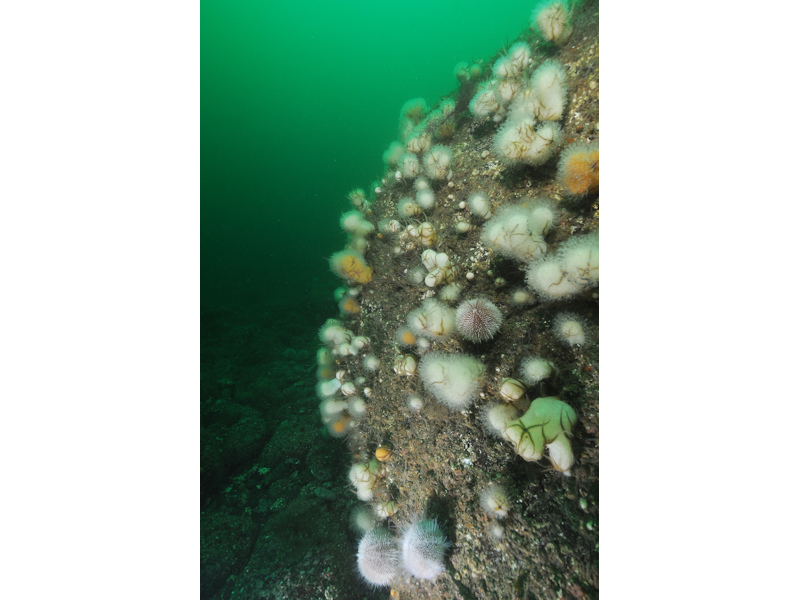
Alcyonium digitatum and faunal crust communities on vertical circalittoral bedrock
Photographer: Dr Keith Hiscock Copyright: Dr Keith Hiscock
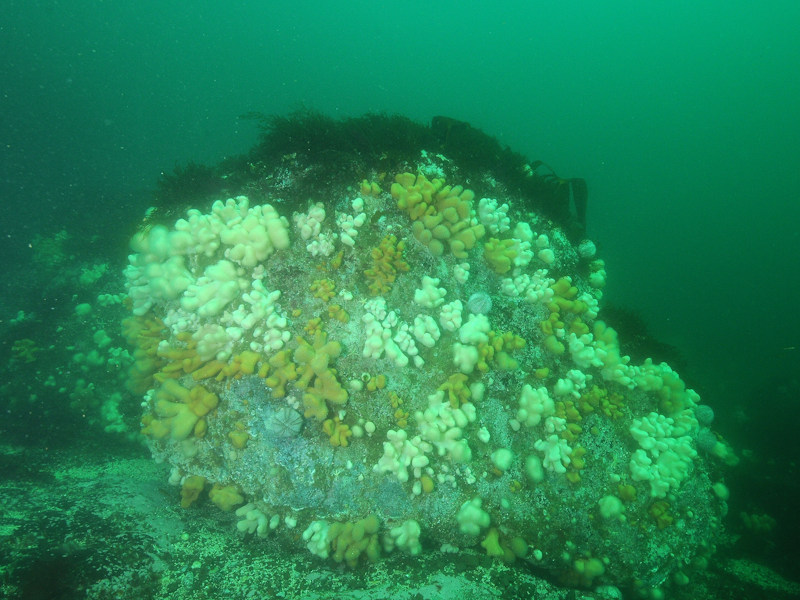
Alcyonium digitatum and faunal crust communities on vertical circalittoral bedrock
Photographer: Dr Keith Hiscock Copyright: Dr Keith Hiscock
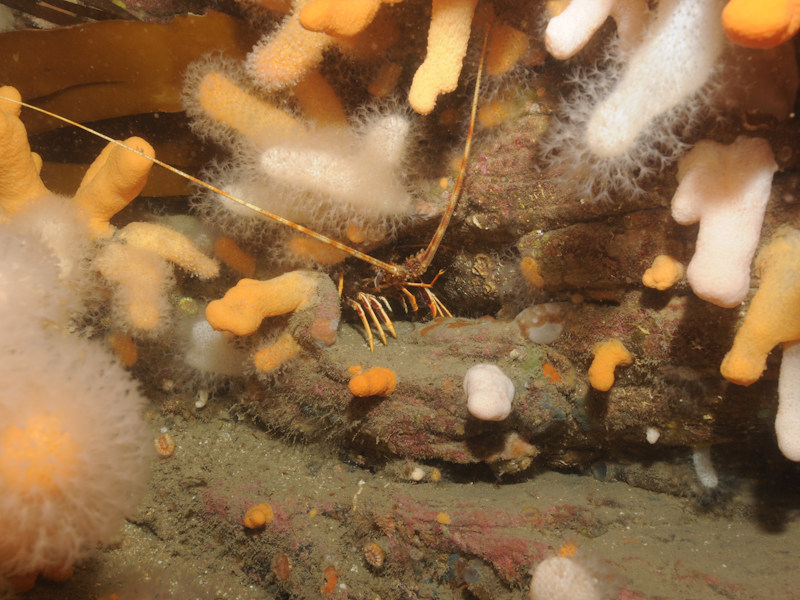
Alcyonium digitatum and faunal crust communities on vertical circalittoral bedrock with Palinurus elephas
Photographer: Dr Keith Hiscock Copyright: Dr Keith Hiscock

| Researched by | John Readman, Emma Williams, Kelsey Lloyd & Amy Watson | Refereed by | This information is not refereed |
|---|
Summary
UK and Ireland classification
Description
This biotope typically occurs on the vertical faces and overhangs of exposed to moderately exposed lower infralittoral and upper circalittoral bedrock subject to moderately strong to weak tidal streams. Due to the large numbers of the urchin Echinus esculentus often recorded, this biotope tends to have a grazed appearance, and the bedrock is often encrusted with pink coralline algae, encrusting bryozoans such as Parasmittina trispinosa and the calcareous tubeworm Spirobranchus triqueter. Dense aggregations of dead mans fingers Alcyonium digitatum may be present along with the cup coral Caryophyllia smithii. Other species present include the echinoderms Asterias rubens, Ophiothrix fragilis and Antedon bifida, the ascidians Clavelina lepadiformis, Ciona intestinalis and Ascidia mentula, the anthozoans Urticina felina, Cortynactis viridis, Metridium senile and Cylista elegans, the gastropod Calliostoma zizyphinum and the crustacean Cancer pagurus. Three regional variations of this biotope have been recorded. One variant found typically off the north-east coast of Scotland and around the Northern Isles, has a very impoverished appearance dominated by anthozoans. A second variant occurs along the west coast of Scotland, extending to Rockall in the west, and the Northern Isles in the north-east, and has a more fauna, characterized by hydroids, sponges, anthozoans and echinoderms. A third variant occurs along the north-east coast of England (Northumberland) up to the Northern Isles and is dominated by Alcyonium digitatum, brittlestars and Echinus esculentus. (Information from Connor et al., 2004; JNCC, 2015).
Depth range
5-10 m, 10-20 m, 20-30 m, 30-50 mAdditional information
-
Listed By
Sensitivity review
Sensitivity characteristics of the habitat and relevant characteristic species
The biotope occurs on vertical faces and overhangs and is characterized by a heavily grazed faunal crust of encrusting bryozoans such as Parasmittina trispinosa with dense aggregations of Alcyonium digitatum.
Grazing by the sea urchin Echinus esculentus is considered significant in preserving the nature of this biotope and loss of this species is likely to significantly affect the biotope to the extent that reclassification would be necessary. For this sensitivity assessment, Alcyonium digitatum and Echinus esculentus are the primary focus of research as the important characterizing species defining CR.MCR.EcCr.AdigVt, with species making up the faunal crust (such as the bryozoan Parasmittina trispinosa) considered where appropriate. Other species present in these biotopes are considered transient, mobile or ubiquitous and are therefore not considered significant to the assessment of the sensitivity of these biotopes. However, information on the sensitivity of other characterizing species is included where appropriate.
Resilience and recovery rates of habitat
Alcyonium digitatum is a colonial species of soft coral with a wide distribution in the North Atlantic, recorded from Portugal (41°N) to Northern Norway (70°N) as well as on the east coast of North America (Hartnoll, 1975). Colonies consist of stout “finger-like” projections (Hartnoll, 1975) that can reach up to 20 cm tall and can dominate circalittoral rock habitats (as in CR.HCR.FaT.CTub.Adig; Connor et al., 2004). Alcyonium digitatum colonies are likely to have a lifespan that exceeds 20 years as colonies have been followed for 28 years in marked plots (Lundälv, pers. comm., in Hartnoll, 1998). Colonies that are 10-15 cm in height have been aged between five and ten years old (Hartnoll, unpublished). The majority of colonies are unisexual, with the majority of individuals being female. Sexual maturity is predicted, at the earliest when the colony reaches the second year of growth. However, the majority of colonies are not predicted to reach maturity until their third year when they attain biomass of approximately 20-30g (Hartnoll, 1975).
Alcyonium digitatum spawns from December and January. Gametes are released into the water and fertilization occurs externally. The embryos are neutrally buoyant and float freely for seven days. The embryos give rise to actively swimming lecithotrophic planulae which may have an extended pelagic life before they eventually settle (usually within one or two further days) and metamorphose to polyps (Matthews, 1917; Hartnoll, 1975). In laboratory experiments, several larvae of Alcyonium digitatum failed to settle within 10 days, presumably finding the conditions unsuitable. These larvae were able to survive 35 weeks as non-feeding planulae. After 14 weeks some were still swimming and after 24 weeks the surface ciliation was still active although they rested on the bottom of the tanks. By the end of the experiment at 35 weeks, the larvae had shrunk to a diameter of 0.3 mm. This ability to survive for long periods in the plankton may favour the dispersal and eventual discovery of a site suitable for settlement (Hartnoll, 1975). The combination of spawning in winter and the long pelagic lifespan may allow a considerable length of time for the planulae to disperse, settle and metamorphose ahead of the spring plankton bloom. Young Alcyonium digitatum will consequently be able to take advantage of an abundant food resource in spring and be well developed before the appearance of other forms that may otherwise compete for the same substrata. In addition, because the planulae do not feed whilst in the pelagic zone, they do not suffer by being released at the time of minimum plankton density and they may also benefit from the scarcity of predatory zooplankton which would otherwise feed upon them (Hartnoll, 1975).
Echinus esculentus is a sea urchin found within the north-east Atlantic, recorded from Murmansk Coast, Russia to Portugal (Hansson, 1998). Echinus esculentus is estimated to have a lifespan of 8-16 years (Nichols, 1979; Gage, 1992) and reaches sexual maturity within 1-3 years (Tyler-Walters, 2008). Maximum spawning occurs in spring although individuals may spawn over a protracted period throughout the year. Gonad weight is at its maximum in February/March in English Channel (Comely & Ansell, 1988) but decreases during spawning in spring and then increases again through summer and winter until the next spawning season. Spawning occurs just before the seasonal rise in temperature in temperate zones but is probably not triggered by rising temperature (Bishop, 1985). Echinus esculentus is a broadcast spawner, with a complex larval life history which includes a blastula, gastrula and a characteristic four-armed echinopluteus stage, which forms an important component of the zooplankton. MacBride (1914) observed planktonic larval development could take 45-60 days in captivity.
Recruitment is sporadic or variable depending on locality. For example, Millport populations showed annual recruitment, whereas few recruits were found in Plymouth populations during Nichols’ studies between 1980-1981 (Nichols, 1984). Bishop & Earll (1984) suggested that the population of Echinus esculentus at St Abbs had a high density and recruited regularly whereas the Skomer population was sparse, ageing and had probably not successfully recruited larvae in the previous six years (Bishop & Earll, 1984). Comely & Ansell (1988) noted that the largest number of Echinus esculentus occurred below the kelp forest.
Echinus esculentus is a mobile species and could therefore migrate and re-populate an area quickly if removed. For example, Lewis & Nichols (1979a) found that adults were able to colonize an artificial reef in small numbers within three months and the population steadily grew over the following year. If completely removed from a site and local populations are naturally sparse, then recruitment may be dependent on larval supply, which can be highly variable. As suggested by Bishop & Earll (1984), the Skomer, Wales Echinus esculentus population had most likely not successfully recruited for six years, which would suggest the mature population would be highly sensitive to removal and may not return for several years. The Prestige oil tanker spilt 63 000t of fuel 130 nautical miles off Galicia, Spain in November 2002. High wave action and strong weather systems increased the mixing of the oil to “some” depth within the water column, causing sensitive faunal communities to be affected. The biological community of Guéthary, France was monitored preceding and for nine years following the oil spill. Following the oil spill, taxonomic richness decreased significantly from 57 recorded species to 41, which included the loss of Echinus esculentus from the site. Two to three years after the oil spill, taxonomic richness had increased to pre-spill levels and Echinus esculentus had returned (Castège et al., 2014).
Coralline crusts, Parasmittina trispinosa and Caryophyllia smithii are also important within the CR.MCR.EcCr.AdigVt biotope. Studies by Edyvean & Ford (1984a; 1986; 1987) of populations of coralline crusts, namely Lithophyllum incrustans, suggest that reproduction may be sexual or asexual (on average early in the third year), and spores are released throughout the year with seasonal variation as fewer spores were produced in the summer. The authors also found that spore survival was extremely low and young mortality was high, but individuals after the age of ten appear relatively long-lived (up to 30 years). Some repair of damaged encrusting coralline occurs through vegetative growth, so recolonization by propagules may also be an important mechanism for rapid recovery (Chamberlain, 1996; Airoldi, 2000).
There is limited information on the life history traits of Parasmittina trispinosa. Eggleston (1972a) noted in the Isle of Man, a peak in reproductive and vegetative growth was not well marked and that the number of embryos present was fairly constant throughout the year, which indicated that Parasmittina trispinosa could potentially reproduce annually within the UK. Caryophyllia smithii is a small (max 3 cm across) solitary coral common within tide swept sites of the UK (Wood, 2005). Fowler & Laffoley (1993) suggested that Caryophyllia smithii was a slow-growing species, which suggested that inter-specific spatial competition with colonial faunal or algae species were important factors in determining local abundance (Bell & Turner, 2000). Caryophyllia smithii reproduces sexually with gamete release most likely triggered by seasonal temperature increases (typically from January-April) (Tranter et al., 1982). The pelagic stage of the larvae may last up to ten weeks, which provides this species with a good dispersal capability (Tranter et al., 1982).
Resilience assessment. Echinus esculentus can reportedly reach sexual maturity within 1-2 years (Tyler-Walters, 2008), however, as highlighted by Bishop & Earll (1984) and Castège et al. (2014) recovery may take 2-6 years (possibly more if local recruitment is poor). Alcyonium digitatum can recruit onto bare surfaces within two years, however, may take up to five years to become a dominant component of the community (Whomersley & Picken, 2003; Hiscock et al., 2010). The faunal crust is heavily grazed by Echinus esculentus and, together with the evidence presented, is likely to be quite resilient. If the community declined significantly (resistance of ‘None’ or ‘Low’) resilience would be assessed as ‘Medium’ (recovery in 2-10 years). However, where resistance was assessed as ‘Medium’ or ‘High’ then resilience would be assessed as ‘High’.
Climate Change Pressures
Use [show more] / [show less] to open/close text displayed
| Resistance | Resilience | Sensitivity | |
Global warming (extreme) [Show more]Global warming (extreme)Extreme emission scenario (by the end of this century 2081-2100) benchmark of:
EvidenceAlcyonium digitatum is a boreal species of octocoral recorded along the Atlantic Coasts of Europe from Portugal to Norway and Iceland, and along the northwest Atlantic coasts, at sea surface temperatures between 5 and 20°C but mostly between 10 and 15°C (www.obis.org). Across this latitudinal gradient species are likely to experience a range of temperatures from approx. 5 and 18°C (Sea temperature, 2015). Alcyonium digitatum spawns during the winter months (Hartnoll, 1975). Gametes are fertilized while in the water column and the embryos give rise to actively swimming lecithotrophic planulae that may have an extended pelagic life before they eventually settle (usually within one or two further days) and metamorphose to polyps (Matthews, 1917; Hartnoll, 1975). However, laboratory experiments have observed settlement failure to occur in unsuitable conditions (Hartnoll, 1975). As spawning occurs when sea temperatures are low there is the probability that spawning and settlement could be correlated to climatic conditions, therefore global warming could impact the reproduction and recruitment of Alcyonium digitatum. However, the combination of spawning in winter and the long pelagic lifespan may allow a considerable length of time for the planulae to disperse, settle and metamorphose ahead of the spring plankton bloom (Hartnoll, 1975). The duration, dispersal and survival of planktonic larvae are dependent on several factors including temperature (O’Connor et al., 2007). O’Connor et al. (2007) reported planktonic larval duration to increase with temperature, therefore cold-water species could see an increase in planktonic larval duration under global warming trends. Larval survival has been reported to decrease exponentially with time (planktonic larval duration) (O’Connor et al., 2007). Elevated temperatures may increase the occurrence of octocoral diseases caused by pathogens that act opportunistically to attack hosts that are under stressful conditions. For example, Cerrano et al. (2000) reported that ecosystems in the Mediterranean are rapidly declining from extensive attacks by microorganisms correlating to elevated seawater temperatures. Echinus esculentus is a sea urchin distributed across the N.E. Atlantic from Iceland, north to Finmark, Norway and south to Portugal. Echinus esculentus is common on most coasts of the British Isles but absent from most of the east coast of England, the eastern English Channel and some parts of north Wales. Echinus esculentus has been recorded primarily between sea temperatures of 5 and 15°C (www.obis.org). Echinus esculentus occurred at temperatures between 0 and 18°C in Limfjord, Denmark (Ursin 1960). Temperature, photoperiod and food availability are considered to be factors that control the reproduction of echinoids (Kelly, 2001). Bishop (1985) noted that gametogenesis proceeded at temperatures between 11 - 19°C although continued exposure to 19°C destroyed synchronicity of gametogenesis between individuals. Embryos and larvae developed abnormally after up to 24 hr at 15°C (Tyler & Young 1998) but normally at the other temperatures tested (4, 7 and 11°C). Tyler & Young (1998) concluded that embryos and larvae were more tolerant of depth and temperature than adults. Bishop (1985) suggested that Echinus esculentus cannot tolerate high temperatures for prolonged periods due to increased respiration rate and resultant metabolic stress. Therefore, Echinus esculentus is likely to be intolerant of chronic long term temperature change but would probably be more intolerant of sudden or short term acute change (e.g. 5°C for one week) in temperature. Elevated seawater temperatures generally increase the metabolic rate of bryozoans and are expected to affect calcification (Smith, 2014; Moreno, 2020). The bryozoan Parasmittina trispinosa has been recorded from Britain, north to western Norway, the Faroe Isles, northwestern Atlantic coasts, the Californian coast and the Gulf of Mexico. Parasmittina trispinosa generally occurs in temperatures between 5 and 15°C, however, there are records of this species between 25 and 30°C (www.obis.org). Therefore, Parasmittina trispinosa is considered unlikely to be affected by long-term changes in temperature. Coralline crusts, including Lithophyllum incrustans are found further south than the UK and are considered to tolerate increased temperatures, although they may be more sensitive to drying rather than higher temperatures. Edyvean & Ford (1984b) suggest that populations of Lithophyllum incrustans are affected by temperature changes and salinity and that temperature and salinity ‘shocks’ induce spawning but no information on thresholds was provided (Edyvean & Ford, 1984b). Populations of Lithophyllum incrustans were less stable in tide pools with a smaller volume of water, which were more exposed to temperature and salinity changes due to lower buffering capacity. Sexual plants (or the spores that give rise to them) were suggested to be more susceptible than asexual plants to extremes of local environmental variables (temperature, salinity etc.) as they occur with greater frequency at sites where temperature and salinity were more stable (Edyvean & Ford, 1984b). Lithophyllum incrustans is close to the northern edge of its range and is likely to tolerate increased temperatures. Caryophyllia smithii is a temperate cup coral that has a wide distribution from Norway to the Mediterranean and South Africa in the Atlantic, found in both shallow and deep water, with records of this species between temperatures of 5 and 30°C. Tranter et al. (1982) suggested Caryophyllia smithii reproduction was cued by seasonal increases in seawater temperature. Therefore, unseasonal increases in temperature may disrupt natural reproductive processes and negatively influence recruitment patterns given that gamete release is most likely triggered by seasonal temperature increases (Tranter et al., 1982). Sensitivity Assessment. Under the middle, high and extreme emission scenarios seawater temperatures are expected to rise by 3-5°C, with potential southern summer temperatures of 22-24°C. While no evidence on the impacts of ocean warming on the characterizing species Alcyonium digitatum was found, biogeographic distribution is often a good predictor of temperature tolerance (Jeffree & Jeffree, 1994). The distribution of Alcyonium digitatum suggests that the species is likely to be impacted by ocean warming, as populations of this species only occur where seawater temperatures range up to 20°C (www.obis.org). Parasmittina trispinosa, Caryophyllia smithii and the coralline crusts are found in geographical locations with higher temperatures than in the UK so that these species are unlikely to be affected by an increase in seawater temperature under these scenarios. However, the sea urchin Echinus esculentus cannot tolerate high temperatures for prolonged periods. A reduction in grazing due to loss of Echinus esculentus may result in loss of the biotope if it is replaced by a more abundant and diverse faunal turf, eg. FaT.CTub.Adig. As CR.MCR.EcCr.AdigVt is a grazed biotope and the main characterizing species Alcyonium digitatum is unknown to tolerate high temperatures resistance is assessed as ‘Low’ and resilience as ‘Very low’ so that sensitivity is, therefore, assessed as 'High' at levels predicted for the end of this century. | LowHelp | Very LowHelp | HighHelp |
Global warming (high) [Show more]Global warming (high)High emission scenario (by the end of this century 2081-2100) benchmark of:
EvidenceAlcyonium digitatum is a boreal species of octocoral recorded along the Atlantic Coasts of Europe from Portugal to Norway and Iceland, and along the northwest Atlantic coasts, at sea surface temperatures between 5 and 20°C but mostly between 10 and 15°C (www.obis.org). Across this latitudinal gradient species are likely to experience a range of temperatures from approx. 5 and 18°C (Sea temperature, 2015). Alcyonium digitatum spawns during the winter months (Hartnoll, 1975). Gametes are fertilized while in the water column and the embryos give rise to actively swimming lecithotrophic planulae that may have an extended pelagic life before they eventually settle (usually within one or two further days) and metamorphose to polyps (Matthews, 1917; Hartnoll, 1975). However, laboratory experiments have observed settlement failure to occur in unsuitable conditions (Hartnoll, 1975). As spawning occurs when sea temperatures are low there is the probability that spawning and settlement could be correlated to climatic conditions, therefore global warming could impact the reproduction and recruitment of Alcyonium digitatum. However, the combination of spawning in winter and the long pelagic lifespan may allow a considerable length of time for the planulae to disperse, settle and metamorphose ahead of the spring plankton bloom (Hartnoll, 1975). The duration, dispersal and survival of planktonic larvae are dependent on several factors including temperature (O’Connor et al., 2007). O’Connor et al. (2007) reported planktonic larval duration to increase with temperature, therefore cold-water species could see an increase in planktonic larval duration under global warming trends. Larval survival has been reported to decrease exponentially with time (planktonic larval duration) (O’Connor et al., 2007). Elevated temperatures may increase the occurrence of octocoral diseases caused by pathogens that act opportunistically to attack hosts that are under stressful conditions. For example, Cerrano et al. (2000) reported that ecosystems in the Mediterranean are rapidly declining from extensive attacks by microorganisms correlating to elevated seawater temperatures. Echinus esculentus is a sea urchin distributed across the N.E. Atlantic from Iceland, north to Finmark, Norway and south to Portugal. Echinus esculentus is common on most coasts of the British Isles but absent from most of the east coast of England, the eastern English Channel and some parts of north Wales. Echinus esculentus has been recorded primarily between sea temperatures of 5 and 15°C (www.obis.org). Echinus esculentus occurred at temperatures between 0 and 18°C in Limfjord, Denmark (Ursin 1960). Temperature, photoperiod and food availability are considered to be factors that control the reproduction of echinoids (Kelly, 2001). Bishop (1985) noted that gametogenesis proceeded at temperatures between 11 - 19°C although continued exposure to 19°C destroyed synchronicity of gametogenesis between individuals. Embryos and larvae developed abnormally after up to 24 hr at 15°C (Tyler & Young 1998) but normally at the other temperatures tested (4, 7 and 11°C). Tyler & Young (1998) concluded that embryos and larvae were more tolerant of depth and temperature than adults. Bishop (1985) suggested that Echinus esculentus cannot tolerate high temperatures for prolonged periods due to increased respiration rate and resultant metabolic stress. Therefore, Echinus esculentus is likely to be intolerant of chronic long term temperature change but would probably be more intolerant of sudden or short term acute change (e.g. 5°C for one week) in temperature. Elevated seawater temperatures generally increase the metabolic rate of bryozoans and are expected to affect calcification (Smith, 2014; Moreno, 2020). The bryozoan Parasmittina trispinosa has been recorded from Britain, north to western Norway, the Faroe Isles, northwestern Atlantic coasts, the Californian coast and the Gulf of Mexico. Parasmittina trispinosa generally occurs in temperatures between 5 and 15°C, however, there are records of this species between 25 and 30°C (www.obis.org). Therefore, Parasmittina trispinosa is considered unlikely to be affected by long-term changes in temperature. Coralline crusts, including Lithophyllum incrustans are found further south than the UK and are considered to tolerate increased temperatures, although they may be more sensitive to drying rather than higher temperatures. Edyvean & Ford (1984b) suggest that populations of Lithophyllum incrustans are affected by temperature changes and salinity and that temperature and salinity ‘shocks’ induce spawning but no information on thresholds was provided (Edyvean & Ford, 1984b). Populations of Lithophyllum incrustans were less stable in tide pools with a smaller volume of water, which were more exposed to temperature and salinity changes due to lower buffering capacity. Sexual plants (or the spores that give rise to them) were suggested to be more susceptible than asexual plants to extremes of local environmental variables (temperature, salinity etc.) as they occur with greater frequency at sites where temperature and salinity were more stable (Edyvean & Ford, 1984b). Lithophyllum incrustans is close to the northern edge of its range and is likely to tolerate increased temperatures. Caryophyllia smithii is a temperate cup coral that has a wide distribution from Norway to the Mediterranean and South Africa in the Atlantic, found in both shallow and deep water, with records of this species between temperatures of 5 and 30°C. Tranter et al. (1982) suggested Caryophyllia smithii reproduction was cued by seasonal increases in seawater temperature. Therefore, unseasonal increases in temperature may disrupt natural reproductive processes and negatively influence recruitment patterns given that gamete release is most likely triggered by seasonal temperature increases (Tranter et al., 1982). Sensitivity Assessment. Under the middle, high and extreme emission scenarios seawater temperatures are expected to rise by 3-5°C, with potential southern summer temperatures of 22-24°C. While no evidence on the impacts of ocean warming on the characterizing species Alcyonium digitatum was found, biogeographic distribution is often a good predictor of temperature tolerance (Jeffree & Jeffree, 1994). The distribution of Alcyonium digitatum suggests that the species is likely to be impacted by ocean warming, as populations of this species only occur where seawater temperatures range up to 20°C (www.obis.org). Parasmittina trispinosa, Caryophyllia smithii and the coralline crusts are found in geographical locations with higher temperatures than in the UK so that these species are unlikely to be affected by an increase in seawater temperature under these scenarios. However, the sea urchin Echinus esculentus cannot tolerate high temperatures for prolonged periods. A reduction in grazing due to loss of Echinus esculentus may result in loss of the biotope if it is replaced by a more abundant and diverse faunal turf, eg. FaT.CTub.Adig. As CR.MCR.EcCr.AdigVt is a grazed biotope and the main characterizing species Alcyonium digitatum is unknown to tolerate high temperatures resistance is assessed as ‘Low’ and resilience as ‘Very low’ so that sensitivity is, therefore, assessed as 'High' at levels predicted for the end of this century. | LowHelp | Very LowHelp | HighHelp |
Global warming (middle) [Show more]Global warming (middle)Middle emission scenario (by the end of this century 2081-2100) benchmark of:
EvidenceAlcyonium digitatum is a boreal species of octocoral recorded along the Atlantic Coasts of Europe from Portugal to Norway and Iceland, and along the northwest Atlantic coasts, at sea surface temperatures between 5 and 20°C but mostly between 10 and 15°C (www.obis.org). Across this latitudinal gradient species are likely to experience a range of temperatures from approx. 5 and 18°C (Sea temperature, 2015). Alcyonium digitatum spawns during the winter months (Hartnoll, 1975). Gametes are fertilized while in the water column and the embryos give rise to actively swimming lecithotrophic planulae that may have an extended pelagic life before they eventually settle (usually within one or two further days) and metamorphose to polyps (Matthews, 1917; Hartnoll, 1975). However, laboratory experiments have observed settlement failure to occur in unsuitable conditions (Hartnoll, 1975). As spawning occurs when sea temperatures are low there is the probability that spawning and settlement could be correlated to climatic conditions, therefore global warming could impact the reproduction and recruitment of Alcyonium digitatum. However, the combination of spawning in winter and the long pelagic lifespan may allow a considerable length of time for the planulae to disperse, settle and metamorphose ahead of the spring plankton bloom (Hartnoll, 1975). The duration, dispersal and survival of planktonic larvae are dependent on several factors including temperature (O’Connor et al., 2007). O’Connor et al. (2007) reported planktonic larval duration to increase with temperature, therefore cold-water species could see an increase in planktonic larval duration under global warming trends. Larval survival has been reported to decrease exponentially with time (planktonic larval duration) (O’Connor et al., 2007). Elevated temperatures may increase the occurrence of octocoral diseases caused by pathogens that act opportunistically to attack hosts that are under stressful conditions. For example, Cerrano et al. (2000) reported that ecosystems in the Mediterranean are rapidly declining from extensive attacks by microorganisms correlating to elevated seawater temperatures. Echinus esculentus is a sea urchin distributed across the N.E. Atlantic from Iceland, north to Finmark, Norway and south to Portugal. Echinus esculentus is common on most coasts of the British Isles but absent from most of the east coast of England, the eastern English Channel and some parts of north Wales. Echinus esculentus has been recorded primarily between sea temperatures of 5 and 15°C (www.obis.org). Echinus esculentus occurred at temperatures between 0 and 18°C in Limfjord, Denmark (Ursin 1960). Temperature, photoperiod and food availability are considered to be factors that control the reproduction of echinoids (Kelly, 2001). Bishop (1985) noted that gametogenesis proceeded at temperatures between 11 - 19°C although continued exposure to 19°C destroyed synchronicity of gametogenesis between individuals. Embryos and larvae developed abnormally after up to 24 hr at 15°C (Tyler & Young 1998) but normally at the other temperatures tested (4, 7 and 11°C). Tyler & Young (1998) concluded that embryos and larvae were more tolerant of depth and temperature than adults. Bishop (1985) suggested that Echinus esculentus cannot tolerate high temperatures for prolonged periods due to increased respiration rate and resultant metabolic stress. Therefore, Echinus esculentus is likely to be intolerant of chronic long term temperature change but would probably be more intolerant of sudden or short term acute change (e.g. 5°C for one week) in temperature. Elevated seawater temperatures generally increase the metabolic rate of bryozoans and are expected to affect calcification (Smith, 2014; Moreno, 2020). The bryozoan Parasmittina trispinosa has been recorded from Britain, north to western Norway, the Faroe Isles, northwestern Atlantic coasts, the Californian coast and the Gulf of Mexico. Parasmittina trispinosa generally occurs in temperatures between 5 and 15°C, however, there are records of this species between 25 and 30°C (www.obis.org). Therefore, Parasmittina trispinosa is considered unlikely to be affected by long-term changes in temperature. Coralline crusts, including Lithophyllum incrustans are found further south than the UK and are considered to tolerate increased temperatures, although they may be more sensitive to drying rather than higher temperatures. Edyvean & Ford (1984b) suggest that populations of Lithophyllum incrustans are affected by temperature changes and salinity and that temperature and salinity ‘shocks’ induce spawning but no information on thresholds was provided (Edyvean & Ford, 1984b). Populations of Lithophyllum incrustans were less stable in tide pools with a smaller volume of water, which were more exposed to temperature and salinity changes due to lower buffering capacity. Sexual plants (or the spores that give rise to them) were suggested to be more susceptible than asexual plants to extremes of local environmental variables (temperature, salinity etc.) as they occur with greater frequency at sites where temperature and salinity were more stable (Edyvean & Ford, 1984b). Lithophyllum incrustans is close to the northern edge of its range and is likely to tolerate increased temperatures. Caryophyllia smithii is a temperate cup coral that has a wide distribution from Norway to the Mediterranean and South Africa in the Atlantic, found in both shallow and deep water, with records of this species between temperatures of 5 and 30°C. Tranter et al. (1982) suggested Caryophyllia smithii reproduction was cued by seasonal increases in seawater temperature. Therefore, unseasonal increases in temperature may disrupt natural reproductive processes and negatively influence recruitment patterns given that gamete release is most likely triggered by seasonal temperature increases (Tranter et al., 1982). Sensitivity Assessment. Under the middle, high and extreme emission scenarios seawater temperatures are expected to rise by 3-5°C, with potential southern summer temperatures of 22-24°C. While no evidence on the impacts of ocean warming on the characterizing species Alcyonium digitatum was found, biogeographic distribution is often a good predictor of temperature tolerance (Jeffree & Jeffree, 1994). The distribution of Alcyonium digitatum suggests that the species is likely to be impacted by ocean warming, as populations of this species only occur where seawater temperatures range up to 20°C (www.obis.org). Parasmittina trispinosa, Caryophyllia smithii and the coralline crusts are found in geographical locations with higher temperatures than in the UK so that these species are unlikely to be affected by an increase in seawater temperature under these scenarios. However, the sea urchin Echinus esculentus cannot tolerate high temperatures for prolonged periods. A reduction in grazing due to loss of Echinus esculentus may result in loss of the biotope if it is replaced by a more abundant and diverse faunal turf, eg. FaT.CTub.Adig. As CR.MCR.EcCr.AdigVt is a grazed biotope and the main characterizing species Alcyonium digitatum is unknown to tolerate high temperatures resistance is assessed as ‘Low’ and resilience as ‘Very low’ so that sensitivity is, therefore, assessed as 'High' at levels predicted for the end of this century. | LowHelp | Very LowHelp | HighHelp |
Marine heatwaves (high) [Show more]Marine heatwaves (high)High emission scenario benchmark: A marine heatwave occurring every two years, with a mean duration of 120 days, and a maximum intensity of 3.5°C. Further detail. EvidenceMarine heatwaves are extreme weather events defined as periods of extreme sea surface temperature that persists for days to months (Frölicher et al., 2018). Marine heatwaves are predicted to occur more frequently, last for longer and at increased intensity by the end of this century under both middle and high emission scenarios (Frölicher et al., 2018). No studies on the impacts of marine heatwaves on Alcyonium digitatum were found. However, this species appears to be restricted to colder waters and occurs in seawater temperatures between 5 and 20°C (www.obis.org). Therefore, Alcyonium digitatum is likely to be impacted by heatwaves under both scenarios. Echinus esculentus cannot tolerate high temperatures for prolonged periods due to increased respiration rate resulting in metabolic stress (Bishop 1985). Bishop (1985) observed gametogenesis to occur between 11 and 19°C however, continued exposure to 19°C disrupted gametogenesis. In addition, embryos and larvae developed abnormally after 24 hr exposure to 15°C (Bishop, 1985). Therefore, marine heatwaves have the potential to impact the reproduction, recruitment and survival of Echinus esculentus. Elevated seawater temperatures generally increase the metabolic rate of bryozoans and is expected to affect calcification (Smith, 2014; Leveroni, 2020). However, although Parasmittina trispinosa generally occurs in temperatures between 5 and 15°C, there are records of this species between 25 and 30°C (www.obis.org). Therefore, Parasmittina trispinosa is considered unlikely to be affected by long-term changes in temperature in the UK, as Parasmittina trispinosa is likely to acclimate to temperatures with time. However, the occurrence of marine heatwaves could cause mass mortality to populations that have not been acclimated to warmer temperatures. Cocito & Sgorbini (2014) studied spatial and temporal patterns of colonial bryozoans in the Ligurian Sea over nine years, during those years marine heatwave events caused mass mortality among a number of species. A warming event (a temperature of 23.87 ± 1.4°C at 11 m and of 22.27 ± 1.2°C at 22 m) in the eastern Ligurian Sea (NW Mediterranean) in 1999 caused rapid declines in the abundance of the bryozoan Pentapora between 11 and 22 m depth with an 86% reduction in colony cover (Cocito & Sgorbini, 2014). Recovery was gradual, with communities at 22 m deep recovering to pre-disturbance levels within four years, however, none of the larger colonies (>1,000 cm2) at 11 m deep survived after the first disturbance. Caryophyllia smithii is a temperate cup coral that has a wide distribution and is found in both shallow and deep waters, with records of this species between temperatures of 5 and 30°C. Tranter et al. (1982) suggested Caryophyllia smithii reproduction was cued by seasonal increases in seawater temperature. Therefore, unseasonal increases in temperature may disrupt natural reproductive processes and negatively influence recruitment patterns given that gamete release is most likely triggered by seasonal temperature increases (Tranter et al., 1982). Therefore, marine heatwaves could impact the reproduction and recruitment of Caryophyllia smithii. Sensitivity assessment. Under the middle emission scenario, if heatwaves occurred every three years, with a maximum intensity of 2°C for 80 days by the end of this century, this could lead to summer sea temperatures reaching up to 24°C in southern England. Under the high emission scenario, if heatwaves occurred every two years by the end of this century, reaching a maximum intensity of 3.5°C for 120 days, this could lead to the heatwave lasting the entire summer with temperatures reaching up to 26.5°C. There is no experimental evidence of the impact of marine heatwaves on the characteristic species of this biotope, however as Alcyonium digitatum is not known to tolerant seawater temperatures >20°C and the sea urchin Echinus esculentus cannot tolerate high temperatures, resistance is assessed as “Low”, under the middle and high emissions scenario, and resilience is assessed as “Low”, so the biotope is assessed as “High” sensitivity. | LowHelp | LowHelp | HighHelp |
Marine heatwaves (middle) [Show more]Marine heatwaves (middle)Middle emission scenario benchmark: A marine heatwave occurring every three years, with a mean duration of 80 days, with a maximum intensity of 2°C. Further detail. EvidenceMarine heatwaves are extreme weather events defined as periods of extreme sea surface temperature that persists for days to months (Frölicher et al., 2018). Marine heatwaves are predicted to occur more frequently, last for longer and at increased intensity by the end of this century under both middle and high emission scenarios (Frölicher et al., 2018). No studies on the impacts of marine heatwaves on Alcyonium digitatum were found. However, this species appears to be restricted to colder waters and occurs in seawater temperatures between 5 and 20°C (www.obis.org). Therefore, Alcyonium digitatum is likely to be impacted by heatwaves under both scenarios. Echinus esculentus cannot tolerate high temperatures for prolonged periods due to increased respiration rate resulting in metabolic stress (Bishop 1985). Bishop (1985) observed gametogenesis to occur between 11 and 19°C however, continued exposure to 19°C disrupted gametogenesis. In addition, embryos and larvae developed abnormally after 24 hr exposure to 15°C (Bishop, 1985). Therefore, marine heatwaves have the potential to impact the reproduction, recruitment and survival of Echinus esculentus. Elevated seawater temperatures generally increase the metabolic rate of bryozoans and is expected to affect calcification (Smith, 2014; Leveroni, 2020). However, although Parasmittina trispinosa generally occurs in temperatures between 5 and 15°C, there are records of this species between 25 and 30°C (www.obis.org). Therefore, Parasmittina trispinosa is considered unlikely to be affected by long-term changes in temperature in the UK, as Parasmittina trispinosa is likely to acclimate to temperatures with time. However, the occurrence of marine heatwaves could cause mass mortality to populations that have not been acclimated to warmer temperatures. Cocito & Sgorbini (2014) studied spatial and temporal patterns of colonial bryozoans in the Ligurian Sea over nine years, during those years marine heatwave events caused mass mortality among a number of species. A warming event (a temperature of 23.87 ± 1.4°C at 11 m and of 22.27 ± 1.2°C at 22 m) in the eastern Ligurian Sea (NW Mediterranean) in 1999 caused rapid declines in the abundance of the bryozoan Pentapora between 11 and 22 m depth with an 86% reduction in colony cover (Cocito & Sgorbini, 2014). Recovery was gradual, with communities at 22 m deep recovering to pre-disturbance levels within four years, however, none of the larger colonies (>1,000 cm2) at 11 m deep survived after the first disturbance. Caryophyllia smithii is a temperate cup coral that has a wide distribution and is found in both shallow and deep waters, with records of this species between temperatures of 5 and 30°C. Tranter et al. (1982) suggested Caryophyllia smithii reproduction was cued by seasonal increases in seawater temperature. Therefore, unseasonal increases in temperature may disrupt natural reproductive processes and negatively influence recruitment patterns given that gamete release is most likely triggered by seasonal temperature increases (Tranter et al., 1982). Therefore, marine heatwaves could impact the reproduction and recruitment of Caryophyllia smithii. Sensitivity assessment. Under the middle emission scenario, if heatwaves occurred every three years, with a maximum intensity of 2°C for 80 days by the end of this century, this could lead to summer sea temperatures reaching up to 24°C in southern England. Under the high emission scenario, if heatwaves occurred every two years by the end of this century, reaching a maximum intensity of 3.5°C for 120 days, this could lead to the heatwave lasting the entire summer with temperatures reaching up to 26.5°C. There is no experimental evidence of the impact of marine heatwaves on the characteristic species of this biotope, however as Alcyonium digitatum is not known to tolerant seawater temperatures >20°C and the sea urchin Echinus esculentus cannot tolerate high temperatures, resistance is assessed as “Low”, under the middle and high emissions scenario, and resilience is assessed as “Low”, so the biotope is assessed as “High” sensitivity. | LowHelp | LowHelp | HighHelp |
Ocean acidification (high) [Show more]Ocean acidification (high)High emission scenario benchmark: a further decrease in pH of 0.35 (annual mean) and corresponding 120% increase in H+ ions , seasonal aragonite saturation of 20% of UK coastal waters and North Sea bottom waters, and the aragonite saturation horizon in the NE Atlantic, off the continental shelf, occurring at a depth of 400 m by the end of this century 2081-2100. Further detail EvidenceIncreasing levels of CO2 in the atmosphere have led to the average pH of sea surface waters dropping from 8.25 in the 1700s to 8.14 in the 1990s (Jacobson, 2005). In general, it is thought that calcifying invertebrates will be more sensitive to ocean acidification than non-calcifying invertebrates, which appear to have a more mixed response (Hofmann et al., 2010). It must be noted that many species show variation in their response to pCO2 independent of their taxonomic group or habitat preferences (Widdicombe & Spicer, 2008; Kroeker et al., 2013). No evidence of the impacts of ocean acidification on Alcyonium digitatum was found. However, studies on the impacts of ocean acidification on octocorals reported various responses (Conci et al., 2021). Gomez et al. (2014) found a significant negative correlation between calcification and CO2 concentrations for Eunicea flexuosa at a pH range of 8.1–7.1. But another study on Eunicea flexuosa observed no significant differences in branch extension and sclerite structure at pH 7.75 and suggested that Eunicea flexuosa had a degree of resilience to ocean acidification (Enochs et al., 2016). Similarly, ocean acidification did not significantly impact the octocorals Ovabunda macrospiculata, Heteroxenia fuscescens and Sarcophyton sp. with no effects on polyp weight and protein concentration, nor any significant differences in chlorophyll abundance or density of zooxanthellae at pH 7.6 and 7.3 when compared to controls at pH 8.2. The findings suggested that the octocoral’s tissue may provide a protective role against acidification (Gabay et al., 2013; Gabay et al., 2014). The planktonic larval stage is often thought to be the most sensitive stage to ocean acidification in benthic organisms (Kurihara, 2008, Chan et al., 2015). The embryos of Alcyonium digitatum are neutrally buoyant and float freely for several days before they give rise to actively swimming lecithotrophic planulae which may have an extended pelagic life before they eventually settle (usually within one or two additional days) and metamorphose to polyps (Matthews, 1917; Hartnoll, 1975; Budd, 2008). In laboratory experiments, larvae of Alcyonium digitatum failed to settle within ten days, presumably finding the conditions unsuitable (Hartnoll, 1975), however, the water conditions were not recorded. Dupont et al. (2010) analysed the literature and suggested that echinoderms were generally robust to ocean acidification, although different life stages and species were affected differently. Limited evidence on the impacts of ocean acidification on Echinus esculentus was found. However, near future CO2-driven ocean acidification (-0.4 units for the end of this century) had negative impacts on survival and developmental dynamics of Echinus esculentus (Dupont and Thorndyke, personal communication, 2009). Evidence on the reproduction or early life stages of Echinus esculentus was not found, however, studies have found a variety of responses to ocean acidification depending on the species of sea urchin. Dworjanyn & Byrne (2018) found acidification to decrease the gonad index of Tripneustes gratilla, with almost no gonads in urchins at pH 7.6 regardless of temperature. Clark et al, (2009) observed the effects of lowered pH on larvae from tropical (Tripneustes gratilla), temperate (Pseudechinus huttoni, Evechinus chloroticus), and a polar species (Sterechinus neumayeri) of sea urchin. The results indicated that the survival of larvae may not be directly affected by the pH levels predicted for 2100, but the low pH may cause reduced growth and calcification, which could compromise survival. Lee et al. (2019) observed metabolic rates of Strongylocentrotus purpuratus larvae to increase with decreasing pH and reach a threshold between pH 7.0 and pH 7.3 where metabolic rates decreased again. Therefore, ocean acidification could have detrimental effects on the survival, reproduction and recruitment of Echinus esculentus. Nevertheless, Suckling et al. (2014) emphasized that studies that presented stressors in a shock-type exposure (as above) may reflect stress response outcomes rather than the results of gradual change in the climate. Cross generation echinoderm studies observed a variety of responses to the progeny produced by adults that have been exposed to low pH. The evidence indicated that the effect on progeny depended on the level of acidification and the conditioning duration of the parents (Byrne et al., 2019). Suckling et al. (2014) found that when Psammechinus miliaris larvae were raised from parents pre-exposed to low pH conditions (pH 7.7 compared to control pH of 7.98), settlement rates were similar to control larvae, and the test (i.e. the urchin shell) diameter was larger, which suggested that this species can acclimate and possibly adapt to low pH conditions. Similarly, Clark et al. (2019) observed that gene expression profiles associated with transgenerational plasticity contributed to Psammechinus miliaris larval resilience when the adults were conditioned to low pH. From observations at natural vent sites, Connell et al. (2018) observed that increased CO2 enrichment reduced the abundance and feeding rates of primary grazers (urchins, Evechinus chloroticus), allowing turf algae to increase in abundance. Therefore, ocean acidification could cause changes to community structure. Bryozoans are invertebrate calcifiers, therefore, they are potentially highly sensitive to ocean acidification (Smith, 2009). The decrease in water pH from global climate change could cause corrosion, changes in mineralogy and decrease the survival of bryozoans (Smith, 2014). No evidence on the impacts of ocean acidification on the characterizing bryozoan species Parasmittina trispinosa was found. However, Swezey et al. (2017) observed that populations of bryozoans raised under high CO2 (1254 μatm; pH 7.60) conditions grew faster, invested less in reproduction and produced lighter skeletons when compared to genetically identical clones raised under current surface atmospheric CO2 values (400 μatm; pH 8.04). In addition, the bryozoans under high CO2 altered the Mg/Ca ratio of skeletal calcite, which could be a protective mechanism against acidification (Swezey et al., 2017). Lombardi et al. (2011) investigated the impacts of ocean acidification on the growth, organic tissue and protein profile of bryozoan Myriapora truncata along a gradient of different pH levels in a natural volcanic CO2 vent site. At sites with normal pH levels (mean pH 8.10), Myriapora truncata produced new and complete zooids. However, at the intermediate (pH 7.83) and low pH (pH 7.32) sites neither partial nor complete zooids were produced. At the intermediate pH sites, Myriapora truncata increased its skeleton thickness suggesting a protective defence against dissolution, but at the low pH sites, there was a decrease in skeletal weights and corrosion of skeletal structures. Additionally, at intermediate and low pH sites Myriapora truncata upregulated protein production to potentially overcome the low pH conditions, however, the upregulation came at a cost, and fitness was reduced resulting in mortality particularly in the lower pH sites. Brodie et al. (2014) reported that Corallina species were more resilient to ocean acidification than other calcified algae species, although competition from flesh algal species that benefit from high CO2 may indirectly cause the loss of calcified species from biotopes. Similarly, observations have indicated Corallinales to be adversely affected at locations where CO2 gradients occur naturally, with evidence of Corallinales being outcompeted by heterokont algae at Mediterranean CO2 seeps (Martin and Hall-Spencer, 2017). Ocean acidification has negative impacts on numerous species of coral; however, laboratory evidence has shown that the temperate cup coral Caryophyllia smithii might have some resistance to ocean acidification. Rodolfo-Metalpa et al. (2015) exposed Caryophyllia smithii samples to elevated CO2 conditions expected for the end of this century for several months. All of the corals survived the treatment and no significant differences in respiration or gross and net calcification rates were observed under high seawater pCO2. Sensitivity Assessment. While no evidence of the effect of ocean acidification on Alcyonium digitatum was found, the effects of ocean acidification on other species of octocoral show some resilience to low pH. Alcyonium digitatum larvae settlement has been reported to be sensitive to environmental conditions, but the conditions were not stated. Ocean acidification studies have shown negative impacts on the health and reproduction of sea urchins. In addition, bryozoans appear to be highly sensitive to ocean acidification, with impacts on health, survival and reproduction. Unfortunately, at present, there are no studies to determine whether Alcyonium digitatum, Echinus esculentus and Parasmittina trispinosa can adapt or acclimate to future pH conditions but, on the evidence available, Parasmittina trispinosa and Echinus esculentus could be lost from this biotope. Therefore, as CR.MCR.EcCr.AdigVt is a grazed biotope, under both the middle and high emission scenarios (0.15 and 0.35 pH unit decrease, respectively) the biotope is assessed as having a resistance level of 'low', and a resilience level of ‘Very low’ because of the long-term nature of ocean acidification. Therefore, sensitivity is assessed as ‘High’ under both scenarios, albeit with ‘Low’ confidence. | MediumHelp | Very LowHelp | MediumHelp |
Ocean acidification (middle) [Show more]Ocean acidification (middle)Middle emission scenario benchmark: a further decrease in pH of 0.15 (annual mean) and corresponding 35% increase in H+ ions with no coastal aragonite undersaturation and the aragonite saturation horizon in the NE Atlantic, off the continental shelf, at a depth of 800 m by the end of this century 2081-2100. Further detail. EvidenceIncreasing levels of CO2 in the atmosphere have led to the average pH of sea surface waters dropping from 8.25 in the 1700s to 8.14 in the 1990s (Jacobson, 2005). In general, it is thought that calcifying invertebrates will be more sensitive to ocean acidification than non-calcifying invertebrates, which appear to have a more mixed response (Hofmann et al., 2010). It must be noted that many species show variation in their response to pCO2 independent of their taxonomic group or habitat preferences (Widdicombe & Spicer, 2008; Kroeker et al., 2013). No evidence of the impacts of ocean acidification on Alcyonium digitatum was found. However, studies on the impacts of ocean acidification on octocorals reported various responses (Conci et al., 2021). Gomez et al. (2014) found a significant negative correlation between calcification and CO2 concentrations for Eunicea flexuosa at a pH range of 8.1–7.1. But another study on Eunicea flexuosa observed no significant differences in branch extension and sclerite structure at pH 7.75 and suggested that Eunicea flexuosa had a degree of resilience to ocean acidification (Enochs et al., 2016). Similarly, ocean acidification did not significantly impact the octocorals Ovabunda macrospiculata, Heteroxenia fuscescens and Sarcophyton sp. with no effects on polyp weight and protein concentration, nor any significant differences in chlorophyll abundance or density of zooxanthellae at pH 7.6 and 7.3 when compared to controls at pH 8.2. The findings suggested that the octocoral’s tissue may provide a protective role against acidification (Gabay et al., 2013; Gabay et al., 2014). The planktonic larval stage is often thought to be the most sensitive stage to ocean acidification in benthic organisms (Kurihara, 2008, Chan et al., 2015). The embryos of Alcyonium digitatum are neutrally buoyant and float freely for several days before they give rise to actively swimming lecithotrophic planulae which may have an extended pelagic life before they eventually settle (usually within one or two additional days) and metamorphose to polyps (Matthews, 1917; Hartnoll, 1975; Budd, 2008). In laboratory experiments, larvae of Alcyonium digitatum failed to settle within ten days, presumably finding the conditions unsuitable (Hartnoll, 1975), however, the water conditions were not recorded. Dupont et al. (2010) analysed the literature and suggested that echinoderms were generally robust to ocean acidification, although different life stages and species were affected differently. Limited evidence on the impacts of ocean acidification on Echinus esculentus was found. However, near future CO2-driven ocean acidification (-0.4 units for the end of this century) had negative impacts on survival and developmental dynamics of Echinus esculentus (Dupont and Thorndyke, personal communication, 2009). Evidence on the reproduction or early life stages of Echinus esculentus was not found, however, studies have found a variety of responses to ocean acidification depending on the species of sea urchin. Dworjanyn & Byrne (2018) found acidification to decrease the gonad index of Tripneustes gratilla, with almost no gonads in urchins at pH 7.6 regardless of temperature. Clark et al, (2009) observed the effects of lowered pH on larvae from tropical (Tripneustes gratilla), temperate (Pseudechinus huttoni, Evechinus chloroticus), and a polar species (Sterechinus neumayeri) of sea urchin. The results indicated that the survival of larvae may not be directly affected by the pH levels predicted for 2100, but the low pH may cause reduced growth and calcification, which could compromise survival. Lee et al. (2019) observed metabolic rates of Strongylocentrotus purpuratus larvae to increase with decreasing pH and reach a threshold between pH 7.0 and pH 7.3 where metabolic rates decreased again. Therefore, ocean acidification could have detrimental effects on the survival, reproduction and recruitment of Echinus esculentus. Nevertheless, Suckling et al. (2014) emphasized that studies that presented stressors in a shock-type exposure (as above) may reflect stress response outcomes rather than the results of gradual change in the climate. Cross generation echinoderm studies observed a variety of responses to the progeny produced by adults that have been exposed to low pH. The evidence indicated that the effect on progeny depended on the level of acidification and the conditioning duration of the parents (Byrne et al., 2019). Suckling et al. (2014) found that when Psammechinus miliaris larvae were raised from parents pre-exposed to low pH conditions (pH 7.7 compared to control pH of 7.98), settlement rates were similar to control larvae, and the test (i.e. the urchin shell) diameter was larger, which suggested that this species can acclimate and possibly adapt to low pH conditions. Similarly, Clark et al. (2019) observed that gene expression profiles associated with transgenerational plasticity contributed to Psammechinus miliaris larval resilience when the adults were conditioned to low pH. From observations at natural vent sites, Connell et al. (2018) observed that increased CO2 enrichment reduced the abundance and feeding rates of primary grazers (urchins, Evechinus chloroticus), allowing turf algae to increase in abundance. Therefore, ocean acidification could cause changes to community structure. Bryozoans are invertebrate calcifiers, therefore, they are potentially highly sensitive to ocean acidification (Smith, 2009). The decrease in water pH from global climate change could cause corrosion, changes in mineralogy and decrease the survival of bryozoans (Smith, 2014). No evidence on the impacts of ocean acidification on the characterizing bryozoan species Parasmittina trispinosa was found. However, Swezey et al. (2017) observed that populations of bryozoans raised under high CO2 (1254 μatm; pH 7.60) conditions grew faster, invested less in reproduction and produced lighter skeletons when compared to genetically identical clones raised under current surface atmospheric CO2 values (400 μatm; pH 8.04). In addition, the bryozoans under high CO2 altered the Mg/Ca ratio of skeletal calcite, which could be a protective mechanism against acidification (Swezey et al., 2017). Lombardi et al. (2011) investigated the impacts of ocean acidification on the growth, organic tissue and protein profile of bryozoan Myriapora truncata along a gradient of different pH levels in a natural volcanic CO2 vent site. At sites with normal pH levels (mean pH 8.10), Myriapora truncata produced new and complete zooids. However, at the intermediate (pH 7.83) and low pH (pH 7.32) sites neither partial nor complete zooids were produced. At the intermediate pH sites, Myriapora truncata increased its skeleton thickness suggesting a protective defence against dissolution, but at the low pH sites, there was a decrease in skeletal weights and corrosion of skeletal structures. Additionally, at intermediate and low pH sites Myriapora truncata upregulated protein production to potentially overcome the low pH conditions, however, the upregulation came at a cost, and fitness was reduced resulting in mortality particularly in the lower pH sites. Brodie et al. (2014) reported that Corallina species were more resilient to ocean acidification than other calcified algae species, although competition from flesh algal species that benefit from high CO2 may indirectly cause the loss of calcified species from biotopes. Similarly, observations have indicated Corallinales to be adversely affected at locations where CO2 gradients occur naturally, with evidence of Corallinales being outcompeted by heterokont algae at Mediterranean CO2 seeps (Martin and Hall-Spencer, 2017). Ocean acidification has negative impacts on numerous species of coral; however, laboratory evidence has shown that the temperate cup coral Caryophyllia smithii might have some resistance to ocean acidification. Rodolfo-Metalpa et al. (2015) exposed Caryophyllia smithii samples to elevated CO2 conditions expected for the end of this century for several months. All of the corals survived the treatment and no significant differences in respiration or gross and net calcification rates were observed under high seawater pCO2. Sensitivity Assessment. While no evidence of the effect of ocean acidification on Alcyonium digitatum was found, the effects of ocean acidification on other species of octocoral show some resilience to low pH. Alcyonium digitatum larvae settlement has been reported to be sensitive to environmental conditions, but the conditions were not stated. Ocean acidification studies have shown negative impacts on the health and reproduction of sea urchins. In addition, bryozoans appear to be highly sensitive to ocean acidification, with impacts on health, survival and reproduction. Unfortunately, at present, there are no studies to determine whether Alcyonium digitatum, Echinus esculentus and Parasmittina trispinosa can adapt or acclimate to future pH conditions but, on the evidence available, Parasmittina trispinosa and Echinus esculentus could be lost from this biotope. Therefore, as CR.MCR.EcCr.AdigVt is a grazed biotope, under both the middle and high emission scenarios (0.15 and 0.35 pH unit decrease, respectively) the biotope is assessed as having a resistance level of 'low', and a resilience level of ‘Very low’ because of the long-term nature of ocean acidification. Therefore, sensitivity is assessed as ‘High’ under both scenarios, albeit with ‘Low’ confidence. | MediumHelp | Very LowHelp | MediumHelp |
Sea level rise (extreme) [Show more]Sea level rise (extreme)Extreme scenario benchmark: a 107 cm rise in average UK by the end of this century (2018-2100). Further detail. EvidenceSea-level rise is occurring through a combination of thermal expansion and ice melt. Sea levels have risen 1-3 mm/yr. in the last century (Cazenave & Nerem, 2004, Church et al., 2004, Church & White, 2006). Evidence appears to suggest that impacts of sea-level rise on exposure or tidal energy will be non-linear and site-specific (Pickering et al., 2012, Li et al., 2016). This biotope occurs on mixed sediment, in moderately exposed to sheltered areas, subject to strong to weak tidal streams and, therefore, should be reasonably robust to any changes which occur. Furthermore, this biotope occurs at depths of 5-50 m around the UK, and sea-level rises predicted for the end of this century should have limited impacts on this biotope. Sensitivity assessment. As this biotope CR.MCR.EcCr.AdigVt can occur from 5-50 m depth, in a range of different energy environments, it is assumed that a sea-level rise of 50 cm, 70 cm or 107 cm (middle, high and extreme emission scenarios) would have limited effect. Therefore, resistance is assessed as ‘High’ under all three scenarios, so that resilience is ‘High’ and sensitivity assessed as ‘Not sensitive’. | HighHelp | HighHelp | Not sensitiveHelp |
Sea level rise (high) [Show more]Sea level rise (high)High emission scenario benchmark: a 70 cm rise in average UK by the end of this century (2018-2100). Further detail. EvidenceSea-level rise is occurring through a combination of thermal expansion and ice melt. Sea levels have risen 1-3 mm/yr. in the last century (Cazenave & Nerem, 2004, Church et al., 2004, Church & White, 2006). Evidence appears to suggest that impacts of sea-level rise on exposure or tidal energy will be non-linear and site-specific (Pickering et al., 2012, Li et al., 2016). This biotope occurs on mixed sediment, in moderately exposed to sheltered areas, subject to strong to weak tidal streams and, therefore, should be reasonably robust to any changes which occur. Furthermore, this biotope occurs at depths of 5-50 m around the UK, and sea-level rises predicted for the end of this century should have limited impacts on this biotope. Sensitivity assessment. As this biotope CR.MCR.EcCr.AdigVt can occur from 5-50 m depth, in a range of different energy environments, it is assumed that a sea-level rise of 50 cm, 70 cm or 107 cm (middle, high and extreme emission scenarios) would have limited effect. Therefore, resistance is assessed as ‘High’ under all three scenarios, so that resilience is ‘High’ and sensitivity assessed as ‘Not sensitive’. | HighHelp | HighHelp | Not sensitiveHelp |
Sea level rise (middle) [Show more]Sea level rise (middle)Middle emission scenario benchmark: a 50 cm rise in average UK sea-level rise by the end of this century (2081-2100). Further detail. EvidenceSea-level rise is occurring through a combination of thermal expansion and ice melt. Sea levels have risen 1-3 mm/yr. in the last century (Cazenave & Nerem, 2004, Church et al., 2004, Church & White, 2006). Evidence appears to suggest that impacts of sea-level rise on exposure or tidal energy will be non-linear and site-specific (Pickering et al., 2012, Li et al., 2016). This biotope occurs on mixed sediment, in moderately exposed to sheltered areas, subject to strong to weak tidal streams and, therefore, should be reasonably robust to any changes which occur. Furthermore, this biotope occurs at depths of 5-50 m around the UK, and sea-level rises predicted for the end of this century should have limited impacts on this biotope. Sensitivity assessment. As this biotope CR.MCR.EcCr.AdigVt can occur from 5-50 m depth, in a range of different energy environments, it is assumed that a sea-level rise of 50 cm, 70 cm or 107 cm (middle, high and extreme emission scenarios) would have limited effect. Therefore, resistance is assessed as ‘High’ under all three scenarios, so that resilience is ‘High’ and sensitivity assessed as ‘Not sensitive’. | HighHelp | HighHelp | Not sensitiveHelp |
Hydrological Pressures
Use [show more] / [show less] to open/close text displayed
| Resistance | Resilience | Sensitivity | |
Temperature increase (local) [Show more]Temperature increase (local)Benchmark. A 5°C increase in temperature for one month, or 2°C for one year. Further detail EvidenceAlcyonium digitatum is described as a northern species by Hiscock et al. (2004), but is distributed from northern Norway (70°N) to Portugal (41°N) (Hartnoll, 1975; Budd, 2008) and is commonly found across the British Isles (Fish & Fish, 1992). Bishop (1985) suggested that Echinus esculentus cannot tolerate high temperatures for prolonged periods due to increased respiration rate and resultant metabolic stress. Ursin (1960) reported Echinus esculentus occurred at temperatures between 0-18°C in Limfjord, Denmark. Bishop (1985) noted that gametogenesis occurred at 11-19°C, however, continued exposure to 19°C disrupted gametogenesis. Embryos and larvae developed abnormally after 24 hr exposure to 15°C but normally at 4, 7 and 11°C (Tyler & Young 1998). Parasmittina trispinosa is commonly found across the whole of the British Isles (NBN, 2015) and is distributed from the Northern coast of Norway to the Mediterranean (Hayward & Ryland, 1990). Cocito & Sgorbini (2014) studied spatial and temporal patterns of colonial bryozoans in the Ligurian Sea over 9 years. High temperature events were recorded, the first causing mass mortality among a number of species. Decline in Pentapora fascialis colony cover between 11 and 22m depth following unusually warm summer in 1999 (temperature at 11m of 23.87 ± 1.4 °C and resulted in a 86% reduction in live colony portion) with larger colonies most affected. Gradual recovery took place, with deeper communities recovering to pre-disturbance levels within 4 years. Bishop (1985) suggested that Echinus esculentus cannot tolerate high temperatures for prolonged periods due to increased respiration rate and resultant metabolic stress. Ursin (1960) reported Echinus esculentus occurred at temperatures between 0-18°C in Limfjord, Denmark. Bishop (1985) noted that gametogenesis occurred at 11-19°C, however, continued exposure to 19°C disrupted gametogenesis. Embryos and larvae developed abnormally after 24 hr exposure to 15°C but normally at 4, 7 and 11°C (Tyler & Young 1998). High temperature (up to 31 °C) had little effect on the growth, survival and boring rate of the sponge Cliona celata (Duckworth & Bradley, 2012). Sensitivity assessment. Whilst Alcyonium digitatum and Parasmittina trispinosa are likely to tolerate an increase in temperature at the benchmark level, evidence suggests that Echinus esculentus may be affected. Resistance has been assessed as ‘Medium’, resilience has been assessed as ‘High’ and sensitivity has been assessed as ‘Low’. | MediumHelp | HighHelp | LowHelp |
Temperature decrease (local) [Show more]Temperature decrease (local)Benchmark. A 5°C decrease in temperature for one month, or 2°C for one year. Further detail EvidenceAlcyonium digitatum is described as a northern species by Hiscock et al. (2004), but is distributed from Northern Norway (70°N) to Portugal (41°N) (Hartnoll, 1975; Budd, 2008). Alcyonium digitatum was also reported to be apparently unaffected by the severe winter of 1962-1963 where air temperature reached -5.8°C (Crisp, 1964a). Parasmittina trispinosa is commonly found across the whole of the British Isles (NBN, 2015) and is distributed from the northern coast of Norway to the Mediterranean (Hayward& Ryland, 1990). Ursin (1960) reported Echinus esculentus occurred at temperatures between 0-18°C in Limfjord, Denmark. Bishop (1985) noted that gametogenesis occurred at 11-19°C, however, continued exposure to 19°C disrupted gametogenesis. Embryos and larvae developed abnormally after 24 hr exposure to 15°C but normally at 4, 7 and 11°C (Tyler & Young 1998). Echinus esculentus has been recorded from the Murmansk Coast, Russia. Due to the high latitude at which Echinus esculentus can occur, it is unlikely to be affected by a decrease in temperature at the pressure benchmark. Sensitivity assessment. None of the characterizing species are at their southern distribution limit and are unlikely to suffer mortality by a decrease in temperature at the benchmark level. Resistance is therefore recorded as ‘High’, resilience as ‘High’ and the biotope is ‘Not Sensitive’ at the benchmark level. | HighHelp | HighHelp | Not sensitiveHelp |
Salinity increase (local) [Show more]Salinity increase (local)Benchmark. A increase in one MNCR salinity category above the usual range of the biotope or habitat. Further detail EvidenceEchinoderms are generally stenohaline and possess no osmoregulatory organ (Boolootian, 1966) and lack the ability to osmo- and ion-regulate (Stickle & Diehl, 1987). The inability of echinoderms to osmoregulate extracellularly causes body fluid volume to decrease when individuals experience higher external salinity. Protracted hypersalinity is likely to result in the decline of echinoderm populations. Echinoderm larvae have a narrow range of salinity tolerance and will develop abnormally and die if exposed to increased salinity (Tyler-Walters, 2008). Alcyonium digitatum distribution and the depth at which it occurs also suggest it would not likely experience regular salinity fluctuations and therefore not resists significant increases in salinity. CR.MCR.EcCr.AdigVt occurs in full salinity (Connor et al., 2004), it is therefore possible that an increase in salinity may cause a decline in the abundance of Alcyonium digitatum, Echinus esculentus and the faunal crust. Sensitivity assessment. It is likely that Echinus esculentus is stenohaline and hypersaline conditions would probably affect the species. Resistance has been assessed as ‘Low’, resilience as ‘Medium’, and sensitivity has been assessed as ‘Medium’. Due to the lack of information regarding salinity effects on the characterizing species, confidence in this assessment has been assessed as low. | LowHelp | MediumHelp | MediumHelp |
Salinity decrease (local) [Show more]Salinity decrease (local)Benchmark. A decrease in one MNCR salinity category above the usual range of the biotope or habitat. Further detail EvidenceAlcyonium digitatum is found at the entrances to sea lochs (Budd, 2008) and estuaries (Braber & Borghouts, 1977) where salinity may vary occasionally. Furthermore, Alcyonium digitatum is found within a number of variable salinity biotopes, e.g. MCR.BYH.Flu.Hocu (Connor et al., 2004). However, its distribution and the depth, at which it occurs suggest that Alcyonium digitatum would not likely often experience salinity fluctuations and is, therefore, unlikely to survive significant reductions in salinity (Budd, 2008). Echinoderms are generally unable to tolerate low salinity (stenohaline) and possess no osmoregulatory organ (Boolootian, 1966). At low salinity urchins gain weight, and the epidermis loses its pigment as patches are destroyed; prolonged exposure is fatal. However, within Echinus esculentus there is some evidence to suggest intracellular regulation of osmotic pressure due to increased amino acid concentrations. Echinus esculentus is found within a number of variable and reduced salinity biotopes, e.g. IR.LIR.KVS.SlatPsaVS (Connor et al., 2004). Sensitivity assessment. CR.MCR.EcCr.AdigVt is recorded exclusively in full marine conditions (30-35 ppt) (Connor et al., 2004). Records from the MNCR suggest Alcyonium digitatum and Echinus esculentus can occur in reduced salinity habitats, however the evidence suggests that these species would decrease in abundance. In addition, a reduction in salinity may result in a reduction in species richness of the biotope anTherefore, resistance has been assessed as ‘Low’, Resilience as ‘Medium’. Sensitivity has been assessed as ‘Medium’. | LowHelp | MediumHelp | MediumHelp |
Water flow (tidal current) changes (local) [Show more]Water flow (tidal current) changes (local)Benchmark. A change in peak mean spring bed flow velocity of between 0.1 m/s to 0.2 m/s for more than one year. Further detail EvidenceThe biotope (EcCr.AdigVT) occurs in extremely to moderately wave exposed conditions in areas of moderately strong to negligible water flow at 5-50m depth (Connor et al., 2004). The biotope is structured by grazing, especially by Echinus esculentus. The biotope probably occurs at a critical range of water movement that allows the Echinus population to remain in high enough abundance to structure the biotope. Deep examples probably depend on water flow or extreme wave action, while shallow examples depend on wave action or water flow. Alcyonium digitatum and the bryozoans are suspension feeders relying on water currents to supply food. These taxa, therefore, thrive in conditions of vigorous water flow e.g. around Orkney and St Abbs, Scotland, where the community may experience tidal currents of 3 and 4 knots (1.5 and 2 m/s) during spring tides (De Kluijver, 1993). Echinus esculentus occurred in kelp beds on the west coast of Scotland in currents of about 0.5 m/sec. Outside the beds, specimens were occasionally seen being rolled by the current (Comely & Ansell, 1988), which may have been up to 1.4 m/sec. Echinus esculentus are also displaced by storm action. After disturbance Echinus esculentus migrates up the shore, an adaptation to being washed to deeper water by wave action (Lewis & Nichols, 1979a). Therefore, increased water flow may remove the population from the affected area, probably to deeper water, however individuals would probably not be killed in the process and could recolonize the area quickly. Sensitivity assessment. This biotope occurs negligible water flow, so a reduction in water flow would therefore not affect the biotope. All characterizing species are likely to be tolerant of an increase at the benchmark level (0.1-0.2 m/s), being present in biotopes with stronger water flow. Resistance is therefore ‘High’, resilience is ‘High’ and the biotope is ‘Not sensitive’ at the benchmark level. | HighHelp | HighHelp | Not sensitiveHelp |
Emergence regime changes [Show more]Emergence regime changesBenchmark. 1) A change in the time covered or not covered by the sea for a period of ≥1 year or 2) an increase in relative sea level or decrease in high water level for ≥1 year. Further detail EvidenceChanges in emergence are ‘Not relevant’ to this biotope as it is restricted to fully subtidal/circalittoral conditions - the pressure benchmark is relevant only to littoral and shallow sublittoral fringe biotopes. | Not relevant (NR)Help | Not relevant (NR)Help | Not relevant (NR)Help |
Wave exposure changes (local) [Show more]Wave exposure changes (local)Benchmark. A change in near shore significant wave height of >3% but <5% for more than one year. Further detail EvidenceThe biotope (EcCr.AdigVT) occurs in extremely to moderately wave exposed conditions in areas of moderately strong to negligible water flow at 5-50 m depth (Connor et al., 2004). The biotope is structured by grazing, especially by Echinus esculentus. The biotope probably occurs at a critical range of water movement that allows the Echinus population to remain in high enough abundance to structure the biotope. Deep examples probably depend on water flow or extreme wave action, while shallow examples depend on wave action or water flow. Alcyonium digitatum are suspension feeders relying on water currents to supply food. These taxa therefore thrive in conditions of vigorous water flow. As a circalittoral biotope (recorded from 5 - 50 m), the depth at which these biotopes occur may therefore also reduce the direct physical effects of a localised change in wave height; wave attenuation is directly related to water depth (Hiscock, 1983). Echinus esculentus occurred in kelp beds on the west coast of Scotland in currents of about 0.5 m/sec. Outside the beds, specimens were occasionally seen being rolled by the current (Comely & Ansell, 1988), which may have been up to 1.4 m/sec. Urchins are removed from the stipe of kelps by wave and current action. Echinus esculentus are also displaced by storm action. After disturbance, Echinus esculentus migrates up the shore, an adaptation to being washed to deeper water by wave action (Lewis & Nichols, 1979a). Keith Hiscock (pers. comm.) reported Echinus esculentus occurred in significant numbers as shallow as 15 m below low water at the extremely wave exposed site of Rockall, Scotland. Sensitivity assessment. Whilst storm events may have an impact on the biotope, a change at the benchmark level is not likely to have a significant effect on the characterizing species. Resistance has been assessed as ‘High’, resilience has been assessed as ‘High’ and the biotope is assessed as ‘Not sensitive’ at the benchmark level. | HighHelp | HighHelp | Not sensitiveHelp |
Chemical Pressures
Use [show more] / [show less] to open/close text displayed
| Resistance | Resilience | Sensitivity | |
Transition elements & organo-metal contamination [Show more]Transition elements & organo-metal contaminationBenchmark. Exposure of marine species or habitat to one or more relevant contaminants via uncontrolled releases or incidental spills. Further detail EvidenceThis pressure is Not assessed but evidence is presented where available. Little is known about the effects of heavy metals on echinoderms. Bryan (1984) reported that early work had shown that echinoderm larvae were sensitive to heavy metals contamination, for example Migliaccio et al. (2014) reported exposure of Paracentrotus lividis larvae to increased levels of cadmium and manganese caused abnormal larval development and skeletal malformations. Kinne (1984) reported developmental disturbances in Echinus esculentus exposed to waters containing 25 µg / l of copper (Cu). No information was found on the direct biological effects of heavy metal contamination on Alcyonium digitatum. Possible sub-lethal effects of exposure to heavy metals, may result in a change in morphology, growth rate or disruption of reproductive cycle. The vulnerability of this species to concentrations of pollutants may also depend on variations in other factors e.g. temperature and salinity conditions outside the normal range. Bryozoans are common members of the fouling community, and amongst those organisms most resistant to antifouling measures, such as copper containing anti-fouling paints (Soule & Soule, 1979; Holt et al., 1995). Bryozoans were shown to bioaccumulate heavy metals to a certain extent (Holt et al., 1995). For example, Bowerbankia gracialis and Nolella pusilla accumulated Cd, exhibiting sublethal effects (reduced sexual reproduction and inhibited resting spore formation) between 10-100 µg Cd /l and fatality above 500 µg Cd/l (Kayser, 1990). | Not Assessed (NA)Help | Not assessed (NA)Help | Not assessed (NA)Help |
Hydrocarbon & PAH contamination [Show more]Hydrocarbon & PAH contaminationBenchmark. Exposure of marine species or habitat to one or more relevant contaminants via uncontrolled releases or incidental spills. Further detail EvidenceThis pressure is Not assessed but evidence is presented where available. Echinus esculentus was reported absent after the oil spill however returned after 2-5 years. Large numbers of dead Echinus esculentus were found between 5.5 and 14.5 m in the vicinity of Sennen cove, presumably due to a combination of wave exposure and heavy spraying of dispersants following the Torrey Canyon oil spill (Smith, 1968). Smith (1968) also demonstrated that 0.5 -1ppm of the detergent BP1002 resulted in developmental abnormalities in its echinopluteus larvae. Echinus esculentus populations in the vicinity of an oil terminal in La Coruna Bay, Spain, showed developmental abnormalities in the skeleton. The tissues contained high levels of aliphatic hydrocarbons, naphthalenes, pesticides and heavy metals (Zn, Hg, Cd, Pb, and Cu) (Gommez & Miguez-Rodriguez, 1999). Oil pollution is mainly a surface phenomenon, so its impact upon circalittoral turf communities is likely to be limited. However, as in the case of the Prestige oil spill off the coast of France, high swell and winds can cause oil pollutants to mix with the seawater and potentially negatively affect sub-littoral habitats (Castège et al., 2014). Smith (1968) reported dead colonies of Alcyonium digitatum at a depth of 16m in the locality of Sennen Cove, Cornwall which was likely a result of toxic detergents sprayed along the shoreline to disperse oil from the Torrey Canyon tanker spill (Budd, 2008). Little information on the effects of hydrocarbons on bryozoans could be found. Ryland & De Putron (1998) did not detect adverse effects of oil contamination on the bryozoan Alcyonidium spp. in Milford Haven or St. Catherine's Island, south Pembrokeshire although it did alter the breeding period. Echinus esculentus is subtidal and unlikely to be directly exposed to oil spills. However, as with the ‘Prestige’ oil spill rough seas can cause mixing with the oil and the seawater, and therefore sub-tidal habitats can be affected by the oil spill. Castège et al., (2014) recorded the recovery of rocky shore communities following the Prestige oil spill which impacted the French Atlantic coast. Rough weather at the time of the spill increased mixing between the oil and seawater, causing sub-tidal communities/habitats to be affected. | Not Assessed (NA)Help | Not assessed (NA)Help | Not assessed (NA)Help |
Synthetic compound contamination [Show more]Synthetic compound contaminationBenchmark. Exposure of marine species or habitat to one or more relevant contaminants via uncontrolled releases or incidental spills. Further detail EvidenceThis pressure is Not assessed but evidence is presented where available. Smith (1968) reported dead colonies of Alcyonium digitatum at a depth of 16 m in the locality of Sennen Cove, Cornwall resulting from the offshore spread and toxic effect of detergents (a mixture of a surfactant and an organic solvent). Possible sub-lethal effects of exposure to synthetic chemicals may result in a change in morphology, growth rate or disruption of reproductive cycle. The vulnerability of this species to concentrations of pollutants may also depend on variations in other factors e.g. temperature and salinity conditions outside the normal range (Budd, 2008). Hoare & Hiscock (1974) suggested that polyzoa (bryozoa) were amongst the most intolerant species to acidified halogenated effluents in Amlwch Bay, Anglesey and reported that Flustra foliacea did not occur less than 165m from the effluent source. The evidence therefore suggests that Parasmittina trispinosa would be sensitive to synthetic compounds. | Not Assessed (NA)Help | Not assessed (NA)Help | Not assessed (NA)Help |
Radionuclide contamination [Show more]Radionuclide contaminationBenchmark. An increase in 10µGy/h above background levels. Further detail Evidence'No evidence' was found. | No evidence (NEv)Help | Not relevant (NR)Help | No evidence (NEv)Help |
Introduction of other substances [Show more]Introduction of other substancesBenchmark. Exposure of marine species or habitat to one or more relevant contaminants via uncontrolled releases or incidental spills. Further detail EvidenceThis pressure is Not assessed. | Not Assessed (NA)Help | Not assessed (NA)Help | Not assessed (NA)Help |
De-oxygenation [Show more]De-oxygenationBenchmark. Exposure to dissolved oxygen concentration of less than or equal to 2 mg/l for one week (a change from WFD poor status to bad status). Further detail EvidenceMass mortality of species including Echinus esculentus was observed due to a stratified hypoxic event below 8 m caused by a phytotplankton bloom ( Griffiths et al., 1979). Hiscock & Hoare (1975) reported an oxycline forming in the summer months (Jun-Sep) in a quarry lake (Abereiddy, Pembrokeshire) from close to full oxygen saturation at the surface to <5% saturation below ca 10 m. During these summer events, no echinoderms were recorded at depths below 10 - 11 m. At the time of writing there was insufficient evidence on which to assess this pressure. There is anecdotal evidence to suggest that Alcyonium digitatum is sensitive to hypoxic events. However, because the degree of de-oxygenation wasn’t quantified the evidence cannot be compared to the pressure benchmark. In general, respiration in most marine invertebrates does not appear to be significantly affected until extremely low concentrations are reached. For many benthic invertebrates this concentration is about 2 ml/l, or even less (Herreid, 1980; Rosenberg et al., 1991; Diaz & Rosenberg, 1995). Alcyonium digitatum mainly inhabits environments in which the oxygen concentration usually exceeds 5 ml/l and respiration is aerobic (Budd, 2008). In August 1978 a dense bloom of a dinoflagellate, Gyrodinium aureolum occurred surrounding Geer Reef in Penzance Bay, Cornwall and persisted until September that year. Observations by local divers indicated a decrease in underwater visibility (<1 m) from below 8 m. It was also noted that many of the faunal species appeared to be affected, e.g. no live Echinus esculentus were observed whereas on surveys prior to August were abundant, Alcyonium sp. and bryozoans were also in an impoverished state. During follow up surveys conducted in early September Alcyonium sp. were noted to be much healthier and feeding. It was suggested the decay of Gyrodinium aureolum either reduced oxygen levels or physically clogged faunal feeding mechanisms. Adjacent reefs where also surveyed during the same time period and the effects of the Gyrodinium aureolum bloom were less apparent. It was suggested that higher water agitation in shallow water on reefs more exposed to wave action were less effected by the phytoplankton bloom (Griffiths et al., 1979). CR.MCR.EcCr.AdigVt is recorded from very weak to moderately strong tidal streams (negligible to 1.5 m/sec) (Connor et al., 2004). Whilst mixing with surrounding oxygenated water is likely to occur in examples of this biotope that experience moderate water movement (Dennis, 1979), de-oxygenation is likely to become a chronic factor in examples where there is negligible water movement. Sensitivity assessment. The characterizing species are likely to suffer significant mortality in a hypoxic event at the benchmark level, especially in examples of the biotope that occur with negligible water flow in which it may take longer for the oxygen levels to recover. Whilst the majority of assessed species are sessile, Echinus esculentus is mobile and may escape the hypoxic event (depending on extent and conditions). Resistance is assessed as ‘Low’, Resilience as ‘Medium’ (assuming recovery to normal oxygen conditions) and sensitivity as ‘Medium’. | LowHelp | MediumHelp | MediumHelp |
Nutrient enrichment [Show more]Nutrient enrichmentBenchmark. Compliance with WFD criteria for good status. Further detail EvidenceIt was suggested by Comely & Ansell (1988) that Echinus esculentus could absorb dissolved organic material for the purposes of nutrition. Nutrient enrichment may encourage the growth of ephemeral and epiphytic algae and therefore increase sea-urchin food availability. Lawrence (1975) reported that sea urchins had persisted over 13 years on barren grounds near sewage outfalls, presumably feeding on dissolved organic material, detritus, plankton and microalgae, although individuals died at an early age. Alcyonium digitatum is a suspension feeders of phytoplankton and zooplankton. Nutrient enrichment of coastal waters that enhances the population of phytoplankton may be beneficial to these species in terms of an increased food supply but the effects are uncertain (Hartnoll, 1998). High primary productivity in the water column combined with high summer temperature and the development of thermal stratification (which prevents mixing of the water column) can lead to hypoxia (see de-oxygenation). Nutrient enrichment could also lead to algal blooms. This biotope is considered to be 'Not sensitive' at the pressure benchmark that assumes compliance with good status as defined by the WFD. | Not relevant (NR)Help | Not relevant (NR)Help | Not sensitiveHelp |
Organic enrichment [Show more]Organic enrichmentBenchmark. A deposit of 100 gC/m2/yr. Further detail EvidenceIt was suggested by Comely & Ansell (1988) that Echinus esculentus could absorb dissolved organic material for the purposes of nutrition. Organic enrichment may encourage the growth of ephemeral and epiphytic algae and therefore increase sea-urchin food availability. Lawrence (1975) reported that sea urchins had persisted over 13 years on barren grounds near sewage outfalls, presumably feeding on dissolved organic material, detritus, plankton and microalgae, although individuals died at an early age. Alcyonium digitatum is a suspension feeders of phytoplankton and zooplankton. Organic enrichment of coastal waters that enhances the population of phytoplankton may be beneficial to these species in terms of an increased food supply but the effects are uncertain (Hartnoll, 1998). High primary productivity in the water column combined with high summer temperature and the development of thermal stratification (which prevents mixing of the water column) can lead to hypoxia, (see de-oxygenation) Sensitivity assessment. ‘No evidence’ of the effects of organic enrichment in circalittoral faunal crusts was found. | No evidence (NEv)Help | Not relevant (NR)Help | No evidence (NEv)Help |
Physical Pressures
Use [show more] / [show less] to open/close text displayed
| Resistance | Resilience | Sensitivity | |
Physical loss (to land or freshwater habitat) [Show more]Physical loss (to land or freshwater habitat)Benchmark. A permanent loss of existing saline habitat within the site. Further detail EvidenceAll marine habitats and benthic species are considered to have a resistance of ‘None’ to this pressure and to be unable to recover from a permanent loss of habitat (resilience is ‘Very low’). Sensitivity within the direct spatial footprint of this pressure is, therefore ‘High’. Although no specific evidence is described confidence in this assessment is ‘High’, due to the incontrovertible nature of this pressure. | NoneHelp | Very LowHelp | HighHelp |
Physical change (to another seabed type) [Show more]Physical change (to another seabed type)Benchmark. Permanent change from sedimentary or soft rock substrata to hard rock or artificial substrata or vice-versa. Further detail EvidenceIf rock were replaced with sediment, this would represent a fundamental change to the physical character of the biotope and the species would be unlikely to recover. The biotope would be lost. Sensitivity assessment. Resistance to the pressure is considered ‘None’, and resilience ‘Very low’. Sensitivity has been assessed as ‘High’. | NoneHelp | Very LowHelp | HighHelp |
Physical change (to another sediment type) [Show more]Physical change (to another sediment type)Benchmark. Permanent change in one Folk class (based on UK SeaMap simplified classification). Further detail Evidence‘Not relevant’ to biotopes occurring on bedrock. | Not relevant (NR)Help | Not relevant (NR)Help | Not relevant (NR)Help |
Habitat structure changes - removal of substratum (extraction) [Show more]Habitat structure changes - removal of substratum (extraction)Benchmark. The extraction of substratum to 30 cm (where substratum includes sediments and soft rock but excludes hard bedrock). Further detail EvidenceThe species characterizing this biotope are epifauna or epiflora occurring on rock and would be sensitive to the removal of the habitat. However, extraction of rock substratum is considered unlikely and this pressure is considered to be ‘Not relevant’ to hard substratum habitats. | Not relevant (NR)Help | Not relevant (NR)Help | Not relevant (NR)Help |
Abrasion / disturbance of the surface of the substratum or seabed [Show more]Abrasion / disturbance of the surface of the substratum or seabedBenchmark. Damage to surface features (e.g. species and physical structures within the habitat). Further detail EvidenceAlcyonium digitatum, Echinus esculentus and Parasmittina trispinosa are sessile or slow moving species that might be expected to suffer from the effects of abrasion. Boulcott & Howell (2011) conducted experimental Newhaven scallop dredging over a circalittoral rock habitat in the sound of Jura, Scotland and recorded the damage to the resident community. Only 13% of photographic samples showed visible damage to Alcyonium digitatum. Where Alcyonium digitatum damage was evident it tended to be small colonies that were ripped off the rock. The authors highlight physical damage to faunal turfs (erect bryozoans and hydroids) was difficult to quantify in the study. However, the faunal turf communities did not show large signs of damage and were only damaged by the scallop dredge teeth, which was often limited in extent (approximately 2 cm wide tracts). The authors indicated that species such as Alcyonium digitatum and faunal turf communities were not as vulnerable to damage through trawling as sedimentary fauna and whilst damage to circalittoral rock fauna did occur it was of an incremental nature, with loss of species such as Alcyonium digitatum and faunal turf communities increasing with repeated trawls. Species with fragile tests, such as Echinus esculentus were reported to suffer badly as a result of scallop or queen scallop dredging (Bradshaw et al., 2000; Hall-Spencer & Moore, 2000a). Kaiser et al. (2000) reported that Echinus esculentus were less abundant in areas subject to high trawling disturbance in the Irish Sea. Jenkins et al. (2001) conducted experimental scallop trawling in the North Irish sea and recorded the damage caused to several conspicuous megafauna species. The authors used simultaneous assessment of both bycatch and organisms left on the seabed to estimate capture efficiency for both target and non-target organisms. This found 16.4% of Echinus esculentus were crushed or dead, 29.3% had >50% spine loss/minor cracks, 1.1% had <50% spine loss and the remaining 53.3% were in good condition. Sea urchins can rapidly regenerate spines, e.g. Psammechinus miliaris were found to re-grow all spines within a period of 2 months (Hobson, 1930). The trawling examples mentioned above were conducted on sedimentary habitats and thus the evidence is not directly relevant to rock based, however it does indicate the likely effects of abrasion on Echinus esculentus. Sensitivity assessment. Whilst abrasion pressures tend to heavily impact sessile or slow moving marine species, the evidence suggests that mortality amongst the characterizing species is ‘Medium’ (<25% loss) for the characterizing Alcyonium digitatum and Echinus esculentus. It should be noted that this is dependent on the abrasion activity and heavier gears may well cause more damage. Based on the evidence for the characterizing species, resistance is ‘Medium’, resilience as ‘High’ and sensitivity as ‘Low’. Please note, Boulcott & Howell (2011) did not mention the abrasion caused by fully loaded collection bags on the new haven dredges. A fully loaded Newhaven dredge may cause higher damage to community than indicated in their study. | MediumHelp | HighHelp | LowHelp |
Penetration or disturbance of the substratum subsurface [Show more]Penetration or disturbance of the substratum subsurfaceBenchmark. Damage to sub-surface features (e.g. species and physical structures within the habitat). Further detail EvidenceThe species characterizing this biotope group are epifauna or epiflora occurring on rock which is resistant to subsurface penetration. The assessment for abrasion at the surface only is therefore considered to equally represent sensitivity to this pressure. This pressure is considered to be ‘Not Relevant’ to hard rock biotopes. | Not relevant (NR)Help | Not relevant (NR)Help | Not relevant (NR)Help |
Changes in suspended solids (water clarity) [Show more]Changes in suspended solids (water clarity)Benchmark. A change in one rank on the WFD (Water Framework Directive) scale e.g. from clear to intermediate for one year. Further detail EvidenceAlcyonium digitatum and Parasmittina trispinosa are not thought to be highly susceptible to changes in water clarity due to the fact they are suspension feeding organisms and are not directly dependent on sunlight for nutrition. Alcyonium digitatum has been shown to be tolerant of high levels of suspended sediment. Hill et al. (1997) demonstrated that Alcyonium digitatum sloughed off settled particles with a large amount of mucous. Alcyonium digitatum is also known to inhabit the entrances to sea lochs (Budd, 2008) or the entrances to estuaries (Braber & Borghouts, 1977) where water clarity is likely to be highly variable. Also, Moore (1977a) suggested that Echinus esculentus was unaffected by turbid conditions. Echinus esculentus is an important grazer in CR.MCR.EcCr.AdigVt but also feeds on detritus or dissolved organic material (Lawrence, 1975, Comely & Ansell, 1988). Sensitivity assessment. The biotope is faunally dominated and circalittoral and is therefore not dependent on light, so a change in suspended sediment is unlikely to affect the characterizing species and Resistance is therefore assessed as ‘High’, Resilience as ‘High’ and the biotope is ‘Not sensitive’. | HighHelp | HighHelp | Not sensitiveHelp |
Smothering and siltation rate changes (light) [Show more]Smothering and siltation rate changes (light)Benchmark. ‘Light’ deposition of up to 5 cm of fine material added to the seabed in a single discrete event. Further detail EvidenceCR.MCR.EcCr.AdigVt occurs on vertical faces and overhangs which would afford the characterizing species protection in the event of sediment deposition. Alcyonium digitatum is sessile and thus would be unable to avoid the deposition of a smothering layer of sediment, however, colonies can attain a height of up to 20 cm (; Budd, 2008; Edwards, 2008), so would still be able to feed in the event of sediment deposition. Parasmittina trispinosa is an encrusting species and would thus likely be smothered, and depending on sediment retention, could block larval settlement. Echinus esculentus are mobile, large globular urchins which can reach a diameter of 17 cm (Tyler-Walters, 2000). Comely & Ansell (1988) recorded large Echinus esculentus from kelp beds on the west coast of Scotland in which the substratum was seasonally covered with "high levels" of silt. This suggests that Echinus esculentus is unlikely to be killed by smothering, however, smaller specimens and juveniles may be less resistant. A layer of sediment may interfere with larval settlement. If retained within the host biotope for extended periods a layer of 5 cm of the sediment may negatively affect successive recruitment events, however this is unlikely given the typically vertical nature of the biotope. Sensitivity assessment. CR.MCR.EcCr.AdigVt occurs on vertical faces and overhangs and sedimentation would be unlikely, with removal likely to be rapid. Areas at the base of the rock could be affected, but overall, resistance is assessed as ‘High’, resilience as ‘High’ and the biotope is ‘Not sensitive’ at the benchmark level. | HighHelp | HighHelp | Not sensitiveHelp |
Smothering and siltation rate changes (heavy) [Show more]Smothering and siltation rate changes (heavy)Benchmark. ‘Heavy’ deposition of up to 30 cm of fine material added to the seabed in a single discrete event. Further detail EvidenceCR.MCR.EcCr.AdigVt typically occurs on vertical faces and overhangs which would afford the characterizing species some protection in the event of sediment deposition. Alcyonium digitatum is sessile and thus would be unable to avoid the deposition of a smothering layer of sediment. However Alcyonium digitatum colonies can attain a height of up to 20 cm (; Budd, 2008; Edwards, 2008), so would still be able to feed in the event of sediment deposition. However, Parasmittina trispinosa is an encrusting species and would thus likely be smothered, and depending on sediment retention, could block larval settlement. Echinus esculentus are mobile, large globular urchins which can reach a diameter of 17 cm (Tyler-Walters, 2000). Comely & Ansell (1988) recorded large Echinus esculentus from kelp beds on the west coast of Scotland in which the substratum was seasonally covered with "high levels" of silt. This suggests that Echinus esculentus is unlikely to be killed by smothering, however, smaller specimens and juveniles may be less resistant. A layer of sediment could interfere with larval settlement. If sediment is retained within the host biotope for extended periods a layer sediment may negatively affect successive recruitment events, however given that the biotope tends to occur on vertical faces and overhangs, this is unlikely. Sensitivity assessment. CR.MCR.EcCr.AdigVt occurs on vertical faces and overhangs and sedimentation would be unlikely, with removal likely to be rapid. Smothering at the base of rocks could result in burial of the encrusting bryozoans and would affect Alcyonium digitatum which grows to 20 cm tall (Budd, 2008; Edwards, 2008). A cautious assessment of ‘Medium’ resistance is applied. Resilience is ‘High’ and sensitivity is ‘Low’. | MediumHelp | HighHelp | LowHelp |
Litter [Show more]LitterBenchmark. The introduction of man-made objects able to cause physical harm (surface, water column, seafloor or strandline). Further detail EvidenceNot assessed. | Not Assessed (NA)Help | Not assessed (NA)Help | Not assessed (NA)Help |
Electromagnetic changes [Show more]Electromagnetic changesBenchmark. A local electric field of 1 V/m or a local magnetic field of 10 µT. Further detail Evidence'No evidence' was found. | No evidence (NEv)Help | Not relevant (NR)Help | No evidence (NEv)Help |
Underwater noise changes [Show more]Underwater noise changesBenchmark. MSFD indicator levels (SEL or peak SPL) exceeded for 20% of days in a calendar year. Further detail EvidenceEchinus esculentus, Alcyonium digitatum and Parasmittina trispinosa have no hearing perception but vibrations may cause an impact, however there is ‘No evidence’ to support an assessment. | Not relevant (NR)Help | Not relevant (NR)Help | Not relevant (NR)Help |
Introduction of light or shading [Show more]Introduction of light or shadingBenchmark. A change in incident light via anthropogenic means. Further detail EvidenceThere is some evidence that the basiepithelial nerve plexus below the entire outer skins of echinoderms is sensitive to light (Hill, 2008). There is no evidence to suggest that algal species would benefit if exposed to anthropogenic light sources. CR.MCR.EcCr.AdigVt is a circalittoral biotope and therefore defined as occurring at low light levels due to depth. Increased shading (e.g. by construction of a pontoon, pier etc) could be beneficial to the characterizing species within these biotopes and Sensitivity assessment. Resistance is assessed as 'High', with 'High' resilience and the biotope is 'Not Sensitive'. | HighHelp | HighHelp | Not sensitiveHelp |
Barrier to species movement [Show more]Barrier to species movementBenchmark. A permanent or temporary barrier to species movement over ≥50% of water body width or a 10% change in tidal excursion. Further detail Evidence‘Not relevant’ as barriers and changes in tidal excursion are not relevant to biotopes restricted to open waters. | Not relevant (NR)Help | Not relevant (NR)Help | Not relevant (NR)Help |
Death or injury by collision [Show more]Death or injury by collisionBenchmark. Injury or mortality from collisions of biota with both static or moving structures due to 0.1% of tidal volume on an average tide, passing through an artificial structure. Further detail EvidenceNot relevant to seabed habitats. NB. Collision by grounding vessels is addressed under ‘surface abrasion’. | Not relevant (NR)Help | Not relevant (NR)Help | Not relevant (NR)Help |
Visual disturbance [Show more]Visual disturbanceBenchmark. The daily duration of transient visual cues exceeds 10% of the period of site occupancy by the feature. Further detail EvidenceNot relevant | Not relevant (NR)Help | Not relevant (NR)Help | Not relevant (NR)Help |
Biological Pressures
Use [show more] / [show less] to open/close text displayed
| Resistance | Resilience | Sensitivity | |
Genetic modification & translocation of indigenous species [Show more]Genetic modification & translocation of indigenous speciesBenchmark. Translocation of indigenous species or the introduction of genetically modified or genetically different populations of indigenous species that may result in changes in the genetic structure of local populations, hybridization, or change in community structure. Further detail EvidenceEchinus esculentus was identified by Kelly & Pantazis (2001) as a species suitable for culture for the urchin roe industry. However, at present no evidence could be found to suggest that significant Echinus esculentus mariculture was present in the UK. If industrially cultivated it is feasible that Echinus esculentus individuals could be translocated. ‘No evidence’ of cultivation or translocation of Alcyonium digitatum and Parasmittina trispinosa was found. | Not relevant (NR)Help | Not relevant (NR)Help | Not relevant (NR)Help |
Introduction of microbial pathogens [Show more]Introduction of microbial pathogensBenchmark. The introduction of relevant microbial pathogens or metazoan disease vectors to an area where they are currently not present (e.g. Martelia refringens and Bonamia, Avian influenza virus, viral Haemorrhagic Septicaemia virus). Further detail EvidenceEchinus esculentus is susceptible to 'Bald-sea-urchin disease', which causes lesions, loss of spines, tube feet, pedicellariae, destruction of the upper layer of skeletal tissue and death. It is thought to be caused by the bacteria Vibrio anguillarum and Aeromonas salmonicida. Bald sea-urchin disease was recorded from Echinus esculentus on the Brittany Coast. Although associated with mass mortalities of Strongylocentrotus franciscanus in California and Paracentrotus lividus in the French Mediterranean it is not known if the disease induces mass mortality (Bower, 1996). Alcyonium digitatum acts as the host for the endoparasitic species Enalcyonium forbesi and Enalcyonium rubicundum (Stock, 1988). Parasitisation may reduce the viability of a colony but not to the extent of causing mortality. No further evidence was found to substantiate this suggestion. Stebbing (1971b) reported that encrusting epizoites reduced the growth rate of Flustra foliacea by ca 50%. The bryozoan Bugula flabellata produces stolons that grow in and through the zooids of Flustra foliacea, causing "irreversible degeneration of the enclosed polypide" (Stebbing, 1971b). No evidence of Parasmittina trispinosa disease could be found. Sensitivity assessment. However, whilst evidence of disease in the characterizing species could be found, ‘No evidence’ of mass-mortality through disease could be found. | No evidence (NEv)Help | Not relevant (NR)Help | No evidence (NEv)Help |
Removal of target species [Show more]Removal of target speciesBenchmark. Removal of species targeted by fishery, shellfishery or harvesting at a commercial or recreational scale. Further detail EvidenceDespite historic extraction as a curio (Jangoux, 1980; Nichols, 1984), Echinus esculentus is not thought to be currently targeted. 'No evidence' for the targeted removal of Alcyonium digitatum or bryozoans could be found. | No evidence (NEv)Help | Not relevant (NR)Help | No evidence (NEv)Help |
Removal of non-target species [Show more]Removal of non-target speciesBenchmark. Removal of features or incidental non-targeted catch (by-catch) through targeted fishery, shellfishery or harvesting at a commercial or recreational scale. Further detail EvidenceThe sensitivity assessment for this pressure considers any biological/ecological effects resulting from the removal of non-target species on this biotope. Alcyonium digitatum goes through an annual cycle, from February to July all Alcyonium digitatum colonies are feeding, from July to November an increasing number of colonies stop feeding. During this period a large number of polyps can retract and a variety of filamentous algae, hydroids and amphipods can colonize the surface of colonies epiphytically. From December-February the epiphytic community is however sloughed off (Hartnoll, 1975). If Alcyonium digitatum were removed the epiphytic species would likely colonize rock surfaces and are therefore not dependent on Alcyonium digitatum. While recovery of the characterizing species should be possible within 2-10 years following non-targeted removal (e.g. from static or mobile gears), loss of Echinus esculentus from the biotope subsequent loss of grazing pressure would result in increasing competition from algae and increased competition for space, which could lead to a change in biotope classification e.g. to XFa biotopes with a more . Alcyonium digitatum and faunal turf communities (which include bryozoans such as Parasmittina trispinosa) are probably resistant to abrasion through bottom fishing (see abrasion pressure). Sensitivity assessment. Decrease in Alcyonium digitatum would result in a decline in the biotope richness. However, removal of Echinus esculentus could result in restructuring of the biotope. If both are lost, reclassification would be necessary. Resistance has therefore been assessed as ‘None’, resilience as ’Medium’ and sensitivity as ‘Medium’. | NoneHelp | MediumHelp | MediumHelp |
Introduction or spread of invasive non-indigenous species (INIS) Pressures
Use [show more] / [show less] to open/close text displayed
| Resistance | Resilience | Sensitivity | |
Other INIS [Show more]Other INISEvidenceCrepidula fornicata larvae require hard substrata for settlement. It prefers muddy gravelly, shell-rich, substrata that include gravel, or shells of other Crepidula, or other species e.g., oysters, and mussels. It is highly gregarious and seeks out adult shells for settlement, forming characteristic ‘stacks’ of adults. But it also recorded from rock, artificial substrata, and Sabellaria alveolata reefs (Blanchard, 1997, 2009; Bohn et al., 2012, 2013a, 2013b, 2015; De Montaudouin et al., 2018; Hinz et al., 2011; Helmer et al., 2019; Powell-Jennings & Calloway, 2018; Preston et al., 2020; Tillin et al., 2020). Close examination of the literature (2023) shows that evidence of its colonization and density on bedrock in the infralittoral or circalittoral was lacking. Tillin et al. (2020) suggested that Crepidula could colonize circalittoral rock due to its presence on tide-swept rough grounds in the English Channel (Hinz et al., 2011). However, Hinz et al. (2011) reported that Crepidula fornicata only dominated one assemblage (with an average of 181 individuals per trawl) on gravel substratum with boulders. Bohn et al. (2015) noted that Crepidula occurred at low density or was absent in areas dominated by boulders, and Bohn et al. (2013a, 2013b, 2015) and Preston et al. (2020) showed that while Crepidula could settle on slate panels or ‘stone’ it preferred shell, especially that of conspecifics. In addition, no evidence was found of the effect of Crepidula populations on faunal turf-dominated habitats. It was only recorded at low density (0.1-0.9/m2) in one faunal turf biotope (CR.MCR.CFaVS.CuSpH.As) (JNCC, 2015). Faunal turfs are dominated by suspension feeders so larval predation is probably high, which may prevent colonization by Crepidula. Also, faunal turf species actively compete for space and many are fast growing and opportunistic, so may out-compete Crepidula for space even if it gained a foothold in the community. Styela clava was first recorded in the UK at Plymouth in 1952 (Eno et al., 1997). Where Styela clava and Ciona intestinalis co-occur they may compete for space and food (Jackson, 2008). Didemnum vexillum is an invasive colonial sea squirt native to Asia which was first recorded in the UK in Darthaven Marina, Dartmouth in 2005. Didemnum vexillum can form extensive mats over the substrata it colonizes; binding boulders and cobbles and altering the host habitat (Griffith et al., 2009). Didemnum vexillum can also grow over and smother the resident biological community. Recent surveys within Holyhead Marina, North Wales have found Didemnum vexillum growing on and smothering native tunicate communities, including Ciona intestinalis (Griffith et al., 2009). Due to the rapid-re-colonization of Didemnum vexillum eradication attempts have to date failed. Presently, Didemnum vexillum is isolated to several sheltered locations in the UK (NBN, 2015). However Didemnum vexillum has successfully colonized the offshore location of the Georges Bank, USA (Lengyel et al., 2009) which is more exposed than the locations which Didemnum vexillum has colonized in the UK. It is therefore possible that Didemnum vexillum could colonize more exposed locations within the UK and could therefore pose a threat to these biotopes. Several invasive bryozoans are of concern including Schizoporella japonica (Ryland et al., 2014) and Tricellaria inopinata (Dyrynda et al., 2000; Cook et al., 2013b). Sensitivity assessment. The circalittoral rock characterizing this biotope is likely to be unsuitable for the colonization by Crepidula fornicata due to the extremely wave exposed to wave exposed conditions, in which wave action and storms may mitigate or prevent the colonization by Crepidula at high densities, although Crepidula has been recorded from areas of strong tidal streams (Hinz et al., 2011). Crepidula has been recorded from the lower intertidal to ca 160 m in depth but is most common in the shallow subtidal above 50 m (Blanchard, 1997; Thieltges et al., 2003; Bohn et al., 2012, 2015; Hinz et al., 2011; OBIS, 2023; Tillin et al., 2020), therefore, colonization of Crepidula would be limited to low densities in deeper examples of the biotope. In addition, no evidence was found of the effect of Crepidula populations on faunal turf-dominated habitats or infralittoral or circalittoral rock habitats. At present, there is 'Insufficient evidence' to suggest that the circalittoral rock biotopes are sensitive to colonization by Crepidula fornicata or other invasive species; further evidence is required. | Insufficient evidence (IEv)Help | Not relevant (NR)Help | Help |
Bibliography
Airoldi, L., 2000. Responses of algae with different life histories to temporal and spatial variability of disturbance in subtidal reefs. Marine Ecology Progress Series, 195 (8), 81-92.
Bell, J.J. & Turner, J.R., 2000. Factors influencing the density and morphometrics of the cup coral Caryophyllia smithii in Lough Hyne. Journal of the Marine Biological Association of the United Kingdom, 80, 437-441. DOI https://dx.doi.org/10.1017/S0025315400002137
Bishop, G.M. & Earll, R., 1984. Studies on the populations of Echinus esculentus at the St Abbs and Skomer voluntary Marine Nature Reserves. Progress in Underwater Science, 9, 53-66.
Bishop, G.M., 1985. Aspects of the reproductive ecology of the sea urchin Echinus esculentus L. Ph.D. thesis, University of Exeter, UK.
Blanchard, M., 2009. Recent expansion of the slipper limpet population (Crepidula fornicata) in the Bay of Mont-Saint-Michel (Western Channel, France). Aquatic Living Resources, 22 (1), 11-19. DOI https://doi.org/10.1051/alr/2009004
Blanchard, M., 1997. Spread of the slipper limpet Crepidula fornicata (L.1758) in Europe. Current state and consequences. Scientia Marina, 61, Supplement 9, 109-118. Available from: http://scimar.icm.csic.es/scimar/index.php/secId/6/IdArt/290/
Bohn, K., Richardson, C. & Jenkins, S., 2012. The invasive gastropod Crepidula fornicata: reproduction and recruitment in the intertidal at its northernmost range in Wales, UK, and implications for its secondary spread. Marine Biology, 159 (9), 2091-2103. DOI https://doi.org/10.1007/s00227-012-1997-3
Bohn, K., Richardson, C.A. & Jenkins, S.R., 2015. The distribution of the invasive non-native gastropod Crepidula fornicata in the Milford Haven Waterway, its northernmost population along the west coast of Britain. Helgoland Marine Research, 69 (4), 313.
Bohn, K., Richardson, C.A. & Jenkins, S.R., 2013a. Larval microhabitat associations of the non-native gastropod Crepidula fornicata and effects on recruitment success in the intertidal zone. Journal of Experimental Marine Biology and Ecology, 448, 289-297. DOI https://doi.org/10.1016/j.jembe.2013.07.020
Bohn, K., Richardson, C.A. & Jenkins, S.R., 2013b. The importance of larval supply, larval habitat selection and post-settlement mortality in determining intertidal adult abundance of the invasive gastropod Crepidula fornicata. Journal of Experimental Marine Biology and Ecology, 440, 132-140. DOI https://doi.org/10.1016/j.jembe.2012.12.008
Boolootian, R.A.,1966. Physiology of Echinodermata. (Ed. R.A. Boolootian), pp. 822. New York: John Wiley & Sons.
Boulcott, P. & Howell, T.R.W., 2011. The impact of scallop dredging on rocky-reef substrata. Fisheries Research (Amsterdam), 110 (3), 415-420.
Bower, S.M., 1996. Synopsis of Infectious Diseases and Parasites of Commercially Exploited Shellfish: Bald-sea-urchin Disease. [On-line]. Fisheries and Oceans Canada. [cited 26/01/16]. Available from:
Braber, L. & Borghouts, C.H., 1977. Distribution and ecology of Anthozoa in the estuarine region of the rivers Rhine, Meuse and Scheldt. Hydrobiologia, 52, 15-21.
Bradshaw, C., Veale, L.O., Hill, A.S. & Brand, A.R., 2000. The effects of scallop dredging on gravelly seabed communities. In: Effects of fishing on non-target species and habitats (ed. M.J. Kaiser & de S.J. Groot), pp. 83-104. Oxford: Blackwell Science.
Brodie J., Williamson, C.J., Smale, D.A., Kamenos, N.A., Mieszkowska, N., Santos, R., Cunliffe, M., Steinke, M., Yesson, C. & Anderson, K.M., 2014. The future of the northeast Atlantic benthic flora in a high CO2 world. Ecology and Evolution, 4 (13), 2787-2798. DOI https://doi.org/10.1002/ece3.1105
Bryan, G.W. & Gibbs, P.E., 1991. Impact of low concentrations of tributyltin (TBT) on marine organisms: a review. In: Metal ecotoxicology: concepts and applications (ed. M.C. Newman & A.W. McIntosh), pp. 323-361. Boston: Lewis Publishers Inc.
Bryan, G.W., 1984. Pollution due to heavy metals and their compounds. In Marine Ecology: A Comprehensive, Integrated Treatise on Life in the Oceans and Coastal Waters, vol. 5. Ocean Management, part 3, (ed. O. Kinne), pp.1289-1431. New York: John Wiley & Sons.
Budd, G.C. 2008. Alcyonium digitatum Dead man's fingers. In Tyler-Walters H. and Hiscock K. (eds) Marine Life Information Network: Biology and Sensitivity Key Information Reviews, [on-line]. Plymouth: Marine Biological Association of the United Kingdom. Available from: http://www.marlin.ac.uk/species/detail/1187
Byrne, M., Foo, S., Ross, P. & Putnam, H., 2019. Limitations of cross and multigenerational plasticity for marine invertebrates faced with global climate change. Global Change Biology, 26. DOI http://doi.org/10.1111/gcb.14882
Castège, I., Milon, E. & Pautrizel, F., 2014. Response of benthic macrofauna to an oil pollution: Lessons from the “Prestige” oil spill on the rocky shore of Guéthary (south of the Bay of Biscay, France). Deep Sea Research Part II: Topical Studies in Oceanography, 106, 192-197.
Cazenave, A. & Nerem, R.S., 2004. Present-day sea-level change: Observations and causes. Reviews of Geophysics, 42 (3). DOI https://doi.org/10.1029/2003rg000139
Cerrano, C., Bavestrello, G., Bianchi, C., Cattaneo-Vietti, R., Bava, S., Morganti, C., Morri, C., Picco, P., Sara, G., Schiaparelli, S., Siccardi, A. & Sponga, F., 2000. A catastrophic mass-mortality episode of gorgonians and other organisms in the Ligurian Sea (North-western Mediterranean), summer 1999. Ecology Letters, 3 (4), 284-293. DOI https://doi.org/10.1046/j.1461-0248.2000.00152.x
Chamberlain, Y.M., 1996. Lithophylloid Corallinaceae (Rhodophycota) of the genera Lithophyllum and Titausderma from southern Africa. Phycologia, 35, 204-221.
Chan, K.Y.K., Grünbaum, D., Arnberg, M. & Dupont, S., 2015. Impacts of ocean acidification on survival, growth, and swimming behaviours differ between larval urchins and brittlestars. ICES Journal of Marine Science, 73 (3), 951-961. DOI https://doi.org/10.1093/icesjms/fsv073
Church, J.A. & White, N.J., 2006. A 20th century acceleration in global sea-level rise. Geophysical Research Letters, 33 (1). DOI https://doi.org/10.1029/2005gl024826
Church, J.A., White, N.J., Coleman, R., Lambeck, K. & Mitrovica, J.X., 2004. Estimates of the Regional Distribution of Sea Level Rise over the 1950–2000 Period. Journal of Climate, 17 (13), 2609-2625.
Clark, D., Lamare, M. & Barker, M., 2009. Response of sea urchin pluteus larvae (Echinodermata: Echinoidea) to reduced seawater pH: a comparison among a tropical, temperate, and a polar species. Marine Biology, 156 (6), 1125-1137. DOI http://doi.org/10.1007/s00227-009-1155-8
Clark, M.S., Suckling, C.C., Cavallo, A., Mackenzie, C.L., Thorne, M.A.S., Davies, A.J. & Peck, L.S., 2019b. Molecular mechanisms underpinning transgenerational plasticity in the green sea urchin Psammechinus miliaris. Scientific Reports, 9 (1), 952. DOI http://doi.org/10.1038/s41598-018-37255-6
Cocito, S. & Sgorbini, S., 2014. Long-term trend in substratum occupation by a clonal, carbonate bryozoan in a temperate rocky reef in times of thermal anomalies. Marine Biology, 161 (1), 17-27.
Cocito, S. & Sgorbini, S., 2014. Long-term trend in substratum occupation by a clonal, carbonate bryozoan in a temperate rocky reef in times of thermal anomalies. Marine Biology, 161 (1), 17-27.
Comely, C.A. & Ansell, A.D., 1988. Invertebrate associates of the sea urchin, Echinus esculentus L., from the Scottish west coast. Ophelia, 28, 111-137.
Conci, N., Vargas, S. & Wörheide, G., 2021. The Biology and Evolution of Calcite and Aragonite Mineralization in Octocorallia. Frontiers in Ecology and Evolution, 9 (81). DOI http://doi.org/10.3389/fevo.2021.623774
Connell, S.D., Doubleday, Z.A., Foster, N.R., Hamlyn, S.B., Harley, C.D.G., Helmuth, B., Kelaher, B.P., Nagelkerken, I., Rodgers, K.L., Sarà, G. & Russell, B.D., 2018. The duality of ocean acidification as a resource and a stressor. Ecology, 99 (5), 1005-1010. DOI http://doi.org/10.1002/ecy.2209
Connor, D.W., Allen, J.H., Golding, N., Howell, K.L., Lieberknecht, L.M., Northen, K.O. & Reker, J.B., 2004. The Marine Habitat Classification for Britain and Ireland. Version 04.05. ISBN 1 861 07561 8. In JNCC (2015), The Marine Habitat Classification for Britain and Ireland Version 15.03. [2019-07-24]. Joint Nature Conservation Committee, Peterborough. Available from https://mhc.jncc.gov.uk/
Cook, E.J., Stehlíková, J., Beveridge, C.M., Burrows, M.T., De Blauwe, H. & Faasse, M., 2013b. Distribution of the invasive bryozoan Tricellaria inopinata in Scotland and a review of its European expansion. Aquatic Invasions, 8 (3), 281-288.
Crisp, D.J. (ed.), 1964. The effects of the severe winter of 1962-63 on marine life in Britain. Journal of Animal Ecology, 33, 165-210.
De Kluijver, M.J., 1993. Sublittoral hard-substratum communities off Orkney and St Abbs (Scotland). Journal of the Marine Biological Association of the United Kingdom, 73 (4), 733-754.
De Montaudouin, X., Blanchet, H. & Hippert, B., 2018. Relationship between the invasive slipper limpet Crepidula fornicata and benthic megafauna structure and diversity, in Arcachon Bay. Journal of the Marine Biological Association of the United Kingdom, 98 (8), 2017-2028. DOI https://doi.org/10.1017/s0025315417001655
Diaz, R.J. & Rosenberg, R., 1995. Marine benthic hypoxia: a review of its ecological effects and the behavioural responses of benthic macrofauna. Oceanography and Marine Biology: an Annual Review, 33, 245-303.
- Dupont, S. & Thorndyke, M.C., 2009. Impact of CO2‐driven ocean acidification on invertebrates early life‐history‐what we know, what we need to know and what we can do. Biogeosciences, 6, 3109– 3131
Dupont, S., Ortega-Martínez, O. & Thorndyke, M., 2010. Impact of near-future ocean acidification on echinoderms. Ecotoxicology, 19 (3), 449-462. DOI https://doi.org/10.1007/s10646-010-0463-6
Dworjanyn, S.A. & Byrne, M., 2018. Impacts of ocean acidification on sea urchin growth across the juvenile to mature adult life-stage transition is mitigated by warming. Proceedings of the Royal Society B: Biological Sciences, 285 (1876), 20172684. DOI http://doi.org/10.1098/rspb.2017.2684
Dyrynda, P., Fairall, V., Occhipinti Ambrogi, A. & d'Hondt, J.-L., 2000. The distribution, origins and taxonomy of Tricellaria inopinata d'Hondt and Occhipinti Ambrogi, 1985, an invasive bryozoan new to the Atlantic. Journal of Natural History, 34 (10), 1993-2006.
Edwards, R.V. 2008. Tubularia indivisa Oaten pipes hydroid. In Tyler-Walters H. and Hiscock K. (eds) Marine Life Information Network: Biology and Sensitivity Key Information Reviews, [on-line]. Plymouth: Marine Biological Association of the United Kingdom. Available from: http://www.marlin.ac.uk/species/detail/1967
Edyvean, R. & Ford, H., 1987. Growth rates of Lithophyllum incrustans (Corallinales, Rhodophyta) from south west Wales. British Phycological Journal, 22 (2), 139-146.
Edyvean, R.G.J. & Ford, H., 1984a. Population biology of the crustose red alga Lithophyllum incrustans Phil. 2. A comparison of populations from three areas of Britain. Biological Journal of the Linnean Society, 23 (4), 353-363.
Eggleston, D., 1972a. Patterns of reproduction in marine Ectoprocta off the Isle of Man. Journal of Natural History, 6, 31-38.
Eno, N.C., Clark, R.A. & Sanderson, W.G. (ed.) 1997. Non-native marine species in British waters: a review and directory. Peterborough: Joint Nature Conservation Committee.
Fish, J.D. & Fish, S., 1996. A student's guide to the seashore. Cambridge: Cambridge University Press.
Fowler, S. & Laffoley, D., 1993. Stability in Mediterranean-Atlantic sessile epifaunal communities at the northern limits of their range. Journal of Experimental Marine Biology and Ecology, 172 (1), 109-127. DOI https://doi.org/10.1016/0022-0981(93)90092-3
Frölicher, T.L., Fischer, E.M. & Gruber, N., 2018. Marine heatwaves under global warming. Nature, 560 (7718), 360-364. DOI https://doi.org/10.1038/s41586-018-0383-9
Gabay, Y., Benayahu, Y. & Fine, M., 2013. Does elevated pCO2 affect reef octocorals? Ecology and Evolution, 3 (3), 465-473. DOI https://doi.org/10.1002/ece3.351
Gabay, Y., Fine, M., Barkay, Z. & Benayahu, Y., 2014. Octocoral Tissue Provides Protection from Declining Oceanic pH. PLoS ONE, 9 (4), e91553. DOI https://doi.org/10.1371/journal.pone.0091553
Gómez, C., Paul, V., Ritson-Williams, R., Muehllehner, N., Langdon, C. & Sanchez, J.A., 2014. Responses of the tropical gorgonian coral Eunicea fusca to ocean acidification conditions. Coral reefs, 34. DOI http://doi.org/10.1007/s00338-014-1241-3
Gommez, J.L.C. & Miguez-Rodriguez, L.J., 1999. Effects of oil pollution on skeleton and tissues of Echinus esculentus L. 1758 (Echinodermata, Echinoidea) in a population of A Coruna Bay, Galicia, Spain. In Echinoderm Research 1998. Proceedings of the Fifth European Conference on Echinoderms, Milan, 7-12 September 1998, (ed. M.D.C. Carnevali & F. Bonasoro) pp. 439-447. Rotterdam: A.A. Balkema.
Griffith, K., Mowat, S., Holt, R.H., Ramsay, K., Bishop, J.D., Lambert, G. & Jenkins, S.R., 2009. First records in Great Britain of the invasive colonial ascidian Didemnum vexillum Kott, 2002. Aquatic Invasions, 4 (4), 581-590.
Griffiths, A.B., Dennis, R. & Potts, G.W., 1979. Mortality associated with a phytoplankton bloom off Penzance in Mounts Bay. Journal of the Marine Biological Association of the United Kingdom, 59, 515-528.
Hall-Spencer, J.M. & Moore, P.G., 2000a. Impact of scallop dredging on maerl grounds. In Effects of fishing on non-target species and habitats. (ed. M.J. Kaiser & S.J., de Groot) 105-117. Oxford: Blackwell Science.
Hansson, H., 1998. NEAT (North East Atlantic Taxa): South Scandinavian marine Echinodermata Check-List. Tjärnö Marine Biological Assocation [On-line] [cited 26/01/16]. Available from:
Hartnoll, R.G., 1975. The annual cycle of Alcyonium digitatum. Estuarine and Coastal Marine Science, 3, 71-78.
Hartnoll, R.G., 1998. Circalittoral faunal turf biotopes: an overview of dynamics and sensitivity characteristics for conservation management of marine SACs, Volume VIII. Scottish Association of Marine Sciences, Oban, Scotland, 109 pp. [UK Marine SAC Project. Natura 2000 reports.] Available from: http://ukmpa.marinebiodiversity.org/uk_sacs/pdfs/circfaun.pdf
Hayward, P.J. & Ryland, J.S. 1990. The marine fauna of the British Isles and north-west Europe. Oxford: Oxford University Press.
Helmer, L., Farrell, P., Hendy, I., Harding, S., Robertson, M. & Preston, J., 2019. Active management is required to turn the tide for depleted Ostrea edulis stocks from the effects of overfishing, disease and invasive species. Peerj, 7 (2). DOI https://doi.org/10.7717/peerj.6431
Herreid, C.F., 1980. Hypoxia in invertebrates. Comparative Biochemistry and Physiology Part A: Physiology, 67 (3), 311-320. DOI https://doi.org/10.1016/S0300-9629(80)80002-8
Hill, A.S., Brand, A.R., Veale, L.O. & Hawkins, S.J., 1997. Assessment of the effects of scallop dredging on benthic communities. Final Report to MAFF, Contract CSA 2332, Liverpool: University of Liverpool
Hill, J., 2008. Antedon bifida. Rosy feather-star. Marine Life Information Network: Biology and Sensitivity Key Information Sub-programme [On-line]. Plymouth: Marine Biological Association of the United Kingdom. [cited 25/01/18] Available from: https://www.marlin.ac.uk/species/detail/1521
Hinz, H., Capasso, E., Lilley, M., Frost, M. & Jenkins, S.R., 2011. Temporal differences across a bio-geographical boundary reveal slow response of sub-littoral benthos to climate change. Marine Ecology Progress Series, 423, 69-82. DOI https://doi.org/10.3354/meps08963
Hiscock, K. & Hoare, R., 1975. The ecology of sublittoral communities at Abereiddy Quarry, Pembrokeshire. Journal of the Marine Biological Association of the United Kingdom, 55 (4), 833-864.
Hiscock, K., 1983. Water movement. In Sublittoral ecology. The ecology of shallow sublittoral benthos (ed. R. Earll & D.G. Erwin), pp. 58-96. Oxford: Clarendon Press.
Hiscock, K., Sharrock, S., Highfield, J. & Snelling, D., 2010. Colonization of an artificial reef in south-west England—ex-HMS ‘Scylla’. Journal of the Marine Biological Association of the United Kingdom, 90 (1), 69-94. DOI https://doi.org/10.1017/S0025315409991457
Hiscock, K., Southward, A., Tittley, I. & Hawkins, S., 2004. Effects of changing temperature on benthic marine life in Britain and Ireland. Aquatic Conservation: Marine and Freshwater Ecosystems, 14 (4), 333-362.
Hoare, R. & Hiscock, K., 1974. An ecological survey of the rocky coast adjacent to the effluent of a bromine extraction plant. Estuarine and Coastal Marine Science, 2 (4), 329-348.
Hobson, A., 1930. Regeneration of the Spines in Sea-Urchins. Nature, 125, 168.
Hofmann, G.E., Barry, J.P., Edmunds, P.J., Gates, R.D., Hutchins, D.A., Klinger, T. & Sewell, M.A., 2010. The Effect of Ocean Acidification on Calcifying Organisms in Marine Ecosystems: An Organism-to-Ecosystem Perspective. Annual Review of Ecology, Evolution, and Systematics, 41, 127-147. DOI https://doi.org/10.1146/annurev.ecolsys.110308.120227
Holt, T.J., Jones, D.R., Hawkins, S.J. & Hartnoll, R.G., 1995. The sensitivity of marine communities to man induced change - a scoping report. Countryside Council for Wales, Bangor, Contract Science Report, no. 65.
Jackson, A., 2008. Ciona intestinalis. A sea squirt. Marine Life Information Network: Biology and Sensitivity Key Information Sub-programme [On-line]. Plymouth: Marine Biological Association of the United Kingdom. [cited 16/12/15] Available from:
Jacobson, M.Z., 2005. Studying ocean acidification with conservative, stable numerical schemes for nonequilibrium air-ocean exchange and ocean equilibrium chemistry. Journal of Geophysical Research: Atmospheres, 110 (D7). DOI https://doi.org/10.1029/2004JD005220
Jangoux, M., 1980. Echinoderms: present and past. A.A. Balkema, Rotterdam: CRC Press.
Jeffree, E.P. & Jeffree, C.E., 1994. Temperature and the Biogeographical Distributions of Species. Functional Ecology, 8 (5), 640-650. DOI https://doi.org/10.2307/2389927
Jenkins, S.R., Beukers-Stewart, B.D. & Brand, A.R., 2001. Impact of scallop dredging on benthic megafauna: a comparison of damage levels in captured and non-captured organisms. Marine Ecology Progress Series, 215, 297-301. DOI https://doi.org/10.3354/meps215297
JNCC (Joint Nature Conservation Committee), 2022. The Marine Habitat Classification for Britain and Ireland Version 22.04. [Date accessed]. Available from: https://mhc.jncc.gov.uk/
Kaiser, M.J., Ramsay, K., Richardson, C.A., Spence, F.E. & Brand, A.R., 2000. Chronic fishing disturbance has changed shelf sea benthic community structure. Journal of Animal Ecology, 69, 494-503.
Kayser, H., 1990. Bioaccumulation and transfer of cadmium in marine diatoms, Bryozoa, and Kamptozoa. In Oceanic processes in marine pollution, vol. 6. Physical and chemical processes: transport and transformation (ed. D.J. Baumgartner & I.W. Duedall), pp. 99-106. Florida: R.E. Krieger Publishing Co.
Kelly, M., Owen, P. & Pantazis, P., 2001. The commercial potential of the common sea urchin Echinus esculentus from the west coast of Scotland. Hydrobiologia, 465 (1-3), 85-94.
Kinne, O. (ed.), 1984. Marine Ecology: A Comprehensive, Integrated Treatise on Life in Oceans and Coastal Waters.Vol. V. Ocean Management Part 3: Pollution and Protection of the Seas - Radioactive Materials, Heavy Metals and Oil. Chichester: John Wiley & Sons.
Kroeker, K.J., Kordas, R.L., Crim, R., Hendriks, I.E., Ramajo, L., Singh, G.S., Duarte, C.M. & Gattuso, J.-P., 2013. Impacts of ocean acidification on marine organisms: quantifying sensitivities and interaction with warming. Global Change Biology, 19 (6), 1884-1896. DOI https://doi.org/10.1111/gcb.12179
Kurihara, H., 2008. Effects of CO2-driven ocean acidification on the early developmental stages of invertebrates. Marine Ecology Progress Series, 373, 275-284. DOI https://doi.org/10.3354/meps07802
Lawrence, J.M., 1975. On the relationships between marine plants and sea urchins. Oceanography and Marine Biology: An Annual Review, 13, 213-286.
Lee, H.-G., Stumpp, M., Yan, J.-J., Tseng, Y.-C., Heinzel, S. & Hu, M.Y.-A., 2019. Tipping points of gastric pH regulation and energetics in the sea urchin larva exposed to CO2 -induced seawater acidification. Comparative Biochemistry and Physiology Part A: Molecular & Integrative Physiology, 234, 87-97. DOI https://doi.org/10.1016/j.cbpa.2019.04.018
Lengyel, N.L., Collie, J.S. & Valentine, P.C., 2009. The invasive colonial ascidian Didemnum vexillum on Georges Bank - Ecological effects and genetic identification. Aquatic Invasions, 4(1), 143-152. DOI https://doi.org/10.3391/ai.2009.4.1.15
Lewis, G.A. & Nichols, D., 1979a. Colonization of an artificial reef by the sea-urchin Echinus esculentus. Progress in Underwater Science, 4, 189-195.
Li, Y., Zhang, H., Tang, C., Zou, T. & Jiang, D., 2016. Influence of Rising Sea Level on Tidal Dynamics in the Bohai Sea. 74 (SI), 22-31. DOI https://doi.org/10.2112/si74-003.1
Lombardi, C., Cocito, S., Gambi, M.C., Cisterna, B., Flach, F., Taylor, P., Keltie, K. & Freer, A., 2011. Effects of ocean acidification on growth, organic tissue and protein profile of the Mediterranean bryozoan Myriapora truncata. Aquatic Biology, 13, 251-262. DOI http://doi.org/10.3354/ab00376
MacBride, E.W., 1914. Textbook of Embryology, Vol. I, Invertebrata. London: MacMillan & Co.
Matthews, A., 1917. The development of Alcyonium digitatum with some notes on early colony formation. Quarterly Journal of Microscopial Science, 62, 43-94.
Migliaccio, O., Castellano, I., Romano, G. & Palumbo, A., 2014. Stress response to cadmium and manganese in Paracentrotus lividus developing embryos is mediated by nitric oxide. Aquatic Toxicology, 156, 125-134. DOI https://doi.org/10.1016/j.aquatox.2014.08.007
Moore, P.G., 1977a. Inorganic particulate suspensions in the sea and their effects on marine animals. Oceanography and Marine Biology: An Annual Review, 15, 225-363.
Moreno, B., 2020. The multidimensional nature of growth in cheilostomatous bryozoans: Where to look in changing oceans. Thesis, pp. DOI http://doi.org/10.1007/s00227-017-3231-9
NBN, 2015. National Biodiversity Network 2015(20/05/2015). https://data.nbn.org.uk/
Nichols, D., 1979. A nationwide survey of the British Sea Urchin Echinus esculentus. Progress in Underwater Science, 4, 161-187.
Nichols, D., 1984. An investigation of the population dynamics of the common edible sea urchin (Echinus esculentus L.) in relation to species conservation management. Report to Department of the Environment and Nature Conservancy Council from the Department of Biological Sciences, University of Exeter.
O'Connor, M., Bruno, J., Gaines, S., Halpern, B., Lester, S., Kinlan, B. & Weiss, J., 2007. Temperature control of larval dispersal and the implications for marine ecology, evolution, and conservation. Proceedings of the National Academy of Sciences of the United States of America, 104, 1266-1271. DOI https://doi.org/10.1073/pnas.0603422104
OBIS (Ocean Biodiversity Information System), 2025. Global map of species distribution using gridded data. Available from: Ocean Biogeographic Information System. www.iobis.org. Accessed: 2025-08-02
Pickering, M.D., Wells, N.C., Horsburgh, K.J. & Green, J.A.M., 2012. The impact of future sea-level rise on the European Shelf tides. Continental Shelf Research, 35, 1-15. DOI https://doi.org/10.1016/j.csr.2011.11.011
Powell-Jennings, C. & Callaway, R., 2018. The invasive, non-native slipper limpet Crepidula fornicata is poorly adapted to sediment burial. Marine Pollution Bulletin, 130, 95-104. DOI https://doi.org/10.1016/j.marpolbul.2018.03.006
Preston, J., Fabra, M., Helmer, L., Johnson, E., Harris-Scott, E. & Hendy, I.W., 2020. Interactions of larval dynamics and substrate preference have ecological significance for benthic biodiversity and Ostrea edulis Linnaeus, 1758 in the presence of Crepidula fornicata. Aquatic Conservation: Marine and Freshwater Ecosystems, 30 (11), 2133-2149. DOI https://doi.org/10.1002/aqc.3446
Rees, H.L., Waldock, R., Matthiessen, P. & Pendle, M.A., 2001. Improvements in the epifauna of the Crouch estuary (United Kingdom) following a decline in TBT concentrations. Marine Pollution Bulletin, 42, 137-144. DOI https://doi.org/10.1016/S0025-326X(00)00119-3
Rodolfo-Metalpa, R., Montagna, P., Aliani, S., Borghini, M., Canese, S., Hall-Spencer, J.M., Foggo, A., Milazzo, M., Taviani, M. & Houlbrèque, F., 2015. Calcification is not the Achilles’ heel of cold-water corals in an acidifying ocean. Global Change Biology, 21 (6), 2238-2248. DOI https://doi.org/10.1111/gcb.12867
Rosenberg, R., Hellman, B. & Johansson, B., 1991. Hypoxic tolerance of marine benthic fauna. Marine Ecology Progress Series, 79, 127-131. DOI https://dx.doi.org/10.3354/meps079127
Ryland, J.S. & De Putron, S., 1998. An appraisal of the effects of the Sea Empress oil spillage on sensitive invertebrate communities. Countryside Council for Wales Sea Empress Contract Report, no. 285, 97pp.
Ryland, J.S., Holt, R., Loxton, J., Spencer Jones, M. & Porter, J.S., 2014. First occurrence of the non-native bryozoan Schizoporella japonica Ortmann (1890) in Western Europe. Zootaxa, 3780 (3), 481-502.
SeaTemperature, 2015. World Sea Temperatures. (15/10/2015). http://www.seatemperature.org/
Smith, A., 2014. Growth and Calcification of Marine Bryozoans in a Changing Ocean. The Biological Bulletin, 226, 203-210. DOI http://doi.org/10.1086/BBLv226n3p203
Smith, A.M., 2009. Bryozoans as southern sentinels of ocean acidification: a major role for a minor phylum. Marine and Freshwater Research, 60 (5), 475-482. DOI https://doi.org/10.1071/MF08321
Smith, J.E. (ed.), 1968. 'Torrey Canyon'. Pollution and marine life. Cambridge: Cambridge University Press.
Soule, D.F. & Soule, J.D., 1979. Bryozoa (Ectoprocta). In Hart, C.W. & Fuller, S.L.H. (eds), Pollution ecology of estuarine invertebrates. New York: Academic Press, pp. 35-76.
Stickle, W.B. & Diehl, W.J., 1987. Effects of salinity on echinoderms. In Echinoderm Studies, Vol. 2 (ed. M. Jangoux & J.M. Lawrence), pp. 235-285. A.A. Balkema: Rotterdam.
Stock, J.H., 1988. Lamippidae (Copepoda : Siphonostomatoida) parasitic in Alcyonium. Journal of the Marine Biological Association of the United Kingdom, 68 (2), 351-359.
Suckling, C.C., Clark, M.S., Beveridge, C., Brunner, L., Hughes, A.D., Harper, E.M., Cook, E.J., Davies, A.J. & Peck, L.S., 2014. Experimental influence of pH on the early life-stages of sea urchins II: increasing parental exposure times gives rise to different responses. Invertebrate Reproduction & Development, 58 (3), 161-175. DOI https://doi.org/10.1080/07924259.2013.875951
Swezey, D., Bean, J., Hill, T., Gaylord, B., Ninokawa, A. & Sanford, E., 2017. Plastic responses of bryozoans to ocean acidification. The Journal of Experimental Biology, 220, jeb.163436. DOI http://doi.org/10.1242/jeb.163436
Thieltges, D.W., Strasser, M. & Reise, K., 2003. The American slipper-limpet Crepidula fornicata (L.) in the Northern Wadden Sea 70 years after its introduction. Helgoland Marine Research, 57, 27-33
Tillin, H.M., Kessel, C., Sewell, J., Wood, C.A. & Bishop, J.D.D., 2020. Assessing the impact of key Marine Invasive Non-Native Species on Welsh MPA habitat features, fisheries and aquaculture. NRW Evidence Report. Report No: 454. Natural Resources Wales, Bangor, 260 pp. Available from https://naturalresourceswales.gov.uk/media/696519/assessing-the-impact-of-key-marine-invasive-non-native-species-on-welsh-mpa-habitat-features-fisheries-and-aquaculture.pdf
Tranter, P.R.G., Nicholson, D.N. & Kinchington, D., 1982. A description of spawning and post-gastrula development of the cool temperate coral, Caryophyllia smithi. Journal of the Marine Biological Association of the United Kingdom, 62, 845-854. DOI https://doi.org/10.1017/s0025315400044106
Tyler, P.A. & Young, C.M., 1998. Temperature and pressure tolerances in dispersal stages of the genus Echinus (Echinodermata: Echinoidea): prerequisites for deep sea invasion and speciation. Deep Sea Research II, 45 (1), 253-277. DOI https://doi.org/10.1016/S0967-0645(97)00091-X
Tyler-Walters, H., 2008. Echinus esculentus. Edible sea urchin. Marine Life Information Network: Biology and Sensitivity Key Information Sub-programme [on-line]. [cited 26/01/16]. Plymouth: Marine Biological Association of the United Kingdom. Available from: http://www.marlin.ac.uk/species/detail/1311
Tyler-Walters, H., 2008b. Corallina officinalis Coral weed. In Tyler-Walters H. and Hiscock K. (eds) Marine Life Information Network: Biology and Sensitivity Key Information Reviews, [on-line]. Plymouth: Marine Biological Association of the United Kingdom. Available from: http://www.marlin.ac.uk/species/detail/1364
Ursin, E., 1960. A quantitative investigation of the echinoderm fauna of the central North Sea. Meddelelser fra Danmark Fiskeri-og-Havundersogelser, 2 (24), pp. 204.
Whomersley, P. & Picken, G., 2003. Long-term dynamics of fouling communities found on offshore installations in the North Sea. Journal of the Marine Biological Association of the UK, 83 (5), 897-901.
Widdicombe, S. & Spicer, J.I., 2008. Predicting the impact of ocean acidification on benthic biodiversity: What can animal physiology tell us? Journal of Experimental Marine Biology and Ecology, 366 (1), 187-197. DOI https://doi.org/10.1016/j.jembe.2008.07.024
Wood. C., 2005. Seasearch guide to sea anemones and corals of Britain and Ireland. Ross-on-Wye: Marine Conservation Society.
Citation
This review can be cited as:
Last Updated: 07/12/2023