
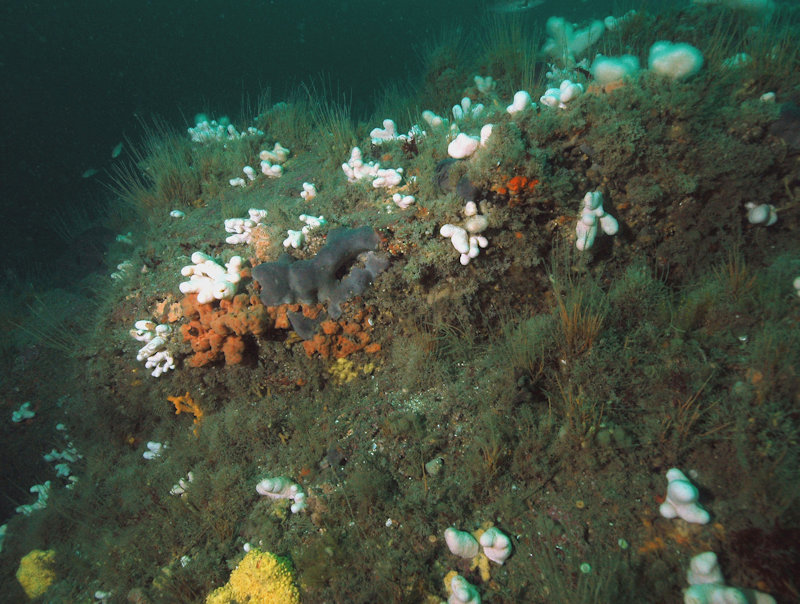
Sponges and anemones on vertical circalittoral bedrock
Summary

UK and Ireland classification

Description

This biotope is found on exposed to moderately wave exposed , vertical and overhanging, circalittoral bedrock, subject to strong through to weak tidal streams. This biotope is characterized by a mixed faunal turf of hydroids (Nemertesis antenninaTubularia indivisa and Halecium halecium) and bryozoans (Alcyonidium diaphanum and crisiid turf). There is frequently a diverse range of sponges recorded, including Cliona celataPachymatisma johnstoniaDysidea fragilis andHemimycale columella. There may be dense aggregation of dead mans fingers Alcyonium digitatum along with clumps of the cup coral Caryophyllia smithii, and the anthozoans Corynactis viridisActinothoe sphyrodetaCylista elegans andMetridium senile. Other species present include the echinoderms Echinus esculentusAsterias rubensMarthasterias glacialisHenricia oculataHolothuria forskali and Antedon bifida, clumps of the lightbulb tunicate Clavelina lepadiformisand the top shell Calliostoma zizyphinum. Three regional variations of this biotope have been recorded. The first variant is characterized by a Bugula turf along with the pink sea fan Eunicella verrucosa, and has been recorded from around southwest England and Wales. The second variant, characterized by a dense 'carpet' of Corynactis viridis and Metridium senile has been recorded predominantly from the west coast of Ireland. The final variant is characterized by a very diverse, dense faunal turf of hydroids, bryozoans and ascidians and has been recorded from the coasts around Northern Ireland. (Information from Connor et al., 2004).

Depth range

10-20 m, 20-30 m, 30-50 m

Additional information

-

Listed By

- none -

Sensitivity reviewHow is sensitivity assessed?

Sensitivity characteristics of the habitat and relevant characteristic species

The biotope occurs on vertical faces and overhangs, is wave exposed to moderately wave exposed and subject to strong to weak water flow.  The biotope is characterized by a diverse community of sponges (including Cliona celata, Pachymatisma Johnstonia and Dysidea fragilis) and an anthozoan component (including Corynactis viridis, Metridium senile and Cylista elegans).  There is also a mixed faunal turf present in CR.HCR.XFa.SpAnVt, made up of a variety of bryozoans and hydroids along with Alcyonium digitatum, Caryophyllia smithii.

For this sensitivity assessment, the sponge community and anthozoan component are the primary focus of research as the important characterizing species defining CR.HCR.XFa.SpAnVt, with common species including Alcyonium digitatum, Caryophyllia smithii and the species making up the faunal crust (a variety of hydroids and bryozoans) considered where appropriate. Other species present in these biotopes are considered transient, mobile or ubiquitous and are, therefore, not considered significant to the assessment of the sensitivity of these biotopes.  However, information on the sensitivity of other characterizing species is included where appropriate. 

Resilience and recovery rates of habitat

Little information on sponge longevity and resilience exists. Reproduction can be asexual (e.g. budding) or sexual (Naylor, 2011), and individual sponges are usually hermaphrodites (Hayward & Ryland, 1994). Short-lived ciliated planula larvae are released via the aquiferous system of the sponges, and metamorphosis follows settlement. Growth and reproduction are generally seasonal (Hayward & Ryland, 1994). Rejuvenation from fragments is also considered an important form of reproduction (Fish & Fish, 1996). Some sponges are known to be highly resilient to physical damage, with an ability to survive severe damage, regenerate and reorganize to function fully againhowever, this recoverability varies between species (Wulff, 2006). Marine sponges often harbour dense and diverse microbial communities, which can include bacteria, archaea and single-celled eukaryotes (fungi and microalgae), and can comprise up to 40% of sponge volume, which may have a profound impact on host biology (Webster & Taylor, 2012). In addition, sponges, such as the massive demosponge Spongosorites coralliophaga, often host a species-rich community of epibionts composed mainly of cnidarians, ophiuroids, other sponges and bryozoans (Kazanidis et al., 2018). Many sponges recruit annually, and growth can be rapid, with a lifespan of one to several years (Ackers, 1983). However, sponge longevity and growth have been described as highly variable depending on the species and environmental conditions (Lancaster et al., 2014). It is likely that erect sponges are generally longer lived and slower growing, given their more complex nature than smaller encrusting or cushion sponges.

Fowler & Lafoley (1993) monitored the marine nature reserves in Lundy and the Isles of Scilly and found that a number of more common sponges showed great variation in size and cover during the study period. However, Fowler & Lafoley (1993) studied the deeper water sponges in Lundy and found that the growth rates for branching sponges were irregular, but generally very slow, with apparent shrinkage in some years (notably between 1985 and 1986). Large colonies appeared and vanished at some locations. Some large encrusting sponges went through periods of both growth and shrinkage, with considerable changes taking place from year to year. For example, Cliona celata colonies generally grew extremely rapidly, doubling their size or more each year. In some years, an apparent shrinkage in size also took place. In contrast, there were no obvious changes in the cover of certain unidentified thin encrusting sponges. Axinellid sponges have been described as very slow growing, and little to no recovery has been observed over long periods of monitoring (Fowler & Laffoley, 1993; Hiscock, 1994, 2003). Monitoring studies at Lundy (Hiscock, 1994; Hiscock, 2003; Hiscock, pers comm) suggested that the growth of Axinellid sponges was no more than about 2 mm a year (up to a height of ca 300 mm) and that all branching sponges included in photographic monitoring over a period of four years exhibited very little or no growth over the study. In addition, no recruitment of Axinellia dissimilis or Axinellia infundibuliformis was observed, although ‘several more’ Axinella damicornis were noted between 2010 compared to 1985 during monitoring in Lundy (Hiscock, 2011). 

Axinellid sponges are oviparous and gonochoric. Idan et al. (2020) was the first description of the reproduction cycle in Axinellid sponges, more specifically, shallow-water (28-32 m) and mesophotic (95-120 m) populations of Axinella polypoides off the Israeli coast. The mesophotic populations reproduced sexually year-round and showed no seasonality. In contrast, the shallow-water population reproduced sexually in a seasonal pattern, linked closely with seasonal temperature changes. The results suggested that the mesophotic population invested more in sexual reproduction than the shallow water population. Nutrient availability did not account for this difference in the different habitats. Instead, Idan et al. (2020) concluded that the stability of the mesophotic environment could provide and allow a surplus of energy to be spent on continual sexual reproduction. Asexual reproduction by fragmentation is widely observed in Porifera. Fragments of Axinella polypoides did not seem to re-attach to substrata and, therefore, it does not appear well suited to asexual reproduction (Idan et al., 2020).

Dysidea fragilis readily colonizes deep water wrecks (Ackers et al., 1992). Pachymatisma johnstonia can be massive-lobose, hemispherical to irregularly rounded and up to 30 cm or more across (Picton & Morrow, 2015). Cliona celata occurs on rock and begins boring but can become massive and lobose with rounded ridges up to 40 cm across (Ackers et al., 1992) and may be able to withstand the harsher environments of intertidal reefs that experience exposure twice a day (Stubler et al., 2017). Reproduction of Cliona celata occurs between April and November, with peak reproduction occurring from August to September, which suggests that temperature may be the most reliable predictor of timing for recruitment events in this species (Stubler et al., 2017). Cliona celata are also regarded as a long-lived species, with an individual sponge at Lough Hyne, Ireland, being recorded for nearly 50 years (Wood et al., 2025). Van Dolah et al. (1987) reported that, following an experimental trawl, 32% of sponges suffered damage, with Cliona spp. the most affected. However, the abundance of sponges had increased to pre-trawl densities or greater 12 months after trawling. 

Freese (2001) studied deep cold-water sponges in Alaska. Following an experimental trawl, 46.8% of sponges exhibited damage, with 32.1% having been torn loose. None of the damaged sponges displayed signs of regrowth or recovery a year after the trawl event. This was in stark contrast to early work by Freese (1999) on warm shallow sponge communities, with impacts of trawling activity being much more persistent due to the slower growth or regeneration rates of deep, cold-water sponges. Given the slow growth rates and long lifespans of the rich, diverse fauna, it is likely to take many years for deep sponge communities to recover if adversely affected by physical damage (Kaiser et al. 2018; Graves et al., 2023). Due to sponge sensitivity to human activity, as well as their functional significance and structural complexity, it has resulted in their classification as vulnerable marine ecosystems (VMEs) by the United Nations General Assembly and a threatened and/or declining habitat by OSPAR (Graves et al., 2023).

The recolonization of epifauna on vertical rock walls was investigated by Sebens (1985, 1986). He reported that rapid colonizers such as encrusting corallines, encrusting bryozoans, amphipods and tubeworms recolonized within 1 to 4 months. Ascidians such as Dendrodoa carnea, Molgula manhattensis and Aplidium spp. achieved significant cover in less than a year, and, together with Halichondria panicea, reached pre-clearance levels of cover after two years. A few individuals of Alcyonium digitatum and Metridium senile colonized within four years (Sebens, 1986) and would probably take longer to reach pre-clearance levels.

There are three ways in which Metridium senile can spread, larvae resulting from sexual reproduction, clonal group building resulting from asexual reproduction through pedal laceration (small pieces of the pedal disc are left behind and grow into clonal individuals), and passive movement during the adult stage (Häussermann et al., 2022). In terms of sexual reproduction, Metridium senile reproduces each year, and the planulae spend months in the plankton and are likely to disperse over in excess of 10 km from parent anemones (Sebens,1985). Northern hemisphere populations undergo oviparous broadcast spawning (external fertilization) in late summer to early fall, and its free-swimming planula larvae are believed to stay in this stage for several months, which may aid in the dispersal of the species outside its native range (Häussermann et al., 2022). Its usual method of reproduction, however, is asexual reproduction via pedal laceration, which occurs at all times of the year and leads to dense clonal groups (Häussermann et al., 2022). In addition, in the adult stage, Metridium senile have been reported to spread via rafting (e.g., natural marine debris, anthropogenic litter, or detached algae) and via passive drifting of adults after disturbance, e.g., through the ballooning of the pedal disc (Teng et al., 2021; Häussermann et al., 2022). The life cycle of Metridium senile is expected to have a duration of 10 to 20 years (Molinet et al., 2023).

The growth of Metridium senile is rapid. Bucklin (1985) working in Britain found that Metridium senile f. dianthus fragments and newly settled Metridium senile f. pallidum grew up to 0.6 mm and 0.8 mm in pedal diameter per day, respectively. In Stanley Harbour, the Falkland Islands, the density of Metridium senile rarely exceeded one individual per square meter, however, off Bird Island in the same region, dense groups were observed, >30 individuals/m2 (Glon et al., 2020). New jetty piles at Lundy were colonized by their third year (L. Cole, pers. comm.). Settled planulae or individuals produced by pedal laceration are likely to grow rapidly, particularly with favourable environmental conditions (Glon et al., 2019; Teng et al., 2021). Bucklin (1987a) found that, for Metridium senile from California, individuals showed rapid growth to large sizes when fed at frequent intervals. Mean size grew steadily during the first eight months, then levelled off. An increase from 5 cm² pedal disk area to 45 cm² occurred within 12 months. In addition, regeneration through fragmentation took approximately three weeks until new tentacles were visible and mobility was seen, and occurred both in intertidal to deep-water habitats, as well as on man-made harbour floats (Bucklin, 1987a).

Molinet et al. (2023) studied the population expansion of Metridium senile in north-western Patagonia and found that it increased in coverage up to 39%, presence by area up to 75%, and patch diameter up to 343 m in approximately six years (up to 2021) from when it was first recorded in a site in 2016. Molinet et al. (2023) suggested this is an aggressive expansion of Metridium senile in the study area, and its increase coincides with the decrease in local edible sea urchin populations, Loxechinus albus. This timeframe was also observed by Sebens (1985) during clearing experiments in which Metridium senile took 5 to 10 years to return to pre-clearance cover. In another study, Wahl (1985) found that Metridium senile returned to rock walls only one week after anoxic conditions returned following annual de-oxygenation events in the Inner Flensburg Fjord. Shick & Hoffman (1980, cited in Sebens, 1985) reported that pedal laceration in Metridium was greater at a site with a higher water flow rate compared to slower-flowing areas. This is presumably because successful recruitment by the planktonic larvae may be difficult in such wave-surged environments. As a result, many of the species capable of asexual reproduction within this biotope may rely more on this method of reproduction in colonizing newly created space.

No specific resilience information for the other characterizing anemones was found. Anemones are not sessile but are capable of slow movement. For example, Sebens (1981) observed immigration to cleared patches of the long-lived anemone Anthopleura xanthogrammica as being the primary driver towards recovery. Sebens (1981) cleared intertidal patches of Anthopleura xanthogrammica at Mukkaw Bay, WA, USA, observing the effects over four years. Even after four years, cleared areas were not back to pre-removal population densities.    

Jensen et al. (1994) reported the colonization of an artificial reef in Poole Bay, England. They noted that erect bryozoans began to appear within six months, reaching a peak in the following summer, 12 months after the reef was constructed. Sponges were slow to establish, with only a few species present within 6 to 12 months, but beginning to increase in number after two years, while anemones were very slow to colonize, with only isolated specimens present after two years (Jensen et al., 1994). In addition, Hatcher (1998) reported a diverse mobile epifauna after a year’s deployment of her settlement panels. Whomersley & Picken (2003) documented epifaunal colonization of offshore oil platforms in the North Sea from 1989 to 2000. For the first three years, hydroids and tubeworms dominated the community below the mussel band. However, the hydroid community were later outcompeted by other more climax communities. Recruitment of Alcyonium digitatum and Metridium senile began at 2 to 5 years (dependent on the oil rig). The community structure and zonation differed between the four rigs, however, generally after four years, Metridium senile had become the dominant organism below the mussel zone to approximately 60-80 m Below Sea Level (BSL). Zonation differed between oil rigs, however, Alcyonium digitatum was the dominant organism. from approximately 60-90 m BSL,

The HMS Scylla was intentionally sunk on the 27th of March 2004 in Whitsand Bay, Cornwall, to act as an artificial reef. Hiscock et al. (2010) recorded the succession of the biological community on the wreck for five years following the sinking of the ship. The wreck was initially colonized by opportunistic species/taxa, filamentous algae, hydroids, serpulid worms and barnacles. Tubularia sp. were early colonizers, appearing within a couple of months after the vessel was sunk. Metridium senile appeared late in the summer of the first year but didn’t become visually dominant until 2007 (three years after the vessel was sunk). Cylista elegans was recorded in the summer of 2005, and by the end of 2006 was well established. Corynactis viridis was first recorded in the summer of the first year and quickly formed colonies via asexual reproduction. Caryophyllia smithii was first observed colonizing the wreck of the ex-HMS Scylla in September 2005, eighteen months after the vessel was placed on the seabed near Plymouth. The coral was still only occasional on the reef after five years (Hiscock et al., 2010). Alcyonium digitatum was first recorded in early summer 2005, a year after the vessel was sunk. Within one year of growth colonies had grown to nearly full size, however, they did not become a visually dominant component of the community until 2009 (five years after the vessel had been sunk). The authors noted that erect branching Bryozoa (such as Securiflustra securifrons) are not a common part of rocky reef communities to the west of Plymouth and at the time of writing had not colonized to any great extent on ‘Scylla’ by the end of the study, although several species of erect bryozoans were recorded, which included Chartella papyracea in August 2006 (two years after the vessel was sunk).

Alcyonidium diaphanum forms an erect colony that can grow up to 50 cm long, but more usually 15 cm. It has a small encrusting base that attaches to a hard substratum. The size, colour, and colony form vary widely around the British Isles (Ager, 2007).

Caryophyllia smithii is a small (max 3 cm across) solitary coral, common within tide-swept sites of the UK (Wood, 2005), but was common on the cliffs within Lough Hyne that experience little water movement (Hiscock, pers comm.). It is distributed from Greece (Koukouras, 2010) to the Shetland Islands and southern Norway (Wilson, 1975; NBN, 2015). In Sweden, Caryophyllia smithii are reported to dominate shallower depths, with the national depth distribution of the species between 25 and 50 m (Nilsson et al., 2025). It was suggested by Fowler & Laffoley (1993) that Caryophyllia smithii was a slow-growing species (0.5 to 1 mm in horizontal dimension of the corallum per year), which in turn suggested that inter-specific spatial competition with colonial faunal or algae species were important factors in determining the local abundance of Caryophyllia smithii (Bell & Turner, 2000). Analysis by Rodolfo‐Metalpa et al. (2015) reported that the growth rate of Caryophyllia smithii was 0.070 to 0.073%/day. Caryophyllia smithii adults develop their gametes between January and March, with spawning occurring from March to June (Tranter et al., 1982). The pelagic stage of the larvae may last up to 10 weeks, which provides this species with a good dispersal capability (Tranter et al., 1982). Asexual reproduction and division are also commonly observed (Hiscock & Howlett, 1976). Bell (2002) reported that juvenile Caryophyllia smithii have variable morphology, which gives them an advantage in colonizing a wide range of habitats. Aggregations of cup coral can form cup coral meadows, which are classed as a vulnerable marine ecosystem and, although there is no commonly agreed density threshold, in the northeast Atlantic, it is proposed as 0.1 to 0.9 /m² for Caryophyllia cup corals on mixed substrata at depths of 1069 to 769 m (Long et al., 2021).

Alcyonium digitatum colonies are likely to have a lifespan that exceeds 20 years, as colonies have been followed for 28 years in marked plots (Lundälv, pers. comm., in Hartnoll, 1998; Gavazzi, Kapasakali & Degraer, 2024). Colonies that were 10 to15 cm in height were aged between 5 and 10 years old (Hartnoll, unpublished). Sexual maturity is predicted, at its earliest, when the colony reaches its second year of growth. However, the majority of colonies are not predicted to reach maturity until their third year (Hartnoll, 1975). Alcyonium digitatum spawns from December to January. Gametes are released into the water, where fertilization occurs. The embryos are neutrally buoyant and float freely for seven days when they give rise to actively swimming lecithotrophic planulae, which may have an extended pelagic life before they eventually settle (usually within 1 or 2 further days) and metamorphose to polyps (Matthews, 1917; Hartnoll, 1975; Budd, 2008). Larvae have been reported to survive for up to 35 weeks as non-feeding planulae and may favour the dispersal and eventual discovery of a site suitable for settlement (Hartnoll, 1975). However, reduced heterozygosity and impaired sexual reproduction have been reported in another cnidarian species subjected to trawling damage, and reduced colony numbers and size have been reported for Alcyonium digitatum in Lyme Bay, southern England, in trawled areas (Holland, Jenkins, & Stevens, 2017). Alcyonium digitatum can recruit onto bare surfaces within two years but may take up to five years to fully recover following significant mortality (Whomersley & Picken, 2003; Hiscock et al., 2010).

Deep-sea sponge recovery from physical disturbances like fishing can be slow and take multiple years to return to previous community levels (Samuelsen et al., 2022). Althaus et al. (2009), in a study of seamounts off Tasmania, reported no significant recovery when trawling was reduced to less than 5% for a decade or ceased for five years. Similarly, Morrison et al. (2020) observed the effect of trawling on deep-sea sponge grounds and recorded that four years post-disturbance, megafaunal densities of the shallow (∼600 m depth) and deep (∼1,400 m depth) sites were still significantly lower on the disturbed patches compared to the control areas. Although few studies exist on the growth and reproduction of most deep-sea sponges (e.g. Geodia grounds) to adequately predict post-disturbance trajectories, available studies indicate that deep-sea sponge grounds have comparatively low potential for recovery from physical disturbance events, and that recovery following impacts is considered more than temporary if recovery takes more than five to 20 years (Pham et al., 2019).

Deep sponges and corals are sessile benthic organisms, and recovery would be aided by the exclusion of demersal towed fishing equipment (Pikesley et al., 2016; Chimienti, Nisio, & Lanzolla, 2020; Kaiser et al., 2018). Kaiser et al. (2018) specifically studied the recovery of sessile epifauna following the exclusion of towed mobile fishing gear in Lyme Bay, UK. Their estimates suggest that no recovery occurred within the timescale of the study (10 years), and that some biogenic habitats (particularly sponges and soft corals) could require up to, or more than, 20 to 30 years before signs of recolonization and recovery may occur. The maximum recovery time modelled was 51 years for yellow branched sponges, while Eunicella verrucosa and Pentapora foliacea increased in abundance, but had not fully recovered, with their projected recovery time being 17 to 20 years (Kaiser et al., 2018). Therefore, recovery rates of biota depend on life-history factors and habitat-specific requirements, with the longer-lived species that require specific habitats and have low dispersal potential taking longer to recover (Kaiser et al., 2018). A 15-year review of the Lyme Bay trawling ban by Renn et al. (2024) highlighted definitive evidence of recovery, in terms of increased species richness. Key sessile taxa (Pentapora foliacea and Phallusia mammillata) showed signs of early recovery between 2008 and 2013. Renn et al. (2024) concluded that the evidence of recovery recorded in Lyme Bay broadly aligned with the wider literature by detecting early stages of recovery within the first few years of MPA establishment. However, full recovery was thought to occur over decadal timescales, and measuring full recovery rates in-situ remained a priority for future research in Lyme Bay.

Prolonged recovery timescales, in terms of sponge communities following disturbance events, were also estimated in other parts of the world. In Lough Hyne, a small (approx. 0.5 km2) lough on the southwest coast of Ireland, an unknown disturbance event caused a large decline of sponges, averaging a 35% reduction in coverage, with some communities experiencing reductions exceeding 95%, which prompted local habitat recovery monitoring (Micaroni et al., 2025). This decrease was documented from surveys conducted in 2010 and 2015, with healthy sponge assemblages observed in 2010 and severely depleted populations in 2015 (Micaroni et al., 2025). Since 2015, continued monitoring of Lough Hyne (6 to 11 years post-2015) has shown minimal signs of community reassembly and limited population recovery for key habitat-forming species, and it is estimated that recovery times are on the order of at least decades for communities dominated by long-lived species (Micaroni et al., 2025). This means that the recovery of benthic communities was either not happening or was occurring too slowly to be detected by the monitoring study. Micaroni et al. (2025) estimated that at the current Lough Hyne population growth rate, papillate polymastid sponges will reach their pre-impact cover at Glannafeen in 5 to 8 years, while erect sponges will take longer (18 to 30 years, at both Glannafeen and Labhra Cliff). However, the absence of recovery at the innermost sites 6 to 10 years after the disturbance event(s) suggests that lough-wide recovery could take even longer. Yet one of the monitoring sites within Lough Hyne, Glannafeen, showed greater signs of recovery. This is possibly due to the site experiencing the greatest water movement among the internal sites, and sponges may be using ambient currents to reduce the high energy costs associated with their filtration activity, thus having more energy reserves for growth, leading to a more rapid recovery of their populations (Micaroni et al., 2025). Furthermore, the dispersal ability of sponge larvae is generally low, which can slow the recolonization rates in disturbed areas, and it is possible that the very slow current speed in the most internal sites (West Cliff and Goleen) could have reduced larvae supply to these sites (Micaroni et al., 2025).

Resilience assessment. Sebens (1985, 1986) found that the sponge Halichondria panicea reached pre-clearance levels of cover after two years. However, some sponges have a very slow rate of growth, such as axinellids or yellow branched sponges, with recovery expected to take decades (Kaiser et al., 2018; Micaroni et al., 2025). A few individuals of Caryophyllia smithii, Alcyonium digitatum, and Metridium senile colonized within two years to five years (Sebens, 1986; Hiscock et al., 2010), and slower-growing sponges would probably take longer to reach pre-clearance levels (Samuelsen et al., 2022). Some of the faster-growing, smaller sponges (such as Cliona celata) would colonize new sites relatively quickly. Hydroids are typically opportunistic, able to recover within a year or a few years, especially where resting dormant stages remain after impact. This biotope is characterized by a diverse community of faunal turf species, and its recovery to a recognisable state is not dependent on one species group. Most of the characteristic species would probably recover within 2 to 10 years. The slow-growing sponges in the biotope occur at low abundance (occasional) and could probably regain that abundance within a decade.  Overall, if the community suffers significant mortality from a pressure (resistance of ‘None’, ‘Low’), resilience is assessed as ‘Medium’ (recovery within 2-10 years). If resistance is assessed as ‘Medium’ or ‘High’, then resilience will be assessed as ‘High’ (recovery within 2 years). 

Hydrological Pressures

Use [show more] / [show less] to open/close text displayed

ResistanceResilienceSensitivity
Temperature increase (local) [Show more]

Temperature increase (local)

Benchmark. A 5°C increase in temperature for one month, or 2°C for one year. Further detail

Evidence

There is little information available about the tolerance of the characterizing sponges in this biotope. However, Kazanidis et al. (2019) reported how water temperature and salinity explained a significant amount of variation in sponge density, and in the North Atlantic. The highest density values were found where temperature and salinity ranged from 6.52 to 8.98°C and 34.91 to 35.13 psu, respectively. In Lough Hyne, a small (approx. 0.5 km2) lough on the southwest coast of Ireland, sponge communities are observed in waters where temperatures range from 7 to 9°C in winter and 14 to18°C in summer (Micaroni et al., 2025).

Long-term temperature increases may cause extension of the British Isles sponge populations, and decreases in temperature may result in population shrinkage. Goodwin et al.  (2013) noted increases in the abundance of Axinella damicornis and Axinella dissimilis in Northern Ireland over a 20-year period and suggested the increase was due to sea temperature warming (relating to a 0.3 to 0.5°C increase in Northern Irish sea surface temperature between 1850 and 2007). 

Berman et al. (2013) monitored sponge communities off Skomer Island, UK, over four years, with all characterizing sponges for this biotope assessed. Seawater temperature, turbidity, photosynthetically active radiation and wind speed were all recorded during the study. They concluded that, despite changes in species composition, primarily driven by the non-characterizing Hymeraphia stellifera and Halicnemia patera, no significant difference in sponge density was recorded in all sites studied. Morphological changes most strongly correlated with a mixture of water visibility and temperature. Research by Webster et al. (2008, 2011), Webster & Taylor (2012) and Preston & Burton (2015) suggested that many sponges rely on a holobiont of many synergistic microbes. Webster et al. (2011) described a much higher thermal tolerance of sponge larval holobiont when compared with adult sponges. 

Davison et al. (2019) highlighted the relationship between Porifera aggregations and temperature in the Faroe-Shetland Channel and noted a statistically significant positive relationship between sponge density and temperature range between 400 and 600 m, with the highest sponge densities occurring at depths of greatest temperature range. Aggregations of sponges in the Faroe-Shetland Channel are frequently subjected to water <0°C due to the movement of the pycnocline, but temperature varies between approximately −1 and 9°C and is on average around 3.5°C, and consistently experience 6°C shifts in temperature, with the highest variation being over 9°C (Davison et al. 2019). This temperature range approximately lines up with the evidence found by Graves (2022), who recorded a temperature range of 3 to 8.5°C between 800 and 2,200 m deep at the Rosemary Bank (UK) when studying the sessile benthic Xenophyophore, Syringammina fragilissima. Graves (pers comm, 2022) characterized the thermal niche of Reteporella and Axinellid sponge assemblages across the UK and Ireland as 9.3 to 9.5°C based on their biotope distribution.

The sponge Dysidea fragilis has been recorded from the Arctic to the Mediterranean (Ackers et al., 1992). The sponge Cliona orientalis is similar to Cliona celata, and has been subjected to warming experiments from 23 to 32°C. At 32 °C, or 3°C above the maximum monthly mean temperature, sponges bleached, and the photosynthetic capacity of Symbiodinium was compromised, consistent with sympatric corals (Ramsby et al., 2018). Cliona orientalis demonstrated little capacity to recover from thermal stress, remaining bleached with reduced Symbiodinium density and energy reserves after one month at reduced temperature (Ramsby et al., 2018). 

The sponge Pachymatisma johnstonia is one of the most common and well-known sponges throughout the North East Atlantic coasts, recorded from the Orkneys to Spain and is ubiquitous across the western and southern coasts of Britain, and it is mainly found in the littoral and sublittoral zones (Ackers et al., 1992; Schiavo et al., 2024). The sponge Cliona celata is found throughout the Atlantic between 1 and 200 m deep and has been recorded from Sweden to the Mediterranean in Europe, across the Southeastern USA in North America, and off Argentina in South America (Ackers et al., 1992; Stubler et al., 2024; Novarin et al., 2025). Cliona celata have been recorded in waters with a temperature range of 23.19 to 35.11°C off Southeastern USA (Stubler et al., 2024), and in a similar boring sponge, Pione truitti, growth was documented to decrease as temperatures dropped below 20°C (Pomponi & Meritt, 1985 cited in Stubler et al., 2024). One way in which sponges respond to increases in temperature is with higher respiration rates, and Cliona celata has been recorded having a significant change in respiration rate as a stress response (Wood et al., 2025). However, Cliona celata have been reported to be resistant to temperatures of up to 4 to 5°C higher than ambient temperatures (Bosch-Belmar et al., 2024).

The sea anemone Cylista (syn. Sargatia) elegans is found from Scandinavia to the Mediterranean (Picton & Morrow 2015). Actinothoe sphyrodeta is distributed from the northern coast of Scotland to Spain (Ramos, 2010; NBN, 2015). Corynactis viridis’s typical habitat encompasses the northeastern Atlantic Ocean, including Scotland, Ireland, and the southern and western coasts of Great Britain, the southwestern coasts of continental Europe and the Mediterranean Sea (Palladino et al., 2021).

Metridium senile is a circumboreally distributed sea anemone native to the northern hemisphere and has been presumed to be introduced to several locations in the southern hemisphere (Glon et al., 2020). In Europe, it has been reported in the North Atlantic, particularly around the coasts of the UK, but it has also been observed in smaller numbers in the Adriatic Sea (Manual, 1988; OBIS, 2025). Metridium senile are primarily found in temperatures from −1 to 20°C, and temperature is considered a limiting factor that restricts the dispersal of the species (Glon et al., 2019; Glon et al., 2020). Glon et al. (2019) observed the temperature and salinity limits of Metridium senile and found that it displays an impressive tolerance to salinity and temperature ranges, withstanding temperatures up to 24°C and salinities ranging from 14.8 to 37.5‰, with mortality less than 50%. Glon et al. (2019) also noted that survival was highest for Metridium senile in the control (17°C) and 20°C treatments, compared to the lethal temperature, 24°C, which caused 50% mortality over 40 days. In addition, pedal laceration only occurred in treatments well within the 50% mortality limits for both salinity and temperature (Glon et al., 2019). Glon et al. (2019) concluded that the patterns of asexual reproduction present within Metridium senile individuals appear to be heavily dependent on whether the surrounding environmental conditions are favourable, and the potential success of the offspring will be high. Teng et al. (2025) studied the effect of heat stress on Metridium senile collected from the Yellow Sea, China, and found that individuals revealed diminished adhesion capacity under thermal stress (13°C and 18°C), and adhesion capacity significantly decreased at 18°C. Voet, Van Colen & Vanaverbeke (2022) conducted an experiment to see the effect of warming on artificial hard substratum communities. Despite the other species experiencing increases in mortality, respiration rate, and clearance rate in warmed treatments (+3°C), Metridium senile exhibited a lower clearance rate. However, Metridium senile individuals in the ocean warming treatment effectively shrank in size, most likely caused by the anemone's inability to balance energy input and metabolic requirements (Voet, Van Colen & Vanaverbeke, 2022). Furthermore, Metridium senile most often showed an antagonistic response to temperature and pH manipulations, being inhibited by an elevated temperature and benefiting from a lower pH environment (Voet, Van Colen & Vanaverbeke, 2022). Though Metridium senile can tolerate temperatures up to 27°C, they are more abundant in cooler temperatures and are not limited in range by a lower limit of temperature, thriving at temperatures below 0°C (Shick, 1991 and Hutchins et al., 2003 cited in Glon et al., 2019).

Caryophyllia smithii is found across the British Isles (NBN, 2015; Coolen et al., 2015) and has been recorded in Greece (Koukouras, 2010). In the Mediterranean, Caryophyllia smithii has been recorded in seawater between 13 and 14°C (Rodolfo‐Metalpa et al., 2015). It is therefore unlikely to be significantly affected by an increase at the benchmark level. However, Tranter et al. (1982) suggested Caryophyllia smithii reproduction was cued by seasonal increases in seawater temperature. Therefore, unseasonal increases in temperature may disrupt natural reproductive processes and negatively influence recruitment patterns. Holt (pers. comm.) also suggested that long-term increases in temperature due to climate change may allow the parasitic barnacle Adna anglica to extend its range northwards and overlap the range of this biotope. Adna anglica is a southern species, limited to the southwest of Britain, where it parasitizes Caryophillia and has probably contributed to the decrease in abundance of Leptopsammia (Holt pers. comm.). It may impact the abundance of Caryophyllia if climate change allows it to extend its range northwards (Holt pers. comm.).

Temperature at the seafloor is an important predictor of Alcyonium digitatum, yet there are no published studies that explore the thermal minima or maxima for the species, so the only current evidence that gives insight into the thermal niches of this species is the sea temperatures at the locations where they are observed (Jenkins & Stevens, 2022). Currently, Alcyonium digitatum is commonly found in inshore and offshore areas of northwest and northern France, the Channel Islands, most of the British Isles, including the Shetland Islands and parts of the southern North Sea, parts of southern Norway, and along the Atlantic slope (Jenkins & Stevens, 2022). Alcyonium digitatum can be found alongside Eunicella verrucosa, and in Britain and Ireland, Eunicella verrucosa has been observed in waters where 9.2°C was the lowest average seafloor temperature, the median temperature was 10.5°C, and the highest temperature was 11.4°C (Jenkins & Stevens, 2022). While trying to understand the impact of climate change on Alcyonium digitatum distribution, Jenkins & Stevens (2022) noted there will likely be a shift north as more suitable habitat becomes available in higher latitudes. However, suitability predictions in the southern portion of their study area decreased. Other species present in the biotope are widespread across the British Isles or are not important to the classification of this biotope.

Cebrian et al. (2011) conducted four-year surveys of two shallow-water sponge species, Ircinia fasciculata and Sarcotragus spinosulum, in the western Mediterranean Sea. Two severe sponge die-offs (total mortality ranging from 80 to 95% of specimens) occurred in the summers of 2008 and 2009. These events primarily affected Ircinia fasciculata, and a significant positive correlation was observed between elevated temperature and injured specimens. It was suggested, following in vitro studies of the associated cyanobacteria in increasing temperatures up to those experienced in the ‘extreme summer’ of 27°C, that heat-related disappearance of the cyanobacteria in Ircinia fasciculata (a bacteriosponge) was important when considering sponge mortality. 

Bell et al. (2018) investigated the potential response of sponges to climate change. Although numerous mass sponge mortalities have been reported in association with abnormally high seawater temperatures, it was unclear if these resulted from exceeding the host's thermal threshold, or because of the disruption of functionally important symbiotic partnerships, or infection by opportunistic pathogens. In contrast, Bell et al. (2018) highlighted that other studies had shown sponges to be more tolerant to increased temperature than other benthic organisms. For example, sponge assemblages in Brazil were highly stable before and after the El Niño Southern Oscillation (a 2°C increase in temperature during the El Niño event), despite massive declines in corals and other benthic organisms. However, ocean warming could induce bleaching, such as in the bioeroding sponge Cliona orientalis (an increase of 2.7°C above the local maximum monthly mean), or reduce flow rates and feeding efficiency, such as in the sponge Rhopaloeides odorabile (exposed to a 2°C higher than the average local ambient seawater temperature). Therefore, temperature tolerance appears to vary among sponge species.

Sensitivity assessment. The characterizing species are widely distributed across the British Isles. Morphological changes were observed in UK sponge communities, with temperature a factor, but the characterizing sponges assessed were not listed as the most highly contributing to these changes (Berman et al., 2013). Resistance has been assessed as ‘High’, resilience as ‘High’ and sensitivity as ‘Not Sensitive’ at the benchmark level.

High
Medium
Medium
Medium
Help
High
High
High
High
Help
Not sensitive
Medium
Medium
Medium
Help
Temperature decrease (local) [Show more]

Temperature decrease (local)

Benchmark. A 5°C decrease in temperature for one month, or 2°C for one year. Further detail

Evidence

There is little information available about the tolerance of the characterizing sponges in this biotope. However, Kazanidis et al. (2019) reported how water temperature and salinity explained a significant amount of variation in sponge density, and in the North Atlantic. The highest density values were found where temperature and salinity ranged from 6.52 to 8.98°C and 34.91 to 35.13 psu, respectively. In Lough Hyne, a small (approx. 0.5 km2) lough on the southwest coast of Ireland, sponge communities are observed in waters where temperatures range from 7 to 9°C in winter and 14 to 18°C in summer (Micaroni et al., 2025).

Long-term temperature increases may cause extension of the British Isles sponge populations, and decreases in temperature may result in population shrinkage. Goodwin et al. (2013) noted increases in the abundance of Axinella damicornis and Axinella dissimilis in Northern Ireland over a 20-year period and suggested the increase was due to sea temperature warming (relating to a 0.3 to 0.5°C increase in Northern Irish sea surface temperature between 1850 and 2007). 

Berman et al. (2013) monitored sponge communities off Skomer Island, UK, over four years, with all characterizing sponges for this biotope assessed. Seawater temperature, turbidity, photosynthetically active radiation and wind speed were all recorded during the study. They concluded that, despite changes in species composition, primarily driven by the non-characterizing Hymeraphia stellifera and Halicnemia patera, no significant difference in sponge density was recorded in all sites studied. Morphological changes most strongly correlated with a mixture of water visibility and temperature. Research by Webster et al. (2008, 2011), Webster & Taylor (2012) and Preston & Burton (2015) suggested that many sponges rely on a holobiont of many synergistic microbes. Webster et al. (2011) described a much higher thermal tolerance of sponge larval holobiont when compared with adult sponges. 

Some sponges do exhibit morphological strategies to cope with winter temperatures, e.g. Halichondria bowerbanki goes into a dormant state below 4°C, characterized by major disintegration and loss of choanocyte chambers, with many sponges surviving mild winters in more protected areas from where it can recolonize (Vethaak et al., 1982). Crisp (1964a) studied the effects of an unusually cold winter (1962-3) on the marine life in Britain, including Porifera in North Wales. Whilst difficulty distinguishing between mortality and delayed development was noted, Crisp (1964a) found that Pachymastia johnstonia and Halichondria panicea were wholly or partly killed by frost, and several species appeared to be missing, including Amphilectus fucorum. Others, including Hymeniacidon perleve, were unusually rare, and a few species, including Polymastia boletiformis, were not seriously affected, and Metridium senile was unaffected by the cold winter of 1962-63. No mention was made of the characterizing sponges assessed in this review. It should be noted that Crisp’s general comments on all marine life state that damage decreased the deeper the habitat. In addition, the extremely cold temperatures recorded in 1962/63 (sea temperatures between 4 and 6°C colder than the five-year mean over a period of 2 months) are more extreme than the benchmark level for assessment. 

Davison et al. (2019) highlighted the relationship between Porifera aggregations and temperature in the Faroe-Shetland Channel and noted a statistically significant positive relationship between sponge density and temperature range between 400 and 600 m, with the highest sponge densities occurring at depths of greatest temperature range. Aggregations of sponges in the Faroe-Shetland Channel are frequently subjected to water <0°C due to the movement of the pycnocline, but temperature varies between approximately −1 and 9°C and is on average around 3.5°C, and consistently experience 6°C shifts in temperature, with the highest variation being over 9°C (Davison et al. 2019). This temperature range approximately lines up with the evidence found by Graves (2022), who recorded a temperature range of 3 to 8.5°C between 800 and 2,200 m deep at the Rosemary Bank (UK) when studying the sessile benthic Xenophyophore, Syringammina fragilissima. Graves (pers comm, 2022) characterized the thermal niche of Reteporella and Axinellid sponge assemblages across the UK and Ireland as 9.3 to 9.5°C based on their biotope distribution.

The sponge Dysidea fragilis has been recorded from the Arctic to the Mediterranean (Ackers et al., 1992). The sponge Pachymatisma johnstonia is one of the most common and well-known sponges throughout the North East Atlantic coasts, recorded from the Orkneys to Spain and is ubiquitous across the western and southern coasts of Britain, and it is mainly found in the littoral and sublittoral zones (Ackers et al., 1992; Schiavo et al., 2024). The sponge Cliona celata is found throughout the Atlantic between 1 and 200 m deep and has been recorded from Sweden to the Mediterranean in Europe, across the Southeastern USA in North America, and off Argentina in South America (Ackers et al., 1992; Stubler et al., 2024; Novarin et al., 2025). Cliona celata have been recorded in waters with a temperature range of 23.19 to 35.11°C off Southeastern USA (Stubler et al., 2024), and in a similar boring sponge, Pione truitti, growth was documented to decrease as temperatures dropped below 20°C (Pomponi & Meritt, 1985 cited in Stubler et al., 2024).

The sea anemone Cylista (syn. Sargatia) elegans is found from Scandinavia to the Mediterranean (Picton & Morrow, 2015), while Actinothoe sphyrodeta is distributed from the northern coast of Scotland to Spain (Ramos, 2010; NBN, 2015) and could, therefore, be affected by a reduction in temperature. Corynactis viridis’s typical habitat encompasses the northeastern Atlantic Ocean, including Scotland, Ireland, and the southern and western coasts of Great Britain, the southwestern coasts of continental Europe and the Mediterranean Sea (Palladino et al., 2021). The characterizing bryozoans Alcyonidium diaphanum has been recorded across the British Isles, from the Channel Isles to the northern coast of Scotland (NBN, 2015).

Metridium senile is a circumboreally distributed sea anemone native to the northern hemisphere and has been presumed to be introduced to several locations in the southern hemisphere (Glon et al., 2020). In Europe, it has been reported in the North Atlantic, particularly around the coasts of the UK, but it has also been observed in smaller numbers in the Adriatic Sea (Manual, 1988; OBIS, 2025). Metridium senile are primarily found in temperatures from −1 to 20°C, and temperature is considered a limiting factor that restricts the dispersal of the species (Glon et al., 2019; Glon et al., 2020). Glon et al. (2019) observed the temperature and salinity limits of Metridium senile and found that it displays an impressive tolerance to salinity and temperature ranges, withstanding temperatures up to 24°C and salinities ranging from 14.8 to 37.5‰, with mortality less than 50%. Glon et al. (2019) also noted that survival was highest for Metridium senile in the control (17°C) and 20°C treatments, compared to the lethal temperature, 24°C, which caused 50% mortality over 40 days. In addition, pedal laceration only occurred in treatments well within the 50% mortality limits for both salinity and temperature (Glon et al., 2019). Glon et al. (2019) concluded that the patterns of asexual reproduction present within Metridium senile individuals appear to be heavily dependent on whether the surrounding environmental conditions are favourable, and the potential success of the offspring will be high. Though Metridium senile can tolerate temperatures up to 27°C, they are more abundant in cooler temperatures and are not limited in range by a lower limit of temperature, thriving at temperatures below 0°C (Shick, 1991 and Hutchins et al., 2003 cited in Glon et al., 2019).

Caryophyllia smithii is a southern species (Fish & Fish, 1992) with a northern range limit in the Shetland Isles (NBN, 2015). It is therefore likely to be close to its northerly range limit and therefore likely to be negatively affected by a decrease in temperature at the benchmark level. 

Temperature at the seafloor is an important predictor of Alcyonium digitatum, yet there are no published studies that explore the thermal minima or maxima for the species, so the only current evidence that gives insight into the thermal niches of this species is the sea temperatures at the locations where they are observed (Jenkins & Stevens, 2022). Currently, Alcyonium digitatum is commonly found in inshore and offshore areas of northwest and northern France, the Channel Islands, most of the British Isles, including the Shetland Islands, parts of the southern North Sea, parts of southern Norway, and along the Atlantic slope (Jenkins & Stevens, 2022). Alcyonium digitatum can be found alongside Eunicella verrucosa, and in Britain and Ireland, Eunicella verrucosa has been observed in waters where 9.2°C was the lowest average seafloor temperature, the median temperature was 10.5°C, and the highest temperature was 11.4°C (Jenkins & Stevens, 2022).

Sensitivity assessment. There is evidence of sponge mortality at extremely low temperatures in the British Isles (give specific ref). Given this evidence, it is likely that rapid cooling of 5°C would affect some of the characterizing species, and resistance is assessed as ‘Medium’. A resilience of ‘High’ is recorded, and sensitivity is assessed as ‘Low’.

Medium
Medium
Medium
Medium
Help
High
Low
NR
NR
Help
Low
Low
Low
Low
Help
Salinity increase (local) [Show more]

Salinity increase (local)

Benchmark. A increase in one MNCR salinity category above the usual range of the biotope or habitat. Further detail

Evidence

The biotope occurs in full salinity, circalittoral environments, and an increase at the benchmark level (40 ppt or greater) is unlikely. Kazanidis et al. (2019) reported how water temperature and salinity explained a significant amount of variation in sponge density, and in the North Atlantic, the highest density values were found where temperature and salinity ranged from 6.52 to 8.98°C and 34.91 to 35.13 psu, respectively. 

Cliona celata is tolerant of higher salinities and is found in more polyhaline (e.g. >20 psu) parts of waterbodies, such as the Chesapeake Bay, USA, where it was differentially distributed along the Bay’s salinity gradient, peaking in the mid-salinity sites (Anchondo et al., 2024). However, when Choptank in Chesapeake Bay experienced a high-salinity event, pre-2017, clionid populations apparently thrived, but then subsequently decreased over the next two years until 2019 due to a freshet (the flood of a river from heavy rain or melted snow) (Anchondo et al., 2024). Marin (1997) describes the presence of Dysidea fragilis in a hypersaline coastal lagoon (at 42 to47 g/l; 42 to 47 ppt) in La Mar Menor, Spain. 

Glon et al. (2019) observed the temperature and salinity limits of Metridium senile and found that it displays an impressive tolerance to salinity and temperature ranges, withstanding temperatures up to 24°C and salinities ranging from 14.8 to 37.5‰, with mortality less than 50%. Salinity treatment had a significant effect on mortality. Survival was highest for Metridium senile in the control salinity (30‰) treatment, decreasing slightly in the flanking treatments of 15 and 37‰, and heavily decreasing at the most extreme treatments of 5 and 40‰ (Glon et al., 2019). Though there was complete mortality of Metridium senile at 5‰, they were able to withstand this salinity for at least 5 days, and low salinities also appeared to trigger increased mucous secretion (Glon et al., 2019). In addition, pedal laceration only occurred in treatments well within the 50% mortality limits for both salinity and temperature (Glon et al., 2019). Although Metridium senile are rare in estuarine habitats in North America, they have been noted in the UK in rivers where the salinity ranges from 13 to 20‰ (Rawlinson, 1934 cited in Glon et al., 2019).

Sensitivity assessment. Hypersaline conditions are unlikely to occur where this biotope is found. Roberts et al. (2010b) reported that hypersaline effluents were likely to sink to the seabed but were rapidly dispersed with 10s of metres from the discharge point. The high-energy (wave action and water flow) environment characteristic of this biotope is likely to mix and dilute the effluent rapidly. Nevertheless, the evidence suggests that Dysidea fragilis and Metridium senile could tolerate exposure to hypersaline conditions (>40). However, no evidence was found for other members of the community. Therefore, ‘Insufficient evidence’ is recorded for the biotope as a whole. 

Insufficient evidence (IEv)
NR
NR
NR
Help
Not relevant (NR)
NR
NR
NR
Help
Insufficient evidence (IEv)
NR
NR
NR
Help
Salinity decrease (local) [Show more]

Salinity decrease (local)

Benchmark. A decrease in one MNCR salinity category above the usual range of the biotope or habitat. Further detail

Evidence

The biotope occurs in full salinity, circalittoral environments, and a decrease at the benchmark level is unlikely. Kazanidis et al. (2019) reported how water temperature and salinity explained a significant amount of variation in sponge density, and in the North Atlantic, the highest density values were found where temperature and salinity ranged from 6.52 to 8.98°C and 34.91 to 35.13 psu, respectively. 

Castric & Chassé (1991) conducted a factorial analysis of the subtidal rocky ecology near Brest, France and rated the distribution of species from estuarine to offshore conditions. Dysidea fragilis and Raspailia ramosa were rated as indifferent to this range. Cliona celata and Pachymatisma johnstonia had a slight preference for more estuarine conditions. Mean salinity difference between the two farthest zones was low (35.1 and 33.8‰, respectively), but with a greater range being experienced in the Inner Rade (±2.4‰ compared with ±0.1‰). It should be noted that the range of salinities identified in this study does not reach the lower benchmark level, and at least some of the characterizing sponges are likely to be affected at the benchmark level. 

Cliona celata is tolerant of higher salinities and is found in more polyhaline (e.g. >20 psu) parts of waterbodies, such as the Chesapeake Bay, USA, where it was differentially distributed along the Bay’s salinity gradient, peaking in the mid-salinity sites (Anchondo et al., 2024). However, when Choptank in Chesapeake Bay experienced a high-salinity event, pre-2017, clionid populations apparently thrived, but then subsequently decreased over the next two years until 2019 due to a freshet (the flood of a river from heavy rain or melted snow) (Anchondo et al., 2024).

Glon et al. (2019) observed the temperature and salinity limits of Metridium senile and found that it displays an impressive tolerance to salinity and temperature ranges, withstanding temperatures up to 24°C and salinities ranging from 14.8 to 37.5‰, with mortality less than 50%. Salinity treatment had a significant effect on mortality. Survival was highest for Metridium senile in the control salinity (30‰) treatment, decreasing slightly in the flanking treatments of 15 and 37‰, and  decreasing heavily at the most extreme treatments of 5 and 40‰ (Glon et al., 2019). Though there was complete mortality of Metridium senile at 5‰, they were able to withstand this salinity for at least 5 days, and low salinities also appeared to trigger increased mucous secretion (Glon et al., 2019). In addition, pedal laceration only occurred in treatments well within the 50% mortality limits for both salinity and temperature (Glon et al., 2019). Although Metridium senile are rare in estuarine habitats in North America, they have been noted in the UK in rivers where the salinity ranges from 13 to 20‰ (Rawlinson, 1934 cited in Glon et al., 2019).

Although Metridium senile is predominantly marine, the species also penetrates into estuaries. Braber & Borghouts (1977) found that Metridium senile occurred in about 10 ppt Chlorinity (about 19 psu) in the Delta Region of the Netherlands, suggesting that it would be tolerant of reduced salinity conditions. Shumway (1978) found that, during exposure to 50% seawater, animals retracted their tentacles, whilst animals exposed to fluctuating salinity contracted their body wall and produced copious mucus. Cylista elegans and Actinothoe sphyrodeta occur in the littoral (Picton & Morrow, 2015) and are therefore likely to experience both higher and lower salinities than ‘Full’ (30-35 ppt) as per the biotope description (Connor et al., 2004).

Ryland (1970) stated that, with a few exceptions, the Gymnolaemata bryozoans were fairly stenohaline and restricted to full salinity (30 to35 ppt), noting that reduced salinities result in an impoverished bryozoan fauna. Dyrynda (1994) noted that Alcyonidium diaphanum was probably restricted to the vicinity of the Poole Harbour entrance by their intolerance to reduced salinity.

Sensitivity assessment. Some of the characterizing sponges, anthozoans, and bryozoans are likely to be adversely affected by a reduction in salinity. Hence, resistance is assessed as ‘Low’, resilience as ‘Medium’ and sensitivity as ‘Medium’.

Low
Medium
Medium
Medium
Help
Medium
Low
NR
NR
Help
Medium
Low
Low
Low
Help
Water flow (tidal current) changes (local) [Show more]

Water flow (tidal current) changes (local)

Benchmark. A change in peak mean spring bed flow velocity of between 0.1 m/s to 0.2 m/s for more than one year. Further detail

Evidence

Sponges and corals are suspension feeders, relying on water currents to supply food (Hiscock, 1983; O’Reilly et al., 2022). Riisgard et al. (1993) discussed the low energy cost of filtration for sponges and concluded that passive current-induced filtration may be insignificant for sponges. Pumping and filtering occur in choanocyte cells, which generate water currents in sponges using flagella (de Vos et al., 1991). 

The sponges Pachymatisma johnstonia and Dysidea fragilis and the anemones Corynactis viridis and Metridium senile have been recorded in biotopes from very weak to very strong water flow (0 to >3 m/s). Some studies have also stated how massive and encrusting sponge morphotypes are more abundant at high-flow areas in the sublittoral zone, due to a high basal area to volume ratio, which decreases removal from the substrata (Kazanidis et al., 2019). In Norway, both Phakellia ventilabrum and Axinella infundibuliformis were primarily observed at sites with a relatively slower horizontal current velocity (0.02 to 0.03 m/s) (Dunlop et al., 2020). 

In Lough Hyne, a small (approx. 0.5 km2) lough on the southwest coast of Ireland, sponge communities experience currents reaching >300 cm/s (>3 m/s), and greater sponge growth/recovery was observed at sites with greater water movement, possibly due to sponges using ambient currents to reduce the high energy costs associated with their filtration activity (Micaroni et al., 2025). Furthermore, the dispersal ability of sponge larvae is generally low, which can slow the recolonization rates in areas, and it is possible that very slow current speeds could reduce the larvae supply to sites (Micaroni et al., 2025). However, this biotope occurs in wave-exposed conditions, and although ameliorated by depth, wave action might be a more important source of water movement than tidal streams.

Alcyonium digitatum, Caryophyllia smithii, and Spirobranchus triqueter  are also suspension feeders, relying on water currents to supply food (Hiscock, 1983; O’Reilly et al., 2022). These taxa, therefore, thrive in conditions of vigorous water flow, e.g. around Orkney and St Abbs, Scotland, where Alcyonium digitatum-dominated biotopes may experience tidal currents of 3 and 4 knots (approximately 1.5 m/s) during spring tides (De Kluijver, 1993; Coolen et al., 2015).

In flume experiments, Hiscock (1983) noted that the tentacles of Caryophyllia smithii were displaced by currents over ca 0.5 m/s but withdrawn at 0.75 m/s and took several hours to re-emerge after cessation of strong flow. Hiscock (1983) noted that Caryophyllia smithii was most abundant in semi-exposed and sheltered habitats. The other cup corals (Balanophyllia regia, Hoplangia durotrix and Leptopsammia pruvoti) were recorded from weak and very weak tidal streams in cave and overhang biotopes (Connor et al., 2004). 

The life cycle of Caryophyllia smithii includes a larval planktotrophic stage with a duration of 8 to 10 weeks, and during this time, the released larvae float freely in the water column and are transported in the direction of net water movement, which is driven by tidal currents and wind. These residual currents in the North Sea, UK, range between 0.02 and 0.08 cm/s (Coolen et al., 2015). Caryophyllia smithii, in particular, is described as favouring sites with a high tidal flow (Bell & Turner, 2000; Wood, 2005; Coolen et al., 2015). Caryophyllia smithii has been recorded in biotopes from negligible to strong water flow (0 to 6 knots; 0 to >3 m/s) (Connor et al., 2004). Rodolfo‐Metalpa et al. (2015) noted that Caryophyllia smithii was recorded in waters with a tidal current of 24 cm/s (±15) off the coast of Italy. This biotope consists mainly of species firmly attached to the substratum, which would be unlikely to be displaced by an increase in the strength of tidal streams at the benchmark level.

Water flow has been shown to be important for the development of bryozoan communities and the provision of suitable hard substrata for colonization (Eggleston, 1972b; Ryland, 1976). In addition, areas subject to the high mass transport of water, such as the Menai Strait and tidal rapids, generally support large numbers of bryozoan species (Moore, 1977). Although active suspension feeders, their feeding currents are probably fairly localized, and they are dependent on water flow to bring adequate food supplies within reach (McKinney, 1986). A substantial decrease in water flow will probably result in impaired growth due to a reduction in food availability, and an increased risk of siltation (Tyler-Walters, 2005c).

Sensitivity assessment. This biotope is characterized by high energy and occurs in areas of very weak to strong tidal water flow (negligible to 3 m/s) and very wave-exposed to moderately wave-exposed habitats. Wave action is probably the major source of water movement in areas of weak water flow Bryozoan communities rely on the movement of water for feeding, and a severe reduction in water flow over an extended period of time could cause mortality. The characteristic sponges and anemones are recorded in biotopes with both stronger and weaker tidal flow and are, therefore, unlikely to be affected by a change in water flow at the benchmark level (0.1-0.2 m/s), in this wave-exposed biotope. Resistance is, therefore, recorded as ‘High’ with resilience as ‘High’, and the biotope is ‘Not sensitive’ at the benchmark level.

High
Medium
Medium
Medium
Help
High
High
High
High
Help
Not sensitive
Medium
Medium
Medium
Help
Emergence regime changes [Show more]

Emergence regime changes

Benchmark.  1) A change in the time covered or not covered by the sea for a period of ≥1 year or 2) an increase in relative sea level or decrease in high water level for ≥1 year. Further detail

Evidence

Changes in emergence are 'Not relevant' to this biotope as it is restricted to fully subtidal/circalittoral conditions - the pressure benchmark is relevant only to littoral and shallow sublittoral fringe biotopes.

Not relevant (NR)
NR
NR
NR
Help
Not relevant (NR)
NR
NR
NR
Help
Not relevant (NR)
NR
NR
NR
Help
Wave exposure changes (local) [Show more]

Wave exposure changes (local)

Benchmark. A change in near shore significant wave height of >3% but <5% for more than one year. Further detail

Evidence

In northern Norway, Phakellia ventilabrum and Axinella infundibuliformis have been observed to dominate sponge communities on wave-exposed circalittoral rock habitat (Dunlop et al., 2020). Similarly, in the Faroe-Shetland Channel, sponge abundance was noted to be highest in the region of internal wave activity at the seabed (Eerkes-Medrano et al., 2020). High sponge diversity and aggregations are likely found in areas of high-wave activity, such as near shelf breaks, due to the wave activity providing an abundant and stable food supply to them, with diversity and densities of sponges decreasing away from such areas (Santín et al., 2018). Roberts et al. (2006) studied deep sponge reef communities (18 to 20 m) in sheltered and exposed locations in Australia. They reported greater diversity and cover (>40% cover) of sponges in wave-sheltered areas compared with a sparser and more temporal cover in exposed sites (25% cover).

Metridium senile seem to prefer more sheltered conditions. Todd, Lavallin & Macreadie (2018) studied invertebrate assemblage dynamics in association with North Sea oil and gas installations and saw an increased abundance of Metridium senile with increasing depth, which dominated below 15 m, and with reduced wave exposure being one possible reason due to the species being vulnerable to disturbance.

Caryophyllia smithii has been recorded in very sheltered to extremely exposed biotopes (Connor et al., 2004; JNCC, 2015). Bell (2002) reported that Caryophyllia smithii near Lough Hyne (Ireland) exposed to strong wave action on open coasts were relatively small, possibly down to juvenile morphological variability, as Caryophyllia smithii found deeper and in sediment were thinner and taller.

Jenkins & Stevens (2022) noted how seabed slope, temperature at the seafloor, and wave orbital velocity were important predictors of distribution in Alcyonium digitatum, and that specifically, wave orbital velocity is more important than tidal velocity for bringing in fresh nutrients and oxygen, both for polyps to feed on and for exporting waste products.

Sensitivity assessment. The SpAnVt complex is found in extreme wave exposure, so that a further increase is 'Not relevant'. However, a reduction in wave exposure is likely to result in faunal communities typical of moderate to low energy, and less wave-exposed, habitats, e.g. the BrAs complex dominated by ascidians and brittlestars or echinoderm grazed faunal turfs. Hence, a significant reduction in wave exposure could result in reclassification and loss of the biotope. However, a 3 to 5% change in significant wave height (the benchmark) is probably not significant given the wave-exposed nature of the habitat. Resistance is, therefore, recorded as ‘High’ with resilience as ‘High’, and the biotope is ‘Not sensitive’ at the benchmark level.

High
Low
NR
NR
Help
High
High
High
High
Help
Not sensitive
Low
Low
Low
Help

Chemical Pressures

Use [show more] / [show less] to open/close text displayed

ResistanceResilienceSensitivity
Transition elements & organo-metal contamination [Show more]

Transition elements & organo-metal contamination

Benchmark. Exposure of marine species or habitat to one or more relevant contaminants via uncontrolled releases or incidental spills. Further detail

Evidence

This pressure is Not assessed but evidence is presented where available.

Mercier et al. (1998) exposed Metridium senile to tri-butyl tin contamination in surrounding water and in contaminated food. The species produced mucus 48 hours after exposure to contaminated seawater. TBT was metabolised but the species accumulated levels of butyl tins leading the authors to suggest that Metridium senile seemed vulnerable to TBT contamination. However, Mercier et al., (1998) did not indicate any mortality and, since Metridium senile is a major component of jetty pile communities immediately adjacent to large vessels coated with TBT antifouling paints.

Not Assessed (NA)
NR
NR
NR
Help
Not assessed (NA)
NR
NR
NR
Help
Not assessed (NA)
NR
NR
NR
Help
Hydrocarbon & PAH contamination [Show more]

Hydrocarbon & PAH contamination

Benchmark. Exposure of marine species or habitat to one or more relevant contaminants via uncontrolled releases or incidental spills. Further detail

Evidence

This pressure is Not assessed but evidence is presented where available.

CR.HCR.XFa.SpAnVt is a subtidal biotope (Connor et al., 2004). Oil pollution is mainly a surface phenomenon its impact upon circalittoral turf communities is likely to be limited. However, as in the case of the Prestige oil spill off the coast of France, high swell and winds can cause oil pollutants to mix with the seawater and potentially negatively affect sublittoral habitats (Castège et al., 2014).

Filter feeders are highly sensitive to oil pollution, particularly those inhabiting the tidal zones which experience high exposure and show correspondingly high mortality, as are bottom dwelling organisms in areas where oil components are deposited by sedimentation (Zahn et al., 1981). There is little information on the effects of hydrocarbons on bryozoans. Ryland & Putron (1998) did not detect adverse effects of oil contamination on the bryozoan Alcyonidium spp. in Milford Haven or St. Catherine's Island, south Pembrokeshire, although it did alter the breeding period. Banks & Brown (2002) found that exposure to crude oil significantly impacted recruitment in the bryozoan Membranipora savartii.

Tethya lyncurium concentrated BaP (benzo[a]pyrene) to 40 times the external concentration and no significant repair of DNA was observed in the sponges, which, in higher animals would likely lead to cancers. As sponge cells are not organized into organs the long-term effects are uncertain (Zahn et al., 1981).

Not Assessed (NA)
NR
NR
NR
Help
Not assessed (NA)
NR
NR
NR
Help
Not assessed (NA)
NR
NR
NR
Help
Synthetic compound contamination [Show more]

Synthetic compound contamination

Benchmark. Exposure of marine species or habitat to one or more relevant contaminants via uncontrolled releases or incidental spills. Further detail

Evidence

Hoare & Hiscock (1974) suggested that polyzoa (bryozoa) were amongst the most intolerant species to acidified halogenated effluents in Amlwch Bay, Anglesey and reported that Flustra foliacea did not occur less than 165 m from the effluent source. The evidence, therefore, suggests that Securiflustra securifrons would be sensitive to synthetic compounds.

Not assessed.


Not Assessed (NA)
NR
NR
NR
Help
Not assessed (NA)
NR
NR
NR
Help
Not assessed (NA)
NR
NR
NR
Help
Radionuclide contamination [Show more]

Radionuclide contamination

Benchmark. An increase in 10µGy/h above background levels. Further detail

Evidence

'No evidence' was found.

No evidence (NEv)
NR
NR
NR
Help
Not relevant (NR)
NR
NR
NR
Help
No evidence (NEv)
NR
NR
NR
Help
Introduction of other substances [Show more]

Introduction of other substances

Benchmark. Exposure of marine species or habitat to one or more relevant contaminants via uncontrolled releases or incidental spills. Further detail

Evidence

This pressure is Not assessed.

Not Assessed (NA)
NR
NR
NR
Help
Not assessed (NA)
NR
NR
NR
Help
Not assessed (NA)
NR
NR
NR
Help
De-oxygenation [Show more]

De-oxygenation

Benchmark. Exposure to dissolved oxygen concentration of less than or equal to 2 mg/l for one week (a change from WFD poor status to bad status). Further detail

Evidence

In general, respiration in most marine invertebrates does not appear to be significantly affected until extremely low concentrations are reached. For many benthic invertebrates, this concentration is about 2 ml/l (Herreid, 1980; Rosenberg et al., 1991; Diaz & Rosenberg, 1995; Vaquer-Sunyer & Duarte, 2008). Cole et al. (1999) suggested possible adverse effects on marine species below 4 mg/l and probable adverse effects below 2 mg/l.

Hiscock & Hoare (1975) reported an oxycline forming in the summer months (June to September) in a quarry lake (Abereiddy, Pembrokeshire) from close to full oxygen saturation at the surface to <5% saturation (ca 0.5 mg O2/l) below ca 10 m. No sponges were recorded at depths below 10 to 11 m. Demosponges maintained under laboratory conditions can tolerate hypoxic conditions for brief periods. Gunda & Janapala (2009) investigated the effects of variable dissolved oxygen (DO) levels on the survival of the marine sponge, Haliclona pigmentifera. Under hypoxic conditions (1.5 to 2.0 ppm O2; 1.5 to 2 mg/l), Haliclona pigmentifera with intact ectodermal layers and subtle oscula survived for 42 ± 3 days. Sponges with prominent oscula, foreign material, and damaged pinacoderm exhibited poor survival (of 1 to 9 days) under similar conditions. Complete mortality of the sponges occurred within two days under anoxic conditions (<0.3 ppm O2; <0.3 mg/l). Schiaparelli et al. (2007) described the decline of Leptopsammia pruvoti by 85% following an anoxic event caused by decomposing mucilage, due to an unexpected bloom of the brown alga Acinetospora crinite as a result of a summer heatwave in 2003 in the Mediterranean.  

Bell et al. (2024) studied the stability of shallow water sponges at Lough Hyne, Ireland, and concluded that changes to the deeper subtidal sponge assemblages were possibly driven by local processes associated with deeper water, potentially related to the seasonal oxythermocline that forms within Lough Hyne. This low-oxygen layer is thought to have a strong influence on the ecology and biology of organisms in the deeper areas of the lough, with a marked decline in the biodiversity of sponges and other organisms below approximately 25 m (Bell et al., 2024). However, explicit testing of Lough Hyne sponges’ oxygen tolerance found sponges to be resilient to short-term oxygen stress, with the focus now being on the presence of hydrogen sulphide as the main driver of change (Bell et al., 2024). Bell (2002) reported that an oxycline at Lough Hyne (<5% surface concentration; ca 0.5 mg/l) limited vertical colonization by Caryophillia smithii. Similarly, in Abereiddy, a coastal quarry in Pembrokeshire, a seasonal oxycline (between 1.5 and 78% oxygen saturation between 0 and 25 m) limits the settlement and migration of some species, for example, Protula tubular (14 m deep in late summer – 4% oxygen saturation), Apomatus similis (16 m deep in early autumn – 3% oxygen saturation), and Micromaldane ornithochae (20 m deep in spring – 1.5% oxygen saturation) (Hiscock & Hoare 1975).

Wahl (1984, 1985) noted that the LC50 value for Metridium senile in anoxic conditions is about three weeks and that none survived beyond six weeks. He observed that anemones detached from the substratum during the first week of deoxygenation in the Inner Flensburg Fjord and could drift away. When oxygen is lacking, Metridium senile diminishes body surface area. At the level of the benchmark, Metridium senile is not sensitive, and even in extreme conditions, it seems able to survive for some time and then detach. In a study understanding the reason behind sea anemone blooms, Teng et al. (2021) noted how oxygen was not the main factor influencing the abundance of Metridium senile. However, in the sample station with the highest biomass of Metridium senile, the oxygen concentration was only 5.2 mg/l, which was significantly lower than the average value of the surrounding stations (the average value of the five nearby stations was 7.5 mg/L). No specific evidence for the other species characterizing this biotope was found.

Little information on the effects of oxygenation on bryozoans was found. Sagasti et al. (2000) reported that epifauna communities, including dominant species such as the bryozoans were unaffected by periods of moderate hypoxia (ca 0.35 -1.4 ml/l which corresponds to ca 0.5 - 2 mg/l ) and short periods of hypoxia (<0.35 ml/l which corresponds to <0.5 mg/l) in the York River, Chesapeake Bay, although bryozoans were more abundant in the area with generally higher oxygen. However, estuarine species are likely to be better adapted to periodic changes in oxygenation. 

Sensitivity assessment. The evidence suggests that the sponge component of the biotope would be severely affected by hypoxic conditions, while the anthozoans and some members of the bryozoan/hydroid turf could be more resistant. Therefore, resistance is assessed as ‘Low’, with a resilience of ‘Medium’, and sensitivity is classed as 'Medium' at the benchmark level.

Low
Medium
Low
Low
Help
Medium
Low
NR
NR
Help
Medium
Low
Low
Low
Help
Nutrient enrichment [Show more]

Nutrient enrichment

Benchmark. Compliance with WFD criteria for good status. Further detail

Evidence

Kazanidis et al. (2019) studied the nitrogen assimilation rates in Spongosorites coralliophaga and Parazoanthus anguicomus. They found that Spongosorites coralliophaga preferentially assimilated particulate organic nitrogen over particulate organic carbon, while this was not the case for Parazoanthus anguicomus. They suggested that the metabolic flexibility of Spongosorites coralliophaga played an important role in its survival under the food-limited conditions in the deep sea. Therefore, it seems Spongosorites coralliophaga can cope with high levels of nitrogen. Kazanidis et al. (2019) reported that this species has been observed in concentrations of ammonium from 30, 100, and 200 μM (from depths of 2 to 15 m).

Gochfeld et al. (2012) studied the effect of nutrient enrichment (≤0.05 to 0.07 μM for nitrate and ≤0.5 μM for phosphate) as a potential stressor in Aplysina caulifornis and its bacterial symbionts and found that nutrient enrichment had no effects on sponge or symbiont physiology when compared to the control. This study does contradict findings in Gochfeld et al. (2007), in which Aplysina spp. sponges were virtually absent from a site of anthropogenic stress in Bocas del Toro, Panama, which experienced high rainfall and terrestrial runoff. The author suggested that whilst this site did include elevated nutrient concentrations, other pressures and stresses could be contributing.

Wood et al. (2025) exposed marine sponges to nitrogenous fertiliser for 13 days and found that sponges showed high survival rates (>95 %) and only one species, Cliona celata, showed evidence of health effects. Cliona celata exhibited both a significant change in respiration rates, coupled with visible changes in surface colouration, but only at the highest fertiliser concentration. High survival rates were seen at 4 to 6 mg/l NO₃-N, and low survival was seen at 16 to 19 mg/l NO₃-N (Wood et al., 2025). Lough Hyne has experienced major shifts in intertidal and subtidal communities in the last two decades, and in particular, a large decline in the abundance of subtidal sponges at some sites in the lough (Micaroni et al., 2021). Excess nitrogen has been proposed as a possible cause of these changes in the subtidal sponges (Micaroni et al., 2021), including a decline in Cliona celata.

In contrast, Stubler et al. (2024) evaluated the impacts of nitrate and phosphate addition on the bioerosion of Cliona celata inhabiting carbonate substrata in the subtropical southeastern USA. Overall, there were no differences in loss of calcium carbonate substratum among treatments in any of the experiments, though very high rates of bioerosion (up to 0.11 g CaCO3/day) were observed in the field experiments. Cliona celata is known to thrive under nutrient-replete conditions and presents high adaptive plasticity to environmental variables, and it is likely that the sponges were generally unimpacted by the nutrient treatments (Stubler et al., 2024). However, previous studies have shown a positive correlative relationship between organic nutrient loading and abundance of clionid boring sponges in the Caribbean and Mediterranean (Rose and Risk, 1985; Ward-Paige et al., 2005; Chaves-Fonnegra et al., 2007 and Muricy, 1991 cited in Stubler et al., 2024). Rose & Risk (1985) described an increase in abundance of Cliona delitrix in an organically polluted section of the Grand fringing reef affected by the discharge of untreated faecal sewage. Ward-Paige et al. (2005) described that the greatest size and biomass of clionids corresponded with the highest nitrogen, ammonia and δ15N levels. Dissolved organic matter has been demonstrated to be an important component of nutrition in tropical encrusting and boring sponges, and a higher amount of organic nutrients may directly benefit boring sponges (Stubler et al., 2024).

Hartikainen et al. (2009) reported that increased nutrient concentrations resulted in freshwater bryozoans achieving higher biomass. O’Dea & Okamura (2000) found that the annual growth of Flustra foliacea in western Europe substantially increased since 1970. They suggested that this could be due to eutrophication in coastal regions due to organic pollution, leading to increased phytoplankton biomass (see Allen et al., 1998). 

Sensitivity assessment. Limited evidence on the effects of nutrient enrichment on the characteristic species was found. The evidence suggests that the characteristic species vary in their response to nutrients. However, the evidence is ‘insufficient’ to form the basis of an assessment.

Insufficient evidence (IEv)
NR
NR
NR
Help
Not relevant (NR)
NR
NR
NR
Help
Insufficient evidence (IEv)
NR
NR
NR
Help
Organic enrichment [Show more]

Organic enrichment

Benchmark. A deposit of 100 gC/m2/yr. Further detail

Evidence

Rose & Risk (1985) described an increase in abundance of the sponge Cliona delitrix in an organically polluted section of Grand Cayman fringing reef affected by the discharge of untreated faecal sewage. 

De Goeij et al. (2008) used 13C to trace the fate of dissolved organic matter in the coral reef sponge Halisarca caerulea. Biomarkers revealed that the sponge incorporated dissolved organic matter through both bacteria mediated and direct pathways, suggesting that it feeds, directly and indirectly, on dissolved organic matter. Mayer-Pinto & Junqueira (2003) studied the effects of organic pollution on fouling communities in Brazil and found that tolerance of polluted/unpolluted artificial reefs varied among bryozoan species.  It should be noted that Bugula spp. preferred the polluted sites.

O’Dea & Okamura (2000) found that annual growth of Flustra foliacea in western Europe has substantially increased since 1970.  They suggest that this could be due to eutrophication in coastal regions due to organic pollution, leading to increased phytoplankton biomass (see Allen et al., 1998).

Sensitivity assessment. This biotope occurs in high energy conditions and it is likely that the deposited organic content would be rapidly removed.  There is also evidence that the filter-feeding characterizing species would tolerate an increase in organic content.  Resistance is therefore assessed as ‘High’, resilience as ‘High’ and the biotope is ‘Not sensitive’ at the benchmark level.

High
Medium
Medium
Medium
Help
High
High
High
High
Help
Not sensitive
Medium
Medium
Medium
Help

Physical Pressures

Use [show more] / [show less] to open/close text displayed

ResistanceResilienceSensitivity
Physical loss (to land or freshwater habitat) [Show more]

Physical loss (to land or freshwater habitat)

Benchmark. A permanent loss of existing saline habitat within the site. Further detail

Evidence

All marine habitats and benthic species are considered to have a resistance of ‘None’ to this pressure and to be unable to recover from a permanent loss of habitat (resilience is ‘Very low’). Sensitivity within the direct spatial footprint of this pressure is, therefore ‘High’. Although no specific evidence is described confidence in this assessment is ‘High’, due to the incontrovertible nature of this pressure.

None
High
High
High
Help
Very Low
High
High
High
Help
High
High
High
High
Help
Physical change (to another seabed type) [Show more]

Physical change (to another seabed type)

Benchmark. Permanent change from sedimentary or soft rock substrata to hard rock or artificial substrata or vice-versa. Further detail

Evidence

Dysidea fragilis and Metridium senile are both found on hard substrata such as rocks, boulders, and shells, or artificial structures (Becker et al., 2020; Evcen & Çinar, 2020; Häussermann et al., 2022; Karlsson et al., 2022). Coolen et al. (2020) observed Metridium senile colonizing a concrete gas platform in the North Sea (>94% biomass) while absent from the surrounding seabed. In particular, the probability of occurrence of Metridium senile was highest in areas with a medium range of 12 to 22% gravel and low mud contents of 0.4 to 0.65% (Becker et al., 2020).

In northern Norway, Phakellia ventilabrum and Axinella infundibuliformis were primarily observed at sites with hard substratum, including sandy-gravels and cobbles, and dominate sponge communities on wave-exposed circalittoral rock habitat (Dunlop et al. 2020). This biotope is also characteristic of circalittoral rock (JNCC, 2022). Kazanidis et al. (2019) found that the type of substratum explained a significant amount of variation in sponge density, with the highest densities found in cobble with boulders.

If the rock were replaced with sediment, this would represent a fundamental change to the physical character of the biotope, and the species would be unlikely to recover. The biotope would be lost. The characterizing species each require a hard substratum to attach to, such as rock, steel, and other coralligenous formations (Trowbridge et al., 2016; Fabri et al., 2022; Jenkins & Stevens, 2022; Langton, Stirling & Boulcott, 2023). Alcyonium digitatum is also capable of settling on other substrata, including shells, cobble and other (unstable) coarse substrates (Jenkins & Stevens, 2022). High terrain ruggedness index (TRI) values are often associated with hard substrates, which may explain the positive relationship between the density of records and TRI. Areas with a high TRI would indicate a more complex seabed with local topographic highs, which coral species have been found to prefer (Langton, Stirling & Boulcott, 2023).

Sensitivity assessment. Resistance to the pressure is considered ‘None’, and resilience is ‘Very low’. Sensitivity has been assessed as ‘High’.

None
High
High
High
Help
Very Low
High
High
High
Help
High
High
High
High
Help
Physical change (to another sediment type) [Show more]

Physical change (to another sediment type)

Benchmark. Permanent change in one Folk class (based on UK SeaMap simplified classification). Further detail

Evidence

‘Not relevant’ to biotopes occurring on bedrock.

Not relevant (NR)
NR
NR
NR
Help
Not relevant (NR)
NR
NR
NR
Help
Not relevant (NR)
NR
NR
NR
Help
Habitat structure changes - removal of substratum (extraction) [Show more]

Habitat structure changes - removal of substratum (extraction)

Benchmark. The extraction of substratum to 30 cm (where substratum includes sediments and soft rock but excludes hard bedrock). Further detail

Evidence

The species characterizing this biotope are epifauna or epiflora occurring on rock and would be sensitive to the removal of the habitat. However, extraction of rock substratum is considered unlikely and this pressure is considered to be ‘Not relevant’ to hard substratum habitats.

Not relevant (NR)
NR
NR
NR
Help
Not relevant (NR)
NR
NR
NR
Help
Not relevant (NR)
NR
NR
NR
Help
Abrasion / disturbance of the surface of the substratum or seabed [Show more]

Abrasion / disturbance of the surface of the substratum or seabed

Benchmark. Damage to surface features (e.g. species and physical structures within the habitat). Further detail

Evidence

The characterizing species are likely to be affected by physical disturbances. Physical disturbance by fishing gear has been shown to adversely affect sessile benthic and emergent epifaunal communities, with hydroid and bryozoan matrices reported to be greatly reduced in fished areas and increase when fishing activity is removed (Jennings & Kaiser, 1998; Sheehan et al., 2017; Kaiser et al., 2018; Long et al., 2021; Langton, Stirling & Boulcott, 2023). Also, heavy mobile gears could also result in the movement of boulders (Bullimore, 1985; Jennings & Kaiser, 1998). All characterizing sponge species for this biotope are sessile or slow-moving epifauna, being either branching or cup-like. The species that create biogenic habitats, such as sponges and corals, often form complex ecological associations and tend to be long-lived, slow-growing and fragile, sensitive to disturbance and vulnerable to damage (Kaiser et al. 2018; Graves et al., 2023). Fishing disturbance is one of the largest pressures for these characterizing species (Kaiser et al. 2018; Kazanidis et al., 2019; Graves et al., 2023). However, they are also vulnerable to other anthropogenic physical disturbances, such as those from oil and gas exploration, deep-sea mining, and recreational SCUBA diving (Vad et al., 2018; Betti et al., 2019; Graves et al., 2023).

Picton & Goodwin (2007) noted that an area of boulders with a rich fauna of sponges and hydroids on the east coast of Rathlin Island, Northern Ireland, was significantly altered since the 1980s. Scallop dredging had begun in 1989, and boulders were observed to have been turned and the gravel harrowed. In addition, many of the boulders had disappeared, and rare hydroid communities were greatly reduced (Picton & Goodwin, 2007). Prior records indicated the presence of large sponges, mainly Axinella infundibuliformis (Picton & Goodwin, 2007). Hiscock (2014) identified Axinella dissimilis as being very susceptible to towed fishing gear. Hinz et al. (2011) studied the effects of scallop dredging in Lyme Bay, UK, and found that the presence of the erect sponge Axinella dissimilis was significantly higher at non-fished sites (33% occurrence) compared to fished sites (15% occurrence). Similarly, these results were observed by Kazanidis et al. (2019), who found that variation in sponge density was strongly explained by fisheries pressure, with higher densities of sponges found in the areas with lowest values of demersal landings, while densities were significantly lower in the areas with higher demersal landings.

Deep-sea sponge recovery from physical disturbances like fishing can be slow and take multiple years to return to previous community levels (Samuelsen et al. 2022). Althaus et al. (2009), in a study of seamounts off Tasmania, reported no significant recovery when trawling was reduced to less than 5% for a decade or ceased for five years. Similarly, Morrison et al. (2020) observed the effect of trawling on deep-sea sponge grounds and recorded that megafaunal densities of the shallow (approx. 600 m depth) and deep (approx. 1,400 m depth) sites were still significantly lower on the disturbed patches four years post-disturbance, compared to the control areas. Although few studies exist on the growth and reproduction of most deep-sea sponges (e.g. Geodia grounds) to adequately predict post-disturbance trajectories, available studies indicate that deep-sea sponge grounds have comparatively low potential for recovery from physical disturbance events, and that recovery following impacts is considered more than temporary if recovery takes more than five to 20 years (Pham et al.,2019).

In the Faroe-Shetland Channel, sessile species, such as sponges, Cirripedia, and Hydrocorals, were associated with areas characterized by low fishing activity, and fishing effort was one of the strongest factors driving the distribution of sponges (Vad et al., 2020). For example, Vieira et al. (2020) observed the effect of commercial bottom trawl fishing on deep-sea sponge aggregations (at a depth range of 1,210-1,250 m) and observed a sponge density decline from 1.09 to 0.03 ind/m2, and biomass density from 246 to 4 gwwt/m2, between the pre- and post-fishing surveys.

Van Dolah et al. (1987) studied the effects on sponges and corals of one trawl event over a low-relief hard bottom habitat off Georgia, US. The densities of individuals taller than 10 cm of three species of sponges in the trawl path and in the adjacent control area were assessed by divers and were compared before, immediately after and 12 months after trawling. Of the total number of sponges remaining in the trawled area, 32% were damaged. Most of the affected sponges were the barrel sponges Cliona spp., whereas Haliclona oculata and Ircina campana were not significantly affected. Twelve months after trawling, the abundance of sponges had increased to pre-trawl densities or greater. Tilnant (1979) found that, following a shrimp trawl in Florida, US, over 50% of sponges, including NeopetrosiaSpheciospongiaSpongia and Hippiospongia, were torn loose from the bottom. The highest damage incidence occurred to the finger sponge Neopetrosia longleyi. Size did not appear to be important in determining whether a sponge was affected by the trawl. Recovery was ongoing, but not complete, 11 months after the trawl, although no specific data was provided.

Freese et al. (1999) studied the effects of trawling on seafloor habitats and associated invertebrates in the Gulf of Alaska. They found that a transect following a single trawling event showed a significant reduction in ‘vase’ sponges (67% expressed damage) and ‘morel’ sponges (total damage could not be quantified as their brittle nature meant that these sponges were completely torn apart and scattered). The ‘finger’ sponges, the smallest and least damaged of the sponges assessed (14%), were damaged by being knocked over. Freese (2001) studied deep cold-water sponges in Alaska a year after a trawl event; 46.8% of sponges exhibited damage, with 32.1% having been torn loose. None of the damaged sponges displayed signs of regrowth or recovery. This was in stark contrast to early work by Freese (1999) on warm shallow sponge communities. Impacts of trawling activity in Alaska were more persistent due to the slower growth/regeneration rates of deep, cold-water sponges. Given the slow growth rates and long lifespans of the rich, diverse fauna, it was considered likely to take many years for deep sponge communities to recover if adversely affected by physical damage (Freese, 2001).

Boulcott & Howell (2011) conducted experimental Newhaven scallop dredging over a circalittoral rock habitat in the Sound of Jura, Scotland and recorded the damage to the resident community. The results indicated that vulnerable epifauna, including the sponge Pachymatisma johnstoni, were highly damaged by the experimental trawl. It should be noted that other epifaunal turfs on uneven rock substrata were more resistant to damage than populations on sediment. However, on hard, uneven rock, damage to more resistant epifauna, whilst in evidence, was restricted. The study also recorded that mobile substrata present were likely to be moved and turned by the passing dredge, leading to further damage to the epifaunal communities. Please note that Boulcott & Howell (2011) did not mention the abrasion caused by fully loaded collection bags on the Newhaven dredges. A fully loaded Newhaven dredge may cause higher damage to the community, as indicated in their study. Hall-Spencer & Moore (2000a) reported that sessile epifauna, including sponges and the anemone Metridium senile, where present, were significantly reduced in abundance in dredged areas for four years post-dredging.

Alcyonium digitatum has been documented as locally depleted (reductions in colony numbers and size) in some areas due to benthic trawling, such as Lyme Bay, before the trawling ban (Holland, Jenkins, & Stevens, 2017). Magorrian & Service (1998) reported that trawling for queen scallops resulted in the removal of emergent epifauna and damage to horse mussel beds in Strangford Lough. They suggested that the emergent epifauna, such as Alcyonium digitatum, were more intolerant than the horse mussels themselves and reflected early signs of damage (Service & Magorrian, 1997; Magorrian & Service, 1998; Service, 1998). Veale et al. (2000) reported that the abundance, biomass and production of epifaunal assemblages, including Alcyonium digitatum, decreased with increasing fishing effort. However, the fact that Alcyonium digitatum is more abundant on high fishing effort grounds suggests that this seemingly fragile species is more resistant to abrasive disturbance than might be assumed (Bradshaw et al., 2000), presumably owing to the ability for the replacement of senescent cells and regeneration of damaged tissue, in addition to the early larval colonization of available substrata.

The abundance of the non-characterizing anemone Urticina felina increased in gravel habitats in the Georges Bank, Canada, which is closed to trawling by bottom gears (Collie et al., 2005), which suggested that this species was sensitive to fishing. In a recent review, assigning species to groups based on tolerances to bottom disturbance from fisheries, the anemone Urticina felina and the sponge Halichondria panacea were assigned to AMBI Fisheries Group II, described as ‘species sensitive to fisheries in which the bottom is disturbed, but their populations recover relatively quickly’ (Gittenberger & van Loon, 2011).

Kaiser et al. (2018) specifically studied the recovery of sessile epifauna following the exclusion of towed mobile fishing gear in Lyme Bay, UK. Their estimates suggest that no recovery occurred within the timescale of the study, and that some biogenic habitats (particularly sponges and soft corals) could require up to, or more than, 20 to 30 years before signs of recolonization and recovery may occur. The maximum recovery time modelled was 51 years for yellow branched sponges, while species such as Eunicella verrucosa and Pentapora foliacea increased in abundance, but had not fully recovered, with their projected recovery time being 17 to 20 years (Kaiser et al., 2018). Therefore, recovery rates of biota depend on life-history factors and habitat-specific requirements, with the longer-lived species that require specific habitats and have low dispersal potential taking longer to recover (Kaiser et al., 2018).

A 15-year review of the Lyme Bay trawling ban by Renn et al. (2024) highlighted definitive evidence of recovery, in terms of increased species richness, with key sessile taxa (Pentapora foliacea and Phallusia mammillata) showing signs of early recovery between 2008 and 2013. In terms of exploited species, between 2008 and 2019, fish experienced a 430% increase in taxon richness and a 370% increase in total abundance inside the Marine Protected Area (MPA), but invertebrates (crab, lobster, cuttlefish, and whelk) exhibited no signs of recovery (Renn et al., 2024). Renn et al. (2024) concluded that the evidence of recovery recorded in Lyme Bay broadly aligned with the wider literature by detecting early stages of recovery within the first few years of MPA establishment. However, full recovery is thought to occur over decadal timescales, and measuring full recovery rates in-situ remains a priority for future research in Lyme Bay.

Sensitivity assessment. Given the sessile, emergent nature of the epifauna (sponges, anthozoans, hydroids and bryozoans), damage and mortality following a physical disturbance effect are likely to be significant, however, some studies have brought into question the extent of damage to the faunal turf. The physiology of the bryozoans affords some protection in the event of abrasion events, and recovery is likely to be rapid if stolons remain undamaged. Hydroids have rapid growth rates, and potentially high recruitment and can recover quickly from fragments or dormant resting stages. Anthozoans are also less vulnerable due to their ability to move slowly and reattach to new surfaces. The vertical nature of this biotope also likely provides protection from most or harsh fishing activities. However, based on the damage to sponges and upright octocorals (e.g. Eunicella), resistance has been assessed as ‘Low’, resilience as ‘Medium’, and sensitivity has been assessed as ‘Medium’.

Low
Medium
Medium
Low
Help
Medium
Low
NR
NR
Help
Medium
Low
Low
Low
Help
Penetration or disturbance of the substratum subsurface [Show more]

Penetration or disturbance of the substratum subsurface

Benchmark. Damage to sub-surface features (e.g. species and physical structures within the habitat). Further detail

Evidence

The species characterizing this biotope group are epifauna or epiflora occurring on rock which is resistant to subsurface penetration.  The assessment for abrasion at the surface only is therefore considered to equally represent sensitivity to this pressure. This pressure is thought ‘Not Relevant’ to hard rock biotopes

Not relevant (NR)
NR
NR
NR
Help
Not relevant (NR)
NR
NR
NR
Help
Not relevant (NR)
NR
NR
NR
Help
Changes in suspended solids (water clarity) [Show more]

Changes in suspended solids (water clarity)

Benchmark. A change in one rank on the WFD (Water Framework Directive) scale e.g. from clear to intermediate for one year. Further detail

Evidence

Schönberg (2015) reviewed and observed the interactions between sediments and marine sponges in Australia and described the lack of research on Porifera. Bell et al. (2015) reviewed the effects and interactions of sponges with sediment in suspension and after deposition. Whilst many sponges are disadvantaged by sedimentation (as would be expected, being sessile filter feeders) (Gerrodette & Flechsig, 1979), many examples exist of sponges adapting to sediment presence (Bell et al., 2015; Schönberg, 2015) and many encrusting sponges appear to be able to survive in highly sedimented conditions, and, in fact, many species prefer such habitats (Bell & Barnes, 2001; Bell & Smith, 2004). Adaptations included sediment incorporation, sediment encrusting, structural modification (such as reduction in numbers of oscula, or repositioning of inhalant and exhalant openings), soft sediment anchoring using spicules, modification of spicules to shield the body from sediment, backwashing, mucus production, morphology (e.g. upright forms intercept less settling sediment) and living, at least partially, embedded within the sediment (Bell et al., 2015; Schönberg, 2015). 

Among the sponges, Schönberg (2015) found that Axinellids frequently formed external crusts and sediment interaction was observed in 5.8 ± 4.8% of observations, but required rock substrata under the sediment for attachment. Ackers et al. (1992) describe Axinella dissimilis as preferring clean oceanic water but tolerating silt. Sanchez et al. (2009) described finding communities composed primarily of Phakellia ventilabrum and Dendrophyllia cornigera in circalittoral rocky habitats in the Cantabrian Seanorthern Spain. Phakellia ventilabrum showed greater tolerance to sedimentation pressures than the coral. The authors concluded that Phakellia ventilabrum preferred a mixed rock–sand habitat where deposition processes predominate, and hence sedimentation, together with hard substrata where it settles (Sanchez et al., 2009). Axinella dissimilis is mainly found on upward-facing clean or silty rock, and whilst it tends to prefer clean oceanic water, it is tolerant of silt (Ackers et al., 1992).

Castric-Fey & Chassé (1991) conducted a factorial analysis of the subtidal rocky ecology near Brest, France, and rated the distribution of species in varying turbidity (corroborated by the depth at which laminarians disappeared). Cliona celata and Stelligera rigida were classed as indifferent to turbidity, Tethya citrinaPachymatisma johnstonia and Polymastia boletiformis (as Polymastia robusta) had a slight preference for clearer water, while Dysidea fragilisPolymastia mamillaris, and Raspailia ramosa had a strong preference for turbid water. 

Bell et al. (2015) noted that upright forms intercepted a smaller amount of settling sediment than encrusting forms. For example, Bell & Barnes (2002; cited in Bell et al., 2015) reported considerable variation in the branching characteristics of Raspaillia ramosa and Stelligera stuposa across a sediment gradient in Lough Hyne, Northern Ireland, although the patterns were due to the interaction between sedimentation and water flow. Raspailia ramosa and Stelligera stuposa have a reduced maximum size in areas of high sedimentation (Bell et al., 2002). Storr (1976) observed the sponge Sphecispongia vesparium backwashing to eject sediment and noted that other sponges (such as Condrilla nucula) use secretions to remove settled material. Tjensvoll et al. (2013) found that Geodia barretti physiologically shuts down when exposed to sediment concentrations of 100 mg /l that caused an 86% reduction in respiration. Rapid recovery to initial respiration levels directly after the exposure indicated that Geodia barretti can cope with a single short exposure to elevated sediment concentrations. However, it should be noted that a laboratory study on the impact of elevated sedimentation rates on deep-water sponges found that sediment load of 30 mg sed./l resulted in significantly higher sponge mortality compared with sponges exposed to 5 and 10 mg sed./l, although no additional information was provided (Hoffman & Tore Rapp, pers comm. cited in Lancaster et al., 2014).

Pineda et al. (2017a) examined the effect of suspended sediments in three species of sponge from New Zealand; two phototrophic (due to symbiotic algae) (Cliona orientalis and Carteriospongia foliascens) and one heterotrophic (Ianthella basta) under laboratory conditions. All sponges exhibited a short-term response to suspended sediment, e.g. closed ocsula, mucus production, and tissue regression. Most survived low to medium turbidity (≤33 mg/l) for up to 28 days, but at high turbidity (≤76 mg/l), Cliona orientalis and Carteriospongia foliascens experienced 20-90% mortality, and Ianthella basta showed tissue regression. Pineda et al. (2017a) suggested that suspended sediment combined with low light due to turbidity increased mortality in the phototrophic species, but noted that there was considerable interspecies variation in their response. In addition, Kazanidis et al. (2018) noted that cold-water sponges exclusively feed on dissolved organic matter particles smaller than 10 μm, and that suspended Particulate Organic Matter (POM) concentration decreased, along with its quality, with depth. For example, in surface waters, 0 to 150 m water depth, the average concentration of suspended POM is about four times higher than between 150 and 4,000 m water depth.

Bell & Turner (2000) studied populations of Caryophyllia smithii at three sites of differing sedimentation regimes in Lough Hyne, Ireland. Calyx size was largest at the site of least sedimentation and smallest at the site of most sedimentation. In contrast, the height of individuals was greatest at the site of most sedimentation and smallest at the site of least sedimentation. The height of individuals correlated with the level of surrounding sediment. High density was correlated with high sedimentation and depth (Bell & Turner, 2000). 

Sensitivity assessment. CR.HCR.XFa.SpAnVt tends to occur in areas of high energy, therefore, an increase in suspended sediment could also result in an increase in scour. The biotope contains a rich and diverse group of species, and an increase in scour would likely result in loss of abundance or diversity (particularly of the sponges), with the biotope coming to resemble a more grazed or scoured example. The sponges and anemones would likely suffer significant decline, and resistance is therefore assessed as ‘Low’, resilience as ‘Medium’ and sensitivity is assessed as ’Medium’.

Low
Low
NR
NR
Help
Medium
Medium
Medium
Medium
Help
Medium
Low
Low
Low
Help
Smothering and siltation rate changes (light) [Show more]

Smothering and siltation rate changes (light)

Benchmark. ‘Light’ deposition of up to 5 cm of fine material added to the seabed in a single discrete event. Further detail

Evidence

Smothering by 5 cm of sediment is likely to prevent feeding, and hence growth and reproduction, as well as respiration in the bryozoans. In addition, associated sediment abrasion may remove the bryozoan colonies. A layer of sediment will probably also interfere with larval settlement (Tyler-Walters, 2005c). Schönberg (2015) reviewed and observed the interactions between sediments and marine sponges in Australia and described the lack of research on Porifera. Bell et al. (2015) reviewed the effects and interactions of sponges with sediment in suspension and after deposition. Despite sediment being considered to have a negative impact on suspension feeders (Gerrodette & Flechsig, 1979), many encrusting sponges appear to be able to survive in highly sedimented conditions, and, in fact, many species prefer such habitats (Bell & Barnes, 2001; Bell & Smith, 2004). While studying coralligenous assemblages of the Apulian continental shelf in the Mediterranean Sea, Piazzi et al. (2019) found that sedimentation was higher on deep outcrops and suggested that it was the main driver of differences between shallow and deep assemblages. Furthermore, in these areas of high sedimentation, an abundance of stress-tolerant organisms was observed, such as the anemone Parazoanthus axinellae (Piazzi et al., 2019).

Pineda et al. (2017b) exposed three phototrophic (due to symbiotic algae) and two heterotrophic sponges from New Zealand to repeated deposition events and sediment cover over 80-100% of sponge surface to a depth of ca 0.5 mm for up to 30 days in laboratory conditions. All five species survived with minimal physiological effects. However, Wulff (2006) described mortality in three sponge groups following four weeks of complete burial under sediment; 16% of Amphimedon biomass died compared with 40% and 47% in Iotrochota and Aplysina, respectively. In Lough Hyne, a small (approx. 0.5 km2) lough on the southwest coast of Ireland, sponge communities experience varying levels of sedimentation, from negligible levels (3 ± 0.2 mm) to higher rates (18 to 34 g /m/ day), and sponges have been continually recorded in these areas under these levels of sedimentation (Micaroni et al., 2025). The complete disappearance of the ‘sponges associated’ with the sea squirt Ascidiella aspersa in the Black Sea near the Kerch Strait was attributed to siltation (Terent'ev, 2008 cited in Tillin & Tyler-Walters, 2014). It should also be noted that some of the characterizing sponges are likely to be buried by 5 cm of sediment deposition.

Bell et al. (2015) noted that upright forms intercepted a smaller amount of settling sediment than encrusting forms. For example, Bell & Barnes (2002; cited in Bell et al., 2015) reported considerable variation in the branching characteristics of Raspaillia ramosa and Stelligera stuposa across a sediment gradient in Lough Hyne, Northern Ireland, although the patterns were due to the interaction between sedimentation and water flow. Raspailia ramosa and Stelligera stuposa have a reduced maximum size in areas of high sedimentation (Bell et al., 2002). 

Tidal fluctuations, mixing by internal waves, and storms (particularly in shallower waters) are natural ways in which sediments are periodically resuspended within oceans, and help to keep deep-sea sponges fed with organic material (Samuelsen et al. 2022). However, one understood source of sedimentation within the marine environment is from offshore oil and gas activities, mainly via drilling (Vad et al., 2018). Vad et al. (2018) studied the impacts of oil and gas drilling on deep-sea sponges and observed that physical disruption and increased sedimentation during well drilling and infrastructure installations can locally diminish benthic communities by more than 90% in terms of megafaunal density within sponge grounds. Major reductions in sponge densities and reduced diversity were seen close to drilling activity, within 100 to 200 m, and persisted for several years (Vad et al. 2018).

Vad et al. (2018) concluded that effects on deep-sea sponge grounds from such physical disturbance were still detectable up to 10 years post-drilling, and this slow, partial recovery was inversely related to the distance to the well and the time after drilling, resulting from the long-lived nature, slow growth rates and low reproduction rates of most deep-sea organisms. Furthermore, if oil and gas drilling used synthetic and water-based muds, the decrease in community diversity and abundance was detected up to 1,000 m away from the release (Vad et al. 2018). Functional changes in benthic communities, associated with a loss of suspension-feeding species and an increase in deposit feeders, have also been detected at drill release sites (Vad et al. 2018). Conversely, Durden et al. (2023) also observed the effects of industrial sedimentation on sponge communities. However, once sedimentation accumulated on sponges, it cleared mostly from them gradually over time, but sometimes sharply. Yet, sponges never returned to their original state, and this partial recovery likely involved a combination of active and passive removal of the sediment.

Caryophyllia smithii is a small (approx. <3 cm height from the seabed) species and would therefore likely be inundated in a “light” sedimentation event. Coolen et al. (2015) noted how a low abundance of Caryophyllia smithii was typically observed at locations with low tidal current strength and high sedimentation. For example, in the Skomer Island, UK, Marine Conservation Zone, higher numbers of Caryophyllia smithii were observed on vertical walls, likely due to less surface sediment accumulating there (Lock et al., 2025). However, Bell & Turner (2000) reported Caryophyllia smithii was abundant at sites of “moderate” sedimentation (7 mm ± 0.5 mm) in Lough Hyne. It is therefore likely that Caryophyllia smithii would be resistant to periodic sedimentation. If 5 cm of sediment were removed rapidly, via tidal currents, Caryophyllia smithii would likely remain within the biotope. Lock et al. (2006) partly attributed fluctuations in Caryophyllia smithii abundance at Skomer Island to surface sediment cover. Bell (2002) reported that juvenile Caryophyllia smithii are morphologically variable and initially undergo rapid growth with tall and thin forms in deeper, sheltered, relatively sedimented conditions near Lough Hyne, Ireland. It was concluded that this was to escape the thin layer of sediment present.  

Sensitivity assessment. Smothering by 5 cm of sediment is likely to cause limited mortality amongst some of characterizing species of this biotope (particularly the smaller sponges). However, this biotope occurs on vertical rock in areas with moderate to strong water movement, which will likely provide some protection from high amounts of sedimentation, and deposition is unlikely. Therefore, resistance has been assessed as ‘High’. Hence, resilience has been assessed as ‘High’, and sensitivity has been assessed as ‘Not sensitive’ at the benchmark level.

High
Medium
Medium
Low
Help
High
High
High
High
Help
Not sensitive
Medium
Medium
Low
Help
Smothering and siltation rate changes (heavy) [Show more]

Smothering and siltation rate changes (heavy)

Benchmark. ‘Heavy’ deposition of up to 30 cm of fine material added to the seabed in a single discrete event. Further detail

Evidence

Smothering by 30 cm of sediment is likely to prevent feeding, and hence growth and reproduction, as well as respiration in the bryozoans. In addition, associated sediment abrasion may remove the bryozoan colonies. Sediment will probably also interfere with larval settlement (Tyler-Walters, 2005c). Schönberg (2015) reviewed and observed the interactions between sediments and marine sponges in Australia and described the lack of research on Porifera. Bell et al. (2015) reviewed the effects and interactions of sponges with sediment in suspension and after deposition. Despite sediment being considered to have a negative impact on suspension feeders (Gerrodette & Flechsig 1979), many encrusting sponges appear to be able to survive in highly sedimented conditions, and, in fact, many species prefer such habitats (Bell & Barnes, 2001; Bell & Smith, 2004). While studying coralligenous assemblages of the Apulian continental shelf in the Mediterranean Sea, Piazzi et al. (2019) found that sedimentation was higher on deep outcrops and suggested that it was the main driver of differences between shallow and deep assemblages. Furthermore, in these areas of high sedimentation, an abundance of stress-tolerant organisms was observed, such as the anemone Parazoanthus axinellae (Piazzi et al., 2019).

Pineda et al. (2017b) exposed three phototrophic (due to symbiotic algae) and two heterotrophic sponges from New Zealand to repeated deposition events and sediment cover over 80-100% of sponge surface to a depth of ca 0.5 mm for up to 30 days in laboratory conditions. All five species survived with minimal physiological effects. However, Wulff (2006) described mortality in three sponge groups following four weeks of complete burial under sediment; 16% of Amphimedon biomass died compared with 40% and 47% in Iotrochota and Aplysina, respectively. In Lough Hyne, a small (approx. 0.5 km2) lough on the southwest coast of Ireland, sponge communities experience varying levels of sedimentation, from negligible levels (3 ± 0.2 mm) to higher rates (18 to 34 g /m/ day), and sponges have been continually recorded in these areas under these levels of sedimentation (Micaroni et al., 2025). The complete disappearance of the ‘sponges associated’ with the sea squirt Ascidiella aspersa in the Black Sea near the Kerch Strait was attributed to siltation (Terent'ev, 2008 cited in Tillin & Tyler-Walters, 2014). It should also be noted that some of the characterizing sponges are likely to be buried by 5 cm of sediment deposition.

Bell et al. (2015) noted that upright forms intercepted a smaller amount of settling sediment than encrusting forms. For example, Bell & Barnes (2002; cited in Bell et al., 2015) reported considerable variation in the branching characteristics of Raspaillia ramosa and Stelligera stuposa across a sediment gradient in Lough Hyne, Northern Ireland, although the patterns were due to the interaction between sedimentation and water flow. Raspailia ramosa and Stelligera stuposa have a reduced maximum size in areas of high sedimentation (Bell et al., 2002). 

Tidal fluctuations, mixing by internal waves, and storms (particularly in shallower waters) are natural ways in which sediments are periodically resuspended within oceans, and help to keep deep-sea sponges fed with organic material (Samuelsen et al. 2022). However, one understood source of sedimentation within the marine environment is from offshore oil and gas activities, mainly via drilling (Vad et al., 2018). Vad et al. (2018) studied the impacts of oil and gas drilling on deep-sea sponges and observed that physical disruption and increased sedimentation during well drilling and infrastructure installations can locally diminish benthic communities by more than 90% in terms of megafaunal density within sponge grounds. Major reductions in sponge densities and reduced diversity were seen close to drilling activity, within 100 to 200 m, and persisted for several years (Vad et al. 2018).

Vad et al. (2018) concluded that effects on deep-sea sponge grounds from such physical disturbance were still detectable up to 10 years post-drilling, and this slow, partial recovery was inversely related to the distance to the well and the time after drilling, resulting from the long-lived nature, slow growth rates and low reproduction rates of most deep-sea organisms. Furthermore, if oil and gas drilling used synthetic and water-based muds, the decrease in community diversity and abundance was detected up to 1,000 m away from the release (Vad et al. 2018). Functional changes in benthic communities, associated with a loss of suspension-feeding species and an increase in deposit feeders, have also been detected at drill release sites (Vad et al. 2018). Conversely, Durden et al. (2023) also observed the effects of industrial sedimentation on sponge communities. However, once sedimentation accumulated on sponges, it cleared mostly from them gradually over time, but sometimes sharply. Yet, sponges never returned to their original state, and this partial recovery likely involved a combination of active and passive removal of the sediment.

Caryophyllia smithii is a small (approx. <3 cm height from the seabed) species and would therefore likely be inundated in a “light” sedimentation event. Coolen et al. (2015) noted how a low abundance of Caryophyllia smithii was typically observed at locations with low tidal current strength and high sedimentation. For example, in the Skomer Island, UK, Marine Conservation Zone, higher numbers of Caryophyllia smithii were observed on vertical walls, likely due to less surface sediment accumulating there (Lock et al., 2025). However, Bell & Turner (2000) reported Caryophyllia smithii was abundant at sites of “moderate” sedimentation (7 mm ± 0.5 mm) in Lough Hyne. It is therefore likely that Caryophyllia smithii would be resistant to periodic sedimentation. If 5 cm of sediment were removed rapidly, via tidal currents, Caryophyllia smithii would likely remain within the biotope. Lock et al. (2006) partly attributed fluctuations in Caryophyllia smithii abundance at Skomer Island to surface sediment cover. Bell (2002) reported that juvenile Caryophyllia smithii are morphologically variable and initially undergo rapid growth with tall and thin forms in deeper, sheltered, relatively sedimented conditions near Lough Hyne, Ireland. It was concluded that this was to escape the thin layer of sediment present. Whilst the majority of the characterizing species are likely to be buried in 30 cm of sediment deposition, the biotope occurs on vertical rock in high-energy conditions, and burial is unlikely.

Sensitivity assessment. Smothering by 30 cm of sediment could cause mortality amongst the majority of characterizing species of this biotope if it settled. However, this biotope occurs on vertical rock in areas with moderate to strong water movement, which will likely provide some protection from high amounts of sedimentation, and deposition is unlikely. Resistance at the benchmark has been assessed as ‘High’. Resilience has been assessed as ‘High’, assuming sediment removal and the biotope is assessed as ‘Not sensitive’ at the benchmark level.

High
Low
NR
NR
Help
High
High
High
High
Help
Not sensitive
Low
Low
Low
Help
Litter [Show more]

Litter

Benchmark. The introduction of man-made objects able to cause physical harm (surface, water column, seafloor or strandline). Further detail

Evidence

All characterizing species for this biotope are sessile or slow-moving epifauna, being either encrusting, branching or cup-like. The species that create biogenic habitats, such as sponges and corals, often form complex ecological associations and tend to be long-lived, slow-growing and fragile, sensitive to disturbance and vulnerable to damage (Kaiser et al. 2018; Graves et al., 2023). Physical disturbance by fishing gear has been shown to adversely affect sessile benthic and emergent epifaunal communities, with hydroid and bryozoan matrices reported to be greatly reduced in fished areas and increased when fishing activity is removed (Jennings & Kaiser, 1998; Sheehan et al., 2017; Kaiser et al., 2018). Both Sheehan et al. (2017) and Giusti et al. (2019) highlight how, in addition to the direct damage from fishing, ghost fishing may also be responsible for some coral mortality, Eunicella verrucosa in this case, either through direct damage or making them more vulnerable to removal from their anchorage to the sea floor, particularly during storms.

In addition, in the adult stage, Metridium senile have been reported to spread via rafting (e.g., natural marine debris, anthropogenic litter, or detached algae) and via passive drifting of adults after disturbance, e.g., through the ballooning of the pedal disc (Teng et al., 2021; Häussermann et al., 2022). Teng et al. (2021) speculated that accumulation of seafloor litter might contribute to the bloom of Metridium senile in the Yellow Sea, China, given that seafloor litter could serve as ‘vectors’ for Metridium senile dispersal and provide a preferable ‘natural habitat’ for their settlement. However, through field observations, it was found that Metridium senile does not attach to fishing nets and fabrics, and tends to attach to plastic bags, glass bottoms, stones, shells, etc. (Teng et al., 2021).

There are no records of ghost fishing affecting the characterizing species for this biotope. However, epifaunal communities are vulnerable to damage from fishing gear, and are likely vulnerable to being dislodged or damaged through lost fishing gear, and possibly certain types of marine litter.

Sensitivity assessment. Ghost fishing by discarded fishing gear, lines and pots could cause severe damage to the community, especially the tall erect epifauna, where discarded lines may catch the upright epifauna and increase drag, especially in stormy weather (Sheehan et al., 2017; Giusti et al., 2019). However, this biotope occurs on vertical rock, which will likely limit interactions with larger marine debris. Fishing lines can also cause lesions to gorgonian coenenchyme, leading to greater aggregates of epibionts, which can eventually cause the branch to rupture (Bo et al., 2014; Canessa et al., 2022). Taking all the evidence from ghost fishing and discarded lines into account, resistance is assessed as ‘Low’, resilience as ‘Medium’ and sensitivity as ‘Medium’.

Low
High
Low
Low
Help
Medium
High
Low
Low
Help
Medium
High
Low
Low
Help
Electromagnetic changes [Show more]

Electromagnetic changes

Benchmark. A local electric field of 1 V/m or a local magnetic field of 10 µT. Further detail

Evidence

Evidence on the effect of electromagnetic fields (EMFs) on benthic organisms is still severely lacking. Some studies have investigated the effect of anthropogenically induced EMFs on benthic invertebrates at intensities ranging between 2 nT and 40 mT, which is often much higher than in-situ measurements from subsea cables. While some report changes to behaviour, physiology, reproduction, development, immunology, cytotoxicity and orientation, others demonstrate no effect from exposure to the EMF (Albert et al., 2020; Hutchison et al., 2020), depending on the study species and duration and intensity of exposure. There have been no studies investigating the effect of EMFs at the population or community level for benthic organisms. 

No studies have examined the effect of EMFs on Caryophyllia smithii, Swiftia pallida, or Alcyonium glomeratum. However, one study was performed on the reef-forming annelid, Ficopomatus enigmaticus (Oliva et al., 2023). Sperm cells from this species were exposed to 0.5 and 1.0 mT of static magnetic field. After only three hours of exposure, sperm fertilization rate was reduced, and significant increases in DNA damage and mitochondrial activity, indicative of a stress response, were reported. However, there is ‘Insufficient evidence’ on which to base an assessment of the likely sensitivity of this biotope to EMFs.

Insufficient evidence (IEv)
NR
NR
NR
Help
Not relevant (NR)
NR
NR
NR
Help
Insufficient evidence (IEv)
NR
NR
NR
Help
Underwater noise changes [Show more]

Underwater noise changes

Benchmark. MSFD indicator levels (SEL or peak SPL) exceeded for 20% of days in a calendar year. Further detail

Evidence

Stanley et al. (2014) studied the effects of vessel noise on fouling communities and found that the bryozoans Bugula neritina, Watersipora arcuate and Watersipora subtorquata responded positively.  More than twice as many bryozoans settled and established on surfaces with vessel noise (128 dB in the 30–10,000 Hz range) compared to those in silent conditions.  Growth was also significantly higher in bryozoans exposed to noise, with 20% higher growth rate in encrusting and 35% higher growth rate in branching species. Whilst no evidence could be found for the effect of noise or vibrations on the characterizing sponges, it is unlikely that these species would be adversely affected by noise.

Sensitivity assessment. Resistance to this pressure is assessed as 'High' and resilience as 'High'. This biotope is therefore considered to be 'Not sensitive'. 

High
Low
NR
NR
Help
High
High
High
High
Help
Not sensitive
Low
Low
Low
Help
Introduction of light or shading [Show more]

Introduction of light or shading

Benchmark. A change in incident light via anthropogenic means. Further detail

Evidence

Jones et al. (2012) compiled a report on the monitoring of sponges around Skomer Island and found that many sponges, particularly encrusting species, preferred vertical or shaded bedrock to open, light surfaces, presumably due to a lack of competition from algae. However, it is possible that this relates to decreased competition with algae. Whilst no evidence could be found for the effect of light on the characterizing species of these biotopes, it is unlikely that these species would be impacted. As a circalittoral biotope, a decrease in light is unlikely to be important, and an increase at the benchmark level is unlikely to be significant, as growth ceases for a number of red algae (such as Chrondrus crispus) below ca 1.0 μmol m-2l-1 (ca 50 Lux).

Lynn et al. (2024) studied the effect of Artificial Light At Night (ALAN) upon the feeding activity of Metridium senile and found that, in day/night conditions, sea anemones showed a circadian rhythm of activity in which feeding occurs primarily at night. This rhythm was altered by ALAN, which turned it into a reduced and more uniform pattern of feeding. Consistently, proteins and superoxide dismutase enzyme concentrations were significantly lower in anemones exposed to ALAN, suggesting that ALAN can be harmful to sea anemones and potentially other marine sessile species (Lynn et al., 2024).

Although no evidence was found for the effect of light on the other characterizing species, it is well understood that light influences the spawning of tropical corals, along with other environmental cues such as solar insolation, day length, and temperature (Davies et al., 2023; Egger et al., 2025). However, for temperate and intermediate-water species, some of these cues may be absent or differ significantly. Many cold-water corals live beyond the reach of moonlight, but the species in this biotope can be found within the first 200 m of depth where light, both natural and artificial, would reach (Holland, Jenkins, & Stevens, 2017; Egger et al., 2025). In addition, shading of light or the introduction of light within the first 50 m could influence marine organisms, such as triggering early coral spawning or affecting the opening and reproduction rhythm of bivalves (Charifi et al., 2023; Davies et al., 2023; Smyth et al.,2021). Below 200 m, it is unlikely that these species would be impacted, as the light level that reaches beyond this point is very low and unsuitable for photosynthesis.

Sensitivity assessment. Whilst sponges seem to favour shaded areas in which to settle, it is unlikely that changes at the benchmark pressure would be significant. However, anemones and their feeding behaviour may be negatively affected by artificial light. Given the rapid expansion of the evidence base but the continuing lack of data at the level of individual biotopes, resistance and resilience cannot be robustly assessed. Sensitivity is therefore recorded as ‘Insufficient evidence’.

Insufficient evidence (IEv)
NR
NR
NR
Help
Not relevant (NR)
NR
NR
NR
Help
Insufficient evidence (IEv)
NR
NR
NR
Help
Barrier to species movement [Show more]

Barrier to species movement

Benchmark. A permanent or temporary barrier to species movement over ≥50% of water body width or a 10% change in tidal excursion. Further detail

Evidence

'Not relevant' as barriers and changes in tidal excursion are not relevant to biotopes restricted to open waters.

Not relevant (NR)
NR
NR
NR
Help
Not relevant (NR)
NR
NR
NR
Help
Not relevant (NR)
NR
NR
NR
Help
Death or injury by collision [Show more]

Death or injury by collision

Benchmark. Injury or mortality from collisions of biota with both static or moving structures due to 0.1% of tidal volume on an average tide, passing through an artificial structure. Further detail

Evidence

'Not relevant' to seabed habitats.  NB. Collision by grounding vessels is addressed under ‘surface abrasion’.

Not relevant (NR)
NR
NR
NR
Help
Not relevant (NR)
NR
NR
NR
Help
Not relevant (NR)
NR
NR
NR
Help
Visual disturbance [Show more]

Visual disturbance

Benchmark. The daily duration of transient visual cues exceeds 10% of the period of site occupancy by the feature. Further detail

Evidence

'Not relevant'

Not relevant (NR)
NR
NR
NR
Help
Not relevant (NR)
NR
NR
NR
Help
Not relevant (NR)
NR
NR
NR
Help

Biological Pressures

Use [show more] / [show less] to open/close text displayed

ResistanceResilienceSensitivity
Genetic modification & translocation of indigenous species [Show more]

Genetic modification & translocation of indigenous species

Benchmark. Translocation of indigenous species or the introduction of genetically modified or genetically different populations of indigenous species that may result in changes in the genetic structure of local populations, hybridization, or change in community structure. Further detail

Evidence

‘No evidence’ was found.

No evidence (NEv)
NR
NR
NR
Help
Not relevant (NR)
NR
NR
NR
Help
No evidence (NEv)
NR
NR
NR
Help
Introduction of microbial pathogens [Show more]

Introduction of microbial pathogens

Benchmark. The introduction of relevant microbial pathogens or metazoan disease vectors to an area where they are currently not present (e.g. Martelia refringens and Bonamia, Avian influenza virus, viral Haemorrhagic Septicaemia virus). Further detail

Evidence

Gochfeld et al. (2012) found that diseased sponges hosted significantly different bacterial assemblages compared to healthy sponges, with diseased sponges also exhibiting a significant decline in sponge mass and protein content.  Sponge disease epidemics can have serious long-term effects on sponge populations, especially in long-lived, slow-growing species (Webster, 2007).  Numerous sponge populations have been brought to the brink of extinction, including cases in the Caribbean with 70-95% disappearance of sponge specimens (Galstoff,1942),and in the Mediterranean (Vacelet,1994 cited in Cebrian et al., 2011; Gaino et al.,1992).  Decaying patches and white bacterial film were reported in Haliclona oculata and Halichondria panicea in North Wales, 1988-89, (Webster, 2007).  Specimens of Cliona spp. have exhibited blackened damage since 2013 in Skomer. Preliminary results have shown that clean, fouled and blackened Cliona all have very different bacterial communities. The blackened Cliona were effectively dead and had a bacterial community similar to marine sediments. The fouled Cliona had a very distinct bacterial community which may suggest a specific pathogen caused the effect (Burton, pers. comm.; Preston & Burton, 2015).   No evidence for disease in the characterizing bryozoans could be found.

Sensitivity assessment Sponge diseases have caused limited mortality in the characterizing genus Cliona in the British Isles. However, there is ‘No evidence’ to support an assessment of mortality due to diseases in the characterizing species of this biotope.

No evidence (NEv)
NR
NR
NR
Help
Not relevant (NR)
NR
NR
NR
Help
No evidence (NEv)
NR
NR
NR
Help
Removal of target species [Show more]

Removal of target species

Benchmark. Removal of species targeted by fishery, shellfishery or harvesting at a commercial or recreational scale. Further detail

Evidence

Spongia officinalis (a Mediterranean species) has been targeted as a commercial species for use as bath sponges, although this species does not occur in the British Isles and no record of commercial exploitation of sponges in the British Isles could be found.  No evidence for commercial exploitation of bryozoans could be found.  Should removal of target species occur, the sessile, epifaunal nature of the characterizing species would result in little resistance to this pressure.

This pressure is ‘Not relevant’ as none of the characterizing species are targeted.

Not relevant (NR)
NR
NR
NR
Help
Not relevant (NR)
NR
NR
NR
Help
Not relevant (NR)
NR
NR
NR
Help
Removal of non-target species [Show more]

Removal of non-target species

Benchmark. Removal of features or incidental non-targeted catch (by-catch) through targeted fishery, shellfishery or harvesting at a commercial or recreational scale. Further detail

Evidence

The characteristic species probably compete for space within the biotope, so that loss of one species would probably have little if any effect on the other members of the community. However, removal of the characteristic epifauna due to by-catch is likely to remove a proportion of the biotope and change the biological character of the biotope. These direct, physical impacts are assessed through the abrasion and penetration of the seabed pressures. The sensitivity assessment for this pressure considers any biological/ecological effects resulting from the removal of non-target species on this biotope.  The sponge community is likely to be severely affected by accidental by-catch and, based on the abrasion pressure above, resistance is, therefore, assessed as ‘Low’, resilience as ‘Medium’ and sensitivity as ‘Medium’.

Low
Low
NR
NR
Help
Medium
Medium
Medium
Medium
Help
Medium
Low
Low
Low
Help

Introduction or spread of invasive non-indigenous species (INIS) Pressures

Use [show more] / [show less] to open/close text displayed

ResistanceResilienceSensitivity
The American slipper limpet, Crepidula fornicata [Show more]

The American slipper limpet, Crepidula fornicata

Evidence

Crepidula fornicata larvae require hard substrata for settlement. It prefers muddy, gravelly, shell-rich substrata that include gravel, the shells of other Crepidula, or other species, e.g., oysters and mussels. It is highly gregarious and seeks out adult shells for settlement, forming characteristic ‘stacks’ of adults. But it also recorded from rock, artificial substrata, and Sabellaria alveolata reefs (Blanchard, 1997, 2009; Bohn et al., 2012, 2013a, 2013b, 2015; De Montaudouin et al., 2018; Hinz et al., 2011; Helmer et al., 2019; Powell-Jennings & Calloway, 2018; Preston et al., 2020; Tillin et al., 2020). Close examination of the literature (2023) shows that evidence of its colonization and density on bedrock in the infralittoral or circalittoral was lacking. Tillin et al. (2020) suggested that Crepidula could colonize circalittoral rock due to its presence on tide-swept rough grounds at 60 metres in the English Channel (Hinz et al., 2011). However, Hinz et al. (2011) reported that Crepidula fornicata only dominated one assemblage (with an average of 181 individuals per trawl) on a gravel substratum with boulders. Bohn et al. (2015) noted that Crepidula occurred at low density or was absent in areas dominated by boulders. Bohn et al. (2013a, 2013b, 2015) and Preston et al. (2020) showed that while Crepidula could settle on slate panels or ‘stone’, it preferred shell, especially that of conspecifics. In addition, no evidence was found of the effect of Crepidula populations on faunal turf-dominated habitats. It was only recorded at low density (0.1-0.9/m2) in one faunal turf biotope (CR.MCR.CFaVS.CuSpH.As) (JNCC, 2015). Faunal turfs are dominated by suspension feeders, so larval predation is probably high, which may prevent colonization by Crepidula. Also, faunal turf species actively compete for space, and many are fast-growing and opportunistic, so they may out-compete Crepidula for space even if it gained a foothold in the community. 

Sensitivity assessment. The circalittoral rock characterizing this biotope is likely to be unsuitable for the colonization by Crepidula fornicata, although a lack of wave action might allow limited colonization than more exposed sites. Crepidula has been recorded from areas of strong tidal streams (Hinz et al., 2011). and has been recorded from the lower intertidal to ca 160 m in depth, but it is most common in the shallow subtidal above 50 m (Blanchard, 1997; Thieltges et al., 2003; Bohn et al., 2012, 2015; Hinz et al., 2011; OBIS, 2023; Tillin et al., 2020). Therefore, colonization of Crepidula would be limited to low densities in deeper examples of the biotope. However, no evidence was found of the effect of Crepidula populations on faunal turf-dominated habitats or infralittoral or circalittoral rock habitats. At present, there is 'Insufficient evidence' to suggest that the circalittoral rock biotopes are sensitive to colonization by Crepidula fornicata or other invasive species; further evidence is required.

Insufficient evidence (IEv)
NR
NR
NR
Help
Not relevant (NR)
NR
NR
NR
Help
Insufficient evidence (IEv)
NR
NR
NR
Help
The carpet sea squirt, Didemnum vexillum [Show more]

The carpet sea squirt, Didemnum vexillum

Evidence

The carpet sea squirt Didemnum vexillum (syn. Didemnum vestitum; Didemnum vestum) is a colonial ascidian with rapidly expanding populations that have invaded most temperate coastal regions around the world (Kleeman, 2009; Stefaniak et al., 2012; Tillin et al., 2020). It is an ‘ecosystem engineer’ that can change or modify invaded habitats and alter biodiversity (Griffith et al., 2009; Mercer et al., 2009). Didemnum vexillum has colonized and established populations in the northeast Pacific, Canadian and USA coast; New Zealand; France, Spain, and the Wadden Sea, Netherlands; the Mediterranean Sea and Adriatic Sea (Bullard et al., 2007; Coutts & Forrest, 2007; Dijkstra et al., 2007; Valentine et al., 2007a; Valentine et al., 2007b; Lambert, 2009; Hitchin, 2012; Tagliapietra et al., 2012; Gittenberger et al., 2015; Vercaemer et al., 2015; Mckenzie et al., 2017; Cinar & Ozgul, 2023; Holt, 2024). In the UK, Didemnum vexillum has colonized Holyhead marina and Milford Haven, Wales; the west coast of Scotland (marinas around Largs, Clyde, Loch Creran and Loch Fyne), South Devon (Plymouth, Yealm, and Dartmouth estuaries), the Solent, northern Kent, Essex, and Suffolk coasts (Griffith et al., 2009; Lambert, 2009; Hitchin, 2012; Minchin & Nunn, 2013; Bishop et al., 2015; Mckenzie et al., 2017; Tillin et al., 2020, Holt, 2024; NBN, 2024).

Although a widespread invader, Didemnum vexillum has a limited ability for natural dispersal since the pelagic larvae remain in the water column for a short time (up to 36 hours). Therefore, it has a short dispersal phase that can allow the species to build localized populations (Herborg et al., 2009; Vercaemer et al., 2015; Holt, 2024). However, Bullard et al. (2007) suggested that Didemnum vexillum can form new colonies asexually by fragmentation. Colonies can produce long tendrils from an encrusting colony, which can fragment, disperse and settle, attaching to suitable hard substrata elsewhere (Bullard et al., 2007; Lambert, 2009; Stefaniak & Whitlatch, 2014). A fragmented colony can spread naturally for up to three weeks, transported by ocean currents, attached to floating seaweed, seagrass or other floating biota, or as free-floating spherical colonies (Bullard et al., 2007; Lengyel et al., 2009; Stefaniak & Whitlatch, 2014; Holt, 2024). Fragments can reattach to suitable substrata within six hours of contact. Fragments have the potential to disperse around 20 km before reattachment (Lengyel et al., 2009). Valentine et al. (2007a) reported that colonies of Didemnum vexillum enlarged by 6 to 11 times by asexual budding after 15 days and enlarged 11 to 19 times after 30 days. Valentine et al. (2007a) concluded fragments could successfully grow, survive, and help to spread Didemnum vexillum.

While natural fragmentation of tendrils is thought to allow Didemnum vexillum to invade longer distances and increase its dispersal potential, Stefaniak & Whitlatch (2014) found that only one tendril out of 80 reattached to the flat, bare substrata used in their study, because tendrils required an extensive (at least eight-hour) period of contact to reattach. Stefaniak & Whitlatch (2014) suggested that once fragmented from a colony, the success of tendril reattachment was limited, and reattachment was not a major contributor to the invasive success of Didemnum vexillum. However, Stefaniak & Whitlatch (2014) also found that larvae-packed tendril fragments may increase natural dispersal distance, reproduction, and invasive success of Didemnum vexillum, and increase the distance larvae can travel. Not all colonies produce tendrils at all locations.

Human-mediated transport via aquaculture facilities, boat hulls, commercial fishing vessels, and ballast water is probably the most important vector that has aided the long-distance dispersal of Didemnum vexillum and explains its prevalence in harbours and marinas (Bullard et al., 2007; Dijkstra et al., 2007; Griffith et al., 2009; Herborg et al., 2009). Fragmentation of colonies during transport or human disturbance (such as trawling or dredging) could indirectly disperse the species and enable it to find suitable conditions for establishment (Herborg et al., 2009). For example, in oyster farms in British Columbia, large fragments of Didemnum sp. come off oyster strings when they are pulled out of water, and other fragments can be pulled off oysters and mussels and thrown back into the water, which is likely to aid dispersal of the invasive species (Bullard et al., 2007). Dijkstra et al. (2007) hypothesised that Didemnum sp. was introduced to the Gulf of Maine with oyster aquaculture in the Damariscotta River and transported via Pacific oysters.

Didemnum vexillum was likely introduced into the UK from northern Europe or Ireland via poorly maintained or not antifouled vessels, movement of contaminated shellfish stock and aquaculture equipment, or via marine industries such as oil, gas, renewables, and dredging (Holt, 2024). Recent evidence from genetic material suggests that human-mediated dispersal, between marinas and shellfish culture sites, is the most likely pathway for connectivity of Didemnum vexillum populations throughout Ireland and Britain (Prentice et al., 2021; Holt, 2024). Didemnum vexillum can disperse away from artificial substrata, invading and colonizing natural substrata in surrounding areas (Tillin et al., 2020). Holt (2024) noted that Didemnum vexillum had not spread as far as feared in the UK since it was first recorded. The current evidence of Didemnum vexillum’s ability to spread on natural habitats in this area is sparse and often conflicting, complicated by genetics and its apparent variable habitat preferences and tolerances and its variable ability to adapt to ‘new’ conditions (Holt 2024).

Didemnum vexillum has a seasonal growth cycle that is influenced by temperature (Valentine et al., 2007a). In warmer months (June and July), colonies may be large and well-developed encrusting mats. Populations experience more rapid growth from July to September, sometimes continuing into December. Colonies begin to decline in health and ‘die-off’ when temperatures drop below 5°C during winter months from around October to April (Gittenberger, 2007; Valentine et al., 2007a; Herborg et al., 2009). Cold water months cause colonies to regress and reduce in size, yet they often regenerate as temperatures warm (Griffith et al., 2009; Kleeman, 2009; Mercer et al., 2009), although some populations may not survive winter at all (Dijkstra et al., 2007). The early growth phase, from May to July, is initiated by smaller colonies developing from remnants of colonies that survived the cold water (Valentine et al., 2007a). The seasonal growth cycle is also likely influenced by location. For example, the Didemnum sp. growth cycle for colonies in Sandwich tide pool (temperature range from -1 °C to 24 °C, with daily fluctuations), probably does not occur in deep offshore subtidal habitats in Georges Bank (annual temperature range from 4 °C to 15°C, and daily fluctuations are minimal) (Valentine et al., 2007a).  Larval release and recruitment typically occur between 14 to 20°C and slow or cease below 9 to 11°C as summer ends (Griffith et al., 2009; McKenzie et al., 2017). In New Zealand, recruitment occurs from November to July, where the highest average temperatures were recorded in February (18 to 22°C) and the lowest average temperatures were recorded in July (9 to 10°C) (Fletcher et al., 2013a). In this New Zealand study, higher water temperatures were associated with a higher level of recruitment (Fletcher et al., 2013a).

Didemnum vexillum requires suitable hard substrata for successful settlement and the establishment of colonies. It can grow quickly and establish large colonies of dense encrusting mats on a variety of hard substrata (Valentine et al., 2007a; Griffith et al., 2009; Lambert, 2009; Groner et al., 2011; Cinar & Ozgul, 2023). Gittenberger (2007) stated that invasive Didemnum sp. was a threat to native ecosystems because of its ability to overgrow virtually all hard substrata present. Suitable hard substrata can include rocky substrata such as bedrock, gravel, pebble, cobble, or boulders or artificial substrata such as a variety of maritime structures, such as pontoons, docks, wood and metal pilings, chains, ropes and moorings, plastic and ship hulls and at aquaculture facilities (Valentine et al., 2007a&b; Bullard et al., 2007; Griffith et al., 2009; Lambert, 2009; Tagliapietra et al., 2012; Tillin et al., 2020). Didemnum vexillum has been reported colonizing these types of hard substrata in the USA, Canada, northern Kent, and the Solent (Bullard et al., 2007; Valentine et al., 2007a; Valentine et al., 2007b; Hitchin, 2012; Vercaemer et al., 2015; Tillin et al., 2020).

Didemnum vexillum has the ability to rapidly overgrow and displace on other sessile organisms such as other colonial ascidians (Ciona intestinalis, Styela clava, Ascidiella aspera, Botrylloides violaceusBotryllus schlosseri, Diplosoma listerianium and Aplidium spp.), bryozoan, hydroids, sponges (Clione celata and Halichrondria sp.), anemone (Diadumene cincta), calcareous tube worms, eelgrass (Zostera marina), kelp (Laminaria spp. and Agarum sp.), green algae (Codium fragile subsp. fragile), red algae (Plocamium, Chondrus crispus and bush weed Agardhiella subulata), brown algae (Ascophyllum nodosum, Sargassum, Halidrys, Fucus evanescens and Fucus serratus), calcareous algae (Corallina officinalis), mussels (Mytilus galloprovincialis, Perna canaliculus  and Mytilus edulis), barnacles, oysters (Magallana gigas, Ostrea edulis and Crassostrea virginica), sea scallops (Placopecten magellanicus), or dead shells (Dijkstra et al., 2007; Gittenberger, 2007; Valentine et al., 2007a; Valentine et al., 2007b; Griffith et al., 2009; Carman & Grunden, 2010; Dijkstra & Nolan, 2011; Groner et al., 2011; Hitchin, 2012; Tagliapietra et al., 2012; Minchin & Nunn, 2013; Gittenberger et al., 2015; Long & Groholz, 2015; Vercaemer et al., 2015).

In contrast, Didemnum vexillum’s preference for sheltered conditions, established colonies observed in Georges Bank and Long Island Sound were exposed to moderately strong tidal currents (1 to 2 knots; ca 0.5 to 1 m/s recorded at both sites) that may mobilise sediment (Valentine et al., 2007b; Mercer et al., 2009; Tillin et al., 2020). However, Valentine et al. (2007b) describe the substratum as immobile, presumably consolidated, gravel, cobbles, and pebbles. Kleeman (2009) stated that the presence of a consistent mild wave action or ‘swash zone’ appears to favour Didemnum sp. establishment in the intertidal. Although some evidence suggests that waves and currents can facilitate the fragmentation and spread of Didemnum vexillum (Mckenzie et al., 2017), the tidal current velocities at some sites where Didemnum vexillum has been reported (for example, New England, where current velocities reach up to around 3 m/s) is lower than the current velocity required for the dislodgement of Didemnum vexillum fragments (around 7.6 m/s) (Reinhardt et al., 2012). This suggests that not all tidal currents are likely to dislodge Didemnum vexillum fragments. When on boat hulls, the species can experience higher current velocities, which is enough to cause dislodgement (Reinhardt et al., 2012).  

Sensitivity assessment. Didemnum vexillum has been recorded in the sublittoral to depths of 81 m in Georges Bank and 30 m in Long Island, USA (Bullard et al., 2007; Valentine et al., 2007b; Mercer et al., 2009). This biotope occurs on bedrock, which could provide a suitable hard substratum for colonization by Didemnum sp. Didemnum vexillum is reported to prefer sheltered conditions but has also been recorded in moderately strong currents (Valentine et al., 2007b; Mercer et al., 2009; Tillin et al., 2020) and is predicted to survive stronger currents, as the current velocity which will dislodge Didemnum vexillum is around 7.6 m/s (Reinhardt et al., 2012). This biotope experiences weak to strong water flow (<0.5 to 3 m/s) and exposed to moderately exposed wave exposure. However, the effect of wave action reduces with depth, so it is possible that only the most wave-exposed examples of the biotope could be unsuitable for Didemnum. Didemnum vexillum regresses as temperatures decline in winter, so shallow examples may be able to recover their condition in winter (Gittenberger, 2007; Valentine et al., 2007a; Herborg et al., 2009). However, deeper examples may not experience enough temperature change to trigger the decline in Didemnum vexillum (Valentine et al., 2007a). If Didemnum sp. could gain a 'foothold', it might overgrow, smother or cause mortality of deep sponges, anthozoans, and other epifauna. Holt (2024) noted that Didemnum vexillum had not spread as far as feared in the UK since it was first recorded. Therefore, a resistance of 'Medium' (some, <25% mortality) is suggested as a precaution in case Didemnum vexillum could colonize the biotope, but with 'Low' confidence due to the lack of direct evidence. Resilience is assessed as 'Very low' as recovery would require the physical removal of Didemnum sp., so sensitivity is assessed as 'Medium'. 

Medium
Low
NR
NR
Help
Very Low
High
High
High
Help
Medium
Low
NR
NR
Help
The Pacific oyster, Magallana gigas [Show more]

The Pacific oyster, Magallana gigas

Evidence

The majority of the evidence indicates that infralittoral rock and other habitats that occur at depths more than 10 m are unlikely to be suitable for Magallana gigas because it is considered an intertidal and shallow subtidal species rarely recorded below extreme low water (Herbert et al., 2012, 2016; Tillin et al., 2020). Therefore, this biotope is probably 'Not sensitive to this INIS.

Not relevant (NR)
NR
NR
NR
Help
Not relevant (NR)
NR
NR
NR
Help
Not sensitive
NR
NR
NR
Help
Wireweed, Sargassum muticum [Show more]

Wireweed, Sargassum muticum

Evidence

The depth and sedimentation probably exclude macroalgae from this biotope. Hence, it is unlikely to be colonized by Sargassum. Therefore, this biotope is probably 'Not sensitive to this INIS.

Not relevant (NR)
NR
NR
NR
Help
Not relevant (NR)
NR
NR
NR
Help
Not sensitive
NR
NR
NR
Help
Wakame, Undaria pinnatifida [Show more]

Wakame, Undaria pinnatifida

Evidence

The depth and sedimentation probably exclude macroalgae from this biotope. Hence, it is unlikely to be colonized by Undaria. Therefore, this biotope is probably 'Not sensitive’ to this INIS.

Not relevant (NR)
NR
NR
NR
Help
Not relevant (NR)
NR
NR
NR
Help
Not sensitive
NR
NR
NR
Help
Other INIS [Show more]

Other INIS

Evidence

This biotope is classified as circalittoral and therefore no algal species have been considered. Several invasive bryozoans are of concern, including Schizoporella japonica (Ryland et al., 2014) and Tricellaria inopinata (Dyrynda et al., 2000; Cook et al., 2013b), however, evidence of potential effects is sparse. At present, there is 'Insufficient evidence' to suggest that the circalittoral rock biotopes are sensitive to colonization by algal or other invasive species; further evidence is required. 

Insufficient evidence (IEv)
NR
NR
NR
Help
Not relevant (NR)
NR
NR
NR
Help
Insufficient evidence (IEv)
NR
NR
NR
Help

Bibliography

  1. Ackers, R.G., 1983. Some local and national distributions of sponges. Porcupine Newsletter, 2 (7).

  2. Ackers, R.G.A., Moss, D. & Picton, B.E. 1992. Sponges of the British Isles (Sponges: V): a colour guide and working document. Ross-on-Wye: Marine Conservation Society.

  3. Ager, O.E.D. 2007. Alcyonidium diaphanum, Sea chervil. In Tyler-Walters H. and Hiscock K. (eds) Marine Life Information Network: Biology and Sensitivity Key Information Reviews, [on-line]. Plymouth: Marine Biological Association of the United Kingdom. Available from: http://www.marlin.ac.uk/species/detail/1738

  4. Albert, L., Deschamps, F., Jolivet, A., Olivier, F., Chauvaud, L. & Chauvaud, S., 2020. A current synthesis on the effects of electric and magnetic fields emitted by submarine power cables on invertebrates. Marine Environmental Research, 159. DOI https://doi.org/10.1016/j.marenvres.2020.104958

  5. Allen, J., Slinn, D., Shummon, T., Hurtnoll, R. & Hawkins, S., 1998. Evidence for eutrophication of the Irish Sea over four decades. Limnology and Oceanography, 43 (8), 1970-1974.

  6. Anchondo, Z., Tracy, A., Raza, A., Meckler, K. & Ogburn, M., 2024. Reefs in no-take reserves host more oysters, macroparasites, and macrofauna than harvested reefs across an estuarine salinity gradient. Marine Ecology Progress Series, 739, 65–83. DOI http://doi.org/10.3354/meps14615

  7. Banks, P.D. & Brown, K.M., 2002. Hydrocarbon effects on fouling assemblages: the importance of taxonomic differences, seasonal, and tidal variation. Marine Environmental Research, 53 (3), 311-326.

  8. Becker, L., Bartholomä, A., Singer, A., Bischof, K., Coers, S. & Kröncke, I., 2020. Small-scale distribution modeling of benthic species in a protected natural hard ground area in the German North Sea (Helgolander Steingrund). Geo-Marine Letters, 40 (2), 167–181. DOI http://doi.org/10.1007/s00367-019-00598-8

  9. Bell, J.J. & Barnes, D.K., 2000. The distribution and prevalence of sponges in relation to environmental gradients within a temperate sea lough: inclined cliff surfaces. Diversity and Distributions, 6 (6), 305-323.

  10. Bell, J.J. & Barnes, D.K., 2001. Sponge morphological diversity: a qualitative predictor of species diversity? Aquatic Conservation: Marine and Freshwater Ecosystems, 11 (2), 109-121.

  11. Bell, J.J. & Smith, D., 2004. Ecology of sponge assemblages (Porifera) in the Wakatobi region, south-east Sulawesi, Indonesia: richness and abundance. Journal of the Marine Biological Association of the UK, 84 (3), 581-591.

  12. Bell, J.J., Barnes, D. & Shaw, C., 2002. Branching dynamics of two species of arborescent demosponge: the effect of flow regime and bathymetry. Journal of the Marine Biological Association of the UK, 82 (2), 279-294.

  13. Bell, J.J., McGrath, E., Biggerstaff, A., Bates, T., Bennett, H., Marlow, J. & Shaffer, M., 2015. Sediment impacts on marine sponges. Marine Pollution Bulletin, 94 (1), 5-13. https://doi.org/10.1016/j.marpolbul.2015.03.030

  14. Bell, J.J., Bennett, H.M., Rovellini, A. & Webster, N.S., 2018. Sponges to Be Winners under Near-Future Climate Scenarios. BioScience, 68 (12), 955–968. DOI http://doi.org/10.1093/biosci/biy142

  15. Bell, J., Micaroni, V., Wood, G., Hughes, M., Donnelly, A. & McAllen, R., 2024. Contrasting patterns of decadal stability for shallow water sponge boulder assemblages and subtidal rocky cliffs at Lough Hyne, Ireland. Journal of the Marine Biological Association of the United Kingdom, 104. DOI http://doi.org/10.1017/s0025315424000493

  16. Berman, J., Burton, M., Gibbs, R., Lock, K., Newman, P., Jones, J. & Bell, J., 2013. Testing the suitability of a morphological monitoring approach for identifying temporal variability in a temperate sponge assemblage. Journal for Nature Conservation, 21 (3), 173-182. DOI https://doi.org/10.1016/j.jnc.2012.12.003

  17. Betti, F., Bavestrello, G., Fravega, L., Bo, M., Coppari, M., Enrichetti, F., Cappanera, V., Venturini, S. & Cattaneo-Vietti, R., 2019. On the effects of recreational SCUBA diving on fragile benthic species: The Portofino MPA (NW Mediterranean Sea) case study. Ocean & Coastal Management, 182. DOI http://doi.org/10.1016/j.ocecoaman.2019.104926

  18. Biggs, B.C., 2013. Harnessing Natural Recovery Processes to Improve Restoration Outcomes: An Experimental Assessment of Sponge-Mediated Coral Reef Restoration. Plos One, 8 (6), e64945.

  19. Bishop, J. D. D., Wood, C. A., Yunnie, A. L. E. & Griffiths, C. A., 2015. Unheralded arrivals: non-native sessile invertebrates in marinas on the English coast. Aquatic Invasions, 10 (3), 249-264. DOI https://doi.org/10.3391/ai.2015.10.3.01

  20. Blanchard, M., 2009. Recent expansion of the slipper limpet population (Crepidula fornicata) in the Bay of Mont-Saint-Michel (Western Channel, France). Aquatic Living Resources, 22 (1), 11-19. DOI https://doi.org/10.1051/alr/2009004

  21. Blanchard, M., 1997. Spread of the slipper limpet Crepidula fornicata (L.1758) in Europe. Current state and consequences. Scientia Marina, 61, Supplement 9, 109-118. Available from: http://scimar.icm.csic.es/scimar/index.php/secId/6/IdArt/290/

  22. Bohn, K., Richardson, C. & Jenkins, S., 2012. The invasive gastropod Crepidula fornicata: reproduction and recruitment in the intertidal at its northernmost range in Wales, UK, and implications for its secondary spread. Marine Biology, 159 (9), 2091-2103. DOI https://doi.org/10.1007/s00227-012-1997-3

  23. Bohn, K., Richardson, C.A. & Jenkins, S.R., 2015. The distribution of the invasive non-native gastropod Crepidula fornicata in the Milford Haven Waterway, its northernmost population along the west coast of Britain. Helgoland Marine Research, 69 (4), 313.

  24. Bohn, K., Richardson, C.A. & Jenkins, S.R., 2013a. Larval microhabitat associations of the non-native gastropod Crepidula fornicata and effects on recruitment success in the intertidal zone. Journal of Experimental Marine Biology and Ecology, 448, 289-297. DOI https://doi.org/10.1016/j.jembe.2013.07.020

  25. Bohn, K., Richardson, C.A. & Jenkins, S.R., 2013b. The importance of larval supply, larval habitat selection and post-settlement mortality in determining intertidal adult abundance of the invasive gastropod Crepidula fornicata. Journal of Experimental Marine Biology and Ecology, 440, 132-140. DOI https://doi.org/10.1016/j.jembe.2012.12.008

  26. Bosch-Belmar, M., Milanese, M., Sarà, A., Mobilia, V. & Sarà, G., 2024. Effect of Acute Thermal Stress Exposure on Ecophysiological Traits of the Mediterranean Sponge Chondrilla nucula: Implications for Climate Change. Biology-Basel, 13 (1). DOI https://doi.org/10.3390/biology13010009

  27. Boulcott, P. & Howell, T.R.W., 2011. The impact of scallop dredging on rocky-reef substrata. Fisheries Research (Amsterdam), 110 (3), 415-420.

  28. Boury-Esnault, N., 1987. The Polymastia species (Demosponges, Hadromerida) of the Atlantic area. Taxonomy of Porifera: Springer, pp. 29-66.

  29. Braber, L. & Borghouts, C.H., 1977. Distribution and ecology of Anthozoa in the estuarine region of the rivers Rhine, Meuse and Scheldt. Hydrobiologia, 52, 15-21.

  30. Bucklin, A., 1985. Biochemical genetic variation, growth and regeneration of the sea anemone, Metridium, of British shores. Journal of the Marine Biological Association of the United Kingdom, 65, 141-157.

  31. Budd, G.C. 2008. Alcyonium digitatum Dead man's fingers. In Tyler-Walters H. and Hiscock K. (eds) Marine Life Information Network: Biology and Sensitivity Key Information Reviews, [on-line]. Plymouth: Marine Biological Association of the United Kingdom. Available from: http://www.marlin.ac.uk/species/detail/1187

  32. Bullard, S. G., Lambert, G., Carman, M. R., Byrnes, J., Whitlatch, R. B., Ruiz, G., Miller, R. J., Harris, L., Valentine, P. C., Collie, J. S., Pederson, J., McNaught, D. C., Cohen, A. N., Asch, R. G., Dijkstra, J. & Heinonen, K., 2007. The colonial ascidian Didemnum sp. A: Current distribution, basic biology and potential threat to marine communities of the northeast and west coasts of North America. Journal of Experimental Marine Biology and Ecology, 342 (1), 99-108. DOI https://doi.org/10.1016/j.jembe.2006.10.020

  33. Bullimore, B., 1985. An investigation into the effects of scallop dredging within the Skomer Marine Reserve. Report to the Nature Conservancy Council by the Skomer Marine Reserve Subtidal Monitoring Project, S.M.R.S.M.P. Report, no 3., Nature Conservancy Council.

  34. Carman, M.R. & Grunden, D.W., 2010. First occurrence of the invasive tunicate Didemnum vexillum in eelgrass habitat. Aquatic Invasions, 5 (1), 23-29. DOI https://doi.org/10.3391/ai.2010.5.1.4

  35. Carver, C., Mallet, A. & Vercaemer, B., 2006. Biological synopsis of the solitary tunicate Ciona intestinalis. Canadian Manuscript Report of Fisheries and Aquatic Science, No. 2746, v + 55 p. Bedford Institute of Oceanography, Dartmouth, Nova Scotia.

  36. Castège, I., Milon, E. & Pautrizel, F., 2014. Response of benthic macrofauna to an oil pollution: Lessons from the “Prestige” oil spill on the rocky shore of Guéthary (south of the Bay of Biscay, France). Deep Sea Research Part II: Topical Studies in Oceanography, 106, 192-197.

  37. Castric-Fey, A. & Chassé, C., 1991. Factorial analysis in the ecology of rocky subtidal areas near Brest (west Brittany, France). Journal of the Marine Biological Association of the United Kingdom, 71, 515-536.

  38. Cebrian, E., Uriz, M.J., Garrabou, J. & Ballesteros, E., 2011. Sponge mass mortalities in a warming Mediterranean Sea: are cyanobacteria-harboring species worse off? Plos One, 6 (6), e20211.

  39. Charifi, M., Khalifa, R., Giraldes, B.W., Sow, M., Hizam, Z., Carrara, M., Maneux, E., Hamza, S., Bassères, A., Blanc, P., Leitao, A. & Massabuau, J.-C., 2023. Deep behavioral impairment in the pearl oyster Pinctada radiata exposed to anthropogenic noise and light stress. Frontiers in Marine Science, 10. DOI https://doi.org/10.3389/fmars.2023.1251011

  40. Chimienti, G., 2020. Vulnerable Forests of the Pink Sea Fan Eunicella verrucosa in the Mediterranean Sea. Diversity, 12 (5). DOI http://doi.org/10.3390/d12050176

  41. Cinar, M. E. & Ozgul, A., 2023. Clogging nets Didemnum vexillum (Tunicata: Ascidiacea) is in action in the eastern Mediterranean. Journal of the Marine Biological Association of the United Kingdom, 103. DOI https://doi.org/10.1017/s0025315423000802

  42. Cole, S., Codling, I.D., Parr, W. & Zabel, T., 1999. Guidelines for managing water quality impacts within UK European Marine sites. Natura 2000 report prepared for the UK Marine SACs Project. 441 pp., Swindon: Water Research Council on behalf of EN, SNH, CCW, JNCC, SAMS and EHS. [UK Marine SACs Project.]. Available from: http://ukmpa.marinebiodiversity.org/uk_sacs/pdfs/water_quality.pdf

  43. Collie, J.S., Hermsen, J.M., Valentine, P.C. & Almeida, F.P., 2005. Effects of fishing on gravel habitats: assessment and recovery of benthic megafauna on Georges Bank.  American Fisheries Society Symposium, American Fisheries Society, 41, pp. 325.

  44. Connor, D.W., Allen, J.H., Golding, N., Howell, K.L., Lieberknecht, L.M., Northen, K.O. & Reker, J.B., 2004. The Marine Habitat Classification for Britain and Ireland. Version 04.05. ISBN 1 861 07561 8. In JNCC (2015), The Marine Habitat Classification for Britain and Ireland Version 15.03. [2019-07-24]. Joint Nature Conservation Committee, Peterborough. Available from https://mhc.jncc.gov.uk/

  45. Cook, E.J., Stehlíková, J., Beveridge, C.M., Burrows, M.T., De Blauwe, H. & Faasse, M., 2013b. Distribution of the invasive bryozoan Tricellaria inopinata in Scotland and a review of its European expansion. Aquatic Invasions, 8 (3), 281-288.

  46. Coolen, J., Bittner, O., Driessen, F., van Dongen, U., Siahaya, M., de Groot, W., Mavraki, N., Bolam, S. & van der Weide, B., 2020b. Ecological implications of removing a concrete gas platform in the North Sea. Journal of Sea Research, 166. DOI http://doi.org/10.1016/j.seares.2020.101968

  47. Coolen, Joop W. P., Lengkeek, Wouter, Lewis, Gareth, Bos, Oscar G., Van Walraven, Lodewijk & Van Dongen, Udo, 2015. First record of Caryophyllia smithii in the central southern North Sea: artificial reefs affect range extensions of sessile benthic species. Marine Biodiversity Records, 8, e140. DOI https://doi.org/10.1017/S1755267215001165

  48. Coutts, A.D.M. & Forrest, B.M., 2007. Development and application of tools for incursion response: Lessons learned from the management of the fouling pest Didemnum vexillum. Journal of Experimental Marine Biology and Ecology, 342 (1), 154-162. DOI https://doi.org/10.1016/j.jembe.2006.10.042

  49. Crisp, D.J. (ed.), 1964. The effects of the severe winter of 1962-63 on marine life in Britain. Journal of Animal Ecology, 33, 165-210.

  50. Davies, T.W., Levy, O., Tidau, S., Marangoni, L.F.d.B., Wiedenmann, J., D’Angelo, C. & Smyth, T., 2023. Global disruption of coral broadcast spawning associated with artificial light at night. Nature Communications, 14 (1). DOI https://doi.org/10.1038/s41467-023-38070-y

  51. Davison, J.J., van Haren, H., Hosegood, P., Piechaud, N. & Howell, K.L., 2019. The distribution of deep-sea sponge aggregations (Porifera) in relation to oceanographic processes in the Faroe-Shetland Channel. Deep Sea Research Part I: Oceanographic Research Papers, 146, 55–61. DOI https://doi.org/10.1016/j.dsr.2019.03.005

  52. De Goeij, J.M., Moodley, L., Houtekamer, M., Carballeira, N.M. & Van Duyl, F.C., 2008. Tracing 13C‐enriched dissolved and particulate organic carbon in the bacteria‐containing coral reef sponge Halisarca caerulea: Evidence for DOM‐feeding. Limnology and Oceanography, 53 (4), 1376-1386.

  53. De Montaudouin, X., Blanchet, H. & Hippert, B., 2018. Relationship between the invasive slipper limpet Crepidula fornicata and benthic megafauna structure and diversity, in Arcachon Bay. Journal of the Marine Biological Association of the United Kingdom, 98 (8), 2017-2028. DOI https://doi.org/10.1017/s0025315417001655

  54. De Vos, L., Rútzler K., Boury-Esnault, N., Donadey C., Vacelet, J., 1991. Atlas of Sponge Morphology. Atlas de Morphologie des Éponges. Washington, Smithsonian Institution Press.

  55. Diaz, R.J. & Rosenberg, R., 1995. Marine benthic hypoxia: a review of its ecological effects and the behavioural responses of benthic macrofauna. Oceanography and Marine Biology: an Annual Review, 33, 245-303.

  56. Dijkstra, J. A. & Nolan, R., 2011. Potential of the invasive colonial ascidian, Didemnum vexillum, to limit escape response of the sea scallop, Placopecten magellanicus. Aquatic Invasions, 6 (4), 451-456. DOI https://doi.org/10.3391/ai.2011.6.4.10

  57. Dijkstra, J., Harris, L.G. & Westerman, E., 2007. Distribution and long-term temporal patterns of four invasive colonial ascidians in the Gulf of Maine. Journal of Experimental Marine Biology and Ecology, 342 (1), 61-68. DOI https://doi.org/10.1016/j.jembe.2006.10.015

  58. Dunlop, K., Harendza, A., Plassen, L. & Keeley, N., 2020. Epifaunal Habitat Associations on Mixed and Hard Bottom Substrates in Coastal Waters of Northern Norway. Frontiers in Marine Science, 7. DOI http://doi.org/10.3389/fmars.2020.568802

  59. Durden, J., Clare, M., Vad, J. & Gates, A., 2023. First in-situ monitoring of sponge response and recovery to an industrial sedimentation event. Marine Pollution Bulletin, 191. DOI http://doi.org/10.1016/j.marpolbul.2023.114870

  60. Dyrynda, P., Fairall, V., Occhipinti Ambrogi, A. & d'Hondt, J.-L., 2000. The distribution, origins and taxonomy of Tricellaria inopinata d'Hondt and Occhipinti Ambrogi, 1985, an invasive bryozoan new to the Atlantic. Journal of Natural History, 34 (10), 1993-2006.

  61. Dyrynda, P.E.J. & Ryland, J.S., 1982. Reproductive strategies and life histories in the cheilostome marine bryozoans Chartella papyracea and Bugula flabellata. Marine Biology, 71, 241-256.

  62. Dyrynda, P.E.J., 1994. Hydrodynamic gradients and bryozoan distributions within an estuarine basin (Poole Harbour, UK). In Proceedings of the 9th International Bryozoology conference, Swansea, 1992. Biology and Palaeobiology of Bryozoans (ed. P.J. Hayward, J.S. Ryland & P.D. Taylor), pp.57-63. Fredensborg: Olsen & Olsen.

  63. Eerkes-Medrano, Dafne, Drewery, Jim, Burns, Finlay, Cárdenas, Paco, Taite, Morag, Mkay, David W., Stirling, David & Neat, Francis, 2020. A community assessment of the demersal fish and benthic invertebrates of the Rosemary Bank Seamount marine protected area (NE Atlantic). Deep Sea Research Part I: Oceanographic Research Papers, 156, 103180. DOI https://doi.org/10.1016/j.dsr.2019.103180

  64. Egger, C., Melo, C., Marquardt, B., Engelen, A., Melzer, R., Santos, E., Fernandes, M., Baylina, N., Serrao, E. & Coelho, M., 2025. Reproductive phenology and sexual propagation of the pink sea fan Eunicella verrucosa (Pallas, 1766): implications for coral restoration. Coral Reefs. DOI http://doi.org/10.1007/s00338-025-02705-x

  65. Eggleston, D., 1972a. Patterns of reproduction in marine Ectoprocta off the Isle of Man. Journal of Natural History, 6, 31-38.

  66. Eggleston, D., 1972b. Factors influencing the distribution of sub-littoral ectoprocts off the south of the Isle of Man (Irish Sea). Journal of Natural History, 6, 247-260.

  67. Evcen, A. & Çinar, M., 2020. Sponge species from ports of the inner and middle parts of Izmir Bay (Aegean Sea, Eastern Mediterranean). Su Urunleri Dergisi, 37 (2), 149–155. DOI http://doi.org/10.12714/egejfas.37.2.05

  68. Fabri, M., Dugornay, O., de la Bernardie, X., Guerin, C., Sanchez, P., Arnaubec, A., Autin, T., Piasco, R. & Puig, P., 2022. 3D-Representations for studying deep-sea coral habitats in the Lacaze-Duthiers Canyon, from geological settings to individual specimens. Deep-Sea Research Part I-Oceanographic Research Papers, 187. DOI http://doi.org/10.1016/j.dsr.2022.103831

  69. Fish, J.D. & Fish, S., 1996. A student's guide to the seashore. Cambridge: Cambridge University Press.

  70. Fletcher, L. M., Forrest, B. M., Atalah, J. & Bell, J. J., 2013a. Reproductive seasonality of the invasive ascidian Didemnum vexillum in New Zealand and implications for shellfish aquaculture. Aquaculture Environment Interactions, 3 (3), 197-211. DOI https://doi.org/10.3354/aei00063

  71. Fortunato, H., Schäfer, P. & Blaschek, H., 2013. Growth Rates, Age Determination, and Calcification Levels in Flustra foliacea (L.) (Bryozoa: Cheilostomata): Preliminary Assessment. In Ernst, A., et al. (eds.). Bryozoan Studies 2010, Berlin, Heidelberg: Springer Berlin Heidelberg, pp. 59-74.

  72. Fowler, S. & Laffoley, D., 1993. Stability in Mediterranean-Atlantic sessile epifaunal communities at the northern limits of their range. Journal of Experimental Marine Biology and Ecology, 172 (1), 109-127. DOI https://doi.org/10.1016/0022-0981(93)90092-3

  73. Freese, J.L., 2001. Trawl-induced damage to sponges observed from a research submersible. Marine Fisheries Review, 63 (3), 7-13.

  74. Freese, L., Auster, P.J., Heifetz, J. & Wing, B.L., 1999. Effects of trawling on seafloor habitat and associated invertebrate taxa in the Gulf of Alaska. Marine Ecology Progress Series, 182, 119-126.

  75. Gaino, E., Pronzato, R., Corriero, G. & Buffa, P., 1992. Mortality of commercial sponges: incidence in two Mediterranean areas. Italian Journal of Zoology, 59 (1), 79-85.

  76. Galstoff, P., 1942. Wasting disease causing mortality of sponges in the West Indies and Gulf of Mexico.  Proceedings 8th American Scientific Congress, pp. 411-421.

  77. Galtsoff, P., 1964. The American Oyster Crassostrea virginica Gmelin. Fishery Bulletin of the Fish and Wildlife Service, 64, 1–480

  78. Gavazzi, G.M., Kapasakali, D.-A. & Degraer, S., 2024. The ecological status of subtidal natural hard substrate biotopes in Belgian waters. MSFD Assessment of the Belgian marine waters – Indicator ANS-BE-BENTH-COND-2024,   1–39 pp. 

  79. Gerrodette, T. & Flechsig, A., 1979. Sediment-induced reduction in the pumping rate of the tropical sponge Verongia lacunosa. Marine Biology, 55 (2), 103-110.

  80. Gittenberger, A, Rensing, M, Dekker, R, Niemantsverdriet, P, Schrieken, N & Stegenga, H, 2015. Native and non-native species of the Dutch Wadden Sea in 2014. Issued by Office for Risk Assessment and Research, The Netherlands Food and Consumer Product Safety Authority.

  81. Gittenberger, A. & Van Loon, W.M.G.M., 2011. Common marine macrozoobenthos species in the Netherlands, their characteristics and sensitivities to environmental pressures. GiMaRIS Report no 2011.08. DOI: https://doi.org/10.13140/RG.2.1.3135.7521

  82. Giusti, M., Canese, S., Fourt, M., Bo, M., Innocenti, C., Goujard, A., Daniel, B., Angeletti, L., Taviani, M., Aquilina, L. & Tunesi, L., 2019. Coral forests and Derelict Fishing Gears in submarine canyon systems of the Ligurian Sea. Progress in Oceanography, 178. DOI http://doi.org/10.1016/j.pocean.2019.102186

  83. Glon, H., Costa, M., de Lecea, A., Goodwin, C., Cartwright, S., Díaz, A., Brickle, P. & Brewin, P., 2020. First record of the plumose sea anemone, Metridium senile (Linnaeus, 1761), from the Falkland Islands. Bioinvasions Records, 9 (3), 461–470. DOI http://doi.org/10.3391/bir.2020.9.3.02

  84. Glon, H.E., Haruka, Y., Daly, M. & Nakaoka, M., 2019. Temperature and salinity survival limits of the fluffy sea anemone, Metridium senile (L.), in Japan. Hydrobiologia, 830, 303–315. DOI http://doi.org/10.1007/s10750-018-3879-2

  85. Gochfeld, D., Easson, C., Freeman, C., Thacker, R. & Olson, J., 2012. Disease and nutrient enrichment as potential stressors on the Caribbean sponge Aplysina cauliformis and its bacterial symbionts. Marine Ecology Progress Series, 456, 101-111.

  86. Gochfeld, D.J., Schlöder, C. & Thacker, R.W., 2007. Sponge community structure and disease prevalence on coral reefs in Bocas del Toro, Panama. Porifera Research: Biodiversity, Innovation, and Sustainability, Série Livros, 28, 335-343.

  87. Graves, K. (2022) The Application of Habitat Suitability Modelling to Mapping VME Distribution in the Deep Sea to Inform Spatial Management. Thesis. University of Plymouth. DOI http://dx.doi.org/10.24382/876

  88. Graves, K., Bridges, A., Dabrowski, T., Furey, T., Lyons, K. & Howell, K., 2023. Oceanographic variability drives the distribution but not the density of the aggregation forming deep-sea sponge Pheronema carpenteri. Deep-Sea Research Part I-Oceanographic Research Papers, 191. DOI http://doi.org/10.1016/j.dsr.2022.103917

  89. Griffith, K., Mowat, S., Holt, R.H., Ramsay, K., Bishop, J.D., Lambert, G. & Jenkins, S.R., 2009. First records in Great Britain of the invasive colonial ascidian Didemnum vexillum Kott, 2002. Aquatic Invasions, 4 (4), 581-590.

  90. Groner, F., Lenz, M., Wahl, M. & Jenkins, S.R., 2011. Stress resistance in two colonial ascidians from the Irish Sea: The recent invader Didemnum vexillum is more tolerant to low salinity than the cosmopolitan Diplosoma listerianum. Journal of Experimental Marine Biology and Ecology, 409 (1), 48-52. DOI https://doi.org/10.1016/j.jembe.2011.08.002

  91. Gunda, V.G. & Janapala, V.R., 2009. Effects of dissolved oxygen levels on survival and growth in vitro of Haliclona pigmentifera (Demospongiae). Cell and tissue research, 337 (3), 527-535.

  92. Häussermann, V., Molinet, C., Gómez, M., Försterra, G., Henríquez, J., Cea, K., Ascencio, T., Hüne, M., Cárdenas, C., Glon, H., Toledo, N. & Mena, D., 2022. Recent massive invasions of the circumboreal sea anemone Metridium senile in North and South Patagonia. Biological Invasions, 24 (12), 3665–3674. DOI http://doi.org/10.1007/s10530-022-02878-4

  93. Hall-Spencer, J.M. & Moore, P.G., 2000a. Impact of scallop dredging on maerl grounds. In Effects of fishing on non-target species and habitats. (ed. M.J. Kaiser & S.J., de Groot) 105-117. Oxford: Blackwell Science.

  94. Hartikainen, H., Johnes, P., Moncrieff, C. & Okamura, B., 2009. Bryozoan populations reflect nutrient enrichment and productivity gradients in rivers. Freshwater Biology, 54 (11), 2320-2334.

  95. Hatcher, A.M., 1998. Epibenthic colonization patterns on slabs of stabilised coal-waste in Poole Bay, UK. Hydrobiologia, 367, 153-162.

  96. Hayward, P.J. & Ryland, J.S. 1979. British ascophoran bryozoans. London: Academic Press.

  97. Hayward, P.J. & Ryland, J.S. 1994. The marine fauna of the British Isles and north-west Europe. Volume 1. Introduction and Protozoans to Arthropods. Oxford: Clarendon Press.

  98. Hayward, P.J. & Ryland, J.S. 1998. Cheilostomatous Bryozoa. Part 1. Aeteoidea - Cribrilinoidea. Shrewsbury: Field Studies Council. [Synopses of the British Fauna, no. 10. (2nd edition)]

  99. Hayward, P.J. & Ryland, J.S. (ed.), 1995. The marine fauna of the British Isles and north-west Europe. Volume 2. Molluscs to Chordates. Oxford Science Publications. Oxford: Clarendon Press.

  100. Helmer, L., Farrell, P., Hendy, I., Harding, S., Robertson, M. & Preston, J., 2019. Active management is required to turn the tide for depleted Ostrea edulis stocks from the effects of overfishing, disease and invasive species. Peerj, 7 (2). DOI https://doi.org/10.7717/peerj.6431

  101. Herbert, R.J.H., Humphreys, J., Davies, C.J., Roberts, C., Fletcher, S. & Crowe, T.P., 2016. Ecological impacts of non-native Pacific oysters (Crassostrea gigas) and management measures for protected areas in Europe. Biodiversity and Conservation, 25 (14), 2835-2865. DOI https://doi.org/10.1007/s10531-016-1209-4

  102. Herbert, R.J.H., Roberts, C., Humphreys, J., & Fletcher, S. 2012. The Pacific oyster (Crassostrea gigas) in the UK: economic, legal and environmental issues associated with its cultivation, wild establishment and exploitation. Available from: https://www.daera-ni.gov.uk/publications/pacific-oyster-uk-issues-associated-its-cultivation-wild-establishment-and-exploitation

  103. Herborg, L.M., O’Hara, P. & Therriault, T.W., 2009. Forecasting the potential distribution of the invasive tunicate Didemnum vexillum. Journal of Applied Ecology, 46 (1), 64-72. DOI https://doi.org/10.1111/j.1365-2664.2008.01568.x

  104. Herreid, C.F., 1980. Hypoxia in invertebrates. Comparative Biochemistry and Physiology Part A: Physiology, 67 (3), 311-320. DOI https://doi.org/10.1016/S0300-9629(80)80002-8

  105. Hincks, T., 1880. A history of British marine Polyzoa, vol. I & II. London: John van Voorst.

  106. Hinz, H., Capasso, E., Lilley, M., Frost, M. & Jenkins, S.R., 2011b. Temporal differences across a bio-geographical boundary reveal slow response of sub-littoral benthos to climate change. Marine Ecology Progress Series, 423, 69-82. DOI https://doi.org/10.3354/meps08963

  107. Hinz, H., Tarrant, D., Ridgeway, A., Kaiser, M.J. & Hiddink, J.G., 2011a. Effects of scallop dredging on temperate reef fauna. Marine Ecology Progress Series, 432, 91-102.

  108. Hiscock, K. & Hoare, R., 1975. The ecology of sublittoral communities at Abereiddy Quarry, Pembrokeshire. Journal of the Marine Biological Association of the United Kingdom, 55 (4), 833-864.

  109. Hiscock, K., 1981. Marine life on the wreck of the M.V. "Robert". Report of the Lundy Field Society, 32, 40-44.

  110. Hiscock, K., 1983. Water movement. In Sublittoral ecology. The ecology of shallow sublittoral benthos (ed. R. Earll & D.G. Erwin), pp. 58-96. Oxford: Clarendon Press.

  111. Hiscock, K., 1985. Littoral and sublittoral monitoring in the Isles of Scilly. September 22nd to 29th, 1984. Nature Conservancy Council, Peterborough, CSD Report, no. 562., Field Studies Council Oil Pollution Research Unit, Pembroke.

  112. Hiscock, K., 1994. Marine communities at Lundy - origins, longevity and change. Biological Journal of the Linnean Society 51, 183-188.

  113. Hiscock, K., 2002. Changes in the marine life of Lundy. Report of the Lundy Field Society. 52, 84-93. Available from https://lfs-resources.s3.amazonaws.com/ar52/LFS_Annual_Report_Vol_52_Part_16.pdf

  114. Hiscock, K., Sharrock, S., Highfield, J. & Snelling, D., 2010. Colonization of an artificial reef in south-west England—ex-HMS ‘Scylla’. Journal of the Marine Biological Association of the United Kingdom, 90 (1), 69-94. DOI https://doi.org/10.1017/S0025315409991457

  115. Hitchin, B., 2012. New outbreak of Didemnum vexillum in North Kent: on stranger shores. Porcupine Marine Natural History Society Newsletter, 31, 43-48.

  116. Hoare, R. & Hiscock, K., 1974. An ecological survey of the rocky coast adjacent to the effluent of a bromine extraction plant. Estuarine and Coastal Marine Science, 2 (4), 329-348.

  117. Holland, L., Jenkins, T. & Stevens, J., 2017. Contrasting patterns of population structure and gene flow facilitate exploration of connectivity in two widely distributed temperate octocorals. Heredity, 119, 35–48. DOI https://doi.org/10.1038/hdy.2017.14

  118. Holland, L., Jenkins, T. & Stevens, J., 2017. Contrasting patterns of population structure and gene flow facilitate exploration of connectivity in two widely distributed temperate octocorals. Heredity, 119, 35–48. DOI https://doi.org/10.1038/hdy.2017.14

  119. Holme, N.A. & Wilson, J.B., 1985. Faunas associated with longitudinal furrows and sand ribbons in a tide-swept area in the English Channel. Journal of the Marine Biological Association of the United Kingdom, 65, 1051-1072.

  120. Holt, R., 2024. GB Non-native organism risk assessment for Didemnum vexillum. GB Non-native Species Information Portal, GB Non-native Species Secretariat.

  121. Hutchison, Z.L., Secor, D.H. & Gill, A.B., 2020. The interaction between resource species an electromagnetic fields associated with electricity production by offshore wind farms. Oceanography, 33 (4), 96–107. DOI https://doi/org/10.5670/oceanog.2020.409

  122. Idan, T., Goren, L., Shefer, S., Brickner, I. & Ilan, M., 2020. Does Depth Matter? Reproduction Pattern Plasticity in Two Common Sponge Species Found in Both Mesophotic and Shallow Waters. Frontiers in Marine Science, 7. DOI https://doi.org/10.3389/fmars.2020.610565

  123. Jenkins, T.L. & Stevens, J.R., 2022. Predicting habitat suitability and range shifts under projected climate change for two octocorals in the north-east Atlantic. Peerj, 10. DOI http://doi.org/10.7717/peerj.13509

  124. Jennings, S. & Kaiser, M.J., 1998. The effects of fishing on marine ecosystems. Advances in Marine Biology, 34, 201-352.

  125. Jensen, A.C., Collins, K.J., Lockwood, A.P.M., Mallinson, J.J. & Turnpenny, W.H., 1994. Colonization and fishery potential of a coal-ash artificial reef, Poole Bay, United Kingdom. Bulletin of Marine Science, 55, 1263-1276.

  126. JNCC (Joint Nature Conservation Committee), 2022.  The Marine Habitat Classification for Britain and Ireland Version 22.04. [Date accessed]. Available from: https://mhc.jncc.gov.uk/

  127. Jones, J., Bunker, F., Newman, P., Burton, M., Lock, K., 2012. Sponge Diversity of Skomer Marine Nature Reserve. CCW Regional Report,  CCW/WW/12/3.

  128. Kaiser, M.J., Hormbrey, S., Booth, J.R., Hinz, H. & Hiddink, J.G., 2018. Recovery linked to life history of sessile epifauna following exclusion of towed mobile fishing gear. Journal of Applied Ecology, 55 (3), 1060–1070. DOI https://doi.org/10.1111/1365-2664.13087

  129. Karlsson, R., Tivefälth, M., Duranovic, I., Martinsson, S., Kjolhamar, A. & Murvoll, K., 2022. Artificial hard-substrate colonisation in the offshore Nywind Scotland Pilot Park. Wind Energy Science, 7 (2), 801–814. DOI http://doi.org/10.5194/wes-7-801-2022

  130. Kazanidis, G., Vad, J., Henry, L.-A., Neat, F., Berx, B., Georgoulas, K. & Roberts, J.M., 2019. Distribution of Deep-Sea Sponge Aggregations in an Area of Multisectoral Activities and Changing Oceanic Conditions. Frontiers in Marine Science, 6 (163). DOI https://doi.org/10.3389/fmars.2019.00163
  131. Kazanidis, G., van Oevelen, D., Veuger, B. & Witte, U., 2018. Unravelling the versatile feeding and metabolic strategies of the cold-water ecosystem engineer Spongosorites coralliophaga (Stephens, 1915). Deep-Sea Research Part I-Oceanographic Research Papers, 141, 71–82. DOI http://doi.org/10.1016/j.dsr.2018.07.009

  132. Knight-Jones, E.W. & Nelson-Smith, A., 1977. Sublittoral transects in the Menai Straits and Milford Haven. In Biology of benthic organisms (ed. B.F. Keegan, P. O Ceidigh & P.J.S. Broaden), pp. 379-390. Oxford: Pergamon Press.

  133. Lambert, G., 2009. Adventures of a sea squirt sleuth: unraveling the identity of Didemnum vexillum, a global ascidian invader. Aquatic Invaders, 4(1), 5-28. DOI https://doi.org/10.3391/ai.2009.4.1.2

  134. Lancaster, J. (ed), McCallum, S., A.C., L., Taylor, E., A., C. & Pomfret, J., 2014. Development of Detailed Ecological Guidance to Support the Application of the Scottish MPA Selection Guidelines in Scotland’s seas. Scottish Natural Heritage Commissioned Report No.491 (29245), Scottish Natural Heritage, Inverness, 40 pp.

  135. Langton, R., Stirling, D. & Boulcott, P., 2023. Using regional-scale predictive habitat models to assess protection and identify potential locations for additional management or monitoring for a species of conservation interest. Aquatic conservation: Marine and Freshwater Ecosystems, 33 (11), 1263–1280. DOI https://doi.org/10.1002/aqc.4021

  136. Lengyel, N.L., Collie, J.S. & Valentine, P.C., 2009. The invasive colonial ascidian Didemnum vexillum on Georges Bank - Ecological effects and genetic identification. Aquatic Invasions, 4(1), 143-152. DOI https://doi.org/10.3391/ai.2009.4.1.15

  137. Lock, K., Burton, M., Luddington, L. & Newman, P., 2006. Skomer Marine Nature Reserve project status report 2005/06. Countryside Council for Wales, Bangor, CCW Regional Report CCW/WW/05/9.

  138. Long, H. A. & Grosholz, E. D., 2015. Overgrowth of eelgrass by the invasive colonial tunicate Didemnum vexillum: Consequences for tunicate and eelgrass growth and epifauna abundance. Journal of Experimental Marine Biology and Ecology, 473, 188-194. DOI https://doi.org/10.1016/j.jembe.2015.08.014

  139. Long, S., Blicher, M., Arboe, N., Fuhrmann, M., Darling, M., Kemp, K., Nygaard, R., Zinglersen, K. & Yesson, C., 2021. Deep-sea benthic habitats and the impacts of trawling on them in the offshore Greenland halibut fishery, Davis Strait, west Greenland. ICES Journal of Marine Science, 78 (8), 2724–2744. DOI http://doi.org/10.1093/icesjms/fsab148

  140. Lynn, K.D., Quintanilla-Ahumada, D., Duarte, C. & Quijón, P.A., 2024. Artificial light at night alters the feeding activity and two molecular indicators in the plumose sea anemone Metridium senile (L.). Marine Pollution Bulletin, 202. DOI https://doi.org/10.1016/j.marpolbul.2024.116352

  141. Manuel, R.L., 1988. British Anthozoa. Synopses of the British Fauna (New Series) (ed. D.M. Kermack & R.S.K. Barnes). The Linnean Society of London [Synopses of the British Fauna No. 18.]. DOI https://doi.org/10.1002/iroh.19810660505

  142. Marin, A., Lopez, M., Esteban, M., Meseguer, J., Munoz, J. & Fontana, A., 1998. Anatomical and ultrastructural studies of chemical defence in the sponge Dysidea fragilis. Marine Biology, 131 (4), 639-645.

  143. Mayer-Pinto, M. & Junqueira, A., 2003. Effects of organic pollution on the initial development of fouling communities in a tropical bay, Brazil. Marine Pollution Bulletin, 46 (11), 1495-1503.

  144. McKenzie, C.H, Reid, V., Lambert, G., Matheson, K., Minchin, D., Pederson, J., Brown, L., Curd, A., Gollasch, S., Goulletquer, P, Occphipinti-Ambrogi, A., Simard, N. & Therriault, T.W., 2017. Alien species alert: Didemnum vexillum Kott, 2002: Invasion, impact, and control. ICES Cooperative Research Reports (CRR), 33 pp. DOI http://doi.org/10.17895/ices.pub.2138

  145. McKinney, F.K., 1986. Evolution of erect marine bryozoan faunas: repeated success of unilaminate species The American Naturalist, 128, 795-809.

  146. Mercer, J.M, Whitlatch, R.B, & Osman, R.W. 2009. Potential effects of the invasive colonial ascidian (Didemnum vexillum Kott, 2002) on pebble-cobble bottom habitats in Long Island Sound, USA. Aquatic Invasions, 4, 133-142. DOI https://doi.org/10.3391/ai.2009.4.1.14

  147. Micaroni, V., McAllen, R., Rovellini, A., Strano, F., Morrow, C., Picton, B., Turner, J., Harman, L. & Bell, J.J., 2025. Slow recovery in temperate mesophotic communities following disturbance: An example from Lough Hyne (Ireland). Marine Environmental Research, 210, 107341. DOI https://doi.org/10.1016/j.marenvres.2025.107341

  148. Minchin, D.M & Nunn, J.D., 2013. Rapid assessment of marinas for invasive alien species in Northern Ireland. Northern Ireland Environment Agency Research and Development Series, Northern Ireland Environment Agency.

  149. Molinet, C., Häussermann, V., Astorga, M., Barahona, N., Espinoza, K., Diaz, M., Díaz, P., Henríquez, J., Matamala, T. & Soto, D., 2023. Population expansion of the invasive sea anemone Metridium senile in the spatial mesoscale of a sea urchin bed in north-western Patagonia. Biological Invasions, 25 (4), 1101–1118. DOI http://doi.org/10.1007/s10530-022-02965-6

  150. Moore, P.G., 1977a. Inorganic particulate suspensions in the sea and their effects on marine animals. Oceanography and Marine Biology: An Annual Review, 15, 225-363.

  151. Morrison, K.M., Meyer, H.K., Roberts, E.M., Rapp, H.T., Colaço, A. & Pham, C.K., 2020. The First Cut Is the Deepest: Trawl Effects on a Deep-Sea Sponge Ground Are Pronounced Four Years on. Frontiers in Marine Science, 7. DOI http://doi.org/10.3389/fmars.2020.605281

  152. Naylor. P., 2011. Great British Marine Animals, 3rd Edition. Plymouth. Sound Diving Publications.

  153. NBN, 2015. National Biodiversity Network 2015(20/05/2015).https://data.nbn.org.uk/

  154. NBN, 2024. National Biodiversity Network 2024(20/05/2024).https://data.nbn.org.uk/

  155. Novarin, M., Meretta, P., Genzano, G. & Schejter, L., 2025. New northernmost record of Clathria (Clathria) unica and updated records of Cliona aff. celata and Spongia (Spongia) magellanica in Mar del Plata, Argentina, SW Atlantic Ocean. Journal of the Marine Biological Association of the United Kingdom, 105. DOI http://doi.org/10.1017/s0025315425000219

  156. O'Dea, A. & Okamura, B., 2000. Life history and environmental inference through retrospective morphometric analysis of bryozoans: a preliminary study. Journal of the Marine Biological Association of the United Kingdom, 80, 1127-1128.

  157. O'Reilly, L., Fentimen, R., Butschek, F., Titschack, J., Lim, A., Moore, N., O'Connor, O., Appah, J., Harris, K., Vennemann, T. & Wheeler, A., 2022. Environmental forcing by submarine canyons: Evidence between two closely situated cold-water coral mounds (Porcupine Bank Canyon and Western Porcupine Bank, NE Atlantic). Marine Geology, 454. DOI http://doi.org/10.1016/j.margeo.2022.106930

  158. OBIS (Ocean Biodiversity Information System),  2026. Global map of species distribution using gridded data. Available from: Ocean Biogeographic Information System. www.iobis.org. Accessed: 2026-02-16

  159. Okamura, B., 1984. The effects of ambient flow velocity, colony size and upstream colonies on the feeding success of Bryozoa, Bugula stolonifera Ryland, an arborescent species. Journal of the Experimental Marine Biology and Ecology, 83, 179-193.

  160. Oliva, M., De Marchi, L., Cuccaro, A., Fumagalli, G., Freitas, R., Fontana, N., Raugi, M., Barmada, S. & Pretti, C., 2023. Introducing energy into marine environments: A lab-scale static magnetic field submarine cable simulation and its effects on sperm and larval development on a reef forming serpulid*. Environmental Pollution, 328. DOI https://doi.org/10.1016/j.envpol.2023.121625

  161. Palladino, G., Biagi, E., Rampelli, S., Musella, M., D'Amico, F., Turroni, S., Brigidi, P., Luna, G. & Candela, M., 2021. Seasonal Changes in Microbial Communities Associated With the Jewel Anemone Corynactis viridis. Frontiers in Marine Science, 8. DOI http://doi.org/10.3389/fmars.2021.627585

  162. Pham, C.K., Murillo, F.J., Lirette, C., Maldonado, M., Colaço, A., Ottaviani, D. & Kenchington, E., 2019. Removal of deep-sea sponges by bottom trawling in the Flemish Cap area: conservation, ecology and economic assessment. Scientific Reports, 9 (1), 15843. DOI http://doi.org/10.1038/s41598-019-52250-1

  163. Piazzi, L., Kaleb, S., Ceccherelli, G., Montefalcone, M. & Falace, A., 2019. Deep coralligenous outcrops of the Apulian continental shelf: Biodiversity and spatial variability of sediment-regulated assemblages. Continental Shelf Research, 172, 50–56. DOI http://doi.org/10.1016/j.csr.2018.11.008

  164. Picton, B.E. & Morrow, C.C., 2015. Ascidia mentula O F Müller, 1776. In Encyclopedia of Marine Life of Britain and Ireland. [cited 26/01/16]. Available from: http://www.habitas.org.uk/marinelife/species.asp?item=ZD1500

  165. Pikesley, S.K., Godley, B.J., Latham, H., Richardson, P.B., Robson, L.M., Solandt, J.-L., Trundle, C., Wood, C. & Witt, M.J., 2016. Pink sea fans (Eunicella verrucosa) as indicators of the spatial efficacy of Marine Protected Areas in southwest UK coastal waters. Marine Policy, 64, 38–45. DOI http://dx.doi.org/10.1016/j.marpol.2015.10.010

  166. Pineda, M.-C., Strehlow, B., Kamp, J., Duckworth, A., Jones, R. & Webster, N.S., 2017a. Effects of combined dredging-related stressors on sponges: a laboratory approach using realistic scenarios. Scientific Reports, 7 (1), 5155.  https://doi.org/10.1038/s41598-017-05251-x

  167. Powell-Jennings, C. & Callaway, R., 2018. The invasive, non-native slipper limpet Crepidula fornicata is poorly adapted to sediment burial. Marine Pollution Bulletin, 130, 95-104. DOI https://doi.org/10.1016/j.marpolbul.2018.03.006

  168. Prentice, M. B., Vye, S. R., Jenkins, S. R., Shaw, P. W. & Ironside, J. E., 2021. Genetic diversity and relatedness in aquaculture and marina populations of the invasive tunicate Didemnum vexillum in the British Isles. Biological Invasions, 23 (12), 3613-3624. DOI https://doi.org/10.1007/s10530-021-02615-3

  169. Preston J. & Burton, M., 2015. Marine microbial assemblages associated with diseased Porifera in Skomer Marine Nature Reserve (SMNR), Wales. Aquatic Biodiversity and Ecosystems, 30th August – 4th September,  Liverpool.,  pp. p110.

  170. Preston, J., Fabra, M., Helmer, L., Johnson, E., Harris-Scott, E. & Hendy, I.W., 2020. Interactions of larval dynamics and substrate preference have ecological significance for benthic biodiversity and Ostrea edulis Linnaeus, 1758 in the presence of Crepidula fornicata. Aquatic Conservation: Marine and Freshwater Ecosystems, 30 (11), 2133-2149. DOI https://doi.org/10.1002/aqc.3446

  171. Ramos, M., 2010. IBERFAUNA. The Iberian Fauna Databank, 2015(2015/12/21). http://iberfauna.mncn.csic.es/

  172. Ramsby, B.D., Hoogenboom, M.O., Smith, H.A., Whalan, S. & Webster, N.S., 2018. The bioeroding sponge Cliona orientalis will not tolerate future projected ocean warming. Scientific Reports, 8 (1), 8302. DOI http://doi.org/10.1038/s41598-018-26535-w

  173. Reinhardt, J.F., Gallagher, K.L., Stefaniak, L.M., Nolan, R., Shaw, M.T. & Whitlatch, R. B., 2012. Material properties of Didemnum vexillum and prediction of tendril fragmentation. Marine Biology, 159 (12), 2875-2884. DOI https://doi.org/10.1007/s00227-012-2048-9

  174. Renn, C., Rees, S., Rees, A., Davies, B.F.R., Cartwright, A.Y., Fanshawe, S., Attrill, M.J., Holmes, L.A. & Sheehan, E.V., 2024. Lessons from Lyme Bay (UK) to inform policy, management, and monitoring of Marine Protected Areas. ICES Journal of Marine Science, 81 (2), 276–292. DOI https://doi.org/10.1093/icesjms/fsad204

  175. Riisgård, H.U., Bondo Christensen, P., Olesen, N.J., Petersen, J.K, Moller, M.M. & Anderson, P., 1993. Biological structure in a shallow cove (Kertinge Nor, Denmark) - control by benthic nutrient fluxes and suspension-feeding ascidians and jellyfish. Ophelia, 41, 329-344.

  176. Roberts, D., Cummins, S., Davis, A. & Chapman, M., 2006. Structure and dynamics of sponge-dominated assemblages on exposed and sheltered temperate reefs. Marine Ecology Progress Series, 321, 19-30.

  177. Rodolfo-Metalpa, R., Montagna, P., Aliani, S., Borghini, M., Canese, S., Hall-Spencer, J.M., Foggo, A., Milazzo, M., Taviani, M. & Houlbrèque, F., 2015. Calcification is not the Achilles’ heel of cold-water corals in an acidifying ocean. Global Change Biology, 21 (6), 2238-2248. DOI https://doi.org/10.1111/gcb.12867

  178. Rose, C.S. & Risk, M.J., 1985. Increase in Cliona delitrix infestation of Montastrea cavernosa heads on an organically polluted portion of the Grand Cayman fringing reef. Marine Ecology, 6 (4), 345-363.

  179. Rosenberg, R., Hellman, B. & Johansson, B., 1991. Hypoxic tolerance of marine benthic fauna. Marine Ecology Progress Series, 79, 127-131. DOI https://dx.doi.org/10.3354/meps079127

  180. Rosso, A., 2003. Bryozoan diversity in the Mediterranean Sea. Biogeographia, 24, 227-250.

  181. Ryland, J.S., 1967. Polyzoa. Oceanography and Marine Biology: an Annual Review, 5, 343-369.

  182. Ryland, J.S., 1970. Bryozoans. London: Hutchinson University Library.

  183. Ryland, J.S., 1976. Physiology and ecology of marine bryozoans. Advances in Marine Biology, 14, 285-443.

  184. Ryland, J.S., Holt, R., Loxton, J., Spencer Jones, M. & Porter, J.S., 2014. First occurrence of the non-native bryozoan Schizoporella japonica Ortmann (1890) in Western Europe. Zootaxa, 3780 (3), 481-502.

  185. Kleeman, S.N., 2009. Didemnum vexillum - Feasibility of Eradication and/or Control. CCW Contract Science report, 53 pp.

  186. Sagasti, A., Schaffner, L.C. & Duffy, J.E., 2000. Epifaunal communities thrive in an estuary with hypoxic episodes. Estuaries, 23 (4), 474-487.

  187. Samuelsen, A., Schrum, C., Yumruktepe, V.Ç., Daewel, U. & Roberts, E.M., 2022. Environmental Change at Deep-Sea Sponge Habitats Over the Last Half Century: A Model Hindcast Study for the Age of Anthropogenic Climate Change. Frontiers in Marine Science, 9. DOI http://doi.org/10.3389/fmars.2022.737164

  188. Schönberg, C.H.L., 2015. Happy relationships between marine sponges and sediments–a review and some observations from Australia. Journal of the Marine Biological Association of the United Kingdom, 1-22.

  189. Schiavo, A., Costantino, G., Carbonara, P., Trani, R. & Longo, C., 2024. Data on the distribution of the uncommon Mediterranean sponge Pachymatisma johnstonia (Porifera: Demospongiae). European Zoological Journal, 91 (2), 1160–1166. DOI http://doi.org/10.1080/24750263.2024.2415661

  190. Sebens, K.P., 1981. Recruitment in a Sea Anemone Population: Juvenile Substrate Becomes Adult Prey. Science, 213 (4509), 785-787.

  191. Sebens, K.P., 1985. Community ecology of vertical rock walls in the Gulf of Maine: small-scale processes and alternative community states. In The Ecology of Rocky Coasts: essays presented to J.R. Lewis, D.Sc. (ed. P.G. Moore & R. Seed), pp. 346-371. London: Hodder & Stoughton Ltd.

  192. Sebens, K.P., 1986. Spatial relationships among encrusting marine organisms in the New England subtidal zone. Ecological Monographs, 56, 73-96. DOI https://doi.org/10.2307/2937271

  193. Sheehan, E.V., Rees, A., Bridger, D., Williams, T. & Hall-Spencer, J.M., 2017. Strandings of NE Atlantic gorgonians. Biological Conservation, 209, 482–487. DOI https://doi.org/10.1016/j.biocon.2017.03.020

  194. Silén, L., 1981. Colony structure in Flustra foliacea (Linnaeus) (Bryozoa, Cheilostomata). Acta Zoologica (Stockholm.), 62, 219-232.

  195. Smyth, T.J., Wright, A.E., McKee, D., Tidau, S., Tamir, R., Dubinsky, Z., Iluz, D. & Davies, T.W., 2021. A global atlas of artificial light at night under the sea. Elementa: Science of the Anthropocene, 9 (1). DOI https://doi.org/10.1525/elementa.2021.00049

  196. Soule, D.F. & Soule, J.D., 1979. Bryozoa (Ectoprocta). In Hart, C.W. & Fuller, S.L.H. (eds), Pollution ecology of estuarine invertebrates. New York: Academic Press, pp. 35-76.

  197. Stanley, J.A., Wilkens, S.L. & Jeffs, A.G., 2014. Fouling in your own nest: vessel noise increases biofouling. Biofouling, 30 (7), 837-844.

  198. Stebbing, A.R.D., 1971a. Growth of Flustra foliacea (Bryozoa). Marine Biology, 9, 267-273.

  199. Stefaniak, L., Zhang, H., Gittenberger, A., Smith, K., Holsinger, K., Lin, S. & Whitlatch, R.B., 2012. Determining the native region of the putatively invasive ascidian Didemnum vexillum Kott, 2002. Journal of Experimental Marine Biology and Ecology, 422-423, 64-71. DOI https://doi.org/10.1016/j.jembe.2012.04.012

  200. Storr, J.F. 1976. Ecological factors controlling sponge distribution in the Gulf of Mexico and the resulting zonation. In Aspects of Sponge Biology (ed. F.W. Harrison & R.R. Cowden), pp. 261-276. New York: Academic Press.

  201. Stubler, A., Robertson, H., Styron, H., Carroll, J. & Finelli, C., 2017. Reproductive and recruitment dynamics of clionaid sponges on oyster reefs in North Carolina. Invertebrate Biology, 136 (4), 365–378. DOI http://doi.org/10.1111/ivb.12188

  202. Stubler, A., Sardine, M., Carroll, J. & Finelli, C., 2024. With or without nutrients, sponges are boring: No effect of inorganic nutrients on clionaid sponge bioerosion of carbonate substrate. Marine Pollution Bulletin, 206. DOI http://doi.org/10.1016/j.marpolbul.2024.116738

  203. Tagliapietra, D., Keppel, E., Sigovini, M. & Lambert, G., 2012. First record of the colonial ascidian Didemnum vexillum Kott, 2002 in the Mediterranean: Lagoon of Venice (Italy). Bioinvasions Records, 1 (4), 247-254. DOI http://dx.doi.org/10.3391/bir.2012.1.4.02

  204. Teng, G., Chen, W., Shan, X., Zhu, Q. & Jin, X., 2025. Heat Stress and Anthropogenic Substrates: Molecular and Behavioral Adaptation of Metridium senile in Human-Modified Marine Environments. International Journal of Molecular Sciences, 26 (17). DOI http://doi.org/10.3390/ijms26178415

  205. Teng, G., Jin, X., Fu, C., Guan, L., Jin, Y., Chen, Y., Yang, T., Ding, Q. & Shan, X., 2021. Is seafloor litter contributing to sea anemone blooms? Science of the Total Environment, 759. DOI http://doi.org/10.1016/j.scitotenv.2020.143479

  206. Thieltges, D.W., Strasser, M. &  Reise, K., 2003. The American slipper-limpet Crepidula fornicata (L.) in the Northern Wadden Sea 70 years after its introduction. Helgoland Marine Research57, 27-33

  207. Tillin, H. & Tyler-Walters, H., 2014b. Assessing the sensitivity of subtidal sedimentary habitats to pressures associated with marine activities. Phase 2 Report – Literature review and sensitivity assessments for ecological groups for circalittoral and offshore Level 5 biotopes. JNCC Report No. 512B,  260 pp. Available from: www.marlin.ac.uk/publications

  208. Tillin, H.M., Kessel, C., Sewell, J., Wood, C.A. & Bishop, J.D.D., 2020. Assessing the impact of key Marine Invasive Non-Native Species on Welsh MPA habitat features, fisheries and aquaculture. NRW Evidence Report. Report No: 454. Natural Resources Wales, Bangor, 260 pp. Available from https://naturalresourceswales.gov.uk/media/696519/assessing-the-impact-of-key-marine-invasive-non-native-species-on-welsh-mpa-habitat-features-fisheries-and-aquaculture.pdf

  209. Tilmant, J.T., 1979. Observations on the impact of shrimp roller frame trawls operated over hard-bottom communities, Biscayne Bay, Florida: National Park Service.

  210. Tjensvoll, I., Kutti, T., Fosså, J.H. & Bannister, R., 2013. Rapid respiratory responses of the deep-water sponge Geodia barretti exposed to suspended sediments. Aquatic Biology, 19, 65-73.

  211. Todd, V., Lavallin, E. & Macreadie, P., 2018. Quantitative analysis of fish and invertebrate assemblage dynamics in association with a North Sea oil and gas installation complex. Marine Environmental Research, 142, 69–79. DOI http://doi.org/10.1016/j.marenvres.2018.09.018

  212. Trowbridge, C.D., Little, C., Ferrenburg, L.S., Resk, H.M., Kachmarik, K., Plowman, C.Q., Stirling, P. & McAllen, R., 2016. Shallow subtidal octocorals in an Irish marine reserve. Marine Biodiversity, 46 (4), 879–887. DOI http://doi.org/10.1007/s12526-016-0450-0

  213. Tyler-Walters, H., 2005c. Bugula turbinata an erect bryozoan. In Tyler-Walters H. and Hiscock K. (eds) Marine Life Information Network: Biology and Sensitivity Key Information Reviews, [on-line]. Plymouth: Marine Biological Association of the United Kingdom. [cited 30.03.16] Available from: http://www.marlin.ac.uk/species/detail/1715

  214. Tyler-Walters, H. & Ballerstedt, S., 2007. Flustra foliacea Hornwrack. In Tyler-Walters H. and Hiscock K. (eds) Marine Life Information Network: Biology and Sensitivity Key Information Reviews, [on-line]. Plymouth: Marine Biological Association of the United Kingdom. Available from: http://www.marlin.ac.uk/species/detail/1609

  215. Vad, J., Kazanidis, G., Henry, L., Jones, D., Gates, A. & Roberts, J., 2020. Environmental controls and anthropogenic impacts on deep-sea sponge grounds in the Faroe-Shetland Channel, NE Atlantic: the importance of considering spatial scale to distinguish drivers of change. ICES Journal of Marine Science, 77 (1), 451–461. DOI http://doi.org/10.1093/icesjms/fsz185

  216. Vad, J., Kazanidis, G., Henry, L.-A., Jones, D.O.B., Tendal, O.S., Christiansen, S., Henry, T.B. & Roberts, J.M., 2018. Chapter Two - Potential Impacts of Offshore Oil and Gas Activities on Deep-Sea Sponges and the Habitats They Form. In Sheppard, C. (ed.) Advances in Marine Biology: Academic Press, pp. 33–60. DOI https://doi.org/10.1016/bs.amb.2018.01.001

  217. Valentine, P.C., Carman, M.R., Blackwood, D.S. & Heffron, E.J., 2007a. Ecological observations on the colonial ascidian Didemnum sp. in a New England tide pool habitat. Journal of Experimental Marine Biology and Ecology, 342 (1), 109-121. DOI https://doi.org/10.1016/j.jembe.2006.10.021

  218. Valentine, P.C., Collie, J.S., Reid, R.N., Asch, R.G., Guida, V.G. & Blackwood, D.S., 2007b. The occurrence of the colonial ascidian Didemnum sp. on Georges Bank gravel habitat — Ecological observations and potential effects on groundfish and scallop fisheries. Journal of Experimental Marine Biology and Ecology, 342 (1), 179-181. DOI https://doi.org/10.1016/j.jembe.2006.10.038

  219. Van Dolah, R.F., Wendt, P.H. & Nicholson, N., 1987. Effects of a research trawl on a hard-bottom assemblage of sponges and corals. Fisheries Research, 5 (1), 39-54.

  220. Van Soest, R.W.M., Picton, B. & Morrow, C., 2000. Sponges of the North East Atlantic. [CD-ROM] Windows version 1.0. Amsterdam: Biodiversity Center of ETI, Multimedia Interactive Software. [World Biodiversity Database CD-ROM Series.]

  221. Vercaemer, B., Sephton, D., Clément, P., Harman, A., Stewart-Clark, S. & DiBacco, C., 2015. Distribution of the non-indigenous colonial ascidian Didemnum vexillum (Kott, 2002) in the Bay of Fundy and on offshore banks, eastern Canada. Management of Biological Invasions, 6, 385-394. DOI https://doi.org/10.3391/mbi.2015.6.4.07

  222. Vethaak, A.D., Cronie, R.J.A. & van Soest, R.W.M., 1982. Ecology and distribution of two sympatric, closely related sponge species, Halichondria panicea (Pallas, 1766) and H. bowerbanki Burton, 1930 (Porifera, Demospongiae), with remarks on their speciation. Bijdragen tot de Dierkunde, 52, 82-102.

  223. Vieira, Rui P., Bett, Brian J., Jones, Daniel O. B., Durden, Jennifer M., Morris, Kirsty J., Cunha, Marina R., Trueman, Clive N. & Ruhl, Henry A., 2020. Deep-sea sponge aggregations (Pheronema carpenteri) in the Porcupine Seabight (NE Atlantic) potentially degraded by demersal fishing. Progress in Oceanography, 183, 102189. DOI https://doi.org/10.1016/j.pocean.2019.102189

  224. Voet, H.E.E., Van Colen, C. & Vanaverbeke, J., 2022. Climate change effects on the ecophysiology and ecological functioning of an offshore wind farm artificial hard substrate community. Science of the Total Environment, 810. DOI https://doi.org/10.1016/j.scitotenv.2021.152194

  225. Wahl, M., 1984. The fluffy sea anemone Metridium senile in periodically oxygen depleted surroundings. Marine Biology, 81, 81-86.

  226. Wahl, M., 1985. The recolonization potential of Metridium senile in an area previously depopulated by oxygen deficiency. Oecologia, 67, 255-259.

  227. Ward-Paige, C.A., Risk, M.J., Sherwood, O.A. & Jaap, W.C., 2005. Clionid sponge surveys on the Florida Reef Tract suggest land-based nutrient inputs. Marine Pollution Bulletin, 51 (5), 570-579.

  228. Webster, N.S., 2007. Sponge disease: a global threat? Environmental Microbiology, 9 (6), 1363-1375.

  229. Webster, N.S. & Taylor, M.W., 2012. Marine sponges and their microbial symbionts: love and other relationships. Environmental Microbiology, 14 (2), 335-346.

  230. Webster, N.S., Botté, E.S., Soo, R.M. & Whalan, S., 2011. The larval sponge holobiont exhibits high thermal tolerance. Environmental Microbiology Reports, 3 (6), 756-762.

  231. Webster, N.S., Cobb, R.E. & Negri, A.P., 2008. Temperature thresholds for bacterial symbiosis with a sponge. The ISME Journal, 2 (8), 830-842.

  232. Whomersley, P. & Picken, G., 2003. Long-term dynamics of fouling communities found on offshore installations in the North Sea. Journal of the Marine Biological Association of the UK, 83 (5), 897-901.

  233. Wood, G., McAllen, R., Woods, L., Wood, A., Harman, L. & Bell, J., 2025. Multispecies approach shows high tolerance of temperate marine sponges to nitrogenous fertiliser. Journal of Experimental Marine Biology and Ecology, 593. DOI http://doi.org/10.1016/j.jembe.2025.152132

  234. Wulff, J., 1995. Effects of a hurricane on survival and orientation of large erect coral reef sponges. Coral Reefs, 14 (1), 55-61.

  235. Wulff, J., 2006. Resistance vs recovery: morphological strategies of coral reef sponges. Functional Ecology, 20 (4), 699-708.

  236. Zahn, R., Zahn, G., Müller, W., Kurelec, B., Rijavec, M., Batel, R. & Given, R., 1981. Assessing consequences of marine pollution by hydrocarbons using sponges as model organisms. Science of The Total Environment, 20 (2), 147-169.

Citation

This review can be cited as:

Readman, J.A.J.,, Charalambides, G.,, Lloyd, K.A., & Watson, A.J., 2026. Sponges and anemones on vertical circalittoral bedrock. In Tyler-Walters H. Marine Life Information Network: Biology and Sensitivity Key Information Reviews, [on-line]. Plymouth: Marine Biological Association of the United Kingdom. [cited 16-02-2026]. Available from: https://www.marlin.ac.uk/habitat/detail/1129

 Download PDF version


Last Updated: 22/01/2026