
Laminaria digitata and piddocks on sublittoral fringe soft rock
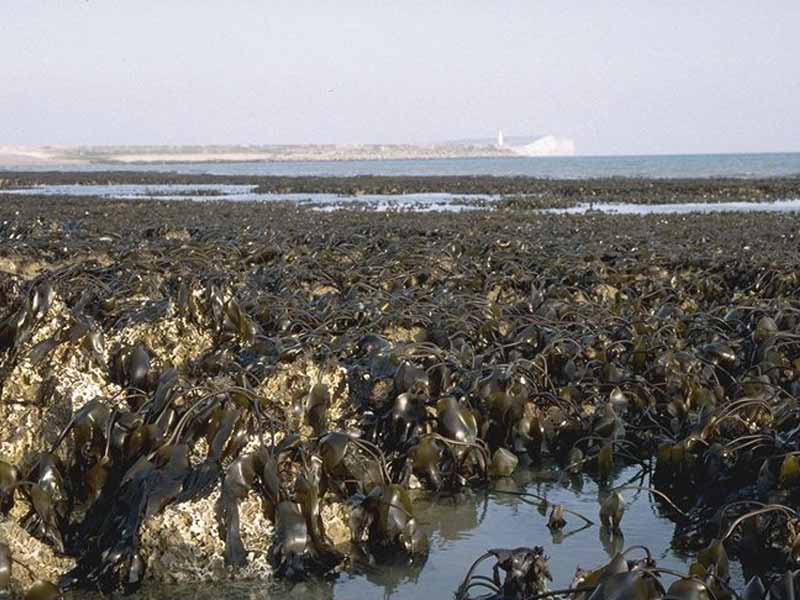
View across shore showing extensive kelp beds on chalk.
Photographer: David George Copyright: Joint Nature Conservation Committee (JNCC)

| Researched by | Dr Heidi Tillin, Jacqueline Hill, Dr Harvey Tyler-Walters & Ellie Burdett | Refereed by | This information is not refereed |
|---|
Summary
UK and Ireland classification
Description
Soft rock, such as chalk, in the sublittoral fringe characterised by Laminaria digitata and rock-boring animals such as piddocks Barnea candida and Pholas dactylus, the bivalve Hiatella arctica and worms Polydora spp. Beneath the kelp forest, a wide variety of foliose red seaweeds occur such as Palmaria palmata, Chondrus crispus, Membranoptera alata and Halurus flosculosus. Filamentous red seaweeds often present are Vertebrata fucoides and Ceramium nodulosum, while coralline crusts cover available rock surface. The bryozoan Membranipora membranacea and the hydroid Dynanema pumila can form colonies on the kelp fronds, while the bryozoan Electra pilosa more often occur on the foliose red seaweeds. Empty piddock burrows are often colonised by the polychaete Sabellaria spinulosa or in more shaded areas the sponges Halichondria panicea and Hymeniacidon perlevis. The undersides of small chalk boulders are colonised by encrusting bryozoans, colonial ascidians and the tube-building polychaete Spirobranchus lamarcki. The boulders and any crevices within the chalk provide a refuge for small crustaceans such as Carcinus maenas, the mussel Mytilus edulis or the barnacle Semibalanus balanoides. The echinoderm Asterias rubens is present as well.
This biotope occurs on moderately exposed soft rock where IR.MIR.KR.Ldig.Ldig would normally occur. Above it may lie a zone of Fucus serratus on similarly bored soft rock (LR.MLR.BF.Fser.Pid) or a variant of one of the Fucus serratus biotopes (LR.LMR.BF.Fser.R or LR.MLR.BF.Fser.Fser). Lower shore sites influenced by sand may have more Mytilus edulis beneath the seaweed canopy (LR.HLR.MusB.MytFR) or the sand-binding red seaweed Rhodothamniella floridula (Rho). Below the IR.MIR.KR.Ldig.Pid biotope a variety of biotopes can occur such as LsacChoR on unstable infralittoral cobbles and boulders or even CR.MCR.SfR.Pid in the turbid waters of south-east England where the kelp generally extends to less than 4m CD.
The under-storey foliose and filamentous seaweeds will diminish towards the autumn and regrow in the spring. Since the soft rock does not provide a stronghold for the seaweeds they are easily dislodged during storm periods. After such an event the green seaweeds Enteromorpha spp. and Ulva spp. and/or the red seaweed Palmaria palmata may temporarily cover much of the rock. Eventually, a more diverse range of seaweeds and associated animals will re-establish on the rock. (Information from JNCC, 2015, 2022).
Depth range
Lower shoreAdditional information
-
Listed By
Habitat review
Ecology
Ecological and functional relationships
Kelp habitats are dynamic ecosystems where competition for space, light and food result in patchy distribution patterns of flora and fauna. Kelp biotopes are diverse species rich habitats and over 1,200 species have been recorded in UK moderately exposed kelp biotopes (MIR.KR) (Birkett et al., 1998b). Kelps are major primary producers; up to 90% of kelp production enters the detrital food web and is probably a major contributor of organic carbon to surrounding communities (Birkett et al., 1998b). Major interactions are thought to be the effects of competition for space, shading, herbivory and predation.
- In most kelp biotopes there is evidence of strong competition for space, especially for space on a favourable substratum. Competition may between individual plants of the same species, between kelps and substratum-colonizing species of animals and other algae and between colonial animals and encrusting algae. Competition for space between individuals and species is dynamic, resulting in a constantly changing patchwork of species covering any suitable substrata within the biotope.
- The blades of Laminaria digitata plants form a canopy layer which may cut off much of the incident irradiance. This restricts the development of species with high light demands so that the understorey of plants becomes dominated by shade tolerant red algae. It also allows species normally restricted to the lower infralittoral in kelp-free areas to compete more effectively in the reduced light levels of the kelp bed and so are found at shallower depths.
- Within kelp beds there are relatively few species that are directly grazing either the kelp or the understorey algae as the enzymes required to directly utilise algae as food are not common. Those species able to graze directly on the kelp include the gastropods: Gibbula spp., Littorina spp., Haliotis tuberculata (in the Channel Islands only), Patella pellucida, Lacuna spp. and the Rissoidae, together with some amphipods and isopods. Patella pellucida grazes epiphytes and the kelp tissue directly, forming pits similar to the home scars of intertidal limpets. The larger, laevis form excavates large cavities in the holdfast of Laminaria spp. which creates tissue damage weakening the adult plant and possibly contributes to its loss due to wave action and storms (Kain, 1979). Infestation with Patella pellucida varies between sites and decreases with depth.
- Burrowing species such as the piddocks, including the common piddock Pholas dactylus, and the tube worm Polydora ciliata are characteristic of this biotope and contribute to the creation of a relatively high silt environment through burrowing activities. The abundance of filter feeding organisms such as sponges, bryozoans and tunicates within kelp biotopes indicates the importance of planktonic input to the benthic community. Although very little information is available about planktonic communities in kelp beds it can be assumed that there will be larger inputs of larval stages from species with bentho-pelagic life cycles than in the general plankton (Birkett et al., 1998b).
- Predation within kelp beds has not been well studied in the UK. Although some species are known to prey on others, such as starfish on mussels, very little is known of the predator-prey relationships for the many species occurring in kelp beds.
- Kelp plants are exploited as a habitat; the holdfast, stipe and frond each support a different type of community consisting of possibly thousands of individuals from hundreds of species; holdfasts shelter a particularly rich diversity of animals from a wide range of taxa (see Habitat complexity).
Seasonal and longer term change
Most species in the biotope are perennial and seasonal changes are likely to be in condition of individuals rather than presence or absence.
- Growth rate of Laminaria digitata is seasonally controlled with a period of rapid growth from February to July and one of slower growth from August to January. Increased wave exposure and storms in winter months are likely to erode Laminaria digitata blades so that they appear tattered in winter months and overall standing biomass is reduced. Periodic storms are also likely to remove older and weaker plants creating patches cleared of kelp and increasing the local turbidity. Cleared patches may encourage growth of sporelings or gametophyte maturation. Growth of understorey algae is also reduced in the winter months.
- Some species of algae have seasonally heteromorphic life histories spending a part of the year as a cryptic or encrusting growth form and only becoming recognizable in the foliose phase of their life cycles. The occurrence of such algae is often seen as the occurrence of 'ephemeral' algae. Some hydrozoans may be present in the kelp bed in their attached, colonial form only for a part of the year, spending the rest of the year as medusae.
- With a lifespan of less than a year and a reproductive period of 3-4 months in the spring or summer numbers of Polydora ciliata are likely to be fairly seasonal with highest abundance of individuals after recruitment in the summer and autumn.
- Pholas dactylus live to approximately 14 years of age with a maximum shell length of 75 mm (Pinn et al., 2005), although earlier work has recorded maximum shell lengths of 125-150 mm (Jeffries, 1865; Turner, 1954). Spawning usually occurs between May and September with settlement and recruitment of juvenile piddocks occuring between November and February. It is likely that populations of Pholas dactylus will not be subject to significant seasonal changes in abundance.
It should be emphasized that present understanding of the natural fluctuations in the species assemblages, populations, distribution and diversity of species in kelp habitats is very limited.
Habitat structure and complexity
The structure of the biotope is complex with many different microhabitats. They include bedrock, crevices, sediment pockets, the holdfast, stipe and blade of Laminaria digitata plants themselves, undersides of boulders and empty piddock burrows.
- Holdfasts provide refuge to a wide variety of animals supporting a diverse fauna that represents a sample of the surrounding mobile fauna and crevice dwelling organisms, e.g. polychaetes, small crabs, gastropods, bivalves, and amphipods.
- Kelp fronds are grazed by molluscs such as the blue-rayed limpet Patella pellucida.
- Older Laminaria digitata stipes provide a substratum for a large number of epiphytic flora and fauna and it has been estimated that rugose stipes provide one and a half times that surface area provided by the bedrock (Jones et al., 2000).
- Empty burrows of piddocks, such as the common piddock Pholas dactylus, create additional refugia which are recorded as being colonized by vagile species such as Littorina littorea, Steromphala cineraria, Porcellana platycheles and Eulalia viridis (Pinn et al., in press). Sabellidae and Lithothamnia spp. Are examples of sessile species utilising the burrows.
- The understorey of red algae and crevices in the bedrock provide space for many cryptic fauna.
- In areas of mud tubes built by Polydora ciliata can agglomerate and form layers of mud up to an average of 20 cm thick, occasionally to 50 cm. These layers can eliminate the original fauna and flora, or at least can be considered as a threat to the ecological balance achieved by some biotopes (Daro & Polk, 1973).
Productivity
Kelp plants are the major primary producers in the marine coastal habitat. Within the euphotic zone kelps produce nearly 75% of the net carbon fixed and large kelps often produce annually well in excess of a kilogram of carbon per square metre of shore. However, only about 10% of this productivity is directly grazed. Kelps contribute 2-3 times their standing biomass each year as particulate detritus and dissolved organic matter that provides the energy supply for filter feeders and detritivores, such as piddocks and polychaetes like Polydora ciliata, in and around the kelp bed. Dissolved organic carbon, algal fragments and microbial film organisms are continually removed by the sea. This may enter the food chain of local subtidal ecosystems, or be exported further offshore. Rocky shores make a contribution to the food of many marine species through the production of planktonic larvae and propagules which contribute to pelagic food chains.
Recruitment processes
Most species in this biotope produce planktonic propagules annually and so recruitment is often from distant sources and is frequent.
- Benthic species, plant and animal, that possess a planktonic stage: gamete, spore or larvae, are likely to be influenced by kelp mediated alteration of fluid and particulate, and consequently larval fluxes. Kelp canopies also affect the physical environment, such as the substratum, experienced by actively settling planktonic larvae. The substrata beneath kelp plants for example, are often dark and sediment laden, conditions likely to affect larval settlement and post settlement survival. Both the demographic structure of populations and the composition of assemblages may be profoundly affected by variation in recruitment rates driven by such factors.
- Laminaria digitata plants are fertile all year round with maximum production of spores in July - August and November - December. Young sporophytes (germlings) appear all year with maxima in spring and autumn. Chapman (1981) demonstrated that substantial recruitment of Laminaria digitata plants to areas barren of kelp plants was possible up to 600m away from reproductive plants.
- Pholas dactylus spawns between May and September with settlement and recruitment of juvenile piddocks occuring between November and February (Knight, 1984; Pinn et al., in press).
- The spawning period for Polydora ciliata varies, from February until June in northern England for example, and from April - September in the Black Sea. Larvae are substrate specific selecting rocks or sediment according to their physical properties settling preferentially on substrates covered with mud
- Among sessile organisms, patterns fixed at settlement, though potentially altered by post settlement mortality, obviously cannot be influenced by dispersal of juveniles or adults.
- Some of the species living in kelp beds do not have pelagic larvae, but instead have direct development producing their offspring as 'miniature adults'.
Time for community to reach maturity
Kain (1975) examined the recolonization of cleared concrete blocks by kelp plants and other algae and found that Laminaria digitata plants were re-established within 2 years and that red algae returned with a year. Although there is no information available on colonization times or growth rates for the common piddock the other main rock borer, Polydora ciliata is able to rapidly (within months of reproductive period) colonize a suitable area. Recruitment of other species to the kelp bed may take longer. However, maturity is likely to be reached within five years.
Additional information
-Preferences & Distribution
Habitat preferences
| Depth Range | Lower shore |
|---|---|
| Water clarity preferences | |
| Limiting Nutrients | Nitrogen (nitrates) |
| Salinity preferences | Full (30-40 psu) |
| Physiographic preferences | Open coast |
| Biological zone preferences | Sublittoral fringe |
| Substratum/habitat preferences | Bedrock |
| Tidal strength preferences | Moderately strong 1 to 3 knots (0.5-1.5 m/sec.), Weak < 1 knot (<0.5 m/sec.) |
| Wave exposure preferences | Moderately exposed |
| Other preferences | Soft rock such as chalk and limestone |
Additional Information
Species composition
Species found especially in this biotope
Rare or scarce species associated with this biotope
-
Additional information
Sensitivity review
Sensitivity characteristics of the habitat and relevant characteristic species
The characterizing species are based on the biotope description from JNCC (2015). The biotope is characterized by soft rock, such as chalk,that is burrowed by piddocks Barnea candida and Pholas dactylus, the bivalve Hiatella arctica and Polydora spp. The sensitvity of the piddocks is specifically assessed as these are considered to be key characterizing species that define the biotope, as the loss of this group would result in biotope reclassification.
The biotope is also characterized by a kelp forest of Laminaria digitata; the sensitivity of this species is considered within assessments as it is a key characterizing species that defines the biotope. A wide variety of foliose red seaweeds occur beneath the canopy such as Palmaria palmata, Chondrus crispus, Membranoptera alata and Halurus flosculosus and the sensitivity of these and the coralline crusts are considered generally. Bryozoans and hydroids grow on the seaweeds but the sensitivity of these and other invertebrates that may occur in the biotope but not characterize it are not considered as these are either infrequent or present at low abundances and are not considered to structure the biotope through grazing, space occupation or other effects.
Resilience and recovery rates of habitat
The available evidence indicates that the recovery of kelp biotopes, where kelp have been entirely removed, requires at least two years. Re-colonization of concrete blocks by Laminaria digitata was investigated by Kain (1975) at Port Erin, Isle of Man. Laminaria digitata was considered re-established two years after removal, with the characterizing red foliose algae following one year later. Similarly, recovery after simulated harvesting of a standing crop of Laminaria digitata occurred within 18-20 months (Kain, 1979). While colonization of young Laminaria sporophytes may occur one year after initial substratum clearance (Kain 1979), the return of the biotope to its original mature condition is likely to lag behind this recolonization. These findings agree with previous studies which showed that when 60% of sporophytes (adult alga) were removed from a location, 18 months were required for the stand to rejuvenate (Perez, 1971), while in France, CIAM (Le Comité interprofessionel des algues marines) proposed that, regardless of collection method, the restoration of stands of laminarians took up to 18 months post harvesting (Arzel, 1998). Some disparities between reported recovery rates do exist, with cleared plots in Helgoland taking 25 months, probably because plots were burned to ensure total removal of spores and germlings (Markham & Munda, 1980). Even after 25 months, although macroalgal density had returned to pre-clearance levels, the Laminaria digitata were smaller than those on undisturbed plots, suggesting full recovery needs longer than 25 months (Markham and Munda, 1980).
The seasonal timing of macroalgal removal impacts recovery rates. Engelen et al. (2011) showed that removal of 0.25 m2 areas of Laminaria digitata forest in the spring and autumn had different recovery rates, with autumn recovery more rapid than spring (taking a minimum of 12 months). Return to conditions prior to removal took 18-24 months, with competition for space by Saccorhiza polyschides impacting recovery rates in the first year of recolonization (Engelen et al., 2011). The growth rate of Laminaria digitata changes with the seasons. Growth is rapid from February to July, slower in August to January, and occurs diffusely in the blade (Kain, 1979). This diffuse growth may enhance its resistance to potential grazers. Spores are produced at temperatures lower than 18°C with a minimum of 10 weeks a year between 5-18 °C needed to ensure spore formation (Bartsch, 2013). Thus temperature and by default season impacts the level of reproductive activity. In order to maximise survival rates of mature gametophytes, gametophyte development can be delayed by the algae until optimum conditions return and the gametophyte produces gametes (Van den Hoek et al., 1995), which suggests a degree of resistance to short-term changes in temperature which may be anthropogenic in origin. However, seaweeds have been cited as being particularly sensitive to short-term warming events (Dayton & Tegner, 1984; Smale & Wernberg, 2013; Wernberg et al., 2013; from Smale et al., 2013).
Smith (1985) recorded the recovery of Laminaria longicruris and Laminaria digitata following total experimental clearance within Lobster bay, Nova Scotia. Within three months Laminaria longicruris recovery was well established, and experimental clearance plots were indistinguishable from the surrounding habitat. Laminaria digitata however required two years to fully recover following clearance.
The dispersal of Laminaria digitata’s spores and subsequent successful recruitment has been recorded 600 m from reproductive individuals (Chapman, 1981). Local water movement plays an important role in the potential recovery of a biotope, with spores dependent on currents to extend their dispersal range, although the majority of larvae settle within its local habitat (Brennan et al., 2014). If only part of the biotope is destroyed then recovery is likely to be fast. However, if the whole of a local biotope is destroyed, then its recovery depends on spores from an external source and, if the biotope is isolated from others of its kind, then recovery may be very slow. As kelp are attached to the substratum and have no mobility, recovery of the biotope where the kelp have been removed will depend on recolonization of cleared surfaces by germlings. The frequency of disturbance is also important when considering the resilience of this biotope to various pressures, especially in terms of allowing novel species to out-compete Laminaria digitata in local areas. A loss in genetic diversity is not regarded as an issue for this species, unless additional pressures result in the isolation and fragmentation of wild coastal populations (Valero et al., 2011). Genetic differentiation in wild populations occurs within 10 km with genetic flow occurring between adjacent species (Billot et al., 2003). Opportunistic species such as Sargassum muticum and Codium fragile exploit gaps in the kelp bed and out-compete Laminaria digitata, so that high frequency, low impact disturbances may make the kelp stands more vulnerable to competition from these and other turf forming algae; especially if climate change results in temperature shifts (Staehr et al., 2000; Scheibling & Gagnon, 2006; Connell & Russell 2010).
In piddocks the sexes are separate and fertilisation is external, with gametes released into the water column (Pinn et al., 2005 and references therein). The fecundity of female Petricolaria pholadiformis is estimated to be between 3 - 3.5 million eggs per year (Duval, 1963a). Studies report that larval release occurs from April to September (e.g. Pelseneer, 1924; El-Maghraby, 1955; Purchon 1955; Duval 1962; Knight 1984). Knight (1984) reported that the resulting planktonic larval stage spends 45 days in the plankton. No information was found on the factors that induce piddocks to settle. Pinn et al., (2005) observed newly settled individuals between November and February. Pinn et al. (2005) found the smallest sexually mature Pholas dactylus was a one year old measuring 27.4 mm, information on age at sexual maturity was not reported for other species.Although rare in the Romanian Black Sea, Micu (2007) reported the first observations of Pholas dactylus in 34 years at three locations illustrating the recovery potential of this species and ability to colonize or recolonize suitable habitat. The vulnerability of piddocks to episodic events such as the deposition of sediments (Hebda, 2011) and storm damage of sediments (Micu, 2007) and the on-going chronic erosion of suitable sediments (Pinn et al., 2005) indicate that larval dispersal and recruitment of new juveniles from source populations is an effective recovery mechanism allowing persistence of piddocks in suitable habitats.
Richter & Sarnthein (1976) studied the re-colonization of different sediments by various molluscs on suspended platforms in Kiel Bay, Germany. The platforms were suspended at 11, 15 and 19 m water depth, each containing three round containers filled with clay, sand, or gravel. Substratum type was found to be the most important factor for the piddock Barnea candida, although for all other species it was depth. This highlights the significance of the availability of a suitable substratum to the recovery of piddock species and suggests that larvae have some mechanisms for selection of suitable substratum. Richter & Sarnthein (1976) found that within the two year study period the piddocks grew to represent up to 98% of molluscan fauna on clay platforms. Piddock species have also shown very high growth rates of up to 54 mm in 30 months in the laboratory (Arntz & Rumohr, 1973). However, the process of colonization on clay at 15 and 19 m was found to be highly discontinuous, as reflected by the repeated growth and decrease of specimen numbers.
In the Arctic Hiatella arctica may be very long-lived with the oldest individual estimated to be 126 years old (based on annual growth rings) and maximum length was estimated to be achieved at 35 years. Populations in warmer waters are likely to be faster growing (Sejr et al., 2002). In the White Sea, Russia, Hiatella arctica reached a maximum age of 6 years and achieved sexual maturity at 1 year (Matveeva & Maksimovich, 1977, abstract only). In study sites in County Clare, Ireland, Trudgill & Crabtree (1987) found the mean age to be 5 years and 6 years on exposed and sheltered shores, respectively, (estimated based on growth rings). In the Clyde larvae are found all year, (Russell-Hunter 1949) although Lebour (1938) report that maximum abundances of planktonic larvae occurred from July to November.
Red algae in general have complex life histories and exhibit distinct morphological stages over the reproductive life history. Some red algae found within the biotope have life stages that include prostrate creeping bases e.g. encrusting corallines whereas in other species such as Palmaria palmata, the thallus or fronds arise from a small discoid holdfast. The basal crusts and crustose tetrasporphytes are perennial, tough, resistant stages that may prevent other species from occupying the rock surface and allow rapid regeneration. They may therefore provide a significant recovery mechanism.
Where holdfasts and basal crusts are removed, recovery will depend on recolonization via spores. Norton (1992) reviewed dispersal by macroalgae and concluded that dispersal potential is highly variable, recruitment usually occurs on a much more local scale, typically within 10 m of the parent plant. Hence, it is expected that the algal turf would normally rely on recruitment from local individuals and that recovery of populations via spore settlement, where adults are removed, could be protracted.
Corallina officinalis was shown to settle on artificial substances within 1 week of their placement in the intertidal in New England summer (Harlin & Lindbergh, 1977). However, settlement plates laid out in the autumn were not recolonized until the next spring. In the lower rocky intertidal in southern California dominated by Corallina officinalis with foliose overstorey algae present, Littler & Kauker (1984) experimentally cleared plots and followed the recovery for 12 months. Some areas were scraped allowing the basal crusts to remain whereas others were completely sterilised (removal of all material and surfaces then scorched with a blow torch to remove bases). In scraped plots up to 15% cover of Corallina officinalis fronds returned within 3 months after removal of fronds and all other epiflora/fauna (Littler & Kauker, 1984) while in sterilized plots (all basal crusts removed) appearance of articulated fronds occurred 6 months following clearance. At the end of the 12 month observation period Corallina officinalis cover had increased to approximately 18% in plots where basal crusts remained and to approximately 10% in sterilised plots. Similarly Bamber & Irving (1993) reported that new plants grew back in scraped transects within 12 months, although the resistant crustose bases were probably not removed.
Coralline crust refers to nongeniculate (crustose) species from the family Corallinacea that could include Lithophyllum incrustans which is noted to form thick crusts in tidepools, especially in the south west (Adey & Adey, 1973). Although ubiquitous in marine coastal systems little is understood about the taxonomy, biology and ecology of this taxa (Littler & Littler, 2013). Studies by Edyvean & Forde (1987) on populations of Lithophyllum incrustans in Pembroke south-west Wales suggest that reproduction occurs on average early in the third year. Reproduction may be sexual or asexual. Populations release spores throughout the year but spore abundance varies seasonally. Spore survival is extremely low with only a tiny proportion of spores eventually recruiting to the adult population (Edyvean & Ford, 1986). Edyvean & Ford (1984a) found that the age structure of populations sampled from Orkney (Scotland) Berwick (northern England) and Devon (England) were similar, mortality seemed highest in younger year classes with surviving individuals after the age of 10 years appear relatively long-lived (up to 30 years). In St Mary’s Northumberland, the population was dominated by the age 6-7 year classes (Edyvean & Ford, 1984a). Some repair of damaged encrusting coralline occurs through vegetative growth. Chamberlain (1996) observed that although Lithophyllum incrustans was quickly affected by oil during the Sea Empress spill, recovery occurred within about a year. The oil was found to have destroyed about one third of the thallus thickness but regeneration occurred from thallus filaments below the damaged area. Recolonization by propagules is an important recovery mechanism.
Resilience assessment. Evidence from Engelen et al. (2011) indicated that complete recovery of Laminaria digitata and its associated epibiota occurs 18-24 month after complete removal of Laminaria digitata. Smith (1985) also suggested 24 months for the recovery of a Laminaria digitata bed. Therefore, resilience has been assessed as ‘High’, where resistance is assessed as 'Medium' or 'Low'. Experimental evidence (Kain, 1975, 1979; Markham & Munda, 1980) indicates that recovery where the entire community is removed (e.g. where resistance is 'None') may take longer, so that resilience is assessed as 'Medium'. Where the holdfasts and/or basal crusts of red algae remain in place then recvoery by vegetative growth is likely to be rapid, although complete removal of a bed would take longer due to poor dispersal. The recovery assessments for kelp are therefore also though to be applicable to recvoery of the red algal turf. Little evidence was found to assess recovery of the piddocks and Hiatella arctica.The sedentary nature of adult piddocks and their vulnerability to episodic impacts such as smothering and chronic erosion suggest that piddocks have evolved effective strategies of larval dispersal and juvenile recruitment with some selectivity for suitable habitats. As recovery of biomass and a typical age-structured population depends on recolonization and subsequent growth to adult size, resilience of the piddocks is assessed as ‘Medium’ (2-10 years) where resistance is None, Low or Medium.
NB: The resilience and the ability to recover from human induced pressures is a combination of the environmental conditions of the site, the frequency (repeated disturbances versus a one-off event) and the intensity of the disturbance. Recovery of impacted populations will always be mediated by stochastic events and processes acting over different scales including, but not limited to, local habitat conditions, further impacts and processes such as larval-supply and recruitment between populations. Full recovery is defined as the return to the state of the habitat that existed prior to impact. This does not necessarily mean that every component species has returned to its prior condition, abundance or extent but that the relevant functional components are present and the habitat is structurally and functionally recognisable as the initial habitat of interest. It should be noted that the recovery rates are only indicative of the recovery potential.
Hydrological Pressures
Use [show more] / [show less] to open/close text displayed
| Resistance | Resilience | Sensitivity | |
Temperature increase (local) [Show more]Temperature increase (local)Benchmark. A 5°C increase in temperature for one month, or 2°C for one year. Further detail EvidenceLaminaria digitata is distributed from Brittany to the coast of Norway, while its UK distribution encompasses the whole of the UK coast (Blight & Thompson, 2008). Its distribution suggests that the species would tolerate chronic temperature change (e.g. by 2°C for a year). However, local populations may have acclimatized to local physical conditions meaning that populations at the extremes of the species’ range are less comparable than those populations in the middle of its range. Additionally, the distribution data of this species suggests it is a northern species, as such it will be vulnerable to increases in temperature and may be out-competed at its southern limits by other kelp species. The thermal optimum of Laminaria digitata is between 10-15°C, with reproductive ability impaired to 20% at 18°C (Arzel, 1998). Therefore while the current population may not be affected, recruitment may be reduced. Spore production only occurs between 5-10°C and is the most temperature sensitive stage of reproduction in Laminaria digitata. Outside this temperature range, reproduction is severely reduced and the species is at risk from local extinction in the long-term. In additional, a temperature increases to 22-23°C causes cell damage and death (Sundene, 1964; Bolton & Lüning, 1982). The sensitivity of this species therefore relies on the current sea temperatures of the specific location (Bartsch et al., 2013). A minimum of 10 weeks a year between 5-18°C is needed in order to ensure spore formation and hence reproduction (Bartsch et al., 2013). Combining predicted sea surface temperate over the next century with the current distribution of Laminaria digitata, Merzouk & Johnson (2011) predict an expansion of its northern limits and localised extinctions across its southern range edge (Mid Bay of Biscay, Northern France and southern England; Birkett et al., 1998). Suggesting at sites where sea temperature is artificially increased as a result of anthropogenic activity (e.g. effluent output) local extinction of the biotope may occur (Raybaud et al., 2013) especially if combined with high UK summer sea temperatures in southern examples of this biotope (Bartsch et al., 2013). In southern examples of IR.MIR.KT.LdigT, Laminaria digitata may also be out-competed by it’s Lusitanian competitor Laminaria ochroleuca which is regionally abundant across the south UK coastline (Smale et al., 2014). Little direct evidence was found to assess the effects of increased temperature on piddocks and the assessment is based on distribution records and evidence for spawning in response to temperature changes. Pholas dactylus occurs in the Mediterranean and the East Atlantic, from Norway to Cape Verde Islands (Micu, 2007). Barnea candida is distributed from Norway to the Mediterranean and West Africa (Gofas, 2015). The current distribution of Hiatella arctica is predominantly arctic and boreal (Sejr et al., 2004; Gordillo, 2001) and palaeecological reviews describe the genus as ‘consistently linked to cool temperate and polar regions’ (Gordillo, 2001). However, populations of Hiatella arctica occur in the Mediterrannean and have clearly acclimated to the warmer temperatures (Oberlechner, 2008). Laboratory experiments on filtration rates of Hiatella arctica found that activity was strongly linked to temperature (Ali, 1970). Activity rates rose steadily between 0 oC to a maximum between 15 oC and 17 oC and fell sharply to almost no activity at 25 oC (Ali, 1970). Although activity may be reduced Hiatella arctica have very low metabolic rates and may be able to sustain a period of reduced activity. Regression models developed by Bourget et al. (2003) found that temperature and water transparency (measured in metres and indicating the level of inorganic suspended solids) explained only 40% of the variation in biomass of Hiatella arctica fouling navigation buoys in the Gulf of St Lawrence system (Canada). These findings suggest that other variables play a more significant role in determining settlement, survival and growth over a year in this system. However the models did indicate that biomass is higher where temperatures were greater (around 14 oC) although a causal link was not identified (Bourget et al., (2003). There is some evidence that temperature influences the timing of reproduction in Pholas dactylus, which usually spawns between July and August. Increased summer temperatures in 1982 induced spawning in July on the south coast of England (Knight, 1984). Spawning of the piddock Petricolaria pholadiformis is initiated by increasing water temperature (>18 °C) (Duval, 1963a), so elevated temperatures outside of usual seasons may disrupt normal spawning periods. The spawning of Barnea candida was also reported to be disrupted by changes in temperature. Barnea candida normally spawns in September when temperatures are dropping (El-Maghraby, 1955). However, a rise in temperature in late June of 1956, induced spawning in some specimens of Barnea candida (Duval, 1963b). Disruption from established spawning periods, caused by temperature changes, may be detrimental to the survival of recruits as other factors influencing their survival may not be optimal, and some mortality may result. Established populations may otherwise remain unaffected by elevated temperatures. Littler & Kauker (1984) suggested that the crustose bases of Corallina officinalis are more resistant of desiccation or heating than fronds. Lüning (1990) reported that Corallina officinalis from Helgoland survived one week exposure to temperatures between 0 °C and 28 °C. Latham (2008) investigated the effects of temperature stress on Corallina officinalis through laboratory tests on samples collected in the Autumn in Devon, (England) from rockpools. Samples kept at 5, 15, 20 and 25 oC showed little change in chemicals produced in reaction to thermal stress and no bleaching suggesting the temperatures in that range had not induced stress reactions. In an exceptionally hot summer (1983, with an increase of between 4.8 and 8.5 °C), Hawkins & Hartnoll (1985) observed that understorey red algae showed signs of damage with bleached Corallina officinalis observed around the edges of pools due to desiccation. Occasional damaged specimens of Palmaria palmata, Osmundea pinnatifida and Mastocarpus stellatus were observed. Palmaria palmata does well in low temperatures, with an optimum between 6 and 15°C, consistent with a distribution in northern temperate and arctic waters. This species is also found in warmer temperate waters as far south as Portugal in Europe and with localized large populations in northern Spain (Garbary et al., 2012 and references therein). Temperatures at or above 15 oC may induce physiological stress (Werner & Dring, 2011; Morgan et al., 1980). In tank cultures of Palmaria palmata at 20°C and above, all plants were dead within a week (Morgan et al., 1980). Populations may be acclimated to typical conditions but it is likely that Palmaria palmata may be bleached or damaged by higher than usual temperatures. Sensitivity assessment. Some of the understorey of red algae, such as Palmaria palmata may be lost during acute temperature increases if these occur in the summer when plants are already close to the limit of thermal tolerances, however, this will not alter classification of the biotope. The global distribution of the piddock species, Petricolaria pholadiformis, Pholas dactylus and Barnea candida, suggest that these species can tolerate warmer waters than currently experienced in the UK and may therefore be tolerant of a chronic increase in temperature. Short-term acute increases may, (depending on timing) interfere with temperature driven spawning cues for Laminaria digitata and piddocks (and possibly other species). The effects will depend on seasonality of occurrence and the species affected. Adult populations may be unaffected and, in such relatively long-lived species, an unfavourable recruitment may be compensated in a following year. Resistance to an acute change in temperature is therefore assessed as ‘High’ (based on Laminaria digitata and piddocks) and recovery as ‘High’ (by default) and the biotope is considered ‘Not Sensitive’. For all species it should be noted that the timing of acute changes may lead to greater impacts, temperature increases in the warmest months may exceed thermal tolerances whilst changes in colder periods may stress individuals acclimated to the lower temperatures. | HighHelp | HighHelp | Not sensitiveHelp |
Temperature decrease (local) [Show more]Temperature decrease (local)Benchmark. A 5°C decrease in temperature for one month, or 2°C for one year. Further detail EvidenceThe thermal optimum of Laminaria digitata is between 10-15°C, with reproductive ability impaired to 20% at 18°C (Arzel, 1998). Therefore while the adult population may not be affected by changes at the pressure benchmark, recruitment may be reduced. Spore production only occurs between 5-10°C and is the most temperature sensitive stage of reproduction in Laminaria digitata. Outside this temperature range, reproduction is severely reduced and the species is at risk from local extinction in the short-term. In additional, a temperature increase to 22-23°C causes cell damage and death (Sundene, 1964; Bolton & Lüning, 1982). During an exceptionally warm summer in Norway, Sundene (1964) reported the destruction of Laminaria digitata plants exposed to temperatures of 22-23°C. The sensitivity of this species therefore relies on the current sea temperatures of the specific location (Bartsch et al., 2013). A minimum of 10 weeks a year between 5-18°C is needed in order to ensure spore formation and hence reproduction (Bartsch et al., 2013). Little empirical evidence was found to assess the effects of decreased temperature on piddocks and the assessment is based on distribution records and evidence for spawning in response to temperature changes. Pholas dactylus occurs in the Mediterranean and the East Atlantic, from Norway to Cape Verde Islands (Micu, 2007). Barnea candida is distributed from Norway to the Mediterranean and West Africa (Gofas, 2015). Temperature changes have been observed to initiate spawning by Pholas dactylus, which usually spawns between July and August. Increased summer temperatures in 1982 induced spawning in July on the south coast of England (Knight, 1984). Spawning of Petricolaria pholadiformis is initiated by increasing water temperature (>18 °C) (Duval, 1963a), so decreased temperatures may disrupt normal spawning periods where this coincides with the reproductive season. The spawning of Barnea candida was also reported to be disrupted by changes in temperature. Barnea candida normally spawns in September when temperatures are dropping (El-Maghraby, 1955). Disruption from established spawning periods, caused by decreased temperatures may be detrimental to the survival of recruits as other factors influencing their survival may not be optimal, and some mortality may result. Established populations may otherwise remain unaffected by decreased temperatures. Gordillo & Aitken (2000) in a review of environmental factors relevant to re-interpreting Late Quaternary environments from fossil collections suggest that Hiatella arctica is eurythermal, based on Aitken (1990) and Peacock (1993). The current distribution of Hiatella arctica is predominantly arctic and boreal (Sejr et al., 2004; Gordillo, 2001) and palaeecological reviews describe the genus as ‘consistently linked to cool temperate and polar regions’ (Gordillo, 2001) suggesting that within temperate regions this species would not be sensitive to a decrease in temperature at the pressure benchmark. Regression models developed by Bourget et al. (2003) found that temperature and water transparency (measured in metres and indicating the level of inorganic suspended solids) explained only 40% of the variation in biomass of Hiatella arctica fouling navigation buoys in the Gulf of St Lawrence system (Canada). These findings suggest that other variables play a more significant role in determining settlement, survival and growth over a year in this system. However the models did indicate that biomass is higher where temperatures were greater (around 14 oC) although a causal link was not identified (Bourget et al., (2003). Lüning (1990) reported that Corallina officinalis from Helgoland survived 0 °C when exposed for one week. New Zealand specimens were found to tolerate -4 °C (Frazer et al., 1988). Lüning (1990) suggested that most littoral algal species were tolerant of cold and freezing. Sensitivity assessment. The global distribution of the piddock species and Hiatella arctica suggest that these species can tolerate cooler waters than currently experienced in the UK and may therefore be tolerant of a chronic decrease in temperature at the benchmark level. Decreased temperatures may, depending on timing, interfere with spawning cues which appear to be temperature driven. The effects will depend on seasonality of occurrence and the species affected. Adult populations may be unaffected and, in these relatively long-lived species, an unfavourable recruitment may be compensated for in a following year. The dominant kelp Laminaria digitata is thought to be a northern species and likely to retreat north as a result of climate change. Therefore, it is unlikely to be sensitive to a reduction in temperature at the benchmark level. Several members of the red algal community are found from the lower shore to the sublittoral, and probably not sensitive to changes at the benchmark level, as if some individual species may reduce in abundance or be lost, the diverse red algal community will remain. Based on the characterizing species, resistance to an acute and chronic decrease in temperature at the pressure benchmark is therefore assessed as ‘High’ and recovery as ‘High’ (within two years) and the biotope is considered ‘Not Sensitive’. Based on the characterizing and associated species, this biotope is considered to have ‘High’ resistance and ‘High resilience (by default) to this pressure and is therefore considered to be ‘Not sensitive’. The timing of changes and seasonal weather could result in greater impacts on species. | HighHelp | HighHelp | Not sensitiveHelp |
Salinity increase (local) [Show more]Salinity increase (local)Benchmark. A increase in one MNCR salinity category above the usual range of the biotope or habitat. Further detail EvidenceKelps are tolerant to short-term daily fluctuation in salinity and are recorded as tolerating 5-60 psu; however they are much less tolerant to long-term changes with growth and photosynthetic rates declining either side of 20-45 psu (Gordillo et al., 2002, Karsten, 2007). Despite this tolerance, Laminaria digitata is considered to be a stenohaline species, and this biotope is only found in conditions of full salinity (Connor et al., 2004). Therefore, other species probably out-compete Laminaria digitata at the limits of its salinity tolerance, meaning that despite the biotope’s tolerance under conditions of no competition, under natural conditions this biotope is unlikely to occur in conditions above 40 psu. No evidence for the range of physiological tolerances to salinity changes were found for piddocks. Filipov et al., (2003, abstract only) tested the salinity tolerances of Hiatella arctica obtained from the White Sea. The salinity tolerance of individuals kept at 25 ppt was 17-36 ppt. Acclimation of Hiatella arctica allowed them to adapt to higher or lower salinities with the potential tolerance range of acclimated individuals assessed as 13-42 ppt. Corallina officinalis is found in tide pools where salinities may fluctuate markedly during exposure to the air. Kinne (1971) cites maximal growth rates for Corallina officinalis between 33 and 38 psu in Texan lagoons. Laboratory experiments have defined the upper and lethal lower limits for Palmaria palmata as 15 psu and 50 psu, (Karsten et al., 2003) with optimal salinity defined as 23-34 psu (Robbins, 1978). No evidence was found to assess the salinity tolerances of Osmundea pinnatifida. Edyvean & Ford (1984b) suggest that populations of Lithophyllum incrustans are affected by temperature changes and salinity and that temperature and salinity ‘shocks’ induce spawning but no information on thresholds was provided (Edyvean & Ford, 1984b). Populations of Lithophyllum incrustans were less stable in rockpools with a smaller volume of water that were more exposed to temperature and salinity changes due to lower buffering capacity. Sexual plants (or the spores that give rise to them) were suggested to be more susceptible than asexual plants to extremes of local environmental variables (temperature, salinity etc.) as they occur with greater frequency at sites where temperature and salinity were more stable (Edyvean & Ford, 1984b). Sensitivity assessment. Although some increases in salinity may be tolerated by the species present these are generally short-term and mitigated during tidal inundation. This biotope is considered, based on distribution of Laminaria digitata, piddocks and the associated red algal species on the mid to lower shore to be sensitive to a persistent increase in salinity to > 40 ppt (although Hiatella arctica is considered to have greater tolerance). Resistance is therefore assessed as ‘Low’ and recovery as ‘Medium’ (based on recovery of piddocks, fucoids and algal turfs following restoration of usual salinity). Sensitivity is therefore assessed as ‘Medium'. | LowHelp | MediumHelp | MediumHelp |
Salinity decrease (local) [Show more]Salinity decrease (local)Benchmark. A decrease in one MNCR salinity category above the usual range of the biotope or habitat. Further detail EvidenceBirkett et al. (1998b) suggested that kelps are stenohaline, in that they do not tolerate wide fluctuations in salinity and require regular salinities of 30-35 psu to maintain optimum growth rates. Growth rate may be adversely affected if the kelp plant is subjected to periodic salinity stress. Laminaria digitata tolerates a large salinity range within a 24 hour period (5-60 psu; Karsten, 2007). At the extremes of this range; decreases in photosynthetic rates are evident, particularly at low salinities (Gordillo et al., 2002). In the study by Karsten (2007), kelp thalli were kept at constant salinities for 5 days, with their photosynthetic rates measured after 2 and 5 days. The lower salinity limit for Laminaria digitata lies between 10 and 15 psu. On the Norwegian coast, Sundene (1964) found healthy Laminaria digitata plants growing between 15 and 25 psu. Axelsson & Axelsson (1987) indicated damage of the plants’ plasma membranes occurs when salinity is below 20 or above 50 psu. Localized, long-term reductions in salinity, to below 20 psu, may result in the loss of kelp beds in affected areas (Birkett et al., 1998b). Laboratory experiments have defined the upper and lethal lower limits for Palmaria palmata as 15 psu and 50 psu, (Karsten et al., 2003) with optimal salinity defined as 23-34 psu (Robbins, 1978). In-situ Palmaria palmata from the Arctic Kongsfjord (Spitsbergen) exposed for four days to salinities of 15 psu following freshwater run-off suffered high levels of mortality (Karsten et al., 2003). In Danish waters where salinities are lowered by freshwater inputs, cultivation experiments found that Palmaria palmata growth over a seven month period was greatest at a site where mean salinity was 21±3 psu, while no growth occurred at a site where mean salinity was 17±5 psu (Bak, 2014). A decrease in salinity may lead to replacement of more sensitive red algal turf forming species by those more tolerant of the changed conditions. Chondrus crispus occurs in areas of 'low' salinity. For example, the species occurs in estuaries in New Hampshire, USA, where surface water salinity varies from 16-32 psu (Mathieson & Burns, 1975). Mathieson & Burns (1971) recorded maximum photosynthesis of Chondrus crispus in culture at 24 psu, but rates were comparable at 8, 16 and 32 psu. Tasende & Fraga (1999) cultured Chondrus crispus spores from north west Spain and concluded that growth was correlated with salinity between 23 and 33 psu. Corallina officinalis is found in tide pools where salinities may fluctuate markedly during exposure to the air. Kinne (1971) cites maximal growth rates for Corallina officinalis between 33 and 38 psu in Texan lagoons. Edyvean & Ford (1984b) suggest that populations of Lithophyllum incrustans are affected by temperature changes and salinity and that temperature and salinity ‘shocks’ induce spawning but no information on thresholds was provided (Edyvean & Ford, 1984b). Populations of Lithophyllum incrustans were less stable in tide pools with a smaller volume of water that were more exposed to temperature and salinity changes due to lower buffering capacity. Sexual plants (or the spores that give rise to them) were suggested to be more susceptible than asexual plants to extremes of local environmental variables (temperature, salinity etc.) as they occur with greater frequency at sites where temperature and salinity were more stable (Edyvean & Ford, 1984b). No information was found for the salinity tolerance of the of Pholas dactylus. A change in full to reduced (18-30 ppt) salinity (the pressure benchmark) may lead to changes in the composition of the piddock population with replacement of Pholas dactylus (if it is sensitive) by piddocks more tolerant of lower salinities particularly Petricolaria pholadiformis. Petricolaria pholadiformis is particularly common off the Essex and Thames estuary, e.g. the River Medway (Bamber, 1985) suggesting tolerance of brackish waters. Zenetos et al. (2009) suggest that at all sites where Petricolaria pholadiformis has been found there is some freshwater inflow into the sea. According to the literature, the species in its native range inhabits environments with salinities between 29 and 35ppt, while in the Baltic Sea it is reported from salinities 10-30 psu (Gollasch & Mecke, 1996, cited from Zenetos et al. 2009). According to Castagna & Chanley (1973, cited from Zenetos et al. 2009) the lower salinity tolerance of Petricolaria pholadiformis is 7.5-10 psu. It thus appears that reduced salinity facilitates its establishment (Zenetos et al., 2009). Barnea candida is reported to extend in to estuarine environments in salinities down to 20 psu (Fish & Fish, 1996). Filipov et al., (2003, abstract only) tested the salinity tolerances of Hiatella arctica obtained from the White Sea. The salinity tolerance of individuals kept at 25 ppt was 17-36 ppt. Acclimation of Hiatella arctica allowed them to adapt to higher or lower salinities with the potential tolerance range of acclimated individuals assessed as 13-42 ppt. Gordillo & Aitken (2000) in a review of environmental factors relevant to re-interpreting Late Quaternary environments from fossil collections suggest that the normal minimum salinity tolerance of Hiatella arctica is 20 ppt, based on Aitken (1990) and Peacock (1993). Sensitivity assessment, Most of the literature found on this topic considered short-term (days to weeks) impacts of changes to salinity whilst the benchmark refers to a longer-term change. Prolonged reduction in salinity at the pressure benchmark is likely to reduce the species richness of the biotope due to loss of less tolerant piddock species, some red algae and some intolerant invertebrates. It is considered that the benchmark decrease in salinity would result in mortality of the key characterizing Laminaria digitata species in biotopes that were previously fully marine and the piddocks or Hiatella arctica may be impacted. Biotope resistance is therefore assessed as 'Low' as the algae and piddocks are a key characterizing component and resilience is assessed as 'Medium', so that biotope sensitivity is assessed as 'Medium'. | LowHelp | MediumHelp | MediumHelp |
Water flow (tidal current) changes (local) [Show more]Water flow (tidal current) changes (local)Benchmark. A change in peak mean spring bed flow velocity of between 0.1 m/s to 0.2 m/s for more than one year. Further detail EvidenceThis biotope occurs in a range of water flow conditions from moderately strong (0.5-1.5 meters /second) to weak (<0.5 m/s) (negligible) (Connor et al., 2004), indicating that the characterizing species can tolerate a range of flow speeds. In Lough Ine in Ireland, Laminaria digitata forms dense forests in the fast flowing water of the Rapids where water speeds vary from 4-6 knots (ca 2-3 m/s) (Bassindale et al., 1948). Laminaria digitata is also found in very strong flows (>3.87 m/s) although it is often out-competed by Alaria esculenta. The biotope is not found in areas where sand scour occurs (associated with high water flow rates). Therefore, Laminaria digitata and associated community will probably not be affected by a change of 0.1-0.2 m/s in peak mean spring bed flow velocity. Laminaria digitata partially achieves survival in a range of water flow conditions by variations in blade morphology, with fronds narrower and more digitate where water flow rates are higher (Sundene, 1964). In a laboratory study, this morphological adaptation was attributed to longitudinal stress with exposure to this stress over 6 weeks resulting in narrower blades and a significantly higher rate of cell elongation, compared to those plants that had not experienced the same stress. This plasticity would serve to decrease the risk of thallus damage in areas of greater exposure or in stormier conditions (Gerard, 1987). Biogenic habitat structures reduce the effects of water flows on individuals by slowing and disrupting flow. The fronds of Laminaria digitata and the red algal turf will reduce the flow experienced by the turf. Boller and Carrington (2006), for example, found that the canopy created by the taller turf of Chondrus cripsus reduced drag forces on individual plants by 15-65%. The crustose holdfasts of Osmundea pinnatifida, Corallina officinalis and the coralline crusts are securely attached and as these are relatively flat, are subject less drag than upright fronds and are likely to tolerate changes in water flows at the pressure benchmark. Moderate water movement is beneficial to seaweeds as it carries a supply of nutrients and gases to the plants and removes waste products. However, if flow becomes too strong, plants may become dislodged. Propagule dispersal in kelps and red algae is in part governed by the local hydrodynamic regime; increased turbulence is associated with an increase in biotope connectivity and a loss of larvae from the local system. A decrease in wave and current mediated water flow is identified by lower connectivity with other sites and a higher settlement rate within the local biotope (Robins et al., 2013). Therefore an increase in water flow could result in larval loss from the local biotope, which if not balanced by a larval influx from another geographically different population, could result in a shift in the age structure of the population and a dearth of young alga. Established adult piddocks are, to a large extent, protected from direct effects of increased water flow, owing to their environmental position within the substratum. Increases or decreases in flow rates may affect suspension feeding by altering the delivery of suspended particles or the efficiency of filter feeding. Adult piddocks may become exposed should physical erosion occur at a greater rate than burrowing, and lost from the substratum. At higher densities bioerosion by piddocks may destabilise the substratum increasing vulnerability to erosion and resulting in loss of habitat and Fucus serratus and red algal turf. Sensitivity assessment. Based on the exposure of Laminaria digitata and red algal turfs and piddocks to a range of water flows in this and other biotopes (Connor et al., 2004), the characterizing species are considered to be unimpacted by changes within this range as long as these do not lead to increased erosion of the substratum. Resistance is therefore assessed as 'High' and resilience as 'High' (based on no impact to recover from), so that the biotope is considered to be ‘Not sensitive’. | HighHelp | HighHelp | Not sensitiveHelp |
Emergence regime changes [Show more]Emergence regime changesBenchmark. 1) A change in the time covered or not covered by the sea for a period of ≥1 year or 2) an increase in relative sea level or decrease in high water level for ≥1 year. Further detail EvidenceThis biotope occurs in the shallow sublittoral and is therefore exposed to changes in emergence. Increased emergence will expose the biotope to air for longer periods leading to drying. Laminaria digitata is relatively resistant to desiccation, surviving up to 40% water loss (Dring & Brown, 1982). The desiccation tolerance of Laminaria digitata allow beds to extend a further 2 cm into the eulittoral zone where grazing pressure is removed (Southward & Southward, 1978). When exposed to the air, kelp canopies buffer the effects of high temperatures and water loss on organisms below their fronds with substratum temperatures on average 8-10°C lower under the canopy than bare rock, additionally decreasing water loss by >45% (Bertness et al, 1999). An increase in the benchmark level for air exposure may result in the depression of the biotope’s upper limit; as this species‘ lower limit is set by competition with Laminaria hyperborea (Hawkins & Harkin, 1985). The upper, landward limits of Laminaria digitata biotopes are generally set by competition with the brown algae Fucus serratus (Hawkins & Harkin, 1985); therefore, a decrease in the benchmark level for air exposure may result in the extension of the biotope’s upper limit. The main driver of competition between Fucus serratus and Laminaria digitata is based on the ability of Fucus serratus to control its respiration rates based on its desiccation rates, which Laminaria digitata is unable to do. Therefore, longer periods of emergence may result in a compression of Laminaria digitata’s extent as it is out-competed by Fucus serratus at its upper limit. The kelp is able to resist both an increase and decrease in emergence; however this resitance is based on the free movement of this species within its environmental optima, shifting up or down the shore. Adult piddocks and the algae that characterize this biotope have no mobility and cannot therefore migrate up or down shore to adapt to changes in emergence. Within the chalk substratum, adult piddocks will be afforded some protection from desiccation and temperature increases, following increased emergence, by their burrows which will retain some moisture. The shells of piddocks do not completely enclose the animals however , and therefore cannot be closed to prevent water loss. The tolerance of piddocks to increased and decreased emergence varies between species. Pholas dactylus inhabits the shallow sub-tidal and lower shore and Barnea candida and Petricolaria pholadiformis live slightly higher up the shore than Pholas dactylus (Duval, 1977) . During extended periods of exposure, Pholas dactylus squirt some water from their inhalant siphon and extend their gaping siphons into the air (Knight, 1984). This may result in increased detection and predation by birds. Hiatella arctica occur within the intertidal and subtidally and that the presence of suitable substratum rather than emergence regime is a more significant factor determining the distribution. Red algal turfs and piddocks and other boring infauna are found higher on the shore in the Fucus serratus biotope, LR.MLR.BF.Fser.Pid; an increase in emergence is therefore considered unlikely to affect these components of the biotope but lead to biotope reclassification (where Fucus serratus replaces Laminaria digitata). Sensitivity assessment. This pressure is a key driver of biotope extent because the upper and lower limits of this species are set by inter-species competition. In the direct footprint of the impact resistance is, therefore, probably ‘Low’ based on loss of Laminaria digitata (loss of 25-75%). Resilience is suggested as ‘High’ (2-10 years) following restoration of the emergence regime. This biotope is, therefore, considered to have ‘Medium’ sensitivity to the pressure. | LowHelp | HighHelp | LowHelp |
Wave exposure changes (local) [Show more]Wave exposure changes (local)Benchmark. A change in near shore significant wave height of >3% but <5% for more than one year. Further detail EvidenceNo direct evidence was found to assess sensitivity to this pressure. The biotope typically occurs in moderately wave exposed locations (Connor et al., 2004). The piddocks and Hiatella arctica are unlikely to be directly affected by changes in wave exposure, owing to their environmental position within the substratum, which protects them. Trudgill & Crabtree (1987) found Hiatella arctica at both sheltered and wave exposed sites, suggesting that substratum, rather than wave action is a more significant factor determining distribution. On chalk and clay substrates, it is possible however, that wave action actively erodes the substratum at a faster rate than the piddocks can burrow leaving them exposed to predators or displaced. At higher densities bioerosion by piddocks may destabilise the substratum increasing vulnerability to erosion. The structure of kelps enables them to survive a range of wave conditions from exposed to sheltered conditions (Connor et al., 2004; Harder et al., 2006). Physiological differences between kelps are evident between low wave exposure and medium-high wave exposure. The greatest wet weight of Laminaria digitata occurs at low wave exposure (mean significant wave height <0.4 m) decreasing by a mean of 83% in medium to high wave exposures (mean significant wave height >0.4m; Gorman et al., 2013). At medium to high levels of wave exposure, Laminaria digitata biomass has been shown to decrease by 83% in the field (Wernberg & Thomsen, 2005). In areas of high wave exposure Laminaria digitata may extend its upper limits into the lower eulittoral zone. A flexible stipe and low profile holdfast allows Laminaria digitata to flourish in moderately to strongly wave exposed areas (as defined by MNCR, Connor et al., 2004). The absence of this biotope from extreme wave exposure and sheltered sites indicates a failure of the biotope to compete with other biotopes for space. An Alaria esculenta dominated biotope (IR.HIR.KFaR.Ala.Ldig) typically replaces a Laminaria digitata dominated biotope under conditions of extreme wave exposure (Connor et al., 2004), while in sheltered conditions, Laminaria saccharina replaces Laminaria digitata and the biotope IR.LIR.K.Slat.Ldig becomes prevelant (Connor et al., 2004). The physiology of seaweeds grown at exposed sites differs morphologically to those at sheltered sites with those exposed to greater wave action. A transplant experiment of Laminaria digitata, from exposed to sheltered sites resulted in a changed morphology with the frond widening, while individuals transplanted from sheltered to exposed sites became thinner and more streamlined (Sundene, 1964; Gerard, 1987). This morphological plasticity is evident during the spore stage; because of this it is suggested that if wave height is increased or decreased the kelp will adapt morphologically over time to optimise its survival in the new environment. As water velocity increases algae can also flex and reconfigure to reduce the size of the alga when aligned with the direction of flow, this minimises drag and hence the risk of dislodgement (Boller & Carrington, 2007). Within a canopy the friction between the fronds and water slows flow reducing drag. On exposed shores, larger, dense patches of the red turf forming algae Osmundea pinnatifida were more able to withstand increased wave action in winter than small patches, which were severely damaged, presumably due to the number and density of stolons (Prathep, 2001) These characteristics allow these species to persist on shores that experience a range of wave action levels. Flat growth forms also minimise drag and crustose bases and encrusting corallines are able to withstand high levels of water movement. Colonies of Lithophyllum incrustans appear to thrive in conditions exposed to strong water movement and Irvine & Chamberlain (1994) observed that the species is best developed on wave exposed shores. Sensitivity assessment. The algal turf and piddocks are also considered to have 'High' resistance to changes at the pressure benchmark where these do not lead to increased erosion of the substratum. The structure of Laminaria digitata makes it resistant to changes in wave action, although large sudden increases in wave action through events such as storms may result in the removal of individuals from the habitat. Also, an increase in wave exposure to very or extremely exposed and a reduction in exposure to sheltered conditions is likely to result in a change in kelp species present and the character of the biotope. However, a 3-5% change in significant wave height is unlikely to be significant and this biotope is therefore considered as having ‘High’ resistance to changes in wave height at the benchmark level. Resilience is also considered as ‘High’ at the benchmark, as there is no impact to recover from. Therefore, this biotope is ’Not sensitive’ at the benchmark level. | HighHelp | HighHelp | Not sensitiveHelp |
Chemical Pressures
Use [show more] / [show less] to open/close text displayed
| Resistance | Resilience | Sensitivity | |
Transition elements & organo-metal contamination [Show more]Transition elements & organo-metal contaminationBenchmark. Exposure of marine species or habitat to one or more relevant contaminants via uncontrolled releases or incidental spills. Further detail EvidenceThis pressure is Not assessed but evidence is presented where available. However, exposure to contaminants at levels greater than the benchmark may lead to impacts, although no evidence was found for sensitivity of piddocks. Bryan (1984) suggested that the general order for heavy metal toxicity in seaweeds is: Organic Hg > inorganic Hg > Cu > Ag > Zn > Cd > Pb. Cole et al. (1999) reported that Hg was very toxic to macrophytes. The sub-lethal effects of Hg (organic and inorganic) on the sporelings of another intertidal red algae, Plumaria elegans, were reported by Boney (1971), where 100% growth inhibition was caused by 1 ppm Hg in his study. However, no information concerning the effects of heavy metals on Palmaria palmata was found. Heavy metals have the potential to accumulate in plant tissue, therefore it may take some time for tissue levels to fall before recovery can begin. | Not Assessed (NA)Help | Not assessed (NA)Help | Not assessed (NA)Help |
Hydrocarbon & PAH contamination [Show more]Hydrocarbon & PAH contaminationBenchmark. Exposure of marine species or habitat to one or more relevant contaminants via uncontrolled releases or incidental spills. Further detail EvidenceThis pressure is Not assessed but evidence is presented where available. However, exposure to contaminants at levels greater than the benchmark may lead to impacts, although no evidence was found for sensitivity of piddocks. O'Brien & Dixon (1976) suggested that red algae were the most sensitive group of algae to oil or dispersant contamination, possibly due to the susceptibility of phycoerythrins to destruction, but that the filamentous forms were the most sensitive. Laboratory studies of the effects of oil and dispersants on several red algae species, including Palmaria palmata (Grandy, 1984 cited in Holt et al. 1995) concluded that they were all sensitive to oil/ dispersant mixtures, with little differences between adults, sporelings, diploid or haploid life stages. Laminaria digitata is less susceptible to coating than some other seaweeds because of its preference for exposed locations where wave action will rapidly dissipate oil. The effects of oil accumulation on the thalli are mitigated by the perennial growth of kelps. No significant effects of the Amoco Cadiz spill were observed for Laminaria populations and the World Prodigy spill of 922 tons of oil in Narragansett Bay had no discernible effects on Laminaria digitata (Peckol et al., 1990). Mesocosm studies in Norwegian waters showed that chronic low level oil pollution (25 µg/L) reduced growth rates in Laminaria digitata but only in the second and third years of growth (Bokn, 1985). Where exposed to direct contact with fresh hydrocarbons, encrusting calcareous algae have a high intolerance. The sensitivities of the faunal components of the kelp bed are not known although amphipods normally suffer high mortality in oil affected areas. Analysis of kelp holdfast fauna after the Sea Empress oil spill in Milford Haven illustrated decreases in number of species, diversity and abundance at sites nearest the spill (SEEEC, 1998). | Not Assessed (NA)Help | Not assessed (NA)Help | Not assessed (NA)Help |
Synthetic compound contamination [Show more]Synthetic compound contaminationBenchmark. Exposure of marine species or habitat to one or more relevant contaminants via uncontrolled releases or incidental spills. Further detail EvidenceThis pressure is Not assessed but evidence is presented where available. However, exposure to synthetic chemical at levels greater than the benchmark may lead to impacts, although no evidence was found for sensitivity of piddocks. O'Brien & Dixon (1976) suggested that red algae were the most sensitive group of algae to oil contamination, although the filamentous forms were the most sensitive. Laboratory studies of the effects of oil and dispersants on several red algae species (Grandy, 1984 cited in Holt et al., 1995) concluded that they were all intolerant of oil/ dispersant mixtures, with little differences between adults, sporelings, diploid or haploid life stages. Cole et al. (1999) suggested that herbicides, such as simazina and atrazine were very toxic to macrophytes. Hoare & Hiscock (1974) noted that all red algae was excluded from Amlwch Bay, Anglesey by acidified halogenated effluent discharge. | Not Assessed (NA)Help | Not assessed (NA)Help | Not assessed (NA)Help |
Radionuclide contamination [Show more]Radionuclide contaminationBenchmark. An increase in 10µGy/h above background levels. Further detail EvidenceNo evidence was found to assess this pressure at the benchmark. Algae bioaccumulate radionuclides (with extent depending on the radionuclide and the algae species). Adverse effects have not been reported at low levels. | No evidence (NEv)Help | Not relevant (NR)Help | No evidence (NEv)Help |
Introduction of other substances [Show more]Introduction of other substancesBenchmark. Exposure of marine species or habitat to one or more relevant contaminants via uncontrolled releases or incidental spills. Further detail EvidenceThis pressure is Not assessed. | Not Assessed (NA)Help | Not assessed (NA)Help | Not assessed (NA)Help |
De-oxygenation [Show more]De-oxygenationBenchmark. Exposure to dissolved oxygen concentration of less than or equal to 2 mg/l for one week (a change from WFD poor status to bad status). Further detail EvidenceSpecific information concerning oxygen consumption and reduced oxygen tolerances were not found for important characterizing species within the biotope. Cole et al. (1999) suggested possible adverse effects on marine species below 4 mg O2/l and probable adverse effects below 2mg O2/l . This biotope would only be exposed to low oxygen in the water column intermittently during periods of tidal immersion. In addition, in areas of wave exposure and/or moderately strong current flow, low oxygen levels in the water are unlikely to persist for very long as oxygen levels will be recharged by the incorporation of oxygen in the air into the water column or flushing with oxygenated waters. Duval (1963a) observed that conditions within the borings of Petricolaria pholadiformis were anaerobic and lined with a loose blue/black sludge, suggesting that the species may be relatively tolerant to conditions of reduced oxygen. Reduced oxygen concentrations have been shown to inhibit both photosynthesis and respiration in macroalgae (Kinne, 1977). Despite this, macroalgae are thought to buffer the environmental conditions of low oxygen, thereby acting as a refuge for organisms in oxygen depleted regions especially if the oxygen depletion is short-term (Frieder et al., 2012). Sensitivity Assessment. Reduced oxygen levels are likely to inhibit photosynthesis and respiration but not cause a loss of the macroalgae population directly. In wave exposed and tidally flushed habitats, oxygen levels are likely to be recharged by water mixing and the effects of deoxygenation are likely to be mitigated. Therefore, resistance is assessed as ‘High’ and resilience is considered to be ‘High’ (based on no impact), and the biotope is considered ‘Not sensitive’ at the pressure benchmark. | HighHelp | HighHelp | Not sensitiveHelp |
Nutrient enrichment [Show more]Nutrient enrichmentBenchmark. Compliance with WFD criteria for good status. Further detail EvidenceThis pressure relates to increased levels of nitrogen, phosphorus and silicon in the marine environment compared to background concentrations. The benchmark is set at compliance with WFD criteria for good status, based on nitrogen concentration (UKTAG, 2014). No evidence was found to assess the sensitivity of piddocks to this pressure and it is unlikely that they, and other animal species present in the biotope, would be directly affected by this pressure. High ambient levels of phosphate and nitrogen enhance spore formation in a number of Laminaria species (Nimura et al., 2002), but will eventually inhibit spore production, particularly at the limits of temperature tolerances as seen in Saccharina latissima (studied as Laminaria saccharina; Yarish et al., 1990). Laminaria digitata seems to follow this trend with a growth peak occurring in conjunction with nutrient upwelling from deeper waters in Norway (Gévaert et al., 2001). Macroalgal growth is generally nitrogen-limited in the summer, as illustrated by the growth rates of Laminaria digitata between an oligotrophic and a eutrophic site in Abroath, Scotland (Davison et al., 1984). Laminaria digitata does not accumulate the significant internal nutrient reserves seen in some other kelp. Higher growth rates have been associated with alga situated close to sewage outfalls. However, after removal of sewage pollution in the Firth of Forth, Laminaria digitata became abundant on rocky shores from which they had previously been absent (Read et al., 1983). Enhancement of coastal nutrients is likely to favour those species with more rapid growth rates including turf forming algae (Gorgula & Connell, 2004) which could explain Laminaria digitata absence from the Firth of Forth. Additionally, epiphytic abundance and biomass on Laminaria longicruris increases under a eutrophic regime decreasing the ability to photosynthesis and withstand pressure from water movement as drag increases (Scheibling et al., 1999). Sensitivity assessment. The pressure benchmark is relatively protective and may represent a reduced level of nutrient enrichment in previously polluted areas. Resistance to this pressure is therefore assessed as ‘High’ and resilience as ‘High’ so that the biotope is assessed as ‘Not sensitive’. | HighHelp | HighHelp | Not sensitiveHelp |
Organic enrichment [Show more]Organic enrichmentBenchmark. A deposit of 100 gC/m2/yr. Further detail EvidenceOrganic deposition may result in siltation (see smothering and siltation change pressure) and subsequent re-suspension of organic particles reducing water clarity (see change in suspended solids pressure). The deposition of sewage effluent into coastal environments resulted in the absence of Laminaria digitata and many other species from the coastline of the Firth of Forth (Read et al., 1983). Addition of organic matter may decrease water clarity and increase particulate matter in the water column the effects of these changes are assessed through the pressure ‘Changes in suspended solids’. Sensitivity assessment. The algae within the biotope are not considered likely to be directly affected by an increase in organic matter. The fronds of algae may intercept particles and may remove these from the chalk surfaces limiting deposition, although red algal turfs may trap silts and organic matter where turf dwelling fauna may consume organic fractions. Suspension feeders inccluding barnacles and piddocks and Polydora spp. may also utilise organic particles as food. Piddocks and the algal turf are likely to be able to withstand a low level of deposition of organic matter (at the pressure benchmark). Resistance is assessed as 'High' and resilience as 'High' so that the biotope is considered to be 'Not sensitive'. | HighHelp | HighHelp | Not sensitiveHelp |
Physical Pressures
Use [show more] / [show less] to open/close text displayed
| Resistance | Resilience | Sensitivity | |
Physical loss (to land or freshwater habitat) [Show more]Physical loss (to land or freshwater habitat)Benchmark. A permanent loss of existing saline habitat within the site. Further detail EvidenceAll marine habitats and benthic species are considered to have a resistance of ‘None’ to this pressure and to be unable to recover from a permanent loss of habitat (resilience is ‘Very Low’). Sensitivity within the direct spatial footprint of this pressure is therefore ‘High’. Although no specific evidence is described confidence in this assessment is ‘High’, due to the incontrovertible nature of this pressure. | NoneHelp | Very LowHelp | HighHelp |
Physical change (to another seabed type) [Show more]Physical change (to another seabed type)Benchmark. Permanent change from sedimentary or soft rock substrata to hard rock or artificial substrata or vice-versa. Further detail EvidenceThis biotope is characterized by the soft rock substratum which supports populations of burrowing piddocks (JNCC, 2015). A change to a sedimentary, hard rock or artifical substratum would result in the loss of piddocks and other boring fauna such as the poychaete Polydora and the bivalve Hiatella arctica, significantly altering the character of the biotope. Sedimentary and artificial substratum would also provide less suitable habitats for algae and otehr attached epifauna. The biotope is considered to have 'No' resistance to this pressure, recovery of the biological assemblage (following habitat restoration) is considered to be 'Very low' as a change at the pressure benchmark is considered to be permanent. Sensitivity is therefore assessed as 'High', based on the lack of recovery of chalk substratum. Although no specific evidence is described confidence in this assessment is ‘High’, based on biotope classification (JNCC, 2015). | NoneHelp | Very LowHelp | HighHelp |
Physical change (to another sediment type) [Show more]Physical change (to another sediment type)Benchmark. Permanent change in one Folk class (based on UK SeaMap simplified classification). Further detail EvidenceThis biotope is characterized by the soft rock substratum which supports populations of burrowing piddocks. A change to a sedimentary substratum would significantly alter the character of the biotope as Fucus serratus and the red algal turf would be lost due to the lack of firm substratum to attach to. Similarly, sediments are not suitable for piddocks. The biotope is therefore considered to have no ('None') resistance to this pressure, recovery of the biological assemblage (following habitat restoration) is considered to be 'Very Low' (2-10 years) as a change at the pressure benchmark is consdiered permanent. Although no specific evidence is described, confidence in this assessment is ‘High’, due to the incontrovertible nature of this pressure. | NoneHelp | Very LowHelp | HighHelp |
Habitat structure changes - removal of substratum (extraction) [Show more]Habitat structure changes - removal of substratum (extraction)Benchmark. The extraction of substratum to 30 cm (where substratum includes sediments and soft rock but excludes hard bedrock). Further detail EvidenceThe removal of substratum to 30cm depth will remove the entire biological assemblage in the impact footprint. Resistance is, therefore, assessed as ‘None’, recovery of the biological assemblage (following habitat restoration) is considered to be 'Medium' (2-10 years) but see caveats in the recovery notes. The biotope is dependent on the presence of chalk or other soft rock, when lost restoration would not be feasible and recovery is therefore categorised as 'Very low'. Sensitivity is, therefore, assessed as 'High', based on the lack of recovery on substratum. | NoneHelp | Very LowHelp | HighHelp |
Abrasion / disturbance of the surface of the substratum or seabed [Show more]Abrasion / disturbance of the surface of the substratum or seabedBenchmark. Damage to surface features (e.g. species and physical structures within the habitat). Further detail EvidenceWithin this biotope the algae and epifauna could be damaged and removed by surface abrasion. Removal of the canopy of Laminaria digitata may have indirect negative impacts as the reduction in shading may lead to bleaching of sub-canopy algae (Hawkins & Harkins, 1985). Some species protruding from the surface, e.g. Polydora spp. may also be removed. Although the piddocks are afforded some protection from surface abrasion by living in their burrows, damage to the chalk may leave individuals, especially those near the surface, vulnerable to damage and death through exposure, damage and compaction. Micu (2007) for example observed that after storms in the Romanian Black Sea, the round goby, Neogobius melanostomus, removed clay from damaged or exposed burrows to be able to remove and eat piddocks. The most significant impact may be on the chalk substratum by removing or damaging surface layers resulting in the chalk being more vulnerable to erosion. Natural erosion processes are, however, likely to be on-going within this habitat type. Where abundant the boring activities of piddocks contribute significantly to bioerosion, which can make the substratum habitat more unstable and can result in increased rates of coastal erosion (Evans 1968a; Trudgill 1983; Trudgill & Crabtree, 1987). Pinn et al. (2005) estimated that over the lifespan of a piddock (12 years), up to 41% of the shore could be eroded to a depth of 8.5 mm. Sensitivity assessment. Surface abrasion may remove the algae and epifauna and result in the loss of some piddocks and damge to habitat. Resistance is therefore assessed as ‘Low’ for the algae and ‘Medium’ for piddocks and substratum. The algal mat and surface infauan are predicted to recover within 2 years, so that resilience is considered to be ‘High’ and sensitivity is ‘Low’. As the substratum cannot recover, resilience is assessed as ‘Very Low’ and the sensitivity of the overall biotope is considered to be ‘Medium’. | MediumHelp | Very LowHelp | MediumHelp |
Penetration or disturbance of the substratum subsurface [Show more]Penetration or disturbance of the substratum subsurfaceBenchmark. Damage to sub-surface features (e.g. species and physical structures within the habitat). Further detail EvidencePenetration and disturbance below the surface of the substratum will damage and remove the algae and surface fauna and could damage and expose piddocks. Piddocks in damaged burrows or those that are removed from the substratum are unlikely to be able to rebury and will be predated by fish and other mobile species (Micu, 2007). The most significant impact may be the damage and removal of the chalk substratum. Where abundant the boring activities of piddocks can make the substratum habitat more unstable and can exacerbate erosion (Evans 1968a; Trudgill 1983; Trudgill & Crabtree, 1987). Pinn et al. (2005) estimated that over the lifespan of a piddock (12 years), up to 41% of the shore could be eroded to a depth of 8.5 mm. Substrata that are heavily bored by piddocks may, therefore, be more vulnerable to damage and removal through exposure to this pressure. Sensitivity assessment. Sub-surface penetration and disturbance will remove and damage the characterizing algae and surface dwelling fauna and result in the loss of piddocks and damage to the habitat. Resistance is therefore assessed as ‘Low’. The algae and epifauna are predicted to remover relatively rapidly and the piddocks within 2-10 years so that resilience of the biological assemblage is considered to be ‘Medium’ and sensitivity is ‘Medium’. As the substratum cannot recover, resilience is assessed as ‘Very Low’ and sensitivity of the overall biotope is considered to be ‘High’. The more precautionary assessment based on the substratum has been entered into the risk assessment table. | LowHelp | Very LowHelp | HighHelp |
Changes in suspended solids (water clarity) [Show more]Changes in suspended solids (water clarity)Benchmark. A change in one rank on the WFD (Water Framework Directive) scale e.g. from clear to intermediate for one year. Further detail EvidenceSuspended Particle Matter (SPM) concentration has a linear relationship with sub surface light attenuation (Kd) (Devlin et al., 2008). Light availability and water turbidity are principal factors in determining depth range at which kelp can be found (Birkett et al., 1998b) an increase in suspended solids and decrease in light penetration is, therefore, directly relevant to this biotope. Light penetration influences the maximum depth at which kelp species can grow and it has been reported that laminarians grow at depths at which the light levels are reduced to 1 percent of incident light at the surface. Maximal depth distribution of laminarians therefore varies from 100 m in the Mediterranean to only 6-7 m in the silt laden German Bight. In Atlantic European waters, the depth limit is typically 35 m. In very turbid waters the depth at which kelp is found may be reduced, or in some cases excluded completely (e.g. Severn Estuary), because of the alteration in light attenuation by suspended sediment (Lüning, 1990; Birkett et al. 1998b). The absence of Laminaria digitata in the Firth of Forth was suggested to be caused by the outflow from a sewage treatment plant that increased the turbidity of the water and thus decreased photosynthetic activity, although the effect of turbidity was probably coupled with increased nutrient levels (Read et al., 1983). Blue light is crucial for the gametophytic stages of Laminaria digitata, and several other congenic species (Lüning, 1980). Dissolved organic materials (yellow substance or gelbstoff) absorbs blue light (Kirk, 1976), therefore changes in riverine input or other land based runoff are likely to influence kelp density and distribution. In the silt-laden waters around Helgoland, Germany the depth limit for Laminaria digitata growth may be reduced to between 0 m and 1.5 m (Birkett et al. 1998b). In locations where water clarity is severely decreased, Laminaria species experience a significant decrease in growth from the shading of suspended matter and/or phytoplankton (Lyngby & Mortensen 1996, Spilmont et al., 2009). No direct evidence was found to assess the effects of this pressure on piddock and other boring fauna. Increased suspended particles may enhance food supply (where these are organic in origin) or decrease feeding efficiency (where the particles are inorganic and require greater filtration efforts). Very high levels of silt may clog respiratory and feeding organs of some suspension feeders. Increased levels of particles may increase scour and deposition in the biotope depending on local hydrodynamic conditions. The piddocks are protected from scour within burrows and increased organic particles will provide a food subsidy. Pholas dactylus occurs in habitats such as soft chalks where turbidity may be high and is therefore unlikely to be affected by an increase in suspended sediments at the pressure benchmark. Piddocks, in common with other suspension feeding bivalves, have efficient mechanisms to remove inorganic particles via pseudofaeces. Experimental work on Pholas dactylus showed that large particles can either be rejected immediately in the pseudofaeces or passed very quickly through the gut (Knight, 1984). Similarly Petricolaria pholadiformis is able to tolerate high-levels of suspended solids through the production of pseudofaeces (Purchon, 1955). Increased suspended sediments may impose sub-lethal energetic costs on piddocks by reducing feeding efficiency and requiring the production of pseudofaeces with impacts on growth and reproduction. A significant decrease in suspended organic particles may reduce food input to the biotope resulting in reduced growth and fecundity of piddocks. However, local primary productivity may be enhanced where suspended sediments decrease, increasing food supply. Decreased suspended sediment may increase macroalgal competition enhancing diversity but is considered unlikely to significantly change the character of the biotope. Sensitivity Assessment. A decrease in inorganic suspended solids is likely to support enhanced growth (and possible habitat expansion) of algae and the biotope is not conisdered is therefore considered 'Not sensitive' (based on 'High' resistance resilience). However, an increase in turbidity, is likely to result in a reduction in growth of kelp and potential loss, particularly where this biotope occurs towards the depth limit. Red algae are more shade tolerant and an increase in suspended sediemnt may result in increased dominance by shade and scour resistant red algae such as Ahnfeltia plicata. Resistance to this pressure is assessed as ‘Low’ based on reduction and loss of kelp canopy and resilience to this pressure is defined as ‘High’ (based on Laminaria digitata resilience. Hence, this biotope is regarded as having a sensitivity of ‘Low‘. | LowHelp | HighHelp | LowHelp |
Smothering and siltation rate changes (light) [Show more]Smothering and siltation rate changes (light)Benchmark. ‘Light’ deposition of up to 5 cm of fine material added to the seabed in a single discrete event. Further detail EvidenceNo direct evidence of the effects of this pressure was found for this biotope although some studies were found for the sensitivity of Saccharina latissima to this pressure. An experiment by Roleda et al. (2008) illustrated potential benefits to low levels of siltation including UV protection for Saccharina latissima for short periods. When burial under a variety of sediment types were extended beyond 7 days, symptoms of bleaching, tissue loss and diminished PSII function were exhibited (Roleda and Dethleff, 2011). A layer of fine grained sediment (0.1-0.2 cm thick) caused rotting of Saccharina latissima disk samples placed in petri dishes and 25% mortality after 4 weeks of coverage in a laboratory experiment. It is unclear how a whole plant would respond to siltation, however the findings are still worth considering.Saccharina latissima is considered to be more silt tolerant than Laminaria digitata, therefore suggesting that in locations of low wave and current mediated water flow; sedimentation is a threat to this biotope (Lyngby & Mortensen, 1996). Sedimentation has additional negative effects on the zoospores of brown algae, with spores attaching to the only substratum available. Hence, fine sediment could interfere with recruitment, by preventing and deterring spores attachment to a hard substratum; resulting in their subsequent loss due to waves and currents (Devinny & Volse, 1978; Norton, 1978; Bartsch et al., 2008). Field observations reveal that kelp are associated with accelerating sediment deposition and additionally prevent sediments being washed away because of their influence on local water current by increasing drag and thus particulate fall out (Airoldi, 2003 references therein). However this sediment is associated with the holdfasts of the kelp and not the fronds. At higher levels of wave exposure, the movement of the kelp fronds sweeps away sediments, reducing accumulation (Kennelly, 1989; Melville & Connell, 2001, cited in Airoldi, 2003). The burrowing mechanisms of the piddocks Pholas dactylus and Barnea candida and other Pholads, mean that the burrows have a narrow entrance excavated by the juvenile. As the individual grows and excavates deeper the burrow widens resulting in a conical burrow from which the adult cannot emerge. Petricolaria pholadiformis excavates a cylindrical burrow (Ansell, 1970) and hence may be able to relocate in sandy sediments, however although burrowing mechanisms have been studied, however no evidence was found to suggest this species can re-emerge through sediments and re-bury. Piddocks cannot therefore emerge from layers of deposited silt as other more mobile bivalves can. No examples of direct empirical evidence or experiments on mortality rates were found to assess this presure for piddocks and other boring infauna. Sometimes the substratum in which piddocks reside is covered by a thin layer of loose sandy material, through which the piddocks maintain contact with the surface via their siphons. It is likely that the piddocks would be able to extend their siphons through loose material, particularly where tidal movements shift the sand around. Pholas dactylus have been found living under layers of sand in Aberystwyth, Wales, (Knight, 1984) and in Eastbourne, with their siphons protruding at the surface (Pinn et al., 2008). Barnea candida has also been found to survive being covered by shallow layers of sand in Merseyside (Wallace & Wallace, 1983). Wallace & Wallace (1983) were unsure as to how long the Barnea candida could survive smothering but noted that, on the coast of the Wirral, the piddocks have survived smothering after periods of rough weather. Where smothering is constant, survival can be more difficult. The redistribution of loose material following storms off Whitstable Street, in the Thames Estuary, is thought to be responsible for the suffocation of many Petricolaria pholadiformis and it is possible that this species may be the most intolerant of the three piddock species associated with this biotope. However, it was not known how deep the layer of 'loose material' was, nor how long it lasted for or what type of material it was made up of. Indirect indications for the impacts of siltation are provided by studies of Witt et al., (2004) on the impacts of harbour dredge disposal. Petricolaria (syn. Petricola) pholadiformis was absent from the disposal area, and Witt et al., (2004) cite reports by Essink (1996, not seen) that smothering of Petricolaria pholadiformis from siltation could lead to mortality within a few hours. Hebda (2011) also identified that sedimentation may be one of the key threats to Barnea truncata populations. At Agigea (Micu, 2007) reported that smothering of clay beds by sand and finer sediments had removed populations of Pholas dactylus. In this area sand banks up to 1m thick frequently shift position driven by storm events and currents (Micu, 2007). Similar smothering was described in the case of Barnea candida populations boring into clay beds (Gomoiu & Muller 1962, cited from Micu, 2007). Sensitivity assessment. The resistance of the kelp and red algal turf in the biotope is considered ‘High’ as wave action and currents should rapidly remove sediment from the biotope. As piddocks are essentially sedentary and as siphons are relatively short, siltation from more cohesive fine sediments rather than sands, even at low levels for short periods could be lethal. Resistance to siltation is therefore assessed as ‘Low’ for piddocks and other boring infauna, although effects would be mitigated where water currents and wave exposure rapidly removed the overburden and this will depend on the impact footprint and local hydrodynamic conditions. Resilience is assessed as ‘Medium’ (2-10 years) for piddocks and sensitivity is therefore assessed as ‘Medium’. | LowHelp | MediumHelp | MediumHelp |
Smothering and siltation rate changes (heavy) [Show more]Smothering and siltation rate changes (heavy)Benchmark. ‘Heavy’ deposition of up to 30 cm of fine material added to the seabed in a single discrete event. Further detail EvidenceThe evidence suggests that Laminaria digitata is sensitive to prolonged smothering (Roleda & Dethleff, 2011) (see ‘light‘ deposition above ). While 5 cm of sediment coverage may be transported from the biotope relatively quickly a deposition of 30 cm is likely to remain in place for a,longer period of time, especially in wave sheltered examples of the biotope. Therefore, heavy siltation' may have a greater effect on the health of the biotope, resulting in smothering of the epifauna and flora, the red algae community and holdfast fauna in particular. The burrowing mechanisms of the piddocks Pholas dactylus and Barnea candida and other Pholads, mean that the burrows have a narrow entrance excavated by the juvenile. As the individual grows and excavates deeper the burrow widens resulting in a conical burrow from which the adult cannot emerge. Petricolaria pholadiformis excavates a cylindrical burrow (Ansell, 1970) and hence may be able to relocate in sandy sediments, however although burrowing mechanisms have been studied, however no evidence was found to suggest this species can re-emerge through sediments and re-bury. Piddocks cannot therefore emerge from layers of deposited silt as other more mobile bivalves can. No examples of direct empirical evidence or experiments on mortality rates in response to siltation have been found for piddocks. Indirect indications for the impacts of siltation are provided by studies of Witt et al., (2004) on the impacts of harbour dredge disposal. Petricolaria (syn. Petricola) pholadiformis was absent from the disposal area, and Witt et al., (2004) cite reports by Essink (1996, not seen) that smothering of Petricolaria pholadiformis from siltation could lead to mortality within a few hours. Hebda (2011) also identified that sedimentation may be one of the key threats to Barnea truncata populations. At Agigea (Micu, 2007) reported that smothering of clay beds by sand and finer sediments had removed populations of Pholas dactylus. In this area sand banks up to 1m thick frequently shift position driven by storm events and currents (Micu, 2007). Similar smothering was described in the case of Barnea candida populations boring into clay beds (Gomoiu & Muller 1962, cited from Micu, 2007). Sensitivity assessment.Siltation at the pressure benchmark is considered to remove most or all of the piddocks and the surface algae and fauna. Resistance to siltation is therefore assessed as ‘None' although effects could be mitigated where water currents and wave exposure rapidly removed the overburden and this will depend on shore height and local hydrodynamic conditions. Resilience is assessed as ‘Medium’ (2-10 years) for piddocks and sensitivity is therefore assessed as ‘Medium’. | NoneHelp | MediumHelp | MediumHelp |
Litter [Show more]LitterBenchmark. The introduction of man-made objects able to cause physical harm (surface, water column, seafloor or strandline). Further detail EvidenceNot assessed. | Not Assessed (NA)Help | Not assessed (NA)Help | Not assessed (NA)Help |
Electromagnetic changes [Show more]Electromagnetic changesBenchmark. A local electric field of 1 V/m or a local magnetic field of 10 µT. Further detail EvidenceNo evidence. | No evidence (NEv)Help | Not relevant (NR)Help | No evidence (NEv)Help |
Underwater noise changes [Show more]Underwater noise changesBenchmark. MSFD indicator levels (SEL or peak SPL) exceeded for 20% of days in a calendar year. Further detail EvidenceNot relevant. | Not relevant (NR)Help | Not relevant (NR)Help | Not relevant (NR)Help |
Introduction of light or shading [Show more]Introduction of light or shadingBenchmark. A change in incident light via anthropogenic means. Further detail EvidenceChapman (1995) noted that too little or too much light are likely to be stressors for macroalgae. It is feasible that localised light sources (e.g. post or harbour side lighting) might increase the length of time available for photosynthesis and increased levels of diffuse irradiation correlate with increased growth in macroalgae (Aguilera et al., 1999). There is considerable literature on the light compensation point of marine algae (see Lüning, 1990) but it is difficult to correlate such evidence with 'shading', as light saturation and compensation points depend on light availability, light quality, season and turbidity. Red algae, in general, are shade tolerant, often occurring under a macroalgal canopy that reduces light penetration. In areas of higher light levels, the fronds may be lighter in colour due to bleaching (Colhart & Johansen, 1973). The piddock Pholas dactylus can perceive and react to light (Hecht, 1928) however there is no evidence that this pressure would impact the piddocks within the biotope. Other macrofauna are also likely to be able to sense light but changes in light intensity and shading are unlikely to alter the character of the biotope. Sensitivity assessment. Shading of shallow examples of the biotope (e.g. by the construction of pontoons or jetties) would limit the availability of light, and have similar effects to that of increased turbidity (see above) in the affected area. The dominant kelp is likely to be excluded while shade tolerant red algae may increase in abundance or be reduced to encrusting corallines and become dominated by faunal turfs, depending on the degree of shading. The biotope may be lost in the affected area, hence a resistance of 'Low' is suggested,with a resilience of 'High' (following restoration of usual light environment) and sensitivity is therefore considered to be 'Low'. Pholas dactylus can perceive and react to light (Hecht, 1928) however there is no evidence that this pressure would impact the piddocks and other boring animals in the biotope. | LowHelp | HighHelp | LowHelp |
Barrier to species movement [Show more]Barrier to species movementBenchmark. A permanent or temporary barrier to species movement over ≥50% of water body width or a 10% change in tidal excursion. Further detail EvidenceNot relevant. | Not relevant (NR)Help | Not relevant (NR)Help | Not relevant (NR)Help |
Death or injury by collision [Show more]Death or injury by collisionBenchmark. Injury or mortality from collisions of biota with both static or moving structures due to 0.1% of tidal volume on an average tide, passing through an artificial structure. Further detail Evidence‘Not relevant’ to seabed habitats. NB. Collision by grounding vessels is addressed under ‘surface abrasion’. | Not relevant (NR)Help | Not relevant (NR)Help | Not relevant (NR)Help |
Visual disturbance [Show more]Visual disturbanceBenchmark. The daily duration of transient visual cues exceeds 10% of the period of site occupancy by the feature. Further detail EvidencePholas dactylus reacts quickly to changes in light intensity, after a couple of seconds, by withdrawing its siphon (Knight, 1984). This reaction is ultimately an adaptation to reduce the risk of predation by, for example, approaching birds (Knight, 1984). However, its visual acuity is probably very limited and it is unlikely to be sensitive to visual disturbance. Birds are highly intolerant of visual presence and are likely to be scared away by increased human activity, therefore reducing the predation pressure on piddocks. Therefore, visual disturbance may be of indirect benefit to piddock populations. Resistance and resilience are, therefore, assessed as ‘High’ and the biotope is considered to be ‘Not sensitive’. | HighHelp | HighHelp | Not sensitiveHelp |
Biological Pressures
Use [show more] / [show less] to open/close text displayed
| Resistance | Resilience | Sensitivity | |
Genetic modification & translocation of indigenous species [Show more]Genetic modification & translocation of indigenous speciesBenchmark. Translocation of indigenous species or the introduction of genetically modified or genetically different populations of indigenous species that may result in changes in the genetic structure of local populations, hybridization, or change in community structure. Further detail EvidenceThe species characterizing this biotope are not farmed or translocated and therefore this pressure is 'Not relevant' to this biotope. | Not relevant (NR)Help | Not relevant (NR)Help | Not relevant (NR)Help |
Introduction of microbial pathogens [Show more]Introduction of microbial pathogensBenchmark. The introduction of relevant microbial pathogens or metazoan disease vectors to an area where they are currently not present (e.g. Martelia refringens and Bonamia, Avian influenza virus, viral Haemorrhagic Septicaemia virus). Further detail EvidenceNo evidence was found for micobial infection and mortality in piddock populations. Symptoms of disease are regularly seen on Laminaria species, however little evidence in the literature is apparent. Infection of Laminaria japonica sporophytes by Pseudoalteromonas, Vibrio and Halomonas results in the characteristic symptoms of hole-rotten disease (Wang et al., 2008). Additionally red spot disease may be caused by bacteria of the genus Alteromonas (Sawabe et al., 1998). Hyperplasia or gall growths are often seen as dark spots on Laminaria digitata and have been associated with endophytic brown filamentous algae. It can be inferred from these observations that microbial pathogens may impact growth rates of individuals. There is no evidence in the literature that infection by microbial pathogens results in mass death of Laminaria populations and the kelp themselves are known to regulate bacterial infections through iodine metabolism (Cosse et al., 2009). Sensitivity Assessment. Due to the evidence of consistent low levels of disease and disease resistance in Laminaria populations, resistance to this pressure is regarded as ‘High’ and resilience is therefore also ‘High’. Hence ‘Not sensitive’ is recorded | HighHelp | HighHelp | Not sensitiveHelp |
Removal of target species [Show more]Removal of target speciesBenchmark. Removal of species targeted by fishery, shellfishery or harvesting at a commercial or recreational scale. Further detail EvidenceTraditionally Laminaria digitata was added to agricultural lands as fertilizers; now Laminaria species are used in a range of different products, with its alginates used in the cosmetic, pharmaceutical and agri-food industries (Kervarec et al., 1999; McHugh, 2003). In France, Laminaria digitata is harvested with a ‘Scoubidou’ (a curved iron hook which is mechanically operated). This device is considered to be selective; only harvesting individuals older than 2 years (Arzel, 2002). France reportedly harvests 75,000t kelp, mainly consisting of Laminaria digitata annually (FAO, 2007). In France, Laminaria digitata is harvested with a ‘Scoubidou’, a curved iron hook which is mechanically operated. This device is considered to be selective; only harvesting individuals older than 2 years (Arzel, 2002). France reportedly harvests 75,000t kelp, mainly consisting of Laminaria digitata annually (FAO, 2007). Davoult et al. (2011) suggested that the maintenance of a sustainable crop of Laminaria digitata was possible if the industry continues employing small vessels evenly dispersed along the coastline. This would protect against habitat fragmentation and buffer over exploitation (Davoult et al., 2011). A fallow period of 18-24 months has been suggested for Laminaria digitata in France, where competition between the juvenile sporophytes of Laminaria digitata and Saccorhiza polyschides was indicated as a threat to the continued harvesting effort of Laminaria digitata (Engelen et al., 2011). If Laminaria digitata, the key characterizing and structuring species of this biotope is removed then the biotope is considered lost due to the significant alteration to the biotope classification and character of the habitat is likely. Canopy removal of Laminaria digitata has been shown to reduce shading, resulting in the bleaching of sub canopy algae (Hawkins & Harkin, 1985). Harvesting may also result in habitat fragmentation, a major threat to this biotope’s ecosystem functioning (Valero et al., 2011). In the UK harvesting of Laminaria digitata is currently restricted to manual removal and farming on small scales. Red algae that occur in this biotope may also be harvested. Palmaria palmata (known as dulse) is harvested from the wild both commercially and recreationally. Garbary et al., (2012) studied harvested and non-harvested shores in Nova Scotia, Canada containing stands of Palmaria palmata. They also conducted experimental removal of Palmaria palmata and assessed simulated removal of Palmaria palmata by an experienced commercial harvester. Simulated commercial harvesting reduced cover of Palmaria palmata from 70% to 40%, although experimental removal on shores not usually harvested reduced cover to 20% (Garbary et al., 2012). Piddocks may be removed as bait and across Europe they have traditionally been harvested for food, however high levels of habitat damage are associated with the removal of boring molluscs (Fanelli et al., 1994) and this practice has largely been banned. The most sensitive component of this biotope to targeted harvesting is the chalk substratum which may be damaged and removed if piddocks were excavated from their burrows, this effect is considered through the physical damage pressures, abrasion and penetration and sub-surface damage. Sensitivity assessment. Removal of the Laminaria digitata canopy, piddocks and red algae will have a negative impact on the primary and secondary productivity of the area and alter the character of the biotope. As these species are attached and easy to select and remove, resistance is assessed as ‘Low’. If some Laminaria digitata and the bases of red algae remain recovery will be fairly rapid. Resilience is assessed as ‘Medium’ (based on recovery of piddocks if these were targeted). The biotope is therefore considered to have ‘Medium’ sensitivity to this pressure. | LowHelp | MediumHelp | MediumHelp |
Removal of non-target species [Show more]Removal of non-target speciesBenchmark. Removal of features or incidental non-targeted catch (by-catch) through targeted fishery, shellfishery or harvesting at a commercial or recreational scale. Further detail EvidenceDirect, physical impacts from harvesting are assessed through the abrasion and penetration of the seabed pressures. The sensitivity assessment for this pressure considers any biological/ecological effects resulting from the removal of non-target species on this biotope. The loss of characterizing and associated species due to incidental removal as by-catch would alter the character of the habitat from the biotope description. The ecological services such as primary production and habitat structure would also be lost. Removal of Laminaria digitata and the red algal turf canopy could result in desiccation leading to bleaching and mortality of corallines, depending on the temperatures experienced and degree of insolation. Sensitivity assessment. Removal of a large percentage of the characterizing species, resulting in bare rock would alter the character of the biotope, species richness and ecosystem function. Resistance is therefore assessed as ‘Low’ and resilience as ‘Medium’, (based on the loss of holdfasts and piddocks, but see resilience section for caveats) so that sensitivity is assessed as 'Medium'. If a high proportion of holdfasts remained, recovery would be assessed as ‘High’ and sensitivity would be assessed as ‘Low’. | LowHelp | MediumHelp | MediumHelp |
Introduction or spread of invasive non-indigenous species (INIS) Pressures
Use [show more] / [show less] to open/close text displayed
| Resistance | Resilience | Sensitivity | |
Other INIS [Show more]Other INISEvidenceCompetition with invasive macroalgae may be a potential threat to this biotope. Potential invasives include Undaria pinnatifida, Sargassum muticum and Codium fragile. Sargassum muticum has been shown to competitively replace Laminaria spp. in Denmark (Staehr et al., 2000). In Nova Scotia, Codium fragile competes successfully with native kelps for space including Laminaria digitata, exploiting gaps within the kelp beds. Once established the algal mat created by Codium fragile prevents re-colonization by other macro-algae (Scheibling et al., 2006). Sargassum muticum is a circumglobal invasive species (Engelen et al., 2015). It is recorded (2015) from Norway to Morocco and into the Mediterranean in the eastern Atlantic, from Alaska to Baja California in the eastern Pacific, and from southern Russia to southern China in the western Pacific (Engelen et al., 2015). It colonizes a variety of habitats and can tolerate -1°C to 30°C and survive salinities below 10 ppt. Although fertilization does not occur below 15 ppt and growth of germlings is limited below 10°C, it can complete its life cycle as long as temperatures are over 8°C for at least four months of the year (Engelen et al., 2015). However, its distribution is limited by the availability of hard substratum (e.g., stones >10 cm) and light (Staeher et al., 2000; Strong & Dring 2011; Engelen et al., 2015). It is most abundant between 1 and 3 m below mean water, but it has been recorded at 18 m or 30 m in the clear waters of California. However, it is a poor competitor under low light and only develops dense canopies in shallow areas (Engelen et al., 2015). Sargassum muticum was shown to replace and out-compete leathery, canopy-forming macroalgae such as Saccharina latissima, Halidrys siliquosa, and Fucus spp. and, to a lesser degree, understorey species such as Codium fragile, Chondrus crispus and Dictyota dichotoma in Limfjorden, Denmark between 1984 and 1997 (Staehr et al., 2000; Engelen et al., 2015; de Bettignies et al., 2021). The invasion in Limfjorden had stabilized by 2005 although many of the native macroalgal species continued to decline (Engelen et al., 2015). In Limfjorden, the distribution of Sargassum muticum was limited to areas with hard substratum, in particular stones >10 cm in diameter, while smaller stones, gravel and sand were unsuitable. It was most abundant between 1 and 4 m in depth but had low cover at 0 to 0.5 m or 4 to 6 m, in the turbid waters of the Limfjorden. Limfjorden is wave sheltered although wave exposure has been reported to restrict the growth and survival of Sargassum muticum (Staehr et al., 2000). Viejo et al. (1995) reported that Sargassum muticum transplanted to wave exposed shores in Spain experienced >80% breakages within a month and that the growth of undamaged plants was significantly lower than that of plants on sheltered shores. Similarly, Andrew & Viejo (1998) noted that Sargassum muticum was restricted to intertidal rockpools in wave exposed sites in the Bay of Biscay. Strong & Dring (2011) used canopy removal experiments to investigate inter- and intra-species competition between Sargassum muticum and Saccharina latissima in the Dorn, Strangford Lough, N. Ireland. The Dorn consists of tidal pools, very sheltered from wave action but with moderately strong tidal streams (1-2 knots). Sargassum muticum grew better in mixed stands with Saccharina latissima than in the highest density monospecific stands examined. However, the growth of Saccharina was not affected by the proportion of Sargassum in mixed stands. They concluded that Saccharina was not impacted significantly by the alien species while Sargassum benefited from growth in mixed stands. Experimental manipulation of subtidal algal canopies in San Juan Islands, Washington State, USA, showed that Sargassum muticum reduced the abundance of native macroalgae, including the kelp Laminaria bongardiana due to shading. However, the experimental removal of Sargassum resulted in the recovery of native species within about 1 year (Britton-Simmons, 2004; Engelen et al., 2015). The negative effects of Sargassum muticum on native macroalgae are mainly due to competition for light, rather than changes in nutrient availability, sedimentation, or water flow (Britton-Simmons, 2004; Engelen et al., 2015). Cosson (1999) reported a significant decline in Laminaria digitata at two sites between 1983 and 1997 on the coast of Normandy, France, due to an increase in Sargassum muticum abundance in the same areas. For example, on the Grandcamp rocks, Laminaria digitata has almost disappeared while Sargassum muticum had covered 80% of the lower intertidal and subtidal zone in summer. Undaria pinnatifida (Wakame or Asian kelp) is a large brown seaweed and an Invasive Non-Indigenous Species (INIS) that could out-compete native UK kelp species (see Farrell & Fletcher, 2006; Thompson & Schiel, 2012; Brodie et al., 2014; Hieser et al., 2014; Arnold et al., 2016; Epstein & Smale, 2017; Epstein & Smale, 2018; Kraan, 2017; Epstein et al., 2019a,b; Tidbury, 2020). Undaria pinnatifida originates from Japan but is established currently on the coastlines of New Zealand, Australia, Northern France, Spain, Italy, the UK, Portugal, Belgium, Holland, Argentina, Mexico, and the USA (De Leij et al., 2017). Undaria pinnatifida was first recorded in the UK in the Hamble Estuary in 1994 (Macleod et al., 2016). It has since proliferated along UK coastlines. One year after its discovery at the Queen Anne Battery marina, Plymouth, it became a major fouling plant on pontoons (Minchin & Nunn, 2014). Although initially restricted to artificial habitats, such as marinas and ports, it is now widespread in natural habitats in several areas, including Plymouth Sound. Undaria pinnatifida seems to settle better on artificial substrata (e.g., floats, marinas, or piers) than on natural rocky shores among local kelps (Vaz-Pinto et al., 2014). It is found predominantly in low intertidal to shallow subtidal habitats (Epstein et al., 2019b) and is significantly more abundant on artificial substrata compared to natural rocky substrata (Heiser et al., 2014; Epstein & Smale, 2018). James (2017) suggested that Undaria pinnatifida could out-compete native species on artificial substrata (such as marinas and wharf structures). In Plymouth, UK, De Leij et al. (2017) found that natural habitats with dense native macroalgal canopies, such as Laminaria hyperborea, Laminaria ochroleuca, Laminaria digitata and Saccharina latissima had more resistance to Undaria pinnatifida invasion than disturbed or sparse canopies, due to limited space and light availability for Undaria pinnatifida recruits. However, the dense canopies did not always prevent invasion of Undaria pinnatifida as sporophytes were still recorded within dense Laminaria canopies, so that canopy disturbance was not always required (De Leij et al., 2017; Epstein & Smale, 2018). Undaria pinnatifida species behaves as a winter annual and recruitment occurs in winter followed by rapid growth through spring, maturity and then senescence through summer, with only the microscopic life stages persisting through autumn. It exhibits multiple dispersal strategies, such as short-range spore dispersal, and long-range dispersal as whole drift plants or fragments. Undaria pinnatifida has spread rapidly across the UK and Europe, resulting in community-wide responses and impacts (Vaz-Pinto et al., 2014; Epstein & Smale, 2017). Its impacts are complex and context-specific, depending on space, time, and taxa present in the introduced location (Epstein & Smale, 2017; Teagle et al., 2017; Tidbury, 2020). Undaria pinnatifida has a wide physiological niche meaning it can occur in both coastal and estuarine environments showing tolerance for varying salinities, turbidity, and siltation (Heiser et al., 2014; Epstein & Smale, 2018). Undaria pinnatifida prefers sheltered sites with low wave exposure and weak tidal streams (Heiser et al., 2014; Epstein & Smale, 2018). In natural habitats, Undaria pinnatifida was not recorded if the wave fetch was greater than 642 km but increased in abundance and cover in very sheltered sites (Epstein & Smale, 2018). In St Malo, France, there was evidence that Undaria pinnatifida could co-exist with Laminaria digitata under certain conditions (Castric-Fey et al., 1993). Epstein et al. (2019b) observed that, in Plymouth Sound, UK, Undaria pinnatifida co-existed with seven species of canopy-forming brown macroalgae within its depth range (+1 to –4 m), including Laminaria digitata; which suggested that they could occupy an overlapping niche. Epstein & Smale (2018) also observed that Undaria pinnatifida was relatively common (abundance of >70 individuals per 25 m transect) at three sites in Devon, UK (Jennycliff, Bovisand and Beacon Cove) where Laminaria spp. were abundant (40-79%) or superabundant (>80%), which suggested that Undaria pinnatifida could co-exist within refugia amongst areas with dense Laminaria spp.. In many cases, Undaria pinnatifida seems to have minimal impacts on native communities (e.g., Forrest & Taylor, 2002; Valentine & Johnson, 2003; South et al., 2016; Epstein & Smale, 2017; Epstein & Smale 2018). Laminaria digitata forms dense monospecific canopies and its thick, extensive laminae are likely to restrict light penetration to the underlying substratum, including Undaria pinnatifida (De Leij et al., 2017). Disturbance to the native kelp canopy can facilitate the spread of INIS by increasing the availability of resources such as light and space. Experimental full removal of the existing kelp canopy in Plymouth Sound allowed the mean cover of Undaria pinnatifida to increase from ca 10% to ca 50% within three months (De Leij et al., 2017). Their experiment showed that the density of Laminaria digitata was important to Undaria pinnatifida invasion (De Leij et al., 2017). Similarly, a primary succession experiment by Epstein et al. (2019b) in Plymouth Sound (UK) showed that clearance of Laminaria digitata in 2016 resulted in an increase in Undaria pinnatifida abundance. However, this was quickly followed by the recovery of Laminaria digitata in 2017 and the concurrent decline in Undaria pinnatifida, which suggested that Laminaria digitata had a higher fitness (Epstein et al., 2019b). Within the same study, Epstein et al. (2019b) observed that Undaria pinnatifida exhibited a significant negative relationship with Laminaria digitata on intertidal rocky reef substrata, which suggested that Laminaria digitata negatively affected Undaria pinnatifida abundance. It was also suggested that Undaria pinnatifida has a lower resistance to desiccation than Laminaria digitata. As a result, Epstein & Smale (2019b) concluded that due to its lower fitness, Undaria found within natural habitats in the northeast Atlantic has low ecological and community level impacts and was competitively inferior to Laminaria spp.. However, Heiser et al. (2014) found that in Plymouth, UK, Laminaria digitata was significantly less abundant at sites with the presence of Undaria pinnatifida, with only ca 1.5 Laminaria digitata individuals per m2 with Undaria pinnatifida, compared to ca 7 individuals per m2 at sites without Undaria pinnatifida. Undaria pinnatifida was successfully eradicated on a sunken ship in Chatham Islands, New Zealand, by applying a heat treatment of 70°C (Wotton et al., 2004). However, numerous other eradication attempts have failed and as noted by Fletcher & Farrell (1998), once established Undaria pinnatifida resists most attempts at long-term removal. The American piddock, Petricolaria pholadiformis is a non-native, boring piddock that was unintentionally introduced from America with the American oyster, Crassostrea virginica, not later than 1890 (Naylor, 1957). Rosenthal (1980) suggested that from the British Isles, the species has colonized several northern European countries by means of its pelagic larva and may also spread via driftwood, although it usually bores into clay, peat or soft rock shores. In Belgium and The Netherlands Petricolaria pholadiformis almost completely displaced the native piddock, Barnea candida (ICES, 1972). However, this has not been observed elsewhere, and later studies have found that Barnea candida is now more common than Petricolaria pholadiformis in Belgium (Wouters, 1993) and there is no documentary evidence to suggest that Barnea candida has been displaced in the British Isles (J. Light & I. Kileen pers. comm. to Eno et al., 1997). Petricolaria pholadiformis is considered unlikely to displace Pholas dactylus which is more likely to occur subtidally. Should Petricolaria pholadiformis be present in this biotope it is not considered to alter the character or ecological function of the biotope. Although not currently established in UK waters, the whelk Rapana venosa, may spread to habitats. This species has been observed predating on Pholas dactylus in the Romanian Black Sea by Micu (2007). Sensitivity Assessment. The above evidence suggests that Undaria pinnatifida can co-exist with native kelp species within its depth range (-1 to 4 m) e.g., Laminaria digitata as shown in Plymouth Sound, UK. The dense kelp canopy may restrict or slow the proliferation of Undaria pinnatifida. But Laminaria digitata has been shown to out-compete Undaria pinnatifida. For example, removal of the Laminaria digitata canopy resulted in the increase of Undaria pinnatifida abundance but recovery of Laminaria digitata in the following year resulted in a concurrent decline in Undaria pinnatifida. In addition, this Laminaria digitata dominated biotope (IR.MIR.KR.Ldig.Pid) is found in the sublittoral fringe with moderate wave exposure and is structured by moderately strong and weak tidal streams. The evidence above suggests that Undaria prefers sheltered conditions, with low tidal flow, and is less tolerant of desiccation than Laminaria digitata. It is unlikely to out-compete or replace Laminaria digitata under the physical conditions that characterize this biotope. Therefore, resistance is assessed as ‘Medium’ to represent the possibility of short-term colonization by Undaria after a disturbance. Resilience is ‘High’ due to the high fitness nature of Laminaria digitata (Epstein et al., 2019b), so sensitivity is assessed as ‘Low’. However, while Sargassum muticum prefers wave sheltered, shallow sites in the sublittoral fringe, it has been reported to invade and out-compete Laminaria digitata beds in Normandy, France (Cosson, 1999; de Bettignies et al., 2021). Therefore, resistance is assessed as ‘Low’ to represent the possibility of colonization by Sargassum. While Laminaria digitata may out-compete Undaria, the recovery after invasion by Sargassum, although rapid, would require direct intervention (removal). Hence, resilience is probably ‘Very low’ so sensitivity is assessed as ‘High’. Overall, confidence is assessed as ‘Low’ due to evidence of variation and the site-specific nature of competition between native kelps and both Undaria pinnatifida and Sargassum muticum and the limited direct evidence of the effect of Sargassum on Laminaria digitata. | LowHelp | Very LowHelp | HighHelp |
Bibliography
Ansell, A.D., 1970. Boring and burrowing mechanisms in Petricola pholadiformis Lamarck. Journal of Experimental Marine Biology and Ecology, 4 (3), 211-220.
Adey, W.H. & Adey, P.J., 1973. Studies on the biosystematics and ecology of the epilithic crustose corallinacea of the British Isles. British Phycological Journal, 8, 343-407.
Aguilera, J., Karsten, U., Lippert, H., Voegele, B., Philipp, E., Hanelt, D. & Wiencke, C., 1999. Effects of solar radiation on growth, photosynthesis and respiration of marine macroalgae from the Arctic. Marine Ecology Progress Series, 191, 109-119.
Airoldi, L., 2003. The effects of sedimentation on rocky coast assemblages. Oceanography and Marine Biology: An Annual Review, 41,161-236
Aitken, A.E., 1990. Fossilization potential of Arctic fiord and continental shelf benthic macrofaunas, p. 155-176. In J.A. Dowdeswell and J.D. Scourse, eds., Glacimarine Environments: Processes and Sediments. Geological Society of London Special Publication,53, 423 pp.
Ali, R. M. 1970. The influence of suspension density and temperature on the filtration rate of Hiatella arctica. Marine Biology, 6 (4), 291-302.
Andrew, N.L. & Viejo, R.M., 1998. Ecological limits to the invasion of Sargassum muticum in northern Spain. Aquatic Botany, 60 (3), 251-263. DOI https://doi.org/10.1016/S0304-3770(97)00088-0
Arnold, M., Teagle, H., Brown, M.P. & Smale, D.A., 2016. The structure of biogenic habitat and epibiotic assemblages associated with the global invasive kelp Undaria pinnatifida in comparison to native macroalgae. Biological Invasions, 18 (3), 661-676. DOI https://doi.org/10.1007/s10530-015-1037-6
Arntz, W.E. & Rumohr, H., 1973. Boring clams (Barnea candida (L.) and Zirfaea crispata (L.)) in Kiel Bay. Kiel Meeresforsch, 29, 141-143.
Arzel, P., 2002. La laminaire digitée. Les nouvelles de l’Ifremer, 33 (4).
Arzel, P., 1998. Les laminaires sur les côtes bretonnes. Évolution de l'exploitation et de la flottille de pêche, état actuel et perspectives. Plouzané, France: Ifremer.
Axelsson, B. & Axelsson, L., 1987. A rapid and reliable method to quantify environmental effects on Laminaria based on measurements of ion leakage. Botanica Marina, 30, 55-61.
Bak, U.G., 2014. Suitable cultivation areas for Palmaria palmata (Rhodophyta) and Saccharina latissima (Phaeophyceae) in the inner Danish waters in relation to variations in light, temperature and salinity. Roskilde University. MSc thesis
Bamber, R.N. & Irving, P.W., 1993. The Corallina run-offs of Bridgewater Bay. Porcupine Newsletter, 5, 190-197.
Bamber, R.N., 1985. Coarse substrate benthos of Kingsnorth outfall lagoon, with observations on Petricola pholadiformis Lamarck. Central Electricity Research Laboratories Report TPRD/L2759/N84., Central Electricity Research Laboratories Report TPRD/L2759/N84.
Barthel, D., 1988. On the ecophysiology of the sponge Halichondria panicea in Kiel Bight. II. Biomass, production, energy budget and integration in environmental processes. Marine Ecology Progress Series, 43, 87-93.
Bartsch, I., Vogt, J., Pehlke, C. & Hanelt, D., 2013. Prevailing sea surface temperatures inhibit summer reproduction of the kelp Laminaria digitata at Helgoland (North Sea). Journal of Phycology, 49 (6), 1061-1073.
Bartsch, I., Wiencke, C., Bischof, K., Buchholz, C.M., Buck, B.H., Eggert, A., Feuerpfeil, P., Hanelt, D., Jacobsen, S. & Karez, R., 2008. The genus Laminaria sensu lato: recent insights and developments. European Journal of Phycology, 43 (1), 1-86.
Bassindale, R., Ebling, F.J., Kitching, J.A. & Purchon, R.D. 1948. The ecology of the Lough Ine rapids with special reference to water currents. I. Introduction and hydrography. Journal of Ecology, 36, 305-322.
Bertness, M.D., Leonard, G.H., Levine, J.M., Schmidt, P.R. & Ingraham, A.O., 1999. Testing the relative contribution of positive and negative interactions in rocky intertidal communities. Ecology, 80 (8), 2711-27
Billot, C., Engel, C.R., Rousvoal, S., Kloareg, B. & Valero, M., 2003. Current patterns, habitat discontinuities and population genetic structure: the case of the kelp Laminaria digitata in the English Channel. Marine Ecology Progress Series, 253 (111), 21.
Birkett, D.A., Maggs, C.A., Dring, M.J. & Boaden, P.J.S., 1998b. Infralittoral reef biotopes with kelp species: an overview of dynamic and sensitivity characteristics for conservation management of marine SACs. Natura 2000 report prepared by Scottish Association of Marine Science (SAMS) for the UK Marine SACs Project., Scottish Association for Marine Science. (UK Marine SACs Project, vol VI.), 174 pp. Available from: http://ukmpa.marinebiodiversity.org/uk_sacs/pdfs/reefkelp.pdf
Blight, A.J. & Thompson, R.C., 2008. Epibiont species richness varies between holdfasts of a northern and a southerly distributed kelp species. Journal of the Marine Biological Association of the United Kingdom, 88 (03), 469-475.
Bokn, T., 1985. Effects of diesel oil on commercial benthic algae in Norway. In Proceedings of 1985 Oil Spill Conference, (ed. American Petroleum Institute), pp. 491-496. Washington, D.C.: American Petroleum Institute.
Boller, M.L. & Carrington, E., 2006. In situ measurements of hydrodynamic forces imposed on Chondrus crispus Stackhouse. Journal of Experimental Marine Biology and Ecology, 337 (2), 159-170.
Boller, M.L. & Carrington, E., 2007. Interspecific comparison of hydrodynamic performance and structural properties among intertidal macroalgae. Journal of Experimental Biology, 210 (11), 1874-1884.
Bolton, J.J. & Lüning, K.A.F., 1982. Optimal growth and maximal survival temperatures of Atlantic Laminaria species (Phaeophyta) in culture. Marine Biology, 66, 89-94.
Boney, A.D., 1971. Sub-lethal effects of mercury on marine algae. Marine Pollution Bulletin, 2, 69-71.
Bourget, E., Ardisson, P-L., Lapointe, L. & Daigle, G. 2003. Environmental factors as predictors of epibenthic assemblage biomass in the St. Lawrence system. Estuarine, Coastal and Shelf Science, 57, 641-652.
Brennan, G., Kregting, L., Beatty, G.E., Cole, C., Elsäßer, B., Savidge, G. & Provan, J., 2014. Understanding macroalgal dispersal in a complex hydrodynamic environment: a combined population genetic and physical modelling approach. Journal of The Royal Society Interface, 11 (95), 20140197.
Britton-Simmons, K.H., 2004. Direct and indirect effects of the introduced alga Sargassum muticum on benthic, subtidal communities of Washington State, USA. Marine Ecology Progress Series, 277, 61-78. DOI https://doi.org/10.3354/meps277061
Brodie J., Williamson, C.J., Smale, D.A., Kamenos, N.A., Mieszkowska, N., Santos, R., Cunliffe, M., Steinke, M., Yesson, C. & Anderson, K.M., 2014. The future of the northeast Atlantic benthic flora in a high CO2 world. Ecology and Evolution, 4 (13), 2787-2798. DOI https://doi.org/10.1002/ece3.1105
Bryan, G.W., 1984. Pollution due to heavy metals and their compounds. In Marine Ecology: A Comprehensive, Integrated Treatise on Life in the Oceans and Coastal Waters, vol. 5. Ocean Management, part 3, (ed. O. Kinne), pp.1289-1431. New York: John Wiley & Sons.
Castagna, M., & Chanley, P., 1973. Salinity tolerance of some marine bivalves from inshore and estuarine environments in Virginia waters on the western mid- Atlantic coast. Malacologia 12, 47-96
Castric-Fey, A., Girard, A. & L'Hardy-Halos, M.T., 1993. The Distribution of Undaria pinnatifida (Phaeophyceae, Laminariales) on the Coast of St. Malo (Brittany, France). Botanica Marina, 36 (4), 351-358. DOI https://doi.org/10.1515/botm.1993.36.4.351
Chamberlain, Y.M., 1996. Lithophylloid Corallinaceae (Rhodophycota) of the genera Lithophyllum and Titausderma from southern Africa. Phycologia, 35, 204-221.
Chapman, A.R.O. (1995). Functional ecology of fucoid algae: twenty-three years of progress. Phycologia, 34(1), 1-32.
Chapman, A.R.O., 1981. Stability of sea urchin dominated barren grounds following destructive grazing of kelp in St. Margaret's Bay, Eastern Canada. Marine Biology, 62, 307-311.
Christie, H., Fredriksen, S. & Rinde, E., 1998. Regrowth of kelp and colonization of epiphyte and fauna community after kelp trawling at the coast of Norway. Hydrobiologia, 375/376, 49-58.
Cole, S., Codling, I.D., Parr, W. & Zabel, T., 1999. Guidelines for managing water quality impacts within UK European Marine sites. Natura 2000 report prepared for the UK Marine SACs Project. 441 pp., Swindon: Water Research Council on behalf of EN, SNH, CCW, JNCC, SAMS and EHS. [UK Marine SACs Project.]. Available from: http://ukmpa.marinebiodiversity.org/uk_sacs/pdfs/water_quality.pdf
Colthart, B.J., & Johanssen, H.W., 1973. Growth rates of Corallina officinalis (Rhodophyta) at different temperatures. Marine Biology, 18, 46-49.
Connell, S.D. & Russell, B.D., 2010. The direct effects of increasing CO2 and temperature on non-calcifying organisms: increasing the potential for phase shifts in kelp forests. Proceedings of the Royal Society B-Biological Sciences, 277 (1686), 1409-1415.
Connor, D.W., Allen, J.H., Golding, N., Howell, K.L., Lieberknecht, L.M., Northen, K.O. & Reker, J.B., 2004. The Marine Habitat Classification for Britain and Ireland. Version 04.05. ISBN 1 861 07561 8. In JNCC (2015), The Marine Habitat Classification for Britain and Ireland Version 15.03. [2019-07-24]. Joint Nature Conservation Committee, Peterborough. Available from https://mhc.jncc.gov.uk/
Cosse, A., Potin, P. & Leblanc, C., 2009. Patterns of gene expression induced by oligoguluronates reveal conserved and environment‐specific molecular defence responses in the brown alga Laminaria digitata. New Phytologist, 182 (1), 239-250.
Crisp, D.J. (ed.), 1964. The effects of the severe winter of 1962-63 on marine life in Britain. Journal of Animal Ecology, 33, 165-210.
Daro, M.H. & Polk, P., 1973. The autecology of Polydora ciliata along the Belgian coast. Netherlands Journal of Sea Research, 6, 130-140.
Davies, C.E. & Moss, D., 1998. European Union Nature Information System (EUNIS) Habitat Classification. Report to European Topic Centre on Nature Conservation from the Institute of Terrestrial Ecology, Monks Wood, Cambridgeshire. [Final draft with further revisions to marine habitats.], Brussels: European Environment Agency.
Davison, I.R., Andrews, M. & Stewart, W.D.P., 1984. Regulation of growth in Laminaria digitata: use of in-vivo nitrate reductase activities as an indicator of nitrogen limitation in field populations of Laminaria spp. Marine Biology, 84, 207-217.
Davoult, E., Engel, C.R., Arzel, P., Knoch, D. & Laurans, M., 2011. Environmental factors and commercial harvesting: exploring possible links behind the decline of the kelp Laminaria digitata in Brittany, France. Cah. Biol. Mar, 52, 1-6.
Dayton, P.K. & Tegner, M.J., 1984. Catastrophic storms, El-Nino, and patch stability in a southern-california kelp community. Science, 224 (4646), 283-285.
Dayton, P.K., 1985. Ecology of kelp communities. Annual Review of Ecology and Systematics, 16, 215-245.
De Bettignies, T., de Bettignies, F., Bartsch, I., Bekkby, T., Boiffin, A., Casado de Amezúa, P., Christie, H., Edwards, H., Fournier, N., García, A., Gauthier, L., Gillham, K., Halling, C., Harrald, M., Hennicke, J., Hernández, S., Kilnäs, M., Martinez, B., Mieszkowska, N., Moore, P., Moy, F., Mueller, M., Norderhaug, K.M., Ó Cadhla, O., Parry, M., Ramsay, K., Robertson, M., Russel, T., Serrão, E., Smale, D., Sousa Pinto, I., Steen, H., Street, M., Walday, M., Werner, T. & La Rivière, M., 2021. Background Document for Kelp Forests. OSPAR Commission, London, OSPAR 788/2021, 66 pp. Available from: https://www.ospar.org/documents?v=46796
De Leij, R., Epstein, G., Brown, M.P. & Smale, D.A., 2017. The influence of native macroalgal canopies on the distribution and abundance of the non-native kelp Undaria pinnatifida in natural reef habitats. Marine Biology, 164 (7). DOI https://doi.org/10.1007/s00227-017-3183-0
Devinny, J. & Volse, L., 1978. Effects of sediments on the development of Macrocystis pyrifera gametophytes. Marine Biology, 48 (4), 343-348.
Devlin, M.J., Barry, J., Mills, D.K., Gowen, R.J., Foden, J., Sivyer, D. & Tett, P., 2008. Relationships between suspended particulate material, light attenuation and Secchi depth in UK marine waters. Estuarine, Coastal and Shelf Science, 79 (3), 429-439.
Dring, M.J. & Brown, F.A., 1982. Photosynthesis of intertidal brown algae during and after periods of emersion: a renewed search for physiological causes of zonation. Marine Ecology Progress Series, 8, 301-308.
Duval, D.M., 1962. Observations on the annual cycles of Barnea candida: (Class Lamellibranchiata, Family Pholadidae). Journal of Molluscan Studies, 35 (2-3), 101-102.
Duval, D.M., 1963a. The biology of Petricola pholadiformis Lamarck (Lammellibranchiata: Petricolidae). Proceedings of the Malacological Society, 35, 89-100.
Duval, D.M., 1963b. Observations on the annual cycle of Barnea candida (Class Lamellibranchiata, Family Pholadidae). Proceedings of the Malacological Society, 35, 101-102.
Duval, M., 1977. A historical note - Barnea candida at Whitstable Street. The Conchologists Newsletter, 62, pp. 28.
Edyvean, R.G.J. & Ford, H., 1987. Growth rates of Lithophyllum incrustans (Corallinales, Rhodophyta) from south west Wales. British Phycological Journal, 22 (2), 139-146.
Edyvean, R.G.J. & Ford, H., 1984a. Population biology of the crustose red alga Lithophyllum incrustans Phil. 2. A comparison of populations from three areas of Britain. Biological Journal of the Linnean Society, 23 (4), 353-363.
Edyvean, R.G.J. & Ford, H., 1984b. Population biology of the crustose red alga Lithophyllum incrustans Phil. 3. The effects of local environmental variables. Biological Journal of the Linnean Society, 23, 365-374.
Edyvean, R.G.J. & Ford, H., 1986. Population structure of Lithophyllum incrustans (Philippi) (Corallinales Rhodophyta) from south-west Wales. Field Studies, 6, 397-405.
El-Maghraby, A., 1955. The inshore plankton of the Thames Estuary. , PhD thesis, University of London.
Engelen, A.H., Leveque, L., Destombe, C. & Valer, M., 2011. Spatial and temporal patterns of recovery of low intertidal Laminaria digitata after experimental spring and autumn removal. Cahiers De Biologie Marine, 52 (4), 441-453.
Engelen, A.H., Serebryakova, A., Ang, P., Britton-Simmons, K., Mineur, F., Pedersen, M. F., & Toth, G., 2015. Circumglobal invasion by the brown seaweed Sargassum muticum. Oceanography and Marine Biology: An Annual Review, 53, 81-126.
Eno, N.C., Clark, R.A. & Sanderson, W.G. (ed.) 1997. Non-native marine species in British waters: a review and directory. Peterborough: Joint Nature Conservation Committee.
Epstein, G. & Smale, D.A., 2017. Undaria pinnatifida: A case study to highlight challenges in marine invasion ecology and management. Ecology and Evolution, 7 (20), 8624-8642. DOI https://doi.org/10.1002/ece3.3430
Epstein, G. & Smale, D.A., 2018. Environmental and ecological factors influencing the spillover of the non-native kelp, Undaria pinnatifida, from marinas into natural rocky reef communities. Biological Invasions, 20 (4), 1049-1072. DOI https://doi.org/10.1007/s10530-017-1610-2
Epstein, G., Foggo, A. & Smale, D.A., 2019a. Inconspicuous impacts: Widespread marine invader causes subtle but significant changes in native macroalgal assemblages. Ecosphere, 10 (7). DOI https://doi.org/10.1002/ecs2.2814
Epstein, G., Hawkins, S.J. & Smale, D.A., 2019b. Identifying niche and fitness dissimilarities in invaded marine macroalgal canopies within the context of contemporary coexistence theory. Scientific Reports, 9. DOI https://doi.org/10.1038/s41598-019-45388-5
Essink, K., 1996. Die Auswirkungen von Baggergutablagerungen auf das Makrozoobenthos—Eine Übersicht der niederländischen Untersuchungen. In: BFG (ed) Baggern und Verklappen im Küstenbereich. BFG Mitt 11:12–17
Evans, J.W., 1968. The role of Penitella penita (Conrad 1837)(Family Pholadidae) as eroders along the Pacific coast of North America. Ecology, 49,156-159.
Fanelli, G., Piraino, S., Belmonte, G., Geraci, S. & Boero, F., 1994. Human predation along Apulian rocky coasts (SE Italy): desertification caused by Lithophaga lithophaga (Mollusca) fisheries. Marine Ecology Progress Series. Oldendorf, 110 (1), 1-8.
FAO (Food and Agriculture Organization of the United Nations), 2007. Aquaculture production: values 1984-2005. FISHSTAT Plus - Universal software for fishery statistical time series [online or CD-ROM]. Fishery Information, Data and Statistics Unit. Food and Agriculture Organization of the United Nations, Rome, Italy.
Farrell, P. & Fletcher, R., 2006. An investigation of dispersal of the introduced brown alga Undaria pinnatifida (Harvey) Suringar and its competition with some species on the man-made structures of Torquay Marina (Devon, UK). Journal of Experimental Marine Biology and Ecology, 334 (2), 236-243.
Filippov, A.A., Komendantov, A.Y. & Khalaman, V.V., 2003. Salinity tolerance of the White Sea mollusk Hiatella arctica L. (Bivalvia, Heterodonta). Zoologichesky Zhurnal, 82 (8), 913-918.
Fish, J.D. & Fish, S., 1996. A student's guide to the seashore. Cambridge: Cambridge University Press.
Fletcher, R.L. & Manfredi, C., 1995. The occurrence of Undaria pinnatifida (Phyaeophyceae, Laminariales) on the South Coast of England. Botanica Marina, 38 (4), 355-358.
Forrest, B.M. & Taylor, M.D., 2002. Assessing invasion impact: Survey design considerations and implications for management of an invasive marine plant. Biological Invasions, 4 (4), 375-386. DOI https://doi.org/10.1023/A:1023613428351
Frazer, A.W.J., Brown, M.T. & Bannister, P., 1988. The frost resistance of some littoral and sub-littoral algae from southern New Zealand. Botanica Marina, 31, 461-464.
Frieder, C., Nam, S., Martz, T. & Levin, L., 2012. High temporal and spatial variability of dissolved oxygen and pH in a nearshore California kelp forest. Biogeosciences, 9 (10), 3917-3930.
Garbary, D.J., Beveridge, L.F., Flynn, A.D. & White, K.L., 2012. Population ecology of Palmaria palmata (Palmariales, Rhodophyta) from harvested and non-harvested shores on Digby Neck, Nova Scotia, Canada. Algae, 27 (1), 33-42.
Gerard, V.A., 1987. Hydrodynamic streamlining of Laminaria saccharina Lamour. in response to mechanical stress. Journal of Experimental Marine Biology and Ecology, 107, 237-244.
Gevaert, F., Davoult, D., Creach, A., Kling, R., Janquin, M.-A., Seuront, L. & Lemoine, Y., 2001. Carbon and nitrogen content of Laminaria saccarina in the eastern English Channel: Biometrics an dseasonal variations. Journal of the Marine Biological Association of the United Kingdom, 81, 727-734.
Gofas, S., 2015. Barnea candida (Linnaeus, 1758). Accessed through: World Register of Marine Species at http://www.marinespecies.org/
Gomoiu M.T. & Müller, G.J., 1962. Studies concerning the benthic association dominated by Barnea candida in the Black Sea. Revue Roumaine de Biologie, 7 (2): 255-271.
Gordillo, F.J.L., Dring, M.J. & Savidge, G., 2002. Nitrate and phosphate uptake characteristics of three species of brown algae cultured at low salinity. Marine Ecology Progress Series, 234, 111-116.
Gordillo, S., 2001. Puzzling distribution of the fossil and living genus Hiatella (Bivalvia). Palaeogeography, Palaeoclimatology, Palaeoecology, 165 (3), 231-249.
Gordillo, S. & Aitken, A.E., 2000. Palaeoenvironmental interpretation of Late Quaternary marine molluscan assemblages, Canadian Arctic archipelago. Géographie physique et Quaternaire, 54 (3), 301-315.
Gorgula, S.K. & Connell, S.D., 2004. Expansive covers of turf-forming algae on human-dominated coast: the relative effects of increasing nutrient and sediment loads. Marine Biology, 145 (3), 613-619.
Gorman, D., Bajjouk, T., Populus, J., Vasquez, M. & Ehrhold, A., 2013. Modeling kelp forest distribution and biomass along temperate rocky coastlines. Marine Biology, 160 (2), 309-325.
Grandy, N., 1984. The effects of oil and dispersants on subtidal red algae. Ph.D. Thesis. University of Liverpool.
Griffiths, A.B., Dennis, R. & Potts, G.W., 1979. Mortality associated with a phytoplankton bloom off Penzance in Mounts Bay. Journal of the Marine Biological Association of the United Kingdom, 59, 515-528.
Harder, D.L., Hurd, C.L. & Speck, T., 2006. Comparison of mechanical properties of four large, wave-exposed seaweeds. American Journal of Botany, 93 (10), 1426-1432.
Harlin, M.M., & Lindbergh, J.M., 1977. Selection of substrata by seaweed: optimal surface relief. Marine Biology, 40, 33-40.
Hawkins, S.J. & Harkin, E., 1985. Preliminary canopy removal experiments in algal dominated communities low on the shore and in the shallow subtidal on the Isle of Man. Botanica Marina, 28, 223-30.
Hawkins, S.J. & Hartnoll, R.G., 1985. Factors determining the upper limits of intertidal canopy-forming algae. Marine Ecology Progress Series, 20, 265-271.
Hebda, A., 2011. Information in Support of a Recovery Potential Assessment for Atlantic Mud-piddock (Barnea Truncata) in Canada: Canadian Science Advisory Secretariat.
Hecht, S.,1928. The relation of time, intensity and wave-length in the photosensory system of Pholas. The Journal of General Physiology, 11(5), 657-672.
Heiser, S., Hall-Spencer, J.M. & Hiscock, K., 2014. Assessing the extent of establishment of Undaria pinnatifida in Plymouth Sound Special Area of Conservation, UK. Marine Biodiversity Records, 7, e93.
Hoare, R. & Hiscock, K., 1974. An ecological survey of the rocky coast adjacent to the effluent of a bromine extraction plant. Estuarine and Coastal Marine Science, 2 (4), 329-348.
Holt, T.J., Jones, D.R., Hawkins, S.J. & Hartnoll, R.G., 1995. The sensitivity of marine communities to man induced change - a scoping report. Countryside Council for Wales, Bangor, Contract Science Report, no. 65.
ICES (International Council for the Exploration of the Sea), 1972. Report of the working group on the introduction of non-indigenous marine organisms. ICES: International Council for the Exploration of the Sea., ICES: International Council for the Exploration of the Sea.
Irvine, L. M. & Chamberlain, Y. M., 1994. Seaweeds of the British Isles, vol. 1. Rhodophyta, Part 2B Corallinales, Hildenbrandiales. London: Her Majesty's Stationery Office.
James, K, 2017. A review of the impacts from invasion by the introduced kelp Undaria pinnatifida. Waikato Regional Council Technical Report 2016/40, Institute of Marine Science, University of Auckland, Hamilton, 40 pp. Available from: https://www.waikatoregion.govt.nz/assets/WRC/WRC-2019/TR201640.pdf
Jeffries, J.G., 1865. An account of the Mollusca which now inhabit the British Isles and the surrounding seas. Volume 3: Marine shells, Conchifera, the Solenoconcia and \gastropoda as far as Littorina. British Conchology, 3, 93-122
JNCC (Joint Nature Conservation Committee), 2022. The Marine Habitat Classification for Britain and Ireland Version 22.04. [Date accessed]. Available from: https://mhc.jncc.gov.uk/
Jones, L.A., Hiscock, K. & Connor, D.W., 2000. Marine habitat reviews. A summary of ecological requirements and sensitivity characteristics for the conservation and management of marine SACs. Joint Nature Conservation Committee, Peterborough. (UK Marine SACs Project report.). Available from: http://ukmpa.marinebiodiversity.org/uk_sacs/pdfs/marine-habitats-review.pdf
Kain, J.M., 1975a. Algal recolonization of some cleared subtidal areas. Journal of Ecology, 63, 739-765.
Kain, J.M., 1979. A view of the genus Laminaria. Oceanography and Marine Biology: an Annual Review, 17, 101-161.
Karsten, U., 2007. Research note: salinity tolerance of Arctic kelps from Spitsbergen. Phycological Research, 55 (4), 257-262.
Karsten, U., Dummermuth, A., Hoyer, K. & Wiencke, C., 2003. Interactive effects of ultraviolet radiation and salinity on the ecophysiology of two Arctic red algae from shallow waters. Polar Biology, 26 (4), 249-258.
Kervarec, F., Arzel, P. & Guyader, O., 1999. Fisher Behaviour and Economic Interactions Between Fisheries: Examining Seaweed and Scallop Fisheries of the Brest District (Western Brittany, France). The XIth Annual Conference of the European Association of Fisheries Economists. 6th-10th April 1999, Dublin, pp.
Kinne, O. (ed.), 1971a. Marine Ecology: A Comprehensive, Integrated Treatise on Life in Oceans and Coastal Waters. Vol. 1 Environmental Factors, Part 2. Chichester: John Wiley & Sons.
Kinne, O. (ed.), 1972. Marine Ecology: A Comprehensive, Integrated Treatise on Life in Oceans and Coastal Waters,Vol.1, Environmental Factors, part 3. New York: John Wiley & Sons.
Kinne, O., 1977. International Helgoland Symposium "Ecosystem research": summary, conclusions and closing. Helgoländer Wissenschaftliche Meeresuntersuchungen, 30(1-4), 709-727.
Kirk, J., 1976. Yellow substance (gelbstoff) and its contribution to the attenuation of photosynthetically active radiation in some inland and coastal south-eastern Australian waters. Marine and Freshwater Research, 27 (1), 61-71.
Knight, J.H., 1984. Studies on the biology and biochemistry of Pholas dactylus L.. , PhD thesis. London, University of London.
Kraan, S., 2017. Undaria marching on; late arrival in the Republic of Ireland. Journal of Applied Phycology, 29 (2), 1107-1114. DOI https://doi.org/10.1007/s10811-016-0985-2
Latham, H., 2008. Temperature stress-induced bleaching of the coralline alga Corallina officinalis: a role for the enzyme bromoperoxidase. Bioscience Horizons, 1-10
Lebour, M.V., 1938. Notes on the breeding of some lamellibranchs from Plymouth and their larvae. Journal of the Marine Biological Association of the United Kingdom, 23, 119-144.
Littler, M. & Littler, D.S. 2013. The nature of crustose coralline algae and their interactions on reefs. Smithsonian Contributions to the Marine Sciences, 39, 199-212
Littler, M.M., & Kauker, B.J., 1984. Heterotrichy and survival strategies in the red alga Corallina officinalis L. Botanica Marina, 27, 37-44.
Lüning, K., 1990. Seaweeds: their environment, biogeography, and ecophysiology: John Wiley & Sons.
Lüning, K., 1980. Critical levels of light and temperature regulating the gametogenesis of three laminaria species (Phaeophyceae). Journal of Phycology, 16, 1-15.
Lyngby, J.E. & Mortensen, S.M., 1996. Effects of dredging activities on growth of Laminaria saccharina. Marine Ecology, Publicazioni della Stazione Zoologica di Napoli I, 17, 345-354.
Macleod, A., Cottier-Cook, E., Hughes, D. & Allen, C., 2016. Investigating the impacts of marine invasive non-native species. Natural England Commissioned Report NECR223, Natural England, 58 pp. Available from: https://pureadmin.uhi.ac.uk/ws/portalfiles/portal/3729569/NECR223_edition_1.pdf
Markham, J.W. & Munda, I.M., 1980. Algal recolonisation in the rocky eulittoral at Helgoland, Germany. Aquatic Botany, 9, 33-71.
Mathieson, A.C. & Burns, R.L., 1971. Ecological studies of economic red algae. 1. Photosynthesis and respiration of Chondrus crispus (Stackhouse) and Gigartina stellata (Stackhouse) Batters. Journal of Experimental Marine Biology and Ecology, 7, 197-206.
Mathieson, A.C. & Burns, R.L., 1975. Ecological studies of economic red algae. 5. Growth and reproduction of natural and harvested populations of Chondrus crispus Stackhouse in New Hampshire. Journal of Experimental Marine Biology and Ecology, 17, 137-156.
Matveeva, T.A. & Maksimovich, N.V., 1977. Ecological and distributional characteristics of Hiatella arctica (Mollusca, Bivalvia, Heterodonta) in the White Sea.. Zoologicheskii Zhurnal, 56 (2), 199-204.
McHugh, D.J., 2003. A guide to the seaweed industry: Food and Agriculture Organization of the United Nations Rome.
Melville, A. & Connell, S., 2001. Experimental effects of kelp canopies on subtidal coralline algae. Austral Ecology, 26 (1), 102-108.
Merzouk, A. & Johnson, L.E., 2011. Kelp distribution in the northwest Atlantic Ocean under a changing climate. Journal of Experimental Marine Biology and Ecology, 400 (1), 90-98.
Michelson, A.M., 1978. Purification and properties of Pholas dactylus luciferin and luciferase. Methods in Enzymology, 57, 385-406.
Micu, D., 2007. Recent records of Pholas dactylus (Bivalvia: Myoida: Pholadidae) from the Romanian Black Sea, with considerations on its habitat and proposed IUCN regional status. Acta Zoologica Bulgarica, 59, 267-273.
Minchin, D. & Nunn, J., 2014. The invasive brown alga Undaria pinnatifida (Harvey) Suringar, 1873 (Laminariales: Alariaceae), spreads northwards in Europe. Bioinvasions Records, 3 (2), 57-63. DOI http://dx.doi.org/10.3391/bir.2014.3.2.01
Morgan, K.C., Shacklock, P.F. & Simpson, F.J., 1980. Some aspects of the culture of Palmaria palmata in greenhouse tanks. Botanica Marina, 23, 765-770.
Naylor, E., 1957. Immigrant marine animals in Great Britain. New Scientist, 2, 21-53.
Nimura, K., Mizuta, H. & Yamamoto, H., 2002. Critical contents of nitrogen and phosphorus for sorus formation in four Laminaria species. Botanica Marina, 45, 184-188.
Norton, T.A., 1978. The factors influencing the distribution of Saccorhiza polyschides in the region of Lough Ine. Journal of the Marine Biological Association of the United Kingdom, 58, 527-536.
Norton, T.A., 1992. Dispersal by macroalgae. British Phycological Journal, 27, 293-301.
O'Brien, P.J. & Dixon, P.S., 1976. Effects of oils and oil components on algae: a review. British Phycological Journal, 11, 115-142.
Oberlechner, M., 2008. Species delineation and genetic variation of Hiatella "arctica" (Bivalvia, Heterodonta) in the Mediterranean Sea. Ph.D. Thesis, University of Wien.
Peacock, J.D., 1993. Late Quaternary marine mollusca as palaeoenvironmental proxies: A compilation and assessment of basic numerical data for NE Atlantic species found in shallow water, Quaternary Science Reviews, 12, 263-275
Pelseneer, P., 1924. La proportion relative des sexes chez les animaux et particulièrement chez les mollusques: Academie Royale de Belgique. Classe des Sciences Mem Deuxieme Series, 8, 1-258.
Pérez, R., 1971. Écologie, croissance et régénération, teneurs en acide alginique de Laminaria digitata sur les cotes de la Manche. Revue des Travaux de l'Institut des Peches Maritimes, 35, 287-346.
Pinn, E.H., Richardson, C.A., Thompson, R.C. & Hawkins, S.J., 2005. Burrow morphology, biometry, age and growth of piddocks (Mollusca: Bivalvia: Pholadidae) on the south coast of England. Marine Biology, 147(4), 943-953.
Pinn, E.H., Thompson, R. & Hawkins, S., 2008. Piddocks (Mollusca: Bivalvia: Pholadidae) increase topographical complexity and species diversity in the intertidal. Marine Ecology Progress Series, 355, 173-182.
Prathep, A. 2001. Population ecology of a turf-forming red alga, Osmundea pinnatifida from the Isle of Man, British Isles. Ph.D. thesis. University of Liverpool.
Purchon, R.D., 1955. The functional morphology of the rock-boring Lamellibranch Petricola pholadiformis Lamarck. Journal of the Marine Biological Association of the United Kingdom, 34, 257-278.
Raybaud, V., Beaugrand, G., Goberville, E., Delebecq, G., Destombe, C., Valero, M., Davoult, D., Morin, P. & Gevaert, F., 2013. Decline in kelp in west Europe and climate. Plos One, 8 (6), e66044.
Read, P.A., Anderson, K.J., Matthews, J.E., Watson, P.G., Halliday, M.C. & Shiells, G.M., 1983. Effects of pollution on the benthos of the Firth of Forth. Marine Pollution Bulletin, 14, 12-16.
Richter, W. & Sarnthein, M., 1976. Molluscan colonization of different sediments on submerged platforms in the Western Baltic Sea. In Biology of benthic organsisms (ed. B.F. Keegan, P.Ó. Céidigh & P.J.S. Boaden), pp. 531-539. Oxford: Pergamon Press.
Robbins, J.V., 1978. Effects of physical and chemical factors on photosynthetic and respiratory rates of Palmaria palmata (Florideophyceae), In Proceedings of the ninth International Seaweed Symposium, Santa Barbara, California, USA, 20-27 August 1977, (ed. Jensen, A. & Stein, J.R.), 273-283. Science Press, Princeton, NJ, USA.
Robins, P.E., Neill, S.P., Giménez, L., Jenkins, S.R. & Malham, S.K., 2013. Physical and biological controls on larval dispersal and connectivity in a highly energetic shelf sea. Limnology and Oceanography, 58(2), 505-524.
Roleda, M.Y. & Dethleff, D., 2011. Storm-generated sediment deposition on rocky shores: Simulating burial effects on the physiology and morphology of Saccharina latissima sporophytes. Marine Biology Research, 7 (3), 213-223.
Roleda, M.Y., Dethleff, D. & Wiencke, C., 2008. Transient sediment load on blades of Arctic Saccharina latissima can mitigate UV radiation effect on photosynthesis. Polar Biology, 31 (6), 765-769.
Rosenthal, H., 1980. Implications of transplantations to aquaculture and ecosystems. Marine Fisheries Review, 42, 1-14.
Rueness, J., 1989. Sargassum muticum and other introduced Japanese macroalgae: biological pollution of European coasts. Marine Pollution Bulletin, 20 (4), 173-176.
Russell-Hunter, W., 1949. The structure and behaviour of Hiatella gallicana (Lamarck) and Hiatella arctica (L.), with special reference to the boring habitat. Proceedings of the Royal Society of Edinburgh, 3, 271-289.
Sawabe, T., Makino, H., Tatsumi, M., Nakano, K., Tajima, K., Iqbal, M.M., Yumoto, I., Ezura, Y. & Christen, R., 1998. Pseudoalteromonas bacteriolytica sp. nov., a marine bacterium that is the causative agent of red spot disease of Laminaria japonica. International Journal of Systematic Bacteriology, 48 (3), 769-774.
Scheibling, R.E. & Gagnon, P., 2006. Competitive interactions between the invasive green alga Codium fragile ssp tomentosoides and native canopy-forming seaweeds in Nova Scotia (Canada). Marine Ecology Progress Series, 325, 1-14.
Scheibling, R.E., Hennigar, A.W. & Balch, T., 1999. Destructive grazing, epiphytism, and disease: the dynamics of sea urchin-kelp interactions in Nova Scotia. Canadian Journal of Fisheries and Aquatic Sciences, 56 (12), 2300-2314.
Scheibling, R.E., Lyons, D.A. & Sumi, C.B., 2008. Grazing of the invasive alga Codium fragile ssp. tomentosoides by the common periwinkle Littorina littorea: effects of thallus size, age and condition. Journal of Experimental Marine Biology and Ecology, 355 (2), 103-113.
Schmidt, A.L. & Scheibling, R.E., 2006. A comparison of epifauna and epiphytes on native kelps (Laminaria species) and an invasive alga (Codium fragile ssp tomentosoides) in Nova Scotia, Canada. Botanica Marina, 49 (4), 315-330.
SEEEC (Sea Empress Environmental Evaluation Committee), 1998. The environmental impact of the Sea Empress oil spill. Final Report of the Sea Empress Environmental Evaluation Committee, 135 pp., London: HMSO.
Sejr, M.K., Petersen, J.K., Jensen, K.T. & Rysgaard, S., 2004. Effects of food concentration on clearance rate and energy budget of the Arctic bivalve Hiatella arctica (L) at subzero temperature. Journal of Experimental Marine Biology and Ecology, 311 (1), 171-183.
Sejr, M.K., Sand, M.K., Jensen, K.T., Petersen, J.K., Christensen, P.B. & Rysgaard, S., 2002. Growth and production of Hiatella arctica (Bivalvia) in a high-Arctic fjord (Young Sound, northeast Greenland). Marine Ecology Progress Series, 244, 163-169.
Smale, D.A. & Wernberg, T., 2013. Extreme climatic event drives range contraction of a habitat-forming species. Proceedings of the Royal Society B-Biological Sciences, 280 (1754).
Smale, D.A., Burrows, M.T., Moore, P., O'Connor, N. & Hawkins, S.J., 2013. Threats and knowledge gaps for ecosystem services provided by kelp forests: a northeast Atlantic perspective. Ecology and evolution, 3 (11), 4016-4038.
Smale, D.A., Wernberg, T., Yunnie, A.L. & Vance, T., 2014. The rise of Laminaria ochroleuca in the Western English Channel (UK) and comparisons with its competitor and assemblage dominant Laminaria hyperborea. Marine ecology.
Smith, B.D., 1985. Recovery following experimental harvesting of Laminaria longicruris and Laminaria digitata in Southwestern Nova Scotia. Helgolander Meeresuntersuchungen, 39(1), 83-101.
South, P. M., Lilley, S. A., Tait, L. W., Alestra, T., Hickford, M. J. H., Thomsen, M. S. & Schiel, D. R., 2016. Transient effects of an invasive kelp on the community structure and primary productivity of an intertidal assemblage. Marine and Freshwater Research, 67 (1), 103-112. DOI https://doi.org/10.1071/MF14211
Southward, A.J. & Southward, E.C., 1978. Recolonisation of rocky shores in Cornwall after use of toxic dispersants to clean up the Torrey Canyon spill. Journal of the Fisheries Research Board of Canada, 35, 682-706.
Spilmont, N., Denis, L., Artigas, L.F., Caloin, F., Courcot, L., Creach, A., Desroy, N., Gevaert, F., Hacquebart, P., Hubas, C., Janquin, M.-A., Lemoine, Y., Luczak, C., Migne, A., Rauch, M. & Davoult, D., 2009. Impact of the Phaeocystis globosa spring bloom on the intertidal benthic compartment in the eastern English Channel: A synthesis. Marine Pollution Bulletin, 58 (1), 55-63.
Staehr, P.A., Pedersen, M.F., Thomsen, M.S., Wernberg, T. & Krause-Jensen, D., 2000. Invasion of Sargassum muticum in Limfjorden (Denmark) and its possible impact on the indigenous macroalgal community. Marine Ecology Progress Series, 207, 79-88. DOI https://doi.org/10.3354/meps207079
Strong, J.A. & Dring, M.J., 2011. Macroalgal competition and invasive success: testing competition in mixed canopies of Sargassum muticum and Saccharina latissima. Botanica Marina, 54 (3), 223-229.
Sundene, O., 1964. The ecology of Laminaria digitata in Norway in view of transplant experiments. Nytt Magasin for Botanik, 11, 83-107.
Tasende, M.G. & Fraga, M.I., 1999. The growth of Chondrus crispus Stackhouse (Rhodophyta, Gigartinaceae) in laboratory culture. Ophelia, 51, 203-213.
Teagle, H., Hawkins, S. J., Moore, P. J. & Smale, D. A., 2017. The role of kelp species as biogenic habitat formers in coastal marine ecosystems. Journal of Experimental Marine Biology and Ecology, 492, 81-98. DOI https://doi.org/10.1016/j.jembe.2017.01.017
Thompson, G.A. & Schiel, D.R., 2012. Resistance and facilitation by native algal communities in the invasion success of Undaria pinnatifida. Marine Ecology, Progress Series, 468, 95-105.
Tidbury, H, 2020. Wakame (Undaria pinnatifida). GB Non-native Species Rapid Risk Assessment., 15 pp. Available from: http://www.nonnativespecies.org/index.cfm?pageid=143
Todd, C.D. & Lewis, J.R., 1984. Effects of low air-temperature on Laminaria digitata in Southwestern Scotland. Marine Ecology Progress Series, 16, 199-201.
Trudgill, S. T. 1983. Weathering and erosion. London: Butterworths.
Trudgill, S.T. & Crabtree, R.W., 1987. Bioerosion of intertidal limestone, Co. Clare, Eire - 2: Hiatella arctica. Marine Geology, 74 (1-2), 99-109.
Turner, R.D., 1954. The family Pholadidae in the western Atlantic and the eastern Pacific Part 1 - Pholadinae. Johnsonia, 3, 1-64.
UKTAG, 2014. UK Technical Advisory Group on the Water Framework Directive [online]. Available from: http://www.wfduk.org
Valentine, J. P. & Johnson, C. R., 2003. Establishment of the introduced kelp Undaria pinnatifida in Tasmania depends on disturbance to native algal assemblages. Journal of Experimental Marine Biology and Ecology, 295 (1), 63-90. DOI https://doi.org/10.1016/S0022-0981(03)00272-7
Valero, M., Destombe, C., Mauger, S., Ribout, C., Engel, C.R., Daguin-Thiebaut, C. & Tellier, F., 2011. Using genetic tools for sustainable management of kelps: a literature review and the example of Laminaria digitata. CBM-Cahiers de Biologie Marine, 52 (4), 467.
Van den Hoek, C., Mann, D.G. & Jahns, H.M., 1995. Algae: an introduction to phycology: Cambridge University Press.
Vaz-Pinto, F., Rodil, I.F., Mineur, F., Olabarria, C. & Arenas, F., 2014. Understanding biological invasions by seaweeds. In Pereira, L. & Neto, J.M. (eds.). Marine algae: biodiversity, taxonomy, environmental assessment and biotechnology. Boca Raton, Florida: CRC Press, pp. 140-177.
Viejo, R.M., Arrontes, J. & Andrew, N.L., 1995. An Experimental Evaluation of the Effect of Wave Action on the Distribution of Sargassum muticum in Northern Spain. , 38 (1-6), 437-442. DOI https://doi.org/10.1515/botm.1995.38.1-6.437
Wallace, B. & Wallace, I.D., 1983. The white piddock Barnea candida (L.) found alive on Merseyside. The Conchologists Newsletter, 84, 71-72.
Wang, G., Shuai, L., Li, Y., Lin, W., Zhao, X. & Duan, D., 2008. Phylogenetic analysis of epiphytic marine bacteria on Hole-Rotten diseased sporophytes of Laminaria japonica. Journal of applied phycology, 20 (4), 403-409.
Wernberg, T. & Thomsen, S., 2005. Miniview: What affects the forces required to break or dislodge macroalgae? European Journal of Phycology, 40 (2), 139-148.
Wernberg, T., Smale, D.A., Tuya, F., Thomsen, M.S., Langlois, T.J., de Bettignies, T., Bennett, S. & Rousseaux, C.S., 2013. An extreme climatic event alters marine ecosystem structure in a global biodiversity hotspot. Nature Climate Change, 3 (1), 78-82.
Werner, A. & Dring, M., 2011. Cultivating Palmaria palmata. Aquaculture Explained, 27, Bord Iascaigh Mhara (BIM).
Witt, J., Schroeder, A., Knust, R. & Arntz, W.E., 2004. The impact of harbour sludge disposal on benthic macrofauna communities in the Weser estuary. Helgoland Marine Research, 58 (2), 117-128.
Wotton, D.M., O'Brien, C., Stuart, M.D. & Fergus, D.J., 2004. Eradication success down under: heat treatment of a sunken trawler to kill the invasive seaweed Undaria pinnatifida. Marine Pollution Bulletin, 49 (9), 844-849.
Wouters, D., 1993. 100 jaar na de invasie van de Amerikaanse boormossel: de relatie Petricola pholadiformis Lamarck, 1818, Barnea candida, Linnaeus, 1758. De Strandvlo, 13, 3-39.
Yarish, C., Penniman, C.A. & Egan, B., 1990. Growth and reproductibe responses of Laminaria longicruris (Laminariales, Phaeophyta) to nutrient enrichment. Hydrobiologia, 204, 505-511.
Zenetos, A., Ovalis, P. & Vardala-Theodorou, E., 2009. The American piddock Petricola pholadiformis Lamarck, 1818 spreading in the Mediterranean Sea. Aquatic Invasions, 4 (2), 385-387.
Citation
This review can be cited as:
Last Updated: 13/10/2023