
Clawed fork weed (Furcellaria lumbricalis)
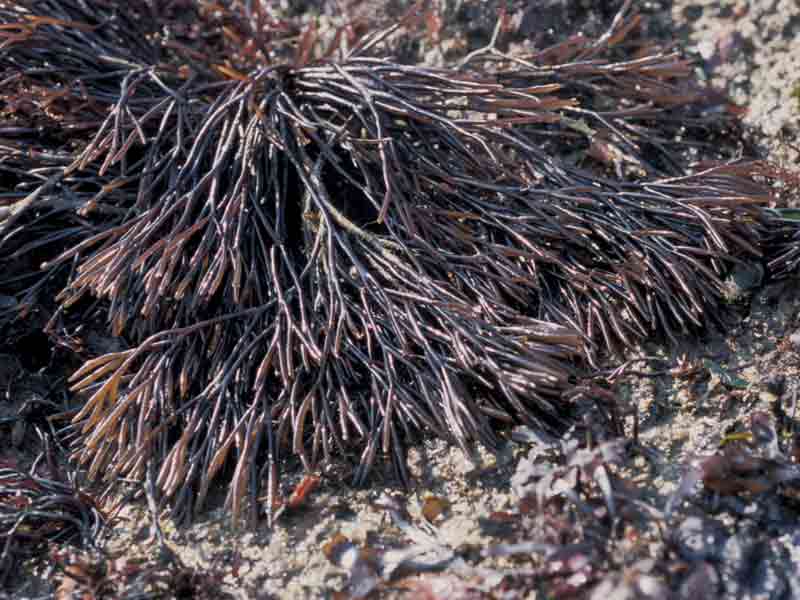
The seaweed Furcellaria lumbricalis, plant with fertile branches.
Photographer: Dr Keith Hiscock Copyright: Dr Keith Hiscock
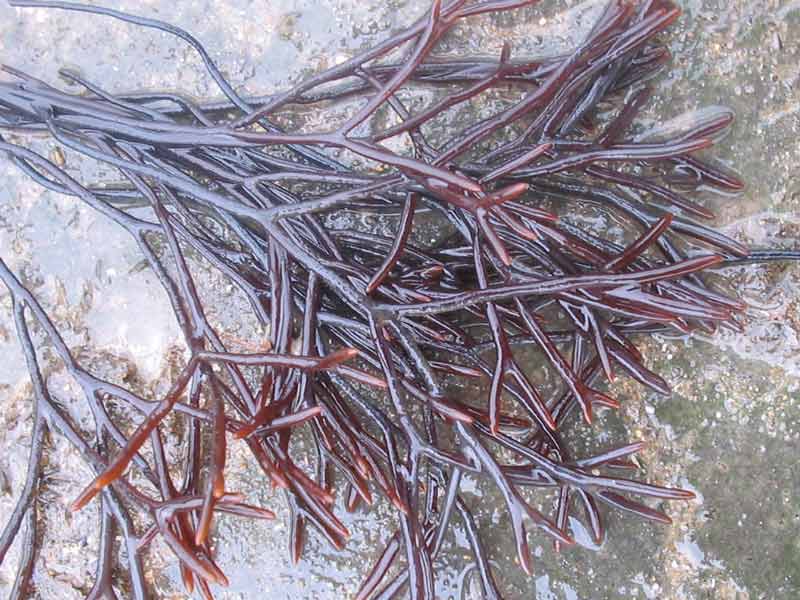
Shiny Furcellaria lumbricalis specimen.
Photographer: Judith Oakley Copyright: Judith Oakley
Distribution data supplied by the Ocean Biodiversity Information System (OBIS). To interrogate UK data visit the NBN Atlas.Map Help
| Researched by | Will Rayment | Refereed by | Dr Stefan Kraan |
| Authority | (Hudson) J.V.Lamouroux, 1813 | ||
| Other common names | - | Synonyms | Furcellaria fastigiata (Hudson) J.V.Lamouroux, 1813, Fucus fastigiata |
Summary
Description
A reddish brown to brownish black seaweed with glossy, cartilaginous, cylindrical fronds, branching dichotomously 6 to 11 times. The fronds rise from a much branched holdfast up to 25 mm in diameter. The reproductive bodies occur as pod-like structures at the ends of the branches. The seaweed grows up to about 30 cm in length.
Recorded distribution in Britain and Ireland
Occurs around all coasts of Britain and Ireland. There is a paucity of records from eastern England and the east coast of Ireland which may reflect a lack of suitable substrata.
Global distribution
In Europe, from northern Norway to the Bay of Biscay, including the Faroe Islands and the Baltic Sea. Also found in Italy and Sardinia. Possibly occurs in Greenland and Iceland. In North America, occurs in Newfoundland and the Gulf of St Lawrence and its outer coasts. In Asia, it occurs in Pakistan and India (see Guiry (2006) for further details).
Habitat
Furcellaria lumbricalis typically grows on rock and stones in the shallow subtidal to a depth of 20 m on sheltered to moderately exposed coasts. Although Furcellaria lumbricalis has been recorded in depths up to 30 m or more in clear water it is rarely found that deeply, especially around the UK, and one would expect to find it to depths of around 10 m. It also occurs in rockpools in the eulittoral. The holdfast is often covered by coarse, sandy deposits. Tolerates sand cover.
Depth range
In pools in eulittoral to 30mIdentifying features
- Erect, cylindrical, dichotomously branching fronds.
- Holdfast is a mass of rhizoids.
- Reddish brown to brownish black in colour, brown in transmitted light and sometimes bleached green by sunlight.
- Tetrasporangial plants larger than gametangial, with branches terminating in spindle shaped pod-like structures.
- Female thalli with fructifications similar to tetrasporangia but with attenuate sterile tip, often forked and 8-18mm long.
- Male thalli distinctive as fertile tips of branches are ovoid, ca 5mm long, slimy and yellowish in colour tinged with pink.
Additional information
-none-Listed by
- none -
Biology review
Taxonomy
| Level | Scientific name | Common name |
|---|---|---|
| Phylum | Rhodophyta | Red seaweeds |
| Class | Florideophyceae | |
| Order | Gigartinales | |
| Family | Furcellariaceae | |
| Genus | Furcellaria | |
| Authority | (Hudson) J.V.Lamouroux, 1813 | |
| Recent Synonyms | Furcellaria fastigiata (Hudson) J.V.Lamouroux, 1813Fucus fastigiata | |
Biology
| Parameter | Data | ||
|---|---|---|---|
| Typical abundance | Moderate density | ||
| Male size range | up to 30 cm | ||
| Male size at maturity | 90-30 cm | ||
| Female size range | 90-30 cm | ||
| Female size at maturity | |||
| Growth form | Arborescent / Arbuscular | ||
| Growth rate | See additional information | ||
| Body flexibility | High (greater than 45 degrees) | ||
| Mobility | Sessile, permanent attachment | ||
| Characteristic feeding method | Autotroph | ||
| Diet/food source | Autotroph | ||
| Typically feeds on | Not relevant | ||
| Sociability | Not relevant | ||
| Environmental position | Epilithic | ||
| Dependency | Independent. | ||
| Supports | None | ||
| Is the species harmful? | No | ||
Biology information
Size at maturity. Plants become fertile when they achieve their full size of 9-30 cm according to habitat, during the 4th to 6th year (Austin 1960a,b).
Growth rate. Bird et al. (1979) reported growth rates of Furcellaria lumbricalis in the laboratory as a doubling in weight in 25-50 days or a 3.3% increase in fresh weight per day. For comparison, the corresponding rates for Chondrus crispus are 10 days and 7.3%, and for Fucus serratus are 12.5 days and 6.2%. These figures suggest that Furcellaria lumbricalis grows slowly in comparison to other red and brown seaweeds. The reported growth rates from the field are even slower. Blinova (1975) (cited in Bird et al., 1979) recorded a doubling in fresh weight every 167 days and Taylor (1975) (cited in Bird et al., 1979) recorded a 1.3% increase in fresh weight per day. From a site in Wales, Austin (1960b) reported annual length increments of 29-37 mm in fronds initially ranging from 10-60 mm in length.
Environmental position. As well as the common epilithic form, a free-floating variant Furcellaria lumbricalis forma aegagropila has been reported forming rafts several metres thick on the Danish coast and may occur in Scottish and Irish sea lochs (Levring et al., 1969). The free-floating form has a globose thallus of radiating fronds and is smaller in stature and frond diameter, with denser and less regular branching than the attached form (Bird et al., 1991).
Habitat preferences
| Parameter | Data |
|---|---|
| Physiographic preferences | Enclosed coast or Embayment, Sea loch or Sea lough, Strait or Sound |
| Biological zone preferences | Lower eulittoral, Lower infralittoral, Mid eulittoral, Sublittoral fringe, Upper circalittoral, Upper eulittoral, Upper infralittoral |
| Substratum / habitat preferences | Bedrock, Cobbles, Large to very large boulders, Macroalgae, Pebbles, Rockpools, Small boulders |
| Tidal strength preferences | Moderately strong 1 to 3 knots (0.5-1.5 m/sec.), Very weak (negligible), Weak < 1 knot (<0.5 m/sec.) |
| Wave exposure preferences | Exposed, Extremely sheltered, Moderately exposed, Sheltered, Very sheltered |
| Salinity preferences | Low (<18 psu), Reduced (18-30 psu), Variable (18-40 psu) |
| Depth range | In pools in eulittoral to 30m |
| Other preferences | |
| Migration Pattern | Non-migratory or resident |
Habitat Information
Around Prince Edward Island, Canada, Furcellaria lumbricalis is sometimes found growing epiphytically on Phyllophora sp. (Sharp et al., 1993).
Life history
Adult characteristics
| Parameter | Data |
|---|---|
| Reproductive type | See additional information |
| Reproductive frequency | Annual episodic |
| Fecundity (number of eggs) | >1,000,000 |
| Generation time | 5-10 years |
| Age at maturity | 4-6 years |
| Season | December - April |
| Life span | Insufficient information |
Larval characteristics
| Parameter | Data |
|---|---|
| Larval/propagule type | - |
| Larval/juvenile development | Spores (sexual / asexual) |
| Duration of larval stage | Not relevant |
| Larval dispersal potential | No information |
| Larval settlement period | Insufficient information |
Life history information
Reproductive type. The typical attached form of Furcellaria lumbricalis reproduces asexually through tetrasporangial plants and sexually through dioecious gametangial plants (Dixon & Irvine, 1977). The male and female plants are usually in equal proportions but are outnumbered by the tetrasporophytes. The free-floating form Furcellaria lumbricalis forma aegagropila reproduces only vegetatively through fragmentation, regeneration and proliferation (Bird et al., 1991). Proliferation, where propagules develop on the parent plant and then detach, is probably the most important mechanism.
Reproduction and seasonality. The mode and timing of reproduction in Furcellaria lumbricalis were reviewed by Dixon & Irvine (1977) and Bird et al. (1991). On the male plants, spermatangial ramuli begin development in late October, developing superficially in the much swollen apical regions and are conspicuous until late April or early May. Discharge of the spermatia occurs from December to April with a peak in February and March. On the female plants, the carpogonial branches are initiated in late December, with carpogonia developing internally in the apical regions. Fertilization probably only occurs over a short period commencing in mid-January. The zygote is retained on the female plant but the carposporophyte is not obvious until mid-summer. Maturation of the carposporophytes does not occur until a year after fertilization, with a massive discharge of carpospores occurring over a 2-4 week period from late December. An average-sized plant may release 1 million 35-50 µm diameter carpospores when a tract of cells disintegrates forming an ill-defined pore to the exterior. On diploid plants, tetrasporangia are initiated in early April and develop in markedly thickened apical regions. They mature in December and 1-2 million tetraspores are liberated per plant over two weeks following the disintegration of the thallus surface. The fruiting pods of all plants fall when they are past maturity and new shoots arise from the resulting truncated tips.
Sensitivity review
The MarLIN sensitivity assessment approach used below has been superseded by the MarESA (Marine Evidence-based Sensitivity Assessment) approach (see menu). The MarLIN approach was used for assessments from 1999-2010. The MarESA approach reflects the recent conservation imperatives and terminology and is used for sensitivity assessments from 2014 onwards.
Physical pressures
Use / to open/close text displayed
| Intolerance | Recoverability | Sensitivity | Evidence / Confidence | |
Substratum loss [Show more]Substratum lossBenchmark. All of the substratum occupied by the species or biotope under consideration is removed. A single event is assumed for sensitivity assessment. Once the activity or event has stopped (or between regular events) suitable substratum remains or is deposited. Species or community recovery assumes that the substratum within the habitat preferences of the original species or community is present. Further details EvidenceRemoval of the substratum would also remove the entire population of Furcellaria lumbricalis growing on it. A small proportion of the population may grow epiphytically on other algal species, e.g. Phyllophora sp. (Sharp et al., 1993), and these would also be removed by substratum loss. Intolerance is therefore assessed as high. Recovery is recorded as moderate (see additional information below). The free living Furcellaria lumbricalis forma aegagropila is not attached to the substratum and therefore would not be affected by substratum loss. However, the free living form is not widely distributed (Levring et al., 1969) and so is not considered to represent the typical intolerance of the species. | High | Moderate | Moderate | High |
Smothering [Show more]SmotheringBenchmark. All of the population of a species or an area of a biotope is smothered by sediment to a depth of 5 cm above the substratum for one month. Impermeable materials, such as concrete, oil, or tar, are likely to have a greater effect. Further details. EvidenceFurcellaria lumbricalis is an erect species which grows up to 300mm in length and is often found with the holdfast buried in coarse sediment (Dixon & Irvine, 1977). Furthermore, Johansson et al. (1998) reported that Furcellaria lumbricalis persisted in areas of the Baltic Sea where eutrophication resulted in high sediment loads. It is likely therefore that mature individuals would be tolerant of smothering with 5cm of sediment. However, recently settled propagules and small developing plants would be buried by 5cm of sediment and be unable to photosynthesize. For example, Vadas et al. (1992) stated that algal spores and propagules are adversely affected by a layer of sediment, which can exclude up to 98% of light. There is therefore likely to be mortality of some portion of the population and so intolerance is assessed as intermediate. Recoverability is recorded as moderate (see additional information below). | Intermediate | Moderate | Moderate | Low |
Increase in suspended sediment [Show more]Increase in suspended sedimentBenchmark. An arbitrary short-term, acute change in background suspended sediment concentration e.g., a change of 100 mg/l for one month. The resultant light attenuation effects are addressed under turbidity, and the effects of rapid settling out of suspended sediment are addressed under smothering. Further details EvidenceFurcellaria lumbricalis is not likely to be affected directly by an increase in suspended sediment. However, increased suspended sediment will have knock on effects in terms of light attenuation (considered in 'turbidity') and siltation. As discussed above in 'smothering', increased rate of siltation may inhibit development of algal spores and propagules resulting in some mortality. Intolerance is therefore assessed as intermediate. Recoverability is recorded as moderate (see additional information below). | Intermediate | Moderate | Moderate | Low |
Decrease in suspended sediment [Show more]Decrease in suspended sedimentBenchmark. An arbitrary short-term, acute change in background suspended sediment concentration e.g., a change of 100 mg/l for one month. The resultant light attenuation effects are addressed under turbidity, and the effects of rapid settling out of suspended sediment are addressed under smothering. Further details EvidenceFurcellaria lumbricalis is not likely to be affected directly by a decrease in suspended sediment and the consequent decrease in siltation. However, the species is tolerant of a certain amount of siltation as demonstrated by the fact that it is often found with its holdfast buried in coarse sediment. If siltation decreased, Furcellaria lumbricalis may become open to competition from algal species which are less sediment tolerant and would otherwise be excluded. | Tolerant | Not relevant | Not sensitive | High |
Desiccation [Show more]Desiccation
EvidenceLike many sublittoral algae, Furcellaria lumbricalis is very intolerant of desiccation. Gessner & Schramm (1971) (reviewed by Bird et al., 1991) recorded that at 18-20°C, the critical saturation deficit for the species was 60-70% of total water content, as contrasted with 10% for the intertidal species Fucus vesiculosus. On desiccation to 65% total water content, photosynthetic rate was depressed to 60% of the norm and recovery following re-immersion took 7 hours. Desiccation to 42% resulted in only 50% recovery in 7 hours and there was no recovery of photosynthesis in thalli dried to 7% of their original water content. Growth experiments by Indergaard et al. (1986) revealed that growth in a continuous spray regime was over 3 times faster (227µm/day vs. 61µm/day) than growth in an intermittent spray regime. The benchmark level of desiccation is exposure to air and sun for one hour. It is difficult to determine how this level relates to the recorded reactions, but it is likely that desiccation would cause mass mortality and so an intolerance of high is recorded. Recovery is recorded as moderate (see additional information below). | High | Moderate | Moderate | Moderate |
Increase in emergence regime [Show more]Increase in emergence regimeBenchmark. A one hour change in the time covered or not covered by the sea for a period of one year. Further details EvidenceFurcellaria lumbricalis is essentially a subtidal algae, but also occurs in rockpools in the intertidal (Dixon & Irvine, 1977) and occasionally at the extreme low water springs level on exposed shores (Austin, 1960b). An increase in emergence of 1 hour every tidal cycle for a year would place the portion of the population furthest up the shore in a zone where it would be vulnerable to desiccation. The effects of desiccation are detailed in the relevant section. Mortality of this portion of the population would be likely so intolerance is assessed as intermediate. Recoverability is recorded as moderate (see additional information below). | Intermediate | Moderate | Moderate | Moderate |
Decrease in emergence regime [Show more]Decrease in emergence regimeBenchmark. A one hour change in the time covered or not covered by the sea for a period of one year. Further details EvidenceFurcellaria lumbricalis is a subtidal species (Dixon & Irvine, 1977) and so would not be affected by a decrease in emergence regime. | Tolerant | Not relevant | Not sensitive | High |
Increase in water flow rate [Show more]Increase in water flow rateA change of two categories in water flow rate (view glossary) for 1 year, for example, from moderately strong (1-3 knots) to very weak (negligible). Further details EvidenceFurcellaria lumbricalis appears to be able to tolerate a wide range of water flow rates. It occurs from extremely sheltered areas with "very weak" tidal streams (Connor et al., 1997a) to exposed coasts (Austin, 1960b) where presumably it experiences much greater water flow rates. Moderate water movement is beneficial to seaweeds as it carries a supply of nutrients and gases to the plants, removes waste products, and prevents settling of silt. However, if flow becomes too strong, plants may be damaged and growth stunted. For example, Austin (1960b) recorded loss of fronds and restricted growth in Furcellaria lumbricalis specimens from an exposed shore in Wales. Additionally, an increase to very strong flows may inhibit settlement of spores and may remove adults or germlings. It is likely therefore that an increase in water flow rate would place the populations originally at the limit of their tolerance into a zone of intolerance and some mortality would result. Intolerance is therefore assessed as intermediate. Recoverability is recorded as moderate. | Intermediate | Moderate | Moderate | Very low |
Decrease in water flow rate [Show more]Decrease in water flow rateA change of two categories in water flow rate (view glossary) for 1 year, for example, from moderately strong (1-3 knots) to very weak (negligible). Further details EvidenceFurcellaria lumbricalis occurs in areas of "very weak" water flow (Connor et al., 1997a) and therefore is likely to be tolerant of decreases in water flow. Gessner (1955) (cited in Schwenke, 1971) stated that deeper growing species of the benthos near Helgoland, including Furcellaria lumbricalis, had a smaller stagnation-caused respiratory inhibition than surface living species, which enabled them to thrive in low flow conditions. Furthermore, Austin (1960b) noted that Furcellaria lumbricalis in areas of low water flow lived longer and grew larger than specimens from areas with high flow. The species is therefore assessed as being tolerant. | Tolerant | Not relevant | Not sensitive | High |
Increase in temperature [Show more]Increase in temperature
For intertidal species or communities, the range of temperatures includes the air temperature regime for that species or community. Further details EvidenceFurcellaria lumbricalis has a wide geographic range, occurring in Europe from northern Norway to the Bay of Biscay. Novaczek & Breeman (1990) recorded that specimens of Furcellaria lumbricalis grew well in the laboratory from 0-25°C with optimal growth between 10 and 15°C. Growth ceased at 25°C and 100% mortality resulted after 3 months exposure to 27°C. Similarly, Bird et al. (1979) recorded optimum growth at 15°C and cessation of growth at 25°C with associated necrosis of apical segments. Considering that maximum sea surface temperatures around the British Isles rarely exceed 20°C (Hiscock, 1998), it is unlikely that Furcellaria lumbricalis would suffer mortality due to the benchmark increase in temperature. However, elevated temperatures would probably result in inhibition of growth and hence intolerance is recorded as low. Growth should quickly return to normal when temperatures return to their original levels so recoverability is assessed as very high. | Low | Very high | Very Low | Moderate |
Decrease in temperature [Show more]Decrease in temperature
For intertidal species or communities, the range of temperatures includes the air temperature regime for that species or community. Further details EvidenceFurcellaria lumbricalis has a wide geographic range, occurring in Europe from northern Norway to the Bay of Biscay. Novaczek & Breeman (1990) recorded that specimens of Furcellaria lumbricalis grew well in the laboratory from 0-25°C with optimal growth between 10 and 15°C. The species tolerated -5°C for 3 months with no mortality. Bird et al. (1979) extrapolated from a growth curve they calculated for Furcellaria lumbricalis and concluded that growth would not be inhibited at 0°C. Minimum surface seawater temperatures rarely fall below 5°C around the British Isles so Furcellaria lumbricalis is likely to tolerate the benchmark decrease in temperature. | Tolerant | Not relevant | Not sensitive | High |
Increase in turbidity [Show more]Increase in turbidity
EvidenceFurcellaria lumbricalis often occurs in relatively turbid waters. Laboratory experiments by Bird et al. (1979) revealed that Furcellaria lumbricalis was growth saturated at very low light levels (ca 20µE/m²/s) compared to other algae such as Chondrus crispus (50-60µE/m²/s) and Fucus serratus (100µE/m²/s). They suggest that this may be an explanation why Furcellaria lumbricalis is able to proliferate in relatively deep and turbid waters. Similarly, in their review, Bird et al. (1999) comment that in all studies, saturation and inhibition radiances were low for Furcellaria lumbricalis compared to other macroalgae indicating good competitive ability in the attenuated light of deeper or more turbid waters. In light of its tolerance of turbid conditions it is expected that the majority of the Furcellaria lumbricalis population would be unaffected by increases in turbidity, indeed, such changes may even provide the species with a competitive advantage over other macroalgae. | Tolerant | Not relevant | Not sensitive | Moderate |
Decrease in turbidity [Show more]Decrease in turbidity
EvidenceFurcellaria lumbricalis is unlikely to be affected by a decrease in turbidity as it is growth saturated at very low light levels compared to other macroalgae (Bird et al., 1979; Bird et al., 1991). | Tolerant | Not relevant | Not sensitive | Low |
Increase in wave exposure [Show more]Increase in wave exposureA change of two ranks on the wave exposure scale (view glossary) e.g., from Exposed to Extremely exposed for a period of one year. Further details EvidenceFurcellaria lumbricalis typically occurs in a wide range of exposure categories, from "extremely sheltered" (Connor et al., 1997a) to exposed (Austin, 1960b). Increases in wave exposure may result in compromised growth and damage to or removal of the plants due to physical abrasion by sediments mobilized by wave action. Austin (1960b) noted that Furcellaria lumbricalis from extremely exposed sites have smaller dimensions than individuals from semi-exposed sites and that fronds may be lost due to storm action. Furthermore, Sharp et al. (1993) reported Furcellaria lumbricalis found cast ashore following storms. It is likely therefore that some mortality would occur due to increases in wave action and so intolerance is assessed as intermediate. Recoverability is recorded as moderate (see additional information below). It should be noted that the free living form Furcellaria lumbricalis forma aegagropila only occurs in sheltered habitats (Levring et al., 1969) and is likely to be more susceptible to being cast ashore by increased wave action. | Intermediate | Moderate | Moderate | Low |
Decrease in wave exposure [Show more]Decrease in wave exposureA change of two ranks on the wave exposure scale (view glossary) e.g., from Exposed to Extremely exposed for a period of one year. Further details EvidenceFurcellaria lumbricalis occurs in "extremely sheltered" habitats (Connor et al., 1997a) and is likely to tolerate decreases in wave exposure. Gessner (1955) (cited in Schwenke, 1971) noted that deep living species such as Furcellaria lumbricalis had a relatively high tolerance of stagnation. However, Austin (1960b) commented that Furcellaria lumbricalis from extremely sheltered habitats achieved smaller dimensions than individuals from moderately exposed habitats. | Tolerant | Not relevant | Not sensitive | High |
Noise [Show more]Noise
EvidenceAlgae have no mechanisms for detection of sound and therefore would not be sensitive to disturbance by noise. | Tolerant | Not relevant | Not sensitive | High |
Visual presence [Show more]Visual presenceBenchmark. The continuous presence for one month of moving objects not naturally found in the marine environment (e.g., boats, machinery, and humans) within the visual envelope of the species or community under consideration. Further details EvidenceAlgae have no visual acuity and therefore would not be affected by visual disturbance. | Tolerant | Not relevant | Not sensitive | High |
Abrasion & physical disturbance [Show more]Abrasion & physical disturbanceBenchmark. Force equivalent to a standard scallop dredge landing on or being dragged across the organism. A single event is assumed for assessment. This factor includes mechanical interference, crushing, physical blows against, or rubbing and erosion of the organism or habitat of interest. Where trampling is relevant, the evidence and trampling intensity will be reported in the rationale. Further details. EvidenceThe fronds of Furcellaria lumbricalis are cartilaginous and flexible and are therefore likely to be reasonably resistant to physical abrasion. However, Austin (1960b) noted that fronds are detached by storm action. The plant's point of attachment to the substratum, the holdfast, is a potential point of weakness. For example, Taylor (1970) (cited in Sharp et al., 1993) stated that clumps of fronds were easily removed from the substratum by drag-raking, but only where the plant had a sufficient number of dichotomies (usually more than 3) to snag in the rake. It is likely therefore that the benchmark level of abrasion, for instance the impact of an anchor and dragging of a chain, would cause some detachment and/or damage. It is unlikely that detached plants would find suitable substrata for reattachment and so mortality is likely to result. Intolerance is therefore assessed as intermediate. Recoverability is recorded as moderate (see additional information below). The free living Furcellaria lumbricalis forma aegagropila would prevent no mechanical resistance to abrasion and so would be unlikely to be damaged. | Intermediate | Moderate | Moderate | Low |
Displacement [Show more]DisplacementBenchmark. Removal of the organism from the substratum and displacement from its original position onto a suitable substratum. A single event is assumed for assessment. Further details EvidenceSharp et al. (1993) noted that, following detachment, Furcellaria lumbricalis plants were capable of reattachment. During this process, growth may be compromised as energy would need to be diverted to the reattachment process. Intolerance is therefore assessed as low. Growth should quickly return to normal once the holdfast has become re-established so recoverability is recorded as very high. It should be noted that reattachment would only be possible if the plant was displaced to a suitable substratum. | Low | Very high | Very Low | Low |
Chemical pressures
Use [show more] / [show less] to open/close text displayed
| Intolerance | Recoverability | Sensitivity | Evidence / Confidence | |
Synthetic compound contamination [Show more]Synthetic compound contaminationSensitivity is assessed against the available evidence for the effects of contaminants on the species (or closely related species at low confidence) or community of interest. For example:
The evidence used is stated in the rationale. Where the assessment can be based on a known activity then this is stated. The tolerance to contaminants of species of interest will be included in the rationale when available; together with relevant supporting material. Further details. EvidenceNo evidence was found specifically relating to the intolerance of Furcellaria lumbricalis to synthetic chemicals. However, inferences may be drawn from the sensitivities of red algal species generally. O'Brien & Dixon (1976) suggested that red algae were the most sensitive group of algae to oil or dispersant contamination, possibly due to the susceptibility of phycoerythrins to destruction. They also report that red algae are effective indicators of detergent damage since they undergo colour changes when exposed to relatively low concentration of detergent. Smith (1968) reported that 10 ppm of the detergent BP 1002 killed the majority of specimens in 24hrs in toxicity tests. Laboratory studies of the effects of oil and dispersants on several red algal species, including Plocamium cartilagineum (order Gigartinales), concluded that they were all sensitive to oil/ dispersant mixtures, with little difference between adults, sporelings, diploid or haploid life stages (Grandy, 1984) (cited in Holt et al., 1995). Cole et al. (1999) suggested that herbicides , such as simazina and atrazine were very toxic to macrophytes. Hoare & Hiscock (1974) noted that all red algae except Phyllophora sp. were excluded from Amlwch Bay, Anglesey, by acidified halogenated effluent discharge. The evidence suggests that in general red algae are very sensitive to synthetic chemicals. Intolerance of Furcellaria lumbricalis is therefore recorded as high. Recoverability is recorded as moderate (see additional information below). | High | Moderate | Moderate | Low |
Heavy metal contamination [Show more]Heavy metal contaminationEvidenceBryan (1984) suggested that the general order for heavy metal toxicity in seaweeds is: Organic Hg > inorganic Hg > Cu > Ag > Zn > Cd > Pb. Cole et al. (1999) reported that Hg was very toxic to macrophytes. The sub-lethal effects of Hg (organic and inorganic) on the sporelings of another intertidal red algae, Plumaria elegans, were reported by Boney (1971). 100% growth inhibition was caused by 1 ppm Hg. No information was found concerning the effects of heavy metals on Furcellaria lumbricalis specifically, and therefore an intolerance assessment has not been attempted. | No information | Not relevant | No information | Not relevant |
Hydrocarbon contamination [Show more]Hydrocarbon contaminationEvidenceNo evidence was found specifically relating to the intolerance of Furcellaria lumbricalis to hydrocarbon contamination. However, inferences may be drawn from the sensitivities of red algal species generally. O'Brien & Dixon (1976) suggested that red algae were the most sensitive group of algae to oil or dispersant contamination, possibly due to the susceptibility of phycoerythrins to destruction. Laboratory studies of the effects of oil and dispersants on several red algal species, including Plocamium cartilagineum (order Gigartinales), concluded that they were all sensitive to oil/ dispersant mixtures, with little difference between adults, sporelings, diploid or haploid life stages (Grandy, 1984) (cited in Holt et al., 1995). Intolerance is therefore assessed as high. Recoverability is recorded as moderate (see additional information below). | High | Moderate | Moderate | Low |
Radionuclide contamination [Show more]Radionuclide contaminationEvidenceNo information was found concerning the intolerance of Furcellaria lumbricalis to radionuclides. | No information | Not relevant | No information | Not relevant |
Changes in nutrient levels [Show more]Changes in nutrient levelsEvidenceBird et al. (1991) commented that productivity by Furcellaria lumbricalis was low, uptake of nutrients was slow and the species was not nutrient limited under normal conditions. This suggests that the species would not be greatly affected by an increase in nutrient concentration. However, eutrophication may have other knock-on effects. Johansson et al. (1998) suggested that one of the symptoms of large scale eutrophication is the deterioration of benthic algal vegetation in areas not directly affected by land-runoff or a point source of nutrient discharge. Altered depth distributions of algal species caused by decreased light penetration and/or increased sedimentation through higher pelagic production have been reported in the Baltic Sea (Kautsky et al., 1986; Vogt & Schramm, 1991). Johansson et al. (1998) studied changes in the benthic algal community of the Skagerrak coast in the Baltic Sea, an area heavily affected by eutrophication, between 1960 and 1997. They noted the disappearance of the red alga, Polyides rotundus, but commented that problems existed in their sampling method. They also noted the increase of delicate red algae with foliaceous thalli, e.g. Delesseria sanguinea and Phycodrys rubens, and tougher red algae with foliaceous thalli, e.g. Phyllophora sp. Increases in the delicate algae were most pronounced at the more wave exposed sites, while increases in the tougher algae occurred at the more sheltered sites with high sedimentation. They commented that these results suggest that the increase of delicate species with large growth potential may have been caused by eutrophication, but that the effect is counteracted when eutrophication results in high sedimentation, in which case the tougher Phyllophora sp. thrive. Additionally, Chondrus crispus and Furcellaria lumbricalis, both species with tough thalli, decreased at the wave exposed sites, possibly due to competition from the more vigorous Phycodrys rubens and Delesseria sanguinea, but persisted at the sites with high sedimentation. This study suggests that, although Furcellaria lumbricalis may be tolerant of eutrophication per se, populations may suffer as result of the reactions of other algal species. Intolerance is therefore recorded as intermediate, and recoverability as moderate (see additional information below). | Intermediate | Moderate | Moderate | Low |
Increase in salinity [Show more]Increase in salinity
EvidenceFurcellaria lumbricalis is a euryhaline species which occurs in a wide range of salinity conditions down to 6-8 psu (Bird et al., 1991). In the Kattegat and the Gulf of St Lawrence, it is reported to compete well with other species at salinities ranging from 25-32 psu (see review by Bird et al., 1991). Growth experiments in the laboratory revealed that optimum growth occurred at 20 psu, the species grew well at 10 psu and 30 psu, but that growth declined above 30 psu to negligible levels at 50 psu (Bird et al., 1979). It is expected that an increase in salinity may cause reduced growth and fecundity, but that mortality is unlikely. Intolerance is therefore assessed as low. Once salinities return to original levels, growth should quickly return to normal so recoverability is recorded as very high. The reason for the alga's euryhalinity may lie in its betaine content. Although these substances are present in insufficient quantity to act as osmotic solutes, they may have a complimentary osmoregulatory function in modifying membrane behaviour or in transporting ions (Blunden et al., 1989). | Low | Very high | Very Low | High |
Decrease in salinity [Show more]Decrease in salinity
EvidenceFurcellaria lumbricalis occurs in the lowest category on the salinity scale (Connor et al., 1997a) and therefore probably relatively tolerant of decreases in salinity. The species forms extensive populations in the main basin of the Baltic Sea where salinity is 6-8 psu in the upper 60-70 m and its extension into the Gulfs of Bothnia and Finland is limited by the 4 psu isohaline (see review by Bird et al., 1991). The reason for the alga's euryhalinity may lie in its betaine content. Although these substances are present in insufficient quantity to act as osmotic solutes, they may have a complimentary osmoregulatory function in modifying membrane behaviour or in transporting ions (Blunden et al., 1989). | Tolerant | Not relevant | Not sensitive | High |
Changes in oxygenation [Show more]Changes in oxygenationBenchmark. Exposure to a dissolved oxygen concentration of 2 mg/l for one week. Further details. EvidenceThe effects of reduced oxygenation on algae are not well studied. Plants require oxygen for respiration, but this may be provided by production of oxygen during periods of photosynthesis. Lack of oxygen may impair both respiration and photosynthesis (see review by Vidaver, 1972). A study of the effects of anoxia on another red alga, Delesseria sanguinea, revealed that specimens died after 24 hours at 15°C but that some survived at 5°C (Hammer, 1972). Insufficientinformation is available to make an intolerance assessment for Furcellaria lumbricalis. | No information | Not relevant | No information | Not relevant |
Biological pressures
Use [show more] / [show less] to open/close text displayed
| Intolerance | Recoverability | Sensitivity | Evidence / Confidence | |
Introduction of microbial pathogens/parasites [Show more]Introduction of microbial pathogens/parasitesBenchmark. Sensitivity can only be assessed relative to a known, named disease, likely to cause partial loss of a species population or community. Further details. EvidenceLittle evidence exists concerning the infection of red algae by microbial pathogens. Barton (1901) noted that Furcellaria lumbricalis may become infested with nematode worms and reacts by gall formation. Insufficientinformation exists to make an intolerance assessment. | No information | Not relevant | No information | Not relevant |
Introduction of non-native species [Show more]Introduction of non-native speciesSensitivity assessed against the likely effect of the introduction of alien or non-native species in Britain or Ireland. Further details. EvidenceJohansson et al. (1998) identified a number of algal species introduced to the Baltic Sea which could potentially compete with the native flora. Of these, only Bonnemaissonia hamifera and Sargassum muticum were observed to proliferate. The habitat preferences of Sargassum muticum and Furcellaria lumbricalis are likely to overlap and competition could potentially occur, with the vigorous Sargassum muticum likely to proliferate. | No information | Not relevant | No information | Not relevant |
Extraction of this species [Show more]Extraction of this speciesBenchmark. Extraction removes 50% of the species or community from the area under consideration. Sensitivity will be assessed as 'intermediate'. The habitat remains intact or recovers rapidly. Any effects of the extraction process on the habitat itself are addressed under other factors, e.g. displacement, abrasion and physical disturbance, and substratum loss. Further details. EvidenceCommercial utilization of Furcellaria lumbricalis is based on the gelling properties of its extracted structural polysaccharide, furcellaran (Bird et al., 1991). Extraction of Furcellaria lumbricalis was reviewed by Guiry & Blunden (1991). Commercial beds of Furcellaria lumbricalis occur in Denmark where the algae are harvested with purpose built trawl nets, whereas in the rest of Europe, the biomass is not sufficient for harvesting. In Denmark, harvesting reached its highest level of 31,000 t p.a. in 1962, but over-exploitation has led to a fall in production and the current harvest is about 10,000 t p.a. Christensen (1971) (cited in Bird et al., 1991) and Plinski & Florczyk (1984) noted that over-exploitation of Furcellaria lumbricalis has resulted in severe depletion of stocks. A sustainable harvest of Furcellaria lumbricalis occurs in Canada on the shores of the Gulf of St Lawrence where the harvest is sustainable as dredging and raking are prohibited and only storm cast plants may be gathered. In view of the potential impact that harvesting may have on the population, intolerance is assessed as high, however, no commercial harvest as yet occurs in Britain or Ireland. Recoverability is recorded as moderate (see additional information below). | High | Moderate | Moderate | Low |
Extraction of other species [Show more]Extraction of other speciesBenchmark. A species that is a required host or prey for the species under consideration (and assuming that no alternative host exists) or a keystone species in a biotope is removed. Any effects of the extraction process on the habitat itself are addressed under other factors, e.g. displacement, abrasion and physical disturbance, and substratum loss. Further details. EvidenceAround Prince Edward Island, Canada, Furcellaria lumbricalis is gathered as bycatch along with the target species, Chondrus crispus. Intolerance is therefore assessed as intermediate and recoverability is recorded as high (see additional information below). However, Furcellaria lumbricalis is unwanted and areas with high proportions of the species are abandoned. Furcellaria lumbricalis may therefore potentially proliferate due to selective exploitation of Chondrus crispus (Sharp et al., 1993). | Intermediate | Moderate | Moderate | Low |
Additional information
Furcellaria lubricalis is highly fecund, an average sized gametophyte being able to produce approximately 1 million carpospores, or a tetrasporophyte, up to 2 million tetraspores (Austin, 1960a). However, the species grows very slowly compared to other red algae (Bird et al., 1979) and takes a long time to reach maturity. For example, Austin (1960b) reported that in Wales, Furcellaria lumbricalis typically takes 5 years to attain fertility. This would mean that, following perturbation, recovery to a mature reproductive community would take at least 5 years. Norton (1992) reviewed dispersal by macroalgae and concluded that dispersal potential is highly variable. Spores of Ulva sp. have been reported to travel 35km, Phycodrys rubens 5km and Sargassum muticum up to 1km. However, the point is made that reach of the furthest propagule and useful dispersal range are not the same thing and recruitment usually occurs on a much more local scale, typically within 10m of the parent plant. Hence, it is expected that Furcellaria lumbricalis would normally only recruit from local populations and hence recovery would be even more protracted in isolated areas. Dispersal could feasibly occur via the free floating Furcellaria lumbricalis forma aegagropila but, as this form only occurs in sheltered areas (Levring et al., 1969) and only reproduces vegetatively (Bird et al., 1991), the establishment of allopatric viable populations is unlikely. Christensen (1971) (cited in Bird et al., 1991) noted that following harvesting of Furcellaria lumbricalis forma aegagropila in the Baltic Sea, harvestable biomass had not been regained 5 years after the suspension of harvesting. In view of its slow growth, time to maturity and limited dispersal, recoverability of Furcellaria lumbricalis is assessed as moderate.Importance review
Policy/legislation
- no data -
Status
| National (GB) importance | - | Global red list (IUCN) category | - |
Non-native
| Parameter | Data |
|---|---|
| Native | Native |
| Origin | - |
| Date Arrived | - |
Importance information
Commercial utilization of Furcellaria lumbricalis is based on the gelling properties of its extracted structural polysaccharide, furcellaran (Bird et al., 1991). Currently, Denmark is the chief producer of furcellaran, mostly processing Furcellaria lumbricalis extracted from Danish waters, although in the past a mixture of Furcellaria lumbricalis and Chondrus crispus was harvested from the Gulf of St Lawrence, Canada (Sharp et al., 1993). Present utilization of furcellaran centres on the food industry, with other applications in pharmaceuticals, wherever water or milk based gels or stabilizers are required (see review by Bird et al., 1991).Bibliography
Austin, A.P., 1960a. Life history and reproduction of Furcellaria fastigiata (L.) Lamouroux. Annals of Botany, New Series, 24, 257-274.
Austin, A.P., 1960b. Observations on the growth, fruiting and longevity of Furcellaria fastigiata (L.) Lamouroux. Hydrobiologia, 15, 193-207.
Barton, E.S., 1901. On certain galls in Furcellaria and Chondrus. Journal of Botany, 39, 49-51.
Bird, C.J., Saunders, G.W. & McLachlan, J., 1991. Biology of Furcellaria lumbricalis (Hudson) Lamouroux (Rhodophyta: Gigartinales), a commercial carrageenophyte. Journal of Applied Phycology, 3, 61-82.
Bird, N.L., Chen, L.C.-M. & McLachlan, J., 1979. Effects of temperature, light and salinity of growth in culture of Chondrus crispus, Furcellaria lumbricalis, Gracilaria tikvahiae (Gigartinales, Rhodophyta), and Fucus serratus (Fucales, Phaeophyta). Botanica Marina, 22, 521-527.
Blunden, G., Smith, B.E. & Cary, P.D., 1989. Trans-4-hydroxy-beta-prolinebetaine, a new betaine from Furcellaria lumbricalis. Journal of Applied Phycology, 1, 1-4.
Boney, A.D., 1971. Sub-lethal effects of mercury on marine algae. Marine Pollution Bulletin, 2, 69-71.
Bryan, G.W., 1984. Pollution due to heavy metals and their compounds. In Marine Ecology: A Comprehensive, Integrated Treatise on Life in the Oceans and Coastal Waters, vol. 5. Ocean Management, part 3, (ed. O. Kinne), pp.1289-1431. New York: John Wiley & Sons.
Cole, S., Codling, I.D., Parr, W. & Zabel, T., 1999. Guidelines for managing water quality impacts within UK European Marine sites. Natura 2000 report prepared for the UK Marine SACs Project. 441 pp., Swindon: Water Research Council on behalf of EN, SNH, CCW, JNCC, SAMS and EHS. [UK Marine SACs Project.]. Available from: http://ukmpa.marinebiodiversity.org/uk_sacs/pdfs/water_quality.pdf
Connor, D.W., Dalkin, M.J., Hill, T.O., Holt, R.H.F. & Sanderson, W.G., 1997a. Marine biotope classification for Britain and Ireland. Vol. 2. Sublittoral biotopes. Joint Nature Conservation Committee, Peterborough, JNCC Report no. 230, Version 97.06., Joint Nature Conservation Committee, Peterborough, JNCC Report no. 230, Version 97.06.
Dickinson, C.I., 1963. British seaweeds. London & Frome: Butler & Tanner Ltd.
Dixon, P.S. & Irvine, L.M., 1977. Seaweeds of the British Isles. Volume 1 Rhodophyta. Part 1 Introduction, Nemaliales, Gigartinales. London: British Museum (Natural History) London.
Fish, J.D. & Fish, S., 1996. A student's guide to the seashore. Cambridge: Cambridge University Press.
Guiry, M.D. & Blunden, G., 1991. Seaweed Resources in Europe: Uses and Potential. Chicester: John Wiley & Sons.
Hammer, L., 1972. Anaerobiosis in marine algae and marine phanerograms. In Proceedings of the Seventh International Seaweed Symposium, Sapporo, Japan, August 8-12, 1971 (ed. K. Nisizawa, S. Arasaki, Chihara, M., Hirose, H., Nakamura V., Tsuchiya, Y.), pp. 414-419. Tokyo: Tokyo University Press.
Hardy, F.G. & Guiry, M.D., 2003. A check-list and atlas of the seaweeds of Britain and Ireland. London: British Phycological Society
Hiscock, K., ed. 1998. Marine Nature Conservation Review. Benthic marine ecosystems of Great Britain and the north-east Atlantic. Peterborough, Joint Nature Conservation Committee.
Hoare, R. & Hiscock, K., 1974. An ecological survey of the rocky coast adjacent to the effluent of a bromine extraction plant. Estuarine and Coastal Marine Science, 2 (4), 329-348.
Holt, T.J., Jones, D.R., Hawkins, S.J. & Hartnoll, R.G., 1995. The sensitivity of marine communities to man induced change - a scoping report. Countryside Council for Wales, Bangor, Contract Science Report, no. 65.
Indergaard, M., Oestgaard, K., Jensen, A. & Stoeren, O., 1986. Growth studies of macroalgae in a microcomputer-assisted spray cultivation system. Journal of Experimental Marine Biology and Ecology, 98, 199-213.
Johansson ,G., Eriksson, B.K., Pedersen, M. & Snoeijs, P., 1998. Long term changes of macroalgal vegetation in the Skagerrak area. Hydrobiologia, 385, 121-138.
Kautsky, N., Kautsky, H., Kautsky, U. & Waern, M., 1986. Decreased depth penetration of Fucus vesiculosus (L.) since the 1940s indicates eutrophication of the Baltic Sea. Marine Ecology Progress Series, 28, 1-8.
Levring, T., Hoppe, H.A. & Schmid, O.J., 1969. Marine Algae: a survey of research and utilization. Hamburg: Cram, de Gruyter & Co. [Botanica Marina Handbooks, Vol. 1.]
Norton, T.A. (ed.), 1985. Provisional Atlas of the Marine Algae of Britain and Ireland. Huntingdon: Biological Records Centre, Institute of Terrestrial Ecology.
Norton, T.A., 1992. Dispersal by macroalgae. British Phycological Journal, 27, 293-301.
Novaczek, I. & Breeman, A.M., 1990. Thermal ecotypes of amphi-Atlantic algae. 2. Cold-temperate species (Furcellaria lumbricalis and Polyides rotundus). Helgolander Meeresuntersuchungen, 44, 475-485.
O'Brien, P.J. & Dixon, P.S., 1976. Effects of oils and oil components on algae: a review. British Phycological Journal, 11, 115-142.
Schwenke, H., 1971. Water movement: 2. Plants. In Marine Ecology. Volume 1. Environmental Factors (2), 705-820 (ed. O. Kinne). Wiley-Interscience, London.
Sharp, G.J., Tetu, C., Semple, R. & Jones, D., 1993. Recent changes in the seaweed community of western Prince Edward Island: implications for the seaweed industry. Hydrobiologia, 260-261, 291-296.
Smith, J.E. (ed.), 1968. 'Torrey Canyon'. Pollution and marine life. Cambridge: Cambridge University Press.
Vadas, R.L., Johnson, S. & Norton, T.A., 1992. Recruitment and mortality of early post-settlement stages of benthic algae. British Phycological Journal, 27, 331-351.
Vidaver, W., 1972. Dissolved gases - plants. In Marine Ecology. Volume 1. Environmental factors (3), (ed. O. Kinne), 1471-1490. Wiley-Interscience, London.
Vogt, H. & Schramm, W., 1991. Conspicuous decline of Fucus in Kiel Bay (Western Baltic): what are the causes ? Marine Ecology Progress Series, 69, 189-194.
Datasets
Centre for Environmental Data and Recording, 2018. Ulster Museum Marine Surveys of Northern Ireland Coastal Waters. Occurrence dataset https://www.nmni.com/CEDaR/CEDaR-Centre-for-Environmental-Data-and-Recording.aspx accessed via NBNAtlas.org on 2018-09-25.
Cofnod – North Wales Environmental Information Service, 2018. Miscellaneous records held on the Cofnod database. Occurrence dataset: https://doi.org/10.15468/hcgqsi accessed via GBIF.org on 2018-09-25.
Fenwick, 2018. Aphotomarine. Occurrence dataset http://www.aphotomarine.com/index.html Accessed via NBNAtlas.org on 2018-10-01
Fife Nature Records Centre, 2018. St Andrews BioBlitz 2014. Occurrence dataset: https://doi.org/10.15468/erweal accessed via GBIF.org on 2018-09-27.
Fife Nature Records Centre, 2018. St Andrews BioBlitz 2015. Occurrence dataset: https://doi.org/10.15468/xtrbvy accessed via GBIF.org on 2018-09-27.
Kent Wildlife Trust, 2018. Biological survey of the intertidal chalk reefs between Folkestone Warren and Kingsdown, Kent 2009-2011. Occurrence dataset: https://www.kentwildlifetrust.org.uk/ accessed via NBNAtlas.org on 2018-10-01.
Kent Wildlife Trust, 2018. Kent Wildlife Trust Shoresearch Intertidal Survey 2004 onwards. Occurrence dataset: https://www.kentwildlifetrust.org.uk/ accessed via NBNAtlas.org on 2018-10-01.
Manx Biological Recording Partnership, 2017. Isle of Man wildlife records from 01/01/2000 to 13/02/2017. Occurrence dataset: https://doi.org/10.15468/mopwow accessed via GBIF.org on 2018-10-01.
Manx Biological Recording Partnership, 2018. Isle of Man historical wildlife records 1995 to 1999. Occurrence dataset: https://doi.org/10.15468/lo2tge accessed via GBIF.org on 2018-10-01.
Merseyside BioBank., 2018. Merseyside BioBank (unverified). Occurrence dataset: https://doi.org/10.15468/iou2ld accessed via GBIF.org on 2018-10-01.
National Trust, 2017. National Trust Species Records. Occurrence dataset: https://doi.org/10.15468/opc6g1 accessed via GBIF.org on 2018-10-01.
NBN (National Biodiversity Network) Atlas. Available from: https://www.nbnatlas.org.
OBIS (Ocean Biodiversity Information System), 2025. Global map of species distribution using gridded data. Available from: Ocean Biogeographic Information System. www.iobis.org. Accessed: 2025-05-09
Outer Hebrides Biological Recording, 2018. Non-vascular Plants, Outer Hebrides. Occurrence dataset: https://doi.org/10.15468/goidos accessed via GBIF.org on 2018-10-01.
Royal Botanic Garden Edinburgh, 2018. Royal Botanic Garden Edinburgh Herbarium (E). Occurrence dataset: https://doi.org/10.15468/ypoair accessed via GBIF.org on 2018-10-02.
South East Wales Biodiversity Records Centre, 2018. SEWBReC Algae and allied species (South East Wales). Occurrence dataset: https://doi.org/10.15468/55albd accessed via GBIF.org on 2018-10-02.
Yorkshire Wildlife Trust, 2018. Yorkshire Wildlife Trust Shoresearch. Occurrence dataset: https://doi.org/10.15468/1nw3ch accessed via GBIF.org on 2018-10-02.
Citation
This review can be cited as:
Last Updated: 22/05/2008