
Spirobranchus triqueter with barnacles and bryozoan crusts on unstable circalittoral cobbles and pebbles
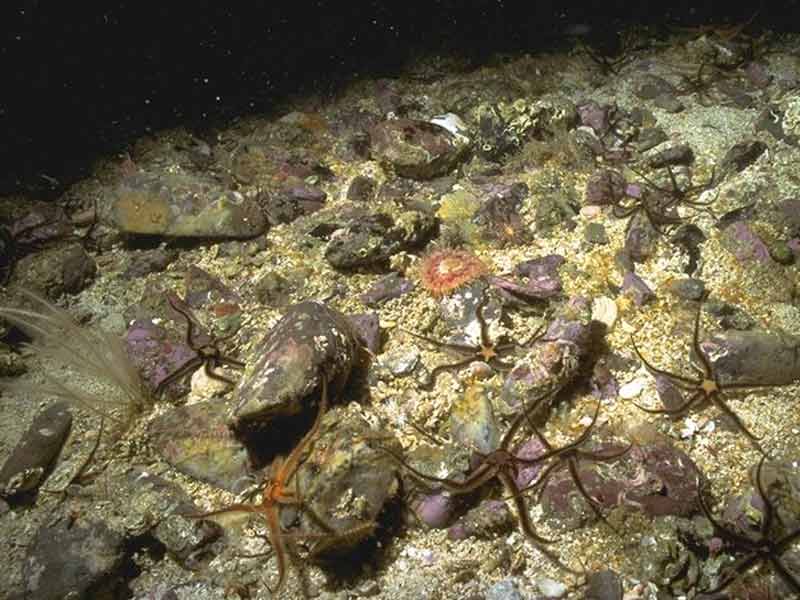
Ophiocomina on cobbles and sediment (ECR.PomByC).
Photographer: Sue Scott Copyright: Joint Nature Conservation Committee (JNCC)
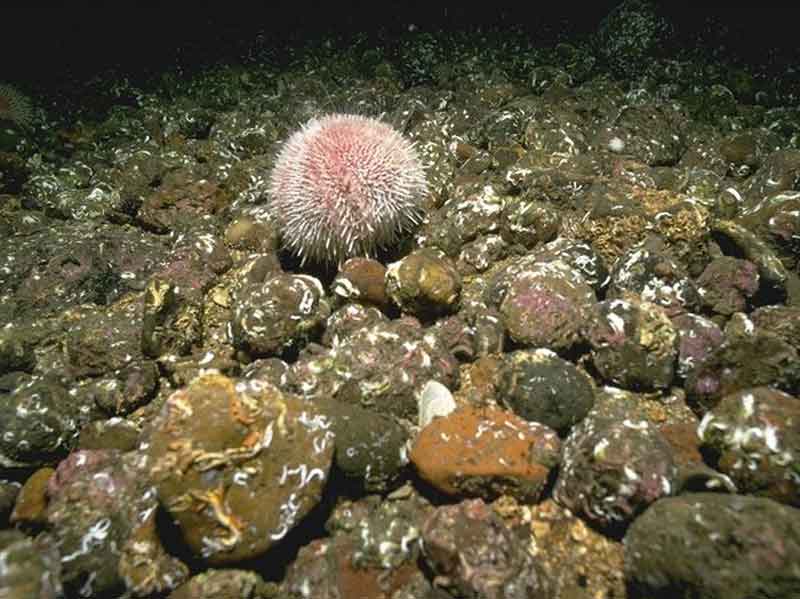
Cobbles with dense Pomatoceros species (ECR.PomByC).
Photographer: Jon Davies Copyright: Joint Nature Conservation Committee (JNCC)

Map Key
- Orange points: Core Records
- Pale Blue points: Non-core, certain determination
- Black points: Non-core, uncertain determination
- Yellow areas: Predicted habitat extent
| Researched by | George Charalambides, Dr Harvey Tyler-Walters, Dr Heidi Tillin & Amy Watson | Refereed by | This information is not refereed |
|---|
Summary
UK and Ireland classification
Description
This biotope is characterized by a few ubiquitous robust and/or fast-growing ephemeral species which are able to colonise pebbles and unstable cobbles and slates which are regularly moved by wave and tidal action. The main cover organisms tend to be restricted to calcareous tube worms such as Spirobranchus triqueter or S. lamarcki, small barnacles including Balanus crenatus and Balanus balanus, and a few bryozoan and coralline algal crusts. Barnacles may be predominantly observed in shallower variants of the biotope. Scour action from the mobile substratum prevents colonisation by more delicate species. Occasionally, in tide-swept conditions tufts of hydroids such as Sertularia argentea and Hydrallmania falcata are present. Occasional epifauna may include Asterias rubens, Synarachnactis lloydii, and Alcyonium digitatum. Bryozoa Parazoanthus anguicomus, Ulva, Porania, and Porifera can also be present. This biotope often grades into SS.SMx.CMx.FluHyd which is characterised by large amounts of the above hydroids on stones also covered in Spirobranchus and barnacles. The main difference here is that SS.SMx.CMx.FluHyd seems to develop on more stable, consolidated cobbles and pebbles or larger stones set in sediment in moderate tides. These stones may be disturbed in the winter and therefore long-lived and fragile species are not found. This biotope is found on exposed open coasts, at the entrance to marine inlets as well as offshore deeper waters. (Information from JNCC, 2022).
Depth range
5-10 m, 10-20 m, 20-30 m, 30-50 m, 50-100 mAdditional information
None entered.
Habitat review
Ecology
Ecological and functional relationships
This biotope is characterized by an impoverished fauna, dominated by fast growing epifauna such as the tubeworms, encrusting bryozoans and barnacles. The dominant species probably compete for space on the available hard substrata. While Spirobranchus triqueter may overgrow encrusting bryozoans, encrusting bryozoans tolerate overgrowth and probably subsequently grow over the calcareous tube of Spirobranchus triqueter (Gordon, 1972; Rubin, 1985). Encrusting bryozoans and encrusting corallines also probably compete for space. But this biotope experiences seasonal and sporadic cycles of severe scour that will free space for colonization, so that competition is probably limited. Numerous species have been recorded within this biotope but most are probably opportunistic or are species that are fortunate to find temporary sheltered niches from scour, and the species present probably vary with location. Overall, the community is primarily opportunistic and ephemeral.- Primary productivity is provided by encrusting corallines although few species present can probably graze them and few other algae are likely to survive scour in the long-term.
- The dominant species are suspension feeders on phytoplankton, zooplankton and organic particulates, e.g. the tubeworm Spirobranchus triqueter, barnacles Balanus crenatus and Balanus balanus, encrusting bryozoans (e.g. Parasmittina trispinosa), occasional erect Bryozoa (e.g. Crissiidae, Flustra foliacea and Scrupocellaria species), and occasional hydroids e.g. Sertularia argentea, Nemertesia species and Hydrallmania falcata).
- Where present, Urticina felina is a passive predator of zooplankton and small invertebrates.
- Mobile predators on epifauna include the starfish Asterias rubens and occasional Echinus esculentus feeding on epifaunal crusts, encrusting corallines, hydroids and bryozoans.
- Starfish and hermit crabs (e.g. Pagurus bernhardus) are probably generalist predators and scavengers within the biotope.
Seasonal and longer term change
This biotope probably experiences seasonal variation in scour, which is most severe in winter storms. Holme & Wilson (1985) suggested that the fauna of his Balanus-Pomatoceros assemblage in the central English Channel was restricted to rapid growing colonizers able to settle rapidly and utilize space in short periods of stability in the summer months. The biotope will probably exhibit spring and summer peaks in hydroids, erect bryozoa and fast growing ascidians. Species richness is probably highest in the spring and summer. Inter-annual variation in storms and wave action is likely to remove the majority of epifauna in some years but allow more species to become established in others. However, the biotope is dominated by opportunistic species and effectively annual and ephemeral. Off Chesil Bank, the epifaunal communities dominated by Spirobranchus (syn. Pomatoceros) triqueter, Balanus crenatus and Electra pilosa, decreased in cover in October, was scoured away in winter storms, and was recolonized in May to June (Warner, 1985). Warner (1985) reported that the community did not contain any persistent individuals, being dominated by rapidly colonizing organisms but, while larval recruitment was patchy and varied between the years studied, recruitment was sufficiently predictable to result in a dynamic stability and a similar community was present in 1979, 1980 and 1983.Habitat structure and complexity
The surface of cobbles and pebbles support tubes of Spirobranchus species, encrusting coralline algae, encrusting bryozoans and barnacles. Boulders and more stable hard substrata may support more delicate species such as the hydroids, erect bryozoans (e.g. Bugula spp. and Flustra foliacea) and fast growing ascidians (e.g. Ascidiella species and Dendrodoa grossularia). Patches of gravel and sand overlying bedrock may support the large dahlia anemone Urticina felina. The sand and gravel infauna probably supports meiofauna and some polychaetes but no information was found. Mobile species such as squat lobster (e.g. Galathea spp.) may use spaces between boulders as temporary refuges. Brittlestars (e.g. Ophiocomina nigra and Ophiothrix fragilis) may utilize spaces between cobbles and pebbles. The biotope may be surrounded by more species rich biotopes. For example, the biotope may grade into MCR.Flu.SerHyd with increasing substratum stability (Connor et al., 1997a). Holmes & Wilson (1985) noted that raised bedrock, above the main area affected by scour, in the English Channel was characterized by Flustra foliacea communities (see MCR.Flu for more information).Productivity
This biotope is dominated by secondary producers. Food in the form of phytoplankton, zooplankton and organic particulates from the water column together with detritus and abraded macroalgal particulates from shallow water ecosystems are supplied by water currents and converted into faunal biomass. Their secondary production supplies higher trophic levels such as mobile predators (e.g. starfish, sea urchins, and fish) and scavengers (e.g. starfish and crabs) and the wider ecosystem in the form of detritus (e.g. dead bodies and faeces). In addition, reproductive products (sperm, eggs, and larvae) also contribute to the zooplankton (Hartnoll, 1998). No estimates of productivity were found in the literature but the biotope is impoverished so that productivity is likely to be low.Recruitment processes
Spirobranchus triqueter probably breeds throughout the year with a peak in spring and summer, although breeding was reported to only occur in April at Port Erin (Moore, 1937; Segrove, 1941; Hayward & Ryland, 1995). Larvae are pelagic for about 2-3 weeks in the summer. However, in the winter this amount of time increases to about 2 months (Hayward & Ryland, 1995). Settlement was reported to be rare in winter but maximum settlement occurred in April, June, August and Sept-Oct (Castric-Fey, 1983). Once settled juveniles grow at about 1.5mm/month, and become sexually mature with about 4 months (see MarLIN review). Spirobranchus triqueter may live for up to 4 years, although 1.5-2.5 years is probably more usual and most die after reproduction (Castric-Fey, 1983; Hayward & Ryland, 1995), so that lifespan probably depends on location and environmental conditions. Dispersal potential is high, depending on local hydrographic condition, and tubeworms, such as spirorbids and Spirobranchus triqueter are commonly the initial recruits to new substrata (Sebens, 1985, 1986; Hatcher, 1998). For example, Spirobranchus triqueter colonized artificial reefs soon after deployment in summer (Jensen et al., 1994), settlement plates within 2-3.5 months and dominated spring recruitment (Hatcher, 1998). However, in the mobile stone communities of Chesil Bank, Warner (1985) suggested that Spirobranchus (syn. Pomatoceros) triqueter did not reach sexual maturity in the population he studied.The barnacle Balanus crenatus reproduces between February and September, larvae settling in a peak from April to October. Once settled, Balanus crenatus matures within 4 months, so that April settled individuals can produce larvae by July, reaching full size before their first winter (Rainbow, 1984). Balanus crenatus has a lifespan of only 18 months so that the population requires continuous recruitment. Therefore, dispersal potential is high, depending on the local hydrographic regime. Balanus crenatus also colonized settlement plates or artificial reefs within 1-3 months of deployment in summer, (Brault & Bourget, 1985; Hatcher, 1998), and became abundant on settlement plates shortly afterwards (Standing, 1976; Brault & Bourget, 1985).
The brooded, lecithotrophic coronate larvae of many bryozoans (e.g. Flustra foliacea, Parasmittina trispinosa, and Bugula species), have a short pelagic lifetime of several hours to about 12 hours (Ryland, 1976). Recruitment is dependant on the supply of suitable, stable, hard substrata (Eggleston, 1972b; Ryland, 1976; Dyrynda, 1994). However, even in the presence of available substratum, Ryland (1976) noted that significant recruitment in bryozoans only occurred in the proximity of breeding colonies. Other species, such as Electra and Crisia release long-lived planktonic larvae. Electra pilosa has a planktonic larvae with a protracted life in the plankton and potentially extended dispersal and can colonize a wide variety of substrata. It is probably adapted to rapid growth and reproduction (r-selected), capable of colonizing ephemeral habitats, but may also be long lived in ideal conditions (Hayward & Ryland, 1998). In settlement studies, Einhornia crustulenta (as Electra crustulenta) recruited to plates within 5 -6months of deployment (Sandrock et al., 1991). Jensen et al. (1994) reported that encrusting bryozoans colonized an artificial reef within 6-12months. Keough (1983) noted that Parasmittina raigii colonized settlement plates annually. Overall, encrusting bryozoans are probably rapid colonizers of available hard substrata.Hydroids are often initial colonizing organisms in settlement experiments and fouling communities (Jensen et al., 1994; Gili & Hughes, 1995; Hatcher, 1998). The hydroids (e.g. Hydrallmania falcata and Sertularia argentea) lack a medusa stage, releasing planula larvae. Planula larvae swim or crawl for short periods (e.g. <24hrs) so that dispersal away from the parent colony is probably very limited (Sommer, 1992; Gili & Hughes, 1995). However, Nemertesia antennina releases planulae on mucus threads, that increase potential dispersal to 5 -50m, depending on currents and turbulence (Hughes, 1977). Most species of hydroid in temperate waters grow rapidly and reproduce in spring and summer. Few species of hydroids have specific substrata requirements and many are generalists. Hydroids are also capable of asexual reproduction and many species produce dormant, resting stages, that are very resistant of environmental perturbation (Gili & Hughes, 1995). But Hughes (1977) noted that only a small percentage of the population of Nemertesia antennina in Torbay developed from dormant, regressed hydrorhizae, the majority of the population developing from planulae as three successive generations. Rapid growth, budding and the formation of stolons allows hydroids to colonize space rapidly. Fragmentation may also provide another route for short distance dispersal. Hydroids may potentially disperse over a wide area in the long-term as dormant stages, or reproductive adults, rafting on floating debris or hitch-hiking on ships hulls or in ballast water (Cornelius, 1992; Gili & Hughes, 1995).
Overall, the dominant species in the biotope, i.e. the tubeworms, encrusting bryozoans and barnacles, are good initial colonizers of hard substrata, capable of rapid growth and reproduction (r-selected) and adapted to ephemeral habitats.Time for community to reach maturity
This biotope has a impoverished community consisting of rapid colonizing, rapid growing and reproducing species (see above). After winter storms or other severe disturbance, the dominant species would probably recolonize the habitat within a few months, and the community probably develops annually by recruitment from surviving individuals or colonies and recruitment from adjacent or upstream habitats. The biotope would probably be recognizable within less than 6 months. Hydroids and erect bryozoans may take longer to establish, probably from surviving fragments or hydrorhizae but would either regrow or re-colonize within 6-12 months in most cases. Holme & Wilson (1985) suggested that the fauna of his Balanus-Pomatoceros assemblage was restricted to rapid growing colonizers able to settle rapidly and utilize space in short periods of stability in the summer months, and develop within less than a year.Additional information
None enteredPreferences & Distribution
Habitat preferences
| Depth Range | 5-10 m, 10-20 m, 20-30 m, 30-50 m, 50-100 m |
|---|---|
| Water clarity preferences | No information |
| Limiting Nutrients | No information |
| Salinity preferences | Full (30-40 psu) |
| Physiographic preferences | Open coast |
| Biological zone preferences | Circalittoral |
| Substratum/habitat preferences | Cobbles, Pebbles |
| Tidal strength preferences | Moderately strong 1 to 3 knots (0.5 to 1.5 m/sec.), Strong 3 to 6 knots (1.5 to 3 m/sec.) |
| Wave exposure preferences | Exposed, Moderately exposed, Very exposed |
| Other preferences | Mobile hard substrata and scour |
Additional Information
This biotope characterizes hard mobile substrata such as cobbles, pebbles and boulders with sand or gravel in areas of considerable water movement either due to wave action or tidal streams. The biotope occurs in very wave exposed to moderately wave exposed habitats, and/or in areas of strong to very weak tidal streams (Connor et al., 1997a; JNCC, 1999). Scour of the cobbles, pebbles and boulders by sand, or by mobilization of the cobbles and pebbles themselves results in a scour-resistant or ephemeral fauna. For example, in the mouth of the Teign, Devon, ECR.PomByC occurs on cobbles sitting on coarse sand and gravel in a scour pit. This biotope is probably very similar to the impoverished Balanus-Pomatoceros assemblage described on hard substrata subject to severe scour or deep submergence by sand or gravel reported by Holme & Wilson (1985) in tide-swept areas of the central English Channel.
Species composition
Species found especially in this biotope
- Balanus crenatus
- Pomatoceros triqueter
Rare or scarce species associated with this biotope
-
Additional information
The MNCR recorded 265 species in 9 records of this biotope. But only a few dominant species occurred in any abundance and most species were only occasional or rare, and not all species occurred in all records of the biotope.Sensitivity review
Sensitivity characteristics of the habitat and relevant characteristic species
This biotope characterizes hard mobile substrata such as cobbles, pebbles and boulders with sand or gravel in areas of considerable water movement either due to wave action or tidal streams. The biotope occurs in very wave exposed to moderately wave exposed habitats, and/or in areas of strong to moderately strong tidal streams (JNCC, 2022). Scour of the cobbles, pebbles and boulders by sand, or by mobilization of the cobbles and pebbles themselves results in a scour-resistant or ephemeral fauna. For example, in the mouth of the Teign, Devon, this biotope (SS.SCS.CCS.SpiB) occurs on cobbles sitting on coarse sand and gravel in a scour pit. This biotope is probably very similar to the impoverished Balanus-Pomatoceros assemblage described on hard substrata subject to severe scour or deep submergence by sand or gravel reported by Holme & Wilson (1985) in tide-swept areas of the central English Channel.
This biotope is characterized by a few ubiquitous robust and/or fast-growing ephemeral species that are able to colonize pebbles and unstable cobbles and slates regularly moved by wave and tidal action. The main cover organisms tend to be restricted to calcareous tube worms such as Spirobranchus triqueter (syn. Pomatoceros lamarcki), small barnacles including Balanus crenatus and Balanus balanus, and a few bryozoan and coralline algal crusts. Hydroids tolerant of tide-swept conditions may colonize deeper examples, where wave action is mitigated by depth, only to be removed in winter storms. Similarly, the burrowing anemone Synarachnactis lloydii probably survives where it can burrow into the underlying coarse sand, and withdraw into its burrow to avoid scour by cobbles and pebbles.
The sensitivity assessments are based on the characterizing species Spirobranchus triqueter, Balanus crenatus, and generic assessments for encrusting corallines and bryozoan crusts. The mobile substrata preventing colonization by larger, long-lived and more sensitive species is a key factor structuring the biotope and significant alteration to the mobility of the cobble/pebble/ slate substrata is likely to change the character of the biotope. Where pressures may alter this factor, this is identified and discussed within the sensitivity assessments.
Resilience and recovery rates of habitat
Spirobranchus triqueter is a species of serpulid worm that forms encrusting tubes, typically 2 to 3 cm long, on rock and shell surfaces. Once settled onto the substratum, the worm forms a temporary, delicate, semi-transparent tube. Mature tubes are formed by a secretion of calcium carbonate. The growth rate was observed by Dons (1927) to be 1.5 mm per month, although this varies with external conditions. Hayward & Ryland (1995) and Dons (1927) stated that sexual maturity is reached in approximately four months. Spirobranchus triqueter lives for two to four years (Dons, 1927; Castric-Fey, 1983; Hayward & Ryland, 1995a). Spirobranchus triqueter is also a visually dominant species within mobile and/or disturbed biotopes, e.g. SS.SCS.CCS.SpiB (Connor et al., 2004; JNCC, 2022), indicating this species is either highly resilient to physical disturbance or has a rapid recolonization rate. In agreement, Hiscock (1983) noted that a community, under conditions of scour and abrasion from stones and boulders moved by storms, developed into a community consisting of fast-growing species such as Spirobranchus triqueter. Furthermore, Michaelis et al. (2019) noted a shift in epibenthic assemblages of hard substrata habitats (particularly at less disturbed sites) in the German Bight from short-lived taxa (<5 years), like Spirobranchus triqueter, to long-lived taxa (>5 years), like Flustra foliacea.
Despite being short-lived, Spirobranchus triqueter have a very long reproductive period (with unpredictable peaks, more frequent from late summer to autumn), have a high reproduction rate, are broadcast spawners, and are therefore likely to have large dispersal capacity (Fava, Ponti & Abbiati, 2016). Larvae are pelagic for about two to three weeks in the summer. However, in the winter, this amount of time increases to about two months (Hayward & Ryland, 1995). The time of reproduction is variable. Hayward & Ryland (1995) and Segrove (1941) suggested that Spirobranchus triqueter reproduction probably takes place throughout the year, but peaks in spring and summer. However, Moore (1937) noted that Spirobranchus triqueter breeding only took place in April in Port Erin, Isle of Man. Castric-Fey (1983) studied variations in settlement rate and concluded that, although the species settled all year round, a very rare settlement was observed during winter and maximum settlement occurred in April, June, August and Sept-Oct. Studies in Bantry Bay, Ireland, revealed a single peak in recruitment during summer (especially July and August) with very little recruitment at other times of the year (Cotter et al., 2003). Also, Spirobranchus triqueter is a protandrous hermaphrodite, with older, larger individuals more likely to be female (Cotter et al., 2003). Spirobranchus triqueter settlers exhibit gregarious behaviour, so the first recruiters may favour the fast growth of local populations (Klockner, 1976 cited in Fava, Ponti & Abbiati, 2016).
Spirobranchus triqueter is also a primary fouling organism (Crisp, 1965) colonizing artificial, commercially important structures such as buoys, ship hulls, docks, and offshore oil rigs (OECD, 1967). Spirobranchus triqueter is a pioneer species and commonly the initial recruit to new substrata (Sebens, 1985; Sebens, 1986; Hatcher, 1998).
For example, Fava, Ponti & Abbiati (2016) noted in a recruitment study in the Northern Adriatic Continental Shelf that Spirobranchus, along with the bivalve Anomia ephippium, were the first species to colonize the set-out bare travertine tiles. The experiment lasted three years (January 2006 to August 2008), and within the first month, the most abundant taxa were serpulid polychaetes, mainly Spirobranchus triqueter (6.5 ± 0.8%), and by June 2006, Spirobranchus triqueter coverage reached 19.5 ± 2.2% (Fava, Ponti & Abbiati, 2016). During the first 10 months of the experiment, Spirobranchus triqueter was the most abundant species, and the early stages of recruitment lasted 10 to 12 months, by which time even species from natural substrata began colonizing tiles by settlement of planktonic propagules (e.g., encrusting calcareous Rhodophyta) or by lateral encroachment (e.g., sponges and ascidians) (Fava, Ponti & Abbiati, 2016). As many other pioneer species, Spirobranchus triqueter is a poor competitor for space, and it is often overgrown by other organisms (Andersson et al., 2009 cited in Fava, Ponti & Abbiati, 2016), as observed after the first year, despite some recruitment occurring in autumn of the second year (Fava, Ponti & Abbiati, 2016). In addition, Fava, Ponti & Abbiati (2016) highlighted that the relatively low sedimentation rate at the northern site of their study was among one of the environmental conditions that may have favoured settlement and recruitment of Spirobranchus triqueter.
Similarly, Spirobranchus triqueter colonized artificial reefs soon after deployment in summer (Jensen et al., 1994), colonized settlement plates within 2 to 3.5 months and dominated spring recruitment (Hatcher, 1998). Nerlovic et al. (2018) studied the composition of biofouling communities in the northern Adriatic Sea, Croatia. Significant differences in the composition of biofouling assemblages were detected between depths (1 and 5 m) and at the larger spatial scale (tens of km). In addition, the biofouling community showed different patterns in relation to the time of immersion (2, 4, 6 and 8 months). Spirobranchus triqueter was the most frequent taxon (between 92.09 and 94.19%) across all four sampling times of immersion at 1 and 5 m deep, and Spirobranchus triqueter was particularly abundant throughout the whole experiment at both locations and at both depths, but were more abundant at 5 m deep (Nerlovic et al., 2018). Comparable frequency and abundance results for these species were obtained for biofouling communities of the Adriatic and Mediterranean Sea (Raby et al. 1994, Saldanha et al. 2003, Hammond and Griffiths 2004, and Sarà et al. 2007 cited in Nerlovic et al., 2018).
Fortic et al. (2021) studied the temporal changes of the fouling community on brick plates in Piran Bay, Gulf of Trieste (northern Adriatic Sea), for two years. The dominant taxonomic groups observed were bryozoans, which accounted for almost half of the total coverage (46%), serpulid polychaetes (25%), and bivalves (11%); most of the species belonging to the dominant taxa occurred throughout the year, with peak occurrence in summer (Fortic et al., 2021). High bryozoan coverage characterized the communities placed in winter and spring, while the plates placed in summer and autumn were dominated by serpulid polychaetes, mainly represented by Spirobranchus triqueter (Fortic et al., 2021). Spirobranchus triqueter was the most common species observed, with a 75% frequency of occurrence after one month of submersion (out of 12 plates sampled), and 88% on all plates examined (out of 132 plates sampled) (Fortic et al., 2021). In addition, Spirobranchus triqueter can colonize mobile hard substrata such as marine debris or other organisms (Gündogdu, Çevik & Karaca, 2017; Abelouah et al., 2024). In Northern Norway, Spirobranchus triqueter had a coverage range of 20 to 73% on Buccinum sp. and Littorina sp. shells utilized by Pagurus pubescens (Balazy & Kuklinski, 2018). Settling on mobile species or floating marine debris may aid Spirobranchus dispersal and recovery.
Balanus crenatus is widely distributed across cold and temperate waters of the Northern Hemisphere (Dauvin et al., 2021; Regel, 2024). Balanus crenatus produce a single, large brood annually with peaks in April and May (Luther, 1987); although subsidiary broods may be produced, the first large brood is the most important for larval supply (Barnes & Barnes, 1968). Balanus crenatus has a lifespan of 18 months (Barnes & Powell, 1953) and grows rapidly (except in winter). Monthly growth increments for Balanus crenatus were estimated at 2 mm in body length and 1.35 mm in basal diameter, respectively, and barnacles with a 9.1 to 10 mm body length were approximately seven months old (Dvoretsky & Dvoretsky, 2024).
Balanus crenatus is a typical early colonizer of sublittoral rock surfaces (Kitching, 1937). For example, it heavily colonized a site that was dredged for gravel within seven months (Kenny & Rees, 1994). Dauvin et al. (2021) deployed an experimental artificial structure in March 2014 in the intertidal zone of the Bay of Seine (eastern part of the English Channel), and at intervals of one year until April 2018, i.e., from February 2015 onwards, two blocks were collected in April each year. The abundance of the sessile fauna was very high in 2014 due to the rapid settlement of the barnacle Balanus crenatus, which remained the dominant species throughout the study (Dauvin et al., 2021). The abundance of Balanus crenatus on the blocks reached 33,000 ind./m2 in April 2014, then varied between 800 and 5,500 ind./m2 from 2015 to 2018 (Dauvin et al., 2021). Although a decrease was observed in the number of individuals on the blocks between 2014 and 2018, the abundances were not significantly different compared with the other years, and at the end of the study in 2017 and 2018, the abundances were of the same order of magnitude for the four blocks (Dauvin et al., 2021).
In other studies, Balanus crenatus colonized settlement plates or artificial reefs within one to three months of deployment in summer and became abundant on settlement plates shortly afterwards (Brault & Bourget, 1985; Hatcher, 1998). In addition, the ship, HMS Scylla, was colonized by Balanus crenatus four weeks after sinking in March; the timing of the sinking in March would have ensured a good larval supply from the spring spawning. The presence of adult Balanus crenatus enhances the settlement rate of larvae on artificial panels (Miron et al., 1996), so that surviving adults enhance recovery rates.
Spirobranchus triqueter and Balanus crenatus are both relatively short-lived species that mature rapidly, have long reproductive seasons, and produce pelagic larvae. Balanus crenatus and Spirobranchus (studied as Pomatoceros) triqueter can utilise a variety of substrata, including artificial and natural hard substrata, bivalves, and other animals. The life-history traits and broad habitat preferences mean that populations of both species can recover rapidly following disturbance. Off Chesil Bank, UK, the epifaunal community dominated by Spirobranchus triqueter, Balanus crenatus and Electra pilosa decreased in cover in October as it was scoured away in winter storms, and was recolonized in May to June (Warner 1985). Warner (1985) reported that the community did not contain any persistent individuals, being dominated by rapidly colonizing organisms. While larval recruitment was patchy and varied between the years studied, recruitment was sufficiently predictable to result in a dynamic stability, and a similar community was present in 1979, 1980 and 1983 (Warner, 1985). Holme & Wilson (1985) suggested that the fauna of the Balanus-Pomatoceros assemblage in the central English Channel was restricted to rapid-growing colonizers able to settle rapidly and utilize space in short periods of stability in the summer months.
Although ubiquitous in marine coastal systems, little is understood about the taxonomy, biology, and ecology of the associated crustose corallines (Littler & Littler, 2013). A 'coralline crust' is a generic term in the UK biotopes that refers to non-geniculate (crustose) species from the family Corallinaceae that could include Lithophyllum incrustans, which is noted to form thick crusts in tidepools, especially in the south-west (Adey & Adey, 1973), as well as Lithothamnion spp. and Phymatolithon spp. The assessments for encrusting corallines are generic due to the lack of evidence for individual species, although species-specific information is presented where available.
Edyvean & Ford (1984a & b; 1986; 1987) describe aspects of reproduction and growth of the encrusting coralline, Lithophyllum incrustans. Studies by Edyvean & Forde (1987) in populations of Lithophyllum incrustans in Pembroke, south-west Wales, suggest that reproduction occurs on average early in the third year. Reproduction may be sexual or asexual. Populations release spores throughout the year, but abundance varies seasonally, with the populations studied in Cullercoats Bay and Lannacombe Bay (North East and South West England, respectively) producing fewer spores in the summer. Spore release is initiated by changes in temperature or salinity (see relevant pressure information) at low tide so that spore dispersal is restricted to within the tide pool, enhancing local recruitment. Within subtidal biotopes, this is not possible, and recruitment success may be altered, although this may be compensated for by avoidance of desiccation. Spore survival is extremely low, with only a tiny proportion of spores eventually recruiting to the adult population (Edyvean & Ford, 1986). However, high-latitude studies have shown that Lithothamnion spp. can release spores and recruit successfully even during the polar night, suggesting that settlement is not strictly light-dependent and may occur over extended seasonal windows (Ronowicz et al., 2024; Sowa et al., 2023). The spores are released from structures on the surface called conceptacles; these are formed annually and are subsequently buried by the new layer of growth. Plants can be aged by counting the number of layers of conceptacles.
Edyvean & Ford (1984a) found that the age structure of populations sampled from Orkney (Scotland), Berwick (northern England), and Devon (England) were similar. Mortality seemed highest in younger year classes, with surviving individuals after the age of 10 years appearing relatively long-lived (up to 30 years). In St Mary’s Northumberland, the population was dominated by the age six-to-seven-year classes (Edyvean & Ford, 1984a). Growth rates were highest in young plants measured at Pembroke (south-west Wales), with an approximate increase in diameter of plants of 24 mm in year class 0 and 155 mm in year one, slowing towards an annual average horizontal growth rate of 3 mm/year (Edyvean & Ford, 1987).
Some repair of damaged encrusting coralline occurs through vegetative growth. Chamberlain (1996) observed that although Lithophyllum incrustans was quickly affected by oil during the Sea Empress spill, recovery occurred within about a year. The oil was found to have destroyed about one-third of the thallus thickness, but regeneration occurred from thallus filaments below the damaged area. Recolonization by propagules is an important recovery mechanism. Airoldi (2000) observed that encrusting coralline algae recruited rapidly onto experimentally cleared subtidal rock surfaces in the Mediterranean Sea, reaching up to 68% cover in two months.
Laboratory studies indicate that environmental context strongly mediates resilience. For example, under combined temperature–pH stress, nutrient enrichment enhanced calcification in Lithophyllum incrustans (Qui-Minet et al., 2019), while recovery of photosynthetic function was observed following chemical stressors such as hydrogen peroxide exposure, although structural damage persisted (Legrand et al., 2022). Similarly, short-term multi-stressor experiments on congeneric rhodoliths (Lithophyllum sp.) showed rapid recovery of photosynthetic performance once stressors were removed (Koerich et al., 2021). These findings suggest that while crustose corallines are sometimes sensitive to disturbance, they may demonstrate considerable capacity for recovery under favourable conditions.
In temperate waters, most bryozoan species tend to grow rapidly in spring and reproduce maximally in late summer, depending on temperature, day length and the availability of phytoplankton (Ryland, 1970). The brooded larvae of many bryozoans (e.g. Flustra foliacea, Parasmittina trispinosa, and Bugula species) have a short pelagic lifetime of several hours to about 12 hours (Ryland, 1976), limiting dispersal. Recruitment is dependent on the supply of suitable, stable, hard substrata (Eggleston, 1972b; Ryland, 1976; Dyrynda, 1994). However, even in the presence of available substrata, Ryland (1976) noted that significant recruitment in bryozoans only occurred in the proximity of breeding colonies, and recovery will therefore be influenced by the survival of colonies to supply larvae to a habitat.
Encrusting species, such as Einhornia crustulenta, Electra pilosa, and Crisia, release long-lived planktonic larvae. Electra pilosa has planktonic larvae (mainly produced in late summer) with a protracted life in the plankton with a potentially extended dispersal (Ryland, 1965 cited in Forde et al., 2016). The asexually produced colonies have a characteristic star-like shape and occur on almost any substratum (Hayward & Ryland 1995b; Forde et al., 2016). Electra pilosa is probably adapted to rapid growth and reproduction (r-selected), capable of colonizing ephemeral habitats, but may also be long-lived in ideal conditions (Hayward & Ryland, 1998). Electra pilosa has been documented colonizing quickly in the deep subtidal, having a high species turnover in the early phase of succession and dominating communities after 1 to 1.5 years (Mesel et al., 2015). However, Seed and O’Connor (1981), cited in Forde et al. (2016), commented that Electra pilosa in Britain tends to be overgrown by other species. Similar results were seen in Canada by Yorke and Metaxas (2011), cited in Forde et al. (2016), where Electra pilosa showed a slower growth rate than another bryozoan, Membranipora membranacea.
In the White Sea, Electra pilosa reproduction was analysed. During the ice-free season, the population of the zygote spawner, Electra pilosa, was represented by three generations: overwintered (maternal) and two young ones (daughter and granddaughter). The overwintered colonies exhibited two-phased reproduction, and the 'early' daughter colonies reproduced just once (Shevchenko et al., 2020). 'Late' colonies, together with the granddaughter generation, remained sterile (Shevchenko et al., 2020). Reproduction in Electra pilosa started in late June, which could be explained by the insufficient abundance of phytoplankton in early summer to support the start of oogenesis and feeding cyphonautes larvae (Shevchenko et al., 2020). Electra pilosa have also been recorded forming colonies as large as 1,140 cm2/m2 and is estimated to have a maximal colony lifespan of 13 months (Shevchenko et al., 2020; Baptist et al., 2025).
Forde et al. (2016) studied the development of the bryozoan fouling on cultivated Saccharina latissima in the temperate coastal waters of Norway from April to September. Sampling of bryozoan larvae abundance at the cultivation locations showed that the bryozoan colonies settled on the cultivated kelp in mid-June, followed by rapid colony growth during late June and July (Forde et al., 2016). The proportion of Electra pilosa was higher early in the sampling season (11.67% of the total bryozoan coverage in mid-June) but then decreased as the bryozoan coverage increased in July (0.53% in late July) (Forde et al., 2016). However, the number of Electra pilosa larvae showed an increase in relative abundance during August and September and were also relatively high in late August (Forde et al., 2016).
Fragoso et al. (2026) also studied the drivers of bryozoan biofouling at a kelp (Saccharina latissima) farm off the coast of central Norway in 2022 and 2023. Phytoplankton biomass and size structure were monitored because cyphonautes are planktotrophic; therefore, phytoplankton was used as a proxy for food availability. Electra pilosa cyphonautes larvae showed two main abundance peaks: one in April (about 200 to 400 ind. m3), one to two weeks after the onset of a spring phytoplankton bloom, and one in June (about 450 ind. m3) (Fragoso et al., 2026). After the spring bloom peak in April, SST increases gradually until the end of June (from 6°C to approximately 1 to 12°C) (Fragoso et al., 2026). Colony abundance, size, and areal coverage were higher in earlier-deployed kelp (October 2022 versus January 2023) and increased exponentially from May (<1%) to late June (up to 11%) (Fragoso et al., 2026). Fragoso et al. (2026) concluded that food availability, water column stability, rapid temperature increases and cyphonautes size structure were the dominant factors influencing bryozoan biofouling on kelp. In particular, larval size, rather than abundance alone, was most closely related to subsequent colony settlement.
Recent declines in coastal water quality in South West Ireland led to changes in the abundance of algal-associated bryozoans. Little et al. (2018) conducted annual surveys for two decades of the abundance of bryozoans on rocky shores in Lough Hyne, and in 2015 expanded the survey to include Electra pilosa. Lough Hyne is a marine lough in southern Ireland that was designated as a Marine Reserve in 1981, partly at least because of its pristine quality, but which has seen a significant decline in environmental conditions in recent years (nutrient enhancement and extreme oxygen fluctuations (Jessopp et al., 2011 and Trowbridge et al., 2017 cited in Little et al., 2018).
Electra pilosa showed a scattered distribution around the lough and, although not followed in detail over the two-decade monitoring period, it appeared to have increased in distribution from 1955 to 1990 and again to 2015 at the 20 monitoring sites (Little et al., 2018). This was mostly due to an increased occurrence at sites in the North Basin, though all the colonies recorded there were very small (5 to 10mm in diameter), and this could suggest unfavourable conditions (Little et al., 2018). However, the small colony size may reflect a seasonal influence, as Electra pilosa colonies regress in winter and new colonies appear in late summer and autumn (Ryland & Hayward, 1977 and Seed et al., 1981 cited in Little et al., 2018). The records of Ebling et al. (1960) for 1955 were taken in July and likely missed the late-settling colonies and colony re-growth, whereas the readings in 1990 were taken in September (Little et al., 2018). When Little et al. (2018) repeated recordings in July 199, they found very few Electra pilosa colonies. Therefore, the apparent increase of this species between 1955 and 1990 may, thus, be an artefact of sampling date.
Furthermore, Electra pilosa was widely distributed in the 2016 survey of Renouf sectors (short lines perpendicular to the shore), being recorded in 82 out of 108 (76%) Renouf sectors (Little et al., 2018). It was also found on a variety of brown and red host algae: Fucus serratus, F. vesiculosus, Ascophyllum nodosum and Chondrus crispus, but was absent in the Goleen and in very sheltered bays (Little et al., 2018). Environmental changes in Lough Hyne have occurred mainly in the last decade (2008 to 2018) (Jessopp et al., 2011 and Trowbridge et al., 2011, 2013, 2017a,b cited in Little et al., 2018), so the relative abundance of the surveyed species in 2016 may give some idea of their tolerance to such changes. In terms of the number of Renouf sectors occupied (out of 108), the species ranked as follows: Flustrellidra hispida, 41.7%; Dynamena pumila, 69.4%; Electra pilosa, 75.9%; Alcyonidium spp., 98.1%. Electra pilosa was thus the third most sensitive species (with the fewest occurrences) out of the four studied (Little et al., 2018).
Einhornia crustulenta is a colonial benthic bryozoan known for forming encrusting mats on hard substrata, particularly in the Baltic Sea, North Sea, and White Sea (Ballerstedt 2006 cited in Piwoni-Piórewicz et al., 2025). Within the brackish environment of the Baltic Sea, Einhornia crustulenta undergoes multiple reproductive cycles during the spring-to-autumn spawning season (Piwoni-Piórewicz et al., 2025). Following settlement, colonies exhibit relatively rapid growth, with expansion rates of up to 657 mm2 per month and can potentially persist for many years (Kukliński et al., 2013 cited in Piwoni-Piórewicz et al., 2025). In settlement studies, Einhornia crustulenta recruited to plates within five to six months of deployment, although it did not recruit to the low-salinity panels occupied by Cordylophora caspia in their study (Sandrock et al., 1991). In the Gulf of Gdańsk (Baltic Sea), panels were placed for recruitment, and over the course of a 21-month experiment (April 2013–December 2014), a total of 30 individuals of the bryozoan Einhornia crustulenta were collected (Piwoni-Piórewicz et al., 2025).
There is little information regarding the life history traits of Parasmittina trispinosa. Eggleston (1972a) noted that a peak in reproductive and vegetative growth was not well marked in the Isle of Man, although the number of embryos present was fairly constant throughout the year, which indicated that Parasmittina trispinosa potentially reproduced annually within the UK. Keough (1983) noted that Parasmittina raigii colonized settlement plates annually.
Jensen et al. (1994) reported that encrusting bryozoans colonized an artificial reef within six to 12 months. Overall, encrusting bryozoans are probably rapid colonizers of available hard substrata, although the composition of the bryozoan assemblage may change in response to different levels of disturbance, depending on whether colonies of species with low dispersal ability survive.
Resilience assessment
This biotope is considered to have a high recovery potential. Sebens (1985, 1986) noted that calcareous tube worms, encrusting bryozoans and erect hydroids and bryozoans covered scraped areas within four months in spring, summer, and autumn. Most of the epifauna is probably subject to severe physical disturbance and scour during winter storms and probably develops annually through recolonization from any surviving individuals and from adjacent habitats. Therefore, recovery is likely to be very high. The biotope develops within less than a year and probably no more than six months in spring and summer. Hence, where resistance is ‘High’, resilience is assessed as ‘High’ by default. Encrusting corallines and bryozoans, Balanus crenatus, and Spirobranchus triqueter are rapid colonizers and are likely to recover quickly, probably within months. Therefore, the resilience of these species is assessed as 'High’ for any level of perturbation (resistance).
NB: The resilience and the ability to recover from human-induced pressures is a combination of the environmental conditions of the site, the frequency (repeated disturbances versus a one-off event) and the intensity of the disturbance. Recovery of impacted populations will always be mediated by stochastic events and processes acting over different scales, including, but not limited to, local habitat conditions, further impacts, and processes such as larval supply and recruitment between populations. Full recovery is defined as the return to the state of the habitat that existed prior to impact. This does not necessarily mean that every component species has returned to its prior condition, abundance, or extent, but that the relevant functional components are present and the habitat is structurally and functionally recognizable as the initial habitat of interest. It should be noted that the recovery rates are only indicative of the recovery potential.
Climate Change Pressures
Use [show more] / [show less] to open/close text displayed
| Resistance | Resilience | Sensitivity | |
Global warming (extreme) [Show more]Global warming (extreme)Extreme emission scenario (by the end of this century 2081-2100) benchmark of:
EvidenceSea surface temperatures around the UK currently fall between 6 and 19°C (Huthnance, 2010). Under the middle emission, high emission and extreme scenarios, sea surface temperatures are expected to increase by 3, 4 and 5°C, respectively, leading to temperatures increasing to between 22 and 24°C by the end of this century, although northern UK temperatures will be up to 5°C lower. Davenport & Davenport (2005) demonstrated that the limits of thermal tolerance to high and low temperatures reflect the distribution of intertidal macroinvertebrate species. Species that occur highest on the shore are more tolerant of a wider range of temperatures than species that occur low on the shore or subtidally. As subtidal biotopes are less exposed to temperature fluctuations, the characterizing species may be less able to tolerate temperature fluctuations. Spirobranchus triqueter is described as a temperate species by Kupriyanova & Badyaev (1998) and is found in both warmer and colder waters than experienced in the UK (De Kluijver et al., 2016). Spirobranchus triqueter is recorded as abundant in sub-tidal habitats of Trondheimsfjord (63°N) (Kukliński & Barnes, 2008); the most northern records for the species are in northern Norway, ca. 70°N (OBIS, 2026). The most southerly records are from the Iberian Peninsula, Spain (Ramos, 2010), as well as from the Alexandria coast of Egypt, Mediterranean Sea (Dorgham et al., 2013). OBIS (2024) lists records of Spirobranchus triqueter from sea surface temperatures of 5 to 30°C, although the majority of records were from 10 to 15°C. Klöckner (1978, summary only) found adult Spirobranchus triqueter (as Pomatoceros triqueter) tolerated temperatures from -3 to 30°C. Oxygen consumption and regeneration of the calcareous tube in Spirobranchus triqueter is temperature-dependent, and increased metabolic rates in polychaetes have been found at high temperatures (Klöckner, 1978). Castric-Fey (1983) found that animals settling during spring showed the best growth rate, and the best larval settlement occurred in the summer months. Therefore, it is assumed that Spirobranchus triqueter has some tolerance to increased temperatures. Balanus crenatus is described as a boreal species (Newman & Ross, 1976) and is found throughout the northeast Atlantic from the Arctic to the west coast of France as far south as Bordeaux; east and west coasts of North America and Japan (Dauvin et al., 2021; Regel, 2024). In Queens Dock, Swansea, where the water was on average 10°C higher than average because of condenser effluent, Balanus crenatus was replaced by the subtropical barnacle Balanus amphitrite. After the water temperature cooled, Balanus crenatus returned (Naylor, 1965). The increase in water temperature in Queens Dock is greater than the increase at the pressure benchmark (2 to 5°C). Balanus crenatus has a peak rate of cirral beating at 20°C, and all spontaneous activity ceases at about 25°C (Southward, 1955). The tolerance of Balanus crenatus, collected in the summer (and thus acclimated to higher temperatures), to increased temperatures was tested in the laboratory. The median upper lethal temperature tolerance was -25.2°C (Davenport & Davenport, 2005), confirming the observations of Southward (1955). Merder et al. (2018) conducted a temporal analysis of change in the rocky intertidal community of Ireland based on the raw dataset described in Simkanin et al. (2005), cited in Merder et al. (2018) (all fieldwork was carried out from March to November 2003 by the same two operators). The averaged sea-surface temperature (2000 to 2003) for every site ranged from 9.76 to 13.6°C, and showed a clear differentiation between north-east and south-west, with the south-west consistently approx. 2 to 3°C warmer than the north-east of Ireland (Merder et al., 2018). Balanus crenatus was documented as being restricted to the east (Merder et al., 2018). Balanus crenatus is a low shore specialist and is known to be intolerant of the higher temperatures that could result from heating of the substrate by insolation at low tide (Southward, 1958, cited in Merder et al., 2018). Merder et al. (2018) noted that the temperature variables presented a largely latitudinal trend, whereas there was a longitudinal (east/west) trend in community composition. Balanus balanus has a boreo-arctic distribution ranging from Long Island Sound in the western Atlantic to around 80°N. Balanus balanus has a similar distribution to Balanus crenatus, and has been recorded from the North Pacific, including Alaska, British Columbia and the Okhotsk Sea and is widespread around the United Kingdom and Irish coastal waters. OBIS (2024) lists records of Balanus balanus and Balanus crenatus from sea surface temperatures of -5 to 30°C, although the majority of records were from 10 to 15°C. The predominantly northern distribution of the Balanus species could suggest it is likely to move further northward as the climate changes and temperatures shift out of its preferred range, particularly as it is a cold-temperate species. Elevated seawater temperatures generally increase the metabolic rate of bryozoans and are expected to affect calcification (Smith, 2014; Moreno, 2020). Most of the encrusting bryozoan species occurring in the biotope are distributed to the north and south of Britain and Ireland. For example, the bryozoans Electra pilosa and Parasmittina trispinosa generally occur in temperatures between 5 and 15°C; however, there are records of these species between 25 and 30°C (www.obis.org). Therefore, they are considered unlikely to be affected by long-term changes in temperature. While investigating the effect of pH fluctuations on Electra pilosa, Johnson et al. (2021) concluded that warming enhanced epibiont growth rates significantly, independently of ocean acidification, indicating no synergistic effects of pH treatments and temperature within their natural temperature range. Electra pilosa were collected from the Western Baltic Sea, where the temperature typically ranges from 3°C (in February) to 18°C (in August), with long-term average temperatures for May between 10°C and 15°C (Johnson et al., 2021). In general, metabolic activity and growth of invertebrates increase with temperature (Smith, 2014; Pistevos et al., 2011 cited in Johnson et al., 2021) until they reach an upper thermal limit (usually above local average summer temperatures), where thermal stress occurs. Therefore, it is not surprising that Electra pilosa grew better under 15°C compared to 10°C. Acclimation to temperatures is possible. Menon (1972), for example, reported that the upper lethal temperature and median lethal temperature of Electra pilosa varied significantly with acclimation temperature, e.g. the 24-hour upper lethal temperature was ca. 25°C in colonies acclimated to 5°C but ca. 29°C when acclimated to 22°C (Menon, 1972). An acute temperature change may affect growth, feeding and hence reproduction in bryozoans. The encrusting coralline, Lithophyllum incrustans, is close to the northern edge of its reported distribution range in the UK, and is found further south than the UK (Kain, 1982; Guiry & Guiry, 2015), and is therefore considered likely to be tolerant of an increase in temperature, particularly in this subtidal biotope, where it is protected from desiccation. Edyvean & Ford (1984b) suggest that populations of Lithophyllum incrustans are affected by temperature changes and salinity, and that temperature and salinity ‘shocks’ induce spawning, but no information on thresholds was provided. Populations of Lithophyllum incrustans were less stable in tide pools with a smaller volume of water, which were more exposed to temperature and salinity changes due to lower buffering capacity. Sexual algae (or their spores) were suggested to be more susceptible than asexual ones to extremes of local environmental variables (temperature, salinity, etc.) as they occurred with greater frequency at sites where temperature and salinity were more stable (Edyvean & Forde, 1984b). In a multidecadal analysis, Fernández (2016) reported that in northern Spain, resurveys of 20 shores previously sampled in 1977 found declines in cold-temperate algae species but increases in warm-temperate taxa, including coralline algae such as Lithophyllum incrustans, suggesting that some crustose corallines may expand under warming conditions. Qui-Minet et al. (2019) tested physiological responses of Lithophyllum incrustans alongside rhodolith-forming Lithothamnion coralloides and Phymatolithon calcareum under a high-emissions future climate scenario (+3°C, reduced pH; IPCC RCP 8.5) with and without nutrient enrichment. Responses were species-specific and seasonally dependent. In winter, future conditions impaired light harvesting and photoprotective mechanisms in the rhodolith species, and calcification rates declined to net dissolution under low nutrient concentrations, although nutrient enrichment reduced these losses. In contrast, Lithophyllum incrustans showed enhanced calcification in the dark under nutrient enrichment in summer. While all three species displayed higher maximal calcification rates in winter under future conditions, inhibition at high irradiance occurred in Phymatolithon calcareum, and summer calcification dropped in Lithothamnion coralloides. The study highlights how local nutrient and irradiance regimes can mediate coralline responses to climate stressors. Simon-Nutbrown et al. (2020) modelled future distributions of non-geniculate corallines in the UK and predicted significant range contractions under a range of future climate warming predictions, with declines of 38% following an increase of <2°C (IPCC RCP2.6) and 84% under the “worst-case” climate scenario representing a temperature increase of 3°C (IPCC RCP 8.5). Although this biotope is characterized by crustose corallines, several of the species that can occur in this biotope, including Lithothamnion crispatum, Lithothamnion glaciale, and Phymatolithon lusitanicum, can form free-living rhodoliths in addition to crusts, and so studies on their rhodolith forms can provide additional insight into potential physiological responses, albeit with caution given morphological and ecological differences. Koerich et al. (2021) showed that Lithothamnion crispatum rhodoliths off Brazil experienced reduced photosynthetic performance when exposed to combined warming (an increase of 6°C), eutrophication and acidification consistent with worst-case future projections (IPCC RCP 8.5) for five days, but recovered to pre-experiment values within five days once conditions returned to ambient. Species distribution models projected a future range expansion under RCP 8.5. Bélanger & Gagnon (2021) reported that Lithothamnion glaciale rhodoliths from Newfoundland maintained normal growth between approx. 1 and 16°C, with resilience to higher temperatures than normally experienced in situ. Legrand et al. (2017) found that net primary production in Lithothamnion coralloides was not altered by a +3°C treatment, although gross primary production declined at higher winter temperatures. Muñoz et al. (2018) reported that Lithothamnion crispatum showed reduced physiological performance under combined future pH and temperature conditions (30 ± 2°C, pH 7.4), but suggested that their overall biological viability indicated capacity to persist under projected climate change scenarios. Schubert et al. (2019) recorded significant declines (40 to 55%) in calcification of Lithothamnion crispatum at 28 °C, although photosynthesis and respiration both increased with temperature. Sordo et al. (2019) found that photosynthesis, calcification, and respiration of Phymatolithon lusitanicum rhodoliths increased with temperature in addition to high CO2. Sensitivity assessmentThe distribution and available evidence on the temperature tolerance of the characterizing species Spirobranchus triqueter suggest it may be able to withstand predicted global warming temperatures. For example, all the characteristic polychaetes occur in the Mediterranean Sea, where sea surface temperatures can reach 28°C in summer months (www.seatemperature.org). However, evidence on Balanus balanus and Balanus crenatus suggests both boreal species may not be able to tolerate high temperatures outside their preferred range, suggesting the species may be vulnerable to global warming. Limited information was found for the encrusting bryozoan species, but most occur to the north and south of Britain and Ireland. Furthermore, some acclimation to higher temperatures may be possible (Menon, 1972). The distribution of Lithophyllum incrustans and other crusting corallines in southern Europe and the Mediterranean suggests that these are tolerant of higher temperatures. Field observations in Australia indicate that crustose coralline cover may decline under prolonged seasonal warming above ~29°C, although carbonate production rates remain stable (Dee et al., 2021), and elevated summer mortality has also been recorded following marine heatwaves (Short et al., 2015). However, the temperatures observed in these studies exceed those expected under the benchmark. Experimental and modelling studies on rhodolith-forming corallines show broad tolerance to moderate warming but potential declines under more extreme scenarios (e.g. Legrand et al., 2017, 2019; Muñoz et al., 2018; Schubert et al., 2019; Simon-Nutbrown et al., 2020), but these results may not be directly transferable to the crustose forms in this biotope. Therefore, for all three scenarios (middle and high emission and extreme scenarios), resistance is assessed as ‘Medium’ to represent the potential loss or movement of some characteristic species and resilience is assessed as ‘Very Low’, as loss is likely to be a long-term decline due to the long-term nature of ocean warming. Hence, sensitivity is assessed as ‘Medium’ to ocean warming under all three scenarios, albeit with ‘Low’ confidence. It should be noted that the physical habitat is likely to remain and become colonized by other, more warm-water-tolerant opportunists over time, although the biotope, as defined, may be degraded. | MediumHelp | Very LowHelp | MediumHelp |
Global warming (high) [Show more]Global warming (high)High emission scenario (by the end of this century 2081-2100) benchmark of:
EvidenceSea surface temperatures around the UK currently fall between 6 and 19°C (Huthnance, 2010). Under the middle emission, high emission and extreme scenarios, sea surface temperatures are expected to increase by 3, 4 and 5°C, respectively, leading to temperatures increasing to between 22 and 24°C by the end of this century, although northern UK temperatures will be up to 5°C lower. Davenport & Davenport (2005) demonstrated that the limits of thermal tolerance to high and low temperatures reflect the distribution of intertidal macroinvertebrate species. Species that occur highest on the shore are more tolerant of a wider range of temperatures than species that occur low on the shore or subtidally. As subtidal biotopes are less exposed to temperature fluctuations, the characterizing species may be less able to tolerate temperature fluctuations. Spirobranchus triqueter is described as a temperate species by Kupriyanova & Badyaev (1998) and is found in both warmer and colder waters than experienced in the UK (De Kluijver et al., 2016). Spirobranchus triqueter is recorded as abundant in sub-tidal habitats of Trondheimsfjord (63°N) (Kukliński & Barnes, 2008); the most northern records for the species are in northern Norway, ca. 70°N (OBIS, 2026). The most southerly records are from the Iberian Peninsula, Spain (Ramos, 2010), as well as from the Alexandria coast of Egypt, Mediterranean Sea (Dorgham et al., 2013). OBIS (2024) lists records of Spirobranchus triqueter from sea surface temperatures of 5 to 30°C, although the majority of records were from 10 to 15°C. Klöckner (1978, summary only) found adult Spirobranchus triqueter (as Pomatoceros triqueter) tolerated temperatures from -3 to 30°C. Oxygen consumption and regeneration of the calcareous tube in Spirobranchus triqueter is temperature-dependent, and increased metabolic rates in polychaetes have been found at high temperatures (Klöckner, 1978). Castric-Fey (1983) found that animals settling during spring showed the best growth rate, and the best larval settlement occurred in the summer months. Therefore, it is assumed that Spirobranchus triqueter has some tolerance to increased temperatures. Balanus crenatus is described as a boreal species (Newman & Ross, 1976) and is found throughout the northeast Atlantic from the Arctic to the west coast of France as far south as Bordeaux; east and west coasts of North America and Japan (Dauvin et al., 2021; Regel, 2024). In Queens Dock, Swansea, where the water was on average 10°C higher than average because of condenser effluent, Balanus crenatus was replaced by the subtropical barnacle Balanus amphitrite. After the water temperature cooled, Balanus crenatus returned (Naylor, 1965). The increase in water temperature in Queens Dock is greater than the increase at the pressure benchmark (2 to 5°C). Balanus crenatus has a peak rate of cirral beating at 20°C, and all spontaneous activity ceases at about 25°C (Southward, 1955). The tolerance of Balanus crenatus, collected in the summer (and thus acclimated to higher temperatures), to increased temperatures was tested in the laboratory. The median upper lethal temperature tolerance was -25.2°C (Davenport & Davenport, 2005), confirming the observations of Southward (1955). Merder et al. (2018) conducted a temporal analysis of change in the rocky intertidal community of Ireland based on the raw dataset described in Simkanin et al. (2005), cited in Merder et al. (2018) (all fieldwork was carried out from March to November 2003 by the same two operators). The averaged sea-surface temperature (2000 to 2003) for every site ranged from 9.76 to 13.6°C, and showed a clear differentiation between north-east and south-west, with the south-west consistently approx. 2 to 3°C warmer than the north-east of Ireland (Merder et al., 2018). Balanus crenatus was documented as being restricted to the east (Merder et al., 2018). Balanus crenatus is a low shore specialist and is known to be intolerant of the higher temperatures that could result from heating of the substrate by insolation at low tide (Southward, 1958, cited in Merder et al., 2018). Merder et al. (2018) noted that the temperature variables presented a largely latitudinal trend, whereas there was a longitudinal (east/west) trend in community composition. Balanus balanus has a boreo-arctic distribution ranging from Long Island Sound in the western Atlantic to around 80°N. Balanus balanus has a similar distribution to Balanus crenatus, and has been recorded from the North Pacific, including Alaska, British Columbia and the Okhotsk Sea and is widespread around the United Kingdom and Irish coastal waters. OBIS (2024) lists records of Balanus balanus and Balanus crenatus from sea surface temperatures of -5 to 30°C, although the majority of records were from 10 to 15°C. The predominantly northern distribution of the Balanus species could suggest it is likely to move further northward as the climate changes and temperatures shift out of its preferred range, particularly as it is a cold-temperate species. Elevated seawater temperatures generally increase the metabolic rate of bryozoans and are expected to affect calcification (Smith, 2014; Moreno, 2020). Most of the encrusting bryozoan species occurring in the biotope are distributed to the north and south of Britain and Ireland. For example, the bryozoans Electra pilosa and Parasmittina trispinosa generally occur in temperatures between 5 and 15°C; however, there are records of these species between 25 and 30°C (www.obis.org). Therefore, they are considered unlikely to be affected by long-term changes in temperature. While investigating the effect of pH fluctuations on Electra pilosa, Johnson et al. (2021) concluded that warming enhanced epibiont growth rates significantly, independently of ocean acidification, indicating no synergistic effects of pH treatments and temperature within their natural temperature range. Electra pilosa were collected from the Western Baltic Sea, where the temperature typically ranges from 3°C (in February) to 18°C (in August), with long-term average temperatures for May between 10°C and 15°C (Johnson et al., 2021). In general, metabolic activity and growth of invertebrates increase with temperature (Smith, 2014; Pistevos et al., 2011 cited in Johnson et al., 2021) until they reach an upper thermal limit (usually above local average summer temperatures), where thermal stress occurs. Therefore, it is not surprising that Electra pilosa grew better under 15°C compared to 10°C. Acclimation to temperatures is possible. Menon (1972), for example, reported that the upper lethal temperature and median lethal temperature of Electra pilosa varied significantly with acclimation temperature, e.g. the 24-hour upper lethal temperature was ca. 25°C in colonies acclimated to 5°C but ca. 29°C when acclimated to 22°C (Menon, 1972). An acute temperature change may affect growth, feeding and hence reproduction in bryozoans. The encrusting coralline, Lithophyllum incrustans, is close to the northern edge of its reported distribution range in the UK, and is found further south than the UK (Kain, 1982; Guiry & Guiry, 2015), and is therefore considered likely to be tolerant of an increase in temperature, particularly in this subtidal biotope, where it is protected from desiccation. Edyvean & Ford (1984b) suggest that populations of Lithophyllum incrustans are affected by temperature changes and salinity, and that temperature and salinity ‘shocks’ induce spawning, but no information on thresholds was provided. Populations of Lithophyllum incrustans were less stable in tide pools with a smaller volume of water, which were more exposed to temperature and salinity changes due to lower buffering capacity. Sexual algae (or their spores) were suggested to be more susceptible than asexual ones to extremes of local environmental variables (temperature, salinity, etc.) as they occurred with greater frequency at sites where temperature and salinity were more stable (Edyvean & Forde, 1984b). In a multidecadal analysis, Fernández (2016) reported that in northern Spain, resurveys of 20 shores previously sampled in 1977 found declines in cold-temperate algae species but increases in warm-temperate taxa, including coralline algae such as Lithophyllum incrustans, suggesting that some crustose corallines may expand under warming conditions. Qui-Minet et al. (2019) tested physiological responses of Lithophyllum incrustans alongside rhodolith-forming Lithothamnion coralloides and Phymatolithon calcareum under a high-emissions future climate scenario (+3°C, reduced pH; IPCC RCP 8.5) with and without nutrient enrichment. Responses were species-specific and seasonally dependent. In winter, future conditions impaired light harvesting and photoprotective mechanisms in the rhodolith species, and calcification rates declined to net dissolution under low nutrient concentrations, although nutrient enrichment reduced these losses. In contrast, Lithophyllum incrustans showed enhanced calcification in the dark under nutrient enrichment in summer. While all three species displayed higher maximal calcification rates in winter under future conditions, inhibition at high irradiance occurred in Phymatolithon calcareum, and summer calcification dropped in Lithothamnion coralloides. The study highlights how local nutrient and irradiance regimes can mediate coralline responses to climate stressors. Simon-Nutbrown et al. (2020) modelled future distributions of non-geniculate corallines in the UK and predicted significant range contractions under a range of future climate warming predictions, with declines of 38% following an increase of <2°C (IPCC RCP2.6) and 84% under the “worst-case” climate scenario representing a temperature increase of 3°C (IPCC RCP 8.5). Although this biotope is characterized by crustose corallines, several of the species that can occur in this biotope, including Lithothamnion crispatum, Lithothamnion glaciale, and Phymatolithon lusitanicum, can form free-living rhodoliths in addition to crusts, and so studies on their rhodolith forms can provide additional insight into potential physiological responses, albeit with caution given morphological and ecological differences. Koerich et al. (2021) showed that Lithothamnion crispatum rhodoliths off Brazil experienced reduced photosynthetic performance when exposed to combined warming (an increase of 6°C), eutrophication and acidification consistent with worst-case future projections (IPCC RCP 8.5) for five days, but recovered to pre-experiment values within five days once conditions returned to ambient. Species distribution models projected a future range expansion under RCP 8.5. Bélanger & Gagnon (2021) reported that Lithothamnion glaciale rhodoliths from Newfoundland maintained normal growth between approx. 1 and 16°C, with resilience to higher temperatures than normally experienced in situ. Legrand et al. (2017) found that net primary production in Lithothamnion coralloides was not altered by a +3°C treatment, although gross primary production declined at higher winter temperatures. Muñoz et al. (2018) reported that Lithothamnion crispatum showed reduced physiological performance under combined future pH and temperature conditions (30 ± 2°C, pH 7.4), but suggested that their overall biological viability indicated capacity to persist under projected climate change scenarios. Schubert et al. (2019) recorded significant declines (40 to 55%) in calcification of Lithothamnion crispatum at 28 °C, although photosynthesis and respiration both increased with temperature. Sordo et al. (2019) found that photosynthesis, calcification, and respiration of Phymatolithon lusitanicum rhodoliths increased with temperature in addition to high CO2. Sensitivity assessmentThe distribution and available evidence on the temperature tolerance of the characterizing species Spirobranchus triqueter suggest it may be able to withstand predicted global warming temperatures. For example, all the characteristic polychaetes occur in the Mediterranean Sea, where sea surface temperatures can reach 28°C in summer months (www.seatemperature.org). However, evidence on Balanus balanus and Balanus crenatus suggests both boreal species may not be able to tolerate high temperatures outside their preferred range, suggesting the species may be vulnerable to global warming. Limited information was found for the encrusting bryozoan species, but most occur to the north and south of Britain and Ireland. Furthermore, some acclimation to higher temperatures may be possible (Menon, 1972). The distribution of Lithophyllum incrustans and other crusting corallines in southern Europe and the Mediterranean suggests that these are tolerant of higher temperatures. Field observations in Australia indicate that crustose coralline cover may decline under prolonged seasonal warming above ~29°C, although carbonate production rates remain stable (Dee et al., 2021), and elevated summer mortality has also been recorded following marine heatwaves (Short et al., 2015). However, the temperatures observed in these studies exceed those expected under the benchmark. Experimental and modelling studies on rhodolith-forming corallines show broad tolerance to moderate warming but potential declines under more extreme scenarios (e.g. Legrand et al., 2017, 2019; Muñoz et al., 2018; Schubert et al., 2019; Simon-Nutbrown et al., 2020), but these results may not be directly transferable to the crustose forms in this biotope. Therefore, for all three scenarios (middle and high emission and extreme scenarios), resistance is assessed as ‘Medium’ to represent the potential loss or movement of some characteristic species and resilience is assessed as ‘Very Low’, as loss is likely to be a long-term decline due to the long-term nature of ocean warming. Hence, sensitivity is assessed as ‘Medium’ to ocean warming under all three scenarios, albeit with ‘Low’ confidence. It should be noted that the physical habitat is likely to remain and become colonized by other, more warm-water-tolerant opportunists over time, although the biotope, as defined, may be degraded. | MediumHelp | Very LowHelp | MediumHelp |
Global warming (middle) [Show more]Global warming (middle)Middle emission scenario (by the end of this century 2081-2100) benchmark of:
EvidenceSea surface temperatures around the UK currently fall between 6 and 19°C (Huthnance, 2010). Under the middle emission, high emission and extreme scenarios, sea surface temperatures are expected to increase by 3, 4 and 5°C, respectively, leading to temperatures increasing to between 22 and 24°C by the end of this century, although northern UK temperatures will be up to 5°C lower. Davenport & Davenport (2005) demonstrated that the limits of thermal tolerance to high and low temperatures reflect the distribution of intertidal macroinvertebrate species. Species that occur highest on the shore are more tolerant of a wider range of temperatures than species that occur low on the shore or subtidally. As subtidal biotopes are less exposed to temperature fluctuations, the characterizing species may be less able to tolerate temperature fluctuations. Spirobranchus triqueter is described as a temperate species by Kupriyanova & Badyaev (1998) and is found in both warmer and colder waters than experienced in the UK (De Kluijver et al., 2016). Spirobranchus triqueter is recorded as abundant in sub-tidal habitats of Trondheimsfjord (63°N) (Kukliński & Barnes, 2008); the most northern records for the species are in northern Norway, ca. 70°N (OBIS, 2026). The most southerly records are from the Iberian Peninsula, Spain (Ramos, 2010), as well as from the Alexandria coast of Egypt, Mediterranean Sea (Dorgham et al., 2013). OBIS (2024) lists records of Spirobranchus triqueter from sea surface temperatures of 5 to 30°C, although the majority of records were from 10 to 15°C. Klöckner (1978, summary only) found adult Spirobranchus triqueter (as Pomatoceros triqueter) tolerated temperatures from -3 to 30°C. Oxygen consumption and regeneration of the calcareous tube in Spirobranchus triqueter is temperature-dependent, and increased metabolic rates in polychaetes have been found at high temperatures (Klöckner, 1978). Castric-Fey (1983) found that animals settling during spring showed the best growth rate, and the best larval settlement occurred in the summer months. Therefore, it is assumed that Spirobranchus triqueter has some tolerance to increased temperatures. Balanus crenatus is described as a boreal species (Newman & Ross, 1976) and is found throughout the northeast Atlantic from the Arctic to the west coast of France as far south as Bordeaux; east and west coasts of North America and Japan (Dauvin et al., 2021; Regel, 2024). In Queens Dock, Swansea, where the water was on average 10°C higher than average because of condenser effluent, Balanus crenatus was replaced by the subtropical barnacle Balanus amphitrite. After the water temperature cooled, Balanus crenatus returned (Naylor, 1965). The increase in water temperature in Queens Dock is greater than the increase at the pressure benchmark (2 to 5°C). Balanus crenatus has a peak rate of cirral beating at 20°C, and all spontaneous activity ceases at about 25°C (Southward, 1955). The tolerance of Balanus crenatus, collected in the summer (and thus acclimated to higher temperatures), to increased temperatures was tested in the laboratory. The median upper lethal temperature tolerance was -25.2°C (Davenport & Davenport, 2005), confirming the observations of Southward (1955). Merder et al. (2018) conducted a temporal analysis of change in the rocky intertidal community of Ireland based on the raw dataset described in Simkanin et al. (2005), cited in Merder et al. (2018) (all fieldwork was carried out from March to November 2003 by the same two operators). The averaged sea-surface temperature (2000 to 2003) for every site ranged from 9.76 to 13.6°C, and showed a clear differentiation between north-east and south-west, with the south-west consistently approx. 2 to 3°C warmer than the north-east of Ireland (Merder et al., 2018). Balanus crenatus was documented as being restricted to the east (Merder et al., 2018). Balanus crenatus is a low shore specialist and is known to be intolerant of the higher temperatures that could result from heating of the substrate by insolation at low tide (Southward, 1958, cited in Merder et al., 2018). Merder et al. (2018) noted that the temperature variables presented a largely latitudinal trend, whereas there was a longitudinal (east/west) trend in community composition. Balanus balanus has a boreo-arctic distribution ranging from Long Island Sound in the western Atlantic to around 80°N. Balanus balanus has a similar distribution to Balanus crenatus, and has been recorded from the North Pacific, including Alaska, British Columbia and the Okhotsk Sea and is widespread around the United Kingdom and Irish coastal waters. OBIS (2024) lists records of Balanus balanus and Balanus crenatus from sea surface temperatures of -5 to 30°C, although the majority of records were from 10 to 15°C. The predominantly northern distribution of the Balanus species could suggest it is likely to move further northward as the climate changes and temperatures shift out of its preferred range, particularly as it is a cold-temperate species. Elevated seawater temperatures generally increase the metabolic rate of bryozoans and are expected to affect calcification (Smith, 2014; Moreno, 2020). Most of the encrusting bryozoan species occurring in the biotope are distributed to the north and south of Britain and Ireland. For example, the bryozoans Electra pilosa and Parasmittina trispinosa generally occur in temperatures between 5 and 15°C; however, there are records of these species between 25 and 30°C (www.obis.org). Therefore, they are considered unlikely to be affected by long-term changes in temperature. While investigating the effect of pH fluctuations on Electra pilosa, Johnson et al. (2021) concluded that warming enhanced epibiont growth rates significantly, independently of ocean acidification, indicating no synergistic effects of pH treatments and temperature within their natural temperature range. Electra pilosa were collected from the Western Baltic Sea, where the temperature typically ranges from 3°C (in February) to 18°C (in August), with long-term average temperatures for May between 10°C and 15°C (Johnson et al., 2021). In general, metabolic activity and growth of invertebrates increase with temperature (Smith, 2014; Pistevos et al., 2011 cited in Johnson et al., 2021) until they reach an upper thermal limit (usually above local average summer temperatures), where thermal stress occurs. Therefore, it is not surprising that Electra pilosa grew better under 15°C compared to 10°C. Acclimation to temperatures is possible. Menon (1972), for example, reported that the upper lethal temperature and median lethal temperature of Electra pilosa varied significantly with acclimation temperature, e.g. the 24-hour upper lethal temperature was ca. 25°C in colonies acclimated to 5°C but ca. 29°C when acclimated to 22°C (Menon, 1972). An acute temperature change may affect growth, feeding and hence reproduction in bryozoans. The encrusting coralline, Lithophyllum incrustans, is close to the northern edge of its reported distribution range in the UK, and is found further south than the UK (Kain, 1982; Guiry & Guiry, 2015), and is therefore considered likely to be tolerant of an increase in temperature, particularly in this subtidal biotope, where it is protected from desiccation. Edyvean & Ford (1984b) suggest that populations of Lithophyllum incrustans are affected by temperature changes and salinity, and that temperature and salinity ‘shocks’ induce spawning, but no information on thresholds was provided. Populations of Lithophyllum incrustans were less stable in tide pools with a smaller volume of water, which were more exposed to temperature and salinity changes due to lower buffering capacity. Sexual algae (or their spores) were suggested to be more susceptible than asexual ones to extremes of local environmental variables (temperature, salinity, etc.) as they occurred with greater frequency at sites where temperature and salinity were more stable (Edyvean & Forde, 1984b). In a multidecadal analysis, Fernández (2016) reported that in northern Spain, resurveys of 20 shores previously sampled in 1977 found declines in cold-temperate algae species but increases in warm-temperate taxa, including coralline algae such as Lithophyllum incrustans, suggesting that some crustose corallines may expand under warming conditions. Qui-Minet et al. (2019) tested physiological responses of Lithophyllum incrustans alongside rhodolith-forming Lithothamnion coralloides and Phymatolithon calcareum under a high-emissions future climate scenario (+3°C, reduced pH; IPCC RCP 8.5) with and without nutrient enrichment. Responses were species-specific and seasonally dependent. In winter, future conditions impaired light harvesting and photoprotective mechanisms in the rhodolith species, and calcification rates declined to net dissolution under low nutrient concentrations, although nutrient enrichment reduced these losses. In contrast, Lithophyllum incrustans showed enhanced calcification in the dark under nutrient enrichment in summer. While all three species displayed higher maximal calcification rates in winter under future conditions, inhibition at high irradiance occurred in Phymatolithon calcareum, and summer calcification dropped in Lithothamnion coralloides. The study highlights how local nutrient and irradiance regimes can mediate coralline responses to climate stressors. Simon-Nutbrown et al. (2020) modelled future distributions of non-geniculate corallines in the UK and predicted significant range contractions under a range of future climate warming predictions, with declines of 38% following an increase of <2°C (IPCC RCP2.6) and 84% under the “worst-case” climate scenario representing a temperature increase of 3°C (IPCC RCP 8.5). Although this biotope is characterized by crustose corallines, several of the species that can occur in this biotope, including Lithothamnion crispatum, Lithothamnion glaciale, and Phymatolithon lusitanicum, can form free-living rhodoliths in addition to crusts, and so studies on their rhodolith forms can provide additional insight into potential physiological responses, albeit with caution given morphological and ecological differences. Koerich et al. (2021) showed that Lithothamnion crispatum rhodoliths off Brazil experienced reduced photosynthetic performance when exposed to combined warming (an increase of 6°C), eutrophication and acidification consistent with worst-case future projections (IPCC RCP 8.5) for five days, but recovered to pre-experiment values within five days once conditions returned to ambient. Species distribution models projected a future range expansion under RCP 8.5. Bélanger & Gagnon (2021) reported that Lithothamnion glaciale rhodoliths from Newfoundland maintained normal growth between approx. 1 and 16°C, with resilience to higher temperatures than normally experienced in situ. Legrand et al. (2017) found that net primary production in Lithothamnion coralloides was not altered by a +3°C treatment, although gross primary production declined at higher winter temperatures. Muñoz et al. (2018) reported that Lithothamnion crispatum showed reduced physiological performance under combined future pH and temperature conditions (30 ± 2°C, pH 7.4), but suggested that their overall biological viability indicated capacity to persist under projected climate change scenarios. Schubert et al. (2019) recorded significant declines (40 to 55%) in calcification of Lithothamnion crispatum at 28 °C, although photosynthesis and respiration both increased with temperature. Sordo et al. (2019) found that photosynthesis, calcification, and respiration of Phymatolithon lusitanicum rhodoliths increased with temperature in addition to high CO2. Sensitivity assessmentThe distribution and available evidence on the temperature tolerance of the characterizing species Spirobranchus triqueter suggest it may be able to withstand predicted global warming temperatures. For example, all the characteristic polychaetes occur in the Mediterranean Sea, where sea surface temperatures can reach 28°C in summer months (www.seatemperature.org). However, evidence on Balanus balanus and Balanus crenatus suggests both boreal species may not be able to tolerate high temperatures outside their preferred range, suggesting the species may be vulnerable to global warming. Limited information was found for the encrusting bryozoan species, but most occur to the north and south of Britain and Ireland. Furthermore, some acclimation to higher temperatures may be possible (Menon, 1972). The distribution of Lithophyllum incrustans and other crusting corallines in southern Europe and the Mediterranean suggests that these are tolerant of higher temperatures. Field observations in Australia indicate that crustose coralline cover may decline under prolonged seasonal warming above ~29°C, although carbonate production rates remain stable (Dee et al., 2021), and elevated summer mortality has also been recorded following marine heatwaves (Short et al., 2015). However, the temperatures observed in these studies exceed those expected under the benchmark. Experimental and modelling studies on rhodolith-forming corallines show broad tolerance to moderate warming but potential declines under more extreme scenarios (e.g. Legrand et al., 2017, 2019; Muñoz et al., 2018; Schubert et al., 2019; Simon-Nutbrown et al., 2020), but these results may not be directly transferable to the crustose forms in this biotope. Therefore, for all three scenarios (middle and high emission and extreme scenarios), resistance is assessed as ‘Medium’ to represent the potential loss or movement of some characteristic species and resilience is assessed as ‘Very Low’, as loss is likely to be a long-term decline due to the long-term nature of ocean warming. Hence, sensitivity is assessed as ‘Medium’ to ocean warming under all three scenarios, albeit with ‘Low’ confidence. It should be noted that the physical habitat is likely to remain and become colonized by other, more warm-water-tolerant opportunists over time, although the biotope, as defined, may be degraded. | MediumHelp | Very LowHelp | MediumHelp |
Marine heatwaves (high) [Show more]Marine heatwaves (high)High emission scenario benchmark: A marine heatwave occurring every two years, with a mean duration of 120 days, and a maximum intensity of 3.5°C (Marine heatwave pressure definitions). EvidenceMarine heatwaves due to increased air-sea heat flux are predicted to occur more frequently, last longer and occur at increased intensity by the end of this century under both middle and high emission scenarios (Frölicher et al., 2018). Climate change will not only shift mean sea surface temperatures but will also increase the intensity of extreme events, exerting additional stress on ecosystems. There was no direct evidence on the effect of heat waves on the characterizing species in this biotope, but evidence is available on the thermal limits of the species. The characterizing species Spirobranchus triqueter is found in both warmer and colder waters than those experienced in the UK, and its global distribution suggests the species is tolerant of a wide range of temperatures (see global warming). Klöckner (1978, summary only) found adult Spirobranchus triqueter (as Pomatoceros triqueter) tolerated temperatures from -3 to 30°C. OBIS (2024) lists records of Spirobranchus triqueter from sea surface temperatures of 5 to 30°C, although the majority of records were from 10 to 15°C. Balanus crenatus and Balanus balanus are described as boreal species (Newman & Ross, 1976, NBN atlas) and have a low thermal tolerance (see global warming above). OBIS (2024) lists records of Balanus balanus and Balanus cernatus from sea surface temperatures of -5 to 30°C, although the majority of records were from 10 to 15°C. The predominantly northern distribution of the Balanus species could suggest it is likely to move further northward as the climate changes and temperatures shift out of its preferred range, particularly as it is a cold temperate species. Elevated seawater temperatures generally increase the metabolic rate of bryozoans and are expected to affect calcification (Smith, 2014; Moreno, 2020). Although Parasmittina trispinosa generally occurs in temperatures between 5 and 15°C, there are records of this species between 25 and 30°C (www.obis.org). Therefore, Parasmittina trispinosa is considered unlikely to be affected by long-term changes in temperature in the UK, as it is likely to acclimate to temperatures with time. However, the occurrence of marine heatwaves could cause mass mortality to populations that have not been acclimated to warmer temperatures. Sensitivity assessmentUnder the middle emission scenario, if heatwaves occurred every three years, with a maximum intensity of 2°C for 80 days by the end of this century, summer sea temperatures could reach up to 24°C in southern England. Under the high emission scenario, if heatwaves occur every two years by the end of this century, reaching a maximum intensity of 3.5°C for 120 days, this could lead to the heatwave lasting the entire summer with temperatures reaching up to 26.5°C. As a precautionary approach, resistance is assessed as ‘Medium’. The resilience of the characteristic opportunistic species is likely to be ‘High’ (<2 years). Therefore, sensitivity is assessed as ‘Low’ but with low confidence due to a lack of direct evidence. | MediumHelp | HighHelp | LowHelp |
Marine heatwaves (middle) [Show more]Marine heatwaves (middle)Middle emission scenario benchmark: A marine heatwave occurring every three years, with a mean duration of 80 days, with a maximum intensity of 2°C. EvidenceMarine heatwaves due to increased air-sea heat flux are predicted to occur more frequently, last longer and occur at increased intensity by the end of this century under both middle and high emission scenarios (Frölicher et al., 2018). Climate change will not only shift mean sea surface temperatures but will also increase the intensity of extreme events, exerting additional stress on ecosystems. There was no direct evidence on the effect of heat waves on the characterizing species in this biotope, but evidence is available on the thermal limits of the species. The characterizing species Spirobranchus triqueter is found in both warmer and colder waters than those experienced in the UK, and its global distribution suggests the species is tolerant of a wide range of temperatures (see global warming). Klöckner (1978, summary only) found adult Spirobranchus triqueter (as Pomatoceros triqueter) tolerated temperatures from -3 to 30°C. OBIS (2024) lists records of Spirobranchus triqueter from sea surface temperatures of 5 to 30°C, although the majority of records were from 10 to 15°C. Balanus crenatus and Balanus balanus are described as boreal species (Newman & Ross, 1976, NBN atlas) and have a low thermal tolerance (see global warming above). OBIS (2024) lists records of Balanus balanus and Balanus cernatus from sea surface temperatures of -5 to 30°C, although the majority of records were from 10 to 15°C. The predominantly northern distribution of the Balanus species could suggest it is likely to move further northward as the climate changes and temperatures shift out of its preferred range, particularly as it is a cold temperate species. Elevated seawater temperatures generally increase the metabolic rate of bryozoans and are expected to affect calcification (Smith, 2014; Moreno, 2020). Although Parasmittina trispinosa generally occurs in temperatures between 5 and 15°C, there are records of this species between 25 and 30°C (www.obis.org). Therefore, Parasmittina trispinosa is considered unlikely to be affected by long-term changes in temperature in the UK, as it is likely to acclimate to temperatures with time. However, the occurrence of marine heatwaves could cause mass mortality to populations that have not been acclimated to warmer temperatures. Sensitivity assessmentUnder the middle emission scenario, if heatwaves occurred every three years, with a maximum intensity of 2°C for 80 days by the end of this century, summer sea temperatures could reach up to 24°C in southern England. Under the high emission scenario, if heatwaves occur every two years by the end of this century, reaching a maximum intensity of 3.5°C for 120 days, this could lead to the heatwave lasting the entire summer with temperatures reaching up to 26.5°C. As a precautionary approach, resistance is assessed as ‘Medium’. The resilience of the characteristic opportunistic species is likely to be ‘High’ (<2 years). Therefore, sensitivity is assessed as ‘Low’ but with low confidence due to a lack of direct evidence. | MediumHelp | HighHelp | LowHelp |
Ocean acidification (high) [Show more]Ocean acidification (high)High emission scenario benchmark: a further decrease in pH of 0.35 (annual mean) and corresponding 120% increase in H+ ions, seasonal aragonite saturation of 20% of UK coastal waters and North Sea bottom waters, and the aragonite saturation horizon in the NE Atlantic, off the continental shelf, occurring at a depth of 400 m by the end of this century 2081-2100 (Ocean acidification pressure definitions). EvidenceIncreasing levels of CO2 in the atmosphere have led to the average pH of sea surface waters dropping from 8.25 in the 1700s to 8.14 in the 1990s (Jacobson, 2005). There is limited evidence on the effects of ocean acidification on the characterizing species. Ocean acidification is expected to negatively affect the reproduction (fecundity and sperm mobility) of annelids and molluscs (David, 2021). Calcifying polychaetes (Serpuild polychaetes) are vulnerable to more acidic oceans due to dissolution of calcite and aragonite, which impacts the structural integrity of the polychaetes’ tubes (David, 2021). Studies on free-living benthic polychaetes found an increase in metabolic rate, oxidative stress, and reduction in sperm motility in hypercapnic conditions (David, 2021). Polychaete species that live in CO2 vents are physiologically more tolerant of elevated pCO2 levels. Characterizing polychaete Spirobranchus triqueter is a serpulid calcifying polychaete and may, therefore, be vulnerable to ocean acidification. A study on the impacts of ocean acidification on the calcified tube growth of Spirobranchus triqueter showed a moderate decrease in the tube elongation rates at pH 7.7 and severe reductions at pH 7.4 (Dìaz-Castañeda et al., 2019). Dìaz-Castañeda et al. (2019) also reported visual evidence of dissolution and found that the tubes have thinner calcareous layers and were more fragile in habitats at lower pH (also cited by Byrne & Fitzer, 2019 and David, 2021). Serpulids are highly vulnerable to dissolution due to their mineral composition, and it is suggested that the early stages of Spirobranchus triqueter are less aragonitic compared to other Serpulids. Therefore, they are more tolerant to seawater chemistry changes, as no specimens were observed which were unable to build tubes (Dìaz-Castañeda et al., 2019). In the early life stage of Spirobranchus triqueter, larval growth was most affected in juvenile tubes at pH 7.7 and 7.4, which were half the size of those at pH 8.1. However, despite observations of reduced density and size of larvae, there was no impact on metabolic rate at low pH 7.4, and the settlement success was similar at all pH levels (8.1, 7.7, 7.4). In addition, another study suggested Spirobranchus larmarcki's sperm mortality reduced significantly during increased pCO2 conditions over a short period (David, 2021). Li et al. (2014) observed changes to the structure, volume, and density of serpulid polychaete tubes, with reductions in hardiness and elasticity, in addition to a 64% reduction in tube crushing force. The reduction in tube size and hardiness could impact the survival of Serpulidae polychaetes with increased predation and reduction in the ability to withstand wave force (Chan et al., 2012; Li et al., 2014), especially as this biotope is structured by scour and wave action. Adult barnacles have a hard, calcareous shell (Iglikowska et al., 2018). Evidence suggests barnacles appear to be resistant to ocean acidification effects (Brown et al., 2016), but not all species show high resistance. For example, Semibalanus balanoides exhibits decreased calcification rates, decreased growth and development rates, and dissolution in response to a decrease in pH levels (Findlay et al., 2010a and Findlay et al., 2010c cited by Wicks & Roberts, 2012). On the other hand, ocean acidification conditions over a nine-year period resulted in an increase in acorn barnacles (Balanus glandula and Semibalanus cariosus) (Wootton et al., 2008 cited by Wicks & Roberts, 2012). Therefore, the effects of ocean acidification depend on the species. Brown et al. (2016) found that ocean acidification had no effect on the percentage cover or maximum size of the characterizing barnacle Balanus crenatus, over a 10-week experiment and no significant trend in mortality. Bryozoans are invertebrate calcifiers and, therefore, potentially highly sensitive to ocean acidification (Smith, 2009). The decrease in water pH from global climate change could cause corrosion, changes in mineralogy and decrease the survival of bryozoans (Smith, 2014). Swezey et al. (2017) observed that populations of bryozoans raised under high CO2 (1254 μatm; pH 7.60) conditions grew faster, invested less in reproduction, and produced lighter skeletons when compared to genetically identical clones raised under current surface atmospheric CO2 values (400 μatm; pH 8.04). In addition, the bryozoans under high CO2 altered the Mg/Ca ratio of skeletal calcite, which could be a protective mechanism against acidification (Swezey et al., 2017). However, while investigating the effect of pH fluctuations on Electra pilosa, Johnson et al. (2021) concluded that warming enhanced epibiont growth rates significantly, independently of ocean acidification, indicating no synergistic effects of pH treatments and temperature within their natural temperature range. In the lab, Electra pilosa were grown on inactive and biologically active surfaces and exposed to (1) constant pH scenarios under ambient (pH 8.1) or ocean acidification conditions (pH 7.7), or (2) oscillating pH scenarios mimicking benthic boundary layer conditions at ambient (pH 7.7 to 8.6) or ocean acidification scenarios (pH 7.4 to 8.2); furthermore, all treatment combinations were tested at 10°C and 15°C (Johnson et al., 2021). Against their predictions, ocean acidification treatments did not affect epibiont growth under constant or fluctuating pH conditions, indicating rather high robustness against predicted ocean acidification scenarios (Johnson et al., 2021). Brodie et al. (2014) reported that Corallina species were more resilient to ocean acidification than other calcified algae species, although competition from fleshy algal species that benefit from high CO2 may indirectly cause the loss of calcified species from biotopes. Similarly, observations have indicated Corallinales to be adversely affected at locations where CO2 gradients occur naturally, with evidence of Corallinales being outcompeted by heterokont algae at Mediterranean CO2 seeps (Martin & Hall-Spencer, 2017). Sensitivity assessmentThere is limited evidence on the effects of ocean acidification on all characterizing species within this biotope. It is suggested that calcifying polychaetes, such as the characterizing Spirobranchus triqueter, are vulnerable to the effects of ocean acidification. However, despite variation in effects of acidification on barnacle species, evidence suggests the characterizing species, Balanus crenatus, is likely to be tolerant of ocean acidification. Limited and conflicting evidence was found for the effect of acidification on encrusting bryozoan and coralline species. Therefore, under both the middle and high emission scenarios, the biotope is assessed as having ‘Medium’ resistance to ocean acidification to represent the possible loss of Serpulid polychaete species. Resilience is assessed as ‘Very low’, and sensitivity as ‘Medium’ at the benchmark level, with low confidence due to lack of evidence. | MediumHelp | Very LowHelp | MediumHelp |
Ocean acidification (middle) [Show more]Ocean acidification (middle)Middle emission scenario benchmark: a further decrease in pH of 0.15 (annual mean) and a corresponding 35% increase in H+ ions with no coastal aragonite undersaturation and the aragonite saturation horizon in the NE Atlantic, off the continental shelf, at a depth of 800 m by the end of this century, 2081-2100. EvidenceIncreasing levels of CO2 in the atmosphere have led to the average pH of sea surface waters dropping from 8.25 in the 1700s to 8.14 in the 1990s (Jacobson, 2005). There is limited evidence on the effects of ocean acidification on the characterizing species. Ocean acidification is expected to negatively affect the reproduction (fecundity and sperm mobility) of annelids and molluscs (David, 2021). Calcifying polychaetes (Serpuild polychaetes) are vulnerable to more acidic oceans due to dissolution of calcite and aragonite, which impacts the structural integrity of the polychaetes’ tubes (David, 2021). Studies on free-living benthic polychaetes found an increase in metabolic rate, oxidative stress, and reduction in sperm motility in hypercapnic conditions (David, 2021). Polychaete species that live in CO2 vents are physiologically more tolerant of elevated pCO2 levels. Characterizing polychaete Spirobranchus triqueter is a serpulid calcifying polychaete and may, therefore, be vulnerable to ocean acidification. A study on the impacts of ocean acidification on the calcified tube growth of Spirobranchus triqueter showed a moderate decrease in the tube elongation rates at pH 7.7 and severe reductions at pH 7.4 (Dìaz-Castañeda et al., 2019). Dìaz-Castañeda et al. (2019) also reported visual evidence of dissolution and found that the tubes have thinner calcareous layers and were more fragile in habitats at lower pH (also cited by Byrne & Fitzer, 2019 and David, 2021). Serpulids are highly vulnerable to dissolution due to their mineral composition, and it is suggested that the early stages of Spirobranchus triqueter are less aragonitic compared to other Serpulids. Therefore, they are more tolerant to seawater chemistry changes, as no specimens were observed which were unable to build tubes (Dìaz-Castañeda et al., 2019). In the early life stage of Spirobranchus triqueter, larval growth was most affected in juvenile tubes at pH 7.7 and 7.4, which were half the size of those at pH 8.1. However, despite observations of reduced density and size of larvae, there was no impact on metabolic rate at low pH 7.4, and the settlement success was similar at all pH levels (8.1, 7.7, 7.4). In addition, another study suggested Spirobranchus larmarcki's sperm mortality reduced significantly during increased pCO2 conditions over a short period (David, 2021). Li et al. (2014) observed changes to the structure, volume, and density of serpulid polychaete tubes, with reductions in hardiness and elasticity, in addition to a 64% reduction in tube crushing force. The reduction in tube size and hardiness could impact the survival of Serpulidae polychaetes with increased predation and reduction in the ability to withstand wave force (Chan et al., 2012; Li et al., 2014), especially as this biotope is structured by scour and wave action. Adult barnacles have a hard, calcareous shell (Iglikowska et al., 2018). Evidence suggests barnacles appear to be resistant to ocean acidification effects (Brown et al., 2016), but not all species show high resistance. For example, Semibalanus balanoides exhibits decreased calcification rates, decreased growth and development rates, and dissolution in response to a decrease in pH levels (Findlay et al., 2010a and Findlay et al., 2010c cited by Wicks & Roberts, 2012). On the other hand, ocean acidification conditions over a nine-year period resulted in an increase in acorn barnacles (Balanus glandula and Semibalanus cariosus) (Wootton et al., 2008 cited by Wicks & Roberts, 2012). Therefore, the effects of ocean acidification depend on the species. Brown et al. (2016) found that ocean acidification had no effect on the percentage cover or maximum size of the characterizing barnacle Balanus crenatus, over a 10-week experiment and no significant trend in mortality. Bryozoans are invertebrate calcifiers and, therefore, potentially highly sensitive to ocean acidification (Smith, 2009). The decrease in water pH from global climate change could cause corrosion, changes in mineralogy and decrease the survival of bryozoans (Smith, 2014). Swezey et al. (2017) observed that populations of bryozoans raised under high CO2 (1254 μatm; pH 7.60) conditions grew faster, invested less in reproduction, and produced lighter skeletons when compared to genetically identical clones raised under current surface atmospheric CO2 values (400 μatm; pH 8.04). In addition, the bryozoans under high CO2 altered the Mg/Ca ratio of skeletal calcite, which could be a protective mechanism against acidification (Swezey et al., 2017). However, while investigating the effect of pH fluctuations on Electra pilosa, Johnson et al. (2021) concluded that warming enhanced epibiont growth rates significantly, independently of ocean acidification, indicating no synergistic effects of pH treatments and temperature within their natural temperature range. In the lab, Electra pilosa were grown on inactive and biologically active surfaces and exposed to (1) constant pH scenarios under ambient (pH 8.1) or ocean acidification conditions (pH 7.7), or (2) oscillating pH scenarios mimicking benthic boundary layer conditions at ambient (pH 7.7 to 8.6) or ocean acidification scenarios (pH 7.4 to 8.2); furthermore, all treatment combinations were tested at 10°C and 15°C (Johnson et al., 2021). Against their predictions, ocean acidification treatments did not affect epibiont growth under constant or fluctuating pH conditions, indicating rather high robustness against predicted ocean acidification scenarios (Johnson et al., 2021). Brodie et al. (2014) reported that Corallina species were more resilient to ocean acidification than other calcified algae species, although competition from fleshy algal species that benefit from high CO2 may indirectly cause the loss of calcified species from biotopes. Similarly, observations have indicated Corallinales to be adversely affected at locations where CO2 gradients occur naturally, with evidence of Corallinales being outcompeted by heterokont algae at Mediterranean CO2 seeps (Martin & Hall-Spencer, 2017). Sensitivity assessmentThere is limited evidence on the effects of ocean acidification on all characterizing species within this biotope. It is suggested that calcifying polychaetes, such as the characterizing Spirobranchus triqueter, are vulnerable to the effects of ocean acidification. However, despite variation in effects of acidification on barnacle species, evidence suggests the characterizing species, Balanus crenatus, is likely to be tolerant of ocean acidification. Limited and conflicting evidence was found for the effect of acidification on encrusting bryozoan and coralline species. Therefore, under both the middle and high emission scenarios, the biotope is assessed as having ‘Medium’ resistance to ocean acidification to represent the possible loss of Serpulid polychaete species. Resilience is assessed as ‘Very low’, and sensitivity as ‘Medium’ at the benchmark level, with low confidence due to lack of evidence. | MediumHelp | Very LowHelp | MediumHelp |
Sea level rise (extreme) [Show more]Sea level rise (extreme)Extreme scenario benchmark: a 107 cm rise in average UK sea-level by the end of this century (2018-2100) (Sea-level rise pressure definitions). EvidenceSea-level rise is occurring through a combination of thermal expansion and ice melt. Sea levels have risen 1-3 mm/yr in the last century (Cazenave & Nerem, 2004; Church et al., 2004; Church & White, 2006). The most recent projections on sea-level rise suggest a rise of 50 cm under the middle emission scenario, 70 cm under the high emission scenario, and 107 cm under the extreme scenario. Understanding how sea-level rise will affect tidal energy, and the tide-swept nature of a habitat, is fraught with uncertainty, although evidence appears to suggest that any alterations will be non-linear (Pickering et al., 2012, Li et al., 2016). Modelling potential outcomes of sea-level rise on the tidal and residual currents in the Bohai Sea, China, showed effects were site-dependent, with energy either increasing or decreasing (Li et al., 2016). Similarly, Pickering et al. (2012) found a similar pattern around the UK for tidal amplitude. The effects of sea-level rise and increased wave action may be increased further due to storms and storm surges. IPCC (2019) note that the frequency of extreme sea-level events (e.g. due to storms) are predicted to increase as sea level rises, however, there is no consensus on the future storm and, hence, wave climate around UK coasts (Mossman et al., 2015; Lowe et al., 2018; Palmer et al., 2018). Spirobranchus triqueter is found predominantly in the sublittoral zone down to 70 m. Balanus balanus is found attached to hard substrates at low water to 150 m, but prefers depths between 20 and 30 m (Iglikowska et al., 2018). Sensitivity assessmentThis habitat occurs from 5 to 100 m, and the characterizing barnacle species are abundant at depths more than 100 m. This biotope is structured by scour due to water flow and storm action. Increase sea-level could reduce the depth penetration of wave action and reduce scour, allowing a more diverse community to colonize the biotope, and result in a change in the biotope. However, this is only likely in shallow examples of the biotope where water movement is dominated by wave action rather than tidal flow. Deeper examples of the biotope are already probably structured by tidal flow rather than wave action. Therefore, an increase in sea-level rise might impact this biotope depending on local hydrography. Therefore, resistance to sea-level rise has been assessed as ‘High’ for the middle (50 cm) and high (70 cm), which is a minor change compared to the depth range of the biotope (5-100 m). As no recovery is deemed necessary, resilience has been assessed as ‘High’, and therefore this species has been classified as ‘Not sensitive’ to sea-level rise at each of the benchmarks. However, resistance is assessed as ‘Medium’ for the extreme scenario (107 cm), as a precaution on a site-by-site basis. Resilience is assessed as ‘Very low’, and sensitivity as ‘Medium’ at the benchmark level, with low confidence due to lack of evidence. | MediumHelp | Very LowHelp | MediumHelp |
Sea level rise (high) [Show more]Sea level rise (high)High emission scenario benchmark: a 70 cm rise in average UK sea-level by the end of this century (2018-2100). EvidenceSea-level rise is occurring through a combination of thermal expansion and ice melt. Sea levels have risen 1-3 mm/yr in the last century (Cazenave & Nerem, 2004; Church et al., 2004; Church & White, 2006). The most recent projections on sea-level rise suggest a rise of 50 cm under the middle emission scenario, 70 cm under the high emission scenario, and 107 cm under the extreme scenario. Understanding how sea-level rise will affect tidal energy, and the tide-swept nature of a habitat, is fraught with uncertainty, although evidence appears to suggest that any alterations will be non-linear (Pickering et al., 2012, Li et al., 2016). Modelling potential outcomes of sea-level rise on the tidal and residual currents in the Bohai Sea, China, showed effects were site-dependent, with energy either increasing or decreasing (Li et al., 2016). Similarly, Pickering et al. (2012) found a similar pattern around the UK for tidal amplitude. The effects of sea-level rise and increased wave action may be increased further due to storms and storm surges. IPCC (2019) note that the frequency of extreme sea-level events (e.g. due to storms) are predicted to increase as sea level rises, however, there is no consensus on the future storm and, hence, wave climate around UK coasts (Mossman et al., 2015; Lowe et al., 2018; Palmer et al., 2018). Spirobranchus triqueter is found predominantly in the sublittoral zone down to 70 m. Balanus balanus is found attached to hard substrates at low water to 150 m, but prefers depths between 20 and 30 m (Iglikowska et al., 2018). Sensitivity assessmentThis habitat occurs from 5 to 100 m, and the characterizing barnacle species are abundant at depths more than 100 m. This biotope is structured by scour due to water flow and storm action. Increase sea-level could reduce the depth penetration of wave action and reduce scour, allowing a more diverse community to colonize the biotope, and result in a change in the biotope. However, this is only likely in shallow examples of the biotope where water movement is dominated by wave action rather than tidal flow. Deeper examples of the biotope are already probably structured by tidal flow rather than wave action. Therefore, an increase in sea-level rise might impact this biotope depending on local hydrography. Therefore, resistance to sea-level rise has been assessed as ‘High’ for the middle (50 cm) and high (70 cm), which is a minor change compared to the depth range of the biotope (5-100 m). As no recovery is deemed necessary, resilience has been assessed as ‘High’, and therefore this species has been classified as ‘Not sensitive’ to sea-level rise at each of the benchmarks. However, resistance is assessed as ‘Medium’ for the extreme scenario (107 cm), as a precaution on a site-by-site basis. Resilience is assessed as ‘Very low’, and sensitivity as ‘Medium’ at the benchmark level, with low confidence due to lack of evidence. | HighHelp | HighHelp | Not sensitiveHelp |
Sea level rise (middle) [Show more]Sea level rise (middle)Middle emission scenario benchmark: a 50 cm rise in average UK sea-level by the end of this century (2081-2100). EvidenceSea-level rise is occurring through a combination of thermal expansion and ice melt. Sea levels have risen 1-3 mm/yr in the last century (Cazenave & Nerem, 2004; Church et al., 2004; Church & White, 2006). The most recent projections on sea-level rise suggest a rise of 50 cm under the middle emission scenario, 70 cm under the high emission scenario, and 107 cm under the extreme scenario. Understanding how sea-level rise will affect tidal energy, and the tide-swept nature of a habitat, is fraught with uncertainty, although evidence appears to suggest that any alterations will be non-linear (Pickering et al., 2012, Li et al., 2016). Modelling potential outcomes of sea-level rise on the tidal and residual currents in the Bohai Sea, China, showed effects were site-dependent, with energy either increasing or decreasing (Li et al., 2016). Similarly, Pickering et al. (2012) found a similar pattern around the UK for tidal amplitude. The effects of sea-level rise and increased wave action may be increased further due to storms and storm surges. IPCC (2019) note that the frequency of extreme sea-level events (e.g. due to storms) are predicted to increase as sea level rises, however, there is no consensus on the future storm and, hence, wave climate around UK coasts (Mossman et al., 2015; Lowe et al., 2018; Palmer et al., 2018). Spirobranchus triqueter is found predominantly in the sublittoral zone down to 70 m. Balanus balanus is found attached to hard substrates at low water to 150 m, but prefers depths between 20 and 30 m (Iglikowska et al., 2018). Sensitivity assessmentThis habitat occurs from 5 to 100 m, and the characterizing barnacle species are abundant at depths more than 100 m. This biotope is structured by scour due to water flow and storm action. Increase sea-level could reduce the depth penetration of wave action and reduce scour, allowing a more diverse community to colonize the biotope, and result in a change in the biotope. However, this is only likely in shallow examples of the biotope where water movement is dominated by wave action rather than tidal flow. Deeper examples of the biotope are already probably structured by tidal flow rather than wave action. Therefore, an increase in sea-level rise might impact this biotope depending on local hydrography. Therefore, resistance to sea-level rise has been assessed as ‘High’ for the middle (50 cm) and high (70 cm), which is a minor change compared to the depth range of the biotope (5-100 m). As no recovery is deemed necessary, resilience has been assessed as ‘High’, and therefore this species has been classified as ‘Not sensitive’ to sea-level rise at each of the benchmarks. However, resistance is assessed as ‘Medium’ for the extreme scenario (107 cm), as a precaution on a site-by-site basis. Resilience is assessed as ‘Very low’, and sensitivity as ‘Medium’ at the benchmark level, with low confidence due to lack of evidence. | HighHelp | HighHelp | Not sensitiveHelp |
Hydrological Pressures
Use [show more] / [show less] to open/close text displayed
| Resistance | Resilience | Sensitivity | |
Temperature increase (local) [Show more]Temperature increase (local)Benchmark. A 5°C increase in temperature for one month, or 2°C for one year (Temperature change pressure definition). EvidenceThis biotope occurs in the subtidal and is therefore protected from exposure to air, so that the thermal regime is more stable and desiccation is not a factor. Examples of distribution and thermal tolerances tested in laboratory experiments are provided as evidence to support the sensitivity assessment. In general, populations can acclimate to prevailing conditions, which can alter tolerance thresholds, and care should, therefore, be used when interpreting reported tolerances. Spirobranchus triqueter is described as a temperate species by Kupriyanova & Badyaev (1998) and is found in both warmer and colder waters than those experienced in the UK (De Kluijver et al., 2016). Spirobranchus triqueter is recorded as abundant in sub-tidal habitats of Trondheimsfjord (63°N) (Kukliński & Barnes, 2008); the most northern records for the species are in northern Norway, ca. 70°N (OBIS, 2026). The most southerly records are from the Iberian Peninsula, Spain (Ramos, 2010), as well as from the Alexandria coast of Egypt, Mediterranean Sea (Dorgham et al., 2013). Across this latitudinal gradient, Spirobranchus triqueter is likely to experience a range of temperatures from approximately 5 to 28°C (Seatemperature, 2015). Balanus crenatus is described as a boreal species (Newman & Ross, 1976) and is found throughout the northeast Atlantic from the Arctic to the west coast of France as far south as Bordeaux; the east and west coasts of North America and Japan (Dauvin et al., 2021; Regel, 2024). In Queens Dock, Swansea, where the water was on average 10°C higher than average due to condenser effluent, Balanus crenatus was replaced by the subtropical barnacle Balanus amphitrite. After the water temperature cooled, Balanus crenatus returned (Naylor, 1965). The increase in water temperature in Queens Dock was greater than the increase at the pressure benchmark (2 to 5°C). Balanus crenatus has a peak rate of cirral beating at 20°C, and all spontaneous activity ceases at about 25°C (Southward, 1955). The tolerance of Balanus crenatus, collected in the summer (and thus acclimated to higher temperatures), to increased temperatures was tested in the laboratory. The median upper lethal temperature tolerance was 25.2°C (Davenport & Davenport, 2005), confirming the observations of Southward (1955). Merder et al. (2018) conducted a temporal analysis of change in the rocky intertidal community of Ireland based on the raw dataset described in Simkanin et al. (2005), cited in Merder et al. (2018) (all fieldwork was carried out from March to November 2003 by the same two operators). The averaged sea-surface temperature (2000 to 2003) for every site ranged from 9.76 to 13.6°C, and showed a clear differentiation between north-east and south-west, with the south-west consistently approx. 2 to 3°C warmer than the north-east of Ireland (Merder et al., 2018). Balanus crenatus was documented as being restricted to the east (Merder et al., 2018). Balanus crenatus is a low shore specialist and is known to be intolerant of the higher temperatures that could result from heating of the substratum by insolation at low tide (Southward, 1958, cited in Merder et al., 2018). Merder et al. (2018) noted that the temperature variables presented a largely latitudinal trend, whereas there was a longitudinal (east/west) trend in community composition. In Sayda Bay, Russian Barents Sea, Balanus crenatus experiences temperature ranges of 1°C in March to 10°C in June, and during their observations, Dvoretsky & Dvoretsky (2024) noted that Balanus crenatus infestation levels of red king crab were lower in winter, most likely due to less favourable temperature conditions. Elevated seawater temperatures generally increase the metabolic rate of bryozoans and are expected to affect calcification (Smith, 2014; Moreno, 2020). Growth rates were reported to increase with temperature in several bryozoan species; however, zooid size decreased, which may be due to increased metabolic costs at higher temperatures (Menon, 1972; Ryland, 1976; Hunter & Hughes, 1994). Most of the encrusting bryozoan species occurring in the biotope are distributed to the north and south of Britain and Ireland. For example, the bryozoans Electra pilosa and Parasmittina trispinosa generally occur in temperatures between 5 and 15°C; however, there are records of these species between 25 and 30°C (www.obis.org). Therefore, they are considered unlikely to be affected by long-term changes in temperature. Fragoso et al. (2026) studied the drivers of bryozoan biofouling at a kelp (Saccharina latissima) farm off the coast of central Norway in 2022 and 2023. Phytoplankton biomass and size structure were monitored because cyphonautes are planktotrophic; therefore, phytoplankton was used as a proxy for food availability. Electra pilosa cyphonautes larvae showed two main abundance peaks: one in April (about 200 to 400 ind. m3), one to two weeks after the onset of a spring phytoplankton bloom, and one in June (about 450 ind. m3) (Fragoso et al., 2026). After the spring bloom peak in April, SST increases gradually until the end of June (from 6°C to approximately 1 to 12°C) (Fragoso et al., 2026). Colony abundance, size, and areal coverage were higher in earlier-deployed kelp (October 2022 versus January 2023) and increased exponentially from May (<1%) to late June (up to 11%) (Fragoso et al., 2026). The fact that cyphonautes were found in high abundance in the water but did not settle on the seaweed earlier in the season (early April) suggested that the temperature was not high enough for the larvae to reach competence and, thus, to settle (Fragoso et al., 2026). In this study, the first bryozoan settlement was detected on April 25 at 6.6°C, with peaks in larval settlement and pre-ancestrulae counts following sharp temperature increases: from 7°C to approx. 9°C, and later from 9.5°C to 11.5°C (Fragoso et al., 2026). Fragoso et al. (2026) concluded that food availability, water column stability, rapid temperature increases and cyphonautes size structure are the dominant factors influencing bryozoan biofouling on kelp; in particular, larval size, rather than abundance alone, was most closely related to subsequent colony settlement. While investigating the effect of pH fluctuations on Electra pilosa, Johnson et al. (2021) concluded that warming enhanced epibiont growth rates significantly, independently of ocean acidification, indicating no synergistic effects of pH treatments and temperature within their natural temperature range. Electra pilosa were collected from the Western Baltic Sea, where the temperature typically ranges from 3°C (in February) to 18°C (in August), with long-term average temperatures for May between 10°C and 15°C (Johnson et al., 2021). In general, metabolic activity and growth of invertebrates increase with temperature (Smith, 2014; Pistevos et al., 2011 cited in Johnson et al., 2021) until they reach an upper thermal limit (usually above local average summer temperatures), where thermal stress occurs. Therefore, it is not surprising that Electra pilosa grew better under 15°C compared to 10°C. Acclimation to temperatures is possible. Menon (1972), for example, reported that the upper lethal temperature and median lethal temperature of Electra pilosa varied significantly with acclimation temperature, e.g. the 24-hour upper lethal temperature was ca. 25°C in colonies acclimated to 5°C but ca. 29°C when acclimated to 22°C (Menon, 1972). An acute temperature change may affect growth, feeding and hence reproduction in bryozoans. Einhornia crustulenta is a colonial benthic bryozoan known for forming encrusting mats on hard substrates, particularly in the Baltic Sea, North Sea, and White Sea (Ballerstedt 2006 cited in Piwoni-Piórewicz et al., 2025). In the UK, Einhornia crustulenta is limited to southern England to Orkney (Hayward & Ryland, 1998; JNCC, 1999). Within the brackish environment of the Baltic Sea, Einhornia crustulenta undergoes multiple reproductive cycles during the spring-to-autumn spawning season (Piwoni-Piórewicz et al., 2025). The average seawater temperature recorded in the Baltic Sea from April 2013 to December 2014 was 12.6°C, fluctuating annually between 6.6°C and 21.2°C (Piwoni-Piórewicz et al., 2025). Temperatures consistently exceeded this mean from June to September, peaking in July 2014 with a mean temperature of 20.7 ± 1.2°C, and dropping to their lowest in December 2014, with an average of 2.7 ± 0.7°C (Piwoni-Piórewicz et al., 2025). Parasmittina trispinosa generally occurs in temperatures between 5 and 15°C; however, there are records of this species between 25 and 30°C (www.obis.org). Therefore, Parasmittina trispinosa is considered unlikely to be affected by long-term changes in temperature. Parasmittina arabiensis, an encrusting bryozoan similar to Parasmittina trispinosa and Parasmittina raigii, is found in the Arabian Gulf with high salinity (exceeding 43 psu) and high temperatures (average 25°C) (El Safori, El–Sorogy & Youssef, 2024). The encrusting coralline, Lithophyllum incrustans, is close to the northern edge of its reported distribution range in the UK, and is found further south than the UK (Kain, 1982; Guiry & Guiry, 2015), and is therefore considered likely to be tolerant of an increase in temperature, particularly in this subtidal biotope, where it is protected from desiccation. Edyvean & Ford (1984b) suggest that populations of Lithophyllum incrustans are affected by temperature changes and salinity, and that temperature and salinity ‘shocks’ induce spawning, but no information on thresholds was provided. Populations of Lithophyllum incrustans were less stable in tide pools with a smaller volume of water, which were more exposed to temperature and salinity changes due to lower buffering capacity. Sexual algae (or their spores) were suggested to be more susceptible than asexual ones to extremes of local environmental variables (temperature, salinity, etc.) as they occurred with greater frequency at sites where temperature and salinity were more stable (Edyvean & Forde, 1984b). In a multidecadal analysis, Fernández (2016) reported that in northern Spain, resurveys of 20 shores previously sampled in 1977 found declines in cold-temperate algae species but increases in warm-temperate taxa, including coralline algae such as Lithophyllum incrustans, suggesting that some crustose corallines may expand under warming conditions. Sensitivity assessmentTypical surface water temperatures around the UK coast vary seasonally from 4 to 19°C (Huthnance, 2010). The biotope is considered to tolerate a 2°C increase in temperature for a year. An acute increase at the pressure benchmark may be tolerated in winter, but a sudden return to typical temperatures could lead to mortalities among acclimated animals. No evidence was found to support this assessment. However, an acute increase of 5°C in summer would be close to the lethal thermal temperature for Balanus crenatus, and the loss of this species would alter the character of the biotope. Therefore, resistance is assessed as ‘Medium’, resilience as ‘High’, and sensitivity is therefore ‘Low’, but with ‘Low’ confidence. | MediumHelp | HighHelp | LowHelp |
Temperature decrease (local) [Show more]Temperature decrease (local)Benchmark. A 5°C decrease in temperature for one month, or 2°C for one year (Temperature change pressure definition). EvidenceThis biotope occurs in the subtidal and is therefore protected from exposure to air, so that the thermal regime is more stable and desiccation is not a factor. Examples of distribution and thermal tolerances tested in laboratory experiments are provided as evidence to support the sensitivity assessment. In general, populations can acclimate to prevailing conditions, which can alter tolerance thresholds, and care should, therefore, be used when interpreting reported tolerances. Spirobranchus triqueter is described as a temperate species by Kupriyanova & Badyaev (1998) and is found in both warmer and colder waters than those experienced in the UK (De Kluijver et al., 2016). Spirobranchus triqueter is recorded as abundant in sub-tidal habitats of Trondheimsfjord (63°N) (Kukliński & Barnes, 2008); the most northern records for the species are in northern Norway, ca. 70°N (OBIS, 2026). Averaged across several years, the lowest winter temperature within Trondheimsfjord is 4.9°C (Seatemperature, 2015). Spirobranchus triqueter is unable to build calcareous tubes below 7°C. However, this effect is not considered to lead to mortality in adults over the duration (one month) of the acute pressure benchmark (Thomas, 1940). Intertidal populations of Spirobranchus triqueter were reported to suffer 50% mortality at Mumbles, on the Gower, after the extreme winter of 1962 to 1963 (Crisp, 1964b). However, the decrease in temperature exceeds the pressure benchmark. Mature adults may survive a decrease at the pressure benchmark; however, larvae may not be able to attach to the substratum (Riley & Ballerstedt, 2005) if a temperature decrease co-occurred with cold winter temperatures in the UK. However, settlement is reportedly low during winter (See resilience section), and therefore, the effects on recruitment are likely to be minor. Balanus crenatus is relatively tolerant of lower temperatures. Balanus crenatus is described as a boreal species (Newman & Ross, 1976) and is found throughout the northeast Atlantic from the Arctic to the west coast of France as far south as Bordeaux; east and west coasts of North America and Japan (Dauvin et al., 2021; Regel, 2024). Balanus crenatus was unaffected during the severe winter of 1962 to 1963, when average temperatures were 5 to 6°C below normal (Crisp, 1964a, b). The tolerance of Balanus crenatus collected from the lower intertidal in the winter (and thus acclimated to lower temperatures) to low temperatures was tested in the laboratory. The median lower lethal temperature tolerance was -1.4°C (Davenport & Davenport, 2005). An acute or chronic decrease in temperature, at the pressure benchmark, is therefore unlikely to negatively affect this species. Meadows (1969) noted that the severe winter of 1962 to 1963 decreased sea temperatures at Newcastle but did not affect fauna, including Balanus crenatus, on settlement panels that were deployed in the area. In Sayda Bay, Russian Barents Sea, Balanus crenatus experiences temperature ranges of 1°C in March to 10°C in June, and during their observations, Dvoretsky & Dvoretsky (2024) noted that Balanus crenatus infestation levels of red king crab were lower in winter, most likely due to less favourable temperature conditions. Most of the encrusting bryozoan species occurring in the biotope are distributed to the north and south of Britain and Ireland. For example, the bryozoans Electra pilosa and Parasmittina trispinosa generally occur in temperatures between 5 and 15°C (www.obis.org). The bryozoan Electra pilosa is widely distributed in temperate seas, occurring as far north as the Barents Sea within the Arctic Circle (Gontar & Denisenko, 1989). It has been suggested that the temperature needs to reach a certain level before Electra pilosa larvae can settle, even if larvae are in high abundance in the water column (Fragoso et al., 2026). While studying the drivers of bryozoan biofouling at a kelp (Saccharina latissima) farm off the coast of central Norway in 2022 and 2023, Fragoso et al. (2026) noted that the first bryozoan settlement was detected on April 25 at 6.6°C, with peaks in larval settlement and pre-ancestrulae counts following sharp temperature increases: from 7°C to approx. 9°C, and later from 9.5°C to 11.5°C (Fragoso et al., 2026). Therefore, temperatures below this may prevent Electra pilosa colonization. Hyman (1959) reported that a reduction in temperature of only 3°C was enough to interrupt feeding and that Electra pilosa colonies became unresponsive at 4°C. Therefore, acute short-term decreases in temperature may interfere with the feeding and reproduction of bryozoans. Menon (1972) reported that individual zooids on the growing rim of colonies survived when kept at -4°C for 14 days, although the inner zooids died. Menon (1972) demonstrated that all the zooids on the rim of colonies acclimated to 6°C for six months before being kept in ice at -4°C for 14 days, although apparently killed, regenerated when returned to 6°C. Therefore, Electra pilosa is unlikely to be adversely affected by long-term temperature changes in British waters. Einhornia crustulenta may exhibit a similar response. Einhornia crustulenta is a colonial benthic bryozoan known for forming encrusting mats on hard substrates, particularly in the Baltic Sea, North Sea, and White Sea (Ballerstedt 2006 cited in Piwoni-Piórewicz et al., 2025). In the UK, Einhornia crustulenta is limited to southern England to Orkney (Hayward & Ryland, 1998; JNCC, 1999). Within the brackish environment of the Baltic Sea, Einhornia crustulenta undergoes multiple reproductive cycles during the spring-to-autumn spawning season (Piwoni-Piórewicz et al., 2025). The average seawater temperature recorded in the Baltic Sea from April 2013 to December 2014 was 12.6°C, fluctuating annually between 6.6°C and 21.2°C (Piwoni-Piórewicz et al., 2025). Temperatures consistently exceeded this mean from June to September, peaking in July 2014 with a mean temperature of 20.7 ± 1.2°C, and dropping to their lowest in December 2014, with an average of 2.7 ± 0.7°C (Piwoni-Piórewicz et al., 2025). Lithophyllum incrustans are close to the northern edge of its reported distribution range in the UK (Guiry & Guiry, 2015). Edyvean & Forde (1984b) suggest that populations of Lithophyllum incrustans are affected by temperature changes and salinity, and that temperature and salinity ‘shocks’ induce spawning, but no information on thresholds was provided (Edyvean & Ford, 1984b). Although this biotope is characterized by crustose corallines, several of the species that can occur in this biotope, including Lithothamnion crispatum, Lithothamnion glaciale, and Phymatolithon lusitanicum, can form free-living rhodoliths in addition to crusts, and so studies on their rhodolith forms can provide additional insight into potential physiological responses, albeit with caution given morphological and ecological differences. Ronowicz et al. (2024) observed high settlement of Lithothamnion sp. during the polar night in Svalbard, indicating that spore release and colonization can occur at temperatures as low as 1.4°C without solar radiation. Arnold et al. (2022) found that Lithothamnion glaciale rhodoliths maintained normal growth rates when exposed to near-zero temperatures (approx. 0.5 to 1 °C) for 85 days, with irradiance a stronger predictor of growth than temperature. Bélanger & Gagnon (2021) reported that Lithothamnion glaciale rhodolith growth ceased at approx. 0.5 °C in field experiments, but was otherwise unaffected between approx. 1 and 16 °C in mesocosms, suggesting resilience to temperature decreases across a broad range. Sensitivity assessmentOverall, a long-term chronic change in temperature at the pressure benchmark is considered likely to fall within natural variation and to be tolerated by the characterizing and associated species, although Lithophyllum incrustans may experience reduced growth (as it is primarily a southern species) rather than mortalities. An acute change at the pressure benchmark is considered unlikely to adversely affect the biotope, as the characterizing species can potentially adapt to a wide range of temperatures experienced in both northern and southern waters (Spirobranchus triqueter) or are found primarily in colder, more northern waters (Balanus crenatus). Most of the encrusting bryozoan species are found in cooler northern waters; however, extreme drops may interfere with the feeding, reproduction, and colonization of bryozoans. Therefore, resistance is assessed as ‘High’ and resilience as ‘High’, so sensitivity is assessed as 'Not sensitive'. | HighHelp | HighHelp | Not sensitiveHelp |
Salinity increase (local) [Show more]Salinity increase (local)Benchmark. An increase in one MNCR salinity category above the usual range of the biotope or habitat (Salinity regime change pressure definition). EvidenceLyster (1965) tested the tolerance of Spirobranchus triqueter larvae to various hyper- and hypo-salinity treatments. Larvae were placed in cultures ranging from 0 to 90‰, and notes were made on the time taken for larvae to die or begin displaying abnormal behaviour. Spirobranchus triqueter larvae were tolerant of salinities ranging from 20 to 50‰; salinities above 50‰ caused high mortality. Spirobranchus triqueter is, therefore, unlikely to be affected at the pressure benchmark. Balanus crenatus occurs in both full-salinity environments, such as in Sayda Bay, Russian Barents Sea, where it experiences salinity between 32 psu in summer and 34 psu in winter (Dvoretsky & Dvoretsky, 2024), and estuarine areas, and is therefore adapted to variable salinity (Davenport, 1976). When subjected to sudden changes in salinity, Balanus crenatus closes its opercular valves so that the blood is maintained temporarily at a constant osmotic concentration (Davenport, 1976). Early stages may be more sensitive than adults. Experimental culturing of Balanus crenatus eggs found that viable nauplii larvae were obtained between 25 and 40‰, but eggs did not develop to viable larvae when held at salinities above 40‰, and only a small proportion (7%) of eggs exposed at later stages developed into viable nauplii, and these were not vigorous swimmers (Barnes & Barnes, 1974). When exposed to salinities of 50‰ and 60‰, eggs exposed at an early developmental stage did not produce viable larvae and, again, only a small proportion of eggs (7% and 1%, respectively) exposed at a later developmental stage produced nauplii; these were deformed and probably non-viable. There was no larval development at 70‰ (Barnes & Barnes, 1974). Little et al. (2018) conducted annual surveys for two decades of the abundance of bryozoans on rocky shores in Lough Hyne, and in 2015 expanded the survey to include Electra pilosa. Lough Hyne salinity remains fairly constant (around 34 psu), and there is almost no dilution of the main body of the lough (Kitching, 1987 cited in Little et al., 2018). Any changes in bryozoan abundance were not because of salinity (Little et al., 2018). While studying the drivers of bryozoan biofouling at a kelp (Saccharina latissima) farm off the coast of central Norway in 2022 and 2023, Fragoso et al. (2026) noted that larval abundance was positively associated with low salinity (32 psu), stratified, fresher coastal waters, rather than high salinity (34 psu). However, no significant effect of salinity on larval size was found (Fragoso et al., 2026). In a laboratory setting, when observing Electra pilosa, decreasing activity of colonies was observed with a decrease in salinity (Dethlefs & Bathelt, 2025). Colonies of Electra pilosa showed reduced activity of individuals in salinities of 25.5‰ to 17.1‰ after one hour but adapted to these conditions within two hours (Dethlefs & Bathelt, 2025). Irreversible damage to some colonies was observed in solutions with 14.3‰ salinity, and all colonies died in solutions of 8.6‰ (Dethlefs & Bathelt, 2025). Dethlefs & Bathelt (2025) concluded a high resiliency of colonies to changes in salinity, however, extreme changes do pose considerable challenges to the organisms and may shape future distributions of Electra pilosa in a changing climate. Einhornia crustulenta are a typical brackish water bryozoan. In the Baltic Sea, populations have been noted to decrease when salinity exceeds 15 psu, parallel to the appearance of stenohaline bryozoan species (Piwoni-Piórewicz et al., 2022). However, Einhornia crustulenta are found in waters with a salinity range of 9.6 to 15.1 psu, with other Bryozoa having a higher salinity tolerance, such as Cribrilina cryptooecium (21.5), Cryptosula pallasiana (21.5 to 26.8), Electra pilosa (18.5), and Escharella immersa (27.2) (Piwoni-Piórewicz et al., 2022). In a follow-up study, Einhornia crustulenta was observed in the same region, the Baltic Sea, with salinities ranging from 6.9 to 7.3 psu, with the lowest values recorded in spring and the highest in autumn (Piwoni-Piórewicz et al., 2025). Parasmittina arabiensis, an encrusting bryozoan similar to Parasmittina trispinosa and Parasmittina raigii, is found in the Arabian Gulf with high salinity (exceeding 43 psu) and high temperatures (average 25°C) (El Safori, El–Sorogy & Youssef, 2024). The crustose corallines that occur in this biotope may also be found on rocky shores and in rockpools where salinities may fluctuate markedly during exposure to the air. Edyvean & Ford (1984b) suggest that populations of Lithophyllum incrustans are affected by temperature changes and salinity and that temperature and salinity ‘shocks’ induce spawning, but no information on thresholds was provided (Edyvean & Ford, 1984b). Populations of Lithophyllum incrustans were less stable in rockpools with a smaller volume of water that were more exposed to temperature and salinity changes due to lower buffering capacity. Sexual plants (or the spores that give rise to them) were suggested to be more susceptible than asexual plants to extremes of local environmental variables (temperature, salinity, etc.) as they occur with greater frequency at sites where temperature and salinity were more stable (Edyvean & Ford, 1984b). Sensitivity assessmentThis biotope is recorded in full salinity (30 to 35 ppt) habitats (JNCC, 2022), and the sensitivity assessment considers an increase from full to >40 ppt (the pressure benchmark). Some increases in salinity may be tolerated by the characterizing species. However, the biotope is probably sensitive to an increase (if persistent) in salinity to >40 ppt (based on species distribution, Barnes & Barnes, 1974 and Edyvean & Ford, 1984b). Therefore, resistance is assessed as ‘Low’ and recovery as ‘High’ (following the restoration of usual salinity). Sensitivity is therefore assessed as ‘Low’. | LowHelp | HighHelp | LowHelp |
Salinity decrease (local) [Show more]Salinity decrease (local)Benchmark. A decrease in one MNCR salinity category above the usual range of the biotope or habitat (Salinity regime change pressure definition detail). EvidenceSpirobranchus triqueter has not been recorded from brackish or estuarine waters. Therefore, it is likely that the species will be very intolerant of a decrease in salinity. However, Dixon (1985, cited in Riley & Ballerstedt, 2005) views the species as able to withstand significant reductions in salinity. Lyster (1965) tested the tolerance of Spirobranchus triqueter larvae to various hyper- and hypo-salinity treatments. Larvae were placed in cultures ranging from 0 to 90‰, and notes were made on the time taken for larvae to die or begin displaying abnormal behaviour. Spirobranchus triqueter larvae can survive very well in salinities down to 20‰ and can tolerate salinities down to 10‰. Adults are tolerant of salinities as low as 3‰ and can be found in areas where salinity ranges from 18 to 23‰ (Alexander et al., 1935). Spirobranchus triqueter is also present in the biotope CR.MCR.EcCr.UrtScr, which occurs in variable-salinity (as well as full) habitats (Connor et al., 2004). Balanus crenatus occurs in both full-salinity environments, such as in Sayda Bay, Russian Barents Sea, where it experiences salinity between 32 psu in summer and 34 psu in winter (Dvoretsky & Dvoretsky, 2024), and estuarine areas, and is therefore adapted to variable salinity (Davenport, 1976). When subjected to sudden changes in salinity, Balanus crenatus closes its opercular valves so that the blood is maintained temporarily at a constant osmotic concentration (Davenport, 1976). Acclimation to different salinity regimes alters the point at which opercular closure and resumption of activity occur (Davenport, 1976). Balanus crenatus can tolerate salinities down to 14 psu if given time to acclimate (Foster, 1970). At salinities below 6 psu, motor activity ceases, respiration falls, and the animal falls into a "salt sleep". In this state, the animals may survive (Barnes & Barnes, 1974) in freshwater for three weeks, enabling them to withstand changes in salinity over moderately long periods (Barnes & Powell, 1953). Larvae are more sensitive than adults. In culture experiments, eggs maintained below 10‰ rupture due to osmotic stress (Barnes & Barnes, 1974). At 15 to 17‰, there is either no development of early stages or the nauplii larvae are deformed and “probably not viable”; similarly, at 20‰, development occurs, but about half of the larvae are deformed and not viable. (Barnes & Barnes, 1974). Normal development resulting in viable larvae occurs between salinities of 25 to 40‰ (Barnes & Barnes, 1974). Ryland (1970) stated that, with a few exceptions, bryozoans were fairly stenohaline and restricted to full salinity (ca 35 psu) and noted that reduced salinities result in an impoverished bryozoan fauna. Little et al. (2018) conducted annual surveys for two decades of the abundance of bryozoans on rocky shores in Lough Hyne, and in 2015 expanded the survey to include Electra pilosa. Lough Hyne salinity remains fairly constant (around 34 psu), and there is almost no dilution of the main body of the lough (Kitching, 1987 cited in Little et al., 2018). Any changes in bryozoan abundance were not because of salinity (Little et al., 2018). While studying the drivers of bryozoan biofouling at a kelp (Saccharina latissima) farm off the coast of central Norway in 2022 and 2023, Fragoso et al. (2026) noted that larval abundance was positively associated with low salinity (32 psu), stratified, fresher coastal waters, rather than high salinity (34 psu). However, no significant effect of salinity on larval size was found (Fragoso et al., 2026). In a laboratory setting, observing Electra pilosa, decreasing activity of colonies was observed with a decrease in salinity (Dethlefs & Bathelt, 2025). Colonies of Electra pilosa showed reduced activity of individuals in salinities of 25.5‰ to 17.1‰ after one hour but adapted to these conditions within two hours (Dethlefs & Bathelt, 2025). Irreversible damage to some colonies was observed in solutions with 14.3‰ salinity, and all colonies died in solutions of 8.6‰ (Dethlefs & Bathelt, 2025). Dethlefs & Bathelt (2025) concluded a high resiliency of colonies to changes in salinity, however, extreme changes do pose considerable challenges to the organisms and may shape future distributions of Electra pilosa in a changing climate. Einhornia crustulenta are a typical brackish water bryozoan. In the Baltic Sea, populations have been noted to decrease when salinity exceeds 15 psu, parallel to the appearance of stenohaline bryozoan species (Piwoni-Piórewicz et al., 2022). However, Einhornia crustulenta are found in waters with a salinity range of 9.6 to 15.1 psu, with other Bryozoa having a higher salinity tolerance, such as Cribrilina cryptooecium (21.5), Cryptosula pallasiana (21.5 to 26.8), Electra pilosa (18.5), and Escharella immersa (27.2) (Piwoni-Piórewicz et al., 2022). In a follow-up study, Einhornia crustulenta was observed in the same region, the Baltic Sea, with salinities ranging from 6.9 to 7.3 psu, with the lowest values recorded in spring and the highest in autumn (Piwoni-Piórewicz et al., 2025). Edyvean & Ford (1984b) suggest that populations of the crustose coralline Lithophyllum incrustans are affected by temperature changes and salinity and that temperature and salinity ‘shocks’ induce spawning, but no information on the relevant thresholds was provided (Edyvean & Ford, 1984b). Populations of Lithophyllum incrustans were less stable in tide pools with a smaller volume of water that were more exposed to temperature and salinity changes due to lower buffering capacity. Sexual plants (or the spores that give rise to them) were suggested to be more susceptible than asexual plants to extremes of local environmental variables (temperature, salinity, etc.) as they occur with greater frequency at sites where temperature and salinity were more stable (Edyvean & Ford, 1984b). Sensitivity assessmentThis biotope is recorded in full salinity (30 to 35 ppt) (JNCC, 2022). A change from full to reduced salinity (18 to 30 ppt) is assessed at the pressure benchmark. The characterizing species are found in a similar biotope, CR.MCR.EcCr.UrtScr., which is present in reduced salinities (JNCC, 2022). Hence, it is likely that the characterizing species will tolerate a reduction in salinity from full to reduced. Therefore, resistance is assessed as ‘High’, and resilience is assessed as ‘High’ (by default), and the biotope is assessed as ‘Not sensitive’. Some losses of sensitive species such as Electra pilosa and other bryozoans may occur, but over the course of a year, this is not considered to significantly alter the biotope assemblage from the description. | HighHelp | HighHelp | Not sensitiveHelp |
Water flow (tidal current) changes (local) [Show more]Water flow (tidal current) changes (local)Benchmark. A change in peak mean spring bed flow velocity of between 0.1 m/s and 0.2 m/s for more than one year (Water flow pressure definition). EvidenceSpirobranchus triqueter has been recorded in areas with very sheltered to exposed water flow rates (Price et al., 1980; Tillin & Tyler-Walters, 2014). Wood (1988) observed Spirobranchus sp. in strong tidal streams, and Hiscock (1983) found that in strong tidal streams or strong wave action where abrasion occurs, fast-growing species such as Spirobranchus triqueter occur. Therefore, Spirobranchus triqueter is considered ‘Not sensitive’ at the pressure benchmark (Tillin & Tyler-Walters, 2014). Balanus crenatus is found in a very wide range of water flows (Tillin & Tyler-Walters, 2014), although it usually occurs in sites sheltered from wave action (Eckman & Duggins, 1993) and can adapt feeding behaviour according to flow rates. In the absence of any current, the barnacle rhythmically beats its cirri to create a current to collect zooplankton. Growth of Balanus crenatus (measured as an increase in basal area), maintained for 69 days at constant flow speeds in laboratory experiments, was greatest at intermediate flow speeds (0.08 m/s) and decreased at higher speeds (Eckman & Duggins, 1993). Over the entire range of flow speeds measured (0.02 to 0.25 m/s), Balanus crenatus was able to control the cirrus, with little or no deformation by flow observed (Eckman & Duggins, 1993). The coralline crusts and bryozoans characterizing this biotope are securely attached, and as they are flat, they are subject to little or no drag compared to upright growth forms of algae. Electra pilosa (and by inference Einhornia crustulenta) was able to grow in strong water flows (e.g. Menai Strait and Lough Ine rapids) (Ryland, 1970; Hermansen et al., 2001). Colonies of Lithophyllum incrustans appear to thrive in conditions exposed to strong water movement (Irvine & Chamberlain, 1994). Sensitivity assessmentThis biotope occurs across a range of flow speeds, from strong (1.5 to 3 m/s) to moderately strong (0.5 to 1.5 m/s) (JNCC, 2022). The suspension feeders within the biotope benefit from high water flow, supplying food and the mobility of the sediment, which prevents other species from colonizing and outcompeting the characterizing species present. Scour from sediment mobility is a key factor in structuring this biotope (JNCC, 2022); changes in flow exceeding the pressure benchmark may increase or decrease the movement of cobbles, pebbles, and slates, resulting in indirect changes in the character of the biotope. However, a change in the water flow of 0.1 to 0.2 m/s (the benchmark) is unlikely to be significant in the strong to moderately strong (0.5 to 3.0 m/s) water flow normally experienced by the biotope. Wave movement is probably dominated by wave exposure in examples of the biotope found in the lowest water flow. Therefore, the resistance of the biotope to changes in water flow is assessed as ‘High’ and resilience as ‘High’ (by default), so that the biotope is assessed as ‘Not sensitive’ at the benchmark level. | HighHelp | HighHelp | Not sensitiveHelp |
Emergence regime changes [Show more]Emergence regime changesBenchmark. 1) A change in the time covered or not covered by the sea for a period of ≥1 year, or 2) an increase in relative sea level or decrease in high water level for ≥1 year. (Emergence regime change pressure definition). EvidenceNot relevant to subtidal biotopes. NB. 100% mortality could be expected in adult Spirobranchus triqueter after 24.1 h and 35.4 h when exposed to air at 7°C and 13°C, respectively (Campbell & Kelly, 2002). | Not relevant (NR)Help | Not relevant (NR)Help | Not relevant (NR)Help |
Wave exposure changes (local) [Show more]Wave exposure changes (local)Benchmark. A change in near shore significant wave height of >3% but <5% for more than one year (Wave action pressure definition). EvidenceBalanus crenatus, Spirobranchus triqueter, and other characterizing species are firmly attached to the substratum and are unlikely to be dislodged by an increase in wave action at the pressure benchmark. Balanus crenatus and Spirobranchus triqueter are found in biotopes from a range of wave exposures from extremely sheltered to very exposed, and were therefore considered ‘Not sensitive’ to this pressure (at the pressure benchmark) by a previous review (Tillin & Tyler-Walters, 2014). Encrusting bryozoans are potentially sensitive to wave exposure. Populations occupying small rocks, cobbles, or pebbles are likely to be more sensitive, and the resultant movement of the substratum and sediment scour may also remove attached hydrorhizae, the resting stages of hydroid and encrusting bryozoan colonies. However, no evidence was found to support this. Colonies of Lithophyllum incrustans appear to thrive in conditions exposed to strong water movement. Irvine & Chamberlain (1994) observe that the species is best developed on wave-exposed shores. Roik et al. (2016) reported that calcification rates of crustose coralline algae were up to 8.8 times higher at offshore exposed sites compared with nearshore sheltered sites in the Red Sea, suggesting positive effects of higher wave exposure. In addition, the crustose corallines associated with this biotope have a flat growth form and are unlikely to be dislodged by increased wave action. As this biotope occurs across a range of exposures, this was therefore considered to indicate, by proxy, that biotopes in the middle of the wave exposure range would tolerate either an increase or decrease in significant wave height at the pressure benchmark. Sensitivity assessmentThis biotope is recorded from locations that range from very exposed to moderately exposed and strong to moderately strong tidal flow (JNCC, 2022). This biotope (SS.SCS.CCS.SpiB) is structured by the scour and physical disturbance caused by wave action and tidal flow. Therefore, a reduction in wave action would stabilise the substratum and result in the loss of this biotope and a change to another, probably to SS.SMx.CMx.FluHyd or a more stable biotope (JNCC, 2022). However, the transition would depend on the time taken for other species to colonize the biotope and is unlikely to be complete within one year (the benchmark duration). Therefore, resistance is assessed as ‘Medium’ to represent temporary changes in the community. Resilience is probably ‘High’, so sensitivity is assessed as ‘Low’ at the benchmark level. Prolonged reduction in wave action (over one year) would result in loss of the biotope. | MediumHelp | HighHelp | LowHelp |
Chemical Pressures
Use [show more] / [show less] to open/close text displayed
| Resistance | Resilience | Sensitivity | |
Transition elements & organo-metal contamination [Show more]Transition elements & organo-metal contaminationBenchmark. Exposure of marine species or habitat to one or more relevant Transitional metal or organometal (e.g. TBT) contaminants via uncontrolled releases or incidental spills (Transitional metals and organometals pressure definition). EvidenceThis pressure is Not assessed, but evidence is presented where available Barnacles accumulate heavy metals and store them as insoluble granules as a detoxification pathway (Rainbow, 1987). Pyefinch & Mott (1948) recorded a median lethal concentration (LC50) of 0.19 mg/l copper and 1.35 mg/l mercury for Balanus crenatus over 24 hours. Barnacles may tolerate a fairly high level of heavy metals in nature. For example, they are found in Dulas Bay, Anglesey, where copper reaches concentrations of 24.5 µg/l due to acid mine waste (Foster et al., 1978). Bryozoans are common members of fouling communities and amongst those organisms most resistant to antifouling measures, such as copper-containing anti-fouling paints. Bryozoans were also shown to bioaccumulate heavy metals to a certain extent (Soule & Soule, 1979; Holt et al., 1995). | Not Assessed (NA)Help | Not assessed (NA)Help | Not assessed (NA)Help |
Hydrocarbon & PAH contamination [Show more]Hydrocarbon & PAH contaminationBenchmark. Exposure of marine species or habitat to one or more relevant hydrocarbon or polyaromatic hydrocarbon (PAH) contaminants via uncontrolled releases or incidental spills (Hydrocarbon & PAH pressure definition). EvidenceThis pressure is Not assessed, but any evidence is presented where available No information is available on the intolerance of Balanus crenatus to hydrocarbons. However, other littoral barnacles generally have a high tolerance to oil (Holt et al., 1995) and were little impacted by the Torrey Canyon oil spill (Smith, 1968), so Balanus crenatus is probably fairly resistant to oil. Where exposed to direct contact with fresh hydrocarbons, encrusting coralline algae appear to have a high intolerance. Crump et al. (1999) described 'dramatic and extensive bleaching' of 'Lithothamnia' following the Sea Empress oil spill. Observations following the Don Marika oil spill (K. Hiscock, pers. comm.) were of rockpools with completely bleached coralline algae. However, Chamberlain (1996) observed that although Lithophyllum incrustans was affected in a short period of time by oil during the Sea Empress spill, recovery occurred within about a year. The oil was found to have destroyed about one third of the thallus thickness, but regeneration occurred from thallus filaments below the damaged area. But bryozoans may be highly intolerant of the effects of oil spills and possibly hydrocarbons. Little information on the effects of hydrocarbons on bryozoans was found. Ryland & de Putron (1998) did not detect adverse effects of oil contamination on the bryozoan Alcyonidium spp. or other sessile fauna in Milford Haven or St. Catherine's Island, south Pembrokeshire. Houghton et al. (1996) reported a reduction in the abundance of intertidal encrusting bryozoa (no species given) at oiled sites after the Exxon Valdez oil spill. Soule and Soule (1979) reported that the encrusting bryozoan Membranipora villosa was not found in the impacted area for 7 months after the December 1976 Bunker C oil spill in Los Angeles Harbour. Additionally, Soule and Soule (1979) reported that Bugula neritina was lost from breakwater rocks in the vicinity (in December 1979) of the Bunker C oil spill and had not recovered within a year. However, Bugula neritina had returned to a nearby area within 5 months (May 1977) even though the area was still affected by sheens of oil. Furthermore, only three of the eight recorded species two weeks after the incident were present in April within the affected breakwater area. By June, all the species had been replaced by dense growths of the erect bryozoan Scrupocellaria diegensis. Mohammad (1974) reported that Bugula spp. and Membranipora spp. were excluded from settlement panels near a Kuwait Oil terminal subject to minor but frequent oil spills. Encrusting bryozoans are also probably intolerant of the smothering effects of acute hydrocarbon contamination and pollution, resulting in suffocation of colonies and communities that may be lost or damaged. Circalittoral communities are likely to be protected from the direct effects of oil spills by their depth. However, the biotope may be exposed to emulsified oil treated with dispersants, especially in areas of turbulence, or may be exposed to water-soluble fractions of oils, PAHs or oil adsorbed onto particulates (Tyler-Walters, 2002). | Not Assessed (NA)Help | Not assessed (NA)Help | Not assessed (NA)Help |
Synthetic compound contamination [Show more]Synthetic compound contaminationBenchmark. Exposure of marine species or habitat to one or more synthetic compound contaminants via uncontrolled releases or incidental spills (Synthetic compound contamination pressure definition). EvidenceThis pressure is Not assessed, but evidence is presented where available. Barnacles have low resilience to chemicals such as dispersants, depending on the concentration and type of chemical involved (Holt et al., 1995). They are less intolerant than some species (e.g. Patella vulgata) to dispersants (Southward & Southward, 1978) and Balanus crenatus was the dominant species on pier pilings at a site subject to urban sewage pollution (Jakola & Gulliksen, 1987). Hoare & Hiscock (1974) found that Balanus crenatus survived near an acidified halogenated effluent discharge where many other species were killed, suggesting a high tolerance to chemical contamination. Little information is available on the impact of endocrine disrupters on adult barnacles. Holt et al. (1995) concluded that barnacles are fairly sensitive to chemical pollution. Cole et al. (1999) suggested that herbicides were (not surprisingly) very toxic to algae and macrophytes. Hoare & Hiscock (1974) noted that with the exception of Phyllophora species, all red algae including encrusting coralline forms were excluded from the vicinity of an acidified halogenated effluent discharge in Amlwch Bay, Anglesey. Furthermore, intertidal populations of Corallina officinalis occurred in significant abundance only 600m east of the effluent. Chamberlain (1996) observed that although Lithophyllum incrustans was quickly affected by oil during the Sea Empress spill, recovery occurred within about a year. The oil was found to have destroyed about one third of the thallus thickness, but regeneration occurred from thallus filaments below the damaged area. Bryan & Gibbs (1991) reported that there was little evidence regarding TBT toxicity in Bryozoans with the exception of the encrusting Schizoporella errata, which suffered 50% mortality when exposed for 63 days to 100ng/l TBT. Hoare & Hiscock (1974) suggested that the Bryozoa were amongst the most intolerant species to acidified halogenated effluents in Amlwch Bay, Anglesey; e.g. Electra pilosa occurred at low abundance on laminarian holdfasts within the bay, compared to sites outside the affected area. Rees et al. (2001) reported that the abundance of epifauna (including bryozoans) had increased in the Crouch estuary in the five years since TBT was banned from use on small vessels. This last report suggests that bryozoans may be at least inhibited by the presence of TBT. Most pesticides and herbicides were suggested to be very toxic for invertebrates, especially crustaceans (amphipods, isopods, mysids, shrimp and crabs) and fish (Cole et al., 1999). | Not Assessed (NA)Help | Not assessed (NA)Help | Not assessed (NA)Help |
Radionuclide contamination [Show more]Radionuclide contaminationBenchmark. An increase in 10µGy/h above background levels (Radionuclides contamination pressure definition). EvidenceNo evidence. | No evidence (NEv)Help | Not relevant (NR)Help | No evidence (NEv)Help |
Introduction of other substances [Show more]Introduction of other substancesBenchmark. Exposure of marine species or habitat to one or more relevant "other" substances (solid, liquid or gas) contaminants via uncontrolled releases or incidental spills (Introduction of other substances pressure definition). EvidenceThis pressure is Not assessed. | Not Assessed (NA)Help | Not assessed (NA)Help | Not assessed (NA)Help |
De-oxygenation [Show more]De-oxygenationBenchmark. Exposure to dissolved oxygen concentration of less than or equal to 2 mg/l for one week (a change from WFD poor status to bad status) (deoxygenation pressure definition). EvidenceSpecific information concerning oxygen consumption and reduced oxygen tolerances were limited for the key characterizing species within the biotope. It is likely that, as this biotope occurs in areas that are subject to strong water movement and tidally flushed, re-oxygenation is likely, limiting the effects of any de-oxygenation events. However, this may mean that the species present have little exposure to low oxygen and may be sensitive to this pressure. In general, respiration in most marine invertebrates does not appear to be significantly affected until extremely low concentrations are reached. For many benthic invertebrates, this concentration is about 2 ml/l, or even less (Herreid, 1980; Rosenberg et al., 1991; Diaz & Rosenberg, 1995). Balanus crenatus can respire anaerobically (likely only when needed), so it can withstand some decrease in oxygen levels. When placed in wet nitrogen, where oxygen stress is maximal and desiccation stress is minimal, Balanus crenatus had a mean survival time of 3.2 days (Barnes et al., 1963). Hence, this species is probably ‘Not sensitive’ to this pressure. Recent declines in coastal water quality in South West Ireland have led to changes in the abundance of algal-associated bryozoans. Little et al. (2018) conducted annual surveys for two decades of the abundance of bryozoans on rocky shores in Lough Hyne, and in 2015 expanded the survey to include Electra pilosa. Lough Hyne is a marine lough in southern Ireland that was designated as a Marine Reserve in 1981, partly at least because of its pristine quality, but which has seen a significant decline in environmental conditions in recent years (nutrient enhancement and extreme oxygen fluctuations (Jessopp et al., 2011 and Trowbridge et al., 2017, cited in Little et al., 2018). Based on a preliminary field experiment, the bryozoans Electra pilosa and Membranipora membranacea were extremely sensitive to smothering and/or oxygen fluctuation by ephemeral algae, with all the bryozoan zooids dead after 48 hours of exposure to ectocarpoid cover (Keats Conley et al., unpubl. data cited in Little et al., 2018). During the two-decade study by Little et al. (2018), many of the monitoring sites in Lough Hyne became progressively more degraded both in appearance, with a marked proliferation of ephemeral macroalgae (ectocarpoids and ulvoids) starting in 2010 or 2011, and in odour (hydrogen sulphide smell). From 2011 onward, the shallow-water algal mats dominated the benthic communities at many sites, particularly in the North Basin and the Goleen (Little et al., 2018). High-flow sites (e.g. Boundary Bay), in contrast, had a low coverage of these ephemeral algal mats (Little et al., 2018). When dissolved oxygen (DO) levels were measured within the ephemeral mats vs. in closely situated bare areas and/or gaps, the amplitude of DO fluctuations were more extreme in and under algal mats than in closely situated bare areas. For example, on the north shore in 2015, DO was 3 to 4 mg/l higher in the daytime and 5 to 6 mg/l lower at night (Little et al., 2018). In September 2015, DO ranged between approx. 2 and 15 mg/l, with normoxia, dependent on temperature and salinity, ranging from 8 to 9 mg/l (Little et al., 2018). Overall, the epibiont species exhibited significant reductions in survivorship with decreasing dissolved oxygen concentrations (Little et al., 2018). Although reduced DO tolerance was not specifically studied for Electra pilosa, evidence exists for another bryozoan, Flustrellidra hispida. The four laboratory treatments were ‘normoxic’ water (unmanipulated control: ca. 8 mg O2/l), ‘suboxic’ (ca. 4 mg/l), ‘hypoxic’ (<2 mg/l), and ‘anoxic’ (<0.2 mg/l) (Little et al., 2018). Samples were placed into ten jars in a water bath with the temperature maintained close to that in the lough (15 to 17°C), and after 24 hours, a neutral red dye was added to stain lysosomes in living animals. After a further six hours, the final DO levels were determined, as well as the number of zooids that were alive vs. dead in each jar. Flustrellidra hispida exhibited significant reductions in survivorship with decreasing dissolved oxygen concentrations (Little et al., 2018). Flustrellidra hispida had a highly significant reduction in survivorship of zooids, and mortality varied significantly between the (1) normoxic and suboxic treatments and (2) the suboxic and hypoxic levels (Little et al., 2018). There was no significant difference in mortality between the two lowest DO treatments, but there were few survivors in either (Little et al., 2018). Electra pilosa showed a scattered distribution around the lough, and although not followed in detail over the two-decade monitoring period, it appeared to have increased in distribution from 1955 to 1990 and again to 2015 at the 20 monitoring sites (Little et al., 2018). This was mostly due to an increased occurrence at sites in the North Basin, though all the colonies recorded there were very small (5 to 10 mm in diameter), and this could suggest unfavourable conditions (Little et al., 2018). However, the small colony size may reflect a seasonal influence, as Electra pilosa colonies regress in winter and new colonies appear in late summer and autumn (Ryland & Hayward, 1977 and Seed et al., 1981 cited in Little et al., 2018). The records of Ebling et al. (1960) for 1955 were taken in July and likely missed the late-settling colonies and colony re-growth, whereas the readings in 1990 were taken in September (Little et al., 2018). When Little et al. (2018) repeated recordings in July 1991, they found very few Electra pilosa colonies. Therefore, the apparent increase of this species between 1955 and 1990 may, thus, be an artefact of sampling date. Furthermore, Electra pilosa was widely distributed in the 2016 survey of Renouf sectors (short lines perpendicular to the shore), being recorded in 82 out of 108 (76%) Renouf sectors (Little et al., 2018). It was also found on a variety of brown and red host algae: Fucus serratus, Fucus vesiculosus, Ascophyllum nodosum and Chondrus crispus, but was absent in the Goleen and in very sheltered bays (Little et al., 2018). Environmental changes in Lough Hyne have occurred mainly in the last decade (2008 to 2018) (Jessopp et al., 2011 and Trowbridge et al., 2011, 2013, 2017a,b cited in Little et al., 2018), so the relative abundance of the surveyed species in 2016 may give some idea of their tolerance to such changes. In terms of the number of Renouf sectors occupied (out of 108), the species ranked as follows: Flustrellidra hispida, 41.7%; Dynamena pumila, 69.4%; Electra pilosa, 75.9%; Alcyonidium spp., 98.1%. Electra pilosa was thus the third most sensitive species (with the fewest occurrences) out of the four studied (Little et al., 2018). Sensitivity assessmentBased on Balanus crenatus, encrusting bryozoans, and mitigation of de-oxygenation by water movements, this biotope is considered to have 'High' resistance and 'High' resilience (by default) and is, therefore, assessed as 'Not sensitive'. | HighHelp | HighHelp | Not sensitiveHelp |
Nutrient enrichment [Show more]Nutrient enrichmentBenchmark. Increased levels of the elements nitrogen, phosphorus, silicon, and iron in the marine environment compared to background concentrations (Nutrient enrichment pressure definition). EvidenceNutrient enrichment at the pressure benchmark is unlikely to affect the fauna within this biotope. In general, at the pressure benchmark, the characterizing invertebrates are unlikely to be affected by changes in plant nutrient levels. A slight increase in nutrient levels could be beneficial for barnacles and other suspension feeders by promoting the growth of phytoplankton and therefore increasing food supplies. If nutrient enrichment promoted the growth of green algae, they would be removed by the scour that characterizes this biotope. Similarly, the high-energy environment (due to wave exposure and tidal streams) would probably flush nutrients through the system quickly. Balanus crenatus and Spirobranchus triqueter are suspension feeders relying on water currents to supply food. Nutrient enrichment of coastal waters that enhances the population of phytoplankton may be beneficial to both species in terms of an increased food supply, but the effects are uncertain (Hartnoll, 1998). However, high primary productivity in the water column combined with high summer temperature and the development of thermal stratification (which prevents mixing of the water column) can lead to hypoxia of the bottom waters. Balanus crenatus was the dominant species on pier pilings, which were subject to urban pollution (Jakola & Gulliksen, 1987). Koerich et al. (2021) reported that Lithothamnion crispatum showed reduced photosynthetic performance when exposed to combined warming (+6 °C), acidification (pH 7.7), and nutrient enrichment (70 µM ammonium, 14 µM nitrate, 10 µM phosphate) for five days, but recovered after returning to ambient conditions. Qui-Minet et al. (2019) showed that nutrient enrichment (PO₄³⁻: 0.8 to 1.2 µmol/l in winter, 0.9 to 1.7 µmol/l in summer; NO₃⁻: 30 to 50 µmol/l in winter, 25 to 55 µmol/l in summer) reduced dissolution of Lithothamnion coralloides and Phymatolithon calcareum in winter under future climate scenarios, and enhanced dark calcification in Lithophyllum incrustans in summer. Schubert et al. (2019) found that nutrient concentration (ambient: NO₃⁻ 2.0 µmol/l, NH₄⁺ 1.1 µmol/l, PO₄³⁻ 1.6 µM; enriched: NO₃⁻ 21 µmol/l, NH₄⁺ 70 µmol/l, PO₄³⁻ 4 µmol/l) had no significant effect on photosynthesis or respiration in Lithothamnion crispatum, but when combined with high temperature (28°C vs. 23°C) the negative effects were additive, reducing daily carbonate production. Overall, Littler & Littler (2013) suggest that corallines as a group can tolerate both low and elevated levels of nutrients. Sensitivity assessmentAlthough limited information on the characterizing species was found, the biotope probably has a ‘High’ resistance and ‘High' resilience (by default) to nutrient enrichment due to its high-energy environment (wave exposure and tidal streams) that would probably flush nutrients through the system quickly. Therefore, it is assessed as ‘Not sensitive’, albeit with 'Low' confidence due to the lack of direct evidence. | HighHelp | HighHelp | Not sensitiveHelp |
Organic enrichment [Show more]Organic enrichmentBenchmark. A deposit of 100 gC/m2/yr (Organic enrichment pressure definition). EvidenceAs the biotope occurs in tide-swept or wave-exposed areas (Connor et al., 2004; JNCC, 2022), water movements will disperse organic matter, reducing the level of exposure. The animals found within the biotope may be able to utilise the input of organic matter as food, or are likely to be tolerant of inputs at the benchmark level. The characterizing animal species, Balanus crenatus and Spirobranchus triqueter and bryozoans (Electra pilosa) were assigned to AMBI Group II, described as “species indifferent to enrichment, always present in low densities with non-significant variations with time, from initial state, to slight unbalance” (Gittenberger & Van Loon, 2011). Furthermore, the crusting coralline Lithophyllum incrustans was present at sites dominated by Ulva spp. in the Mediterranean exposed to high levels of organic pollution from domestic sewage (Arévalo et al., 2007), suggesting the encrusting corallines are not sensitive to this pressure. Sensitivity assessmentIt is not clear whether the pressure benchmark would lead to enrichment effects in this dynamic habitat. High water movements would disperse organic matter particles, mitigating the effect of this pressure. Based on the AMBI categorisation (Borja et al., 2000; Gittenberger & Van Loon, 2011), the characterizing species are assessed as ‘Not Sensitive’ to this pressure. | HighHelp | HighHelp | Not sensitiveHelp |
Physical Pressures
Use [show more] / [show less] to open/close text displayed
| Resistance | Resilience | Sensitivity | |
Physical loss (to land or freshwater habitat) [Show more]Physical loss (to land or freshwater habitat)Benchmark. A permanent loss of existing saline habitat within the site (Physical loss pressure definition). EvidenceAll marine habitats and benthic species are considered to have a resistance of ‘None’ to this pressure and to be unable to recover from a permanent loss of habitat (resilience is ‘Very Low’). Sensitivity within the direct spatial footprint of this pressure is therefore ‘High’. Although no specific evidence is described, confidence in this assessment is ‘High’, due to the incontrovertible nature of this pressure. | NoneHelp | Very LowHelp | HighHelp |
Physical change (to another seabed type) [Show more]Physical change (to another seabed type)Benchmark. Permanent change from sedimentary or soft rock substrata to hard rock or artificial substrata, or vice versa (Physical change in subtratum type pressure definition). EvidenceThis biotope is characterized by the hard rock substratum to which the characterizing and associated species can firmly attach to (Connor et al., 2004; JNCC, 2022). Changes to a sedimentary habitat or an artificial substratum would significantly alter the character of the biotope through the loss of habitat. Tillin & Tyler-Walters (2014) used records from the MNCR database as a proxy indicator of the resistance to physical change by Balanus crenatus and Spirobranchus triqueter. These species were reported from a variety of substratum types, including fine (muddy sand, sandy mud, and fine sands) and coarse sediments, where some hard surfaces (such as pebbles or shells) are present for the attached species. Spirobranchus triqueter is also known to colonize floating marine debris, mostly favouring plastics (Gündogdu, Çevik & Karaca, 2017; Abelouah et al., 2024). Balanus crenatus and Spirobranchus triqueter are fouling organisms and occur on a wide variety of substrata (Harms & Anger, 1983; Andersson et al., 2009). As well as artificial and natural hard substrata, Balanus crenatus and Spirobranchus triqueter also encrust a range of invertebrates. For example, Spirobranchus triqueter has been recorded on the hermit crab, Pagurus bernhardus (Fernandez-Leborans & Gabilondo, 2006). In Northern Norway, Spirobranchus triqueter had a coverage range of 20 to 73% on Buccinum sp. and Littorina sp. shells utilized by Pagurus pubescens (Balazy & Kuklinski, 2018). Similarly, Balanus crenatus has been reported to encrust empty shells of the invasive non-indigenous species Ensis americanus (Donovan, 2011) and Carcinus maenas (Heath, 1976; Campos et al., 2022), and the red king crab Paralithodes camtschaticus (Dvoretsky & Dvoretsky, 2024). Settling on mobile species or floating marine debris may aid Balanus crenatus and Spirobranchus triqueter dispersal and recovery. Encrusting bryozoa species, such as Einhornia crustulenta, Electra pilosa, and Parasmittina arabiensis, are known for forming encrusting mats on hard substrata, particularly in the Baltic Sea, North Sea, and White Sea (Forde et al., 2016; Safori, El–Sorogy & Youssef, 2024; Ballerstedt, 2006 cited in Piwoni-Piórewicz et al., 2025). In particular, Electra pilosa tends to be less selective when choosing substrata, occurring on algae, rocks, and shells (Forde et al., 2016). In the absence of a hard substratum, crustose corallines can propagate as free-living rhodolith nodules and can form extensive subtidal habitats (Littler & Little, 2013). However, these biogenic reefs are not analogous to this habitat type. The loss of hard substrata would remove the habitat, and sediments would be unsuitable for the crustose corallines and other attached algae that characterize this biotope. Sensitivity assessmentIt should be noted that the basis of the sensitivity assessment for this pressure is the sensitivity of the biotope to changes in substratum type, rather than the sensitivity of the species. A permanent change in substratum type to artificial or sedimentary would lead to re-classification of the biotope. Biotope resistance to this pressure is therefore assessed as ‘None’, as the change at the benchmark is permanent, and resilience is assessed as ‘Very low’. Sensitivity, based on combined resistance and resilience, is therefore assessed as ‘High’. | NoneHelp | Very LowHelp | HighHelp |
Physical change (to another sediment type) [Show more]Physical change (to another sediment type)Benchmark. Permanent change in one Folk class (based on UK SeaMap simplified classification) (Physical change in sediment type pressure definition). EvidenceThis biotope is characterized by the hard substratum provided by the pebbles and cobbles to which the key characterizing species, barnacles, tube worms, and encrusting corallines can firmly attach (Connor et al., 2004; JNCC, 2022). A change to a mobile gravel or soft sedimentary substratum would significantly alter the character of the biotope. The biotope is considered to have 'None' resistance to this pressure based on a change to a soft sediment substratum. Recovery of the biological assemblage (following habitat restoration) is considered to be 'High'. However, the pressure benchmark is considered to refer to a permanent change, and recovery is therefore ‘Very low’. Sensitivity is therefore assessed as 'High'. | NoneHelp | Very LowHelp | HighHelp |
Habitat structure changes - removal of substratum (extraction) [Show more]Habitat structure changes - removal of substratum (extraction)Benchmark. The extraction of substratum to 30 cm (where substratum includes sediments and soft rock but excludes hard bedrock) (Removal of substratum pressure definition). EvidenceThe species characterizing this biotope are epifauna occurring on the cobbles and pebbles that characterize this biotope (Connor et al., 2004; JNCC, 2022). Removal of the substratum would remove both the habitat (cobbles and pebbles) and the characterizing, attached species. In areas where large amounts of gravel have been extracted, Balanus crenatus has been observed to rapidly recolonize within months (Kenny & Rees, 1996). Sensitivity assessmentBiotope resistance is assessed as ‘None’ (in the extraction footprint), and resilience (following habitat restoration, or where the underlying substratum remains the same) is assessed as ‘High’. Sensitivity is therefore assessed as ‘Medium’. Recovery will be prolonged (and sensitivity greater) where all the habitat is removed, and restoration (artificial or natural) to the previous state does not occur. | NoneHelp | HighHelp | MediumHelp |
Abrasion / disturbance of the surface of the substratum or seabed [Show more]Abrasion / disturbance of the surface of the substratum or seabedBenchmark. Damage to surface features (e.g. species and physical structures within the habitat) (Surface abrasion/disturbance pressure definition). EvidenceThe species characterizing this biotope occur on the rock surface and therefore have no protection from surface abrasion. High levels of abrasion from scouring by mobile sands and gravels are an important structuring factor in this biotope (Connor et al., 2004, JNCC, 2022) and prevent replacement by less scour-tolerant species, such as red algae. Where individuals are attached to mobile pebbles, cobbles, and boulders rather than bedrock, surfaces can be displaced and turned over leading to the smothering of attached algae and animals or at least reducing photosynthesis, respiration, feeding efficiency, and fertilization of gametes in the water column. Hiscock (1983) noted that a community, under conditions of scour and abrasion from stones and boulders moved by storms, developed into a community consisting of fast-growing species such as Spirobranchus (formerly Pomatoceros) triqueter. Off Chesil Bank, UK, the epifaunal community dominated by Spirobranchus (as Pomatoceros) triqueter and Balanus crenatus decreased in cover in October as it was scoured away in winter storms, but recolonized in May to June (Gorzula, 1977). Warner (1985) reported that the community did not contain any persistent individuals, but that recruitment was sufficiently predictable to result in a dynamic stability and a similar community, dominated by Spirobranchus (as Pomatoceros triqueter), Balanus crenatus, and Electra pilosa (an encrusting bryozoan), as was present in 1979, 1980, and 1983 (Warner,1985). Fishing disturbance is unlikely to affect species on cave and gully walls. However, it can be looked at as an example of how epifaunal communities react to scour. For example, Picton & Goodwin (2007) noted that an area of boulders with a rich fauna of sponges and hydroids on the east coast of Rathlin Island, Northern Ireland, was significantly altered since the 1980s. Scallop dredging had begun in 1989, and boulders were observed to have been turned and the gravel harrowed. In addition, many of the boulders had disappeared, and rare hydroid communities were greatly reduced (Picton & Goodwin, 2007). Furthermore, re-sampling of fishing grounds that were historically studied (from the 1930s) indicated that some encrusting species, including serpulid worms and several species of barnacles, had decreased in abundance in gravel substrata subject to long-term scallop fishing (Bradshaw et al., 2002). These may have been adversely affected by the disturbance of the stones and dead shells onto which they attach (Bradshaw et al., 2002). Where individuals are attached to mobile pebbles, cobbles, and boulders rather than bedrock, surfaces can be displaced and turned over, preventing feeding and leading to smothering. This observation is supported by experimental trawling, carried out in shallow, wave-disturbed areas using a toothed clam dredge, which found that Spirobranchus sp. decreased in intensively dredged areas over the monitoring period (Constantino et al., 2009). In contrast, a study of Spirobranchus spp. aggregations found that the tube heads were not significantly affected by biannual beam trawling in the eastern Irish Sea (Kaiser et al., 1999). No changes in the number or size of serpulid tube heads were apparent throughout the study, and no significant changes were detectable in the composition of the tube head fauna that could be attributed to fishing disturbance (Kaiser et al., 1999). Subsequent laboratory experiments on collected tube heads found that these were unlikely to resettle on the seabed in an orientation similar to that prior to disturbance (Kaiser et al., 1999). This may lead to the death of resident serpulids and sessile associated fauna. Encrusting and colonial organisms such as coralline crusts and bryozoans may have good regenerative abilities. Veale et al. (2000) reported that the abundance, biomass, and production of epifaunal assemblages decreased with increasing fishing effort. Mechanical abrasion from scuba divers was reported to impact encrusting corallines, with cover of Lithophyllum stictaeforme greater in areas where diving was forbidden than in visited areas (abundance, 6.36 vs 1.4; it is presumed this refers to proportion of cover, although this is not clear from the text, Guarinieri et al., 2012). Dethier (1994) manipulated surface abrasion on a range of encrusting algae experimentally, including Lithophyllum impressum. Crusts were brushed with either a nylon or steel brush for one minute each month for 24 months. Unbrushed controls grew by approximately 50%, whereas the cover of nylon-brushed crusts and steel-brushed crusts decreased by approximately 25% and 40%, respectively (interpreted from figures in Dethier, 1994). In laboratory tests on chips of Lithophyllum impressum, brushing with a steel brush for one minute once a week for three weeks resulted in no cover loss in two samples, while a third ‘thinned and declined’ (Dethier, 1994). Sensitivity assessmentThe impact of surface abrasion will depend on the footprint, duration, and magnitude of the pressure. High levels of abrasion from scouring by mobile cobbles and pebbles are an important structuring factor in this biotope (Connor et al., 2004; JNCC, 2022), but the persistence of the assemblage may depend on rapid recovery rather than high resistance (Gorzula, 1977). Evidence for the effects of severe scour and trawling on Balanus crenatus and Spirobranchus triqueter suggests that resistance to a single abrasion event is ‘Low’, but resilience is ‘High’, so sensitivity is assessed as ‘Low’. | LowHelp | HighHelp | LowHelp |
Penetration or disturbance of the substratum subsurface [Show more]Penetration or disturbance of the substratum subsurfaceBenchmark. Damage to sub-surface features (e.g. species and physical structures within the habitat) (Sub-surface penetration pressure definition). EvidenceThis biotope is characterized by mobile pebbles and cobbles, pressures that lead to penetration and disturbance could damage associated species through abrasion and by overturning surfaces could result in the smothering of attached algae and animals or reductions in photosynthesis, respiration, feeding efficiency or fertilization of gametes in the water column. The biotope is, however, likely to be exposed to at least seasonal movement of substrata and this movement and scour maintains this biotope by preventing species that require more stable habitats from colonizing and developing stable populations (Connor et al., 2004; JNCC, 2022). Evidence presented above for surface abrasion is considered equally relevant to this pressure, as abrasion in this biotope is likely to lead to movement and displacement of mobile substrata. Sensitivity assessmentThe impact of pressures that disturb and penetrate the mobile substrata will depend on the footprint, duration and magnitude of the pressure. High levels of abrasion from scouring by mobile cobbles and pebbles is an important structuring factor in this biotope but the persistence of the assemblage may depend on rapid recovery rather than high resistance (Gorzula, 1977). Evidence for the effects of severe scour and trawling on Balanus crenatus and Spirobranchus triqueter suggests that resistance to a single abrasion event is ‘Low’ and resilience is ‘High’, so sensitivity is assessed as ‘Low’. | LowHelp | HighHelp | LowHelp |
Changes in suspended solids (water clarity) [Show more]Changes in suspended solids (water clarity)Benchmark. A change in one rank on the WFD (Water Framework Directive) scale, e.g. from clear to intermediate for one year (Suspended sediment pressure definition). EvidenceThis biotope occurs in scoured habitats, and it is likely, depending on local sediment supply, that the biotope is exposed to chronic or intermittent episodes of high levels of suspended solids as local sediments are re-mobilised and transported. A significant increase in suspended solids may result in smothering (see siltation pressures) where these are deposited. Based on Cole et al. (1999) and Devlin et al. (2008), this biotope is considered to experience intermediate turbidity (10 to 100 mg/l; UK TAG, 2014). An increase at the pressure benchmark refers to a change to medium turbidity (100 to 300 mg/l), and a decrease is assessed as a change to clear (<10 mg/l) based on UK TAG (2014). An increase in turbidity could be beneficial if the suspended particles are composed of organic matter, however, high levels of suspended solids with increased inorganic particles may reduce filter-feeding efficiencies. A reduction in suspended solids will reduce food availability for filter-feeding species in the biotope (where the solids are organic), although the effects are not likely to be lethal over the course of a year. A reduction in light penetration could also reduce the growth rate of phytoplankton and so limit zooplankton levels and food supply to filter feeders such as Balanus crenatus. However, light penetration itself is unlikely to be an important factor as both Balanus crenatus and Spirobranchus triqueter are recorded from the lower eulittoral or the lower circalittoral. Available evidence indicates that Spirobranchus triqueter is tolerant of a wide range of suspended sediment concentrations (Riley & Ballerstedt, 2005). Stubbings and Houghton (1964) recorded Spirobranchus (as Pomatoceros) triqueter in Chichester Harbour, UK, which is a muddy environment. However, Spirobranchus (as Pomatoceros) triqueter has also been noted to occur in areas where there is little or no silt present (Price et al., 1980). According to Bacescu (1972), sabellids are accustomed to turbidity and silt. Spirobranchus triqueter has also recently been recorded by De Kluijver (1993) from Scotland in the aphotic zone, indicating that the species would not be sensitive to an increase in turbidity. Barnes & Bagenal (1951) found that the growth rate of Balanus crenatus epizoic on Nephrops norvegicus was considerably slower than that of animals on raft-exposed panels. This was attributed to reduced currents and increased silt loading of water in the immediate vicinity of Nephrops norvegicus. In dredge disposal areas in the Weser estuary, Germany, where turbidity is 35% above the natural rate of 10 to 100 mg/l, the abundance of Balanus crenatus was lower than in reference areas (Witt et al., 2004). Separating the effect of increased suspended solids from increased sedimentation and changes in sediment from sediment dumping in this example is, however, problematic (Witt et al., 2004). Balanids may stop filtration after silt layers of a few millimetres have been discharged (Witt et al., 2004), as the feeding apparatus is very close to the sediment surface. Encrusting bryozoans may be more intolerant of increased suspended sediments, although Electra pilosa is relatively tolerant of suspended sediment. For example, Moore (1973c; 1977a) regarded Electra pilosa to be ubiquitous with respect to turbidity in subtidal kelp holdfasts in northeast England. Encrusting coralline algae, especially, are known to be shade-tolerant and are common components of the understorey on seaweed-dominated shores. Therefore, an increase or decrease in light intensity is unlikely to adversely affect the crustose corallines, as plants can acclimate to different light levels. Legrand et al. (2021) reported that the deposition of salmon faeces at a depositional flux of 15 g/m2 per day, equivalent to locations between 100 and 200 m from a high-capacity salmon farm, reduced light by 60% in mesocosms, resulting in a 94% decline in calcification rates of Lithophyllum soriferum rhodoliths over six weeks. An accumulation of sediment within the turf may attract more sediment-dwelling interstitial invertebrates such as nematodes, harpacticoids, and polychaetes, although in more wave-exposed locations, accumulation of sediment is likely to be minimal. Increased suspended sediment may also result in increased scour, which may adversely interfere with settling spores and recruitment if the factor is coincident with their major reproductive period. However, coralline algae, especially the crustose forms, are thought to be resistant to sediment scour (Littler & Kauker, 1984) and will probably not be adversely affected at the benchmark level. Recoverability is likely to be very high as species are likely to remain in situ, from which recruitment can occur. Sensitivity assessmentThe biotope probably experiences local near-surface pulses of suspended sediment due to the constant resuspension of sediment (sand) and resultant scour. An increase in suspended sediment may increase scour, while a decrease may have limited effect compared to the scour experienced by the biotope. Overall biotope resistance is assessed as ‘High’ to an increase or decrease in suspended solids. Resilience is categorised as ‘High’ (by default), and the biotope is assessed as ’Not sensitive’ to changes in suspended solids. | HighHelp | HighHelp | Not sensitiveHelp |
Smothering and siltation rate changes (light) [Show more]Smothering and siltation rate changes (light)Benchmark. ‘Light’ deposition of up to 5 cm of fine material added to the seabed in a single discrete event (Smothering pressure definition). EvidenceAs small, sessile species attached to the substratum, siltation at the pressure benchmark would bury Balanus crenatus and Spirobranchus triqueter. Spirobranchus triqueter is sessile and thus would be unable to avoid the deposition of a smothering layer of sediment. Furthermore, Spirobranchus triqueter are an encrusting species and, depending on sediment retention, could block larval settlement. Available evidence indicates that Spirobranchus triqueter is tolerant of a wide range of suspended sediment concentrations (Riley & Ballerstedt, 2005). Stubbings and Houghton (1964) recorded Spirobranchus (as Pomatoceros) triqueter in Chichester Harbour, UK, which is a muddy environment. However, Spirobranchus (as Pomatoceros) triqueter has also been noted to occur in areas where there is little or no silt present (Price et al., 1980). According to Bacescu (1972), sabellids are accustomed to turbidity and silt. Spirobranchus triqueter has also recently been recorded by De Kluijver (1993) from Scotland in the aphotic zone, indicating that the species would not be sensitive to an increase in turbidity. Holme & Wilson (1985) described a Pomatoceros-Balanus assemblage on ‘hard surfaces subjected to periodic severe scour and ‘deep submergence by sand or gravel’ in the English Channel. They inferred that the Pomatoceros-Balanus assemblage was restricted to fast-growing settlers able to establish themselves in short periods of stability during summer months (Holme & Wilson, 1985), as all fauna were removed in the winter months. Barnacles may stop filtration after silt layers of a few millimetres have been discharged, as the feeding apparatus is very close to the sediment surface (Witt et al., 2004). In dredge disposal areas in the Weser estuary, Germany, where the modelled exposure to sedimentation was 10 mm for 25 days, with the centre of the disposal ground exposed to 65 mm for several hours before dispersal, Balanus crenatus declined in abundance compared to reference areas (Witt et al., 2004). However, separating the effect of sedimentation from increased suspended solids and changes in sediment from sediment dumping was problematic (Witt et al., 2004). Encrusting bryozoans may be more intolerant of increased suspended sediments. However, Electra pilosa is thought to be relatively tolerant of suspended sediments. For example, Moore (1973c; 1977a) regarded Electra pilosa to be ubiquitous with respect to turbidity in subtidal kelp holdfasts in northeast England. Furthermore, Electra pilosa was documented as being more tolerant of silt (Seed and O'Connor, 1981a and Seed, 1985 cited in Little et al., 2018) and would be expected to colonise the siltier sites. However, based on a preliminary field experiment in Lough Hyne, South West Ireland, the bryozoans Electra pilosa and Membranipora membranacea were documented as being extremely sensitive to smothering and/or oxygen fluctuations by ephemeral algae, with all the bryozoan zooids dead after 48 hours of exposure to ectocarpoid cover (Keats Conley et al., unpubl. data cited in Little et al., 2018). In a review of the effects of sedimentation on rocky coast assemblages, Airoldi (2003) outlined the evidence for the sensitivity of encrusting coralline algae to sedimentation. The reported results are contradictory, with some authors suggesting that coralline algae are negatively affected by sediments while others report that encrusting corallines are often abundant or even dominant in a variety of sediment-impacted habitats (Airoldi, 2003). Encrusting coralline algae, especially, are known to be shade-tolerant and are common components of the understorey on seaweed-dominated shores. Therefore, an increase or decrease in light intensity is unlikely to adversely affect the crustose corallines, as plants can acclimate to different light levels. While studying coralligenous assemblages of the Apulian continental shelf in the Mediterranean Sea, Piazzi et al. (2019) found that sedimentation was higher on deep outcrops and suggested that it was the main driver of differences between shallow and deep assemblages. Furthermore, in these areas of high sedimentation, an abundance of stress-tolerant organisms was observed, such as the anemone Parazoanthus axinellae (Piazzi et al., 2019). Legrand et al. (2021) reported that the deposition of salmon faeces at a depositional flux of 15 g/m2 per day, equivalent to locations between 100 and 200 m from a high-capacity salmon farm, reduced light by 60% in mesocosms, resulting in a 94% decline in calcification rates of Lithophyllum soriferum rhodoliths over six weeks. An accumulation of sediment within the turf may attract more sediment-dwelling interstitial invertebrates such as nematodes, harpacticoids, and polychaetes, although in more wave-exposed locations, accumulation of sediment is likely to be minimal. Crustose corallines have been reported to survive under a turf of filamentous algae and sediment for 58 days (the duration of the experiment) in the Galapagos (species not identified, Kendrick, 1991). The crustose coralline Hydrolithon reinboldii has also been reported to survive deposition of silty sediments on subtidal reefs off Hawaii (Littler, 1973). In an experimental study, Balata et al. (2007) enhanced sedimentation on experimental plots in the Mediterranean (close to Tuscany) by adding 400 g of fine sediment every 45 days on plots of 400 cm2 for one year. Nearby sites with higher and lower levels of sedimentation were assessed as control plots. Some clear trends were observed. Crustose corallines declined at medium and high levels of sedimentation (Balata et al., 2007). The experiment relates to chronic low levels of sedimentation rather than a single acute event, as in the pressure benchmark, however, the trends observed are considered to have some relevance to the pressure assessment. Sensitivity assessmentThis biotope is described as subject to scour (Connor et al., 2004; JNCC, 2022). The characterizing species occur in biotopes subject to sedimentation and scour (such as IR.FIR.SG.CC and CR.MCR.EcCr.UrtScr) and are therefore likely to tolerate intermittent episodes of sediment movement and deposition. At the pressure benchmark, ‘light deposition’ represents a low thickness of deposit (5 cm of fine sediment) but could still completely bury the characterizing species. Removal of ‘light’ sediments by wave action and tidal currents would be quick but could result in considerable scour. The effect of this pressure will be mediated by the length of exposure to the deposit and the nature of the deposit. Overall biotope resistance is assessed as ‘High’ to ‘light smothering’. Resilience is assessed as ‘High’ (by default) and the biotope as ’Not sensitive’ to smothering at the benchmark level. | HighHelp | HighHelp | Not sensitiveHelp |
Smothering and siltation rate changes (heavy) [Show more]Smothering and siltation rate changes (heavy)Benchmark. ‘Heavy’ deposition of up to 30 cm of fine material added to the seabed in a single discrete event (Smothering pressure definition). EvidenceThis biotope is described as subject to scouring (Connor et al., 2004). The characterizing species occur in biotopes subject to sedimentation and scour (such as IR.FIR.SG.CC and CR.MCR.EcCr.UrtScr) and are therefore likely to tolerate intermittent episodes of sediment movement and deposition. At the pressure benchmark, ‘heavy deposition’ represents a considerable thickness of deposit, and complete burial of the characterizing species would occur. Removal of the sediments by wave action and tidal currents would result in considerable scour. The effect of this pressure will be mediated by the length of exposure to the deposit and the nature of the deposit. As small, sessile species attached to the substratum, siltation at the pressure benchmark would bury Balanus crenatus and Spirobranchus triqueter. Spirobranchus triqueter is sessile and thus would be unable to avoid the deposition of a smothering layer of sediment. Securiflustra securifrons colonies can attain a height of 10 cm (Porter, 2012), so they would be unable to feed in the event of ‘heavy’ sediment deposition. Spirobranchus triqueter are an encrusting species and would thus likely be smothered, and depending on sediment retention, could block larval settlement. Available evidence indicates that Spirobranchus triqueter is tolerant of a wide range of suspended sediment concentrations (Riley & Ballerstedt, 2005). Stubbings and Houghton (1964) recorded Spirobranchus (as Pomatoceros) triqueter in Chichester Harbour, UK, which is a muddy environment. However, Spirobranchus (as Pomatoceros) triqueter has also been noted to occur in areas where there is little or no silt present (Price et al., 1980). According to Bacescu (1972), sabellids are accustomed to turbidity and silt. Spirobranchus triqueter has also recently been recorded by De Kluijver (1993) from Scotland in the aphotic zone, indicating that the species would not be sensitive to an increase in turbidity. Holme & Wilson (1985) described a Pomatoceros-Balanus assemblage on ‘hard surfaces subjected to periodic severe scour and ‘deep submergence by sand or gravel’ in the English Channel. They inferred that the Pomatoceros-Balanus assemblage was restricted to fast-growing settlers able to establish themselves in short periods of stability during summer months (Holme & Wilson, 1985), as all fauna were removed in the winter months. Barnacles may stop filtration after silt layers of a few millimetres have been discharged, as the feeding apparatus is very close to the sediment surface (Witt et al., 2004). In dredge disposal areas in the Weser estuary, Germany, where the modelled exposure to sedimentation was 10 mm for 25 days, with the centre of the disposal ground exposed to 65 mm for several hours before dispersal, Balanus crenatus declined in abundance compared to reference areas (Witt et al., 2004). However, separating the effect of sedimentation from increased suspended solids and changes in sediment from sediment dumping was problematic (Witt et al., 2004). Encrusting bryozoans may be more intolerant of increased suspended sediments. However, Electra pilosa is thought to be relatively tolerant of suspended sediments. For example, Moore (1973c; 1977a) regarded Electra pilosa to be ubiquitous with respect to turbidity in subtidal kelp holdfasts in northeast England. Furthermore, Electra pilosa was documented as being more tolerant of silt (Seed and O'Connor, 1981a and Seed, 1985 cited in Little et al., 2018) and would be expected to colonise the siltier sites. However, based on a preliminary field experiment in Lough Hyne, South West Ireland, the bryozoans Electra pilosa and Membranipora membranacea were documented as being extremely sensitive to smothering and/or oxygen fluctuations by ephemeral algae, with all the bryozoan zooids dead after 48 hours of exposure to ectocarpoid cover (Keats Conley et al., unpubl. data cited in Little et al., 2018). In a review of the effects of sedimentation on rocky coast assemblages, Airoldi (2003) outlined the evidence for the sensitivity of encrusting coralline algae to sedimentation. The reported results are contradictory, with some authors suggesting that coralline algae are negatively affected by sediments while others report that encrusting corallines are often abundant or even dominant in a variety of sediment-impacted habitats (Airoldi, 2003 and references therein). Encrusting coralline algae, especially, are known to be shade-tolerant and are common components of the understorey on seaweed-dominated shores. Therefore, an increase or decrease in light intensity is unlikely to adversely affect the crustose corallines, as plants can acclimate to different light levels. While studying coralligenous assemblages of the Apulian continental shelf in the Mediterranean Sea, Piazzi et al. (2019) found that sedimentation was higher on deep outcrops and suggested that it was the main driver of differences between shallow and deep assemblages. Furthermore, in these areas of high sedimentation, an abundance of stress-tolerant organisms was observed, such as the anemone Parazoanthus axinellae (Piazzi et al., 2019). Legrand et al. (2021) reported that the deposition of salmon faeces at a depositional flux of 15 g/m2 per day, equivalent to locations between 100 and 200 m from a high-capacity salmon farm, reduced light by 60% in mesocosms, resulting in a 94% decline in calcification rates of Lithophyllum soriferum rhodoliths over six weeks. An accumulation of sediment within the turf may attract more sediment-dwelling interstitial invertebrates such as nematodes, harpacticoids, and polychaetes, although in more wave-exposed locations, accumulation of sediment is likely to be minimal. Increased suspended sediment may also result in increased scour, which may adversely interfere with settling spores and recruitment if the factor is coincident with their major reproductive period. However, coralline algae, especially the crustose forms, are thought to be resistant to sediment scour (Littler & Kauker, 1984) and will probably not be adversely affected at the benchmark level. Recoverability is likely to be very high as species are likely to remain in situ, from which recruitment can occur. Crustose corallines have been reported to survive under a turf of filamentous algae and sediment for 58 days (the duration of the experiment) in the Galapagos (species not identified, Kendrick, 1991). The crustose coralline Hydrolithon reinboldii has also been reported to survive deposition of silty sediments on subtidal reefs off Hawaii (Littler, 1973). In an experimental study, Balata et al. (2007) enhanced sedimentation on experimental plots in the Mediterranean (close to Tuscany) by adding 400 g of fine sediment every 45 days on plots of 400 cm2 for one year. Nearby sites with higher and lower levels of sedimentation were assessed as control plots. Some clear trends were observed. Crustose corallines declined at medium and high levels of sedimentation (Balata et al., 2007). The experiment relates to chronic low levels of sedimentation rather than a single acute event, as in the pressure benchmark, however, the trends observed are considered to have some relevance to the pressure assessment. Sensitivity assessmentThis biotope is described as subject to scour (Connor et al., 2004; JNCC, 2022). The characterizing species occur in biotopes subject to sedimentation and scour (such as IR.FIR.SG.CC and CR.MCR.EcCr.UrtScr) and are therefore likely to tolerate intermittent episodes of sediment movement and deposition. At the pressure benchmark, ‘heavy deposition’ represents a high thickness of deposit (30 cm of fine sediment) but could still completely bury the characterizing species. Removal of ‘heavy’ sediments by wave action and tidal currents would be quick but could result in considerable scour. The effect of this pressure will be mediated by the length of exposure to the deposit and the nature of the deposit. Overall biotope resistance is assessed as ‘High’ to ‘heavy smothering’. Resilience is assessed as ‘High’ (by default) and the biotope as ’Not sensitive’ to smothering at the benchmark level. | HighHelp | HighHelp | Not sensitiveHelp |
Litter [Show more]LitterBenchmark. The introduction of man-made objects able to cause physical harm (surface, water column, seafloor or strandline) (Litter pressure definition). EvidenceAll characterizing species for this biotope are sessile encrusting epifauna. Fishing disturbance is unlikely to affect species on cave and gully walls, however, ghost fishing from discarded or lost gear could be responsible for damage to epifaunal communities (Sheehan et al., 2017; Giusti et al., 2019). In addition, Spirobranchus triqueter is also known to colonize floating marine debris, mostly favouring plastics (Gündogdu, Çevik & Karaca, 2017; Abelouah et al., 2024). Settling on floating marine debris may aid Spirobranchus dispersal and recovery. There are no records of ghost fishing affecting the characterizing species for this biotope. However, epifaunal communities are vulnerable to damage from fishing gear, and are likely vulnerable to being dislodged or damaged through lost fishing gear, and possibly certain types of marine litter. At present, there is 'Insufficient evidence' to complete a sensitivity assessment on the effect of litter on this biotope. | Insufficient evidence (IEv)Help | Not relevant (NR)Help | Help |
Electromagnetic changes [Show more]Electromagnetic changesBenchmark. A local electric field of 1 V/m or a local magnetic field of 10 µT (Electromagnetic pressure definition). EvidenceEvidence on the effect of electromagnetic fields (EMFs) on benthic organisms is still severely lacking. Some studies have investigated the effect of anthropogenically induced EMFs on benthic invertebrates at intensities ranging between 2 nT and 40 mT, which is often much higher than in-situ measurements from subsea cables. While some report changes to behaviour, physiology, reproduction, development, immunology, cytotoxicity and orientation, others demonstrate no effect from exposure to the EMF (Albert et al., 2020; Hutchison et al., 2020), depending on the study species and duration and intensity of exposure. There have been no studies investigating the effect of EMFs at the population or community level for benthic organisms. No studies have examined the effect of EMFs on the characterizing species. However, one study was performed on the reef-forming annelid, Ficopomatus enigmaticus (Oliva et al., 2023). Sperm cells from this species were exposed to 0.5 and 1.0 mT of static magnetic field. After only three hours of exposure, sperm fertilization rate was reduced, and significant increases in DNA damage and mitochondrial activity, indicative of a stress response, were reported. However, there is ‘Insufficient evidence’ on which to base an assessment of the likely sensitivity of this biotope to EMFs. | Insufficient evidence (IEv)Help | Not relevant (NR)Help | Help |
Underwater noise changes [Show more]Underwater noise changesBenchmark. MSFD indicator levels (SEL or peak SPL) exceeded for 20% of days in a calendar year. Further detail EvidenceNot relevant. | Not relevant (NR)Help | Not relevant (NR)Help | Not relevant (NR)Help |
Introduction of light or shading [Show more]Introduction of light or shadingBenchmark. A change in incident light via anthropogenic means (Introduced light or shade pressure definition). EvidenceSpirobranchus triqueter is found in a variety of light environments from shallow sublittoral biotopes where light levels are relatively high, to deeper sites that are aphotic (De Kluijver, 1993). Balanus crenatus possesses a rudimentary eye and can detect and respond to sudden shading, which may be an anti-predator defence (Forbes et al., 1971). Balanus crenatus tend to orient themselves when settling, with the least light-sensitive area directed towards the light (Forbes et al., 1971), so that the more sensitive area can detect shading from predator movements in the area where light availability is lower (Forbes et al., 1971). Encrusting corallines and bryozoans can occur in deeper water than other algae, where light penetration is limited. Spiecker & Menge (2024) reported that shading increased crustose algal cover by between 22 and 32% in a New Zealand field experiment, depending on grazer presence. Arnold et al. (2022) found that Lithothamnion glaciale rhodoliths in Newfoundland grew steadily across irradiances from 0.02 to 0.78 mol photons/m²/day, indicating broad light tolerance. Bélanger & Gagnon (2021) reported that Lithothamnion glaciale rhodoliths maintained similar growth rates at 15 m and 25 m depth, despite approx. 60% lower irradiance, showing high light-use efficiency. Sowa et al. (2023) found that crustose corallines dominated experimental settlement plates during the winter in Svalbard. Similarly, Ronowicz et al. (2024) observed high settlement of crustose Lithothamnion sp. during the polar night in Svalbard, indicating that reproduction and recruitment can occur without solar radiation and confirming adaptation to very low light conditions. However, Tâmega & Figueiredo (2019) found that low light inhibited the growth of Porolithon onkodes and Lithophyllum stictaeforme, while Porolithon onkodes dominated high-light environments and grew faster, indicating species-specific responses. Legrand et al. (2021) found that salmon faeces deposition at 15 g/m²/day reduced light by ~60% in mesocosms and led to a 94% decline in calcification and 41% lower net primary production of Lithothamnion soriferum rhodoliths after six weeks. Samples of Lithophyllum impressum suspended from a raft and shaded (50 to 75% light reduction) continued to grow over two years (Dethier, 1994). Similarly, Plocamium cartilagineum grows in shaded conditions beneath laminarian canopies, where irradiance is greater, growth is lower, and it appears that light levels of 0.5 mmol/m2/s are inhibitory (Kain, 1987). In areas of higher light levels, the fronds and bases may be lighter in colour due to bleaching (Colhart & Johansen, 1973). Other red algae in the biotope are flexible regarding light levels and can also acclimate to different light levels. It should be noted that, since 2016, research on artificial light at night (ALAN) has expanded rapidly. ALAN alters benthic communities, algal cover, and ecological interactions in coastal systems (reviewed in Marangoni et al., 2022; Ferretti et al., 2025), with experimental studies demonstrating effects on algal assemblages under both increased and reduced light conditions (Schaefer et al., 2025; Trethewy et al., 2023). Although no studies have tested direct effects on any of the characterizing species, the assumption that light is an insignificant pressure is no longer supported by the wider evidence base. Sensitivity assessmentAlthough Spirobranchus triqueter and Balanus crenatus are demonstrably tolerant of variation in natural light and shade (Forbes et al., 1971; De Kluijver, 1993), and crustose and rhodolith-forming corallines also show broad tolerance of natural light variation, with growth and recruitment maintained under shading and very low light (e.g. Bélanger & Gagnon 2021; Arnold et al., 2022; Sowa et al., 2023; Ronowicz et al., 2024), there is now substantial evidence that artificial light at night (ALAN) alters coastal communities and trophic interactions, including algal assemblages (e.g. Marangoni et al., 2022; Trethewy et al., 2023; Ferretti et al., 2025; Schaefer et al., 2025). As no studies have tested direct effects on any of the characterizing species, the sensitivity of this biotope to the introduction of light via anthropogenic means is assessed as ‘Insufficient evidence’. | Insufficient evidence (IEv)Help | Not relevant (NR)Help | Help |
Barrier to species movement [Show more]Barrier to species movementBenchmark. A permanent or temporary barrier to species movement over ≥50% of water body width or a 10% change in tidal excursion (Barrier to species movement pressure definition). EvidenceBarriers that reduce the degree of tidal excursion may alter larval supply to suitable habitats from source populations. Conversely, the presence of barriers may enhance local population supply by preventing the loss of larvae from enclosed habitats. No direct evidence was found to assess this pressure. As the larvae of Balanus crenatus and Spirobranchus triqueter are planktonic and are transported by water movements, barriers that reduce the degree of tidal excursion may alter larval supply to suitable habitats from source populations. However, the presence of barriers may enhance local population supply by preventing the loss of larvae from enclosed habitats. As both species are widely distributed and have larvae capable of long-distance transport, resistance to this pressure is assessed as 'High' and resilience as 'High' by default. This biotope is therefore considered to be 'Not sensitive'. | HighHelp | HighHelp | Not sensitiveHelp |
Death or injury by collision [Show more]Death or injury by collisionBenchmark. Injury or mortality from collisions of biota with both static or moving structures due to 0.1% of tidal volume on an average tide, passing through an artificial structure (Death for collision pressure definition). Evidence'Not relevant’ to seabed habitats. NB. Collision by grounding vessels is addressed under surface abrasion | Not relevant (NR)Help | Not relevant (NR)Help | Not relevant (NR)Help |
Visual disturbance [Show more]Visual disturbanceBenchmark. The daily duration of transient visual cues exceeds 10% of the period of site occupancy by the feature (Visual disturbance pressure definition). EvidenceBalanus crenatus possesses a rudimentary eye and can detect and respond to sudden shading, which may be an anti-predator defence (Forbes et al., 1971). However, this species and others within the biotope are not considered sensitive to visual disturbance from passing ships or other disturbances, and this pressure is considered to be 'Not relevant'. | Not relevant (NR)Help | Not relevant (NR)Help | Not relevant (NR)Help |
Biological Pressures
Use [show more] / [show less] to open/close text displayed
| Resistance | Resilience | Sensitivity | |
Genetic modification & translocation of indigenous species [Show more]Genetic modification & translocation of indigenous speciesBenchmark. Translocation of indigenous species or the introduction of genetically modified or genetically different populations of indigenous species may result in changes in the genetic structure of local populations, hybridization, or a change in community structure (Translocation pressure definition). EvidenceKey characterizing species within this biotope are not cultivated or translocated. This pressure is therefore considered ‘Not relevant’ to this biotope group. | Not relevant (NR)Help | Not relevant (NR)Help | Not relevant (NR)Help |
Introduction of microbial pathogens [Show more]Introduction of microbial pathogensBenchmark. The introduction of relevant microbial pathogens or metazoan disease vectors to an area where they are currently not present (e.g. Martelia refringens and Bonamia, Avian influenza virus, viral Haemorrhagic Septicaemia virus) (pathogen or disease pressure definition). EvidenceNo evidence was found that microbial pathogens cause high levels of disease or mortality in this biotope. The commensal ciliate Trichodina pediculus was observed in "fair numbers" moving over the branchial crown of Spirobranchus (syn. Pomatoceros) triqueter (Thomas, 1940). Parasites found in the worm include gregarines and ciliated protozoa, as well as parasites that had the appearance of sporozoan cysts. However, no information was found about the effects of these parasites on Spirobranchus triqueter. | No evidence (NEv)Help | Not relevant (NR)Help | No evidence (NEv)Help |
Removal of target species [Show more]Removal of target speciesBenchmark. Removal of species targeted by fishery, shellfishery or harvesting at a commercial or recreational scale (targeted removal pressure definition). EvidenceDirect, physical impacts from harvesting are assessed through the abrasion and penetration of the seabed pressures. The sensitivity assessment for this pressure considers any biological/ecological effects resulting from the removal of target species on this biotope. No commercial application or harvesting of characterizing or associated species was described in the literature, this pressure is therefore considered to be 'Not relevant'. | Not relevant (NR)Help | Not relevant (NR)Help | Not relevant (NR)Help |
Removal of non-target species [Show more]Removal of non-target speciesBenchmark. Removal of features or incidental non-targeted catch (by-catch) through targeted fishery, shellfishery or harvesting at a commercial or recreational scale (non-targeted removed pressure definition). EvidenceIncidental removal of the key characterizing species would alter the character of the biotope, resulting in reclassification and the loss of species richness. The ecological services such as primary and secondary production, provided by species, would also be lost. Sensitivity assessmentRemoval of a large percentage of the characterizing species, resulting in bare rock, would alter the character of the biotope, species richness and ecosystem function. Resistance is therefore assessed as ‘Low’ and recovery as ‘High’, so biotope sensitivity is assessed as 'Low’. | LowHelp | HighHelp | LowHelp |
Introduction or spread of invasive non-indigenous species (INIS) Pressures
Use [show more] / [show less] to open/close text displayed
| Resistance | Resilience | Sensitivity | |
The American slipper limpet, Crepidula fornicata [Show more]The American slipper limpet, Crepidula fornicataEvidenceCrepidula fornicata larvae require hard substrata for settlement. It prefers muddy, gravelly, shell-rich substrata that include gravel, the shells of other Crepidula, or other species, e.g., oysters and mussels. It is highly gregarious and seeks out adult shells for settlement, forming characteristic ‘stacks’ of adults. But it also recorded from rock, artificial substrata, and Sabellaria alveolata reefs (Blanchard, 1997, 2009; Bohn et al., 2012, 2013a, 2013b, 2015; De Montaudouin et al., 2018; Hinz et al., 2011; Helmer et al., 2019; Powell-Jennings & Calloway, 2018; Preston et al., 2020; Tillin et al., 2020). Close examination of the literature (2023) shows that evidence of its colonization and density on bedrock in the infralittoral or circalittoral was lacking. Tillin et al. (2020) suggested that Crepidula could colonize circalittoral rock due to its presence on tide-swept rough grounds at 60 metres in the English Channel (Hinz et al., 2011). However, Hinz et al. (2011) reported that Crepidula fornicata only dominated one assemblage (with an average of 181 individuals per trawl) on a gravel substratum with boulders. Bohn et al. (2015) noted that Crepidula occurred at low density or was absent in areas dominated by boulders. Bohn et al. (2013a, 2013b, 2015) and Preston et al. (2020) showed that while Crepidula could settle on slate panels or ‘stone’, it preferred shell, especially that of conspecifics. In addition, no evidence was found of the effect of Crepidula populations on faunal turf-dominated habitats. It was only recorded at low density (0.1-0.9/m2) in one faunal turf biotope (CR.MCR.CFaVS.CuSpH.As) (JNCC, 2015). Faunal turfs are dominated by suspension feeders, so larval predation is probably high, which may prevent colonization by Crepidula. Also, faunal turf species actively compete for space, and many are fast-growing and opportunistic, so they may out-compete Crepidula for space even if it gained a foothold in the community. Sensitivity assessmentThe wave-exposed circalittoral cobbles and pebbles, and high levels of scour characterizing this biotope is likely to be unsuitable for the colonization by Crepidula fornicata. Crepidula fornicata was reported from 'rough sediments' subject to strong tidal streams in the English Channel (Hinz et al., 2011) and has been recorded from the lower intertidal to ca 160 m in depth, but it is most common in the shallow subtidal above 50 m (Blanchard, 1997; Thieltges et al., 2003; Bohn et al., 2012, 2015; Hinz et al., 2011; OBIS, 2023; Tillin et al., 2020). However, this biotope is characterized by unstable, mobile cobbles and pebbles, whose scour due to wave action and winter storms removes most of the resident fauna on a seasonal basis, so Crepidula is unlikely to become established. Therefore, resistance to Crepidula fornicata is assessed as ‘High’ and resilience as ‘High’ (by default) so that the biotope is considered to be ‘Not sensitive’. | HighHelp | HighHelp | Not sensitiveHelp |
The carpet sea squirt, Didemnum vexillum [Show more]The carpet sea squirt, Didemnum vexillumEvidenceThe carpet sea squirt Didemnum vexillum (syn. Didemnum vestitum; Didemnum vestum) is a colonial ascidian with rapidly expanding populations that have invaded most temperate coastal regions around the world (Kleeman, 2009; Stefaniak et al., 2012; Tillin et al., 2020). It is an ‘ecosystem engineer’ that can change or modify invaded habitats and alter biodiversity (Griffith et al., 2009; Mercer et al., 2009). Didemnum vexillum has colonized and established populations in the northeast Pacific, Canadian and USA coast; New Zealand; France, Spain, and the Wadden Sea, Netherlands; the Mediterranean Sea and Adriatic Sea (Bullard et al., 2007; Coutts & Forrest, 2007; Dijkstra et al., 2007; Valentine et al., 2007a; Valentine et al., 2007b; Lambert, 2009; Hitchin, 2012; Tagliapietra et al., 2012; Gittenberger et al., 2015; Vercaemer et al., 2015; Mckenzie et al., 2017; Cinar & Ozgul, 2023; Holt, 2024). In the UK, Didemnum vexillum has colonized Holyhead marina and Milford Haven, Wales; the west coast of Scotland (marinas around Largs, Clyde, Loch Creran and Loch Fyne), South Devon (Plymouth, Yealm, and Dartmouth estuaries), the Solent, northern Kent, Essex, and Suffolk coasts (Griffith et al., 2009; Lambert, 2009; Hitchin, 2012; Minchin & Nunn, 2013; Bishop et al., 2015; Mckenzie et al., 2017; Tillin et al., 2020, Holt, 2024; NBN, 2024). Although a widespread invader, Didemnum vexillum has a limited ability for natural dispersal since the pelagic larvae remain in the water column for a short time (up to 36 hours). Therefore, it has a short dispersal phase that can allow the species to build localized populations (Herborg et al., 2009; Vercaemer et al., 2015; Holt, 2024). However, Bullard et al. (2007) suggested that Didemnum vexillum can form new colonies asexually by fragmentation. Colonies can produce long tendrils from an encrusting colony, which can fragment, disperse and settle, attaching to suitable hard substrata elsewhere (Bullard et al., 2007; Lambert, 2009; Stefaniak & Whitlatch, 2014). A fragmented colony can spread naturally for up to three weeks, transported by ocean currents, attached to floating seaweed, seagrass or other floating biota, or as free-floating spherical colonies (Bullard et al., 2007; Lengyel et al., 2009; Stefaniak & Whitlatch, 2014; Holt, 2024). Fragments can reattach to suitable substrata within six hours of contact. Fragments have the potential to disperse around 20 km before reattachment (Lengyel et al., 2009). Valentine et al. (2007a) reported that colonies of Didemnum vexillum enlarged by 6 to 11 times by asexual budding after 15 days and enlarged 11 to 19 times after 30 days. Valentine et al. (2007a) concluded fragments could successfully grow, survive, and help to spread Didemnum vexillum. While natural fragmentation of tendrils is thought to allow Didemnum vexillum to invade longer distances and increase its dispersal potential, Stefaniak & Whitlatch (2014) found that only one tendril out of 80 reattached to the flat, bare substrata used in their study, because tendrils required an extensive (at least eight-hour) period of contact to reattach. Stefaniak & Whitlatch (2014) suggested that once fragmented from a colony, the success of tendril reattachment was limited, and reattachment was not a major contributor to the invasive success of Didemnum vexillum. However, Stefaniak & Whitlatch (2014) also found that larvae-packed tendril fragments may increase natural dispersal distance, reproduction, and invasive success of Didemnum vexillum, and increase the distance larvae can travel. Not all colonies produce tendrils at all locations. Human-mediated transport via aquaculture facilities, boat hulls, commercial fishing vessels, and ballast water is probably the most important vector that has aided the long-distance dispersal of Didemnum vexillum and explains its prevalence in harbours and marinas (Bullard et al., 2007; Dijkstra et al., 2007; Griffith et al., 2009; Herborg et al., 2009). Fragmentation of colonies during transport or human disturbance (such as trawling or dredging) could indirectly disperse the species and enable it to find suitable conditions for establishment (Herborg et al., 2009). For example, in oyster farms in British Columbia, large fragments of Didemnum sp. come off oyster strings when they are pulled out of the water, and other fragments can be pulled off oysters and mussels and thrown back into the water, which is likely to aid dispersal of the invasive species (Bullard et al., 2007). Dijkstra et al. (2007) hypothesised that Didemnum sp. was introduced to the Gulf of Maine with oyster aquaculture in the Damariscotta River and transported via Pacific oysters. Didemnum vexillum was likely introduced into the UK from northern Europe or Ireland via poorly maintained or not antifouled vessels, movement of contaminated shellfish stock and aquaculture equipment, or via marine industries such as oil, gas, renewables, and dredging (Holt, 2024). Recent evidence from genetic material suggests that human-mediated dispersal, between marinas and shellfish culture sites, is the most likely pathway for connectivity of Didemnum vexillum populations throughout Ireland and Britain (Prentice et al., 2021; Holt, 2024). Didemnum vexillum can disperse away from artificial substrata, invading and colonizing natural substrata in surrounding areas (Tillin et al., 2020). Holt (2024) noted that Didemnum vexillum had not spread as far as feared in the UK since it was first recorded. The current evidence of Didemnum vexillum’s ability to spread on natural habitats in this area is sparse and often conflicting, complicated by genetics, and its apparent variable habitat preferences and tolerances and its variable ability to adapt to ‘new’ conditions (Holt 2024). Didemnum vexillum has a seasonal growth cycle that is influenced by temperature (Valentine et al., 2007a). In warmer months (June and July), colonies may be large and well-developed encrusting mats. Populations experience more rapid growth from July to September, sometimes continuing into December. Colonies begin to decline in health and ‘die-off’ when temperatures drop below 5°C during winter months from around October to April (Gittenberger, 2007; Valentine et al., 2007a; Herborg et al., 2009). Cold-water months cause colonies to regress and reduce in size, yet they often regenerate as temperatures warm (Griffith et al., 2009; Kleeman, 2009; Mercer et al., 2009), although some populations may not survive winter at all (Dijkstra et al., 2007). The early growth phase, from May to July, is initiated by smaller colonies developing from remnants of colonies that survived the cold water (Valentine et al., 2007a). The seasonal growth cycle is also likely influenced by location. For example, the Didemnum sp. growth cycle for colonies in Sandwich tide pool (temperature range from -1 °C to 24 °C, with daily fluctuations), probably does not occur in deep offshore subtidal habitats in Georges Bank (annual temperature range from 4 °C to 15°C, and daily fluctuations are minimal) (Valentine et al., 2007a). Larval release and recruitment typically occur between 14 and 20°C and slow or cease below 9 to 11°C as summer ends (Griffith et al., 2009; McKenzie et al., 2017). In New Zealand, recruitment occurs from November to July, where the highest average temperatures were recorded in February (18 to 22°C), and the lowest average temperatures were recorded in July (9 to 10°C) (Fletcher et al., 2013a). In this New Zealand study, higher water temperatures were associated with a higher level of recruitment (Fletcher et al., 2013a). Didemnum vexillum requires suitable hard substrata for successful settlement and the establishment of colonies. It can grow quickly and establish large colonies of dense encrusting mats on a variety of hard substrata (Valentine et al., 2007a; Griffith et al., 2009; Lambert, 2009; Groner et al., 2011; Cinar & Ozgul, 2023). Gittenberger (2007) stated that invasive Didemnum sp. was a threat to native ecosystems because of its ability to overgrow virtually all hard substrata present. Suitable hard substrata can include rocky substrata such as bedrock, gravel, pebble, cobble, or boulders or artificial substrata such as a variety of maritime structures, such as pontoons, docks, wood and metal pilings, chains, ropes and moorings, plastic and ship hulls and at aquaculture facilities (Valentine et al., 2007a&b; Bullard et al., 2007; Griffith et al., 2009; Lambert, 2009; Tagliapietra et al., 2012; Tillin et al., 2020). Didemnum vexillum has been reported colonizing these types of hard substrata in the USA, Canada, northern Kent, and the Solent (Bullard et al., 2007; Valentine et al., 2007a; Valentine et al., 2007b; Hitchin, 2012; Vercaemer et al., 2015; Tillin et al., 2020). Didemnum vexillum has the ability to rapidly overgrow and displace on other sessile organisms such as other colonial ascidians (Ciona intestinalis, Styela clava, Ascidiella aspera, Botrylloides violaceus, Botryllus schlosseri, Diplosoma listerianium and Aplidium spp.), bryozoan, hydroids, sponges (Clione celata and Halichrondria sp.), anemone (Diadumene cincta), calcareous tube worms, eelgrass (Zostera marina), kelp (Laminaria spp. and Agarum sp.), green algae (Codium fragile subsp. fragile), red algae (Plocamium, Chondrus crispus and bush weed Agardhiella subulata), brown algae (Ascophyllum nodosum, Sargassum, Halidrys, Fucus evanescens and Fucus serratus), calcareous algae (Corallina officinalis), mussels (Mytilus galloprovincialis, Perna canaliculus and Mytilus edulis), barnacles, oysters (Magallana gigas, Ostrea edulis and Crassostrea virginica), sea scallops (Placopecten magellanicus), or dead shells (Dijkstra et al., 2007; Gittenberger, 2007; Valentine et al., 2007a; Valentine et al., 2007b; Griffith et al., 2009; Carman & Grunden, 2010; Dijkstra & Nolan, 2011; Groner et al., 2011; Hitchin, 2012; Tagliapietra et al., 2012; Minchin & Nunn, 2013; Gittenberger et al., 2015; Long & Groholz, 2015; Vercaemer et al., 2015). In contrast, Didemnum vexillum’s preference for sheltered conditions, established colonies in Georges Bank and Long Island Sound were exposed to moderately strong tidal currents (1 to 2 knots; ca 0.5 to 1 m/s recorded at both sites) that may mobilise sediment (Valentine et al., 2007b; Mercer et al., 2009; Tillin et al., 2020). However, Valentine et al. (2007b) describe the substratum as immobile, presumably consolidated, gravel, cobbles, and pebbles. Kleeman (2009) stated that the presence of a consistent mild wave action or ‘swash zone’ appears to favour Didemnum sp. establishment in the intertidal. Although some evidence suggests that waves and currents can facilitate the fragmentation and spread of Didemnum vexillum (Mckenzie et al., 2017), the tidal current velocities at some sites where Didemnum vexillum has been reported (for example, New England, where current velocities reach up to around 3 m/s) is lower than the current velocity required for the dislodgement of Didemnum vexillum fragments (around 7.6 m/s) (Reinhardt et al., 2012). This suggests that not all tidal currents are likely to dislodge Didemnum vexillum fragments. When on boat hulls, the species can experience higher current velocities, which are enough to cause dislodgement (Reinhardt et al., 2012). Sensitivity assessmentDidemnum vexillum has been recorded in the sublittoral to depths of 81 m in Georges Bank and 30 m in Long Island, USA (Bullard et al., 2007; Valentine et al., 2007b; Mercer et al., 2009). This biotope occurs on unstable cobbles or pebbles, which could provide a suitable hard substratum for colonization by Didemnum sp. Didemnum vexillum is reported to prefer sheltered conditions but has also been recorded in moderately strong currents (Valentine et al., 2007b; Mercer et al., 2009; Tillin et al., 2020) and is predicted to survive stronger currents, as the current velocity which will dislodge Didemnum vexillum is around 7.6 m/s (Reinhardt et al., 2012). This biotope, and related biotopes, experiences moderately strong to strong water flow (0.5 to 3 m/s) and moderately exposed to very exposed wave exposure. However, the effect of wave action reduces with depth, so it is possible that only the most wave-exposed examples of the biotope could be unsuitable for Didemnum. Didemnum vexillum regresses as temperatures decline in winter, so shallow examples may be able to recover their condition in winter (Gittenberger, 2007; Valentine et al., 2007a; Herborg et al., 2009). However, deeper examples may not experience enough temperature change to trigger the decline in Didemnum vexillum (Valentine et al., 2007a). If Didemnum sp. could gain a 'foothold', it might overgrow, smother or cause mortality of epifauna. Holt (2024) noted that Didemnum vexillum had not spread as far as feared in the UK since it was first recorded. Therefore, a resistance of 'Medium' (some, <25% mortality) is suggested as a precaution in case Didemnum vexillum could colonize the biotope, but with 'Low' confidence due to the lack of direct evidence. The unstable substratum and scour would probably prevent Didemnum from forming extensive mats and would probably remove all but fragments together with the characteristic species, especially in winter storms. Hence, it would need to recolonize the habitat regularly, so resilience is assessed as 'Medium'. Therefore, sensitivity is assessed as 'Medium'. | MediumHelp | MediumHelp | MediumHelp |
The Pacific oyster, Magallana gigas [Show more]The Pacific oyster, Magallana gigasEvidenceThe majority of the evidence indicates that circalittoral rock and other habitats that occur at depths more than 10 m are unlikely to be suitable for Magallana gigas because it is considered an intertidal and shallow subtidal species rarely recorded below extreme low water (Herbert et al., 2012, 2016; Tillin et al., 2020). In addition, the scour and unstable substratum that characteristic of this biotope would probably remove any Magallana that settle in the shallowest examples of the biotope. Therefore, this biotope is probably 'Not sensitive to this INIS. | HighHelp | HighHelp | Not sensitiveHelp |
Wireweed, Sargassum muticum [Show more]Wireweed, Sargassum muticumEvidenceThe wave surge and scour, combined with the low levels of light within this biotope, are considered to inhibit colonization of invasive algal species. Hence, it is unlikely to be colonized by Sargassum. Therefore, this biotope is probably 'Not sensitive to this INIS. | HighHelp | HighHelp | Not sensitiveHelp |
Wakame, Undaria pinnatifida [Show more]Wakame, Undaria pinnatifidaEvidenceThe wave surge and scour, combined with the low levels of light within this biotope, are considered to inhibit colonization of invasive algal species. Hence, it is unlikely to be colonized by Undaria. Therefore, this biotope is probably 'Not sensitive’ to this INIS. | HighHelp | HighHelp | Not sensitiveHelp |
Other INIS [Show more]Other INISEvidenceThe high levels of scour in this biotope will limit the establishment of all but the most scour-resistant invasive non-indigenous species (INIS) in this biotope, and no direct evidence was found for the effects of INIS on this biotope. Increased warming has allowed the Australian barnacle Austrominius (formerly Elminius) modestus to dominate sites previously occupied by Semibalanus balanoides and Balanus crenatus (Witte, 2010). However, on settlement panels deployed in SW Ireland, Austrominius modestus initially dominated panels in the lower subtidal, but post-recruitment mortality over a year allowed Balanus crenatus to become the dominant barnacle (Watson et al., 2005). Balanus crenatus and Austrominius modestus have shown recruitment differences, which may alter the seasonal dominance patterns (Witte, 2010). Free-living aggregations (Balanuliths) of Balanus crenatus have been observed growing on shell fragments of the INIS, Ensis directus (Cadée, 2007). Sensitivity assessmentAs scouring of this biotope by mobile coarse sediments limits the establishment of all but robust species, resistance to INIS is assessed as ‘High’ and resilience as ‘High’ (by default), so that the biotope is assessed as ‘Not sensitive’. | HighHelp | HighHelp | Not sensitiveHelp |
Bibliography
Abelouah, M., Ben-Haddad, M., Hajji, S., Nouj, N., Ouheddou, M., Mghili, B., De-la-Torre, G., Costa, L., Banni, M. & Alla, A., 2024. Exploring marine biofouling on anthropogenic litter in the Atlantic coastline of Morocco. Marine Pollution Bulletin, 199. DOI http://doi.org/10.1016/j.marpolbul.2023.115938
Adey, W.H. & Adey, P.J., 1973. Studies on the biosystematics and ecology of the epilithic crustose corallinacea of the British Isles. British Phycological Journal, 8, 343-407.
Airoldi, L., 2003. The effects of sedimentation on rocky coast assemblages. Oceanography and Marine Biology: An Annual Review, 41,161-236
Airoldi, L., 2000. Responses of algae with different life histories to temporal and spatial variability of disturbance in subtidal reefs. Marine Ecology Progress Series, 195 (8), 81-92.
Albert, L., Deschamps, F., Jolivet, A., Olivier, F., Chauvaud, L. & Chauvaud, S., 2020. A current synthesis on the effects of electric and magnetic fields emitted by submarine power cables on invertebrates. Marine Environmental Research, 159. DOI https://doi.org/10.1016/j.marenvres.2020.104958
Alexander, W., Southgate, B.A. & Bassindale, R., 1935. Survey of the River Tees: The Estuary, Chemical and Biological. HM Stationery Office.
Andersson, M.H., Berggren, M., Wilhelmsson, D. & Öhman, M.C., 2009. Epibenthic colonization of concrete and steel pilings in a cold-temperate embayment: a field experiment. Helgoland Marine Research, 63, 249-260.
Arévalo, R., Pinedo, S. & Ballesteros, E. 2007. Changes in the composition and structure of Mediterranean rocky-shore communities following a gradient of nutrient enrichment: descriptive study and test of proposed methods to assess water quality regarding macroalgae. Marine Pollution Bulletin, 55(1), 104-113.
Arnold, Cassidy L., Bélanger, David & Gagnon, Patrick, 2022. Growth resilience of subarctic rhodoliths (Lithothamnion glaciale, Rhodophyta) to chronic low sea temperature and irradiance. Journal of Phycology, 58 (2), 251–266. DOI https://doi.org/10.1111/jpy.13231
Bélanger, D. & Gagnon, P., 2021. High growth resilience of subarctic rhodoliths (Lithothamnion glaciale) to ocean warming and chronic low irradiance. Marine Ecology Progress Series, 663, 77-97. DOI https://doi.org/10.3354/meps13647
Bacescu, M.C., 1972. Substratum: Animals. In: Marine Ecology: A Comprehensive Treatise on Life in Oceans and Coastal Waters. Volume 1 Environmental Factors Part 3. (ed. O. Kinne ). Chichester: John Wiley & Sons.
Balata, D., Piazzi, L. & Cinelli, F., 2007. Increase of sedimentation in a subtidal system: effects on the structure and diversity of macroalgal assemblages. Journal of Experimental Marine Biology and Ecology, 351(1), 73-82.
Balazy, P. & Kuklinski, P., 2018. Year-to-year variability of epifaunal assemblages on a mobile hard substrate-Case study from high latitudes. Marine Ecology-an Evolutionary Perspective, 39 (6). DOI http://doi.org/10.1111/maec.12533
Baptist, M.J., Coolen, J.W.P., Bos, O.G., Bittner, O., van der Weide, B.E. & Peck, N., 2025. Hard substrate fauna on a sublittoral rock revetment in the western Wadden Sea, the Netherlands. Journal of Sea Research, 205. DOI https://doi.org/10.1016/j.seares.2025.102582
Barnes, H. & Bagenal, T.B., 1951. Observations on Nephrops norvegicus and an epizoic population of Balanus crenatus. Journal of the Marine Biological Association of the United Kingdom, 30, 369-380.
Barnes, H. & Barnes, M., 1974. The responses during development of the embryos of some common cirripedes to wide changes in salinity. Journal of Experimental Marine Biology and Ecology, 15 (2), 197-202.
Barnes, H. & Barnes, M., 1968. Egg numbers, metabolic efficiency and egg production and fecundity; local and regional variations in a number of common cirripedes. Journal of Experimental Marine Biology and Ecology, 2, 135-153.
Barnes, H. & Powell, H.T., 1953. The growth of Balanus balanoides and B. crenatus under varying conditions of submersion. Journal of the Marine Biological Association of the United Kingdom, 32, 107-127.
Barnes, H., Finlayson, D.M. & Piatigorsky, J., 1963. The effect of desiccation and anaerobic conditions on the behaviour, survival and general metabolism of three common cirripedes. Journal of Animal Ecology, 32, 233-252.
Bishop, J. D. D., Wood, C. A., Yunnie, A. L. E. & Griffiths, C. A., 2015. Unheralded arrivals: non-native sessile invertebrates in marinas on the English coast. Aquatic Invasions, 10 (3), 249-264. DOI https://doi.org/10.3391/ai.2015.10.3.01
Blanchard, M., 2009. Recent expansion of the slipper limpet population (Crepidula fornicata) in the Bay of Mont-Saint-Michel (Western Channel, France). Aquatic Living Resources, 22 (1), 11-19. DOI https://doi.org/10.1051/alr/2009004
Blanchard, M., 1997. Spread of the slipper limpet Crepidula fornicata (L.1758) in Europe. Current state and consequences. Scientia Marina, 61, Supplement 9, 109-118. Available from: http://scimar.icm.csic.es/scimar/index.php/secId/6/IdArt/290/
Bohn, K., Richardson, C. & Jenkins, S., 2012. The invasive gastropod Crepidula fornicata: reproduction and recruitment in the intertidal at its northernmost range in Wales, UK, and implications for its secondary spread. Marine Biology, 159 (9), 2091-2103. DOI https://doi.org/10.1007/s00227-012-1997-3
Bohn, K., Richardson, C.A. & Jenkins, S.R., 2015. The distribution of the invasive non-native gastropod Crepidula fornicata in the Milford Haven Waterway, its northernmost population along the west coast of Britain. Helgoland Marine Research, 69 (4), 313.
Bohn, K., Richardson, C.A. & Jenkins, S.R., 2013a. Larval microhabitat associations of the non-native gastropod Crepidula fornicata and effects on recruitment success in the intertidal zone. Journal of Experimental Marine Biology and Ecology, 448, 289-297. DOI https://doi.org/10.1016/j.jembe.2013.07.020
Bohn, K., Richardson, C.A. & Jenkins, S.R., 2013b. The importance of larval supply, larval habitat selection and post-settlement mortality in determining intertidal adult abundance of the invasive gastropod Crepidula fornicata. Journal of Experimental Marine Biology and Ecology, 440, 132-140. DOI https://doi.org/10.1016/j.jembe.2012.12.008
Boney, A.D., 1971. Sub-lethal effects of mercury on marine algae. Marine Pollution Bulletin, 2, 69-71.
Borja, A., Franco, J. & Perez, V., 2000. A marine biotic index to establish the ecological quality of soft-bottom benthos within European estuarine and coastal environments. Marine Pollution Bulletin, 40 (12), 1100-1114.
Bradshaw, C., Veale, L.O., Hill, A.S. & Brand, A.R., 2002. The role of scallop-dredge disturbance in long-term changes in Irish Sea benthic communities: a re-analysis of an historical dataset. Journal of Sea Research, 47, 161-184. DOI https://doi.org/10.1016/S1385-1101(02)00096-5
Brault, S. & Bourget, E., 1985. Structural changes in an estuarine subtidal epibenthic community: biotic and physical causes. Marine Ecology Progress Series, 21, 63-73.
Brazier, D.P., Holt, R.H.F., Murray, E. & Nichols, D.M., 1999. Marine Nature Conservation Review Sector 10. Cardigan Bay and North Wales: area summaries. Peterborough: Joint Nature Conservation Committee. [Coasts and seas of the United Kingdom. MNCR Series.]
Brodie J., Williamson, C.J., Smale, D.A., Kamenos, N.A., Mieszkowska, N., Santos, R., Cunliffe, M., Steinke, M., Yesson, C. & Anderson, K.M., 2014. The future of the northeast Atlantic benthic flora in a high CO2 world. Ecology and Evolution, 4 (13), 2787-2798. DOI https://doi.org/10.1002/ece3.1105
Brown, N.E.M., Therriault, T.W. & Harley, C.D.G., 2016. Field-based experimental acidification alters fouling community structure and reduces diversity. 85 (5), 1328-1339. DOI https://doi.org/10.1111/1365-2656.12557
Bryan, G.W. & Gibbs, P.E., 1991. Impact of low concentrations of tributyltin (TBT) on marine organisms: a review. In: Metal ecotoxicology: concepts and applications (ed. M.C. Newman & A.W. McIntosh), pp. 323-361. Boston: Lewis Publishers Inc.
Bryan, G.W., 1984. Pollution due to heavy metals and their compounds. In Marine Ecology: A Comprehensive, Integrated Treatise on Life in the Oceans and Coastal Waters, vol. 5. Ocean Management, part 3, (ed. O. Kinne), pp.1289-1431. New York: John Wiley & Sons.
Bullard, S. G., Lambert, G., Carman, M. R., Byrnes, J., Whitlatch, R. B., Ruiz, G., Miller, R. J., Harris, L., Valentine, P. C., Collie, J. S., Pederson, J., McNaught, D. C., Cohen, A. N., Asch, R. G., Dijkstra, J. & Heinonen, K., 2007. The colonial ascidian Didemnum sp. A: Current distribution, basic biology and potential threat to marine communities of the northeast and west coasts of North America. Journal of Experimental Marine Biology and Ecology, 342 (1), 99-108. DOI https://doi.org/10.1016/j.jembe.2006.10.020
Byrne, M. & Fitzer, S., 2019. The impact of environmental acidification on the microstructure and mechanical integrity of marine invertebrate skeletons. Conservation Physiology, 7. DOI http://doi.org/10.1093/conphys/coz062
Cadée, G.C., 2007. Balanuliths: free-living clusters of the barnacle Balanus crenatus. Palaios, 22, 680-681.
Campbell, D.A. & Kelly, M.S., 2002. Settlement of Pomatoceros triqueter (L.) in two Scottish lochs, and factors determining its abundance on mussels grown in suspended culture. Journal of Shellfish Research, 21, 519-528.
Campos, J., Ribas, F., Bio, A., Freitas, Souza, A. & van der Veer, H., 2022. Body condition and energy content of the shore crab Carcinus maenas L. in a temperate coastal system: the cost of barnacle epibiosis. Biofouling, 38 (8), 764–777. DOI https://doi.org/10.1080/08927014.2022.2130269
Carman, M.R. & Grunden, D.W., 2010. First occurrence of the invasive tunicate Didemnum vexillum in eelgrass habitat. Aquatic Invasions, 5 (1), 23-29. DOI https://doi.org/10.3391/ai.2010.5.1.4
Castric-Fey, A., 1983. Recruitment, growth and longevity of Pomatoceros triqueter and Pomatoceros lamarckii (Polychaeta, Serpulidae) on experimental panels in the Concarneau area, South Brittany. Annales de l'Institut Oceanographique, Paris, 59, 69-91.
Cazenave, A. & Nerem, R.S., 2004. Present-day sea-level change: Observations and causes. Reviews of Geophysics, 42 (3). DOI https://doi.org/10.1029/2003rg000139
Chamberlain, Y.M., 1996. Lithophylloid Corallinaceae (Rhodophycota) of the genera Lithophyllum and Titausderma from southern Africa. Phycologia, 35, 204-221.
Chan, I., Tseng, L. C., Kâ, S., Chang, C. F. & Hwang, J. S., 2012. An experimental study of the response of the gorgonian coral Subergorgia suberosa to polluted seawater from a former coastal mining site in Taiwan. Zoological Studies, 51 (1), 27-37.
Church, J.A. & White, N.J., 2006. A 20th century acceleration in global sea-level rise. Geophysical Research Letters, 33 (1). DOI https://doi.org/10.1029/2005gl024826
Church, J.A., White, N.J., Coleman, R., Lambeck, K. & Mitrovica, J.X., 2004. Estimates of the Regional Distribution of Sea Level Rise over the 1950–2000 Period. Journal of Climate, 17 (13), 2609-2625.
Cinar, M. E. & Ozgul, A., 2023. Clogging nets Didemnum vexillum (Tunicata: Ascidiacea) is in action in the eastern Mediterranean. Journal of the Marine Biological Association of the United Kingdom, 103. DOI https://doi.org/10.1017/s0025315423000802
Cole, S., Codling, I.D., Parr, W. & Zabel, T., 1999. Guidelines for managing water quality impacts within UK European Marine sites. Natura 2000 report prepared for the UK Marine SACs Project. 441 pp., Swindon: Water Research Council on behalf of EN, SNH, CCW, JNCC, SAMS and EHS. [UK Marine SACs Project.]. Available from: http://ukmpa.marinebiodiversity.org/uk_sacs/pdfs/water_quality.pdf
Colthart, B.J., & Johanssen, H.W., 1973. Growth rates of Corallina officinalis (Rhodophyta) at different temperatures. Marine Biology, 18, 46-49.
Connor, D.W., Allen, J.H., Golding, N., Howell, K.L., Lieberknecht, L.M., Northen, K.O. & Reker, J.B., 2004. The Marine Habitat Classification for Britain and Ireland. Version 04.05. ISBN 1 861 07561 8. In JNCC (2015), The Marine Habitat Classification for Britain and Ireland Version 15.03. [2019-07-24]. Joint Nature Conservation Committee, Peterborough. Available from https://mhc.jncc.gov.uk/
Connor, D.W., Dalkin, M.J., Hill, T.O., Holt, R.H.F. & Sanderson, W.G., 1997a. Marine biotope classification for Britain and Ireland. Vol. 2. Sublittoral biotopes. Joint Nature Conservation Committee, Peterborough, JNCC Report no. 230, Version 97.06., Joint Nature Conservation Committee, Peterborough, JNCC Report no. 230, Version 97.06.
Constantino, R., Gaspar, M., Tata-Regala, J., Carvalho, S., Cúrdia, J., Drago, T., Taborda, R. & Monteiro, C., 2009. Clam dredging effects and subsequent recovery of benthic communities at different depth ranges. Marine Environmental Research, 67, 89-99.
Cornelius, P.F.S., 1992. Medusa loss in leptolid Hydrozoa (Cnidaria), hydroid rafting, and abbreviated life-cycles among their remote island faunae: an interim review.
Cotter, E., O’Riordan, R.M. & Myers, A.A., 2003. Recruitment patterns of serpulids (Annelida: Polychaeta) in Bantry Bay, Ireland. Journal of the Marine Biological Association of the United Kingdom, 83 (1), 41- 48. DOI https://doi.org/10.1017/S0025315403006787h
Coutts, A.D.M. & Forrest, B.M., 2007. Development and application of tools for incursion response: Lessons learned from the management of the fouling pest Didemnum vexillum. Journal of Experimental Marine Biology and Ecology, 342 (1), 154-162. DOI https://doi.org/10.1016/j.jembe.2006.10.042
Crisp, D.J., 1965. The ecology of marine fouling. In: Ecology and the Industrial Society, 5th Symposium of the British Ecological Society, 99-117 (ed. G.T. Goodman, R.W. Edwards & J.M. Lambert).
Crump, R.G., Morley, H.S., & Williams, A.D., 1999. West Angle Bay, a case study. Littoral monitoring of permanent quadrats before and after the Sea Empress oil spill. Field Studies, 9, 497-511.
Díaz-Castañeda, Victoria, Cox, T. Erin, Gazeau, Frédéric, Fitzer, Susan, Delille, Jérémy, Alliouane, Samir & Gattuso, Jean-Pierre, 2019. Ocean acidification affects calcareous tube growth in adults and reared offspring of serpulid polychaetes. Journal of Experimental Biology, 222 (13). DOI http://doi.org/10.1242/jeb.196543
Dauvin, J., Deloor, M., Pezy, J., Raoux, A., Claquin, P. & Foveau, A., 2021. Four-Year Temporal Study of an Intertidal Artificial Structure in the English Channel. Journal of Marine Science and Engineering, 9 (11). DOI http://doi.org/10.3390/jmse9111174
Davenport, J., 1976. A comparative study of the behaviour of some balanomorph barnacles exposed to fluctuating sea water concentrations. Journal of the Marine Biological Association of the United Kingdom, 5, pp.889-907.
Davenport, J. & Davenport, J.L., 2005. Effects of shore height, wave exposure and geographical distance on thermal niche width of intertidal fauna. Marine Ecology Progress Series, 292, 41-50.
David, Andrew A., 2021. Climate Change and Shell-Boring Polychaetes (Annelida: Spionidae): Current State of Knowledge and the Need for More Experimental Research. The Biological Bulletin, 241 (1), 4-15. DOI https://doi.org/10.1086/714989
Davies, C.E. & Moss, D., 1998. European Union Nature Information System (EUNIS) Habitat Classification. Report to European Topic Centre on Nature Conservation from the Institute of Terrestrial Ecology, Monks Wood, Cambridgeshire. [Final draft with further revisions to marine habitats.], Brussels: European Environment Agency.
De Kluijver, M.J., 1993. Sublittoral hard-substratum communities off Orkney and St Abbs (Scotland). Journal of the Marine Biological Association of the United Kingdom, 73 (4), 733-754.
De Mesel, I., Kerckhof, F., Norro, A., Rumes, B. & Degraer, S., 2015. Succession and seasonal dynamics of the epifauna community on offshore wind farm foundations and their role as stepping stones for non-indigenous species. Hydrobiologia, 756 (1), 37–50. DOI http://doi.org/10.1007/s10750-014-2157-1
De Montaudouin, X., Blanchet, H. & Hippert, B., 2018. Relationship between the invasive slipper limpet Crepidula fornicata and benthic megafauna structure and diversity, in Arcachon Bay. Journal of the Marine Biological Association of the United Kingdom, 98 (8), 2017-2028. DOI https://doi.org/10.1017/s0025315417001655
Dethier, M.N., 1994. The ecology of intertidal algal crusts: variation within a functional group. Journal of Experimental Marine Biology and Ecology, 177 (1), 37-71.
Dethlefs, L. & Bathelt, A., 2025. Assessing the tolerance of the marine bryozoan Electra pilosa to decreasing salinity in a laboratory experiment. Humboldt-Universität zu Berlin.
Devlin, M.J., Barry, J., Mills, D.K., Gowen, R.J., Foden, J., Sivyer, D. & Tett, P., 2008. Relationships between suspended particulate material, light attenuation and Secchi depth in UK marine waters. Estuarine, Coastal and Shelf Science, 79 (3), 429-439.
Diaz, R.J. & Rosenberg, R., 1995. Marine benthic hypoxia: a review of its ecological effects and the behavioural responses of benthic macrofauna. Oceanography and Marine Biology: an Annual Review, 33, 245-303.
Dijkstra, J. A. & Nolan, R., 2011. Potential of the invasive colonial ascidian, Didemnum vexillum, to limit escape response of the sea scallop, Placopecten magellanicus. Aquatic Invasions, 6 (4), 451-456. DOI https://doi.org/10.3391/ai.2011.6.4.10
Dijkstra, J., Harris, L.G. & Westerman, E., 2007. Distribution and long-term temporal patterns of four invasive colonial ascidians in the Gulf of Maine. Journal of Experimental Marine Biology and Ecology, 342 (1), 61-68. DOI https://doi.org/10.1016/j.jembe.2006.10.015
Dixon, D.R., 1985. Cytogenetic procedures. Pomatoceros triqueter: A test system for environmental mutagenesis. In The effects of stress and pollution in marine animals.
Donovan, S.K., 2011. Postmortem encrustation of the alien bivalve Ensis americanus (Binney) by the barnacle Balanus crenatus Brugière in the North Sea. Palaios, 26, 665-668.
Dons, C., 1927. Om Vest og voskmåte hos Pomatoceros triqueter. Nyt Magazin for Naturvidenskaberne, LXV, 111-126.
Dorgham, M.M., Hamdy, R., El-Rashidy, H.H. & Atta, M.M., 2013. First records of polychaetes new to Egyptian Mediterranean waters. Oceanologia, 55 (1), 235-267.
Dvoretsky, A. & Dvoretsky, V., 2024. Winter Epibiotic Community of the Red King Crab Paralithodes camtschaticus in Sayda Bay (Barents Sea). Animals, 14 (1). DOI http://doi.org/10.3390/ani14010100
Dyrynda, P.E.J., 1994. Hydrodynamic gradients and bryozoan distributions within an estuarine basin (Poole Harbour, UK). In Proceedings of the 9th International Bryozoology conference, Swansea, 1992. Biology and Palaeobiology of Bryozoans (ed. P.J. Hayward, J.S. Ryland & P.D. Taylor), pp.57-63. Fredensborg: Olsen & Olsen.
Eckman, J.E. & Duggins, D.O., 1993. Effects of flow speed on growth of benthic suspension feeders. Biological Bulletin, 185, 28-41.
Edyvean, R.G.J. & Ford, H., 1987. Growth rates of Lithophyllum incrustans (Corallinales, Rhodophyta) from south west Wales. British Phycological Journal, 22 (2), 139-146.
Edyvean, R.G.J. & Ford, H., 1984a. Population biology of the crustose red alga Lithophyllum incrustans Phil. 2. A comparison of populations from three areas of Britain. Biological Journal of the Linnean Society, 23 (4), 353-363.
Edyvean, R.G.J. & Ford, H., 1984b. Population biology of the crustose red alga Lithophyllum incrustans Phil. 3. The effects of local environmental variables. Biological Journal of the Linnean Society, 23, 365-374.
Edyvean, R.G.J. & Ford, H., 1986. Population structure of Lithophyllum incrustans (Philippi) (Corallinales Rhodophyta) from south-west Wales. Field Studies, 6, 397-405.
Eggleston, D., 1972b. Factors influencing the distribution of sub-littoral ectoprocts off the south of the Isle of Man (Irish Sea). Journal of Natural History, 6, 247-260.
El Safori, Y., El–Sorogy, A. & Youssef, M., 2024. Encrusting bryozoans on molluscan shells collected intertidally from the Arabian Gulf, Saudi Arabia. Regional Studies in Marine Science, 76, 103575. DOI https://doi.org/10.1016/j.rsma.2024.103575
Fava, F., Ponti, M. & Abbiati, M., 2016. Role of Recruitment Processes in Structuring Coralligenous Benthic Assemblages in the Northern Adriatic Continental Shelf. PLoS ONE, 11 (10). DOI http://doi.org/10.1371/journal.pone.0163494
Fernández, C., 2016. Current status and multidecadal biogeographical changes in rocky intertidal algal assemblages: The northern Spanish coast. Estuarine Coastal and Shelf Science, 171, 35–40. DOI https://doi.org/10.1016/j.ecss.2016.01.026
Fernandez‐Leborans, G. & Gabilondo, R., 2006. Taxonomy and distribution of the hydrozoan and protozoan epibionts on Pagurus bernhardus (Linnaeus, 1758) (Crustacea, Decapoda) from Scotland. Acta Zoologica, 87, 33-48.
Ferretti, M., Rossi, F., Benedetti-Cecchi, L. & Maggi, E., 2025. Ecological consequences of artificial light at night on coastal species in natural and artificial habitats: a review. Marine Biology, 172 (1). DOI https://doi.org/10.1007/s00227-024-04568-2
Fletcher, L. M., Forrest, B. M., Atalah, J. & Bell, J. J., 2013a. Reproductive seasonality of the invasive ascidian Didemnum vexillum in New Zealand and implications for shellfish aquaculture. Aquaculture Environment Interactions, 3 (3), 197-211. DOI https://doi.org/10.3354/aei00063
Forbes, L., Seward, M.J. & Crisp, D.J., 1971. Orientation to light and the shading response in barnacles. In: Proceedings of the 4th European Marine Biology Symposium. Ed. Crisp, D.J., Cambridge University Press, Cambridge. pp 539-558.
Forde, H., Forbord, S., Handå, A., Fossberg, J., Arff, J., Johnsen, G. & Reitan, K., 2016. Development of bryozoan fouling on cultivated kelp (Saccharina latissima) in Norway. Journal of Applied Phycology, 28 (2), 1225–1234. DOI https://doi.org/10.1007/s10811-015-0606-5
Fortic, A., Mavric, B., Pitacco, V. & Lipej, L., 2021. Temporal changes of a fouling community: Colonization patterns of the benthic epifauna in the shallow northern Adriatic Sea. Regional Studies in Marine Science, 45. DOI http://doi.org/10.1016/j.rsma.2021.101818
Foster, B.A., 1970. Responses and acclimation to salinity in the adults of some balanomorph barnacles. Philosophical Transactions of the Royal Society of London, Series B, 256, 377-400.
Foster, P., Hunt, D.T.E. & Morris, A.W., 1978. Metals in an acid mine stream and estuary. Science of the Total Environment, 9, 75-86.
Fragoso, G., Hama, N., Snijder, E., Aldridge, D., Borrero-Santiago, A., Broch, O., Johnsen, G., Olsen, Y. & Hatlebakk, M., 2026. The influence of environmental factors and phytoplankton blooms on cyphonautes larvae abundance and bryozoan colony development at a kelp farm in central Norway. Marine Environmental Research, 215. DOI https://doi.org/10.1016/j.marenvres.2026.107854
Frölicher, T.L., Fischer, E.M. & Gruber, N., 2018. Marine heatwaves under global warming. Nature, 560 (7718), 360-364. DOI https://doi.org/10.1038/s41586-018-0383-9
Gündogdu, S., Çevik, C. & Karaca, S., 2017. Fouling assemblage of benthic plastic debris collected from Mersin Bay, NE Levantine coast of Turkey. Marine Pollution Bulletin, 124 (1), 147–154. DOI http://doi.org/10.1016/j.marpolbul.2017.07.023
Gili, J-M. & Hughes, R.G., 1995. The ecology of marine benthic hydroids. Oceanography and Marine Biology: an Annual Review, 33, 351-426.
Gittenberger, A, Rensing, M, Dekker, R, Niemantsverdriet, P, Schrieken, N & Stegenga, H, 2015. Native and non-native species of the Dutch Wadden Sea in 2014. Issued by Office for Risk Assessment and Research, The Netherlands Food and Consumer Product Safety Authority.
Gittenberger, A. & Van Loon, W.M.G.M., 2011. Common marine macrozoobenthos species in the Netherlands, their characteristics and sensitivities to environmental pressures. GiMaRIS Report no 2011.08. DOI: https://doi.org/10.13140/RG.2.1.3135.7521
Giusti, M., Canese, S., Fourt, M., Bo, M., Innocenti, C., Goujard, A., Daniel, B., Angeletti, L., Taviani, M., Aquilina, L. & Tunesi, L., 2019. Coral forests and Derelict Fishing Gears in submarine canyon systems of the Ligurian Sea. Progress in Oceanography, 178. DOI http://doi.org/10.1016/j.pocean.2019.102186
Gontar, V.I. & Denisenko, N.V., 1989. Arctic Ocean Bryozoa. In The Arctic Seas. Climatology, oceanography, geology, and biology (ed. Y. Herman), pp.341-371. New York: Van Nostrand Reinhold Co.
Gordon, D.P., 1972. Biological relationships of an intertidal bryozoan population. Journal of Natural History, 6, 503-514.
Gorzula, S., 1977. A study of growth in the brittle-star Ophiocomina nigra. Western Naturalist, 6, 13-33.
Griffith, K., Mowat, S., Holt, R.H., Ramsay, K., Bishop, J.D., Lambert, G. & Jenkins, S.R., 2009. First records in Great Britain of the invasive colonial ascidian Didemnum vexillum Kott, 2002. Aquatic Invasions, 4 (4), 581-590.
Groner, F., Lenz, M., Wahl, M. & Jenkins, S.R., 2011. Stress resistance in two colonial ascidians from the Irish Sea: The recent invader Didemnum vexillum is more tolerant to low salinity than the cosmopolitan Diplosoma listerianum. Journal of Experimental Marine Biology and Ecology, 409 (1), 48-52. DOI https://doi.org/10.1016/j.jembe.2011.08.002
Guarnieri, G., Terlizzi, A., Bevilacqua, S. & Fraschetti, S., 2012. Increasing heterogeneity of sensitive assemblages as a consequence of human impact in submarine caves. Marine Biology, 159 (5), 1155-1164.
Guiry, M.D. & Guiry, G.M. 2015. AlgaeBase [Online], National University of Ireland, Galway [cited 30/6/2015]. Available from: http://www.algaebase.org/
Harms, J. & Anger, K., 1983. Seasonal, annual, and spatial variation in the development of hard bottom communities. Helgoländer Meeresuntersuchungen, 36, 137-150.
Hartnoll, R.G., 1998. Circalittoral faunal turf biotopes: an overview of dynamics and sensitivity characteristics for conservation management of marine SACs, Volume VIII. Scottish Association of Marine Sciences, Oban, Scotland, 109 pp. [UK Marine SAC Project. Natura 2000 reports.] Available from: http://ukmpa.marinebiodiversity.org/uk_sacs/pdfs/circfaun.pdf
Hatcher, A.M., 1998. Epibenthic colonization patterns on slabs of stabilised coal-waste in Poole Bay, UK. Hydrobiologia, 367, 153-162.
Hawkins, S.J. & Hartnoll, R.G., 1985. Factors determining the upper limits of intertidal canopy-forming algae. Marine Ecology Progress Series, 20, 265-271.
Hayward, P.J. & Ryland, J.S. 1998. Cheilostomatous Bryozoa. Part 1. Aeteoidea - Cribrilinoidea. Shrewsbury: Field Studies Council. [Synopses of the British Fauna, no. 10. (2nd edition)]
Hayward, P.J. & Ryland, J.S. (ed.) 1995b. Handbook of the marine fauna of North-West Europe. Oxford: Oxford University Press.
Heath, D., 1976. The distribution and orientation of epizoic barnacles on crabs. Zoological Journal of the Linnean Society, 59, 59-67.
Helmer, L., Farrell, P., Hendy, I., Harding, S., Robertson, M. & Preston, J., 2019. Active management is required to turn the tide for depleted Ostrea edulis stocks from the effects of overfishing, disease and invasive species. Peerj, 7 (2). DOI https://doi.org/10.7717/peerj.6431
Herbert, R.J.H., Humphreys, J., Davies, C.J., Roberts, C., Fletcher, S. & Crowe, T.P., 2016. Ecological impacts of non-native Pacific oysters (Crassostrea gigas) and management measures for protected areas in Europe. Biodiversity and Conservation, 25 (14), 2835-2865. DOI https://doi.org/10.1007/s10531-016-1209-4
Herbert, R.J.H., Roberts, C., Humphreys, J., & Fletcher, S. 2012. The Pacific oyster (Crassostrea gigas) in the UK: economic, legal and environmental issues associated with its cultivation, wild establishment and exploitation. Available from: https://www.daera-ni.gov.uk/publications/pacific-oyster-uk-issues-associated-its-cultivation-wild-establishment-and-exploitation
Herborg, L.M., O’Hara, P. & Therriault, T.W., 2009. Forecasting the potential distribution of the invasive tunicate Didemnum vexillum. Journal of Applied Ecology, 46 (1), 64-72. DOI https://doi.org/10.1111/j.1365-2664.2008.01568.x
Hermansen, P., Larsen, P.S. & Riisgård, H.U., 2001. Colony growth rate of encrusting bryozoans (Electra pilosa and Celleporella hyalina). Journal of Experimental Marine Biology and Ecology, 263, 1-23.
Herreid, C.F., 1980. Hypoxia in invertebrates. Comparative Biochemistry and Physiology Part A: Physiology, 67 (3), 311-320. DOI https://doi.org/10.1016/S0300-9629(80)80002-8
Hinz, H., Capasso, E., Lilley, M., Frost, M. & Jenkins, S.R., 2011b. Temporal differences across a bio-geographical boundary reveal slow response of sub-littoral benthos to climate change. Marine Ecology Progress Series, 423, 69-82. DOI https://doi.org/10.3354/meps08963
Hinz, H., Tarrant, D., Ridgeway, A., Kaiser, M.J. & Hiddink, J.G., 2011a. Effects of scallop dredging on temperate reef fauna. Marine Ecology Progress Series, 432, 91-102.
Hiscock, K., 1983. Water movement. In Sublittoral ecology. The ecology of shallow sublittoral benthos (ed. R. Earll & D.G. Erwin), pp. 58-96. Oxford: Clarendon Press.
Hiscock, S., 1986c. Skomer Marine Nature Reserve subtidal monitoring project. Algal results. August 1984 to February 1986. Nature Conservancy Council, Peterborough, CSD Report no. 620., Peterborough, Nature Conservancy Council. (CSD Report No. 620.)
Hitchin, B., 2012. New outbreak of Didemnum vexillum in North Kent: on stranger shores. Porcupine Marine Natural History Society Newsletter, 31, 43-48.
Hoare, R. & Hiscock, K., 1974. An ecological survey of the rocky coast adjacent to the effluent of a bromine extraction plant. Estuarine and Coastal Marine Science, 2 (4), 329-348.
Holme, N.A. & Wilson, J.B., 1985. Faunas associated with longitudinal furrows and sand ribbons in a tide-swept area in the English Channel. Journal of the Marine Biological Association of the United Kingdom, 65, 1051-1072. DOI https://doi.org/10.1017/S0025315400019500
Holt, R., 2024. GB Non-native organism risk assessment for Didemnum vexillum. GB Non-native Species Information Portal, GB Non-native Species Secretariat. Available from: https://www.nonnativespecies.org/assets/Uploads/Didemnum-vexillum-final_forwebsite.pdf
Holt, T.J., Jones, D.R., Hawkins, S.J. & Hartnoll, R.G., 1995. The sensitivity of marine communities to man induced change - a scoping report. Countryside Council for Wales, Bangor, Contract Science Report, no. 65.
Houghton, J.P., Lees, D.C., Driskell, W.B., Lindstrom & Mearns, A.J., 1996. Recovery of Prince William Sound intertidal epibiota from Exxon Valdez oiling and shoreline treatments, 1989 through 1992. In Proceedings of the Exxon Valdez Oil Spill Symposium. American Fisheries Society Symposium, no. 18, Anchorage, Alaska, USA, 2-5 February 1993, (ed. S.D. Rice, R.B. Spies, D.A., Wolfe & B.A. Wright), pp.379-411.
Hughes, R.G., 1977. Aspects of the biology and life-history of Nemertesia antennina (L.) (Hydrozoa: Plumulariidae). Journal of the Marine Biological Association of the United Kingdom, 57, 641-657.
Hutchison, Z.L., Secor, D.H. & Gill, A.B., 2020. The interaction between resource species an electromagnetic fields associated with electricity production by offshore wind farms. Oceanography, 33 (4), 96–107. DOI https://doi/org/10.5670/oceanog.2020.409
Huthnance, J., 2010. Temperature and salinity, in: Charting the Progress 2: Ocean processes feeder report, section 3.2. (eds. Buckley, P., et al.): UKMMAS, Defra, London.
Hyman, L.V., 1959. The Invertebrates, vol. V. Smaller coelomate groups. New York: McGraw-Hill.
Iglikowska, A., Ronowicz, M., Humphreys-Williams, E. & Kuklinski, P., 2018. Trace element accumulation in the shell of the Arctic cirriped Balanus balanus. Hydrobiologia, 818 (1), 43-56. DOI http://doi.org/10.1007/s10750-018-3564-5
IPCC (Intergovernmental Panel on Climate Change), 2019. IPCC Special Report on the Ocean and Cryosphere in a Changing Climate. Intergovernmental Panel on Climate Change, Geneva, Switzerland, 1170 pp. Available from https://www.ipcc.ch/srocc/home/
Irvine, L. M. & Chamberlain, Y. M., 1994. Seaweeds of the British Isles, vol. 1. Rhodophyta, Part 2B Corallinales, Hildenbrandiales. London: Her Majesty's Stationery Office.
Jacobson, M.Z., 2005. Studying ocean acidification with conservative, stable numerical schemes for nonequilibrium air-ocean exchange and ocean equilibrium chemistry. Journal of Geophysical Research: Atmospheres, 110 (D7). DOI https://doi.org/10.1029/2004JD005220
Jakola, K.J. & Gulliksen, B., 1987. Benthic communities and their physical environment to urban pollution from the city of Tromso, Norway. Sarsia, 72, 173-182.
Jensen, A.C., Collins, K.J., Lockwood, A.P.M., Mallinson, J.J. & Turnpenny, W.H., 1994. Colonization and fishery potential of a coal-ash artificial reef, Poole Bay, United Kingdom. Bulletin of Marine Science, 55, 1263-1276.
JNCC (Joint Nature Conservation Committee), 1999. Marine Environment Resource Mapping And Information Database (MERMAID): Marine Nature Conservation Review Survey Database. [on-line] http://www.jncc.gov.uk/mermaid
JNCC (Joint Nature Conservation Committee), 2022. The Marine Habitat Classification for Britain and Ireland Version 22.04. [Date accessed]. Available from: https://mhc.jncc.gov.uk/
Johnson, M., Hennigs, L., Sawall, Y., Pansch, C. & Wall, M., 2021. Growth response of calcifying marine epibionts to biogenic pH fluctuations and global ocean acidification scenarios. Limnology and Oceanography, 66 (4), 1125–1138. DOI https://doi.org/10.1002/lno.11669
Kain, J.M., 1982. The reproductive phenology of nine species of the Rhodophycota in the subtidal region of the Isle of Man. British Phycological Journal, 17, 321-331.
Kain, J.M., 1987. Photoperiod and temperature as triggers in the seasonality of Delesseria sanguinea. Helgolander Meeresuntersuchungen, 41, 355-370.
Kaiser, M.J., Cheney, K., Spence, F.E., Edwards, D.B. & Radford, K., 1999. Fishing effects in northeast Atlantic shelf seas: patterns in fishing effort, diversity and community structure VII. The effects of trawling disturbance on the fauna associated with the tubeheads of serpulid worms. Fisheries Research (Amsterdam), 40, 195-205.
Kendrick, G.A., 1991. Recruitment of coralline crusts and filamentous turf algae in the Galapagos archipelago: effect of simulated scour, erosion and accretion. Journal of Experimental Marine Biology and Ecology, 147 (1), 47-63
Kenny, A.J. & Rees, H.L., 1994. The effects of marine gravel extraction on the macrobenthos: early post dredging recolonisation. Marine Pollution Bulletin, 28, 442-447.
Keough, M.J., 1983. Patterns of recruitment of sessile invertebrates in two subtidal habitats. Journal of Experimental Marine Biology and Ecology, 66, 213-245.
Kitching, J.A., 1937. Studies in sublittoral ecology. II Recolonization at the upper margin of the sublittoral region; with a note on the denudation of Laminaria forest by storms. Journal of Ecology, 25, 482-495.
Klöckner, K., 1978. Zur Ökologie vonPomatoceros triqueter (Serpulidae, Polychaeta). Helgoländer wissenschaftliche Meeresuntersuchungen, 31 (3), 257-284. DOI http://doi.org/10.1007/BF02189481
Kleeman, S.N., 2009. Didemnum vexillum - Feasibility of Eradication and/or Control. CCW Contract Science report, 53 pp. Available from: https://www.nonnativespecies.org/assets/Management-documents/Kleeman_2009-1.pdf
Koerich, G., Costa, G. B., Sissini, M. N., Ortiz, C. L., Canever, B. F., Oliveira, W., Tonkin, J. D. & Horta, P. A., 2021. Physiology, niche characteristics and extreme events: Current and future habitat suitability of a rhodolith-forming species in the Southwestern Atlantic. Marine Environmental Research, 169. DOI https://doi.org/10.1016/j.marenvres.2021.105394
Kukliński, P. & Barnes, D.K., 2008. Structure of intertidal and subtidal assemblages in Arctic vs temperate boulder shores. Polish Polar Research, 29 (3), 203-218.
Kupriyanova, E.K. & Badyaev, A.V., 1998. Ecological correlates of arctic Serpulidae (Annelida, Polychaeta) distributions. Ophelia, 49 (3), 181-193.
Lambert, G., 2009. Adventures of a sea squirt sleuth: unraveling the identity of Didemnum vexillum, a global ascidian invader. Aquatic Invaders, 4(1), 5-28. DOI https://doi.org/10.3391/ai.2009.4.1.2
Legrand, E., Kutti, T., Casal, E. V. G., Rastrick, S. P. S., Andersen, S. & Husa, V., 2021. Reduced physiological performance in a free-living coralline alga induced by salmon faeces deposition. Aquaculture Environment Interactions, 13, 225–236. DOI https://doi.org/10.3354/aei00403
Legrand, E., Parsons, A.E., Escobar-Lux, R.H., Freytet, F., Agnalt, A.L., Samuelsen, O.B. & Husa, V., 2022. Effect of sea lice chemotherapeutant hydrogen peroxide on the photosynthetic characteristics and bleaching of the coralline alga Lithothamnion soriferum. Aquatic Toxicology, 247. DOI https://doi.org./10.1016/j.aquatox.2022.106173
Legrand, E., Riera, P., Lutier, M., Coudret, J., Grall, J. & Martin, S., 2017. Species interactions can shift the response of a maerl bed community to ocean acidification and warming. Biogeosciences, 14 (23), 5359–5376. DOI https://doi.org/10.5194/bg-14-5359-2017
Lengyel, N.L., Collie, J.S. & Valentine, P.C., 2009. The invasive colonial ascidian Didemnum vexillum on Georges Bank - Ecological effects and genetic identification. Aquatic Invasions, 4(1), 143-152. DOI https://doi.org/10.3391/ai.2009.4.1.15
Li, C., Chan, V.B.S., He, C., Meng, Y., Yao, H., Shih, K. & Thiyagarajan, V., 2014. Weakening Mechanisms of the Serpulid Tube in a High-CO2 World. Environmental Science & Technology, 48 (24), 14158-14167. DOI https://doi.org/10.1021/es501638h
Li, Y., Zhang, H., Tang, C., Zou, T. & Jiang, D., 2016. Influence of Rising Sea Level on Tidal Dynamics in the Bohai Sea. 74 (SI), 22-31. DOI https://doi.org/10.2112/si74-003.1
Little, C., Trowbridge, C., Pilling, G., Cottrell, D., Plowman, C., Stirling, P., Morritt, D. & Williams, G., 2018. Long-term fluctuations in epibiotic bryozoan and hydroid abundances in an Irish sea lough. Estuarine Coastal and Shelf Science, 210, 142–152. DOI https://doi.org/10.1016/j.ecss.2018.06.007
Littler, M. & Littler, D.S. 2013. The nature of crustose coralline algae and their interactions on reefs. Smithsonian Contributions to the Marine Sciences, 39, 199-212
Littler, M.M., 1973. The population and community structure of Hawaiian fringing-reef crustose Corallinaceae (Rhodophyta, Cryptonemiales). Journal of Experimental Marine Biology and Ecology, 11 (2), 103-120.
Littler, M.M. & Littler, D.S., 1995. Impact of CLOD pathogen on Pacific coral reefs. Science, 267, 1356-1356.
Littler, M.M., & Kauker, B.J., 1984. Heterotrichy and survival strategies in the red alga Corallina officinalis L. Botanica Marina, 27, 37-44.
Littler, M.M., Littler, D.S. & Brooks, B.L. 2007. Target phenomena on south Pacific reefs: strip harvesting by prudent pathogens? Reef Encounter, 34, 23-24
Long, H. A. & Grosholz, E. D., 2015. Overgrowth of eelgrass by the invasive colonial tunicate Didemnum vexillum: Consequences for tunicate and eelgrass growth and epifauna abundance. Journal of Experimental Marine Biology and Ecology, 473, 188-194. DOI https://doi.org/10.1016/j.jembe.2015.08.014
Lowe, J., Bernie, D., Bett, P., Bricheno, L., Brown, S., Calvert, D., Clark, R.T., Eagle, K.E., Edwards, T., Fosser, G., Fung, F., Gohar, L., Good, P., Gregory, J., Harris, G.R., Howard, T., Kaye, N., Kendon, E.J., Krijnen, J., Maisey, P., McDonald, R.E., McInnes, R.N., McSweeney, C.F., Mitchell, J.F.B., Murphy, J.M., Palmer, M., Roberts, C., Rostron, J.W., Sexton, D.M.H., Thornton, H.E., Tinker, J., Tucker, S., Yamazaki, K. & Belcher, S., 2018. UKCP18 Science Overview Report. Meterological Office, Hadley Centre, Exeter, UK, 73 pp. Available from https://www.metoffice.gov.uk/research/approach/collaboration/ukcp/index
Lüning, K., 1990. Seaweeds: their environment, biogeography, and ecophysiology: John Wiley & Sons.
Marangoni, L.F.B., Davies, T., Smyth, T., Rodríguez, A., Hamann, M., Duarte, C., Pendoley, K., Berge, J., Maggi, E. & Levy, O., 2022. Impacts of artificial light at night in marine ecosystems - A review. Global Change Biology, 28 (18), 5346–5367. DOI https://doi.org/10.1111/gcb.16264
Martin, S. & Hall-Spencer, J.M., 2017. Effects of Ocean Warming and Acidification on Rhodolith / Maerl Beds. In Riosmena-Rodriguez, R., Nelson, W., Aguirre, J. (ed.) Rhodolith / Maerl Beds: A Global Perspective, Switzerland: Springer Nature, pp. 55-85. [Coastal Research Library, 15].
McKenzie, C.H, Reid, V., Lambert, G., Matheson, K., Minchin, D., Pederson, J., Brown, L., Curd, A., Gollasch, S., Goulletquer, P, Occphipinti-Ambrogi, A., Simard, N. & Therriault, T.W., 2017. Alien species alert: Didemnum vexillum Kott, 2002: Invasion, impact, and control. ICES Cooperative Research Reports (CRR), 33 pp. DOI http://doi.org/10.17895/ices.pub.2138
Meadows, P.S., 1969. Sublittoral fouling communities on northern coasts of Britain. Hydrobiologia, 34 (3-4), pp.273-294.
Menon, N.R., 1972. Heat tolerance, growth and regeneration in three North Sea bryozoans exposed to different constant temperatures. Marine Biology, 15, 1-11.
Mercer, J.M, Whitlatch, R.B, & Osman, R.W. 2009. Potential effects of the invasive colonial ascidian (Didemnum vexillum Kott, 2002) on pebble-cobble bottom habitats in Long Island Sound, USA. Aquatic Invasions, 4, 133-142. DOI https://doi.org/10.3391/ai.2009.4.1.14
Merder, J., Freund, J., Meysick, L., Simkanin, C., O'Riordan, R. & Power, A., 2018. East-west spatial groupings in intertidal communities, environmental drivers and key species. Journal of the Marine Biological Association of the United Kingdom, 98 (2), 423–435. DOI https://doi.org/10.1017/s0025315416001442
Michaelis, R., Hass, H., Mielck, F., Papenmeier, S., Sander, L., Gutow, L. & Wiltshire, K., 2019. Epibenthic assemblages of hard-substrate habitats in the German Bight (south-eastern North Sea) described using drift videos. Continental Shelf Research, 175, 30–41. DOI http://doi.org/10.1016/j.csr.2019.01.011
Minchin, D.M & Nunn, J.D., 2013. Rapid assessment of marinas for invasive alien species in Northern Ireland. Northern Ireland Environment Agency Research and Development Series, Northern Ireland Environment Agency.
Miron, G., Bourget, E. & Archambault, P., 1996. Scale of observation and distribution of adult conspecifics: their influence in assessing passive and active settlement mechanisms in the barnacle Balanus crenatus (Brugière). Journal of Experimental Marine Biology and Ecology, 201 (1), 137-158.
Mohammad, M-B.M., 1974. Effect of chronic oil pollution on a polychaete. Marine Pollution Bulletin, 5, 21-24.
Moore, H.B., 1937. Marine Fauna of the Isle of Man. Liverpool University Press.
Moore, J., Smith, J. & Northen, K.O., 1999. Marine Nature Conservation Review Sector 8. Inlets in the western English Channel: area summaries. Peterborough: Joint Nature Conservation Committee. [Coasts and seas of the United Kingdom. MNCR Series.]
Moore, P.G., 1973c. Bryozoa as a community component on the northeast coast of Britain. In Living and fossil Bryozoa. Recent advances in research (ed. G.P. Larwood), pp. 21-36.
Moreno, B., 2020. The multidimensional nature of growth in cheilostomatous bryozoans: Where to look in changing oceans. Thesis, pp. DOI http://doi.org/10.1007/s00227-017-3231-9
Mossman, H.L., Grant, A., Lawrence, P.J. & Davy, A.J., 2015. Biodiversity climate change impacts report card technical paper 10. Implications of climate change for coastal and inter-tidal habitats of the UK. Biodiversity climate change impacts, Living With Environmental Change, NERC, UKRI, 26 pp. Available from https://nerc.ukri.org/research/partnerships/ride/lwec/report-cards/biodiversity-source10/
Muñoz, P.T., Sáez, C.A., Martínez-Callejas, M.B., Flores-Molina, M.R., Bastos, E., Fonseca, A., Gurgel, C.F.D., Barufi, J.B., Rörig, L., Hall-Spencer, J.M. & Horta, P.A., 2018. Short-term interactive effects of increased temperatures and acidification on the calcifying macroalgae Lithothamnion crispatum and Sonderophycus capensis. Aquatic Botany, 148, 46–52. DOI https://doi.org/10.1016/j.aquabot.2018.04.008
Naylor, E., 1965. Effects of heated effluents upon marine and estuarine organisms. Advances in Marine Biology, 3, 63-103.
NBN, 2024. National Biodiversity Network 2024(20/05/2024).https://data.nbn.org.uk/
NBN (National Biodiversity Network) Atlas. Available from: https://www.nbnatlas.org.
Nerlovic, V., Peric, L., Sliskovic, M. & Mrcelic, G., 2018. The invasive Anadara transversa (Say, 1822) (Mollusca: Bivalvia) in the biofouling community of northern Adriatic mariculture areas. Management of Biological Invasions, 9 (3), 239–251. DOI http://doi.org/10.3391/mbi.2018.9.3.06
Newman, W. A. & Ross, A., 1976. Revision of the Balanomorph barnacles including a catalogue of the species. San Diego Society of Natural History Memoirs, 9, 1–108.
OBIS (Ocean Biodiversity Information System), 2026. Global map of species distribution using gridded data. Available from: Ocean Biogeographic Information System. www.iobis.org. Accessed: 2026-11-14
OECD (ed.), 1967. Catalogue of main marine fouling organisms. Vol. 3: Serpulids. Paris: Organisation for Economic Co-operation and Development.
Oliva, M., De Marchi, L., Cuccaro, A., Fumagalli, G., Freitas, R., Fontana, N., Raugi, M., Barmada, S. & Pretti, C., 2023. Introducing energy into marine environments: A lab-scale static magnetic field submarine cable simulation and its effects on sperm and larval development on a reef forming serpulid*. Environmental Pollution, 328. DOI https://doi.org/10.1016/j.envpol.2023.121625
Palmer, M., Howard, T., Tinker, J., Lowe, J., Bricheno, L., Calvert, D., Edwards, T., Gregory, J., Harris, G., Krijnen, J., Pickering, M., Roberts, C. & Wolf, J., 2018. UKCP18 Marine Report. Met Office, The Hadley Centre, Exeter, UK, 133 pp. Available from https://www.metoffice.gov.uk/pub/data/weather/uk/ukcp18/science-reports/UKCP18-Marine-report.pdf
Piazzi, L., Kaleb, S., Ceccherelli, G., Montefalcone, M. & Falace, A., 2019. Deep coralligenous outcrops of the Apulian continental shelf: Biodiversity and spatial variability of sediment-regulated assemblages. Continental Shelf Research, 172, 50–56. DOI http://doi.org/10.1016/j.csr.2018.11.008
Pickering, M.D., Wells, N.C., Horsburgh, K.J. & Green, J.A.M., 2012. The impact of future sea-level rise on the European Shelf tides. Continental Shelf Research, 35, 1-15. DOI https://doi.org/10.1016/j.csr.2011.11.011
Picton, B. & Goodwin, C., 2007. Sponge biodiversity of Rathlin Island, Northern Ireland. Journal of the Marine Biological Association of the United Kingdom, 87 (06), 1441-1458. DOI https://doi.org/10.1017/S0025315407058122
Picton, B.E. & Costello, M.J., 1998. BioMar biotope viewer: a guide to marine habitats, fauna and flora of Britain and Ireland. [CD-ROM] Environmental Sciences Unit, Trinity College, Dublin.
Piwoni-Piórewicz, A., Strekopytov, S., Humphreys-Williams, E. & Kukliński, P., 2025. Impact of environmental variables on elemental composition of calcite skeletons of barnacle Amphibalanus improvisus and bryozoan Einhornia crustulenta from the brackish Baltic Sea. Marine Biology, 172 (9), 144. DOI https://doi.org/10.1007/s00227-025-04702-8
Piwoni-Piórewicz, A., Strekopytov, S., Humphreys-Williams, E., Najorka, J., Szymczycha, B. & Kukliński, P., 2022. Polymorphism of CaCO3 and the variability of elemental composition of the calcareous skeletons secreted by invertebrates along the salinity gradient of the Baltic Sea. Geobiology, 20 (4), 575–596. DOI https://doi.org/10.1111/gbi.12496
Porter, J., 2012. Seasearch Guide to Bryozoans and Hydroids of Britain and Ireland. Ross-on-Wye: Marine Conservation Society.
Powell-Jennings, C. & Callaway, R., 2018. The invasive, non-native slipper limpet Crepidula fornicata is poorly adapted to sediment burial. Marine Pollution Bulletin, 130, 95-104. DOI https://doi.org/10.1016/j.marpolbul.2018.03.006
Prentice, M. B., Vye, S. R., Jenkins, S. R., Shaw, P. W. & Ironside, J. E., 2021. Genetic diversity and relatedness in aquaculture and marina populations of the invasive tunicate Didemnum vexillum in the British Isles. Biological Invasions, 23 (12), 3613-3624. DOI https://doi.org/10.1007/s10530-021-02615-3
Preston, J., Fabra, M., Helmer, L., Johnson, E., Harris-Scott, E. & Hendy, I.W., 2020. Interactions of larval dynamics and substrate preference have ecological significance for benthic biodiversity and Ostrea edulis Linnaeus, 1758 in the presence of Crepidula fornicata. Aquatic Conservation: Marine and Freshwater Ecosystems, 30 (11), 2133-2149. DOI https://doi.org/10.1002/aqc.3446
Price, J.H., Irvine, D.E. & Farnham, W.F., 1980. The shore environment. Volume 2: Ecosystems. London Academic Press.
Pyefinch, K.A. & Mott, J.C., 1948. The sensitivity of barnacles and their larvae to copper and mercury. Journal of Experimental Biology, 25, 276-298.
Qui-Minet, Z. N., Coudret, J., Davoult, D., Grall, J., Mendez-Sandin, M., Cariou, T. & Martin, S., 2019. Combined effects of global climate change and nutrient enrichment on the physiology of three temperate maerl species. Ecology and Evolution, 9 (24), 13787–13807. DOI https://doi.org/10.1002/ece3.5802
Rainbow, P.S., 1984. An introduction to the biology of British littoral barnacles. Field Studies, 6, 1-51.
Rainbow, P.S., 1987. Heavy metals in barnacles. In Barnacle biology. Crustacean issues 5 (ed. A.J. Southward), 405-417. Rotterdam: A.A. Balkema.
Ramos, M., 2010. IBERFAUNA. The Iberian Fauna Databank, 2015(2015/12/21). http://iberfauna.mncn.csic.es/
Regel, K., 2024. Semibalanus balanoides (L.) and Balanus crenatus Bruguiere (Balanidae) Are Intermediate Hosts of Fimbriarioides intermedia (Fuhrmann, 1913) and Two Species of the Genus Microsomacanthus (Cestoda: Hymenolepidae), Parasites of Sea Ducks from the Atlantic Sector of the Arctic and Northern Pacific. Doklady Biochemistry and Biophysics, 518 (1), 313–324. DOI https://doi.org/10.1134/s1607672924701035
Reinhardt, J.F., Gallagher, K.L., Stefaniak, L.M., Nolan, R., Shaw, M.T. & Whitlatch, R. B., 2012. Material properties of Didemnum vexillum and prediction of tendril fragmentation. Marine Biology, 159 (12), 2875-2884. DOI https://doi.org/10.1007/s00227-012-2048-9
Riley, K. & Ballerstedt, S., 2005. Spirobranchus triqueter. Marine Life Information Network: Biology and Sensitivity Key Information Sub-programme [on-line]. Plymouth: Marine Biological Association of the United Kingdom:. [cited 08/01/2016]. Available from: https://www.marlin.ac.uk/species/detail/1794
Roik, A., Roder, C., Röthig, T. & Voolstra, C.R., 2016. Spatial and seasonal reef calcification in corals and calcareous crusts in the central Red Sea. Coral Reefs, 35 (2), 681–693. DOI https://doi.org/10.1007/s00338-015-1383-y
Ronowicz, M., Balazy, P., Chelchowski, M., Kuklinski, P., Patuła, W., Sowa, A., Søreide, J.E. & Weydmann-Zwolicka, A., 2024. Factors shaping pelagic-benthic coupling in the process of settlement in an Arctic fjord. Scientific Reports, 14 (1). DOI https://doi.org/10.1038/s41598-024-74062-8
Rosenberg, R., Hellman, B. & Johansson, B., 1991. Hypoxic tolerance of marine benthic fauna. Marine Ecology Progress Series, 79, 127-131. DOI https://dx.doi.org/10.3354/meps079127
Rubin, J.A., 1985. Mortality and avoidance of competitive overgrowth in encrusting Bryozoa. Marine Ecology Progress Series, 23, 291-299.
Ryland, J.S. & De Putron, S., 1998. An appraisal of the effects of the Sea Empress oil spillage on sensitive invertebrate communities. Countryside Council for Wales Sea Empress Contract Report, no. 285, 97pp.
Ryland, J.S., 1970. Bryozoans. London: Hutchinson University Library.
Ryland, J.S., 1976. Physiology and ecology of marine bryozoans. Advances in Marine Biology, 14, 285-443.
Salman, S., 1982. Seasonal and short-term variations in abundance of barnacle larvae near the south-west of the Isle of Man. Estuarine, Coastal and Shelf Science, 15 (3), 241-253.
Sandrock, S., Scharf, E-M., von Oertzen, J.A., 1991. Short-term changes in settlement of micro- and macro-fouling organisms in brackish waters. Acta Ichthyologica et Piscatoria, 21(Suppl.), 221-235.
Schaefer, N., Hoey, A.S., Bishop, M.J., Bugnot, A.B., Herbert, B., Mayer-Pinto, M., Sherman, C.D.H., Foster-Thorpe, C., Vozzo, M.L. & Dafforn, A., 2025. Shining the light on marine infrastructure: The use of artificial light to manipulate benthic marine communities. Journal of Applied Ecology, 62 (2), 220–230. DOI https://doi.org/10.1111/1365-2664.14843
Schubert, N., Salazar, V. W., Rich, W. A., Bercovich, M. V., Saá, A. C. A., Fadigas, S. D., Silva, J. & Horta, P. A., 2019. Rhodolith primary and carbonate production in a changing ocean: The interplay of warming and nutrients. Science of the Total Environment, 676, 455–468. DOI https://doi.org/10.1016/j.scitotenv.2019.04.280
Seapy , R.R. & Littler, M.M., 1982. Population and Species Diversity Fluctuations in a Rocky Intertidal Community Relative to Severe Aerial Exposure and Sediment Burial. Marine Biology, 71, 87-96.
SeaTemperature, 2015. World Sea Temperatures. (15/10/2015). http://www.seatemperature.org/
Sebens, K.P., 1985. Community ecology of vertical rock walls in the Gulf of Maine: small-scale processes and alternative community states. In The Ecology of Rocky Coasts: essays presented to J.R. Lewis, D.Sc. (ed. P.G. Moore & R. Seed), pp. 346-371. London: Hodder & Stoughton Ltd.
Sebens, K.P., 1986. Spatial relationships among encrusting marine organisms in the New England subtidal zone. Ecological Monographs, 56, 73-96. DOI https://doi.org/10.2307/2937271
Segrove, F., 1941. The development of the serpulid Pomatoceros triqueta L. Quarterly Journal of Microscopical Science, 82, 467-540.
Sheehan, E.V., Rees, A., Bridger, D., Williams, T. & Hall-Spencer, J.M., 2017. Strandings of NE Atlantic gorgonians. Biological Conservation, 209, 482–487. DOI https://doi.org/10.1016/j.biocon.2017.03.020
Shevchenko, E.T., Varfolomeeva, M.A., Nekliudova, U.A., Kotenko, O.N., Usov, N.V., Granovitch, A.I. & Ostrovsky, A.N., 2020. Electra vs Callopora: life histories of two bryozoans with contrasting reproductive strategies in the White Sea. Invertebrate Reproduction & Development, 64 (2), 137–157. DOI http://doi.org/10.1080/07924259.2020.1729260
Simon-Nutbrown, C., Hollingsworth, P. M., Fernandes, T. F., Kamphausen, L., Baxter, J. M. & Burdett, H. L., 2020. Species Distribution Modeling Predicts Significant Declines in Coralline Algae Populations Under Projected Climate Change With Implications for Conservation Policy. Frontiers in Marine Science, 7. DOI https://doi.org/10.3389/fmars.2020.575825
Smith, A., 2014. Growth and Calcification of Marine Bryozoans in a Changing Ocean. The Biological Bulletin, 226, 203-210. DOI http://doi.org/10.1086/BBLv226n3p203
Smith, A.M., 2009. Bryozoans as southern sentinels of ocean acidification: a major role for a minor phylum. Marine and Freshwater Research, 60 (5), 475-482. DOI https://doi.org/10.1071/MF08321
Smith, J.E. (ed.), 1968. 'Torrey Canyon'. Pollution and marine life. Cambridge: Cambridge University Press.
Sommer, C., 1992. Larval biology and dispersal of Eudendrium racemosum (Hydrozoa, Eudendriidae). Scientia Marina, 56, 205-211. [Proceedings of 2nd International Workshop of the Hydrozoan Society, Spain, September 1991. Aspects of hydrozoan biology (ed. J. Bouillon, F. Cicognia, J.M. Gili & R.G. Hughes).]
Sordo, L., Santos, R., Barrote, I. & Silva, J., 2019. Temperature amplifies the effect of high CO2 on the photosynthesis, respiration, and calcification of the coralline algae Phymatolithon lusitanicum. Ecology and Evolution, 9 (19), 11000–11009. DOI https://doi.org/10.1002/ece3.5560
Soule, D.F. & Soule, J.D., 1979. Bryozoa (Ectoprocta). In Hart, C.W. & Fuller, S.L.H. (eds), Pollution ecology of estuarine invertebrates. New York: Academic Press, pp. 35-76.
Southward, A.J. & Southward, E.C., 1978. Recolonisation of rocky shores in Cornwall after use of toxic dispersants to clean up the Torrey Canyon spill. Journal of the Fisheries Research Board of Canada, 35, 682-706.
Southward, A.J., 1955. On the behaviour of barnacles. I. The relation of cirral and other activities to temperature. Journal of the Marine Biological Association of the United Kingdom, 34, 403-432.
Sowa, A., Kuklinski, P., Weydmann-Zwolicka, A., Balazy, P., Chelchowski, M., Søreide, J. E. & Ronowicz, M., 2023. Factors shaping epibionts recruitment in the high Arctic (Isfjorden, Spitsbergen): A year-round investigation using experimental plates. Estuarine, Coastal and Shelf Science, 283, 108281. DOI https://doi.org/10.1016/j.ecss.2023.108281
Spiecker, B.J. & Menge, B.A., 2024. Testing effects of bottom-up factors, grazing, and competition on New Zealand rocky intertidal algal communities. Ecology and Evolution, 14 (3). DOI https://doi.org/10.1002/ece3.10704
Standing, J.D., 1976. Fouling community structure: effect of the hydroid Obelia dichotoma on larval recruitment. In Coelenterate ecology and behaviour (ed. G.O. Mackie), pp. 155-164. New York: Plenum Press.
Stefaniak, L. M. & Whitlatch, R. B., 2014. Life history attributes of a global invader: factors contributing to the invasion potential of Didemnum vexillum. Aquatic Biology, 21 (3), 221-229. DOI https://doi.org/10.3354/ab00591
Stefaniak, L., Zhang, H., Gittenberger, A., Smith, K., Holsinger, K., Lin, S. & Whitlatch, R.B., 2012. Determining the native region of the putatively invasive ascidian Didemnum vexillum Kott, 2002. Journal of Experimental Marine Biology and Ecology, 422-423, 64-71. DOI https://doi.org/10.1016/j.jembe.2012.04.012
Stubbings, H.G. & Houghton, D.R., 1964. The ecology of Chichester Harbour, south England, with special reference to some fouling species. Internationale Revue der Gesamten Hydrobiologie, 49, 233-279.
Swezey, D., Bean, J., Hill, T., Gaylord, B., Ninokawa, A. & Sanford, E., 2017. Plastic responses of bryozoans to ocean acidification. The Journal of Experimental Biology, 220, jeb.163436. DOI http://doi.org/10.1242/jeb.163436
Tâmega, F.T.S. & Figueiredo, M.A.O., 2019. Colonization, Growth and Productivity of Crustose Coralline Algae in Sunlit Reefs in the Atlantic Southernmost Coral Reef. Frontiers in Marine Science, 6. DOI https://doi.org/10.3389/fmars.2019.00081
Tagliapietra, D., Keppel, E., Sigovini, M. & Lambert, G., 2012. First record of the colonial ascidian Didemnum vexillum Kott, 2002 in the Mediterranean: Lagoon of Venice (Italy). Bioinvasions Records, 1 (4), 247-254. DOI http://dx.doi.org/10.3391/bir.2012.1.4.02
Thomas, J.G., 1940. Pomatoceros, Sabella and Amphitrite. LMBC Memoirs on typical British marine plants and animals no.33. University Press of Liverpool. Liverpool
Tillin, H. & Tyler-Walters, H., 2014b. Assessing the sensitivity of subtidal sedimentary habitats to pressures associated with marine activities. Phase 2 Report – Literature review and sensitivity assessments for ecological groups for circalittoral and offshore Level 5 biotopes. JNCC Report No. 512B, 260 pp. Available from: www.marlin.ac.uk/publications
Tillin, H.M., Kessel, C., Sewell, J., Wood, C.A. & Bishop, J.D.D., 2020. Assessing the impact of key Marine Invasive Non-Native Species on Welsh MPA habitat features, fisheries and aquaculture. NRW Evidence Report. Report No: 454. Natural Resources Wales, Bangor, 260 pp. Available from https://naturalresourceswales.gov.uk/media/696519/assessing-the-impact-of-key-marine-invasive-non-native-species-on-welsh-mpa-habitat-features-fisheries-and-aquaculture.pdf
Trethewy, M., Mayer-Pinto, M. & Dafforn, K.A., 2023. Urban shading and artificial light at night alter natural light regimes and affect marine intertidal assemblages. Marine Pollution Bulletin, 193. DOI https://doi.org/10.1016/j.marpolbul.2023.115203
UKTAG, 2014. UK Technical Advisory Group on the Water Framework Directive [online]. Available from: http://www.wfduk.org
Valentine, P.C., Carman, M.R., Blackwood, D.S. & Heffron, E.J., 2007a. Ecological observations on the colonial ascidian Didemnum sp. in a New England tide pool habitat. Journal of Experimental Marine Biology and Ecology, 342 (1), 109-121. DOI https://doi.org/10.1016/j.jembe.2006.10.021
Valentine, P.C., Collie, J.S., Reid, R.N., Asch, R.G., Guida, V.G. & Blackwood, D.S., 2007b. The occurrence of the colonial ascidian Didemnum sp. on Georges Bank gravel habitat — Ecological observations and potential effects on groundfish and scallop fisheries. Journal of Experimental Marine Biology and Ecology, 342 (1), 179-181. DOI https://doi.org/10.1016/j.jembe.2006.10.038
Veale, L.O., Hill, A.S., Hawkins, S.J. & Brand, A.R., 2000. Effects of long term physical disturbance by scallop fishing on subtidal epifaunal assemblages and habitats. Marine Biology, 137, 325-337.
Vercaemer, B., Sephton, D., Clément, P., Harman, A., Stewart-Clark, S. & DiBacco, C., 2015. Distribution of the non-indigenous colonial ascidian Didemnum vexillum (Kott, 2002) in the Bay of Fundy and on offshore banks, eastern Canada. Management of Biological Invasions, 6, 385-394. DOI https://doi.org/10.3391/mbi.2015.6.4.07
Warner, G.F., 1985. Dynamic stability in two contrasting epibenthic communities. In Proceedings of the 19th European Marine Biology Symposium, Plymouth, Devon, UK, 16-21 September, 1984 (ed. P.E. Gibbs), pp. 401-410.
Watson, D.I., O'Riordan, R.M., Barnes, D.K. & Cross, T., 2005. Temporal and spatial variability in the recruitment of barnacles and the local dominance of Elminius modestus Darwin in SW Ireland. Estuarine, Coastal and Shelf Science, 63 (1), pp.119-131.
Wicks, L.C. & Roberts, J.M., 2012. Benthic invertebrates in a high-CO2 world. CRC Press.
Witt, J., Schroeder, A., Knust, R. & Arntz, W.E., 2004. The impact of harbour sludge disposal on benthic macrofauna communities in the Weser estuary. Helgoland Marine Research, 58 (2), 117-128.
Witte, S., Buschbaum, C., van Beusekom, J.E. & Reise, K., 2010. Does climatic warming explain why an introduced barnacle finally takes over after a lag of more than 50 years? Biological Invasions, 12 (10), 3579-3589.
Citation
This review can be cited as:
Last Updated: 23/09/2026