
Caryophyllia (Caryophyllia) smithii and Swiftia pallida on circalittoral rock
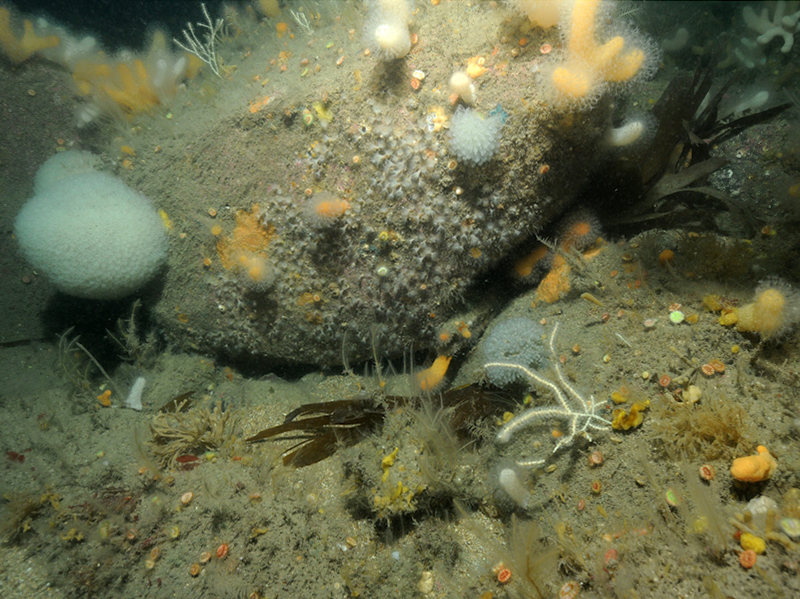
Caryophyllia smithii and Swiftia pallida on circalittoral rock
Photographer: Dr Keith Hiscock Copyright: Dr Keith Hiscock

| Researched by | John Readman, Olivia Durkin, Kelsey Lloyd & Amy Watson | Refereed by | Dr Rohan Holt |
|---|
Summary
UK and Ireland classification
Description
Typically found on the upper and vertical faces of very exposed through to wave-sheltered circalittoral bedrock and boulders, favouring weak tidal streams. It is characterized by dense aggregations of the cup coral Caryophyllia smithii and the northern sea fan, Callistephanus pallida, on the silty substratum. Under the silt, bryozoan crusts such as Parasmittina trispinosa and encrusting red algae may be present. This biotope may have a grazed appearance, perhaps attributable to the frequently occurring edible sea urchin, Echinus esculentus. There may be a sparse hydroid turf present, with species such as Nemertesia antennina, Nemertesia ramosa and Halecium halecinum. The soft corals Alcyonium glomeratum and Alcyonium digitatum may be present on the tops of boulders along with the crinoids Antedon petasus and Antedon bifida. Other echinoderms occasionally observed include the starfish Marthasterias glacialis, Asterias rubens and Luidia ciliaris. Sponges feature only occasionally in this biotope, including species such as Cliona celata. The bryozoan Porella compressa may also be recorded. Ascidians occasionally present include Ascidia mentula, Clavelina lepadiformis and Ciona intestinalis. Under-boulder fauna typically consists of the crustacean Munida rugosa. The polychaete Spirobranchus triqueter may be seen encrusting the rocky surface. (Information from Connor et al., 2004).
Depth range
10-20 m, 20-30 m, 30-50 mAdditional information
-
Listed By
Habitat review
Ecology
Ecological and functional relationships
Seasonal and longer term change
Sea urchins (e.g. Echinus esculentus) have a significant effect on community structure and succession, their grazing trails can often be seen through the bryozoan turf, leaving bare rock or encrusting corallines behind.Species such as Alcyonium digitatum have seasonal stages, retracting their polyps and cease feeding from July to November, during which time the surface of the colony becomes colonized by encrusting algae and hydroids (Fish & Fish, 1996). When the colony recommences feeding in December, the surface film together with the surface epithelium is shed. Alcyonium digitatum may take advantage of available space for colonization during winter spawning events.
In temperate waters, most bryozoan species tend to grow rapidly in spring and optimal reproduction occurs in late summer, depending on temperature, day length and the availability of phytoplankton (Ryland, 1970). Some species of bryozoans and hydroids demonstrate seasonal cycles of growth in spring/summer and die off in late autumn/winter, overwintering as dormant stages or juvenile stages (see Ryland, 1976; Gili & Hughes, 1995; Hayward & Ryland, 1998). The biotope is likely to demonstrate seasonal changes in the abundance or cover of the dominant bryozoans and hydroids.
Habitat structure and complexity
The biotope occurs on bedrock and boulders which may provide overhangs, crevices and shelter where crevice dwelling species such as sea cucumbers (Aslia lefevrei), squat lobsters (Munida rugosa) and wrasse (e.g. Ctenolabrus rupestris) may live. Swiftia pallida colonies are present on the silty substratum and are important habitats for the sea fan anemone Amphianthus dohrnii. Small invertebrates, such as crabs, seek refuge within the complexity of sea fan (Swiftia pallida) structures and may also protect their host from fouling algae or other invertebrates. Dense aggregations of Caryophyllia smithii colonise boulders and bedrock surfaces, Bedrock surfaces are colonized by encrusting invertebrates, such as the bryozoan Parasmittina trispinosa, and algae. The fan shape of Swiftia pallida enhances the feeding efficiency of the colony with respect to current flow, as it changes water flow pattern through the colony (Chamberlain & Graus, 1975).Productivity
The main trophic group in this biotope is suspension feeders although there may be several species of predatory fish and grazing echinoderms present. Circalittoral faunal turf biotopes are dominated by secondary producers. Food in the form of phytoplankton, zooplankton and organic particulates from the water column together with detritus and abraded macroalgal particulates from shallow water ecosystems are supplied by water currents and converted into faunal biomass. Their secondary production supplies higher trophic levels such as mobile predators (e.g. starfish, sea urchins, and fish) and scavengers (e.g. starfish and crabs) and the wider ecosystem in the form of detritus (e.g. dead bodies and faeces).Recruitment processes
Caryophyllia smithii reproduces between January and March, spawning occurs from March to June (Tranter et al., 1982). However, asexual reproduction and division is commonly observed (Hiscock & Howlett, 1976). Hydroids are often the first organisms to colonize available space in settlement experiments (Gili & Hughes, 1995). Anthozoans, such as Alcyonium digitatum and Caryophyllia smithii are long lived with potentially highly dispersive pelagic larvae and are relatively widespread. They are not restricted to this biotope and would probably be able to recruit within 2-5 years (refer to the Key Information reviews; Sebens, 1985; Jensen et al., 1994). Juvenile Alcyonium digitatum are highly susceptible to being smothered or eaten, however, can survive intense sea urchin predation when larger (Sebens, 1985, 1986). Maximum spawning of Echinus esculentus occurs in spring. Hydroids are capable of asexual reproduction and many species produce dormant, resting stages, which are very resistant of environmental perturbation (Gili & Hughes, 1995). Echinoderms are highly fecund; producing planktonic larvae with high dispersal potential. Sponges may proliferate both asexually and sexually. A sponge can regenerate from a broken fragment, produce buds either internally or externally or release clusters of cells known as gemmules which develop into a new sponge, depending on species. Most sponges are hermaphroditic but cross-fertilization normally occurs. Spawning for Antedon bifida is stated as May to July. Cerianthus lloydii has pelagic larvae and have been recorded in the plankton from January to August having a planktonic life of about 3 months (Fish & Fish, 1996).Time for community to reach maturity
Caryophyllia smithii is slow growing, with a reported growth rate of 0.5 1mm horizontal growth per year (Fowler & Lafferty, 1993). Bryozoans, hydroids, and ascidians are opportunistic, grow and colonize space rapidly and will probably develop a faunal turf within 1-2 years. Swiftia pallida is likely to have a similar growth rate to that of Eunicella verrucosa, at 1 cm per year (see species reviews). Swiftia pallida colonies are generally 7 - 20 cm, (i.e. 7 - 20 years old). Taking growth rates of key species into consideration, it could take approximately 15 years for this community to reach maturity.Additional information
-Preferences & Distribution
Habitat preferences
| Depth Range | 10-20 m, 20-30 m, 30-50 m |
|---|---|
| Water clarity preferences | No information |
| Limiting Nutrients | No information |
| Salinity preferences | Full (30-40 psu) |
| Physiographic preferences | Open coast, Sea loch or Sea lough |
| Biological zone preferences | Circalittoral |
| Substratum/habitat preferences | Bedrock, Large to very large boulders, Small boulders |
| Tidal strength preferences | Moderately strong 1 to 3 knots (0.5-1.5 m/sec.), Very weak (negligible), Weak < 1 knot (<0.5 m/sec.) |
| Wave exposure preferences | Exposed, Extremely exposed, Moderately exposed, Sheltered, Very exposed |
| Other preferences | Vertical and upper faces of bedrock and boulders. |
Additional Information
Sea temperature around Scotland ranges from 4 - 15°C. It is thought that colonization of the Shetland Islands by Swiftia pallida, and as such this biotope, has been prevented by geographical barriers (Hiscock et al., 2001).Species composition
Species found especially in this biotope
Rare or scarce species associated with this biotope
- Caryophyllia smithii
Additional information
Swiftia pallida is host to the sea fan anemone Amphianthus dohrnii, which is found exclusively on sea fans.Sensitivity review
Sensitivity characteristics of the habitat and relevant characteristic species
The CR.MCR.EcCr.CarSwi biotope complex is characterized by dense aggregations of the cup coral Caryophyllia smithii and the northern sea fan Swiftia pallida on rock or boulders with a thin layer of silt. CarSwi.Aglo is a more silted variant of this biotope complex found off south-west Ireland that includes Alcyonium glomeratum and may have a more diverse sponge component. CarSwi.LgAs is a more impoverished variant, which occurs across a wide range of wave exposures, up to extremely exposed off the western coast of Scotland. The biotope CR.HCR.XFa.SwiLgAs is very similar to the CR.MCR.EcCr.CarSwi complex, but with the addition of a characteristic faunal turf.
This assessment focuses on the characterizing Caryophyllia smithii and Swiftia pallida. The faunal turf is composed of typically opportunistic species and is considered where appropriate. Alcyonium glomeratum is also considered for the biotope CR.MCR.EcCr.CarSwi.Aglo. Given the lack of information on Swiftia pallida, evidence for other sea fans, including Eunicella verrucosa is presented where applicable. The evidence is also sparse for Alcyonium glomeratum and assessments are based on the similar Alcyonium digitatum. Other species present are considered opportunistic colonizers, ephemeral or not important characterizing within the biotopes.
Resilience and recovery rates of habitat
Caryophyllia smithii is a small (max 3 cm across) solitary coral, common within tide swept sites of the UK (Wood, 2005), and distributed from Greece (Koukouras, 2010) to the Shetland Islands and Orkney (NBN, 2015; Wilson, 1975). It was suggested by Fowler & Laffoley (1993) that Caryophyllia smithii was a slow growing species (0.5-1 mm in horizontal dimension of the corallum per year), which in turn suggested that inter-specific spatial competition with colonial faunal or algae species were important factors in determining local abundance of Caryophyllia smithii (Bell & Turner, 2000). Caryophyllia smithii reproduces between January and March and spawning occurs from March to June (Tranter et al., 1982). The pelagic stage of the larvae may last up to 10 weeks, which provides this species with a good dispersal capability (Tranter et al., 1982) Asexual reproduction and division is also commonly observed (Hiscock & Howlett, 1976). Bell (2002) reported that juvenile Caryophyllia smithii has a variable morphology that gives them an advantage in colonizing a wide range of habitats.
Sea fans are sessile colonial cnidarians that grow erect from the substratum, with each colony formed of many small polyps, each with tentacles that may be either extended or retracted. Swiftia pallida is a small sea fan that forms slender colonies with infrequent branching, up to 20 cm tall but usually 7- 10 cm. Branches are irregularly orientated and twig-like (Manuel, 1988; Hiscock, 2007). Populations of Swiftia pallida are thought to be self-sustaining, with short-lived larvae and limited potential for larval dispersal. It is thought that the colonization of the Shetland Islands has been prevented by geographical barriers (Hiscock et al., 2001). Reproduction is likely to be annual and may be triggered by either summer high or winter low temperatures (Hiscock et al., 2001).
Although Swiftia pallida has not been specifically studied, the average number of eggs per polyp in other gorgonians increases with increasing colony size. The number of eggs released from larger colonies can be orders of magnitude higher than for smaller colonies (Beiring & Lasker, 2000). It has been suggested that when a large colony size is attained, more energy is available for reproduction because relative colony growth decreases (Beiring & Lasker, 2000). Swiftia pallida abundance may be up to three colonies per square metre (Minchin, 1987c) or 5-10 /m2 (Holt pers comm.) and typically occurs at ca 1-9 /10m2 in this biotope (Connor et al., 2004). Growth rates for this species are unknown, however, the pink sea fan Eunicella verrucosa has highly variable growth. A population of Eunicella verrucosa at Lundy Island had growth rates of approximately 1 cm/year, which may be similar to Swiftia pallida. The lifespan of Swiftia pallida is estimated to be between 10 and 20 years (Hiscock et al. 2001; Wilding & Wilson, 2009). Very little information was found on the recovery potential of this species. The ability to recolonize an area following mass mortality is likely to be restricted (Hiscock et al., 2001).
Little information was available for Alcyonium glomeratum and resilience was assessed based on the similar Alcyonium digitatum. Alcyonium digitatum colonies are likely to have a lifespan that exceeds 20 years as colonies have been followed for 28 years in marked plots (Lundälv, pers. comm., in Hartnoll, 1998). Colonies that were 10-15 cm in height were aged at between 5 and 10 years old (Hartnoll, unpublished). Sexual maturity is predicted to occur, at its earliest, when the colony reaches its second year of growth. However, the majority of colonies are not predicted to reach maturity until their third year (Hartnoll, 1975). Alcyonium digitatum spawns from December and January. Gametes are released into the water where fertilization occurs. The embryos are neutrally buoyant and float freely for 7 days when they give rise to actively swimming lecithotrophic planulae which may have an extended pelagic life before they eventually settle (usually within 1 or 2 further days) and metamorphose to polyps (Matthews, 1917; Hartnoll, 1975; Budd, 2008). Larvae have been reported to survive for up to 35 weeks as non-feeding planulae and may favour the dispersal and eventual discovery of a site suitable for settlement (Hartnoll, 1975). Alcyonium digitatum can recruit onto bare surfaces within 2 years but may take up to 5 years to fully recover following significant mortality (Whomersley & Picken, 2003; Hiscock et al., 2010).
Resilience assessment. Caryophyllia smithii colonized the wreck of the Scylla within a year, however, this may be due to the time of the vessel sinking and if removed recovery may take longer. Alcyonium glomeratum is likely to recruit fairly rapidly, however full recovery following a significant decline may take longer. Swiftia pallida is likely to be the slowest to recover and if a population was completely removed from the habitat (resistance of ‘None’) resilience has been assessed as ‘Low’ (recovery in 10-25 years) because of the low larvae dispersal, probable importance of self-sustaining communities and slow growth rate of Swiftia pallida (Hiscock et al., 2001). For resistance assessments of ‘Low’ or ‘Medium’, resilience has been assessed as ‘Medium’ (recovery in 2-10 years).
Hydrological Pressures
Use [show more] / [show less] to open/close text displayed
| Resistance | Resilience | Sensitivity | |
Temperature increase (local) [Show more]Temperature increase (local)Benchmark. A 5°C increase in temperature for one month, or 2°C for one year. Further detail EvidenceMitchell et al. (1983) suggested that the Scottish and Irish populations of Swiftia pallida were at the southern limit of the species range. It should be noted that there are reports of Swiftia pallida in deep waters (518-766 m depth) in the Mediterranean (Mastrototaro et al., 2010). However, their distribution in the British Isles appears to be limited to the Atlantic coasts of Scotland and Ireland (NBN, 2015). Hiscock et al. (2001) predicted the loss of all populations occurring in the Inner Hebrides and mainland western Scotland with a 2°C increase in summer surface temperatures over a 20 year period. Caryophyllia smithii is found across the British Isles (NBN, 2015) and has been recorded in Greece (Koukouras, 2010). It is, therefore, unlikely to be significantly affected by an increase at the benchmark level. However, Tranter et al. (1982) suggested Caryophyllia smithii reproduction was cued by seasonal increases in seawater temperature. Therefore, unseasonal increases in temperature may disrupt natural reproductive processes and negatively influence recruitment patterns. Holt (pers. comm.) also suggested that long-term increases in temperature due to climate change may allow the parasitic barnacle Adna anglica to extend its range northwards and overlap the range of this biotope. Adna anglica is a southern species limited to the southwest of Britain where it parasitizes Caryophillia and has probably contributed to the decrease in abundance of Leptopsammia (Holt pers. comm.). It may impact the abundance of Caryophyllia if climate change allowed it to extend its range northwards (Holt pers. comm.). Alcyonium glomeratum has been recorded from Scotland to the Bay of Biscay (Hayward & Ryland, 1995b) and would probably tolerate an increase at the benchmark level. Other species present in the biotope are widespread across the British Isles or are not important to the classification of this biotope. Sensitivity assessment. The CR.MCR.EcCr.CarSwi biotope complex generally has a northern distribution within the British Isles, with the characterizing Swiftia pallida being intolerant of warmer conditions. Resistance is likely to be ‘Low’, therefore, resilience is ‘Medium’ and sensitivity is assessed as ‘Medium’. | LowHelp | MediumHelp | MediumHelp |
Temperature decrease (local) [Show more]Temperature decrease (local)Benchmark. A 5°C decrease in temperature for one month, or 2°C for one year. Further detail EvidenceCaryophyllia smithii is a southern species (Fish & Fish, 1992) with a northern range limit in the Shetland Isles (NBN, 2015). It is, therefore, likely to be close to its northerly range limit and therefore likely to be negatively affected by a decrease in temperature at the benchmark level. Swiftia pallida is classed as a northerly species and is recorded in Scotland, south-west Ireland (e.g. Kenmare Bay) on the west coasts of Norway and Sweden and in deep water from the Bay of Biscay and the Mediterranean (Wilding & Wilson, 2009). Alcyonium glomeratum has been recorded from Scotland to Biscay (Hayward & Ryland, 1995b) and, being close to it northerly distribution limit, is likely to experience a significant decline due to a decrease in temperature. Sensitivity assessment. Caryophyllia smithii and Alcyonium glomeratum are already close to their northern range limit and a decrease would likely significantly affect the northern populations of the species and hence the biotope. Resistance is assessed as ‘Low’, resilience as ‘Medium’ and sensitivity as ‘Medium’. | LowHelp | MediumHelp | MediumHelp |
Salinity increase (local) [Show more]Salinity increase (local)Benchmark. A increase in one MNCR salinity category above the usual range of the biotope or habitat. Further detail EvidenceCR.MCR.EcCr.CarSwi is a circalittoral biotope and an increase in salinity at the benchmark would result in a change from 'full' to hypersalinity. No records of the characterizing Caryophyllia smithii or Swiftia pallida in hypersaline conditions was found. Hence, no assessment was made due to the lack of evidence. | No evidence (NEv)Help | Not relevant (NR)Help | No evidence (NEv)Help |
Salinity decrease (local) [Show more]Salinity decrease (local)Benchmark. A decrease in one MNCR salinity category above the usual range of the biotope or habitat. Further detail EvidenceThis biotope occurs in full salinity. Caryophyllia smithii has been recorded in biotopes from Full to Low salinity (Connor et al., 2004) and would probably tolerate a change at the benchmark level. Swiftia pallida has only been recorded in full salinity biotopes (Connor et al., 2004) and is likely to be intolerant of a decrease in salinity. Therefore, resistance has been assessed as ‘Low’, resilience as ‘Medium’ and sensitivity has been assessed as ‘Medium’. | LowHelp | MediumHelp | MediumHelp |
Water flow (tidal current) changes (local) [Show more]Water flow (tidal current) changes (local)Benchmark. A change in peak mean spring bed flow velocity of between 0.1 m/s to 0.2 m/s for more than one year. Further detail EvidenceAlcyonium digitatum, Caryophyllia smithii, Spirobranchus triqueter and sponges are suspension feeders, relying on water currents to supply food (Hiscock, 1983). These taxa, therefore, thrive in conditions of vigorous water flow e.g. around Orkney and St Abbs, Scotland, where Alcyonium digitatum dominated biotopes may experience tidal currents of 3 and 4 knots (approximately 1.5 m/sec) during spring tides (De Kluijver, 1993). Caryophyllia smithii, in particular, is described as favouring sites with high tidal flow (Bell & Turner, 2000; Wood, 2005). This biotope consists mainly of species firmly attached to the substratum, which would be unlikely to be displaced by an increase in the strength of tidal streams at the benchmark level. Sea fans are found in strong tidal streams but probably retract their polyps when current velocity gets too high for the polyps to retain food. Tidal streams exert a steady pull on the colonies and are therefore likely to detach only very weakly attached colonies. Colonies rely on high water flow rates to bring food and to remove silt (Hiscock, 2007). Caryophyllia smithii has been recorded in biotopes from negligible to strong water flow (0-6 knots) (Connor et al., 2004) No evidence for Swiftia pallida was found, however, Bunker (1986) reported that the sea fan Eunicella verrucosa was present in areas subject to at least moderate tidal streams but was most abundant in strong tidal streams. There is a tendency for Eunicella verrucosa to grow aligned across the direction of the prevailing current (Bunker, 1986). Sensitivity assessment. The CR.MCR.EcCr.CarSwi biotope complex is found from negligible to moderately strong water flow (0-3 knots) but can be found from extremely exposed to sheltered wave exposure. It is likely that the biotope exists in moderate energy, with either water flow or wave action prevailing. Change in water flow is, therefore, probably only relevant to wave sheltered examples. The characterizing species (including gorgonians, soft corals and Caryophyllia smithii) are generally associated with moderate to high energy environments. However, a change at the benchmark level is unlikely to be significant. Resistance is, therefore, assessed as ‘High’, resilience as ‘High’ and the biotope is ‘Not Sensitive’ at the benchmark level. | HighHelp | HighHelp | Not sensitiveHelp |
Emergence regime changes [Show more]Emergence regime changesBenchmark. 1) A change in the time covered or not covered by the sea for a period of ≥1 year or 2) an increase in relative sea level or decrease in high water level for ≥1 year. Further detail EvidenceChanges in emergence are Not Relevant to this biotope as it is restricted to fully subtidal/circalittoral conditions. The pressure benchmark is relevant only to littoral and shallow sublittoral fringe biotopes. | Not relevant (NR)Help | Not relevant (NR)Help | Not relevant (NR)Help |
Wave exposure changes (local) [Show more]Wave exposure changes (local)Benchmark. A change in near shore significant wave height of >3% but <5% for more than one year. Further detail EvidenceDead sea fans have been recorded washed up along Chesil Beach (UK) following winter storms (Hatcher & Trewhella, 2006). However, Bunker (1986) reported that Eunicella verrucosa was most abundant in moderately exposed locations. Caryophyllia smithii has been recorded in very sheltered to extremely exposed biotopes (Connor et al., 2004). Bell (2002) reported that Caryophyllia smithii near Lough Hyne (Ireland) exposed to strong wave action on open coasts were relatively small, possibly due to juvenile morphological variability, as Caryophyllia smithii found deeper and in sediment were thinner and taller. Sensitivity assessment. The CR.MCR.EcCr.CarSwi biotope complex is extremely exposed to sheltered from wave action, but can be found from negligible to moderately strong water flow (0-3 knots). It is likely that the biotope exists in moderate to high energy, with either water flow or wave action prevailing. Change in wave exposure is therefore probably only relevant to habitats that experience weak water flow. The characterizing species (including gorgonians and Caryophyllia smithii) are generally associated with moderate to high energy environments. However, a change at the benchmark level is unlikely to be significant. Resistance is therefore assessed as ‘High’, resilience as ‘High’ and the biotope is ‘Not Sensitive’ at the benchmark level. | HighHelp | HighHelp | Not sensitiveHelp |
Chemical Pressures
Use [show more] / [show less] to open/close text displayed
| Resistance | Resilience | Sensitivity | |
Transition elements & organo-metal contamination [Show more]Transition elements & organo-metal contaminationBenchmark. Exposure of marine species or habitat to one or more relevant contaminants via uncontrolled releases or incidental spills. Further detail EvidenceChan et al. (2012) studied the response of the gorgonian Subergorgia suberosa to heavy metal-contaminated seawater from a former coastal mining site in Taiwan. Cu, Zn, and Cd each showed characteristic bioaccumulation. Metallic Zn accumulated but rapidly dissipated. In contrast, Cu easily accumulated but was slow to dissipate, and Cd was only slowly absorbed and dissipated. Associated polyp necrosis, mucus secretion, tissue expansion, and increased mortality were reported in Subergorgia suberosa exposed to water polluted with heavy metals. However, this pressure is Not assessed | Not Assessed (NA)Help | Not assessed (NA)Help | Not assessed (NA)Help |
Hydrocarbon & PAH contamination [Show more]Hydrocarbon & PAH contaminationBenchmark. Exposure of marine species or habitat to one or more relevant contaminants via uncontrolled releases or incidental spills. Further detail EvidenceThis pressure is Not assessed but evidence is presented where available. CR.MCR.EcCr.CarSwi is a sub-tidal biotope complex (Connor et al., 2004). Oil pollution is mainly a surface phenomenon and its impact on circalittoral turf communities is likely to be limited. However, as in the case of the Prestige oil spill off the coast of France, high swell and winds can cause oil pollutants to mix with the seawater and could potentially negatively affect sub-littoral habitats (Castège et al., 2014). Filter feeders are highly sensitive to oil pollution, particularly those inhabiting the tidal zones which experience high exposure and show correspondingly high mortality, as are bottom-dwelling organisms in areas where oil components are deposited by sedimentation (Zahn et al., 1981). White et al. (2012) reported on deep-water gorgonian communities, including Swiftia pallida six months after the Deep Water Horizon oil spill. Stress in the gorgonians was observed including excessive mucous production, retracted polyps and smothering of brown flocculent material (floc) which contained oil from the Macondo well. Hsing et al. (2013) reported that, following smothering by floc associated with the Deep Water Horizon spill, recovery of corals and gorgonians was inversely correlated with floc presence. | Not Assessed (NA)Help | Not assessed (NA)Help | Not assessed (NA)Help |
Synthetic compound contamination [Show more]Synthetic compound contaminationBenchmark. Exposure of marine species or habitat to one or more relevant contaminants via uncontrolled releases or incidental spills. Further detail EvidenceThis pressure is Not assessed but evidence is presented where available. | Not Assessed (NA)Help | Not assessed (NA)Help | Not assessed (NA)Help |
Radionuclide contamination [Show more]Radionuclide contaminationBenchmark. An increase in 10µGy/h above background levels. Further detail Evidence'No evidence'. | No evidence (NEv)Help | Not relevant (NR)Help | No evidence (NEv)Help |
Introduction of other substances [Show more]Introduction of other substancesBenchmark. Exposure of marine species or habitat to one or more relevant contaminants via uncontrolled releases or incidental spills. Further detail EvidenceThis pressure is Not assessed. | Not Assessed (NA)Help | Not assessed (NA)Help | Not assessed (NA)Help |
De-oxygenation [Show more]De-oxygenationBenchmark. Exposure to dissolved oxygen concentration of less than or equal to 2 mg/l for one week (a change from WFD poor status to bad status). Further detail EvidenceIn general, respiration in most marine invertebrates does not appear to be significantly affected until extremely low concentrations are reached. For many benthic invertebrates this concentration is about 2 ml/l (ca 2.66 mg/l) (Herreid, 1980; Rosenberg et al., 1991; Diaz & Rosenberg, 1995). Cole et al. (1999) suggest possible adverse effects on marine species below 4 mg/l and probable adverse effects below 2 mg/l. Little information on the effects of oxygenation on bryozoans was found. No evidence was found concerning the effects of hypoxia for Swiftia pallida. However, as a species that lives in fully oxygenated waters in conditions of flowing waters, it is expected that it would be intolerant to decreased oxygen levels. Bell (2002) reported that an oxycline at Lough Hyne (<5 % surface concentration) limited vertical colonization by Caryophillia smithii. Sensitivity assessment Despite limited evidence, Swiftia pallida and Caryophyllia smithii are unlikely to tolerate hypoxic events given their preference for moderate water movement. Resistance is ‘Low’, resilience is ‘Medium’ and sensitivity is ‘Medium’. It should be noted that, as these biotopes occur in high energy habitats and low oxygen events are likely to be short-lived. | LowHelp | MediumHelp | MediumHelp |
Nutrient enrichment [Show more]Nutrient enrichmentBenchmark. Compliance with WFD criteria for good status. Further detail EvidenceEchavarri-Erasun et al. (2007) described the effects of deepwater sewage outfall discharges on the relative abundance of rocky reef communities. Species typical of hard substrata (including Caryophyllia smithii and bryozoans) increased in total richness and abundance near the outfall. Whilst Swifita pallida could be at risk of competition from algae in shallow waters due to nutrient enrichment, this biotope occurs in the circalittoral below the depth suitable for most macroalgae. If nutrient enrichment resulted in algal blooms, then their subsequent death could result in deposition of dead algae on the sea bed and resultant localised hypoxia (see above). This biotope is considered to be 'Not sensitive' at the pressure benchmark, that assumes compliance with good status as defined by the WFD. | Not relevant (NR)Help | Not relevant (NR)Help | Not sensitiveHelp |
Organic enrichment [Show more]Organic enrichmentBenchmark. A deposit of 100 gC/m2/yr. Further detail EvidenceEchavarri-Erasun et al. (2007) described the effects of deepwater sewage outfall discharges on the relative abundance of rocky reef communities. Species typical of hard substrata (including Caryophyllia smithii and bryozoans) increased in total richness and abundance near the outfall. Sensitivity assessment. Evidence for some of the characterizing species suggests some tolerance or even increased abundance when exposed to organic enrichment in the circalittoral. However, ‘No evidence’ for the important characterizing Swiftia pallida could be found. | No evidence (NEv)Help | Not relevant (NR)Help | No evidence (NEv)Help |
Physical Pressures
Use [show more] / [show less] to open/close text displayed
| Resistance | Resilience | Sensitivity | |
Physical loss (to land or freshwater habitat) [Show more]Physical loss (to land or freshwater habitat)Benchmark. A permanent loss of existing saline habitat within the site. Further detail EvidenceAll marine habitats and benthic species are considered to have a resistance of ‘None’ to this pressure and to be unable to recover from a permanent loss of habitat (resilience is ‘Very low’). Sensitivity within the direct spatial footprint of this pressure is, therefore ‘High’. Although no specific evidence is described confidence in this assessment is ‘High’, due to the incontrovertible nature of this pressure. | NoneHelp | Very LowHelp | HighHelp |
Physical change (to another seabed type) [Show more]Physical change (to another seabed type)Benchmark. Permanent change from sedimentary or soft rock substrata to hard rock or artificial substrata or vice-versa. Further detail EvidenceIf rock were replaced with sediment, this would represent a fundamental change to the physical character of the biotope and the species would be unlikely to recover. The biotope would be lost. Sensitivity assessment. Resistance to the pressure is considered ‘None’, and resilience ‘Very low’. Sensitivity has been assessed as ‘High’. | NoneHelp | Very LowHelp | HighHelp |
Physical change (to another sediment type) [Show more]Physical change (to another sediment type)Benchmark. Permanent change in one Folk class (based on UK SeaMap simplified classification). Further detail EvidenceNot relevant’ to biotopes occurring on bedrock. | Not relevant (NR)Help | Not relevant (NR)Help | Not relevant (NR)Help |
Habitat structure changes - removal of substratum (extraction) [Show more]Habitat structure changes - removal of substratum (extraction)Benchmark. The extraction of substratum to 30 cm (where substratum includes sediments and soft rock but excludes hard bedrock). Further detail EvidenceThe species characterizing this biotope are epifauna or epiflora occurring on rock and would be sensitive to the removal of the habitat. However, extraction of rock substratum is considered unlikely and this pressure is considered to be ‘Not relevant’ to hard substratum habitats. | Not relevant (NR)Help | Not relevant (NR)Help | Not relevant (NR)Help |
Abrasion / disturbance of the surface of the substratum or seabed [Show more]Abrasion / disturbance of the surface of the substratum or seabedBenchmark. Damage to surface features (e.g. species and physical structures within the habitat). Further detail EvidencePhysical disturbance by fishing gear has been shown to adversely affect emergent epifaunal communities with hydroid and bryozoan matrices reported to be greatly reduced in fished areas (Jennings & Kaiser, 1998). Heavy mobile gears could also result in movement of boulders (Bullimore, 1985; Jennings & Kaiser, 1998). Whilst no evidence for Swiftia pallida was found, reviews have considered the sea fan Eunicella verrucosa to be sensitive to abrasion (MacDonald et al., 1996; Hall et al., 2008; Tillin et al., 2010). Swiftia pallida has been observed tangled in lobster pot netting and detached in the vicinity of lobster pots (Holt, pers comm.). Other studies suggest that Eunicella verrucosa may be more resistant to abrasion pressures. Eno et al. (2001) conducted experimental potting on areas containing fragile epifaunal species in Lyme Bay, south-west England. Divers observed that pink sea fan ‘flexed and bent before returning to an upright position under the weight of pots’. Although relatively resistant to a single event it was not clear whether repeated exposure could cause further damage or whether injuries had been inflicted that could lead to deterioration (Eno et al., 2001). Observation of pots suggested that these were dragged along the bottom when wind and tidal streams were strong, however little damage to epifauna was observed. Eunicella verrucosa were patchily distributed in areas subject to potting damage, but the study could not determine whether this was due to damage from potting (Eno et al., 2001). A further four-year study on potting in the Lundy Marine Protected Area detected no significant differences in Eunicella verrucosa between areas subject to commercial potting and those where this activity was excluded (Sheehan et al., 2013). However, Tinsley (2006) observed flattened sea fans, that had continued growing, with new growth being aligned perpendicular to the current, so clearly even colonies of Eunicella verrucosa that are damaged can continue to survive. Healthy Eunicella verrucosa are able to recover from minor damage and scratches to the coenenchyme (Tinsley, 2006), and the coenenchyme covering the axial skeleton will regrow over scrapes on one side of the skeleton in about one week (Hiscock, pers. comm.) Hinz et al. (2011) reported that Eunicella verrucosa did not show a significant negative response with respect to abundance and average body size to the intensity of scallop dredging. A study by Boulcott & Howell (2011) on the effects of scallop dredging in rocky substrata suggested that associated epifaunal communities, such as bryozoans, hydroids, soft corals and sponges were removed by a passing scallop dredge. However, on hard, uneven rock damage, damage to more resistant epifauna, whilst in evidence, was restricted. The study also recorded that the mobile substrata present were likely to be moved and turned by the passing dredge, leading to further damage to the epifaunal communities. This biotope is also characterized by the bryozoan Porella compressa. Porella compressa is a delicate, 'stony' and brittle, erect bryozoan that is likely to be damaged by abrasion (Holt pers. comm.). However, its loss from the biotope would not result in loss of the biotope. Sensitivity assessment. Swiftia pallida is sessile and epifaunal and, based on evidence for Eunicella verrucosa, is likely to be severely damaged by heavy gears, such as scallop dredging (MacDonald et al., 1996). However, some studies suggest the sea fan Eunicella verrucosa may be more resistant, particularly to low intensity lighter abrasion pressures, such as pots and associated anchor damage (Eno et al. 2001; Sheehan et al., 2013), and this could be the case for Swiftia pallida. Therefore, a resistance of ‘Low’ is recorded. Resilience is assessed as ‘Medium’ and sensitivity as ‘Medium’. | LowHelp | MediumHelp | MediumHelp |
Penetration or disturbance of the substratum subsurface [Show more]Penetration or disturbance of the substratum subsurfaceBenchmark. Damage to sub-surface features (e.g. species and physical structures within the habitat). Further detail EvidenceThe species characterizing this biotope group are epifauna or epiflora occurring on rock which is resistant to subsurface penetration. The assessment for abrasion at the surface only is therefore considered to equally represent sensitivity to this pressure. This pressure is thought ‘Not Relevant’ to hard rock biotopes | Not relevant (NR)Help | Not relevant (NR)Help | Not relevant (NR)Help |
Changes in suspended solids (water clarity) [Show more]Changes in suspended solids (water clarity)Benchmark. A change in one rank on the WFD (Water Framework Directive) scale e.g. from clear to intermediate for one year. Further detail EvidenceBell & Turner (2000) studied populations of Caryophyllia smithii at three sites of differing sedimentation regime in Lough Hyne, Ireland. Calyx size was largest at the site of least sedimentation and smallest at the site of most sedimentation. In contrast, the height of individuals was greatest at the site of most sedimentation and smallest at the site of least sedimentation. The height of individuals correlated with the level of surrounding sediment. High density correlated with high sedimentation and depth (Bell & Turner, 2000). While siltation may inhibit feeding, colonies of the sea fan Eunicella verrucosa produce mucus to clear themselves of silt (Hiscock, 2007) and sea fans are probably tolerant of increases in suspended sediment (Hiscock et al., 2004). Bunker (1986) reported that Eunicella verrucosa were mostly observed on bedrock or boulders, but did occur at sites up to ‘moderately silted’. Sensitivity assessment. CR.MCR.EcCr.CarSwi occurs on bedrock in the circalittoral and is unlikely to experience highly turbid conditions. From the evidence presented above, the characterizing species tolerate some siltation and a change at the benchmark level is unlikely to cause mortality. Resistance is recorded as ‘High’, resilience as ‘High’ and the biotope is ‘Not sensitive’ at the benchmark level. | HighHelp | HighHelp | Not sensitiveHelp |
Smothering and siltation rate changes (light) [Show more]Smothering and siltation rate changes (light)Benchmark. ‘Light’ deposition of up to 5 cm of fine material added to the seabed in a single discrete event. Further detail EvidenceCaryophyllia smithii is small (approx. <3 cm height from the seabed) and would therefore likely be inundated in a 'light' sedimentation event. However, Bell & Turner (2000) reported Caryophyllia smithii was abundant at sites of 'moderate' sedimentation (7 mm ± 0.5 mm) in Lough Hyne. It is therefore likely that Caryophyllia smithii would be resistant to periodic sedimentation. If 5 cm of sediment were removed rapidly, via tidal currents, Caryophyllia smithii would likely remain within the biotope. Burton et al. (2005) partly attributed fluctuations in Caryophyllia smithii abundance at Skomer Island to surface sediment cover. Bell (2002) reported that juvenile Caryophyllia smithii are morphologically variable and initially undergo rapid growth with tall and thin forms in deeper, sheltered, relatively sedimented conditions near Lough Hyne, Ireland. It was concluded that this was to escape the thin layer of sediment present. Swiftia pallida generally grows to a height of about 7-10 cm (Wilson, 2007). It is found on rocks covered with a fine layer of silt (Mitchell et al., 1983). While siltation may inhibit feeding, colonies of the sea fan Eunicella verrucosa produce mucus to clear themselves of silt (Hiscock, 2007). It is however thought that smothering causes mortality (Hiscock et al., 2004). Bunker (1986) reported that Eunicella verrucosa were mostly observed on bedrock or boulders, but did occur at sites up to ‘moderately silted’. Sensitivity assessment. Smothering by 5 cm would cover the majority of Caryophyllia smithii and the smallest examples of the other characterizing species and could result in limited mortality. Caryophyllia smithii has been reported as quite tolerant of temporary burial and the biotope occurs in moderate water flow and the sediment would likely be removed rapidly. Resistance was assessed as ‘High’, resilience as ‘High’ and the biotope is ‘Not sensitive’ at the benchmark level. | HighHelp | HighHelp | Not sensitiveHelp |
Smothering and siltation rate changes (heavy) [Show more]Smothering and siltation rate changes (heavy)Benchmark. ‘Heavy’ deposition of up to 30 cm of fine material added to the seabed in a single discrete event. Further detail EvidenceCaryophyllia smithii is small (approx. <3 cm height from the seabed) and would therefore likely be inundated in a “light” sedimentation event. However, Bell & Turner (2000) reported Caryophyllia smithii was abundant at sites of “moderate” sedimentation (7 mm ± 0.5 mm) in Lough Hyne. It is therefore likely that Caryophyllia smithii would be resistant to periodic sedimentation. If the sediment was removed rapidly, via tidal currents, Caryophyllia smithii would likely remain within the biotope. Burton et al. (2005) partly attributed fluctuations in Caryophyllia smithii abundance at Skomer Island to surface sediment cover. Bell (2002) reported that juvenile Caryophyllia smithii are morphologically variable and initially undergo rapid growth with tall and thin forms in deeper, sheltered, relatively sedimented conditions near Lough Hyne, Ireland. It was concluded that this was to escape the thin layer of sediment present. Swiftia pallida generally grows to a height of about 7-10 cm (Wilson, 2007). It is found on rocks covered with a fine layer of silt (Mitchell et al., 1983). While siltation may inhibit feeding, colonies of the sea fan Eunicella verrucosa produce mucus to clear themselves of silt (Hiscock, 2007). It is however thought that smothering causes mortality (Hiscock et al., 2004). Bunker (1986) reported that Eunicella verrucosa were mostly observed on bedrock or boulders, but did occur at sites up to ‘moderately silted’. Sensitivity assessment. Smothering by 30 cm of sediment would likely bury the majority of characterizing species, with only those individuals on boulders and vertical surfaces escaping burial. The biotope occurs in moderate water flow and it is likely that the sediment would probably be removed rapidly. Resistance was assessed as ‘Medium’, resilience as ‘Medium’ and sensitivity as ‘Medium’. | MediumHelp | MediumHelp | MediumHelp |
Litter [Show more]LitterBenchmark. The introduction of man-made objects able to cause physical harm (surface, water column, seafloor or strandline). Further detail EvidenceNot assessed. | Not Assessed (NA)Help | Not assessed (NA)Help | Not assessed (NA)Help |
Electromagnetic changes [Show more]Electromagnetic changesBenchmark. A local electric field of 1 V/m or a local magnetic field of 10 µT. Further detail Evidence‘No evidence’ was found | No evidence (NEv)Help | Not relevant (NR)Help | No evidence (NEv)Help |
Underwater noise changes [Show more]Underwater noise changesBenchmark. MSFD indicator levels (SEL or peak SPL) exceeded for 20% of days in a calendar year. Further detail EvidenceWhilst no evidence could be found on the effects of noise or vibrations on the characterizing species, it is unlikely that these species would be adversely affected by noise. This pressure ‘Not relevant’. | Not relevant (NR)Help | Not relevant (NR)Help | Not relevant (NR)Help |
Introduction of light or shading [Show more]Introduction of light or shadingBenchmark. A change in incident light via anthropogenic means. Further detail EvidenceWhilst no evidence could be found for the effect of light on the characterizing species of these biotopes, it is unlikely that these species would be impacted. The biotope is circalittoral, occurs below 10 m and is dependent on secondary rather than primary production. Resistance to this pressure is assessed as 'High' and resilience as 'High'. This biotope is therefore considered to be 'Not sensitive' at the benchmark level. | HighHelp | HighHelp | Not sensitiveHelp |
Barrier to species movement [Show more]Barrier to species movementBenchmark. A permanent or temporary barrier to species movement over ≥50% of water body width or a 10% change in tidal excursion. Further detail EvidenceBarriers and changes in tidal excursion are ‘Not relevant’ to biotopes restricted to open waters. | Not relevant (NR)Help | Not relevant (NR)Help | Not relevant (NR)Help |
Death or injury by collision [Show more]Death or injury by collisionBenchmark. Injury or mortality from collisions of biota with both static or moving structures due to 0.1% of tidal volume on an average tide, passing through an artificial structure. Further detail Evidence‘Not relevant’ to seabed habitats. NB. Collision by grounding vessels is addressed under ‘surface abrasion’. | Not relevant (NR)Help | Not relevant (NR)Help | Not relevant (NR)Help |
Visual disturbance [Show more]Visual disturbanceBenchmark. The daily duration of transient visual cues exceeds 10% of the period of site occupancy by the feature. Further detail Evidence‘Not relevant’. | Not relevant (NR)Help | Not relevant (NR)Help | Not relevant (NR)Help |
Biological Pressures
Use [show more] / [show less] to open/close text displayed
| Resistance | Resilience | Sensitivity | |
Genetic modification & translocation of indigenous species [Show more]Genetic modification & translocation of indigenous speciesBenchmark. Translocation of indigenous species or the introduction of genetically modified or genetically different populations of indigenous species that may result in changes in the genetic structure of local populations, hybridization, or change in community structure. Further detail EvidenceNo evidence of translocation or genetic modification of populations of the characterizing species was found. Therefore, there is currently ‘No evidence’ on which to assess this pressure. | No evidence (NEv)Help | Not relevant (NR)Help | No evidence (NEv)Help |
Introduction of microbial pathogens [Show more]Introduction of microbial pathogensBenchmark. The introduction of relevant microbial pathogens or metazoan disease vectors to an area where they are currently not present (e.g. Martelia refringens and Bonamia, Avian influenza virus, viral Haemorrhagic Septicaemia virus). Further detail EvidenceWhilst no evidence of disease in Swiftia pallida could be found, the first recorded incidence of cold-water coral disease was noted in the sea fan Eunicella verrucosa, in south-west England in 2002 (Hall-Spencer et al., 2007). Video surveys of 634 separate colonies at 13 sites revealed that disease outbreaks were widespread in south-west England from 2003 to 2006. Coenenchyme became necrotic in diseased specimens, leading to tissue sloughing and exposing skeletal gorgonin to settlement by fouling organisms. Sites, where necrosis was found, had significantly higher incidences of fouling. No fungi were isolated from diseased or healthy tissue, but significantly higher concentrations of bacteria occurred in diseased specimens. Vibrios isolated from Eunicella verrucosa did not induce disease at 15°C, but at 20°C controls remained healthy and test gorgonians became diseased. Bacteria associated with diseased tissue produced proteolytic and cytolytic enzymes that damaged Eunicella verrucosa tissue and may be responsible for the necrosis observed. Monitoring at the site where the disease was first noted showed new gorgonian recruitment from 2003 to 2006; some individuals had died and become completely overgrown, whereas others had continued to grow around a dead central area (Hall-Spencer et al., 2007). No evidence for disease in the characterizing bryozoans was found. Sensitivity assessment. Based on reports of mortality linked to disease in the sea fan Eunicella verrucosa, a disease may result in mortality of Swiftia pallida. It should be noted that the colder temperatures in which Swiftia pallida occurs may confer some resistance. Resistance is assessed as ‘Medium’, resilience as ‘Medium’ and sensitivity as ‘Medium’. | MediumHelp | MediumHelp | MediumHelp |
Removal of target species [Show more]Removal of target speciesBenchmark. Removal of species targeted by fishery, shellfishery or harvesting at a commercial or recreational scale. Further detail EvidenceEunicella verrucosa was collected historically as a curio by divers and was collected until recently in the British Isles (Wells et al., 1983; Bunker, 1986). It is now protected under schedule 5 of the Wildlife and Countryside Act 1981, no evidence of harvesting of the sea fan Swifita pallida or any of the other characterizing species was found. As there is historical evidence of harvesting of other sea fans, the sessile, epifaunal Swifita pallida would have no resistance to harvesting by divers. Resistance has been assessed as ‘None’, resilience as ‘Low’ and sensitivity is, therefore ‘High’. | NoneHelp | LowHelp | HighHelp |
Removal of non-target species [Show more]Removal of non-target speciesBenchmark. Removal of features or incidental non-targeted catch (by-catch) through targeted fishery, shellfishery or harvesting at a commercial or recreational scale. Further detail EvidenceThe characteristic species probably compete for space within the biotope, so that loss of one species would probably have little if any effect on the other members of the community. However, removal of the characteristic epifauna due to by-catch is likely to remove a proportion of the biotope and change the biological character of the biotope. As sessile epifauna, the characterizing species and likely to be severely damaged by heavy gears, such as scallop dredging (MacDonald et al., 1996). However, some studies suggest that sea fans may be more resistant, particularly to low intensity, lighter abrasion pressures, such as pots and associated anchor damage (Eno et al. 1996; Sheehan et al., 2013) Taking all the evidence into account, a resistance of ‘Low’ is recorded, albeit with a low confidence value owing to the lack of consensus in the literature. Resilience is assessed as ‘Medium’ and sensitivity as ‘Medium’. | LowHelp | MediumHelp | MediumHelp |
Introduction or spread of invasive non-indigenous species (INIS) Pressures
Use [show more] / [show less] to open/close text displayed
| Resistance | Resilience | Sensitivity | |
Other INIS [Show more]Other INISEvidenceThis biotope is classed as circalittoral and, therefore, no invasive algal species have been considered. Crepidula fornicata larvae require hard substrata for settlement. It prefers muddy gravelly, shell-rich, substrata that include gravel, or shells of other Crepidula, or other species e.g., oysters, and mussels. It is highly gregarious and seeks out adult shells for settlement, forming characteristic ‘stacks’ of adults. But it also recorded from rock, artificial substrata, and Sabellaria alveolata reefs (Blanchard, 1997, 2009; Bohn et al., 2012, 2013a, 2013b, 2015; De Montaudouin et al., 2018; Hinz et al., 2011; Helmer et al., 2019; Powell-Jennings & Calloway, 2018; Preston et al., 2020; Tillin et al., 2020). Close examination of the literature (2023) shows that evidence of its colonization and density on bedrock in the infralittoral or circalittoral was lacking. Tillin et al. (2020) suggested that Crepidula could colonize circalittoral rock due to its presence on tide-swept rough grounds in the English Channel (Hinz et al., 2011). However, Hinz et al. (2011) reported that Crepidula fornicata only dominated one assemblage (with an average of 181 individuals per trawl) on gravel substratum with boulders. Bohn et al. (2015) noted that Crepidula occurred at low density or was absent in areas dominated by boulders, and Bohn et al. (2013a, 2013b, 2015) and Preston et al. (2020) showed that while Crepidula could settle on slate panels or ‘stone’ it preferred shell, especially that of conspecifics. In addition, no evidence was found of the effect of Crepidula populations on faunal turf-dominated habitats. It was only recorded at low density (0.1-0.9/m2) in one faunal turf biotope (CR.MCR.CFaVS.CuSpH.As) (JNCC, 2015). Faunal turfs are dominated by suspension feeders so larval predation is probably high, which may prevent colonization by Crepidula. Also, faunal turf species actively compete for space and many are fast growing and opportunistic, so may out-compete Crepidula for space even if it gained a foothold in the community. Therefore, no evidence was found of the effect of Crepidula populations on faunal turf-dominated habitats or infralittoral or circalittoral rock habitats. Hence, there is 'Insufficient evidence' to suggest that the circalittoral rock biotopes are sensitive to colonization by Crepidula fornicata and further evidence is required. Hesperibalanus (syn. Solidobalanus) fallax is an invasive southern species of barnacle only recently recorded in southwest England (Southward et al., 2004). It has been observed fouling (primarily damaged or diseased) gorgonians (Hall-Spencer et al., 2007). However, it has not yet been recorded in Scottish waters (NBN, 2023). Therefore, resistance to fouling by this barnacle is assessed as ‘Medium’ as a precaution based on its potential to foul sea fans but with 'Low' confidence. Hence, resilience is assessed as ‘Medium’ and sensitivity as ‘Medium’. Due to the constant risk of new invasive species, the literature on this pressure should be revisited and the confidence for this assessment is 'Low'. | MediumHelp | MediumHelp | MediumHelp |
Bibliography
Beiring, E.A. & Lasker, H.R., 2000. Egg production by colonies of a gorgonian coral. Marine Ecology Progress Series, 196, 169-177.
Bell, J.J. & Turner, J.R., 2000. Factors influencing the density and morphometrics of the cup coral Caryophyllia smithii in Lough Hyne. Journal of the Marine Biological Association of the United Kingdom, 80, 437-441. DOI https://dx.doi.org/10.1017/S0025315400002137
Bell, J.J., 2002. Morphological responses of a cup coral to environmental gradients. Sarsia, 87, 319-330. DOI https://doi.org/10.1080/00364820260400825
Blanchard, M., 2009. Recent expansion of the slipper limpet population (Crepidula fornicata) in the Bay of Mont-Saint-Michel (Western Channel, France). Aquatic Living Resources, 22 (1), 11-19. DOI https://doi.org/10.1051/alr/2009004
Blanchard, M., 1997. Spread of the slipper limpet Crepidula fornicata (L.1758) in Europe. Current state and consequences. Scientia Marina, 61, Supplement 9, 109-118. Available from: http://scimar.icm.csic.es/scimar/index.php/secId/6/IdArt/290/
Bohn, K., Richardson, C. & Jenkins, S., 2012. The invasive gastropod Crepidula fornicata: reproduction and recruitment in the intertidal at its northernmost range in Wales, UK, and implications for its secondary spread. Marine Biology, 159 (9), 2091-2103. DOI https://doi.org/10.1007/s00227-012-1997-3
Bohn, K., Richardson, C.A. & Jenkins, S.R., 2015. The distribution of the invasive non-native gastropod Crepidula fornicata in the Milford Haven Waterway, its northernmost population along the west coast of Britain. Helgoland Marine Research, 69 (4), 313.
Bohn, K., Richardson, C.A. & Jenkins, S.R., 2013b. The importance of larval supply, larval habitat selection and post-settlement mortality in determining intertidal adult abundance of the invasive gastropod Crepidula fornicata. Journal of Experimental Marine Biology and Ecology, 440, 132-140. DOI https://doi.org/10.1016/j.jembe.2012.12.008
Bohn, K., Richardson, C.A. & Jenkins, S.R., 2013a. Larval microhabitat associations of the non-native gastropod Crepidula fornicata and effects on recruitment success in the intertidal zone. Journal of Experimental Marine Biology and Ecology, 448, 289-297. DOI https://doi.org/10.1016/j.jembe.2013.07.020
Boulcott, P. & Howell, T.R.W., 2011. The impact of scallop dredging on rocky-reef substrata. Fisheries Research (Amsterdam), 110 (3), 415-420.
Budd, G.C. 2008. Alcyonium digitatum Dead man's fingers. In Tyler-Walters H. and Hiscock K. (eds) Marine Life Information Network: Biology and Sensitivity Key Information Reviews, [on-line]. Plymouth: Marine Biological Association of the United Kingdom. Available from: http://www.marlin.ac.uk/species/detail/1187
Bullimore, B., 1985. An investigation into the effects of scallop dredging within the Skomer Marine Reserve. Report to the Nature Conservancy Council by the Skomer Marine Reserve Subtidal Monitoring Project, S.M.R.S.M.P. Report, no 3., Nature Conservancy Council.
Bunker, F., 1986. Survey of the Broad sea fan Eunicella verrucosa around Skomer Marine Reserve in 1985 and a review of its importance (together with notes on some other species of interest and data concerning previously unsurveyed or poorly documented areas). Volume I. Report to the NCC by the Field Studies Council.
Castège, I., Milon, E. & Pautrizel, F., 2014. Response of benthic macrofauna to an oil pollution: Lessons from the “Prestige” oil spill on the rocky shore of Guéthary (south of the Bay of Biscay, France). Deep Sea Research Part II: Topical Studies in Oceanography, 106, 192-197.
Chamberlain Jr., J.A. & Graus, R.R., 1975. Water Flow and Hydromechanical Adaptations of Branched Reef Corals. Bulletin of Marine Science, 25 (1), 112-125.
Chan, I., Tseng, L. C., Kâ, S., Chang, C. F. & Hwang, J. S., 2012. An experimental study of the response of the gorgonian coral Subergorgia suberosa to polluted seawater from a former coastal mining site in Taiwan. Zoological Studies, 51 (1), 27-37.
Cocito, S., Ferrier-Pagès, C., Cupido, R., Rottier, C., Meier-Augenstein, W., Kemp, H., Reynaud, S. & Peirano, A., 2013. Nutrient acquisition in four Mediterranean gorgonian species. Marine Ecology Progress Series, 473, 179-188.
Cole, S., Codling, I.D., Parr, W. & Zabel, T., 1999. Guidelines for managing water quality impacts within UK European Marine sites. Natura 2000 report prepared for the UK Marine SACs Project. 441 pp., Swindon: Water Research Council on behalf of EN, SNH, CCW, JNCC, SAMS and EHS. [UK Marine SACs Project.]. Available from: http://ukmpa.marinebiodiversity.org/uk_sacs/pdfs/water_quality.pdf
Connell, S.D., 2003. The monopolization of understorey habitat by subtidal encrusting coralline algae: a test of the combined effects of canopy-mediated light and sedimentation. Marine Biology, 142 (6), 1065-1071.
Connor, D.W., Allen, J.H., Golding, N., Howell, K.L., Lieberknecht, L.M., Northen, K.O. & Reker, J.B., 2004. The Marine Habitat Classification for Britain and Ireland. Version 04.05. ISBN 1 861 07561 8. In JNCC (2015), The Marine Habitat Classification for Britain and Ireland Version 15.03. [2019-07-24]. Joint Nature Conservation Committee, Peterborough. Available from https://mhc.jncc.gov.uk/
De Kluijver, M.J., 1993. Sublittoral hard-substratum communities off Orkney and St Abbs (Scotland). Journal of the Marine Biological Association of the United Kingdom, 73 (4), 733-754.
De Montaudouin, X., Blanchet, H. & Hippert, B., 2018. Relationship between the invasive slipper limpet Crepidula fornicata and benthic megafauna structure and diversity, in Arcachon Bay. Journal of the Marine Biological Association of the United Kingdom, 98 (8), 2017-2028. DOI https://doi.org/10.1017/s0025315417001655
Diaz, R.J. & Rosenberg, R., 1995. Marine benthic hypoxia: a review of its ecological effects and the behavioural responses of benthic macrofauna. Oceanography and Marine Biology: an Annual Review, 33, 245-303.
Echavarri-Erasun, B., Juanes, J.A., García-Castrillo, G. & Revilla, J.A., 2007. Medium-term responses of rocky bottoms to sewage discharges from a deepwater outfall in the NE Atlantic. Marine Pollution Bulletin, 54 (7), 941-954.
Eno, N.C., MacDonald, D. & Amos, S.C., 1996. A study on the effects of fish (Crustacea/Molluscs) traps on benthic habitats and species. Final report to the European Commission. Study Contract, no. 94/076.
Fish, J.D. & Fish, S., 1996. A student's guide to the seashore. Cambridge: Cambridge University Press.
Fowler, S. & Laffoley, D., 1993. Stability in Mediterranean-Atlantic sessile epifaunal communities at the northern limits of their range. Journal of Experimental Marine Biology and Ecology, 172 (1), 109-127. DOI https://doi.org/10.1016/0022-0981(93)90092-3
Gili, J-M. & Hughes, R.G., 1995. The ecology of marine benthic hydroids. Oceanography and Marine Biology: an Annual Review, 33, 351-426.
Hall, K., Paramour, O.A.L., Robinson, L.A., Winrow-Giffin, A., Frid, C.L.J., Eno, N.C., Dernie, K.M., Sharp, R.A.M., Wyn, G.C. & Ramsay, K., 2008. Mapping the sensitivity of benthic habitats to fishing in Welsh waters - development of a protocol. CCW (Policy Research) Report No: 8/12, Countryside Council for Wales (CCW), Bangor, 85 pp.
Hall-Spencer, J.M., Pike, J. & Munn, C.B., 2007. Diseases affect cold-water corals too: Eunicella verrucosa (Cnidaria: Gorgonacea) necrosis in SW England Diseases of Aquatic Organisms, 76, 87-97.
Hartnoll, R.G., 1975. The annual cycle of Alcyonium digitatum. Estuarine and Coastal Marine Science, 3, 71-78.
Hartnoll, R.G., 1998. Circalittoral faunal turf biotopes: an overview of dynamics and sensitivity characteristics for conservation management of marine SACs, Volume VIII. Scottish Association of Marine Sciences, Oban, Scotland, 109 pp. [UK Marine SAC Project. Natura 2000 reports.] Available from: http://ukmpa.marinebiodiversity.org/uk_sacs/pdfs/circfaun.pdf
Hayward, P.J. & Ryland, J.S. 1998. Cheilostomatous Bryozoa. Part 1. Aeteoidea - Cribrilinoidea. Shrewsbury: Field Studies Council. [Synopses of the British Fauna, no. 10. (2nd edition)]
Hayward, P.J. & Ryland, J.S. (ed.), 1995. The marine fauna of the British Isles and north-west Europe. Volume 2. Molluscs to Chordates. Oxford Science Publications. Oxford: Clarendon Press.
Helmer, L., Farrell, P., Hendy, I., Harding, S., Robertson, M. & Preston, J., 2019. Active management is required to turn the tide for depleted Ostrea edulis stocks from the effects of overfishing, disease and invasive species. Peerj, 7 (2). DOI https://doi.org/10.7717/peerj.6431
Herreid, C.F., 1980. Hypoxia in invertebrates. Comparative Biochemistry and Physiology Part A: Physiology, 67 (3), 311-320. DOI https://doi.org/10.1016/S0300-9629(80)80002-8
Hinz, H., Capasso, E., Lilley, M., Frost, M. & Jenkins, S.R., 2011. Temporal differences across a bio-geographical boundary reveal slow response of sub-littoral benthos to climate change. Marine Ecology Progress Series, 423, 69-82. DOI https://doi.org/10.3354/meps08963
Hinz, H., Tarrant, D., Ridgeway, A., Kaiser, M.J. & Hiddink, J.G., 2011. Effects of scallop dredging on temperate reef fauna. Marine Ecology Progress Series, 432, 91-102.
Hiscock, K. 2007. Eunicella verrucosa Pink sea fan. In Tyler-Walters H. and Hiscock K. (eds) Marine Life Information Network: Biology and Sensitivity Key Information Reviews, [on-line]. Plymouth: Marine Biological Association of the United Kingdom. Available from: http://www.marlin.ac.uk/species/detail/1121
Hiscock, K. & Howlett, R. 1976. The ecology of Caryophyllia smithii Stokes & Broderip on south-western coasts of the British Isles. In Underwater Research (ed. E.A. Drew, J.N. Lythgoe & J.D. Woods), pp. 319-344. London: Academic Press.
Hiscock, K., 1983. Water movement. In Sublittoral ecology. The ecology of shallow sublittoral benthos (ed. R. Earll & D.G. Erwin), pp. 58-96. Oxford: Clarendon Press.
Hiscock, K., Sharrock, S., Highfield, J. & Snelling, D., 2010. Colonization of an artificial reef in south-west England—ex-HMS ‘Scylla’. Journal of the Marine Biological Association of the United Kingdom, 90 (1), 69-94. DOI https://doi.org/10.1017/S0025315409991457
Hiscock, K., Southward, A., Tittley, I. & Hawkins, S., 2004. Effects of changing temperature on benthic marine life in Britain and Ireland. Aquatic Conservation: Marine and Freshwater Ecosystems, 14 (4), 333-362.
Hiscock, K., Southward, A., Tittley, I., Jory, A. & Hawkins, S., 2001. The impact of climate change on subtidal and intertidal benthic species in Scotland. Scottish National Heritage Research, Survey and Monitoring Report , no. 182., Edinburgh: Scottish National Heritage
Jennings, S. & Kaiser, M.J., 1998. The effects of fishing on marine ecosystems. Advances in Marine Biology, 34, 201-352.
Jensen, A.C., Collins, K.J., Lockwood, A.P.M., Mallinson, J.J. & Turnpenny, W.H., 1994. Colonization and fishery potential of a coal-ash artificial reef, Poole Bay, United Kingdom. Bulletin of Marine Science, 55, 1263-1276.
JNCC (Joint Nature Conservation Committee), 2022. The Marine Habitat Classification for Britain and Ireland Version 22.04. [Date accessed]. Available from: https://mhc.jncc.gov.uk/
Koukouras, A., 2010. Check-list of marine species from Greece. Aristotle University of Thessaloniki. Assembled in the framework of the EU FP7 PESI project.
MacDonald, D.S., Little, M., Eno, N.C. & Hiscock, K., 1996. Disturbance of benthic species by fishing activities: a sensitivity index. Aquatic Conservation: Marine and Freshwater Ecosystems, 6 (4), 257-268.
Manuel, R.L., 1988. British Anthozoa. Synopses of the British Fauna (New Series) (ed. D.M. Kermack & R.S.K. Barnes). The Linnean Society of London [Synopses of the British Fauna No. 18.]. DOI https://doi.org/10.1002/iroh.19810660505
Mastrototaro, F., d’Onghia, G., Corriero, G., Matarrese, A., Maiorano, P., Panetta, P., Gherardi, M., Longo, C., Rosso, A. & Sciuto, F., 2010. Biodiversity of the white coral bank off Cape Santa Maria di Leuca (Mediterranean Sea): An update. Deep Sea Research Part II: Topical Studies in Oceanography, 57 (5), 412-430.
Matthews, A., 1917. The development of Alcyonium digitatum with some notes on early colony formation. Quarterly Journal of Microscopial Science, 62, 43-94.
Miller M.W. & Hay, M.E. 1998. Effects of fish predation and seaweed competition on the survival and growth of corals. Oecologia, 113 (2), 231-238.
Minchin, D., 1987. Swiftia pallida Madsen (Coelenterata: Gorgonacea) in Irish waters, with a note on Pseudanthessiusthorelli (Brady) (Crustacea: Copepoda) new to Ireland Irish Naturalists' Journal, 22(5), 183-185
Mitchell, R., Earll, R.C. & Dipper, F.A., 1983. Shallow sublittoral ecosystems in the Inner Hebrides. Proceedings of the Royal Society of Edinburgh Section B 83 161-184
NBN, 2015. National Biodiversity Network 2015(20/05/2015). https://data.nbn.org.uk/
Picton, B.E. & Morrow C.C., 2005. Encyclopedia of Marine Life of Britain and Ireland http://www.habitas.org.uk/marinelife/species.asp?item=D10920, 2008-01-08
Powell-Jennings, C. & Callaway, R., 2018. The invasive, non-native slipper limpet Crepidula fornicata is poorly adapted to sediment burial. Marine Pollution Bulletin, 130, 95-104. DOI https://doi.org/10.1016/j.marpolbul.2018.03.006
Preston, J., Fabra, M., Helmer, L., Johnson, E., Harris-Scott, E. & Hendy, I.W., 2020. Interactions of larval dynamics and substrate preference have ecological significance for benthic biodiversity and Ostrea edulis Linnaeus, 1758 in the presence of Crepidula fornicata. Aquatic Conservation: Marine and Freshwater Ecosystems, 30 (11), 2133-2149. DOI https://doi.org/10.1002/aqc.3446
Rosenberg, R., Hellman, B. & Johansson, B., 1991. Hypoxic tolerance of marine benthic fauna. Marine Ecology Progress Series, 79, 127-131. DOI https://dx.doi.org/10.3354/meps079127
Ryland, J.S., 1970. Bryozoans. London: Hutchinson University Library.
Ryland, J.S., 1976. Physiology and ecology of marine bryozoans. Advances in Marine Biology, 14, 285-443.
Sebens, K.P., 1985. Community ecology of vertical rock walls in the Gulf of Maine: small-scale processes and alternative community states. In The Ecology of Rocky Coasts: essays presented to J.R. Lewis, D.Sc. (ed. P.G. Moore & R. Seed), pp. 346-371. London: Hodder & Stoughton Ltd.
Sebens, K.P., 1986. Spatial relationships among encrusting marine organisms in the New England subtidal zone. Ecological Monographs, 56, 73-96. DOI https://doi.org/10.2307/2937271
Shears, N.T. Babcock, R.C. 2002. Marine reserves demonstrate top-down control of community structure on temperate reefs. Oecologia, 132, 131–142.
Sheehan, E.V., Stevens, T.F., Gall, S.C., Cousens, S.L. & Attrill, M.J., 2013. Recovery of a temperate reef assemblage in a marine protected area following the exclusion of towed demersal fishing. Plos One, 8 (12), e83883.
Southward, A.J., Hiscock, K., Kerckhof, F., Moyse J. & Elfimov, A.S., 2004. Habitat and distribution of the warm water barnacle Solidobalanus fallax (Crustacea: Cirripedia). Journal of the Marine Biological Association of the United Kingdom, 84, 1169–1177.
Tillin, H.M., Hull, S.C. & Tyler-Walters, H., 2010. Development of a sensitivity matrix (pressures-MCZ/MPA features). Report to the Department of the Environment, Food and Rural Affairs from ABPmer, Southampton and the Marine Life Information Network (MarLIN) Plymouth: Marine Biological Association of the UK., Defra Contract no. MB0102 Task 3A, Report no. 22., London, 145 pp.
Tillin, H.M., Kessel, C., Sewell, J., Wood, C.A. & Bishop, J.D.D., 2020. Assessing the impact of key Marine Invasive Non-Native Species on Welsh MPA habitat features, fisheries and aquaculture. NRW Evidence Report. Report No: 454. Natural Resources Wales, Bangor, 260 pp. Available from https://naturalresourceswales.gov.uk/media/696519/assessing-the-impact-of-key-marine-invasive-non-native-species-on-welsh-mpa-habitat-features-fisheries-and-aquaculture.pdf
Tinsley, P., 2006. Worbarrow Reefs Sea Fan Project, 2003-2005 Dorset Wildlife Trust Report
Tranter, P.R.G., Nicholson, D.N. & Kinchington, D., 1982. A description of spawning and post-gastrula development of the cool temperate coral, Caryophyllia smithi. Journal of the Marine Biological Association of the United Kingdom, 62, 845-854. DOI https://doi.org/10.1017/s0025315400044106
White, H.K., Hsing, P.-Y., Cho, W., Shank, T.M., Cordes, E.E., Quattrini, A.M., Nelson, R.K., Camilli, R., Demopoulos, A.W. & German, C.R., 2012. Impact of the Deepwater Horizon oil spill on a deep-water coral community in the Gulf of Mexico. Proceedings of the National Academy of Sciences, 109 (50), 20303-20308.
Whomersley, P. & Picken, G., 2003. Long-term dynamics of fouling communities found on offshore installations in the North Sea. Journal of the Marine Biological Association of the UK, 83 (5), 897-901.
Wilson, J.B., 1975. The distribution of the coral Caryophyllia smithii S. & B. on the Scottish continental shelf. Journal of the Marine Biological Association of the United Kingdom, 55, 611-625.
Wood. C., 2005. Seasearch guide to sea anemones and corals of Britain and Ireland. Ross-on-Wye: Marine Conservation Society.
Zahn, R., Zahn, G., Müller, W., Kurelec, B., Rijavec, M., Batel, R. & Given, R., 1981. Assessing consequences of marine pollution by hydrocarbons using sponges as model organisms. Science of The Total Environment, 20 (2), 147-169.
Citation
This review can be cited as:
Last Updated: 13/12/2023