
Limaria hians beds in tide-swept sublittoral muddy mixed sediment
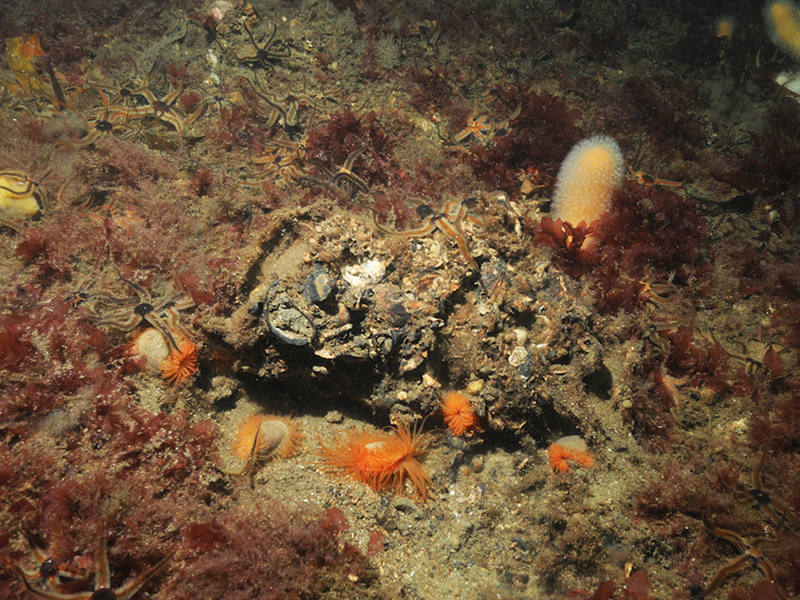
Limaria hians beds in tide-swept sublittoral muddy mixed sediment
Photographer: Dr Keith Hiscock Copyright: Dr Keith Hiscock
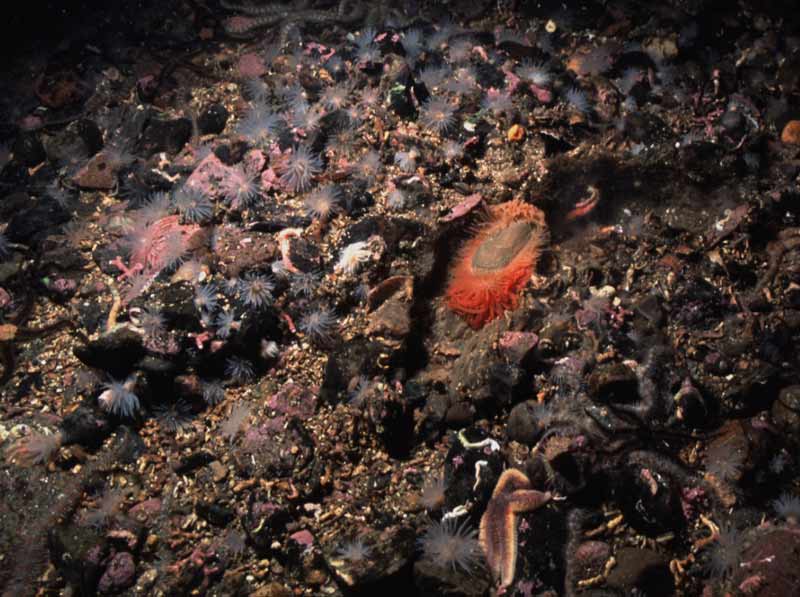
Limaria hians in excavated "nest". Limaria hians bed colonized by Protanthea simplex in background.
Photographer: Dr Keith Hiscock Copyright: Dr Keith Hiscock
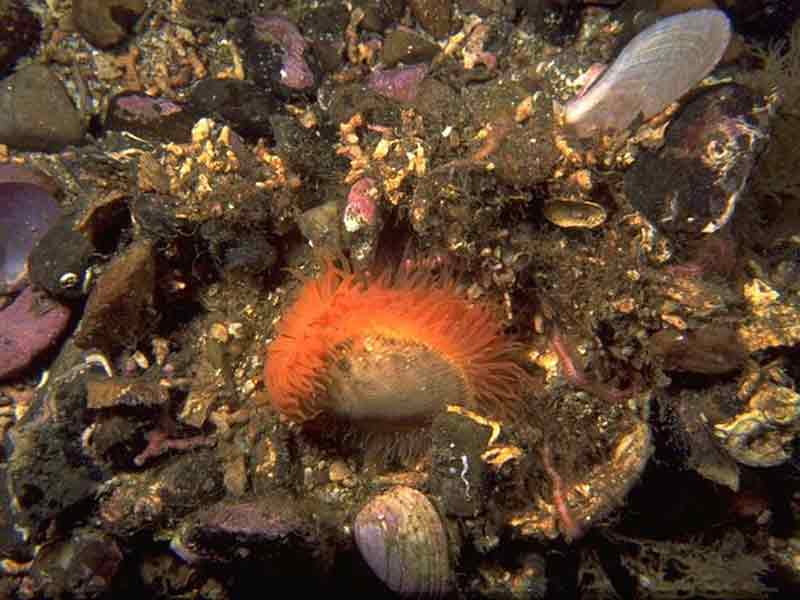
Gaping file shell nest on mixed muddy substratum, with nest opened and Limaria hians exposed.
Photographer: Sue Scott Copyright: Sue Scott

| Researched by | Dr Harvey Tyler-Walters, Frances Perry, Dr Colin Trigg & Amy Watson | Refereed by | Prof. Jason Hall-Spencer |
|---|
Summary
UK and Ireland classification
Description
Mixed muddy gravel and sand often in tide-swept narrows in the entrances or sills of sea lochs with beds or 'nests' of the flame shell Limaria hians. Individuals of Limaria hians form woven 'nests' or galleries from byssus and fragments of seaweeds essentially camouflaging themselves. The horse mussel Modiolus modiolus sometimes occurs at the same locations, lying amongst the Limaria hians bed. Other fauna associated with this biotope include hydroids such as Kirchenpaueria pinnata, Plumularia setacea and Nemertesia spp., mobile crustaceans such as Cancer pagarus and Necora puber and echinoderms, including Asterias rubens and Ophiothrix fragilis. Although generally present in water shallower than 30 m depth, beds have been recorded deeper, such as the bed at Loch Sunart which extends to >40 m depth. In shallow enough water, dense algal beds can cover the biogenic habitat, with algae potentially comprising red seaweeds, such as Phycodrys rubens and Plocamium cartilagineum and kelp such as Laminaria hyperborea. (Information adapted from Connor et al., 2004; JNCC, 2015, 2022).
Depth range
0-5 m, 10-20 m, 20-30 m, 30-50 mAdditional information
Little information on the ecology of this biotope was found, and the review presented has been based on the survey data and few detailed studies available (JNCC, 1999; Minchin, 1995, Hall-Spencer & Moore, 2000b, Trigg, 2009; Trigg & Moore, 2009; and Trigg et al., 2011).
Listed By
Habitat review
Ecology
Ecological and functional relationships
The information below is based on survey data and the few detailed studies available: Gilmour (1967), Minchin (1995), Connor et al. (1997), JNCC (1999), and Hall-Spencer & Moore (2000b).
- Limaria hians is an active suspension feeder on phytoplankton, bacteria, and detritus.
- The carpet of byssus threads, coarse sediment, and shell produced by Limaria hians provides refugia, and substratum for attachment for a wide variety of sessile and sedentary species.
- Other suspension feeders include sponges, hydroids (e.g. Kirchenpaueria pinnata, Nemertesia spp., and Tubularia spp.), bryozoans (e.g. Bugula spp.) , soft corals (e.g. Alcyonium digitatum), epifaunal and infaunal bivalves (e.g. Modiolus modiolus and Mya truncata respectively), tube worms (e.g. Spirobranchus triqueter), ascidians and small crustaceans. If present, the brittlestars, e.g. Ophiura spp. or Ophiopholis aculeata, may also suspension feed.
- Kelp (e.g. Laminaria hyperborea) and foliose red algae (e.g. Delesseria sanguinea or Phycodrys rubens) probably provide primary production in the form of detritus and dissolved organic matter, and via grazing by amphipods, isopods, chitons, gastropods (e.g. Gibbula cineria, Tectura virginea or Calliostoma zizyphinum) or sea urchins (e.g. Psammechinus miliaris). Suspension feeders, including Limaria hians obtain primary productivity from phytoplankton and benthic and epiphytic microalgae.
- The faunal turf of hydroids and bryozoans is probably grazed by echinoderms (e.g. Henricia oculata and Echinus esculentus) or gastropods (e.g. Calliostoma zizyphinum) or preyed on by polychaetes (e.g. the sea mouse Aphrodite aculeata), nudibranchs (e.g. Onchidoris sp.) and pycnogonids (e.g. Achelia echinata) (Gordon, 1972; Salvini-Plawen, 1972: Ryland, 1976).
- Mobile predators include crabs such as Cancer pagurus and Necora puber, which probably eat a variety of epifauna including gastropods, small crustacea and bivalves. The nests of Limaria hians provide a defence against most predators (Merrill & Turner, 1963: Gilmour, 1967). In addition, Limaria hians can also discard its tentacles leaving a predator with a sticky, unpalatable meal while the rest of the animal makes its escape by swimming. The tentacles of Limaria hians (especially the longer tentacles) secrete an adhesive and irritant mucus, that has been shown to deter a variety of predators from crabs to fish; e.g. the flounder was reported to spit out Limaria hians (Gilchrist, 1896; Merrill & Turner, 1963; Gilmour, 1967). However, the starfish Asterias rubens and Marthasterias glacialis prey on a wide range of epifauna and molluscs including Limaria hians (Minchin, 1995).
- Fish such as juvenile cod Gadus morhua, small-spotted catshark (dogfish) Scyliorhinus canicula, and dragonets Callionymus lyra and gobies probably prey on mobile and sessile epifauna on the bed and may take damaged specimens of Limaria hians (JNCC, 1999; Hall-Spencer & Moore, 2000b).
- Starfish, brittlestars, hermit crabs (e.g. Pagurus bernhardus), crabs and the common whelk Buccinum undatum probably act as epifaunal scavengers within this biotope (JNCC, 1999; Hall-Spencer & Moore, 2000b).
- The nest galleries support a number of detrivores, deposit feeders, scavengers and predators. For example, polychaetes (e.g. Polynoe spp. and Flabelligera affinis), flatworms and small crustaceans are probably scavengers within the nests, preyed on by polychaetes such as Glycera lapidum and Nephtys hombergi and ribbon worms) (Hall-Spencer & Moore, 2000b).
Seasonal and longer term change
Seasonal change. In the Plymouth area, Limaria hians breeds between early spring to late summer, the larvae present in the water column from August to the following April, with a peak of larval abundance in October at Plymouth or in late summer in Mulroy Bay, Co. Donegal (Lebour, 1937b, MBA, 1957; Allen, 1962; Minchin, 1995).
The macroalgae in the biotope may be expected to show seasonal changes in growth and development; for examples see Delesseria sanguinea and Laminaria hyperborea reviews. In temperate waters most bryozoan species tend to grow rapidly in spring and reproduce maximally in late summer, depending on temperature, day length and the availability of phytoplankton (Ryland, 1970). Several species of bryozoans and hydroids demonstrate seasonal cycles of growth in spring/summer and regression (die back) in late autumn/winter, overwintering as dormant stages or juvenile stages (see Ryland, 1976; Gili & Hughes, 1995; Hayward & Ryland, 1998). For example, the fronds of Bugula species are ephemeral, surviving about 3-4 months but producing two frond generations in summer before dying back in winter, although the holdfasts are probably perennial (Eggleston, 1972a; Dyrynda & Ryland, 1982). The hydroid Tubularia indivisa is annual, dying back in winter (Fish & Fish, 1996), while the uprights of Nemertesia antennina die back after 4-5 months and exhibit three generations per year (spring, summer and winter) (see reviews; Hughes, 1977; Hayward & Ryland, 1998; Hartnoll, 1998). Many of the bryozoans and hydroid species are opportunists (e.g. Bugulina flabellata) adapted to rapid growth and reproduction (r-selected), taking advantage of the spring/summer phytoplankton bloom and more favourable (less stormy) conditions (Dyrynda & Ryland, 1982; Gili & Hughes, 1995). Some species such as the ascidians Ciona intestinalis and Clavellina lepadiformis are effectively annual (Hartnoll, 1998). Therefore, the biotope is likely to demonstrate seasonal changes in the abundance or cover of the epifauna and macroalgae.
Temporal change. Hall-Spencer & Moore (2000b) studied a Limaria hians bed over a 5 year period, while Minchin (1995) reported the that Limaria hians was abundant in the Moross Channel, Mulroy Bay from 1978-1982 and had been recorded from Mulroy Bay a hundred years previously. This suggests that Limaria hians beds, once established, are probably relatively stable unless affected by human impacts or storms (see sensitivity).
Habitat structure and complexity
The gaping file shell Limaria hians can build extensive nests made of shell, stones debris and maerl (when present) interlaced by several hundred byssus threads, and lined by mucus, mud and their faeces (Gilchrist, 1896; Hall-Spencer & Moore, 2000b). Nests may be constructed by expansion of smaller burrows, in gravel, shell sand or laminarian holdfasts, or may be simply composed of byssus threads (see Merrill & Turner (1963) and Gilmour (1967) for details). Nests are about the maximum gape of shell in diameter by about twice the length of the animal, with holes for the entrance and exit of water. Nests vary in size and complexity with individual Limaria hians being recorded from nests of 2-5 cm diameter, while larger nests of up to 25 cm diameter and 10 cm in length consisted of numerous ventilated holes and galleries (Gilmour, 1967; Tebble, 1976; Hall-Spencer & Moore, 2000b). Hall-Spencer & Moore (2000b) reported that six of these large nests contained 24-52 small and 25-40 large individuals of Limaria hians, with adult individuals occupying single galleries with two ventilation holes, while juveniles occupied complex galleries with multiple ventilation holes. Limaria hians can also occur individually or in small numbers, for example in kelp holdfasts, or under stones intertidally (Jason Hall-Spencer, pers com.).
This biotope is characterized by dense populations of Limaria hians where the nests coalesce into a carpet or bed over the sedimentary substratum, and in which individual Limaria hians are not visible (Connor et al., 1997; JNCC, 1999). For example, in the Creag Gobhainn area of Loch Fyne, Limaria hians formed a bed 10-20 cm high, composed of >700 individuals/m⊃2; and covering several hectares (Hall-Spencer & Moore, 2000b) and 216-584 /m⊃2; were reported in the Moross Channel, Mulroy Bay in 1980 (Hobson, 1980 cited in Minchin, 1995). The carpet of nests covers and hence stabilizes the substratum. In addition, the carpet of nests provides substratum for the attachment for a diverse array of sessile and sedentary invertebrates, niches and refugia for mobile epifauna, and the nests themselves support a burrowing infauna and scavengers. The exact composition of the associated community probably varies with location depending on the species present in the surrounding area.
- In shallow examples of this biotope the Limaria hians carpet provides substratum for macroalgae, including the kelps Saccorhiza polyschides, Laminaria digitata and Saccharina latissima (studied as Laminaria saccharina and their associated flora and fauna (e.g. see EIR.LhypR) , which would otherwise be unable to attach to a sedimentary substratum (Minchin, 1995).
- Sessile epifauna attached to the nests and any available hard substrata such as stones include, sponges (e.g. Esperiopsis fucorum), hydroids (e.g. Kirchenpaueria pinnata, Nemertesia spp., and Tubularia spp.), soft corals (e.g. Alcyonium digitatum), anemones (e.g. Urticina felina and Metridium senile), bryozoans (e.g. Bugula spp.), barnacles (e.g. Balanus crenatus), amphipods (e.g. Ampelisca spp. and Jassa spp.), ascidians (e.g. Ciona intestinalis and Corella parallelogramma), tube worms (e.g. Spirobranchus triqueter), and bivalves (e.g. the horse mussel Modiolus modiolus and scallops Pecten maximus and Chlamys varia) (Connor et al., 1997; JNCC, 1999; Hall-Spencer & Moore, 2000b).
- Mobile epifauna include flatworms, ribbon worms (Nemertea), polychaetes (e.g. the sea mouse Aphrodite aculeata), pycnogonids, amphipods, shrimp, hermit crabs (e.g. Pagurus bernhardus), crabs (e.g. Cancer pagurus, Hyas araneus, and Necora puber), gastropods (e.g. Gibbula spp., Calliostoma zizyphinum, and Buccinum undatum), nudibranchs (e.g. Onchidoris spp.), sea urchins (e.g. Psammechinus miliaris), brittlestars (e.g., Ophiothrix fragilis and Ophiocomina nigra), and starfish (e.g. Asterias rubens, Crossaster papposus and Marthasterias glacialis) (Connor et al., 1997; JNCC, 1999; Hall-Spencer & Moore, 2000b).
- The galleries of the nests also supported scavengers such as scale worms (e.g. Polynoe sp.) and predatory polychaetes (e.g. Lepidonotus squamatus and Glycera lapidum), while the polychaetes Flabelligera affinis and the bivalve Kurtiella bidentata were associated with the faeces-lined walls of nest galleries (Hall-Spencer & Moore, 2000b).
- Hall-Spencer & Moore (2000b) reported that the sediment underneath the Limaria hians bed supported a diverse infaunal community including burrowing bivalves (e.g. Mya truncata, Dosinia exoleta and Tapes rhomboides), the heart urchin Echinocardium pennatifidum and the holothurian Thyonidium drummondi. The high infaunal biodiversity observed in their study area was attributed to the porosity of the Limaria hians beds and the locally strong currents, that allowed adequate exchange of oxygenated water and nutrient. Examples of this biotope that occur in areas of low water movement (i.e. weak currents and wave sheltered conditions) may not exhibit such as diverse community.
Productivity
Little information on productivity was found. However, phytoplankton, benthic microalgae, kelps and other macroalgae probably make an important contribution to primary productivity where abundant. Dame (1996) suggested that dense beds of bivalve suspension feeders increase turnover of nutrients and organic carbon in estuarine (and presumably coastal) environments by effectively transferring pelagic phytoplanktonic primary production to secondary production in the sediments (pelagic-benthic coupling). The Limaria hians beds probably also provide secondary productivity in the form of tissue, faeces and pseudofaeces.
Recruitment processes
Limaria hians is dioecious (Ansell, 1974) and can reproduce in its second summer (Minchin, 1995). Hrs-Benko (1973) reported that Limaria hians in the northern Adriatic were sexually active throughout the year, with a main spawning period between late spring and summer, while Minchin (1995) noted that settlement normally occurred in August to September in Mulroy Bay. Veligers of Limaria hians were collected between August and the following April in the Plymouth area, absent in early summer with a peak in abundance in October (Lebour, 1937b). Limaria hians veligers are distinctive and triangular in shape (80-320 µm in length). Larvae reach 320 µm in length within a few weeks in the laboratory, after which metamorphosis occurs, suggesting that the veligers could spend at least a few weeks in the plankton. Newly metamorphosed juveniles grow rapidly, reaching 2 mm in length within about 2.5 months (Lebour, 1937b). Minchin (1995) noted that Limaria hians laid down two growth rings per year after their first year, and reported a mean shell length of 2 cm in their third summer. Hrs-Benko (1973) noted that individuals >2.7-3 cm in size died in the Adriatic population, while Minchin (1995) recorded 5 year classes and 6 year old specimens in Mulroy Bay. It is thought that Limaria hians may live up to 10 or 11 years; however, growth is very limited after six to seven years (Trigg, 2009). Trigg (2009) suggested there could be variability in the reproductive cycles of Limaria hians even within similar geographical locations. Little information is available on the mortality rates of Limaria hians. A size-frequency study from a population on the west coast of Scotland, between April 2006 and June 2007, recorded a decline in population density during May in both years (Trigg, 2009). The observed decline could indicate a natural fluctuation within the population when mortality rates are high after spawning (Trigg, 2009).
Limaria hians populations are dependant on recruitment to maintain their abundance as recruitment failure in the Moross Channel, Mulroy Bay , associated with tri-butyl tin (TBT) contamination, resulted in loss of the resident population (Minchin, 1995). This recruitment is in turn dependent on the production of larvae from either the adjacent Limaria hians s population or populations within the vicinity of the affected area.
The associated macroalgae, epifauna and interstitial fauna probably depend on locality and recruit from the surrounding area. Many hydroids and most bryozoans, ascidians and probably sponges have short lived plankton or demersal larvae with relatively poor dispersal capabilities. Exceptions include Nemertesia antennina and Alcyonium digitatum and hydroids that produce medusoid life stages, which probably exhibit relatively good dispersal potential. Hydroids and bryozoans are opportunistic, rapid growing species, with relatively widespread distributions, which colonize rapidly and are often the first groups of species to occur on settlement panels. Sponges and anemones may take longer to recruit to the habitat but are good competitors for space. Recruitment in epifauna communities is discussed in detail in the faunal turf biotopes MCR.Flu, CR.Bug and in Modiolus modiolus beds (MCR.ModT).
Mobile epifaunal species, such as echinoderms, crustaceans, and amphipods are fairly vagile and capable of colonizing the community by migration from the surrounding areas, probably attracted by the refugia and niches supplied by the Limaria hians carpet. In addition, most echinoderms and crustaceans have long-lived planktonic larvae with high dispersal potential, although, recruitment may be sporadic, especially in echinoderms.
Time for community to reach maturity
The time taken for the biotope to develop would depend on the time required for the Limaria hians population to increase in abundance and develop a carpet or bed of byssal nests. Colonization by macroalgae, epifauna, and mobile species would probably be rapid and may enhance development of the byssus carpet (Jason Hall-Spencer pers comm.).
Information on recovery rates is limited and is based largely on observations from Mulroy Bay (Minchin, 1995) and modelled predictions (Trigg & Moore, 2009). The recovery of the Limaria hians beds in Moross Channel, Mulroy Bay was studied by Minchin (1995). The population was reduced to only <2% of its 1980 abundance by 1986 (Minchin et al., 1987). In the follow up study, Minchin (1995) reported that after successful spat falls in 1989 onwards, the population, carpet and associated community had returned to their 1980 state by 1994, presumably due to recruitment from a few surviving old specimens or populations in other areas of Mulroy Bay. Trigg & Moore (2009) completely removed a number of small patches of bed material from a Limaria hians bed on the west coast of Scotland. They cleared a number of 0.25 m2 sections within with a bed that represented 100% Limaria hians cover. They reported that regrowth generally occurred from peripheral nest material but that recovery within these test patches was not as thick as the undisturbed bed (Trigg & Moore, 2009). Trigg & Moore (2009) estimated that regrowth occurred at a rate of 3.2 cm/annum when the regrowth in the test areas was converted to a linear front. They further estimated that at this rate of regrowth it could take up to 117 years for a Limaria hians bed to recover from a 7.5 m dredge running through the habitat, assuming that this dredge completely removed all nest material and Limaria hians within the affected area (Trigg & Moore, 2009). However, recent observations from a Limaria hians bed in Loch Carron suggest that where the bed is not completely removed by dredging and individual Limaria hians remain, then regrowth may occur more rapidly (Moore, pers. comm).
Additional information
None entered
Preferences & Distribution
Habitat preferences
| Depth Range | 0-5 m, 10-20 m, 20-30 m, 30-50 m |
|---|---|
| Water clarity preferences | Data deficient |
| Limiting Nutrients | Data deficient |
| Salinity preferences | Full (30-40 psu), Low (<18 psu), Reduced (18-30 psu), Variable (18-40 psu) |
| Physiographic preferences | Sea loch or Sea lough |
| Biological zone preferences | Circalittoral, Infralittoral, Lower circalittoral, Lower infralittoral, Sublittoral, Upper circalittoral |
| Substratum/habitat preferences | Coarse clean sand, Cobbles, Mixed, Muddy gravel, Muddy gravelly sand, Muddy sand, Muddy sandy gravel, Pebbles |
| Tidal strength preferences | Moderately strong 1 to 3 knots (0.5-1.5 m/sec.), Strong 3 to 6 knots (1.5-3 m/sec.), Weak < 1 knot (<0.5 m/sec.) |
| Wave exposure preferences | Exposed, Extremely sheltered, Moderately exposed, Sheltered, Very sheltered |
| Other preferences | Data deficient |
Additional Information
This biotope has been recorded from 4-98 m on mixed muddy gravel or sand, coarse sands, muddy maerl, and bedrock in areas with weak to strong tidal streams and wave sheltered to extremely wave sheltered habitats (Connor et al., 1997; JNCC, 1999; Hall-Spencer & Moore, 2000b). It is probable that the Limaria hians carpet does not occur in shallow depths in wave exposed locations. It occurs at high densities in the Creag Gobhainn area of Loch Fyne (Hall-Spencer & Moore, 2000b) and Moross Channel, Mulroy Bay, Ireland (Minchin, 1995), and is very common in Loch Sunart (Howson, 1996).
Species composition
Species found especially in this biotope
- Crossaster papposus
- Hyas araneus
- Kirchenpauria pinnata
- Limaria hians
- Nemertesia antennina
- Nemertesia ramosa
- Ophiocomina nigra
- Ophiothrix fragilis
- Plumularia setacea
Rare or scarce species associated with this biotope
-
Additional information
Beds of Limaria hians provide stable substrata in otherwise sedimentary habitats and support a diverse epifauna and infauna (Hall-Spencer & Moore, 2000b). The MNCR recorded 324 species within this biotope, although not all species were present in all records of the biotope (Connor et al., 1997a). Hall-Spencer & Moore (2000b) reported 19 species of macroflora and 265 species of invertebrate macrofauna in only six Limaria hians nests from one site in Loch Fyne, Scotland. Recently, Trigg et al. (2011) recorded 282 species (across 16 phyla) of epiflora, epifauna and infauna, from only two sites in Scotland.
Sensitivity review
Sensitivity characteristics of the habitat and relevant characteristic species
The biotope is characterized by a dense bed (biogenic reef)of the flame shell Limaria hians. Individual Limaria hians secrete byssus threads that are attached to surrounding material forming a carpet composed of threads, coarse sediment, shell, and organic matter. This porous layer lies on top of the mixed muddy gravel found within this biotope. Beds of Limaria hians provide a stable substratum in otherwise sedimentary habitats and support a diverse epifaunal and infaunal community (Hall-Spencer & Moore, 2000). Many of the species found within the community are characteristic of the wave sheltered and tide swept situations where Limaria hians beds are found. The Marine Nature Conservation Review (MNCR) recorded 324 species within this biotope, although not all species were present in all records of the biotope (Connor et al., 1997a). Hall-Spencer & Moore (2000b) recorded more than 280 macrofaunal taxa, of which 19 were algae, in only six Limaria hians nests from one site in Loch Fyne, Scotland. A more recent study recorded 227 taxa from a single sampling site, incorporating an area of just 0.08m2 (Trigg et al., 2011).
Loss or degradation of the Limaria hians beds in this biotope would result in reclassification of the sedimentary biotope and the loss or degradation of the associated assemblage, and destabilization of the sediment (Minchin, 1995). Therefore, Limaria hians is considered to be the key characterizing and structural species and the sensitivity review focuses on the sensitivity of this species and the beds they create. The sensitivity of other associated species found within this biotope are not given in this assessment as none are thought to be pivotal to the recruitment or maintenance of Limaria hians bed. The effect of individual pressures on the other components of the community will be addressed where relevant.
Resilience and recovery rates of habitat
The Limaria hians biotope is recorded from the west coast of Scotland, Orkney, and Mulroy Bay, Ireland. It is possible that the highly camouflaged nature of these nests has led to a lack of data regarding their location (Trigg, 2009). In a number of the localities where this biotope has been recorded its extent is decreasing (e.g. Hall-Spencer, 1998; Moore et al., 2013). Wide scale declines of this biotope have been recorded in the Clyde Sea and off the Isle of Man, and it has disappeared from prior strongholds such as the Skelmorlie Bank, Stravanan Bay and Tan Buoy, Great Cumbrae (Hall-Spencer & Moore, 2000b). A report by Moore et al. (2013) noted the reduction in extent of a Limaria hians bed in Loch Linnhe. Recent communications have confirmed that this bed has deteriorated further since the report was published (Moore, pers.comm). Limaria hians is not subject to direct exploitation for either commercial or recreational use. However, Aequipecten opercularis, Pecten maximus and Buccinum undatum are exploited commercially and are associated with SS.SMx.IMx.Lim biotope (Connor et al., 2004).
Natural disturbance of Limaria hians beds have been recorded by both Minchin (1995) and Trigg et al. (2011). In the strong tidal currents associated with Limaria hians beds, kelp holdfasts can tear free from the substratum removing sections of the byssus mat (Minchin, 1995; Hall-Spencer & Moore, 2000; Trigg et al., 2011). It was suggested that these events could lead to a reduction in biodiversity, when compared with the adjacent undisturbed Limaria hians bed, at the point of disturbance (Trigg et al., 2011). After a disturbance event the bed can recover through a combination of nest regrowth by individual Limaria hians still present, settlement of juvenile Limaria hians and peripheral growth from the edge of the unaffected Limaria hians bed, if available (Minchin, 1995; Trigg, 2009; Trigg & Moore, 2009). Therefore, recolonization of the habitat by associated species can take place. It is also possible that translocation of dislodged, undamaged adults could contribute to recovery (Hall-Spencer & Moore, 2000b).
Juvenile recruitment is probably the most important mechanism for recovery of significantly impacted beds i.e. where individuals of Limaria hians have been completely removed from the affected area. This recruitment is in turn dependent on the production of larvae from either the adjacent Limaria hians population or populations within the vicinity of the affected area.
Limaria hians is dioecious (Ansell, 1974) and can reproduce in its second summer (Minchin, 1995). It is thought that Limaria hians may live up to 10 or 11 years; however, growth is very limited after six to seven years (Trigg, 2009). Within the northern Adriatic, Limaria hians are sexually active throughout the year, with a peak in reproduction between late spring and summer (Hrs-Benko, 1973). Minchin (1995) noted that settlement normally occurred in August to September in Mulroy Bay. Veligers of Limaria hians were collected between August and the following April in the Plymouth area (Lebour, 1937b). However, Trigg (2009) suggests that there could be variability in the reproductive cycles of Limaria hians even within similar geographical locations. Little information is available on the mortality rates of Limaria hians. A size-frequency study from a population on the west coast of Scotland, between April 2006 and June 2007, recorded a decline in population density during May in both years (Trigg, 2009). The observed decline could indicate a natural fluctuation within the population when mortality rates are high after spawning (Trigg, 2009).
Information on recovery rates is limited and is based largely on observations from Mulroy Bay (Minchin, 1995) and modelled predictions (Trigg & Moore, 2009). Experiments tracking recovery of deliberately cleared patches also provide some information on recovery from small-scale disturbance. For example, work by Minchin (1995) found that the affected bed in Mulroy Bay fully recovered after nine years following cessation of the antifoulant TBT and an increase in recruitment. Trigg & Moore (2009) completely removed a number of small patches of bed material from a Limaria hians bed on the west coast of Scotland. They cleared a number of 0.25 m2 sections within with a bed that represented 100% Limaria hians cover. They reported that regrowth generally occurred from peripheral nest material but that recovery within these test patches was not as thick as the undisturbed bed (Trigg & Moore, 2009). Trigg & Moore (2009) estimated that regrowth occurred at a rate of 3.2 cm/annum when the regrowth in the test areas was converted to a linear front. They further estimated that at this rate of regrowth it could take up to 117 years for a Limaria hians bed to recover from a 7.5 m dredge running through the habitat, assuming that this dredge completely removed all nest material and Limaria hians within the affected area (Trigg & Moore, 2009). However, recent observations from a Limaria hians bed in Loch Carron suggest that where the bed is not completely removed by dredging and individual Limaria hians remain, then regrowth may occur more rapidly (Moore, pers. comm).
Resilience assessment. It is considered that the presence of a local healthy population of Limaria hians could contribute significantly to the recovery of an impacted bed (e.g. Minchin, 1995; Trigg & Moore, 2009). Recovery rates are, therefore, site-specific and depend on the presence of a source population to allow recolonization. This ability to recruit from a nearby population does not mean that recovery to previous habitat structure is quick, as the study by Trigg & Moore (2009) indicated. Although Minchin (1995) recorded a recovery time of <10 years from a bed reduced to 2% of its original density, Hall-Spencer (pers comm) suggested that this short recovery time may be an exception to a rule. Therefore, where a population of Limaria hians experiences some mortality but the habitat is not changed (e.g. Medium resistance), then the habitat has the potential to recover within several years depending on recruitment, a resilience of 'Medium' (2-10 years). Where the population experiences significant mortality, specifically when all individuals of Limaria hians have been removed from an affected area, and/or the carpet (bed) is damaged (e.g. resistance is Low or None), then the recovery is likely to be prolonged. In this instance, a resilience score of 'Low' (10-25 years) or ‘Very Low’ (at least 25 years, prolonged or negligible) would be recorded, based on the recovery rates modelled by Trigg & Moore (2009) and the evidence that Limaria hians beds are in decline in UK waters.
Note - resilience and the ability of a habitat to recover from human induced pressures is subject to a number of factors. These include, but are not limited to; environmental conditions of the site, the frequency of disturbance events, the intensity of the disturbance and the number of pressures being exerted on a site at any one time. Recovery of impacted populations will always be mediated by stochastic events and processes acting over different scales. Local habitat conditions, further impacts and processes such as larval-supply and recruitment between populations are examples of such scales. Full recovery is defined as the return to the state of the habitat that existed prior to impact. This does not necessarily mean that every component species has returned to its prior condition, abundance or extent. It is more important that the relevant functional components are present and the habitat is structurally and functionally recognisable. It should be noted that the recovery rates are only indicative of the recovery potential.
Hydrological Pressures
Use [show more] / [show less] to open/close text displayed
| Resistance | Resilience | Sensitivity | |
Temperature increase (local) [Show more]Temperature increase (local)Benchmark. A 5°C increase in temperature for one month, or 2°C for one year. Further detail EvidenceLimaria hians has been recorded from the Lofoten Isles in Norway, to as far south as the Canary Isles in the Azores. Therefore, it is unlikely to be affected by long-term changes in temperature at the benchmark level in British waters. Although individual Limaria hians have been recorded from the lower shore, the beds are only found in the subtidal and are thus buffered against extreme changes in water temperature. However, it is likely that other species within the community may be affected, for example, Boreal species (e.g. Balanus crenatus and Modiolus modiolus) may decrease in abundance with an increase in temperature. Sastry (1966) considered environmental conditions, such as temperature, influential to the reproductive cycle of bivalves. Studies on another member of the Limidae family, Ctenoides scaber, found that when water temperature and food abundance increased, gonad size within the organisms studied also increased (Dukeman et al., 2005). Hence, any significant increase in temperature may increase the spawning period of Limaria hians. However, as the distribution of Limaria hians in the British Isles puts it in the middle of its known geographic range this is unlikely to occur. Sensitivity assessment. The community composition found on the Limaria hians beds may differ with temperature changes. However, the presence of Limaria hians is unlikely to change with an increase in temperature at the benchmark level, due to Limaria hians being in the middle of its geographic range in the British Isles. Therefore, resistance is assessed as ‘High’, resilience as ‘High’ and sensitivity as ‘Not sensitive’ at the benchmark level. | HighHelp | HighHelp | Not sensitiveHelp |
Temperature decrease (local) [Show more]Temperature decrease (local)Benchmark. A 5°C decrease in temperature for one month, or 2°C for one year. Further detail EvidenceLimaria hians has been recorded from the Lofoten Isles in Norway, to as far south as the Canary Isles in the Azores. Therefore, it is unlikely to be affected by long-term changes in temperature at the benchmark level in British waters. Although individual Limaria hians have been recorded from the lower shore, the beds are only found in the subtidal and are thus buffered against extreme changes in water temperature. However, it is likely that other species within the community may be affected, for example, boreal species (e.g. Balanus crenatus and Modiolus modiolus) may increase in abundance with a decrease in temperature. Sastry (1966) considered environmental conditions, such as temperature, influential to the reproductive cycle of bivalves. Studies on another member of the Limidae family, Ctenoides scaber, found that when water temperature and food abundance increased, gonad size within the organisms studied also increased (Dukeman et al., 2005). Any significant decrease in temperature may restrict the spawning period of Limaria hians. However, as the distribution of Limaria hians in the British Isles puts it in the middle of its geographic range this is unlikely to occur. Sensitivity assessment. The community composition found on the Limaria hians beds may differ with temperature changes. However, the presence of Limaria hians is unlikely to change with an increase in temperature at the benchmark level, due to Limaria hians being in the middle of its range in the British Isles. Therefore, resistance is assessed as ‘High’, resilience as ‘High’ and sensitivity as ‘Not sensitive’ at the benchmark level. | HighHelp | HighHelp | Not sensitiveHelp |
Salinity increase (local) [Show more]Salinity increase (local)Benchmark. A increase in one MNCR salinity category above the usual range of the biotope or habitat. Further detail EvidenceLimaria hians beds are found in fully marine environments. In some locations, such as the shallow sills of sealochs, Limaria hians may be exposed to occasional drops in salinity during winter or as a consequence of high rainfall; however, the environment is still considered fully marine. An increase in salinity at the benchmark level would result in a salinity of >40 psu for one year. Hypersaline water is likely to sink to the seabed and the biotope could be affected by hypersaline effluents (brines). Ruso et al. (2007) reported that changes in the community structure of soft sediment communities due to desalinisation plant effluent in Alicante, Spain. In particular, in close vicinity to the effluent, where the salinity reached 39 psu, the community of polychaetes, crustaceans and molluscs was lost and replaced by one dominated by nematodes. Roberts et al. (2010b) suggested that hypersaline effluent dispersed quickly but was more of a concern at the seabed and in areas of low energy where widespread alternations in the community of soft sediments were observed. In several studies, echinoderms and ascidians were amongst the most sensitive groups examined (Roberts et al., 2010b). Sensitivity assessment. Hypersaline effluents are likely to be localised but dispersed quickly in areas of strong currents. Therefore, where the biotope occurs on strong to moderate tidal streams hypersaline effluents may not have an adverse effect. But in areas of weak tidal streams hypersaline effluent could adversely affect the diversity of the biotope and reduce the abundance of Limaria hians. Although there is no direct evidence of the effects of hypersaline water on this biotope, hypersaline effluent may cause mortality. Therefore, a resistance of 'Low' is suggested but at Low confidence. Resilience would probably be 'Low', so that sensitivity may be 'High'. | LowHelp | LowHelp | HighHelp |
Salinity decrease (local) [Show more]Salinity decrease (local)Benchmark. A decrease in one MNCR salinity category above the usual range of the biotope or habitat. Further detail EvidenceLimaria hians beds are found in fully marine environments. In some locations, such as the shallow sills of sea lochs, Limaria hians may be exposed to occasional drops in salinity during winter or as a consequence of high rainfall; however, the environment is still considered fully marine. Therefore, in shallow waters beds may be vulnerable to short-term reductions in salinity; however, these would not be within the benchmark criteria. Several bivalves have been shown to be able to increase the concentration of free amino acids in their cytoplasm to compensate for decreases in salinity (Berger & Kharazova, 1997). As salinity falls most bivalves close their shells to isolate themselves from the surrounding environment. Limaria hians has a gaping shell that cannot be fully closed, and numerous, tentacles that cannot be withdrawn into the mantle cavity. Therefore, although it may exhibit an unknown degree of physiological tolerance, it is unlikely to be able to tolerate reduced or prolonged periods of variable salinity. Sensitivity assessment. No evidence is available on the impact of a decrease in salinity on Limaria hians but the biotope is considered to be fully marine. Consequently, it is not thought that Limaria hians would tolerate a decrease in salinity according to the benchmark criteria (i.e. from ‘full’ to ‘reduced’ salinity). Therefore, resistance is assessed as ‘Low’ and resilience as ‘Low’ so that sensitivity may be ‘High’. | LowHelp | LowHelp | HighHelp |
Water flow (tidal current) changes (local) [Show more]Water flow (tidal current) changes (local)Benchmark. A change in peak mean spring bed flow velocity of between 0.1 m/s to 0.2 m/s for more than one year. Further detail EvidenceThis biotope occurs in weak to moderately strong tidal streams (Connor et al., 2004). A change in water flow may affect settlement success of larvae. Studies of both epiphytic and infaunal organisms have found that larvae can settle at a range of flow rates (Abelson et al., 1994; Eckman et al., 1990; Mullineaux & Butman, 1991; Pawlik & Butman, 1993). It is likely that larvae use different flow rates as physical cues as to whether they have settled in the correct habitat (Abelson & Denny, 1997). To date, there is no information on how Limaria hians larvae respond to changes in water flow rate. However, significant changes in water flow rate could determine the success of larval settlement. Limaria hians feeds on suspended organic matter such as microalgae, phytoplankton, bacteria and detritus (Trigg, 2009). As an active suspension feeder water is diverted into the mantle cavity of the organism, and then over its gill filaments (Ward et al., 2004). Changes in flow rate would, therefore, affect the amount of suspended particulate matter passing the organism within the water column. Investigations into the effects of water flow velocity on scallops have found that flow rates can affect growth (Cahalan et al., 1989; Eckman, 1987; Wildish et al., 1987). No specific information is available on water flow and growth rates for Limaria hians. A reduction in flow rate would also lead to lighter sediment particles falling out of suspension, increasing siltation on the Limaria hians bed (see siltation). Reduced water flow would also reduce the availability of oxygen to the organism (see deoxygenation), and reduce removal of faeces generated by Limaria hians and other organisms residing in the nest material If water flow was to increase from strong (1.5-3 m/s) to very strong (> 3 m/s) it is possible that physical damage to the bed could occur. The additional drag caused by epibiota attached to the carpet, particularly kelp, could result in removal of patches as the kelp is torn from the bed. Holes in the carpet may then lead to remobilization of the sediment, resulting in further damage (Minchin, 1995) and leaving coarser sediment fractions. However, water flow is important for the oxygen and nutrient exchange within the byssus carpet, the removal of waste products, the supply of food to the dominant suspension feeders (inc. Limaria hians) and to keep the byssus carpet clear of sediment that may otherwise clog the carpet. Therefore, a reduction in flow is likely to be detrimental to the survival and diversity of the Limaria hians beds, especially in areas that lack wave-induced water flow. For example, Hall-Spencer & Moore (2000b) reported that the sediment underneath the Limaria hians bed supported a diverse infaunal community including burrowing bivalves (e.g. Mya truncata, Dosinia exoleta and Polititapes rhomboides), the heart urchin Echinocardium pennatifidum and the holothurian Thyonidium drummondi. The high infaunal biodiversity observed in their study area was attributed to the porosity of the Limaria hians beds and the locally strong currents, that allowed adequate exchange of oxygenated water and nutrient. Examples of this biotope that occur in areas of low water movement (i.e. weak currents and wave sheltered conditions) may not exhibit such as diverse community. Sensitivity assessment. A significant increase in water flow rate may physically disturb the bed, particularly where examples of the feature inhabit areas already at the upper tolerance limit to flow rates but an increase in water flow of 0.1-0.2 m/s, is unlikely to adversely affect the biotope. However, a significant decrease in water flow is likely to be detrimental. Therefore, a precautionary resistance of ‘Medium’ is recorded (at the benchmark level) to represent possible damage and loss of diversity. Hence, resilience is assessed as 'Medium' and sensitivity as ‘Medium’. | MediumHelp | MediumHelp | MediumHelp |
Emergence regime changes [Show more]Emergence regime changesBenchmark. 1) A change in the time covered or not covered by the sea for a period of ≥1 year or 2) an increase in relative sea level or decrease in high water level for ≥1 year. Further detail EvidenceIndividual Limaria hians have been recorded from the low water mark. However the SS.SMx.IMx.Lim biotope is only found subtidally (Connor et al., 2004) from approximately 5 m to 40 m. Therefore, as the beds are found in fully subtidal areas this pressure is considered ‘Not relevant’. | Not relevant (NR)Help | Not relevant (NR)Help | Not relevant (NR)Help |
Wave exposure changes (local) [Show more]Wave exposure changes (local)Benchmark. A change in near shore significant wave height of >3% but <5% for more than one year. Further detail EvidenceThis biotope is associated extremely wave sheltered to wave sheltered environments (Connor et al., 2004). Even a small increase in significant wave height has the potential to damage shallow examples of the biotope if this increase would lead to a wave ‘exposed’ environment. The oscillatory nature of wave induced water movement is potentially damaging, especially where foliose macroalgae (e.g. kelps) attached to the carpet increase drag. An increase in wave exposure from sheltered to exposed may result in disruption of the byssal carpet and mobilization of the substratum, especially where the biotope is found in shallower water. Conversely, a decrease in wave exposure would not be considered to affect the community if flow rates were not significantly affected. Sensitivity assessment. This is a wave sheltered biotope so that even a small increase in significant wave height has the potential to damage shallow examples of the biotope if this increase would lead to a wave exposed environment. However, a 3-5% change in significant wave height is only likely to affect sheltered examples of the biotope in their most shallow extent. Conversely, a decrease in wave exposure would not be considered to affect the community provided that flow rates were not significantly affected. Therefore, a precautionary resistance of ‘Medium’ is recorded to represent possible damage to the most shallow extent of the biotope in already wave sheltered localities. Hence, resilience is assessed as 'Medium' and sensitivity as ‘Medium’. | MediumHelp | MediumHelp | MediumHelp |
Chemical Pressures
Use [show more] / [show less] to open/close text displayed
| Resistance | Resilience | Sensitivity | |
Transition elements & organo-metal contamination [Show more]Transition elements & organo-metal contaminationBenchmark. Exposure of marine species or habitat to one or more relevant contaminants via uncontrolled releases or incidental spills. Further detail EvidenceThis pressure is Not assessed but evidence is presented where available. In the Moross Channel, Mulroy Bay, an intensive settlement of Limaria hians spat occurred in 1982 followed by five years of failed settlement, which coincided with the use of TBT in fish farms in the area. Limaria hians samples in 1985 contained 0.2 µg/g tri-butyl tin oxide and similar levels were found in the Pacific oyster, scallops and mussels in the same area.Limaria hians larvae were detected again after the use of TBT was discontinued in 1985 (Minchin et al., 1987; Minchin, 1995). Minchin (1995) suggested that TBT contamination was the most likely cause of the disappearance of larvae from the plankton. Mytilus edulis continued to settle during the impacted period suggesting that Limaria hians was more intolerant. Limaria hians populations are dependent on recruitment to maintain their abundance. A recruitment failure in Mulroy Bay associated with tri-butyl tin (TBT) contamination, resulted in loss 98% of the population between 1980 and 1986. Minchin (1995) studied the recovery of this population of Limaria hians and found that once recruitment began again in 1989, recovery was rapid so that by 1994 the population and an extensive carpet of byssal nests indicated recovery to the earlier 1980 state. Young saithe were again present sheltering in a re-established kelp cover, suggesting that the community as a whole had also recovered. This suggests that where individuals survive and in the presence of good recruitment, a population may be able to regain its prior abundance within five years. Minchin (1995) noted that good recruitment was necessary to maintain the byssal carpet. Poor recruitment resulted in a weakening of the byssal carpet, which was pulled away in tufts due to drag by kelps in the strong currents, mobilization of the sediment and resultant smothering, and loss of the carpet, its attached kelps and associated community and the population was reduced to 1.6% of its 1980 abundance. If TBT inhibits the settlement of Limaria hians larvae then it is accurate to give a resistance of ‘None’. The fast recovery recorded by Minchin (1995) suggests that if TBT use is restricted then Limaria hians can recover. However, it is not clear if the speed of recovery seen in Mulroy Bay would occur everywhere. | Not Assessed (NA)Help | Not assessed (NA)Help | Not assessed (NA)Help |
Hydrocarbon & PAH contamination [Show more]Hydrocarbon & PAH contaminationBenchmark. Exposure of marine species or habitat to one or more relevant contaminants via uncontrolled releases or incidental spills. Further detail EvidenceThis pressure is Not assessed but evidence is presented where available. Subtidal populations are protected from the direct effects of oil spills by their depth but are likely to be exposed to the water soluble fraction of oils and hydrocarbons, or hydrocarbons adsorbed onto particulates. Suchanek (1993) noted that sub-lethal levels of oil or oil fractions reduce feeding rates, reduce respiration and hence growth, and may disrupt gametogenesis in bivalve molluscs. Widdows et al.(1995) noted that the accumulation of PAHs contributed to a reduced scope for growth in Mytilus edulis. However, no information on the responses of Limaria hians to hydrocarbons was found. Laboratory studies of the effects of oil and dispersants on several red algae species, including Delesseria sanguinea (Grandy, 1984 cited in Holt et al., 1995) concluded that they were all sensitive to oil/ dispersant mixtures, with little differences between adults, sporelings, diploid or haploid life stages. O'Brien & Dixon (1976) suggested that red algae were the most sensitive group of algae to oil or dispersant contamination. | Not Assessed (NA)Help | Not assessed (NA)Help | Not assessed (NA)Help |
Synthetic compound contamination [Show more]Synthetic compound contaminationBenchmark. Exposure of marine species or habitat to one or more relevant contaminants via uncontrolled releases or incidental spills. Further detail EvidenceThis pressure is Not assessed but evidence is presented where available | Not Assessed (NA)Help | Not assessed (NA)Help | Not assessed (NA)Help |
Radionuclide contamination [Show more]Radionuclide contaminationBenchmark. An increase in 10µGy/h above background levels. Further detail EvidenceSensitivity assessment. There is ‘No Evidence’ available for the effect of this pressure on Limaria hians. | No evidence (NEv)Help | Not relevant (NR)Help | No evidence (NEv)Help |
Introduction of other substances [Show more]Introduction of other substancesBenchmark. Exposure of marine species or habitat to one or more relevant contaminants via uncontrolled releases or incidental spills. Further detail EvidenceThis pressure is Not assessed. | Not Assessed (NA)Help | Not assessed (NA)Help | Not assessed (NA)Help |
De-oxygenation [Show more]De-oxygenationBenchmark. Exposure to dissolved oxygen concentration of less than or equal to 2 mg/l for one week (a change from WFD poor status to bad status). Further detail EvidenceNo information on the tolerance of hypoxia by Limaria hians was found. However, as Limaria hians beds tend to be found in areas subjected to moderate water flow it may suggest that this organism requires well oxygenated water. Nevertheless, there is ‘No evidence’ available for the effect of this pressure on Limaria hians beds. | No evidence (NEv)Help | Not relevant (NR)Help | No evidence (NEv)Help |
Nutrient enrichment [Show more]Nutrient enrichmentBenchmark. Compliance with WFD criteria for good status. Further detail EvidenceThis pressure relates to increased levels of nitrogen, phosphorus and silicon in the marine environment compared to background concentrations. Moderate increases in nutrient levels may benefit Limaria hians by increasing macroalgal and phytoplankton productivity. In turn, these factors would increase the supply of materials used to bind into byssal nests and increase the food supply. Similarly, increased availability of organic particulates may benefit the other suspension feeding members of the community, e.g. hydroids, bryozoans, sponges and ascidians. Conversely, nutrient enrichment could lead to increased turbidity (see ‘changes in suspended solids’) and decreased oxygen levels due to bacterial decomposition of organic material (see ‘deoxygenation’). However, Shumway (1990) reported the toxic effects of algal blooms on commercially important bivalves. This would suggest that prolonged or acute nutrient enrichment may have adverse effects on suspension feeding bivalves such as Limaria hians. A bloom of the toxic flagellate Chrysochromulina polypedis in the Skagerrak resulted in death or damage of numerous benthic animals, depending on depth. Sensitivity assessment. The benchmark is set at compliance with WFD criteria for good status, based on nitrogen concentration (UKTAG, 2014). Therefore, the biotope is considered to be 'Not sensitive' at the pressure benchmark that assumes compliance with good status as defined by the WFD. | Not relevant (NR)Help | Not relevant (NR)Help | Not sensitiveHelp |
Organic enrichment [Show more]Organic enrichmentBenchmark. A deposit of 100 gC/m2/yr. Further detail EvidenceNo empirical evidence was found to support the sensitivity assessment of Limaria hians and its beds to organic enrichment. Therefore, 'No evidence' has been recorded.
| No evidence (NEv)Help | Not relevant (NR)Help | No evidence (NEv)Help |
Physical Pressures
Use [show more] / [show less] to open/close text displayed
| Resistance | Resilience | Sensitivity | |
Physical loss (to land or freshwater habitat) [Show more]Physical loss (to land or freshwater habitat)Benchmark. A permanent loss of existing saline habitat within the site. Further detail EvidenceSensitivity assessment. All marine habitats and benthic species are considered to have a resistance of ‘None’ to this pressure and to be unable to recover from a permanent loss of habitat (resilience is ‘Very Low’). Sensitivity within the direct spatial footprint of this pressure is, therefore ‘High’. Although no specific evidence is described confidence in this assessment is ‘High’, due to the incontrovertible nature of this pressure. | NoneHelp | Very LowHelp | HighHelp |
Physical change (to another seabed type) [Show more]Physical change (to another seabed type)Benchmark. Permanent change from sedimentary or soft rock substrata to hard rock or artificial substrata or vice-versa. Further detail EvidenceLimaria hians beds are only recorded from sedimentary habitats. A permanent change from a soft (sediment) to a hard (rock, or artificial) substratum will result in the loss of the biotope. Therefore, the habitat is considered to have a resistance of ‘None’ to this pressure and to be unable to recover from a permanent change of substratum, so that resilience is ‘Very Low’. Sensitivity within the direct spatial footprint of this pressure is, therefore ‘High’. Although no specific evidence is described confidence in this assessment is ‘High’, due to the incontrovertible nature of this pressure. | NoneHelp | Very LowHelp | HighHelp |
Physical change (to another sediment type) [Show more]Physical change (to another sediment type)Benchmark. Permanent change in one Folk class (based on UK SeaMap simplified classification). Further detail EvidenceThe Limaria hians biotope is found on mixed muddy, sandy gravel (Connor et al., 2004). Trigg et al. (2011) commented that any one Limaria hians bed can cover a range of sediment types. Sedimentary particles are bound up in the byssus nests created by these bivalves and contribute to their camouflage. The ability of Limaria hians to bind different sediment types into their byssus threads suggests that a change in the sediment composition may not decrease their ability to bind substrata. Although not proven with Limaria hians beds, other complex bivalve reefs have been shown to slow down water flow (Crooks & Khim, 1999), leading to the deposition of fine sediments within the reef. This process would mean that well established Limaria hians beds could change the sediment composition themselves and become muddier over time. If the sediment composition changes it’s likely that the biodiversity of the area would decrease. Trigg et al. (2011) found that there was high infaunal polychaete diversity within the different sediment types. Consequently, if you were to lose one of these sediment types you would lose a niche and its associated fauna. Sensitivity assessment. The impact of the underlying sediment becoming either finer or coarser is not clear and there is also a possibility that the presence of the Limaria hians bed could over time change the substratum composition by decreasing the speed of water flow. A resistance of ‘Medium’ is given to represent the change in the associated infaunal community (e.g. from a coarse sediment community to a fine sediment community). The pressure represents a permanent change so that resilience is 'Very low'. Therefore, sensitivity is assessed as 'Medium'. | MediumHelp | Very LowHelp | MediumHelp |
Habitat structure changes - removal of substratum (extraction) [Show more]Habitat structure changes - removal of substratum (extraction)Benchmark. The extraction of substratum to 30 cm (where substratum includes sediments and soft rock but excludes hard bedrock). Further detail EvidenceRemoval of the substratum would result in removal of the Limaria hians byssal carpet and the associated community (see abrasion/disturbance). Sensitivity assessment. A resistance of ‘None’ has been given. If the substratum is removed then the overlying byssal nest would also be removed. Resilience would depend on the extent of substratum removal. Even if a small amount of substratum was removed, based on Trigg & Moores (2009) predictions for recovery within a healthy bed, it could take decades for the bed to recover fully. Therefore, resilience has been assessed as ‘Very Low’, and overall sensitivity as ‘High’. | NoneHelp | Very LowHelp | HighHelp |
Abrasion / disturbance of the surface of the substratum or seabed [Show more]Abrasion / disturbance of the surface of the substratum or seabedBenchmark. Damage to surface features (e.g. species and physical structures within the habitat). Further detail EvidenceEvidence suggests that anthropogenic pressures have led to decreases in the abundance of Limaria. hians throughout the UK, most significantly in the second half of the 20th century (Trigg, 2009; Gilmour, 1967; Ansell, 1974; Tebble, 1974; Seaward, 1990; Hall-Spencer & Moore, 2000b). Hall-Spencer & Moore (2000b) concluded that Limaria hians beds were intolerant to physical disturbance by mooring chains, hydraulic dredges or towed demersal fishing gear. Hall-Spencer & Moore (2000b) reported that a single pass of a scallop dredge at Creag Gobhainn, Loch Fyne ripped apart and mostly removed the Limaria hians bed. Damaged file shells were consumed by scavengers (e.g. juvenile cod Gadus morhua, whelks Buccinum undatum, hermit crabs Pagurus bernhardus and other crabs) within 24 hrs. Hall-Spencer & Moore (2000b) noted that although Limaria hians were able to swim, the shell was thin and likely to be damaged by mechanical impact. Damage to the Limaria hians carpet would result in the exposure of the underlying sediment and exacerbate the damage resulting in the marked loss of associated species (Hall-Spencer & Moore, 2000b). Trigg & Moore (2009) simulated a scallop dredge event on the extensive Limaria hians bed off Port Appin on the west coast of Scotland. They cleared 0.25 m2 sections within an area of habitat with 100% Limaria hians cover. They reported that re-growth generally occurred from peripheral nest material but that recovery within these test patches was not as thick as the undisturbed bed (Trigg & Moore, 2009). Trigg & Moore (2009) estimated that regrowth occurred at a rate of 3.2 cm/annum when the regrowth in the test areas was converted to a linear front. However, this prediction does not allow for the effect of any other pressures or the return of the bed to maximum density. Species with fragile tests such as Echinus esculentus and the brittlestar Ophiocomina nigra are reported to suffer badly from the impact of a passing scallop dredge (Bradshaw et al., 2000). Scavenging species would probably benefit in the short-term, while epifauna would be removed or damaged with the byssal carpet. Sensitivity assessment. A resistance of ‘None’ has been recorded. Resilience to such pressures are ‘Very low’ and the overall sensitivity assessment is ‘High’. | NoneHelp | Very LowHelp | HighHelp |
Penetration or disturbance of the substratum subsurface [Show more]Penetration or disturbance of the substratum subsurfaceBenchmark. Damage to sub-surface features (e.g. species and physical structures within the habitat). Further detail EvidencePenetration and or disturbance of the substratum would result in similar, if not identical results as abrasion or removal of the Limaria hians byssal carpet and the associated community (see abrasion/disturbance). Sensitivity assessment. A resistance of ‘None’ has been given. If the substratum is removed then the overlying byssal nest would also be removed. Even if a small amount of substratum was removed, based on Trigg & Moores’ (2009) predictions for recovery within a healthy reef, it could take decades for the bed to recover fully. Therefore, resistance is ranked ‘None’, resilience has been assessed as ‘Very Low’ resulting in sensitivity being ‘High’. | NoneHelp | Very LowHelp | HighHelp |
Changes in suspended solids (water clarity) [Show more]Changes in suspended solids (water clarity)Benchmark. A change in one rank on the WFD (Water Framework Directive) scale e.g. from clear to intermediate for one year. Further detail EvidenceAn increase in suspended sediment levels may adversely affect suspension feeding species by clogging feeding and respiratory structures and may result in increased siltation depending on water movement. Minchin (1995) suggested that Limaria hians was common in areas free of silt and mud. However, Limaria hians beds have been recorded on muddy sand and gravel in wave sheltered areas with weak tidal streams such as lochs, and presumably are subject to suspended sediment and siltation. Limaria hians beds are probably reasonably tolerant to changes in suspended sediment and siltation regimes. However, an increase in suspended sediment loads is likely to reduce feeding efficiency of suspension feeders including Limaria hians and increase energetic costs in the form of sediment rejection currents, mucus and pseudofaeces in the Limaria hians. Sensitivity assessment. Overall, a resistance of ‘Medium’ has been recorded with a resilience of ‘Medium’, giving a sensitivity score of ‘Medium’ | MediumHelp | MediumHelp | MediumHelp |
Smothering and siltation rate changes (light) [Show more]Smothering and siltation rate changes (light)Benchmark. ‘Light’ deposition of up to 5 cm of fine material added to the seabed in a single discrete event. Further detail EvidenceMinchin (1995) reported that degradation of the Limaria hians bed resulted in patches of exposed shell-sand. As the underlying substratum became exposed it became mobile and subsequently began to bury some of the surviving Limaria hians, which contributed to the decline of the bed. Smothering by 5 cm of sediment is likely to prevent water flow through the byssal nests of Limaria hians, preventing feeding, and resulting in local hypoxia. Interstitial or infaunal species are unlikely to be adversely affected, although feeding may be interrupted and mobile species will avoid the effects. Small epifaunal species, who require water flow for gaseous exchange and feeding are likely to be killed by a large deposition of sediment. Some larger species may not be entirely smothered and continue growing. However, it should be acknowledged that deposition of fine material in areas consistently subjected to moderate tidal streams is likely to result in remobilisation of the fine sediment. Therefore, any chronic effects of deposition are likely to be highly temporary. Consequently, resistance would likely be higher than expected, due to removal and dispersion of the fine material within a tidal cycle. Sensitivity assessment. The deposition of fine sediment, as a single event, could cause the loss of a proportion of the gaping file shell population and resultant degradation of the byssal carpet and loss of some associated epifauna and, hence, species richness. However, in areas of strong to moderately strong water flow, any deposit is likely to be removed rapidly and resistance would be ‘High’. But in areas of weak water flow or sheltered from water flow and wave action, the deposit may adversely affect a proportion of the bed. Therefore, resistance is assessed as ‘Medium’, resilience as 'Medium', and sensitivity assessed as ‘Medium’ against light deposition of fine sediments. | MediumHelp | MediumHelp | MediumHelp |
Smothering and siltation rate changes (heavy) [Show more]Smothering and siltation rate changes (heavy)Benchmark. ‘Heavy’ deposition of up to 30 cm of fine material added to the seabed in a single discrete event. Further detail EvidenceThe deposition of 30 cm of fine sediment on a Limaria hians bed is likely to have more severe consequences than the deposition on 5 cm of similar sediment (see above). Remobilisation of 30 cm of fine material is unlikely to occur within the same timeframes as for light deposition. Should the material remain then it is assumed that all Limaria hians and many of the associated community would die of hypoxia. It could also be assumed that all but the largest epiphytes would also be affected by the inability to undergo gaseous exchange, photosynthesise or feed. This would remove many of the species within the biotope, leading to a loss of ecosystem function. Sensitivity assessment. Therefore, resistance is assessed as ‘None’, resilience as ‘Very low’ and sensitivity as ‘High’. | NoneHelp | Very LowHelp | HighHelp |
Litter [Show more]LitterBenchmark. The introduction of man-made objects able to cause physical harm (surface, water column, seafloor or strandline). Further detail EvidenceNot assessed | Not Assessed (NA)Help | Not assessed (NA)Help | Not assessed (NA)Help |
Electromagnetic changes [Show more]Electromagnetic changesBenchmark. A local electric field of 1 V/m or a local magnetic field of 10 µT. Further detail EvidenceSensitivity assessment. There is ‘No Evidence’ available for the effect of this pressure on Limaria hians. | No evidence (NEv)Help | Not relevant (NR)Help | No evidence (NEv)Help |
Underwater noise changes [Show more]Underwater noise changesBenchmark. MSFD indicator levels (SEL or peak SPL) exceeded for 20% of days in a calendar year. Further detail EvidenceNo evidence was found as to whether Limaria hians can perceive sound, or whether this could cause negative stress to the animal. Some members of the community may respond to vibrations caused by sound and withdraw and temporarily stop feeding but otherwise, the effects of noise are probably Not relevant. | Not relevant (NR)Help | Not relevant (NR)Help | Not relevant (NR)Help |
Introduction of light or shading [Show more]Introduction of light or shadingBenchmark. A change in incident light via anthropogenic means. Further detail EvidenceSensitivity assessment. In this biotope, Limaria hians lives with a byssus nest and is unlikely to be exposed to changes in light levels. An increase in light levels at the benchmark is unlikely to influence photosynthesis in macroalgae, expect in the shallowest habitats, and even then a change of 0.1 lux is unlikely to be significant. Changes in the duration of illumination may affect spawning in species that use moonlight or day length as cues but no evidence of this effect was found. Therefore, the effects of this pressure are considered 'Not relevant'. | Not relevant (NR)Help | Not relevant (NR)Help | Not relevant (NR)Help |
Barrier to species movement [Show more]Barrier to species movementBenchmark. A permanent or temporary barrier to species movement over ≥50% of water body width or a 10% change in tidal excursion. Further detail EvidenceSensitivity assessment. This pressure is only applicable to mobile species such as fish and marine mammals, and not seabed habitats. Physical and hydrographic barriers may limit the dispersal of seed. But seed dispersal is not considered under the pressure definition and benchmark. Consequently, the effect of this pressure on Limaria hians has been considered ‘Not Relevant’. | Not relevant (NR)Help | Not relevant (NR)Help | Not relevant (NR)Help |
Death or injury by collision [Show more]Death or injury by collisionBenchmark. Injury or mortality from collisions of biota with both static or moving structures due to 0.1% of tidal volume on an average tide, passing through an artificial structure. Further detail EvidenceSensitivity assessment. ‘Not Relevant’ for benthic habitats. Collision by grounding vessels is addressed under the ‘surface abrasion’ pressure. | Not relevant (NR)Help | Not relevant (NR)Help | Not relevant (NR)Help |
Visual disturbance [Show more]Visual disturbanceBenchmark. The daily duration of transient visual cues exceeds 10% of the period of site occupancy by the feature. Further detail EvidenceSensitivity assessment. In this biotope, Limaria hians lives with a byssus nest and is unlikely to be exposed to visual disturbance. Therefore, the effects of this pressure are considered 'Not relevant'. | Not relevant (NR)Help | Not relevant (NR)Help | Not relevant (NR)Help |
Biological Pressures
Use [show more] / [show less] to open/close text displayed
| Resistance | Resilience | Sensitivity | |
Genetic modification & translocation of indigenous species [Show more]Genetic modification & translocation of indigenous speciesBenchmark. Translocation of indigenous species or the introduction of genetically modified or genetically different populations of indigenous species that may result in changes in the genetic structure of local populations, hybridization, or change in community structure. Further detail EvidenceKey characterizing species within this biotope are not cultivated or translocated. Translocation has the potential to transport pathogens or non-native species to uninfected areas (see pressures ‘introduction of microbial pathogens’ and ‘introduction or spread of invasive non-native species’). The sensitivity of the ‘donor’ population to harvesting to supply stock for translocation is assessed for the pressure ‘removal of non-target species’. Therefore, this pressure is ‘Not relevant’ to Limaria hians beds. | Not relevant (NR)Help | Not relevant (NR)Help | Not relevant (NR)Help |
Introduction of microbial pathogens [Show more]Introduction of microbial pathogensBenchmark. The introduction of relevant microbial pathogens or metazoan disease vectors to an area where they are currently not present (e.g. Martelia refringens and Bonamia, Avian influenza virus, viral Haemorrhagic Septicaemia virus). Further detail EvidenceLimaria hians may be infested with 'oyster gill worms', trematodes of the genus Urastoma but they are considered to be harmless facultative commensals (Lauckner, 1983). Limaria hians may also act as secondary hosts for the metacercariae of digenean trematodes, which may cause sublethal effects or in extreme cases parasitic castration (Lauckner, 1983). Sensitivity assessment. Although infected individuals may not recover from the sublethal effects of trematodes, the relatively short lifespan of Limaria hians may allow the population to recover rapidly. However, in the absence of evidence of mortality due to diseases or pathogens, a resistance of ‘High’ is recorded. Therefore, resilience is assessed as High’ and sensitivity as ‘Not sensitive’. | HighHelp | HighHelp | Not sensitiveHelp |
Removal of target species [Show more]Removal of target speciesBenchmark. Removal of species targeted by fishery, shellfishery or harvesting at a commercial or recreational scale. Further detail EvidenceExploitation of other species in the vicinity of Limaria hians beds is likely to be responsible for a significant decline in Limaria hians (Hall-Spencer, 1998, 1999, Hall-Spencer & Moore, 2000, A. Brand pers comm. taken from Hall-Spencer & Moore, 2000b, Wood, 1988). Lobsters and crabs are targeted by potting on the Loch Fyne Limaria hians beds, although no evidence of damage to the Limaria hians has been seen in this area (Hall-Spencer, pers comm.). The scallop species Aequipecten opercularis and Pecten maximus, as well as the whelk Buccinum undatum, are species which are associated with Limaria hians beds as well as being commercially exploited species within the UK. The static or mobile gears that are used to target these species can cause direct physical impact. These impacts are assessed through the abrasion and penetration of the seabed pressures. Aequipecten opercularis is recorded as occasional, Pecten maximus is recorded as rare and Buccinum undatum is recorded as occasional within SS.SMx.IMx.Lim (Connor et al., 2004). However, the removal of the above species from the biotope may not have a significant negative impact on the community. While removal of this target species will reduce species richness there is no known obligate relationship between these species and, therefore, the loss of species is unlikely to adversely affect the resident Limaria hians population. Sensitivity assessment. Therefore, a ‘High’ resistance and resilience to this pressure is suggested and sensitivity is ranked ‘Not Sensitive’. | HighHelp | HighHelp | Not sensitiveHelp |
Removal of non-target species [Show more]Removal of non-target speciesBenchmark. Removal of features or incidental non-targeted catch (by-catch) through targeted fishery, shellfishery or harvesting at a commercial or recreational scale. Further detail EvidenceSS.SMx.IMx.Lim may be directly removed or damaged by static or mobile gears that are targeting other species. Scallop dredging and other invasive forms of fishing have been reported to have decimated the previously extensive Limaria hians beds in the Clyde (Wood, 1988, Hall-Spencer, 1998, Hall-Spencer & Moore, 2000a, 2000b; Trigg & Moore, 2009). These direct, physical impacts are assessed through the abrasion and penetration of the seabed pressures. The accidental removal of Limaria hians would be highly detrimental to the biotope as the biotope is characterized by this species. Sensitivity assessment. The resistance of Limaria hians to accidental removal is ‘None’. The resilience of the species would depend on the extent of removal. A resilience score of ‘Very low’ has been given in light of the recovery times predicted by Trigg & Moore (2009). This results in a sensitivity score of ‘High’. | NoneHelp | Very LowHelp | HighHelp |
Introduction or spread of invasive non-indigenous species (INIS) Pressures
Use [show more] / [show less] to open/close text displayed
| Resistance | Resilience | Sensitivity | |
Other INIS [Show more]Other INISEvidenceThe carpet sea squirt Didemnum vexillum (syn. Didemnum vestitum; Didemnum vestum) is a colonial ascidian with rapidly expanding populations that have invaded most temperate coastal regions around the world (Kleeman, 2009; Stefaniak et al., 2012; Tillin et al., 2020). It is an ‘ecosystem engineer’ that can change or modify invaded habitats and alter biodiversity (Griffith et al., 2009; Mercer et al., 2009). Didemnum vexillum has colonized and established populations in the northeast Pacific, Canadian and USA coast; New Zealand; France, Spain, and the Wadden Sea, Netherlands; the Mediterranean Sea and Adriatic Sea (Bullard et al., 2007; Coutts & Forrest, 2007; Dijkstra et al., 2007; Valentine et al., 2007a; Valentine et al., 2007b; Lambert, 2009; Hitchin, 2012; Tagliapietra et al., 2012; Gittenberger et al., 2015; Vercaemer et al., 2015; Mckenzie et al., 2017; Cinar & Ozgul, 2023; Holt, 2024). In the UK, Didemnum vexillum has colonized Holyhead marina and Milford Haven, Wales; the west coast of Scotland (marinas around Largs, Clyde, Loch Creran and Loch Fyne), South Devon (Plymouth, Yealm, and Dartmouth estuaries), the Solent, northern Kent, Essex, and Suffolk coasts (Griffith et al., 2009; Lambert, 2009; Hitchin, 2012; Michin & Nunn, 2013; Bishop et al., 2015; Mckenzie et al., 2017; Tillin et al., 2020, Holt, 2024; NBN, 2024). Although a widespread invader, Didemnum vexillum has a limited ability for natural dispersal since the pelagic larvae remain in the water column for a short time (up to 36 hours). Therefore, it has a short dispersal phase that can allow the species to build localized populations (Herborg et al., 2009; Vercaemer et al., 2015; Holt, 2024). However, Bullard et al. (2007) suggested that Didemnum vexillum can form new colonies asexually by fragmentation. Colonies can produce long tendrils from an encrusting colony, which can fragment, disperse and settle, attaching to suitable hard substrata elsewhere (Bullard et al., 2007; Lambert, 2009; Stefaniak & Whitlatch, 2014). A fragmented colony can spread naturally for up to three weeks transported by ocean currents, attached to floating seaweed, seagrass or other floating biota, or as free-floating spherical colonies (Bullard et al., 2007; Lengyel et al., 2009; Stefaniak & Whitlatch, 2014; Holt, 2024). Fragments can reattach to suitable substrata within six hours of contact. Fragments have the potential to disperse around 20 km before reattachment (Lengyel et al., 2009). Valentine et al. (2007a) reported that colonies of Didemnum vexillum enlarged by 6 to 11 times by asexual budding after 15 days and enlarged 11 to 19 times after 30 days. Valentine et al. (2007a) concluded fragments could successfully grow, survive, and help to spread Didemnum vexillum. While natural fragmentation of tendrils is thought to allow Didemnum vexillum to invade longer distances and increase its dispersal potential, Stefaniak & Whitlatch (2014) found that only one tendril out of 80 reattached to the flat, bare substrata used in their study, because tendrils required an extensive (at least eight hour) period of contact to reattach. Stefaniak & Whitlatch (2014) suggested that once fragmented from a colony, the success of tendril reattachment was limited, and reattachment was not a major contributor to the invasive success of Didemnum vexillum. However, Stefaniak & Whitlatch (2014) also found that larvae-packed tendril fragments may increase natural dispersal distance, reproduction, and invasive success of Didemnum vexillum, and increase the distance larvae can travel. Not all colonies produce tendrils at all locations. Human-meditated transport via aquaculture facilities, boat hulls, commercial fishing vessels, and ballast water is probably the most important vector that has aided the long-distance dispersal of Didemnum vexillum and explains its prevalence in harbours and marinas (Bullard et al., 2007; Dijkstra et al., 2007; Griffith et al., 2009; Herborg et al., 2009). Fragmentation of colonies during transport or human disturbance (such as trawling or dredging) could indirectly disperse the species and enable it to find suitable conditions for establishment (Herborg et al., 2009). For example, in oyster farms in British Columbia, large fragments of Didemnum sp. come off oyster strings when they are pulled out of water and other fragments can be pulled off oysters and mussels and thrown back into the water, which is likely to aid dispersal of the invasive species (Bullard et al., 2007). Dijkstra et al. (2007) hypothesised that Didemnum sp. was introduced to the Gulf of Maine with oyster aquaculture in the Damariscotta River and transported via Pacific oysters. Didemnum vexillum was likely introduced into the UK from northern Europe or Ireland via poorly maintained or not antifouled vessels, movement of contaminated shellfish stock and aquaculture equipment, or via marine industries such as oil, gas, renewables, and dredging (Holt, 2024). Recent evidence from genetic material suggests that human-mediated dispersal, between marinas and shellfish culture sites, is the most likely pathway for connectivity of Didemnum vexillum populations throughout Ireland and Britain (Prentice et al., 2021; Holt, 2024). Didemnum vexillum can disperse away from artificial substrata, invading and colonizing natural substrata in surrounding areas (Tillin et al., 2020). Holt (2024) noted that Didemnum vexillum had not spread as far as feared in the UK since it was first recorded. The current evidence of Didemnum vexillum’s ability to spread on natural habitats in this area is sparse and often conflicting, complicated by genetics and its apparent variable habitat preferences and tolerances and its variable ability to adapt to ‘new’ conditions (Holt 2024). Didemnum vexillum has a seasonal growth cycle that is influenced by temperature (Valentine et al., 2007a). In warmer months (June and July) colonies may be large and well-developed encrusting mats. Populations experience more rapid growth from July to September sometimes continuing into December. Colonies begin to decline in health and ‘die-off’ when temperatures drop below 5°C during winter months from around October to April (Gittenberger, 2007; Valentine et al., 2007a; Herborg et al., 2009). Cold water months cause colonies to regress and reduce in size, yet they often regenerate as temperatures warm (Griffith et al., 2009; Kleeman, 2009, Mercer et al., 2009), although some populations may not survive winter at all (Dijkstra et al., 2007). The early growth phase, from May to July, is initiated by smaller colonies developing from remnants of colonies that survived the cold water (Valentine et al., 2007a). The seasonal growth cycle is also likely influenced by location. For example, the Didemnum sp. growth cycle for colonies in Sandwich tide pool (temperature range from -1 °C to 24 °C, with daily fluctuations), probably does not occur in deep offshore subtidal habitats in Georges Bank (annual temperature range from 4 °C to 15°C, and daily fluctuations are minimal) (Valentine et al., 2007a). Larval release and recruitment typically occur between 14 to 20°C and slow or cease below 9 to 11°C as summer ends (Griffith et al., 2009; Mckenzie et al., 2017). In New Zealand, recruitment occurs from November to July, where the highest average temperatures were recorded in February (18 to 22°C) and the lowest average temperatures were recorded in July (9 to 10°C) (Fletcher et al., 2013a). In this New Zealand study, higher water temperatures were associated with a higher level of recruitment (Fletcher et al., 2013a). Didemnum vexillum requires suitable hard substrata for successful settlement and the establishment of colonies. It can grow quickly and establish large colonies of dense encrusting mats on a variety of hard substrata (Valentine et al., 2007a; Griffith et al., 2009; Lambert, 2009; Groner et al., 2011; Cinar & Ozgul, 2023). Gittenberger (2007) stated that invasive Didemnum sp. was a threat to native ecosystems because of its ability to overgrow virtually all hard substrata present. Suitable hard substrata can include rocky substrata such as bedrock gravel, pebble, cobble, or boulders or artificial substrata such as a variety of maritime structures such as pontoons, docks, wood and metal pilings, chains, ropes and moorings, plastic and ship hulls and at aquaculture facilities (Valentine et al., 2007 a&b; Bullard et al., 2007; Griffith et al., 2009; Lambert, 2009; Tagliapietra et al., 2012; Tillin et al., 2020). Didemnum vexillum has been reported colonizing these types of hard substrata in the USA, Canada, northern Kent, and the Solent (Bullard et al., 2007; Valentine et al., 2007a; Valentine et al., 2007b; Hitchin, 2012; Vercaemer et al., 2015; Tillin et al., 2020). There are few observations of Didemnum vexillum on soft-bottom habitats as evidence suggests it is unable to establish or grow easily on mud, mobile sand or other unstable substrata, and it is vulnerable to smothering by fine sediment (Bullard et al., 2007; Valentine et al., 2007a; Griffith et al., 2009). The species is usually found established in areas where the colony is protected from sedimentation and wave action (Valentine et al., 2007b; Mckenzie et al., 2017; Tillin et al., 2020). For example, at Georges Bank, USA the Didemnum vexillum mats were limited to gravelly areas and unable to colonize the sand ridges that bounded the site, which have a mobile surface that is moved daily by the strong tidal currents (Valentine et al., 2007b). In addition, evidence found the species can also not survive being buried or smothered by coarse or fine-grained sediment. Furthermore, in Holyhead marina, Didemnum vexillum colonies were contained in the harbour and established on artificial pontoons, and they were not present on the natural seabed under the pontoon, which is composed of silty mud or on deeper sections of mooring chains that are immersed in mud at low spring tides (Griffith et al., 2009). However, some studies on Georges Bank, USA and Sandwich, Massachusetts observed colonies survived partial covering by sand (Bullard et al., 2007; Valentine et al., 2007a). Gittenberger et al. (2015) reported that Didemnum vexillum was able to overgrow sandy bottom (cited Gittenberger, 2007). In northern Kent, Didemnum vexillum has been recorded covering London clay boulders on Whitstable Flats, West Beach, north Kent, covering tabulate sandstone boulders (0.5 to 2 m across) on the mid-shore and colonizing sediment mounds on the low shore characterized by larger areas of sand, mud and low-lying sediment at Reculver and Bishopstone, north Kent (Hitchin, 2012). It was also recorded from muddy substrata at that site. Hitchin (2012) noted that the site was exposed to enough waves and currents to cause sedimentation. However, Didemnum vexillum grew hanging from on the underside of sandstone boulders nestled on sediment, on consolidated sediment mounds and firm clays, hence burial may prevent colonization and its survival rather than sedimentation alone. In contrast, Didemnum vexillum’s preference for sheltered conditions, established colonies observed in Georges Bank and Long Island Sound were exposed to moderately strong tidal currents (1 to 2 knots; ca 0.5 to 1 m/s recorded at both sites) that may mobilise sediment (Valentine et al., 2007b; Mercer et al., 2009; Tillin et al., 2020). However, Valentine et al. (2007b) describe the substratum as immobile, presumably consolidated, gravel, cobbles, and pebbles. Kleeman (2009), stated that the presence of a consistent mild wave action or ‘swash zone’ appears to favour Didemnum sp. establishment in the intertidal. Although some evidence suggests that waves and currents can facilitate the fragmentation and spread of Didemnum vexillum (Mckenzie et al., 2017), the tidal current velocities at some sites where Didemnum vexillum has been reported (for example, New England, where current velocities reach up to around 3 m/s) is lower than the current velocity required for the dislodgement of Didemnum vexillum fragments (around 7.6 m/s) (Reinhardt et al., 2012). This suggests that not all tidal currents are likely to dislodge Didemnum vexillum fragments. When on boat hulls the species can experience higher current velocities which is enough to cause dislodgement (Reinhardt et al., 2012). Didemnum vexillum can overgrow bivalve species, such as oysters, scallops, and mussels, as the hard shells can provide suitable hard substrata for settlement. It has been described as a ‘shellfish pest’ by the aquaculture industry because it is likely to completely encapsulate bivalves and smother them resulting in death or partially encapsulate and partially smother them resulting in reduced bivalve growth (Auker, 2010; Bullard et al., 2007; Coutts & Forrest, 2007, Valentine et al., 2007a; Carman et al., 2009; Kleeman, 2009; Fletcher et al., 2013b; Tillin et al., 2020). Didemnum vexillum has been recorded overgrowing mussels in Strangford Lough, Northern Ireland (Minchin & Nunn, 2013) and recorded forming large mats over Blue Mussel beds in the Gulf of Maine, completely covering individuals (Auker et al., 2014). Didemnum vexillum fouling on aquaculture equipment and bivalve species causes great economic impacts, as Didemnum vexillum removal methods are expensive, labour-intensive, and not always effective (Coutts & Forrest, 2007; Carman et al., 2009; Kleeman, 2009; Fletcher et al., 2013b; Tillin et al., 2020; Holt, 2024). The fouling on aquaculture nets and bags can restrict water flow and food availability for shellfish and smothering on mussel farms may result in crop losses (Coutts & Forrest, 2007; Carver et al., 2003 cited by Carman et al., 2009; Fletcher et al., 2013b; Holt, 2024). Effects on mussels are likely to become more prominent as Didemnum vexillum becomes more abundant (Auker, 2010). The epibiotic relationship between Didemnum vexillum and Mytilus edulis negatively impacts mussel growth (Auker, 2010). Clean control mussels with no Didemnum vexillum overgrowth had thicker shells, a significantly thicker lip, and a greater tissue index, compared to mussels overgrown by Didemnum vexillum (Auker, 2010). Mortality of both control and overgrown mussels was relatively low over the one-year study period, but higher mortality was seen in overgrown mussels (6.7% died) compared to the clean control mussels (1.1% died) (Auker, 2010). Auker (2010) also found that Didemnum vexillum affected reproduction and recruitment of Mytilus edulis as the invasive species grew over gamete release point (siphons) or inhibited settlement of recruits, but this varied seasonally. Fletcher et al. (2013b) also noted that Didemnum vexillum clogged cages and mesh used to house shellfish (e.g. mussels and oysters), which could reduce shellfish growth rates. In contrast, the overgrowth of mussels by Didemnum vexillum has reduced the predation risk on mussels, as Didemnum vexillum mats act as refuges for blue mussels (Auker, 2010; Auker et al., 2014, Lyu et al., 2020). The American slipper limpet Crepidula fornicata was introduced to the UK and Europe in the 1870s from the Atlantic coasts of North America with imports of the eastern oyster Crassostrea virginica. It was recorded in Liverpool in 1870 and the Essex coast in 1887-1890. It has spread through expansion and introductions along the full extent of the English Channel and into the European mainland (Blanchard, 1997, 2009; Bohn et al., 2012, 2013a, 2013b, 2015; De Montaudouin et al., 2018; Helmer et al., 2019; Hinz et al., 2011; McNeill et al., 2010; Powell-Jennings & Calloway, 2018; Preston et al., 2020; Stiger-Pouvreau & Thouzeau, 2015). Crepidula fornicata is recorded from shallow, sheltered bays, lagoons and estuaries or the sheltered sides of islands, in variable salinity (18 to 40) although it prefers ca 30 (Tillin et al., 2020). Larvae require hard substrata for settlement. It prefers muddy gravelly, shell-rich, substrata that include gravel, or shells of other Crepidula, or other species e.g., oysters, and mussels. It is highly gregarious and seeks out adult shells for settlement, forming characteristic ‘stacks’ of adults. But it also recorded in a wide variety of habitats including clean sands, artificial substrata, Sabellaria alveolata reefs and areas subject to moderately strong tidal streams (Blanchard, 1997, 2009; Bohn et al., 2012, 2013a, 2013b, 2015; De Montaudouin et al., 2018; Hinz et al., 2011; Powell-Jennings & Calloway, 2018; Preston et al., 2020; Stiger-Pouvreau & Thouzeau, 2015; Tillin et al., 2020). High densities of Crepidula fornicata cause ecological impacts on sedimentary habitats. The species can form dense carpets that can smother the seabed in shallow bays, changing and modifying the habitat structure. At high densities, the species physically smothers the sediment, and the resultant build-up of silt, pseudofaeces, and faeces is deposited and trapped within the bed (Tillin et al., 2020, Fitzgerald, 2007, Blanchard, 2009, Stiger-Pouvreau & Thouzeau, 2015). The biodeposition rates of Crepidula are extremely high and once deposited, form an anoxic mud, making the environment suitable for other species, including most infauna (Stiger-Pouvreau & Thouzeau, 2015, Blanchard, 2009). For example, in fine sands, the community is replaced by a reef of slipper limpets, that provide hard substrata for sessile suspension-feeders (e.g., sea squirts, tube worms and fixed shellfish), while mobile carnivorous microfauna occupy species between or within shells, resulting in a homogeneous Crepidula dominated habitat (Blanchard, 2009). Blanchard (2009) suggested the transition occurred and became irreversible at 50% cover of the limpet. De Montaudouin et al. (2018) suggested that homogenization occurred above a threshold of 20-50 Crepidula /m2. Impacts on the structure of benthic communities will depend on the type of habitat that Crepidula colonizes. De Montaudouin & Sauriau (1999) reported that in muddy sediment dominated by deposit-feeders, species richness, abundance and biomass increased in the presence of high densities of Crepidula (ca 562 to 4772 ind./m2), in the Bay of Marennes-Oléron, presumably because the Crepidula bed provided hard substrata in an otherwise sedimentary habitat. In medium sands, Crepidula density was moderate (330-1300 ind./m2) but there was no significant difference between communities in the presence of Crepidula. Intertidal coarse sediment was less suitable for Crepidula with only moderate or low abundances (11 ind./m2) and its presence did not affect the abundance or diversity of macrofauna. However, there was a higher abundance of suspension–feeders and mobile Crustacea in the absence of Crepidula (De Montaudouin & Sauriau, 1999). The presence of Crepidula as an ecosystem engineer has created a range of new niche habitats, reducing biodiversity as it modifies habitats (Fitzgerald, 2007). De Montaudouin et al. (1999) concluded that Crepidula did not influence macroinvertebrate diversity or density significantly under experimental conditions, on fine sands in Arcachon Bay, France. De Montaudouin et al. (2018) noted that the limpet reef increased the species diversity in the bed, but homogenised diversity compared to areas where the limpets were absent. In the Milford Haven Waterway (MHW), the highest densities of Crepidula were found in areas of sediment with hard substrata, e.g., mixed fine sediment with shell or gravel or both (grain sizes 16-256 mm) but, while Crepidula density increased as gravel cover increased in the subtidal, the reverse was found in the intertidal (Bohn et al., 2015). Bohn et al. (2015) suggested that high densities of Crepidula in high-energy environments were possible in the subtidal but not the intertidal, suggesting the availability of this substratum type is beneficial for its establishment. Hinz et al. (2011) reported a substantial increase in the occurrence of Crepidula off the Isle of Wight, between 1958 and 2006, at a depth of ca 60 m, on hard substrata (gravel, cobbles, and boulders), swept by strong tidal streams. Presumably, Crepidula is more tolerant of tidal flow than the oscillatory flow caused by wave action which may be less suitable (Tillin et al., 2020). The availability of hard substrata (e.g., gravel) may only restrict initial colonization as higher densities of Crepidula function as substrata for subsequent colonization (Thieltges et al., 2004; Blanchard, 2009). However, Bohn et al. (2015) noted that Crepidula occurred at low density or was absent in areas of homogenous fine sediment and areas dominated by boulders. Bohn et al. (2015) suggested that wave action (exposure) probably prevented the establishment of large numbers of Crepidula in high-energy areas. Blanchard (2009) noted that sandy areas in the Bay of Saint-Mont Michel were not colonized by Crepidula because of surface sand mobility. Thieltges et al. (2003) also noted that storm events removed some clumps of mussels and presumably Crepidula onto tidal flats where they disappeared, which caused their abundance to fluctuate. Similarly, Crepidula was absent from sandy substrata in Swansea Bay but was most abundant in the shelter of the breakwater at the Swansea east site (Powell-Jennings & Calloway, 2018). Powell-Jennings & Calloway (2018) noted that Crepidula is killed by sudden burial and possibly burial due to deposition, which could mitigate Crepidula density. Sensitivity assessment. The above evidence suggests that Crepidula fornicata could colonize the mixed, muddy sandy gravel that characterizes this biotope. In addition, it prefers sites sheltered from wave action, can tolerate strong tidal streams and is most abundant at the same depth range as this biotope. Therefore, Crepidula has the potential to colonize, and modify the habitat and its associated community due to the introduction of Crepidula shell biomass, silt, pseudofaeces and faeces (Blanchard, 2009; Tillin et al., 2020). However, Limaria hians form a dense, byssal mat or carpet across the surface of the sediment. It is unclear if Crepidula could settle on or grow into stacks on the byssal carpet. Crepidula may be restricted to gaps in the carpet, which would depend on the local density of the Limaria bed or the frequency of disturbance to the bed. Equally, no evidence was found to suggest that Limaria hians could or could not grow over a bed a Crepidula, or how they may compete with each other for space. Therefore, where the Limaria bed is dense and their bed carpets the substratum, colonization by Crepidula may be limited or prevented, and sensitivity is probably 'Not sensitive'. However, where the Limaria bed is patchy or recovering from disturbance, the Crepidula may be able to colonize the substratum and compete for space with Limaria. Hence, resistance is assessed as 'Medium' to represent the 'worst-case' scenario but with 'Low' confidence due to the lack of evidence on competition between the species. Resilience is assessed as 'Very low' because Crepidula may need to be removed if it gained a foothold and sensitivity as 'Medium'. Didemnum vexillum has not been recorded from Limaria hians beds (in 2024). No evidence was found on the potential effects of Didemnum sp. on Limaria hians beds. Limaria hians form a dense, byssal mat or carpet across the surface of the sediment. Didemnum vexillum requires hard substrata (such as rock, gravel, and shell) or consolidated sediment for settlement (Gittenberger, 2007; Valentine et al., 2007a; Hitchin, 2012). Didemnum vexillum has also been recorded in moderately strong currents (Valentine et al., 2007b; Mercer et al., 2009; Tillin et al., 2020) and predicted to survive stronger currents, as current velocity which will dislodge Didemnum vexillum fragments is around 7.6 m/s (Reinhardt et al., 2012). Therefore, Didemnum vexillum could colonize tide-swept examples of these biotopes. It has been recorded to settle on mussel shells but it is unclear if it could settle on the byssus mat. Didemnum vexillum may be restricted to gaps in the carpet, which would depend on the local density of the Limaria bed or the frequency of disturbance to the bed. If Didemnum sp. could gain a 'foothold' it could overgrow, smother or cause mortality to the Limaria hians beds. It could also interfere with recruitment and contribute to the long-term decline of Lamaria hians. However, Holt (2024) noted that Didemnum vexillum had not spread as far as feared in the UK since it was first recorded. Therefore, a resistance of 'Medium' (some mortality, <25%) is suggested as a precaution but with 'Low' confidence due to the lack of evidence of the interaction between the two species. Resilience is likely to be 'Very low' as Didemnum vexillum would need to be physically removed to allow recovery. Hence, sensitivity to invasion by Didemnum is assessed as 'Medium'. | MediumHelp | MediumHelp | MediumHelp |
Bibliography
Abelson, A. & Denny, M., 1997. Settlement of marine organisms in flow. Annual Review of Ecology and Systematics, 28: 317-339.
Abelson, A., Weihs, D. & Loya, Y., 1994. Hydrodynamic impediments to settlement of marine propagules, and adhesive-filament solutions. Limnology and Oceanography, 39, 164-169.
Allen, J.A. 1962. The fauna of the Clyde Sea area. Mollusca. Millport: Scottish Marine Biological Association.
Ansell, A.D., 1974. Seasonal change in biochemical composition of the bivalve Lima hians from the Clyde Sea area. Marine Biology, 27, 115-122.
Auker, L.A., 2010. The effects of Didemnum vexillum overgrowth on Mytilus edulis biology and ecology. University of New Hampshire.
Auker, L.A., Majkut, A. L. & Harris, L. G., 2014. Exploring Biotic Impacts from Carcinus maenas Predation and Didemnum vexillum Epibiosis on Mytilus edulis in the Gulf of Maine. Northeastern Naturalist, 21 (3), 479-494. DOI https://doi.org/10.1656/045.021.0314
Berger, V.J. & Kharazova, A., 1997. Mechanisms of salinity adaptations in marine molluscs. Interactions and Adaptation Strategies of Marine Organisms: Springer, pp. 115-126.
Bishop, J. D. D., Wood, C. A., Yunnie, A. L. E. & Griffiths, C. A., 2015. Unheralded arrivals: non-native sessile invertebrates in marinas on the English coast. Aquatic Invasions, 10 (3), 249-264. DOI https://doi.org/10.3391/ai.2015.10.3.01
Blanchard, M., 2009. Recent expansion of the slipper limpet population (Crepidula fornicata) in the Bay of Mont-Saint-Michel (Western Channel, France). Aquatic Living Resources, 22 (1), 11-19. DOI https://doi.org/10.1051/alr/2009004
Blanchard, M., 1997. Spread of the slipper limpet Crepidula fornicata (L.1758) in Europe. Current state and consequences. Scientia Marina, 61, Supplement 9, 109-118. Available from: http://scimar.icm.csic.es/scimar/index.php/secId/6/IdArt/290/
Bohn, K., Richardson, C. & Jenkins, S., 2012. The invasive gastropod Crepidula fornicata: reproduction and recruitment in the intertidal at its northernmost range in Wales, UK, and implications for its secondary spread. Marine Biology, 159 (9), 2091-2103. DOI https://doi.org/10.1007/s00227-012-1997-3
Bohn, K., Richardson, C.A. & Jenkins, S.R., 2015. The distribution of the invasive non-native gastropod Crepidula fornicata in the Milford Haven Waterway, its northernmost population along the west coast of Britain. Helgoland Marine Research, 69 (4), 313.
Bohn, K., Richardson, C.A. & Jenkins, S.R., 2013a. Larval microhabitat associations of the non-native gastropod Crepidula fornicata and effects on recruitment success in the intertidal zone. Journal of Experimental Marine Biology and Ecology, 448, 289-297. DOI https://doi.org/10.1016/j.jembe.2013.07.020
Bohn, K., Richardson, C.A. & Jenkins, S.R., 2013b. The importance of larval supply, larval habitat selection and post-settlement mortality in determining intertidal adult abundance of the invasive gastropod Crepidula fornicata. Journal of Experimental Marine Biology and Ecology, 440, 132-140. DOI https://doi.org/10.1016/j.jembe.2012.12.008
Boolootian, R.A.,1966. Physiology of Echinodermata. (Ed. R.A. Boolootian), pp. 822. New York: John Wiley & Sons.
Bradshaw, C., Veale, L.O., Hill, A.S. & Brand, A.R., 2000. The effects of scallop dredging on gravelly seabed communities. In: Effects of fishing on non-target species and habitats (ed. M.J. Kaiser & de S.J. Groot), pp. 83-104. Oxford: Blackwell Science.
Bricker, S.B., Clement, C.G., Pirhalla, D.E., Orlando, S.P. & Farrow, D.R., 1999. National estuarine eutrophication assessment: effects of nutrient enrichment in the nation's estuaries. NOAA, National Ocean Service, Special Projects Office and the National Centers for Coastal Ocean Science, Silver Spring, MD, 71 pp.
Bricker, S.B., Longstaff, B., Dennison, W., Jones, A., Boicourt, K., Wicks, C. & Woerner, J., 2008. Effects of nutrient enrichment in the nation's estuaries: a decade of change. Harmful Algae, 8 (1), 21-32.
Bryan, G.W., 1984. Pollution due to heavy metals and their compounds. In Marine Ecology: A Comprehensive, Integrated Treatise on Life in the Oceans and Coastal Waters, vol. 5. Ocean Management, part 3, (ed. O. Kinne), pp.1289-1431. New York: John Wiley & Sons.
Bullard, S. G., Lambert, G., Carman, M. R., Byrnes, J., Whitlatch, R. B., Ruiz, G., Miller, R. J., Harris, L., Valentine, P. C., Collie, J. S., Pederson, J., McNaught, D. C., Cohen, A. N., Asch, R. G., Dijkstra, J. & Heinonen, K., 2007. The colonial ascidian Didemnum sp. A: Current distribution, basic biology and potential threat to marine communities of the northeast and west coasts of North America. Journal of Experimental Marine Biology and Ecology, 342 (1), 99-108. DOI https://doi.org/10.1016/j.jembe.2006.10.020
Cahalan, J.A., Siddall, S.E. & Luckenbach, M.W., 1989. Effects of flow velocity, food concentration and particle flux on growth rates of juvenile bay scallops Argopecten irradians. Journal of Experimental Marine Biology and Ecology, 129 (1), 45-60.
Carman, M.R., Allen, H.M. & Tyrrell, M.C., 2009. Limited value of the common periwinkle snail Littorina littorea as a biological control for the invasive tunicate Didemnum vexillum. Aquatic Invasions, 4 (1), 291-294. DOI https://doi.org/10.3391/ai.2009.4.1.30
Cinar, M. E. & Ozgul, A., 2023. Clogging nets Didemnum vexillum (Tunicata: Ascidiacea) is in action in the eastern Mediterranean. Journal of the Marine Biological Association of the United Kingdom, 103. DOI https://doi.org/10.1017/s0025315423000802
Connor, D.W., Allen, J.H., Golding, N., Howell, K.L., Lieberknecht, L.M., Northen, K.O. & Reker, J.B., 2004. The Marine Habitat Classification for Britain and Ireland. Version 04.05. ISBN 1 861 07561 8. In JNCC (2015), The Marine Habitat Classification for Britain and Ireland Version 15.03. [2019-07-24]. Joint Nature Conservation Committee, Peterborough. Available from https://mhc.jncc.gov.uk/
Connor, D.W., Dalkin, M.J., Hill, T.O., Holt, R.H.F. & Sanderson, W.G., 1997a. Marine biotope classification for Britain and Ireland. Vol. 2. Sublittoral biotopes. Joint Nature Conservation Committee, Peterborough, JNCC Report no. 230, Version 97.06., Joint Nature Conservation Committee, Peterborough, JNCC Report no. 230, Version 97.06.
Coutts, A.D.M. & Forrest, B.M., 2007. Development and application of tools for incursion response: Lessons learned from the management of the fouling pest Didemnum vexillum. Journal of Experimental Marine Biology and Ecology, 342 (1), 154-162. DOI https://doi.org/10.1016/j.jembe.2006.10.042
Crimaldi, J.P., Thompson, J.K., Rosman, J.H., Lowe, R.J. & Koseff, J.R., 2002. Hydrodynamics of larval settlement: The influence of turbulent stress events at potential recruitment sites. Limnology and Oceanography, 47 (4), 1137-1151.
Crompton, T.R., 1997. Toxicants in the aqueous ecosystem. New York: John Wiley & Sons.
Crooks, J.A. & Khim, H.S., 1999. Architectural vs. biological effects of a habitat-altering, exotic mussel, Musculista senhousia. Journal of Experimental Marine Biology and Ecology, 240 (1), 53-75.
Dame, R.F.D., 1996. Ecology of Marine Bivalves: an Ecosystem Approach. New York: CRC Press Inc. [Marine Science Series.]
Davies, C.E. & Moss, D., 1998. European Union Nature Information System (EUNIS) Habitat Classification. Report to European Topic Centre on Nature Conservation from the Institute of Terrestrial Ecology, Monks Wood, Cambridgeshire. [Final draft with further revisions to marine habitats.], Brussels: European Environment Agency.
De Montaudouin, X. & Sauriau, P.G., 1999. The proliferating Gastropoda Crepidula fornicata may stimulate macrozoobenthic diversity. Journal of the Marine Biological Association of the United Kingdom, 79, 1069-1077. DOI https://doi.org/10.1017/S0025315499001319
De Montaudouin, X., Andemard, C. & Labourg, P-J., 1999. Does the slipper limpet (Crepidula fornicata L.) impair oyster growth and zoobenthos diversity ? A revisited hypothesis. Journal of Experimental Marine Biology and Ecology, 235, 105-124.
De Montaudouin, X., Blanchet, H. & Hippert, B., 2018. Relationship between the invasive slipper limpet Crepidula fornicata and benthic megafauna structure and diversity, in Arcachon Bay. Journal of the Marine Biological Association of the United Kingdom, 98 (8), 2017-2028. DOI https://doi.org/10.1017/s0025315417001655
Dijkstra, J., Harris, L.G. & Westerman, E., 2007. Distribution and long-term temporal patterns of four invasive colonial ascidians in the Gulf of Maine. Journal of Experimental Marine Biology and Ecology, 342 (1), 61-68. DOI https://doi.org/10.1016/j.jembe.2006.10.015
Dukeman, A.K., Blake, N.J. & Arnold, W.S., 2005. The reproductive cycle of the flame scallop, Ctenoides scaber (Born 1778), from the lower Florida Keys and its relationship with environmental conditions. Journal of Shellfish Research, 24 (2), 341-351.
Dyrynda, P.E.J. & Ryland, J.S., 1982. Reproductive strategies and life histories in the cheilostome marine bryozoans Chartella papyracea and Bugula flabellata. Marine Biology, 71, 241-256.
Eckman J.E., 1987. The role of hydrodynamics in recruitment, growth, and survival of Argopecten irradians (L.) and Anomia simplex (D'Orbigny) within eelgrass meadows. Journal of Experimental Marine Biology and Ecology, 106 (2), 165-191.
Eckman, J.E., 1990. A model of passive settlement by planktonic larvae onto bottoms of differing roughness. Limnology and Oceanography, 35 (4), 887-901.
Eggleston, D., 1972a. Patterns of reproduction in marine Ectoprocta off the Isle of Man. Journal of Natural History, 6, 31-38.
Fish, J.D. & Fish, S., 1996. A student's guide to the seashore. Cambridge: Cambridge University Press.
FitzGerald, A., 2007. Slipper Limpet Utilisation and Management. Final Report. Port of Truro Oyster Management Group., Truro, 101 pp. Available from https://www.shellfish.org.uk/files/Literature/Projects-Reports/0701-Slipper_Limpet_Report_Final_Small.pdf
Fletcher, L. M., Forrest, B. M. & Bell, J. J., 2013b. Impact of the invasive ascidian Didemnum vexillum on green-lipped mussel Perna canaliculus aquaculture in New Zealand. Aquaculture Environment Interactions, 4, 17-30. DOI https://doi.org/10.3354/aei00069
Fletcher, L. M., Forrest, B. M., Atalah, J. & Bell, J. J., 2013a. Reproductive seasonality of the invasive ascidian Didemnum vexillum in New Zealand and implications for shellfish aquaculture. Aquaculture Environment Interactions, 3 (3), 197-211. DOI https://doi.org/10.3354/aei00063
Göransson, P., Karlsson, M., 1998. Knähagen Reef - Pride of the Öresund. A 100 Year Perspective of Biological Diversity in a Marine Coastal Area. Helsingborg. Report to the Malmöhus County Board and the Environmental Agency of Helsingborg City,
Gilchrist, J.D.F., 1896. Lima hians and its mode of life. Transactions of the Natural History Society of Glasgow, 4, 218-225.
Gili, J-M. & Hughes, R.G., 1995. The ecology of marine benthic hydroids. Oceanography and Marine Biology: an Annual Review, 33, 351-426.
Gilmour, T.H.J., 1967. The defensive adaptations of Lima hians (Mollusca, Bivalvia). Journal of the Marine Biological Association of the United Kingdom, 47, 209-221.
Gittenberger, A, Rensing, M, Dekker, R, Niemantsverdriet, P, Schrieken, N & Stegenga, H, 2015. Native and non-native species of the Dutch Wadden Sea in 2014. Issued by Office for Risk Assessment and Research, The Netherlands Food and Consumer Product Safety Authority.
Gittenberger, A., 2007. Recent population expansions of non-native ascidians in The Netherlands. Journal of Experimental Marine Biology and Ecology, 342 (1), 122-126. DOI https://doi.org/10.1016/j.jembe.2006.10.022
Gordon, D.P., 1972. Biological relationships of an intertidal bryozoan population. Journal of Natural History, 6, 503-514.
Griffith, K., Mowat, S., Holt, R.H., Ramsay, K., Bishop, J.D., Lambert, G. & Jenkins, S.R., 2009. First records in Great Britain of the invasive colonial ascidian Didemnum vexillum Kott, 2002. Aquatic Invasions, 4 (4), 581-590. DOI https://doi.org/10.3391/ai.2009.4.4.3
Groner, F., Lenz, M., Wahl, M. & Jenkins, S.R., 2011. Stress resistance in two colonial ascidians from the Irish Sea: The recent invader Didemnum vexillum is more tolerant to low salinity than the cosmopolitan Diplosoma listerianum. Journal of Experimental Marine Biology and Ecology, 409 (1), 48-52. DOI https://doi.org/10.1016/j.jembe.2011.08.002
Hall-Spencer, J., 1999. Maerl habitats under threat. Marine Conservation, 4, 15.
Hall-Spencer, J.M. & Moore, P.G., 2000a. Impact of scallop dredging on maerl grounds. In Effects of fishing on non-target species and habitats. (ed. M.J. Kaiser & S.J., de Groot) 105-117. Oxford: Blackwell Science.
Hall-Spencer, J.M. & Moore, P.G., 2000b. Limaria hians (Mollusca: Limacea): A neglected reef-forming keystone species. Aquatic Conservation: Marine and Freshwater Ecosystems, 10, 267-278.
Hall-Spencer, J.M., 1998. Conservation issues relating to maerl beds as habitats for molluscs. Journal of Conchology Special Publication, 2, 271-286.
Hartnoll, R.G., 1998. Circalittoral faunal turf biotopes: an overview of dynamics and sensitivity characteristics for conservation management of marine SACs, Volume VIII. Scottish Association of Marine Sciences, Oban, Scotland, 109 pp. [UK Marine SAC Project. Natura 2000 reports.] Available from: http://ukmpa.marinebiodiversity.org/uk_sacs/pdfs/circfaun.pdf
Hayward, P.J. & Ryland, J.S. 1998. Cheilostomatous Bryozoa. Part 1. Aeteoidea - Cribrilinoidea. Shrewsbury: Field Studies Council. [Synopses of the British Fauna, no. 10. (2nd edition)]
Helmer, L., Farrell, P., Hendy, I., Harding, S., Robertson, M. & Preston, J., 2019. Active management is required to turn the tide for depleted Ostrea edulis stocks from the effects of overfishing, disease and invasive species. Peerj, 7 (2). DOI https://doi.org/10.7717/peerj.6431
Herborg, L.M., O’Hara, P. & Therriault, T.W., 2009. Forecasting the potential distribution of the invasive tunicate Didemnum vexillum. Journal of Applied Ecology, 46 (1), 64-72. DOI https://doi.org/10.1111/j.1365-2664.2008.01568.x
Hinz, H., Capasso, E., Lilley, M., Frost, M. & Jenkins, S.R., 2011. Temporal differences across a bio-geographical boundary reveal slow response of sub-littoral benthos to climate change. Marine Ecology Progress Series, 423, 69-82. DOI https://doi.org/10.3354/meps08963
Hiscock, K., 1983. Water movement. In Sublittoral ecology. The ecology of shallow sublittoral benthos (ed. R. Earll & D.G. Erwin), pp. 58-96. Oxford: Clarendon Press.
Hitchin, B., 2012. New outbreak of Didemnum vexillum in North Kent: on stranger shores. Porcupine Marine Natural History Society Newsletter, 31, 43-48.
Holt, R., 2024. GB Non-native organism risk assessment for Didemnum vexillum. GB Non-native Species Information Portal, GB Non-native Species Secretariat.
Holt, T.J., Jones, D.R., Hawkins, S.J. & Hartnoll, R.G., 1995. The sensitivity of marine communities to man induced change - a scoping report. Countryside Council for Wales, Bangor, Contract Science Report, no. 65.
Holt, T.J., Rees, E.I., Hawkins, S.J. & Seed, R., 1998. Biogenic reefs (Volume IX). An overview of dynamic and sensitivity characteristics for conservation management of marine SACs. Scottish Association for Marine Science (UK Marine SACs Project), 174 pp. Available from: http://ukmpa.marinebiodiversity.org/uk_sacs/pdfs/biogreef.pdf
Howson, C.M., 1996. Survey of the shallow sublittoral biotopes in Loch Sunart. Scottish Natural Heritage Research, Survey and Monitoring Report, no. 67.
Hrs-Benko, M., 1973. Notes on the biology of Lima hians in the north Adriatic Sea. Rapports et Proces-verbaux des Reunions. Commission Internationale pour l'Exploration Scientifique de la Mer Mediterranee. Paris, 21(9), 697-699.
Hughes, R.G., 1977. Aspects of the biology and life-history of Nemertesia antennina (L.) (Hydrozoa: Plumulariidae). Journal of the Marine Biological Association of the United Kingdom, 57, 641-657.
JNCC (Joint Nature Conservation Committee), 2022. The Marine Habitat Classification for Britain and Ireland Version 22.04. [Date accessed]. Available from: https://mhc.jncc.gov.uk/
JNCC (Joint Nature Conservation Committee), 1999. Marine Environment Resource Mapping And Information Database (MERMAID): Marine Nature Conservation Review Survey Database. [on-line] http://www.jncc.gov.uk/mermaid
Johnston, E.L. & Roberts, D.A., 2009. Contaminants reduce the richness and evenness of marine communities: a review and meta-analysis. Environmental Pollution, 157 (6), 1745-1752.
Lambert, G., 2009. Adventures of a sea squirt sleuth: unraveling the identity of Didemnum vexillum, a global ascidian invader. Aquatic Invaders, 4(1), 5-28. DOI https://doi.org/10.3391/ai.2009.4.1.2
Lauckner, G., 1983. Diseases of Mollusca: Bivalvia. In Diseases of marine animals. Vol. II. Introduction, Bivalvia to Scaphopoda (ed. O. Kinne), pp. 477-961. Hamburg: Biologische Anstalt Helgoland.
Lebour, M.V., 1937b. Larval and post-larval Lima from Plymouth. Journal of the Marine Biological Association of the United Kingdom, 21, 705-710.
Lengyel, N.L., Collie, J.S. & Valentine, P.C., 2009. The invasive colonial ascidian Didemnum vexillum on Georges Bank - Ecological effects and genetic identification. Aquatic Invasions, 4(1), 143-152. DOI https://doi.org/10.3391/ai.2009.4.1.15
Lundälv, T., 1990. Effects of eutrophication and plankton blooms in waters bordering the Swedish west coast - an overview. Water Pollution Research Reports, 12, 195-213.
Lyu, J. J., Auker, L. A., Priyadarshi, A. & Parshad, R. D., 2020. The Effects of Invasive Epibionts on Crab-Mussel Communities: A Theoretical Approach to Understand Mussel Population Decline. Journal of Biological Systems, 28 (1), 127-166. DOI https://doi.org/10.1142/s0218339020500060
MBA (Marine Biological Association), 1957. Plymouth Marine Fauna. Plymouth: Marine Biological Association of the United Kingdom.
McKenzie, C.H, Reid, V., Lambert, G., Matheson, K., Minchin, D., Pederson, J., Brown, L., Curd, A., Gollasch, S., Goulletquer, P, Occphipinti-Ambrogi, A., Simard, N. & Therriault, T.W., 2017. Alien species alert: Didemnum vexillum Kott, 2002: Invasion, impact, and control. ICES Cooperative Research Reports (CRR), 33 pp. DOI http://doi.org/10.17895/ices.pub.2138
McNeill, G., Nunn, J. & Minchin, D., 2010. The slipper limpet Crepidula fornicata Linnaeus, 1758 becomes established in Ireland. Aquatic Invasions, 5 (Suppl. 1), S21-S25. DOI https://doi.org/10.3391/ai.2010.5.S1.006
Mercer, J.M, Whitlatch, R.B, & Osman, R.W. 2009. Potential effects of the invasive colonial ascidian (Didemnum vexillum Kott, 2002) on pebble-cobble bottom habitats in Long Island Sound, USA. Aquatic Invasions, 4, 133-142. DOI https://doi.org/10.3391/ai.2009.4.1.14
Merrill, A.S. & Turner, R.D., 1963. Nest building in the bivalve genera Musculus and Lima. Veliger, 6, 55-59.
Minchin, D., 1995. Recovery of a population of the flame shell, Lima hians, in an Irish bay previously contaminated with TBT. Environmental Pollution, 90, 259-262.
Minchin, D., Duggan, C.B. & King, W., 1987. Possible effects of organotins on scallop recruitment. Marine Pollution Bulletin, 18, 604-608.
Minchin, D.M & Nunn, J.D., 2013. Rapid assessment of marinas for invasive alien species in Northern Ireland. Northern Ireland Environment Agency Research and Development Series, Northern Ireland Environment Agency.
Moore, C.G., Harries, D.B., Cook, R.L., Hirst, N.E., Saunders, G.R., Kent, F.E.A., Trigg, C. & Lyndon, A.R., 2013. The distribution and condition of selected MPA search features within Lochs Alsh, Duich, Creran and Fyne. Scottish Natural Heritage, Commissioned Report No. 566., 197 pp. http://www.snh.org.uk/pdfs/publications/commissioned_reports/566.pdf
Mullineaux, L.S. & Butman, C.A., 1990. Recruitment of encrusting benthic invertebrates in boundary‐layer flows: A deep‐water experiment on Cross Seamount. Limnology and Oceanography, 35 (2), 409-423.
NBN (National Biodiversity Network) Atlas. Available from: https://www.nbnatlas.org.
O'Brien, P.J. & Dixon, P.S., 1976. Effects of oils and oil components on algae: a review. British Phycological Journal, 11, 115-142.
Pawlik, J.R. & Butman, C.A., 1993. Settlement of a marine tube worm as a function of current velocity: Interacting effects of hydrodynamics and behavior. Limnology and Oceanography, 38 (8), 1730-1740.
Powell-Jennings, C. & Callaway, R., 2018. The invasive, non-native slipper limpet Crepidula fornicata is poorly adapted to sediment burial. Marine Pollution Bulletin, 130, 95-104. DOI https://doi.org/10.1016/j.marpolbul.2018.03.006
Prentice, M. B., Vye, S. R., Jenkins, S. R., Shaw, P. W. & Ironside, J. E., 2021. Genetic diversity and relatedness in aquaculture and marina populations of the invasive tunicate Didemnum vexillum in the British Isles. Biological Invasions, 23 (12), 3613-3624. DOI https://doi.org/10.1007/s10530-021-02615-3
Preston, J., Fabra, M., Helmer, L., Johnson, E., Harris-Scott, E. & Hendy, I.W., 2020. Interactions of larval dynamics and substrate preference have ecological significance for benthic biodiversity and Ostrea edulis Linnaeus, 1758 in the presence of Crepidula fornicata. Aquatic Conservation: Marine and Freshwater Ecosystems, 30 (11), 2133-2149. DOI https://doi.org/10.1002/aqc.3446
Reinhardt, J.F., Gallagher, K.L., Stefaniak, L.M., Nolan, R., Shaw, M.T. & Whitlatch, R. B., 2012. Material properties of Didemnum vexillum and prediction of tendril fragmentation. Marine Biology, 159 (12), 2875-2884. DOI https://doi.org/10.1007/s00227-012-2048-9
Ringelband, U., 2001. Salinity dependence of vanadium toxicity against the brackish water hydroid Cordylophora caspia. Ecotoxicology and Environmental Safety, 48, 18-26.
Ryland, J.S., 1970. Bryozoans. London: Hutchinson University Library.
Ryland, J.S., 1976. Physiology and ecology of marine bryozoans. Advances in Marine Biology, 14, 285-443.
Kleeman, S.N., 2009. Didemnum vexillum - Feasibility of Eradication and/or Control. CCW Contract Science report, 53 pp.
Salvini-Plawen, L.V., 1972. Cnidaria as food sources for marine invertebrates. Cahiers de Biologie Marine, 13, 385-400.
Salvini-Plawen, L.V., 1977. Caudofoveata (Mollusca), Priapulida and apodous holothurian (Labidoplax, Myriothrochus) off Banyuls and throughout the Mediterranean. Vie et Milieu, Paris, 27, 55-81.
Sastry, A., 1966. Temperature effects in reproduction of the bay scallop, Aequipecten irradians Lamarck. The Biological Bulletin, 130 (1), 118-134.
Seaward, D.R., 1990. Distribution of marine molluscs of north west Europe. Peterborough: Nature Conservancy Council.
Shumway, S.E., 1990. A review of the effects of algal blooms on shellfish and aquaculture. Journal of the World Aquaculture Society, 21, 65-104.
Soule, D.F. & Soule, J.D., 1979. Bryozoa (Ectoprocta). In Hart, C.W. & Fuller, S.L.H. (eds), Pollution ecology of estuarine invertebrates. New York: Academic Press, pp. 35-76.
Stefaniak, L. M. & Whitlatch, R. B., 2014. Life history attributes of a global invader: factors contributing to the invasion potential of Didemnum vexillum. Aquatic Biology, 21 (3), 221-229. DOI https://doi.org/10.3354/ab00591
Stefaniak, L., Zhang, H., Gittenberger, A., Smith, K., Holsinger, K., Lin, S. & Whitlatch, R.B., 2012. Determining the native region of the putatively invasive ascidian Didemnum vexillum Kott, 2002. Journal of Experimental Marine Biology and Ecology, 422-423, 64-71. DOI https://doi.org/10.1016/j.jembe.2012.04.012
Stiger-Pouvreau, V. & Thouzeau, G., 2015. Marine Species Introduced on the French Channel-Atlantic Coasts: A Review of Main Biological Invasions and Impacts. Open Journal of Ecology, 5, 227-257. DOI https://doi.org/10.4236/oje.2015.55019
Suchanek, T.H., 1993. Oil impacts on marine invertebrate populations and communities. American Zoologist, 33, 510-523. DOI https://doi.org/10.1093/icb/33.6.510
Tagliapietra, D., Keppel, E., Sigovini, M. & Lambert, G., 2012. First record of the colonial ascidian Didemnum vexillum Kott, 2002 in the Mediterranean: Lagoon of Venice (Italy). Bioinvasions Records, 1 (4), 247-254. DOI http://dx.doi.org/10.3391/bir.2012.1.4.02
Tebble, N., 1976. British Bivalve Seashells. A Handbook for Identification, 2nd ed. Edinburgh: British Museum (Natural History), Her Majesty's Stationary Office.
Thieltges, D.W., Strasser, M. & Reise, K., 2003. The American slipper-limpet Crepidula fornicata (L.) in the Northern Wadden Sea 70 years after its introduction. Helgoland Marine Research, 57, 27-33
Thieltges, D.W., Strasser, M., Van Beusekom, J.E. & Reise, K., 2004. Too cold to prosper—winter mortality prevents population increase of the introduced American slipper limpet Crepidula fornicata in northern Europe. Journal of Experimental Marine Biology and Ecology, 311 (2), 375-391. DOI https://doi.org/10.1016/j.jembe.2004.05.018
Tillin, H.M., Kessel, C., Sewell, J., Wood, C.A. & Bishop, J.D.D., 2020. Assessing the impact of key Marine Invasive Non-Native Species on Welsh MPA habitat features, fisheries and aquaculture. NRW Evidence Report. Report No: 454. Natural Resources Wales, Bangor, 260 pp. Available from https://naturalresourceswales.gov.uk/media/696519/assessing-the-impact-of-key-marine-invasive-non-native-species-on-welsh-mpa-habitat-features-fisheries-and-aquaculture.pdf
Townsend, C.R., Scarsbrook, M.R. & Dolédec, S., 1997. The intermediate disturbance hypothesis, refugia, and biodiversity in streams. Limnology and Oceanography, 42 (5), 938-949.
Trigg, C. & Moore, C.G., 2009. Recovery of the biogenic nest habitat of Limaria hians (Mollusca: Limacea) following anthropogenic disturbance. Estuarine, Coastal and Shelf Science, 82, 351-356.
Trigg, C., 2009. Ecological studies on the bivalve Limaria hians (Gmelin). Ph.D. Thesis, Heriot-Watt University.
Trigg, C., Harries, D., Lyndon, A. & Moore, C.G., 2011. Community composition and diversity of two Limaria hians (Mollusca: Limacea) beds on the west coast of Scotland. Journal of the Marine Biological Association of the United Kingdom, 91, 1403-1412.
Valentine, P.C., Carman, M.R., Blackwood, D.S. & Heffron, E.J., 2007a. Ecological observations on the colonial ascidian Didemnum sp. in a New England tide pool habitat. Journal of Experimental Marine Biology and Ecology, 342 (1), 109-121. DOI https://doi.org/10.1016/j.jembe.2006.10.021
Valentine, P.C., Collie, J.S., Reid, R.N., Asch, R.G., Guida, V.G. & Blackwood, D.S., 2007b. The occurrence of the colonial ascidian Didemnum sp. on Georges Bank gravel habitat — Ecological observations and potential effects on groundfish and scallop fisheries. Journal of Experimental Marine Biology and Ecology, 342 (1), 179-181. DOI https://doi.org/10.1016/j.jembe.2006.10.038
Vercaemer, B., Sephton, D., Clément, P., Harman, A., Stewart-Clark, S. & DiBacco, C., 2015. Distribution of the non-indigenous colonial ascidian Didemnum vexillum (Kott, 2002) in the Bay of Fundy and on offshore banks, eastern Canada. Management of Biological Invasions, 6, 385-394. DOI https://doi.org/10.3391/mbi.2015.6.4.07
Ward, J.E. & Shumway, S.E., 2004. Separating the grain from the chaff: particle selection in suspension-and deposit-feeding bivalves. Journal of Experimental Marine Biology and Ecology, 300 (1), 83-130.
Widdows, J., Donkin, P., Brinsley, M.D., Evans, S.V., Salkeld, P.N., Franklin, A., Law, R.J. & Waldock, M.J., 1995. Scope for growth and contaminant levels in North Sea mussels Mytilus edulis. Marine Ecology Progress Series, 127, 131-148.
Wildish, D., Kristmanson, D., Hoar, R., DeCoste, A., McCormick, S. & White, A., 1987. Giant scallop feeding and growth responses to flow. Journal of Experimental Marine Biology and Ecology, 113 (3), 207-220.
Wood, E. (ed.), 1988. Sea Life of Britain and Ireland. Marine Conservation Society. IMMEL Publishing, London
Citation
This review can be cited as:
Last Updated: 22/11/2024
- flame shell
- file shell
- carpet
- biogenic
- beds
- tide-swept
- tideswept
- tide swept
- epifauna